Introduction to HRM: Fair and Friendly Workplace Act Analysis

Verified

Added on  2022/12/22

|5
|1041
|97
Report
AI Summary
This report provides an overview of the Fair and Friendly Workplace Act (Bill 17) and its implications for Human Resource Management. It details the key changes to Alberta's employment standards, including regulations concerning the employment of individuals under 18, working hours, overtime, leaves and absences, and minimum wage for individuals with disabilities. The report highlights the responsibilities of the human resource department in implementing and ensuring compliance with these new regulations, such as updating workplace policies, increasing employee awareness, and gathering necessary resources. The report concludes by emphasizing the importance of regulation in industrial practices and the ongoing need for employers to adapt to changes in employment standards to ensure fair and compliant workplaces. References from Alberta Queen's Printer, Lawson Lundell, and academic journals support the analysis.
Document Page
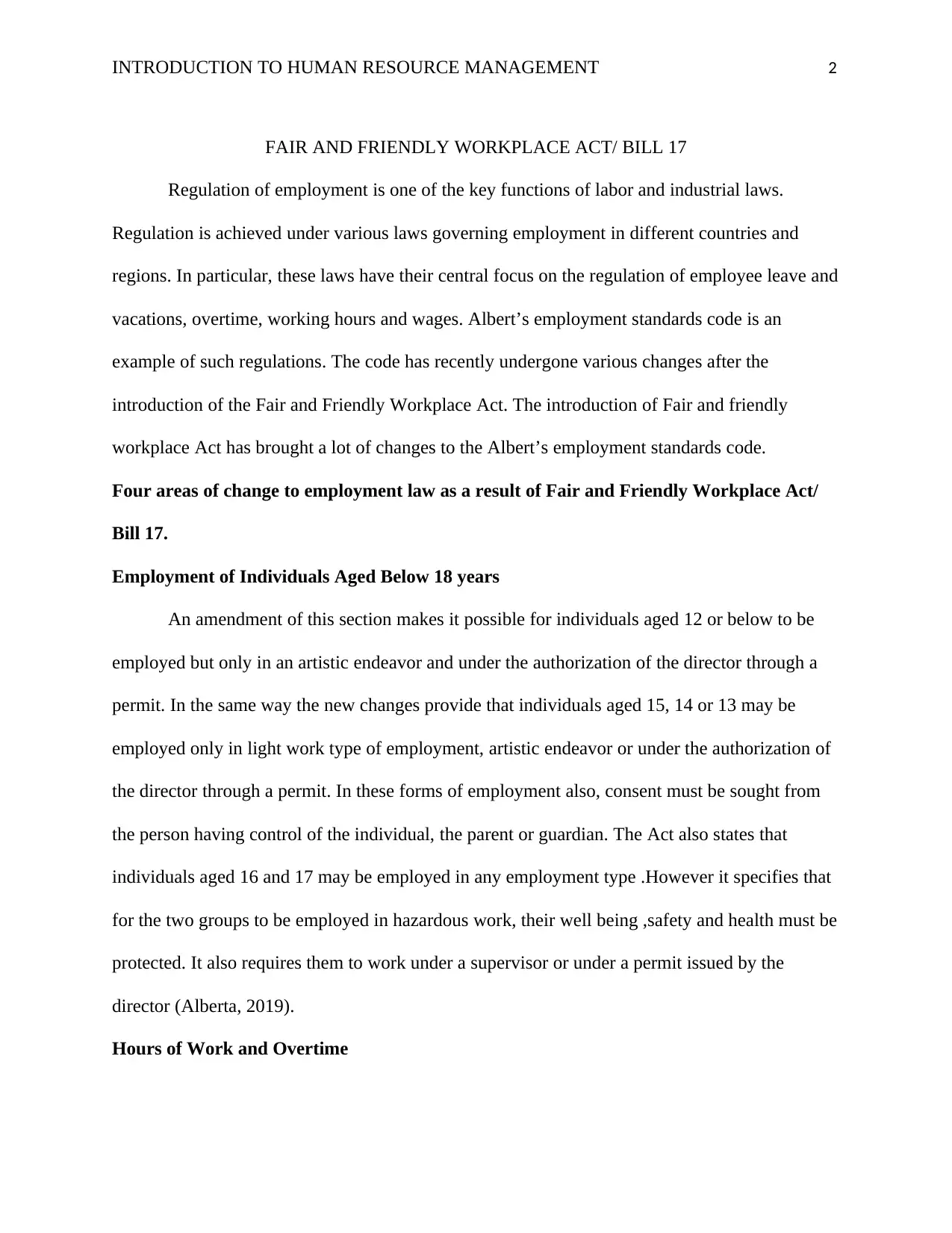
Running head: INTRODUCTION TO HUMAN RESOURCE MANAGEMENT 1
INTRODUCTION TO HUMAN RESOURCE MANAGEMENT
Name of Student
Institutional Affiliation
tabler-icon-diamond-filled.svg

Paraphrase This Document

Need a fresh take? Get an instant paraphrase of this document with our AI Paraphraser
Document Page
INTRODUCTION TO HUMAN RESOURCE MANAGEMENT 2
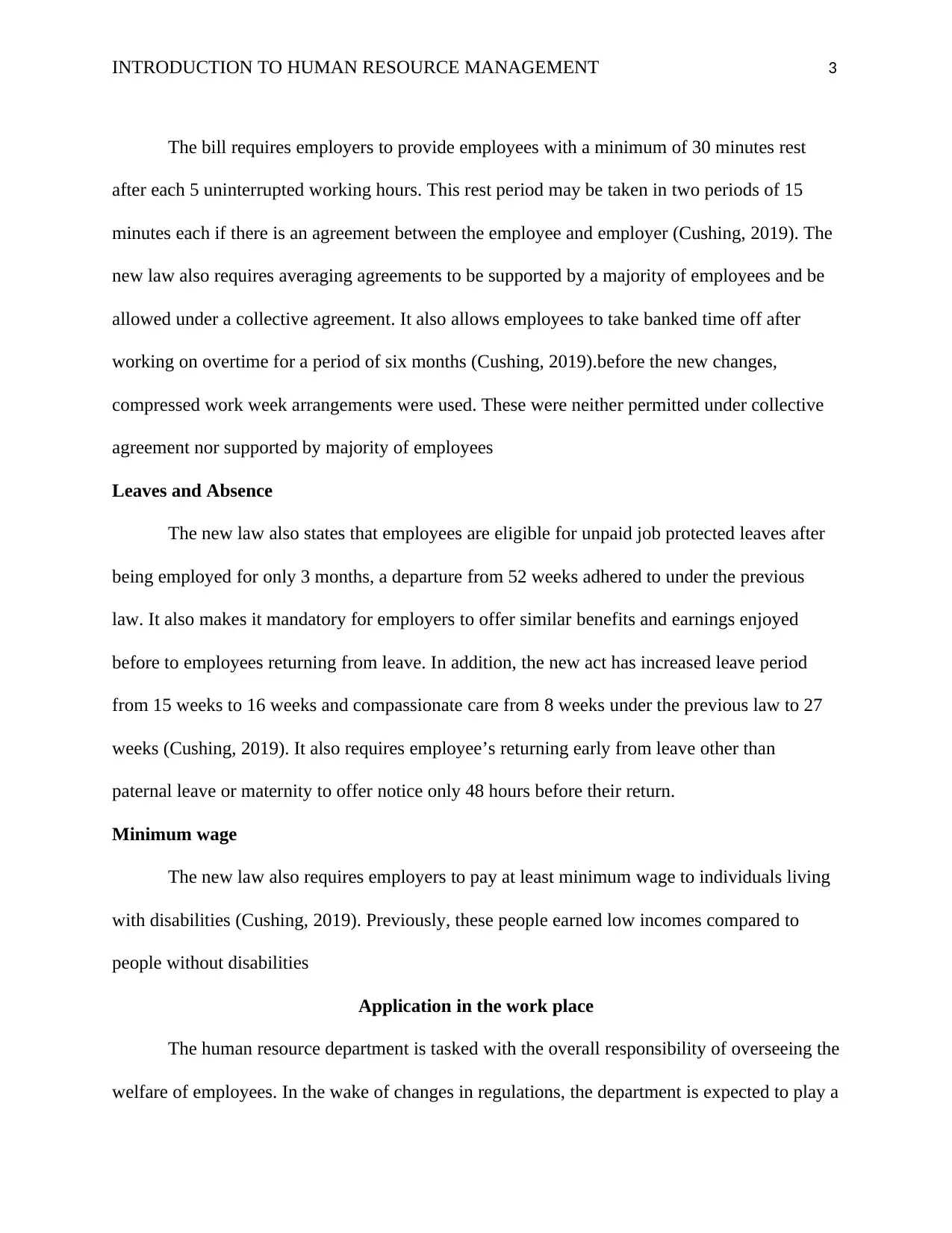
FAIR AND FRIENDLY WORKPLACE ACT/ BILL 17
Regulation of employment is one of the key functions of labor and industrial laws.
Regulation is achieved under various laws governing employment in different countries and
regions. In particular, these laws have their central focus on the regulation of employee leave and
vacations, overtime, working hours and wages. Albert’s employment standards code is an
example of such regulations. The code has recently undergone various changes after the
introduction of the Fair and Friendly Workplace Act. The introduction of Fair and friendly
workplace Act has brought a lot of changes to the Albert’s employment standards code.
Four areas of change to employment law as a result of Fair and Friendly Workplace Act/
Bill 17.
Employment of Individuals Aged Below 18 years
An amendment of this section makes it possible for individuals aged 12 or below to be
employed but only in an artistic endeavor and under the authorization of the director through a
permit. In the same way the new changes provide that individuals aged 15, 14 or 13 may be
employed only in light work type of employment, artistic endeavor or under the authorization of
the director through a permit. In these forms of employment also, consent must be sought from
the person having control of the individual, the parent or guardian. The Act also states that
individuals aged 16 and 17 may be employed in any employment type .However it specifies that
for the two groups to be employed in hazardous work, their well being ,safety and health must be
protected. It also requires them to work under a supervisor or under a permit issued by the
director (Alberta, 2019).
Hours of Work and Overtime
Document Page
INTRODUCTION TO HUMAN RESOURCE MANAGEMENT 3
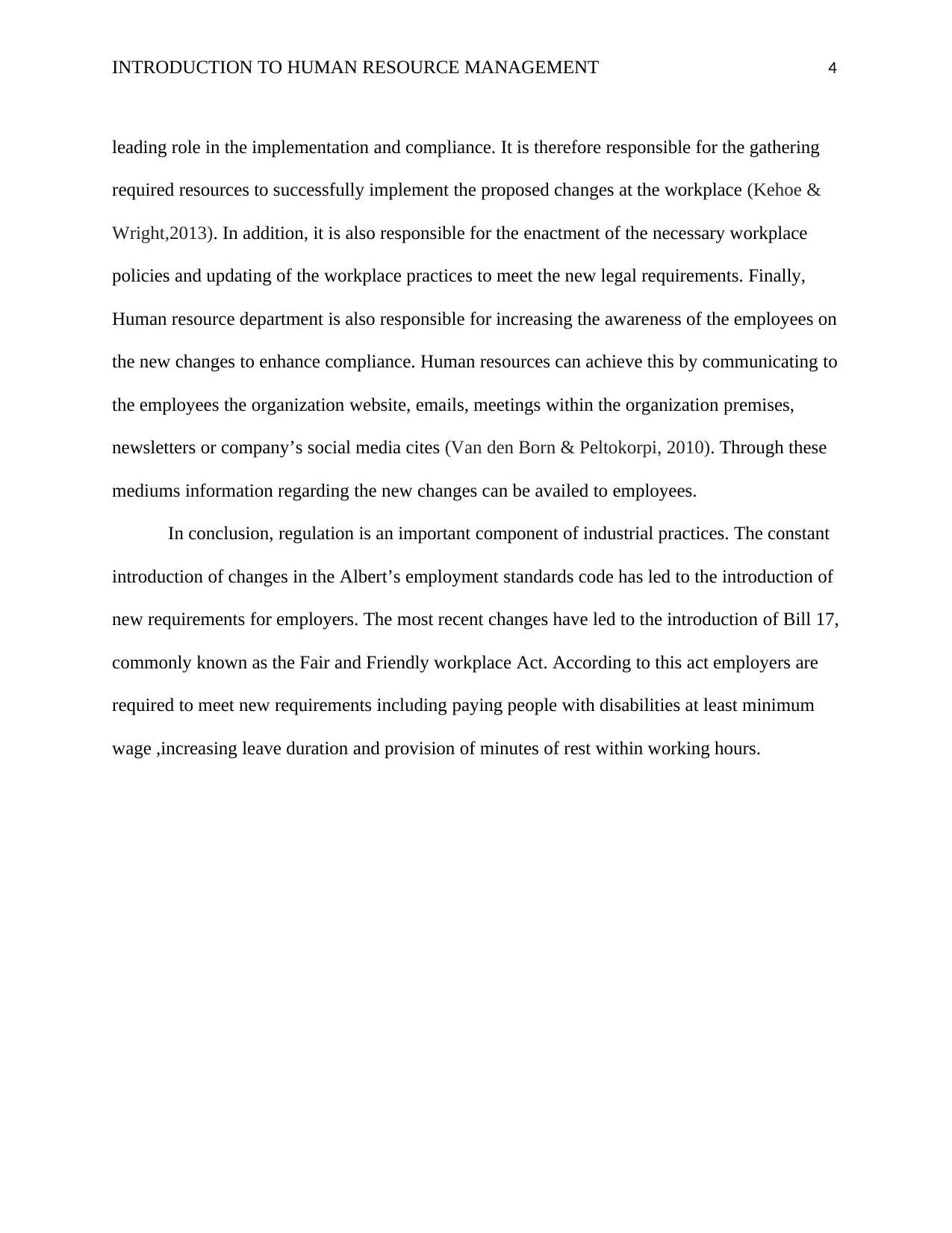
The bill requires employers to provide employees with a minimum of 30 minutes rest
after each 5 uninterrupted working hours. This rest period may be taken in two periods of 15
minutes each if there is an agreement between the employee and employer (Cushing, 2019). The
new law also requires averaging agreements to be supported by a majority of employees and be
allowed under a collective agreement. It also allows employees to take banked time off after
working on overtime for a period of six months (Cushing, 2019).before the new changes,
compressed work week arrangements were used. These were neither permitted under collective
agreement nor supported by majority of employees
Leaves and Absence
The new law also states that employees are eligible for unpaid job protected leaves after
being employed for only 3 months, a departure from 52 weeks adhered to under the previous
law. It also makes it mandatory for employers to offer similar benefits and earnings enjoyed
before to employees returning from leave. In addition, the new act has increased leave period
from 15 weeks to 16 weeks and compassionate care from 8 weeks under the previous law to 27
weeks (Cushing, 2019). It also requires employee’s returning early from leave other than
paternal leave or maternity to offer notice only 48 hours before their return.
Minimum wage
The new law also requires employers to pay at least minimum wage to individuals living
with disabilities (Cushing, 2019). Previously, these people earned low incomes compared to
people without disabilities
Application in the work place
The human resource department is tasked with the overall responsibility of overseeing the
welfare of employees. In the wake of changes in regulations, the department is expected to play a
Document Page
INTRODUCTION TO HUMAN RESOURCE MANAGEMENT 4
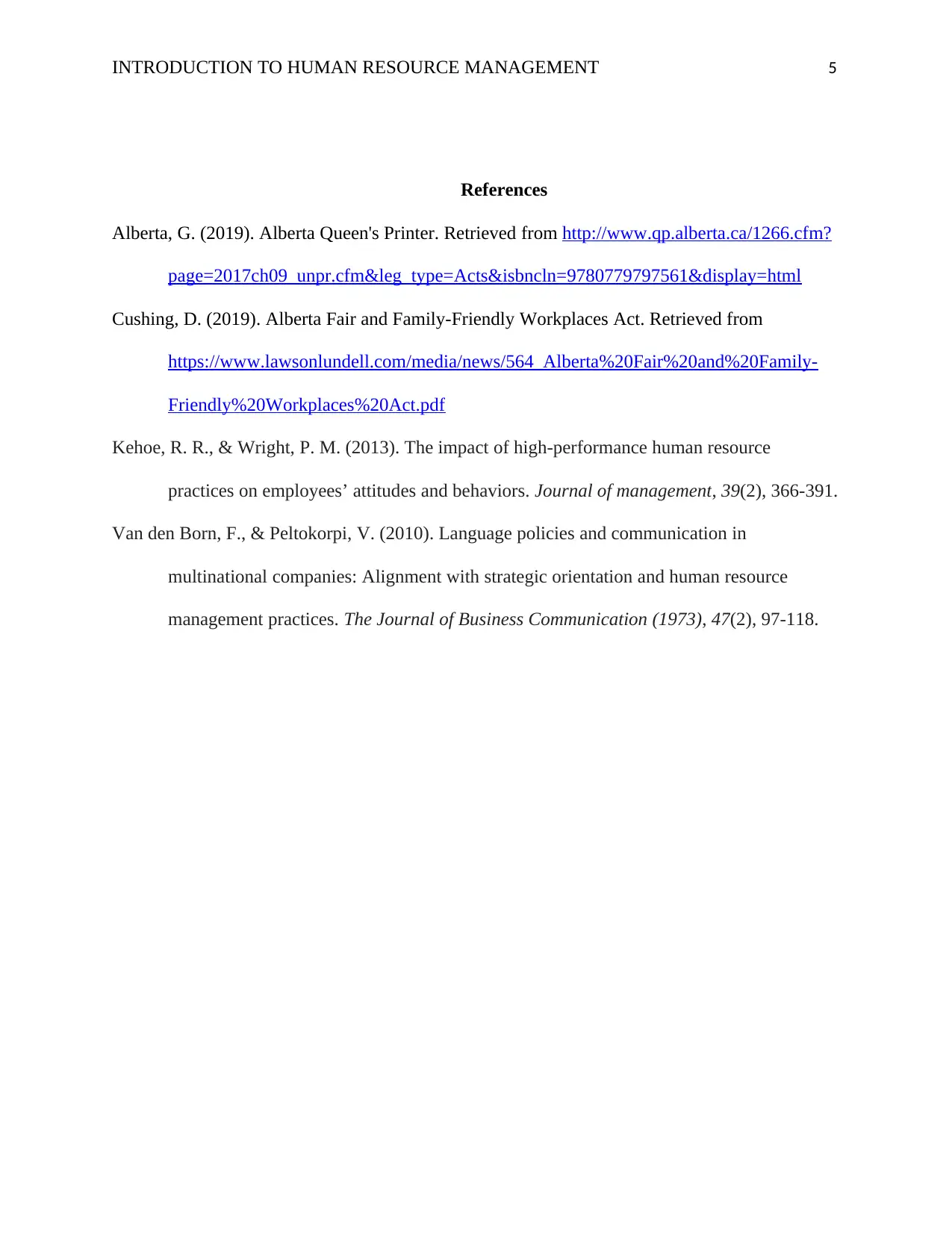
leading role in the implementation and compliance. It is therefore responsible for the gathering
required resources to successfully implement the proposed changes at the workplace (Kehoe &
Wright,2013). In addition, it is also responsible for the enactment of the necessary workplace
policies and updating of the workplace practices to meet the new legal requirements. Finally,
Human resource department is also responsible for increasing the awareness of the employees on
the new changes to enhance compliance. Human resources can achieve this by communicating to
the employees the organization website, emails, meetings within the organization premises,
newsletters or company’s social media cites (Van den Born & Peltokorpi, 2010). Through these
mediums information regarding the new changes can be availed to employees.
In conclusion, regulation is an important component of industrial practices. The constant
introduction of changes in the Albert’s employment standards code has led to the introduction of
new requirements for employers. The most recent changes have led to the introduction of Bill 17,
commonly known as the Fair and Friendly workplace Act. According to this act employers are
required to meet new requirements including paying people with disabilities at least minimum
wage ,increasing leave duration and provision of minutes of rest within working hours.
tabler-icon-diamond-filled.svg

Paraphrase This Document

Need a fresh take? Get an instant paraphrase of this document with our AI Paraphraser
Document Page
INTRODUCTION TO HUMAN RESOURCE MANAGEMENT 5
References
Alberta, G. (2019). Alberta Queen's Printer. Retrieved from http://www.qp.alberta.ca/1266.cfm?
page=2017ch09_unpr.cfm&leg_type=Acts&isbncln=9780779797561&display=html
Cushing, D. (2019). Alberta Fair and Family-Friendly Workplaces Act. Retrieved from
https://www.lawsonlundell.com/media/news/564_Alberta%20Fair%20and%20Family-
Friendly%20Workplaces%20Act.pdf
Kehoe, R. R., & Wright, P. M. (2013). The impact of high-performance human resource
practices on employees’ attitudes and behaviors. Journal of management, 39(2), 366-391.
Van den Born, F., & Peltokorpi, V. (2010). Language policies and communication in
multinational companies: Alignment with strategic orientation and human resource
management practices. The Journal of Business Communication (1973), 47(2), 97-118.
chevron_up_icon
1 out of 5
circle_padding
hide_on_mobile
zoom_out_icon
[object Object]