Evaluating Fair Trade in National Interest: Trade Agreements Analysis
VerifiedAdded on 2023/06/11
|7
|2150
|95
Essay
AI Summary
This essay provides a comprehensive analysis of fair trade in the context of national interest, drawing upon Joseph E. Stiglitz's article. It summarizes Stiglitz's arguments regarding protectionism versus free trade, double standards in trade agreements, and the impact on America's national interest. The essay critically evaluates these arguments, discussing the role of protectionism, the importance of fair and reciprocal trade, and the challenges faced by developing countries. It also examines the gap between unfair managed trade and free trade, the impact of trade agreements on various stakeholders, and the role of organizations like the WTO in promoting international trade. The essay concludes by emphasizing the potential of fair trade to address social and environmental issues, reduce inequality, and promote sustainable development, while also highlighting the need for rich countries to support developing nations through access to markets and temporary relocation opportunities for unskilled workers. The essay is available on Desklib, a platform offering a range of study tools and solved assignments for students.

Running Head: FAIR TRADE 0
Fair trade
7/11/2018
Fair trade
7/11/2018
Paraphrase This Document
Need a fresh take? Get an instant paraphrase of this document with our AI Paraphraser

FAIR TRADE 1
FAIR TRADE
Introduction
Fair trade in National interest is an article published in April 5, 2008. Joseph E. Stiglitz wrote
this article. The writer of the article focuses on how fair trade can promote development. Fair
Trade has been on the rise in the last few decades to solve the problem of inequality in
international trade. It is a business between companies of developed and developing nations
in which fair prices are paid to the producers. It has now become common parlance for
politicians to lead effectively. The objective is that both rich and poor in developing and
developed countries will achieve benefits. In the following, an effort has been made to point
out main arguments of the article stated as “Which protection or free trade”? In addition, give
critical analysis on the same, gap analysis between trade agreements and America’s national
interest and evaluate article based on your own understanding.
Article Summary
Fair trade is a common platform of both politicians and political parties to expand market
through trade liberalization, which offers a situation in which there is no loss to anyone in the
market. The unskilled people are not getting employment because competition is day-by-day
increasing. Globalization and Liberalization are increasing at a fast pace. Globalization also
increases the employment but somehow unskilled and semi-skilled people are not getting
employment. As there is cutthroat, competition and due to that government are also taking
initiative to run projects on international level to provide employment to poor people. The
article mainly focuses on key elements such as-
Waxing Politic-
It is stating about the argument of the fact that “Which protection or free-trade” can be
elaborated as most successful industries give protection to new companies at their critical
stages and at the same time enabling them free trade, which proves the concept of
liberalization has not been achieved
It has also been argued that the step at which poor countries open their marketplace to
business should correspond with the development of new institutions. Since many poor
countries cannot manage, the contribution required to build these institutions. (Reich, 2006)
FAIR TRADE
Introduction
Fair trade in National interest is an article published in April 5, 2008. Joseph E. Stiglitz wrote
this article. The writer of the article focuses on how fair trade can promote development. Fair
Trade has been on the rise in the last few decades to solve the problem of inequality in
international trade. It is a business between companies of developed and developing nations
in which fair prices are paid to the producers. It has now become common parlance for
politicians to lead effectively. The objective is that both rich and poor in developing and
developed countries will achieve benefits. In the following, an effort has been made to point
out main arguments of the article stated as “Which protection or free trade”? In addition, give
critical analysis on the same, gap analysis between trade agreements and America’s national
interest and evaluate article based on your own understanding.
Article Summary
Fair trade is a common platform of both politicians and political parties to expand market
through trade liberalization, which offers a situation in which there is no loss to anyone in the
market. The unskilled people are not getting employment because competition is day-by-day
increasing. Globalization and Liberalization are increasing at a fast pace. Globalization also
increases the employment but somehow unskilled and semi-skilled people are not getting
employment. As there is cutthroat, competition and due to that government are also taking
initiative to run projects on international level to provide employment to poor people. The
article mainly focuses on key elements such as-
Waxing Politic-
It is stating about the argument of the fact that “Which protection or free-trade” can be
elaborated as most successful industries give protection to new companies at their critical
stages and at the same time enabling them free trade, which proves the concept of
liberalization has not been achieved
It has also been argued that the step at which poor countries open their marketplace to
business should correspond with the development of new institutions. Since many poor
countries cannot manage, the contribution required to build these institutions. (Reich, 2006)

FAIR TRADE 2
Double standards-
In this point, it is clearly stated, as the agreements are not free- trade agreements as it
includes all the tariffs, subsidies, non-tariff barriers that should be abolished .They are
managed –trade agreements specially arranged the advanced industrial countries. It is
supporting free trade as long as it is fair and reciprocal. There is all over liberalization around
as anyone can trade as trade liberalization is stated as the biggest argument we have today.
The developing countries should focus on providing lifesaving medicines to poor, as they
cannot afford to buy brand-name generic products, which are a necessity for them. On the
other hand, companies mandate huge prices for them, this can create trouble for poor. This is
quite surprising that these companies give importance to profits only rather than problem of
affordability of poor people to buy generic products. (Block, Krasnozhon and Simpson,
2006).
It is also focusing on Foreign direct investment is in agriculture but now a days it is coming
on the retail sector itself. It is thereby expanding the global trade.
Trade Agreements and America’s National Interest-
The gap analysis between unfair managed and free trade is been utilized by the markets of
U.S. It has helped many countries to reduce inequality and promote the democracy among the
citizens, which moreover can build relations with other countries, but the people of America
are not satisfied with this agreement and protest against the U.S. It is stated, “We need social
protections not protectionism.” To give commitment of complete free-market access to all
developing nations and richer nations should allow unskilled people to relocate on a
temporary basis so that earned sufficient money could be transferred to their native place and
by this; we give social protections to them
To take an example U.S is one of the leading countries in the world and the workers are
always have fear about losing their jobs either due to foreign competition or technological
change as recession can occur suddenly. Therefore, we need to manage trade liberalization
better so that it will provide benefits to both rich and poor in developed and developing
countries.
Double standards-
In this point, it is clearly stated, as the agreements are not free- trade agreements as it
includes all the tariffs, subsidies, non-tariff barriers that should be abolished .They are
managed –trade agreements specially arranged the advanced industrial countries. It is
supporting free trade as long as it is fair and reciprocal. There is all over liberalization around
as anyone can trade as trade liberalization is stated as the biggest argument we have today.
The developing countries should focus on providing lifesaving medicines to poor, as they
cannot afford to buy brand-name generic products, which are a necessity for them. On the
other hand, companies mandate huge prices for them, this can create trouble for poor. This is
quite surprising that these companies give importance to profits only rather than problem of
affordability of poor people to buy generic products. (Block, Krasnozhon and Simpson,
2006).
It is also focusing on Foreign direct investment is in agriculture but now a days it is coming
on the retail sector itself. It is thereby expanding the global trade.
Trade Agreements and America’s National Interest-
The gap analysis between unfair managed and free trade is been utilized by the markets of
U.S. It has helped many countries to reduce inequality and promote the democracy among the
citizens, which moreover can build relations with other countries, but the people of America
are not satisfied with this agreement and protest against the U.S. It is stated, “We need social
protections not protectionism.” To give commitment of complete free-market access to all
developing nations and richer nations should allow unskilled people to relocate on a
temporary basis so that earned sufficient money could be transferred to their native place and
by this; we give social protections to them
To take an example U.S is one of the leading countries in the world and the workers are
always have fear about losing their jobs either due to foreign competition or technological
change as recession can occur suddenly. Therefore, we need to manage trade liberalization
better so that it will provide benefits to both rich and poor in developed and developing
countries.
⊘ This is a preview!⊘
Do you want full access?
Subscribe today to unlock all pages.

Trusted by 1+ million students worldwide

FAIR TRADE 3
Critical Analysis of Article
Fair trade is a common parlance predetermined for contribute for assisting poor people in
developed nations. It is based on faith, which helps to solve the critical social problems.
The author argued that Protectionism is not a bad thing and on one side it is been stated that
everyone is liberal. On the other side trade can be done at any time but we give protection to
new industries which are now establishing and need economic benefit so if the policy of
safeguard of poor industries is embraced, question arises whether protection ought to be
accomplished through imposing tariffs on imports or through licensing. Besides this, the
famous economist David Ricardo secured free –trade to stimulate productivity and
competency in the economy (Mukher, 2018).
Thomson Henry examines the conclusion by protectionism from distinctive shareholders such
as consumers, government, employees, and firms. It reorganizes income. It creates gains for
some industries and losses for others. Those individuals who have the benefit of profits can
be expected to favor protection. It consistently advocated economic policy, which led to
economies of scale. It prohibits the ultimate benefit of misusing comparative edge, lowering
federal income, trade barriers etc. Economists induce government to give protectionism.
Those individual who was benefited from this policy are willing to contribute wealth and
effect legislative decisions. From LeaAnn Stagg’s perspective, from any one state’s point of
view, exporting to a remote nation or to another state represents methods of creating wealth.
However, one state’s meets profit at the cost of another.
The contribution of international trade is so enormous that some countries could become
competent even with the greatest effort. Franklin argued that the survival of these countries
depends primarily on the exports of manufacturers that need limited area. However, countries
that are capable to fulfill the necessity of life would be faced an unbearable downturn in
living standards if they were cut-off from international trade. Infant industries are getting
huge initiative and support from various government bodies to achieve sustainable industrial
growth and development. Accordingly, over a period their cost per unit will go down and
therefore, for quite a while they should be protected else they would be destroyed by foreign
competition (Ma and Lu, 2011).
Critical Analysis of Article
Fair trade is a common parlance predetermined for contribute for assisting poor people in
developed nations. It is based on faith, which helps to solve the critical social problems.
The author argued that Protectionism is not a bad thing and on one side it is been stated that
everyone is liberal. On the other side trade can be done at any time but we give protection to
new industries which are now establishing and need economic benefit so if the policy of
safeguard of poor industries is embraced, question arises whether protection ought to be
accomplished through imposing tariffs on imports or through licensing. Besides this, the
famous economist David Ricardo secured free –trade to stimulate productivity and
competency in the economy (Mukher, 2018).
Thomson Henry examines the conclusion by protectionism from distinctive shareholders such
as consumers, government, employees, and firms. It reorganizes income. It creates gains for
some industries and losses for others. Those individuals who have the benefit of profits can
be expected to favor protection. It consistently advocated economic policy, which led to
economies of scale. It prohibits the ultimate benefit of misusing comparative edge, lowering
federal income, trade barriers etc. Economists induce government to give protectionism.
Those individual who was benefited from this policy are willing to contribute wealth and
effect legislative decisions. From LeaAnn Stagg’s perspective, from any one state’s point of
view, exporting to a remote nation or to another state represents methods of creating wealth.
However, one state’s meets profit at the cost of another.
The contribution of international trade is so enormous that some countries could become
competent even with the greatest effort. Franklin argued that the survival of these countries
depends primarily on the exports of manufacturers that need limited area. However, countries
that are capable to fulfill the necessity of life would be faced an unbearable downturn in
living standards if they were cut-off from international trade. Infant industries are getting
huge initiative and support from various government bodies to achieve sustainable industrial
growth and development. Accordingly, over a period their cost per unit will go down and
therefore, for quite a while they should be protected else they would be destroyed by foreign
competition (Ma and Lu, 2011).
Paraphrase This Document
Need a fresh take? Get an instant paraphrase of this document with our AI Paraphraser

FAIR TRADE 4
Protectionism preserves domestic employment at any given time in an economy. Major
businesses are in downfall, as they cannot contend with overseas competition. For example,
mid-80s was the sunset time for the steel business as they were not competitive anymore so it
is better to re-employ these resources in the economy. It is often stated that the reason for
declining domestic enterprises is the reducing cost of labor in exporting nations and that is
the reason economy should be protected from imports, where cost of labor is very low. Many
governments contend that a sunrise enterprise that is simply growing may not have the
economies of scale so that the heavy industries may enjoy. It avoids limit of over-
specialization, and country is highly dependent on the exports. It can create major
consequences for the country’s economy.
It is often contended that specific enterprises need to be secured as a result in strategic
reasons so that the country has these resources available in the time of crises that they are
required in war or electricity, agriculture, and steel. In major developing nations, it is hard to
muster taxes and government levied tariffs to raise revenue. Foreign producers emulate
unjustifiably by dumping the merchandise in another nation. Dumping is a type of price
discrimination when producers of a nation offer merchandise in another nation at lower price.
Once competitive spirit enables, protection abandoned fair trade.
The World Trade Organization has taken a great step towards Doha development round,
bilateral agreements, and multilateral trade negotiations. It has governed that American
cotton subsidies are illegal, and then United States continues giving them –twenty five
thousand rich American agriculturists getting benefit at cost of many dejected people in the
emerging world. It is America and Europe’s refusal to deal with their agricultural subsidies
that are so called Doha development round. It would reduce the non-tariff barriers and
eliminate agricultural subsidies.
Currently, the DDA is in a conclusive stage and there is a great opportunity to redirect and be
prepared for the future of the Doha round. At last, all WTO members benefit from a stable
and anticipated multilateral trading system that offers for expansion of new business. Many
members criticized that the export products of their nations have to compete with the
subsidized products of developed countries. In addition, it increases the burden on
agricultural undertaking in developing nation, which would probably confront negative
outcomes and high alteration expenses for the time being.
Protectionism preserves domestic employment at any given time in an economy. Major
businesses are in downfall, as they cannot contend with overseas competition. For example,
mid-80s was the sunset time for the steel business as they were not competitive anymore so it
is better to re-employ these resources in the economy. It is often stated that the reason for
declining domestic enterprises is the reducing cost of labor in exporting nations and that is
the reason economy should be protected from imports, where cost of labor is very low. Many
governments contend that a sunrise enterprise that is simply growing may not have the
economies of scale so that the heavy industries may enjoy. It avoids limit of over-
specialization, and country is highly dependent on the exports. It can create major
consequences for the country’s economy.
It is often contended that specific enterprises need to be secured as a result in strategic
reasons so that the country has these resources available in the time of crises that they are
required in war or electricity, agriculture, and steel. In major developing nations, it is hard to
muster taxes and government levied tariffs to raise revenue. Foreign producers emulate
unjustifiably by dumping the merchandise in another nation. Dumping is a type of price
discrimination when producers of a nation offer merchandise in another nation at lower price.
Once competitive spirit enables, protection abandoned fair trade.
The World Trade Organization has taken a great step towards Doha development round,
bilateral agreements, and multilateral trade negotiations. It has governed that American
cotton subsidies are illegal, and then United States continues giving them –twenty five
thousand rich American agriculturists getting benefit at cost of many dejected people in the
emerging world. It is America and Europe’s refusal to deal with their agricultural subsidies
that are so called Doha development round. It would reduce the non-tariff barriers and
eliminate agricultural subsidies.
Currently, the DDA is in a conclusive stage and there is a great opportunity to redirect and be
prepared for the future of the Doha round. At last, all WTO members benefit from a stable
and anticipated multilateral trading system that offers for expansion of new business. Many
members criticized that the export products of their nations have to compete with the
subsidized products of developed countries. In addition, it increases the burden on
agricultural undertaking in developing nation, which would probably confront negative
outcomes and high alteration expenses for the time being.

FAIR TRADE 5
Contribution
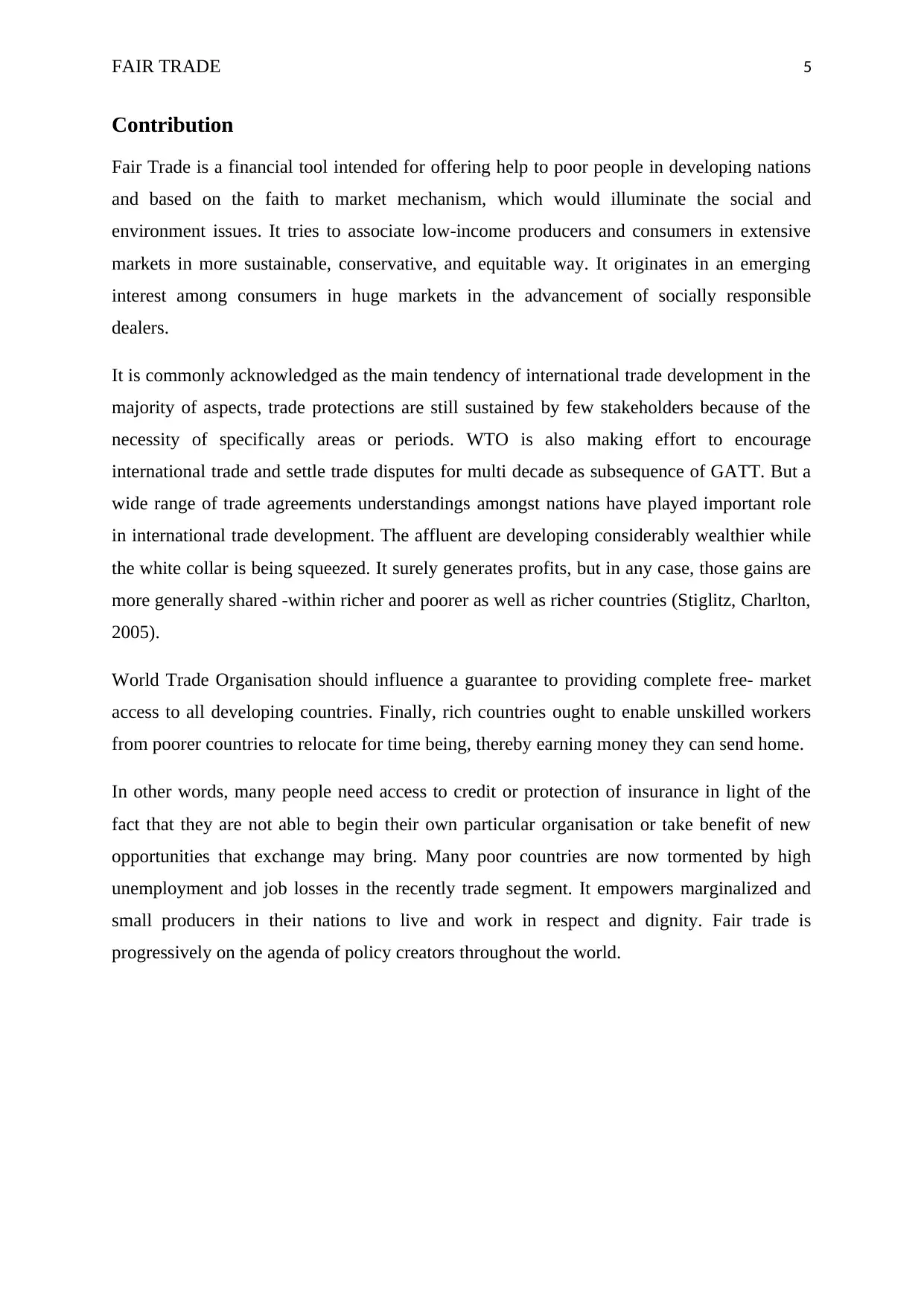
Fair Trade is a financial tool intended for offering help to poor people in developing nations
and based on the faith to market mechanism, which would illuminate the social and
environment issues. It tries to associate low-income producers and consumers in extensive
markets in more sustainable, conservative, and equitable way. It originates in an emerging
interest among consumers in huge markets in the advancement of socially responsible
dealers.
It is commonly acknowledged as the main tendency of international trade development in the
majority of aspects, trade protections are still sustained by few stakeholders because of the
necessity of specifically areas or periods. WTO is also making effort to encourage
international trade and settle trade disputes for multi decade as subsequence of GATT. But a
wide range of trade agreements understandings amongst nations have played important role
in international trade development. The affluent are developing considerably wealthier while
the white collar is being squeezed. It surely generates profits, but in any case, those gains are
more generally shared -within richer and poorer as well as richer countries (Stiglitz, Charlton,
2005).
World Trade Organisation should influence a guarantee to providing complete free- market
access to all developing countries. Finally, rich countries ought to enable unskilled workers
from poorer countries to relocate for time being, thereby earning money they can send home.
In other words, many people need access to credit or protection of insurance in light of the
fact that they are not able to begin their own particular organisation or take benefit of new
opportunities that exchange may bring. Many poor countries are now tormented by high
unemployment and job losses in the recently trade segment. It empowers marginalized and
small producers in their nations to live and work in respect and dignity. Fair trade is
progressively on the agenda of policy creators throughout the world.
Contribution
Fair Trade is a financial tool intended for offering help to poor people in developing nations
and based on the faith to market mechanism, which would illuminate the social and
environment issues. It tries to associate low-income producers and consumers in extensive
markets in more sustainable, conservative, and equitable way. It originates in an emerging
interest among consumers in huge markets in the advancement of socially responsible
dealers.
It is commonly acknowledged as the main tendency of international trade development in the
majority of aspects, trade protections are still sustained by few stakeholders because of the
necessity of specifically areas or periods. WTO is also making effort to encourage
international trade and settle trade disputes for multi decade as subsequence of GATT. But a
wide range of trade agreements understandings amongst nations have played important role
in international trade development. The affluent are developing considerably wealthier while
the white collar is being squeezed. It surely generates profits, but in any case, those gains are
more generally shared -within richer and poorer as well as richer countries (Stiglitz, Charlton,
2005).
World Trade Organisation should influence a guarantee to providing complete free- market
access to all developing countries. Finally, rich countries ought to enable unskilled workers
from poorer countries to relocate for time being, thereby earning money they can send home.
In other words, many people need access to credit or protection of insurance in light of the
fact that they are not able to begin their own particular organisation or take benefit of new
opportunities that exchange may bring. Many poor countries are now tormented by high
unemployment and job losses in the recently trade segment. It empowers marginalized and
small producers in their nations to live and work in respect and dignity. Fair trade is
progressively on the agenda of policy creators throughout the world.
⊘ This is a preview!⊘
Do you want full access?
Subscribe today to unlock all pages.

Trusted by 1+ million students worldwide

FAIR TRADE 6
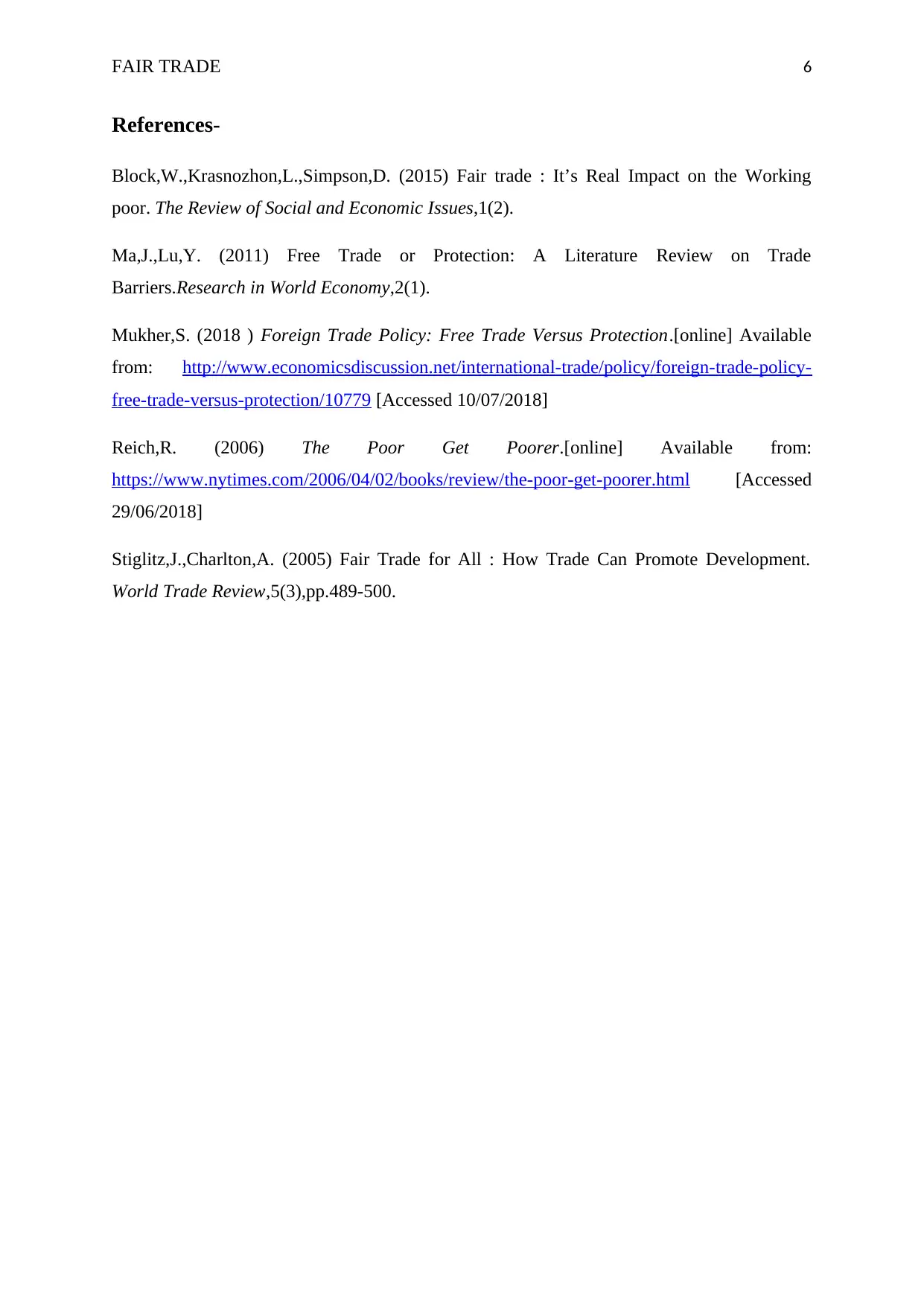
References-
Block,W.,Krasnozhon,L.,Simpson,D. (2015) Fair trade : It’s Real Impact on the Working
poor. The Review of Social and Economic Issues,1(2).
Ma,J.,Lu,Y. (2011) Free Trade or Protection: A Literature Review on Trade
Barriers.Research in World Economy,2(1).
Mukher,S. (2018 ) Foreign Trade Policy: Free Trade Versus Protection.[online] Available
from: http://www.economicsdiscussion.net/international-trade/policy/foreign-trade-policy-
free-trade-versus-protection/10779 [Accessed 10/07/2018]
Reich,R. (2006) The Poor Get Poorer.[online] Available from:
https://www.nytimes.com/2006/04/02/books/review/the-poor-get-poorer.html [Accessed
29/06/2018]
Stiglitz,J.,Charlton,A. (2005) Fair Trade for All : How Trade Can Promote Development.
World Trade Review,5(3),pp.489-500.
References-
Block,W.,Krasnozhon,L.,Simpson,D. (2015) Fair trade : It’s Real Impact on the Working
poor. The Review of Social and Economic Issues,1(2).
Ma,J.,Lu,Y. (2011) Free Trade or Protection: A Literature Review on Trade
Barriers.Research in World Economy,2(1).
Mukher,S. (2018 ) Foreign Trade Policy: Free Trade Versus Protection.[online] Available
from: http://www.economicsdiscussion.net/international-trade/policy/foreign-trade-policy-
free-trade-versus-protection/10779 [Accessed 10/07/2018]
Reich,R. (2006) The Poor Get Poorer.[online] Available from:
https://www.nytimes.com/2006/04/02/books/review/the-poor-get-poorer.html [Accessed
29/06/2018]
Stiglitz,J.,Charlton,A. (2005) Fair Trade for All : How Trade Can Promote Development.
World Trade Review,5(3),pp.489-500.
1 out of 7
Related Documents
Your All-in-One AI-Powered Toolkit for Academic Success.
+13062052269
info@desklib.com
Available 24*7 on WhatsApp / Email
Unlock your academic potential
Copyright © 2020–2025 A2Z Services. All Rights Reserved. Developed and managed by ZUCOL.