Analyzing Fairness of Trail in Literature: An Essay on Justice

Verified

Added on  2022/09/08

|5
|851
|17
Essay
AI Summary
This essay delves into the multifaceted concept of fairness in literary trials and punishments, analyzing three seminal works: Fyodor Dostoevsky's 'Crime and Punishment', Joseph Conrad's 'Lord Jim', and William Shakespeare's 'Merchant of Venice'. The essay examines the justice meted out to Raskolnikov, the protagonist of 'Crime and Punishment', and questions whether his suffering constitutes a just outcome. It then explores the trials faced by Jim in Conrad's novel, highlighting the significance of his actions and the consequences he endures. Finally, the essay scrutinizes the treatment of Shylock in Shakespeare's play, challenging traditional interpretations and prompting a deeper understanding of who the true victim is. Through close textual analysis, the essay provides critical insights into the complexities of justice, suffering, and societal biases within these literary masterpieces.
Document Page
Running Head: ESSAY ON FAIRNESS OF TRAIL
Essay on fairness of trail
Name of the Student:
Name of the University:
Author Note:
tabler-icon-diamond-filled.svg

Paraphrase This Document

Need a fresh take? Get an instant paraphrase of this document with our AI Paraphraser
Document Page
1ESSAY ON FAIRNESS OF TRAIL
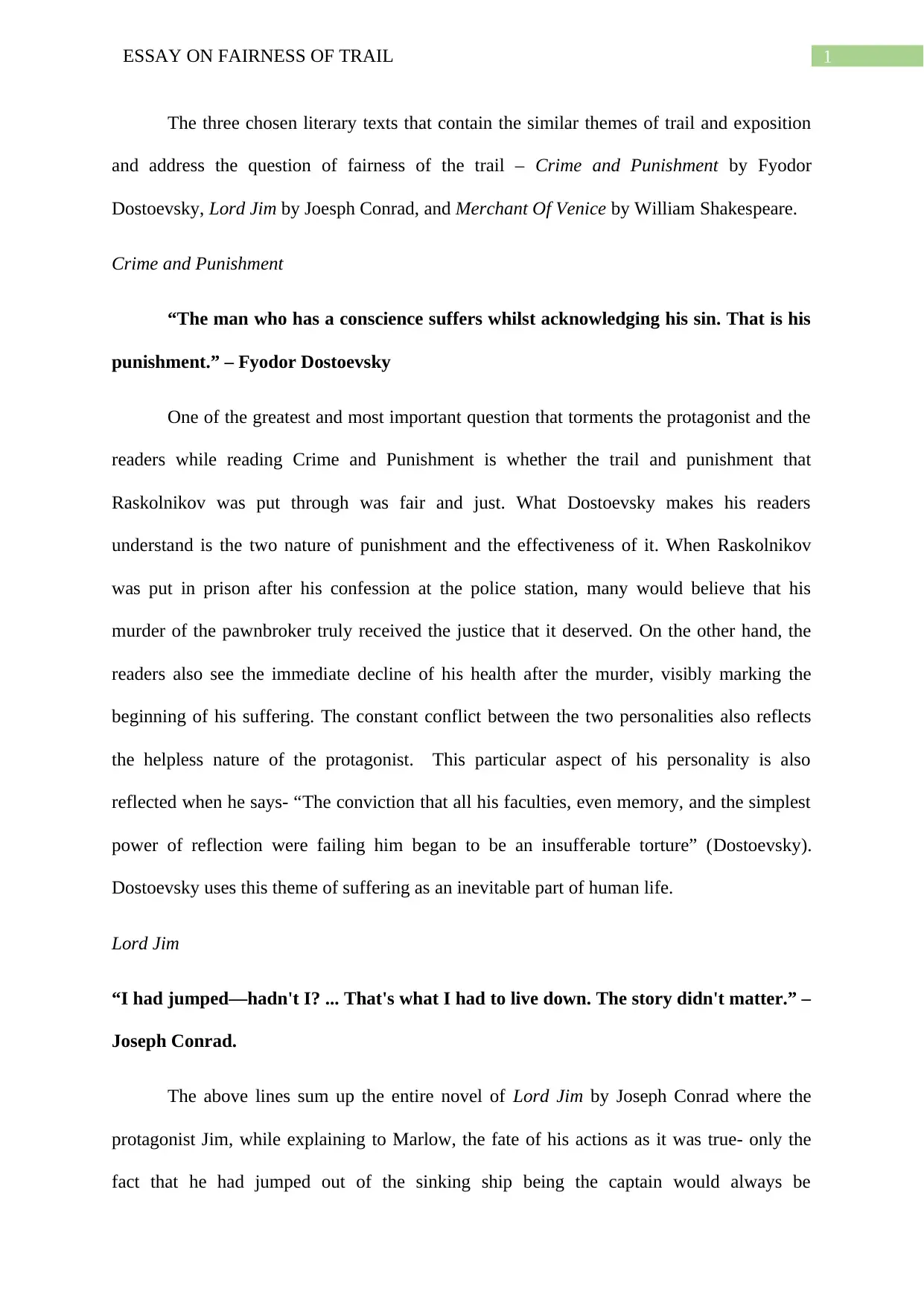
The three chosen literary texts that contain the similar themes of trail and exposition
and address the question of fairness of the trail – Crime and Punishment by Fyodor
Dostoevsky, Lord Jim by Joesph Conrad, and Merchant Of Venice by William Shakespeare.
Crime and Punishment
“The man who has a conscience suffers whilst acknowledging his sin. That is his
punishment.” – Fyodor Dostoevsky
One of the greatest and most important question that torments the protagonist and the
readers while reading Crime and Punishment is whether the trail and punishment that
Raskolnikov was put through was fair and just. What Dostoevsky makes his readers
understand is the two nature of punishment and the effectiveness of it. When Raskolnikov
was put in prison after his confession at the police station, many would believe that his
murder of the pawnbroker truly received the justice that it deserved. On the other hand, the
readers also see the immediate decline of his health after the murder, visibly marking the
beginning of his suffering. The constant conflict between the two personalities also reflects
the helpless nature of the protagonist. This particular aspect of his personality is also
reflected when he says- “The conviction that all his faculties, even memory, and the simplest
power of reflection were failing him began to be an insufferable torture” (Dostoevsky).
Dostoevsky uses this theme of suffering as an inevitable part of human life.
Lord Jim
“I had jumped—hadn't I? ... That's what I had to live down. The story didn't matter.” –
Joseph Conrad.
The above lines sum up the entire novel of Lord Jim by Joseph Conrad where the
protagonist Jim, while explaining to Marlow, the fate of his actions as it was true- only the
fact that he had jumped out of the sinking ship being the captain would always be
Document Page
2ESSAY ON FAIRNESS OF TRAIL
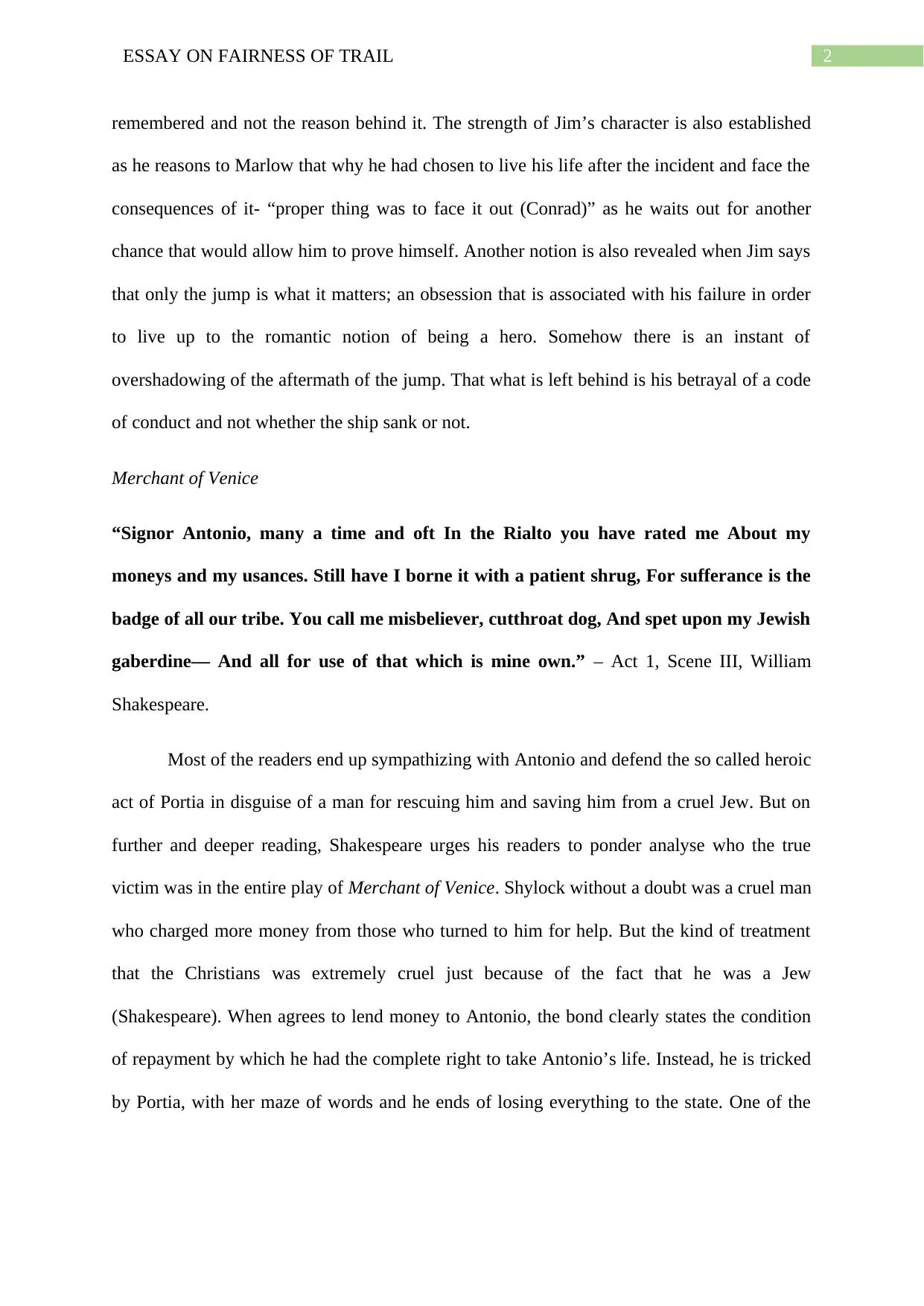
remembered and not the reason behind it. The strength of Jim’s character is also established
as he reasons to Marlow that why he had chosen to live his life after the incident and face the
consequences of it- “proper thing was to face it out (Conrad)” as he waits out for another
chance that would allow him to prove himself. Another notion is also revealed when Jim says
that only the jump is what it matters; an obsession that is associated with his failure in order
to live up to the romantic notion of being a hero. Somehow there is an instant of
overshadowing of the aftermath of the jump. That what is left behind is his betrayal of a code
of conduct and not whether the ship sank or not.
Merchant of Venice
“Signor Antonio, many a time and oft In the Rialto you have rated me About my
moneys and my usances. Still have I borne it with a patient shrug, For sufferance is the
badge of all our tribe. You call me misbeliever, cutthroat dog, And spet upon my Jewish
gaberdine— And all for use of that which is mine own.” – Act 1, Scene III, William
Shakespeare.
Most of the readers end up sympathizing with Antonio and defend the so called heroic
act of Portia in disguise of a man for rescuing him and saving him from a cruel Jew. But on
further and deeper reading, Shakespeare urges his readers to ponder analyse who the true
victim was in the entire play of Merchant of Venice. Shylock without a doubt was a cruel man
who charged more money from those who turned to him for help. But the kind of treatment
that the Christians was extremely cruel just because of the fact that he was a Jew
(Shakespeare). When agrees to lend money to Antonio, the bond clearly states the condition
of repayment by which he had the complete right to take Antonio’s life. Instead, he is tricked
by Portia, with her maze of words and he ends of losing everything to the state. One of the
Document Page
3ESSAY ON FAIRNESS OF TRAIL
worst exposition from the scene was the fact that Antonio was completely unaware of the
effect of his words and insults that he meted out to Shylock (Shakespeare).
tabler-icon-diamond-filled.svg

Paraphrase This Document

Need a fresh take? Get an instant paraphrase of this document with our AI Paraphraser
Document Page
4ESSAY ON FAIRNESS OF TRAIL
Work Cited
Conrad, Joseph. Lord Jim. Broadview Press, 2000.
Dostoevsky, Fyodor. Crime and punishment. Vol. 199. Modern Library, 1999.
Shakespeare, William. "Merchant Of Venice: Entire Play". Shakespeare.Mit.Edu, 1600,
http://shakespeare.mit.edu/merchant/full.html.
chevron_up_icon
1 out of 5
circle_padding
hide_on_mobile
zoom_out_icon
[object Object]