Strategies for Successful Fairtrade Coffee Mainstreaming: A Review
VerifiedAdded on 2023/06/07
|9
|2613
|313
Essay
AI Summary
This essay examines the challenges and strategies for mainstreaming Fair Trade coffee, focusing on the role of the Fairtrade Labelling Organisation (FLO). The essay begins by differentiating between fair trade and free trade, highlighting the limitations and restrictions imposed by fair trade. It then explores strategies FLO should undertake to ensure successful mainstreaming, including expanding and adapting general conditions, boosting demand markets in developing nations like China, and partnering with various stakeholders. The essay emphasizes the importance of incentives, guidelines, and establishing partnerships to enhance the advantages of Fairtrade. The analysis covers the need for co-ops to differentiate their products, motivate income generation, and focus on the long-term viability of the Fairtrade system. It discusses the importance of increasing demand, especially in emerging markets, and the potential for partnerships to improve efficiency. The essay concludes by emphasizing the need for FLO to adapt to the changing market conditions, address the challenges of mainstreaming, and ensure the long-term sustainability of the Fair Trade coffee market.
Running head: ESSAY 0
sustainibilty and business
SEPTEMBER 15, 2018
student details:
sustainibilty and business
SEPTEMBER 15, 2018
student details:

Paraphrase This Document
Need a fresh take? Get an instant paraphrase of this document with our AI Paraphraser
ESSAY 1
The fair trade coffee market was facing the crisis in 2008. In the various industry, it is found
that the survival will require mainstreaming fair trade coffee in non-special brand such as
Maxwell house and Folgers. In the present time, the procedure of mainstreaming fair trade
and development of substitute sustainability norms in the industry of coffee is observed. The
coffee industry was second most merchandised commodity after the oil. Two or more than
two billions cup of coffee were consumed daily (Estevez, Bhat and Bray, 2018). The size of
retail coffee market is more than seventy billion in respect of the sale.
In this essay, differences between fair trade and free trade, and the strategies adopted by
Fairtrade Labelling Organisation (FLO) to improve mainstreaming of coffee are discussed
and examined.
First, it is essential to understand the differences between fair trade and free trade. The fair
trade and free trade can sound same but the free trade and fair trade are considered as enemy.
The fair trade puts the limitation on the manufacturers and the farmers. The fair trade makes
force on the farmers to pay less wages. It accepts the secured working condition. On the other
hand, the free trade eliminates the restrictions for all the partners. These restrictions include
unregulated international export and international import, exemption of taxes, charges,
security of the members and annoying less wages. The fair trade creates the expensive things.
On the other hand, the free trade creates cheaper things. The main difference is that free trade
requires the employees to earn more, while the fair trade requires the employees to earn less.
For the solution of the problems related to Fairtrade, various plans and recommendations are
suggested to enhance the advantages of the Fairtrade and make sure the durable
sustainability. It involve both proposals related to supply and proposals related to demand.
Some recommendations related to supply contain motivating planters to differentiate their
manufacture, adapt conditions of Fairtrade Labelling Organisation to suit general
The fair trade coffee market was facing the crisis in 2008. In the various industry, it is found
that the survival will require mainstreaming fair trade coffee in non-special brand such as
Maxwell house and Folgers. In the present time, the procedure of mainstreaming fair trade
and development of substitute sustainability norms in the industry of coffee is observed. The
coffee industry was second most merchandised commodity after the oil. Two or more than
two billions cup of coffee were consumed daily (Estevez, Bhat and Bray, 2018). The size of
retail coffee market is more than seventy billion in respect of the sale.
In this essay, differences between fair trade and free trade, and the strategies adopted by
Fairtrade Labelling Organisation (FLO) to improve mainstreaming of coffee are discussed
and examined.
First, it is essential to understand the differences between fair trade and free trade. The fair
trade and free trade can sound same but the free trade and fair trade are considered as enemy.
The fair trade puts the limitation on the manufacturers and the farmers. The fair trade makes
force on the farmers to pay less wages. It accepts the secured working condition. On the other
hand, the free trade eliminates the restrictions for all the partners. These restrictions include
unregulated international export and international import, exemption of taxes, charges,
security of the members and annoying less wages. The fair trade creates the expensive things.
On the other hand, the free trade creates cheaper things. The main difference is that free trade
requires the employees to earn more, while the fair trade requires the employees to earn less.
For the solution of the problems related to Fairtrade, various plans and recommendations are
suggested to enhance the advantages of the Fairtrade and make sure the durable
sustainability. It involve both proposals related to supply and proposals related to demand.
Some recommendations related to supply contain motivating planters to differentiate their
manufacture, adapt conditions of Fairtrade Labelling Organisation to suit general
ESSAY 2
requirements, and mix enticements in co-op association and the administration (Arana-
Coronado, et. al, 2018). Further, the suggestions related to demand involve the approaches to
improve the extent of the Fairtrade market of coffee. It also encourages Fairtrade Labelling
Organisation to stay open and result-oriented related to the procedures and strategies.
Following are the strategies to be followed by Fairtrade Labelling Organisation (FLO) to
make sure that the mainstreaming of coffee becomes successful-
1. Expansion and general conditions-
Co-ops must evade in contradiction of improbability using the various technologies. They are
suggested to advance more marketing relations directly with vendors of their goods. The old
developed co-ops are previously displaying predisposition to differentiate the marketplace of
sales. The Fairtrade can also be endorsed as an option for the producers to differentiate and
increase in the fields in which they are generally and globally competitive. The Fairtrade
labelling organisation must motivate generation of income by the diversification, making use
of the high Fairtrade price and Fairtrade Premium to purchase extra bags where to place
familiar eggs (Breuer, et. al, 2018).
It is advised that the great influence on strategies of diversification in high value markets be
motivated, making use of Fairtrade coffee like treading stone to enter into more marketplaces
and finally the conversion beyond coffee agriculture. In various circumstances, small holders
manufacture coffee in ineffective and economic way in the comparison of the production at
large scale. Transitioning out of the manufacturing of coffee will help to encompass the
advantages of Fairtrade coffee authorisation to the person who want it additionally, since the
conversion out of coffee helps in avoiding the domination of market by developed people
(Dietz, et. al, 2018).
requirements, and mix enticements in co-op association and the administration (Arana-
Coronado, et. al, 2018). Further, the suggestions related to demand involve the approaches to
improve the extent of the Fairtrade market of coffee. It also encourages Fairtrade Labelling
Organisation to stay open and result-oriented related to the procedures and strategies.
Following are the strategies to be followed by Fairtrade Labelling Organisation (FLO) to
make sure that the mainstreaming of coffee becomes successful-
1. Expansion and general conditions-
Co-ops must evade in contradiction of improbability using the various technologies. They are
suggested to advance more marketing relations directly with vendors of their goods. The old
developed co-ops are previously displaying predisposition to differentiate the marketplace of
sales. The Fairtrade can also be endorsed as an option for the producers to differentiate and
increase in the fields in which they are generally and globally competitive. The Fairtrade
labelling organisation must motivate generation of income by the diversification, making use
of the high Fairtrade price and Fairtrade Premium to purchase extra bags where to place
familiar eggs (Breuer, et. al, 2018).
It is advised that the great influence on strategies of diversification in high value markets be
motivated, making use of Fairtrade coffee like treading stone to enter into more marketplaces
and finally the conversion beyond coffee agriculture. In various circumstances, small holders
manufacture coffee in ineffective and economic way in the comparison of the production at
large scale. Transitioning out of the manufacturing of coffee will help to encompass the
advantages of Fairtrade coffee authorisation to the person who want it additionally, since the
conversion out of coffee helps in avoiding the domination of market by developed people
(Dietz, et. al, 2018).
⊘ This is a preview!⊘
Do you want full access?
Subscribe today to unlock all pages.

Trusted by 1+ million students worldwide
ESSAY 3
It is required that the manufacturers should have more sovereignty in pointing and deciding
their own codes of practice and making focus on what is significant to them at the time of
developing the vision of the Fairtrade Labelling Organisation. The Costa Rica require
describing the own established objects so that they may turn to effect, which is useful, proper
and better for them. The Fairtrade Premium should be implemented in respect of major
advance problems, which are particular to the public for it to have a discernable effect. The
communities may improve from involved rural evaluations or other method of root-cause
examination to recognise the root reasons of complex problems. These evaluations must be
conducted by co-op to improve general importance. It should not be conducted by Fairtrade
labelling organisation to improve importance (Ludeke-Freund, et. al, 2018).
2. Boost the demand market
It is found that it is very essential to increase the demand market for Fairtrade coffee in
respect of the system to be proper in the long period. The main field for the progress is in
establishing nations. The tea is major drink full of caffeine. It is consumed in the nations
having low income that have high-income progress potential and high income bounce for the
nourishment. The manufacturers of the coffee must be motivated to make focus on
contravention into the markets. The main limitation of this strategy is that the enhanced
consumption of coffee would likely shift drinking of the tea and harm the people who
involved in the manufacturing of the tea. Many people face same fights to coffee
manufacturers and reside in similar conditions (Martin, et. al, 2018). Contradictory, the tea is
generally refined on big farms with holder and employed workers, when coffee is generally
produced by producers at small scale. The placing coffee rather than tea should be result in an
extra reasonable net allocation of earning since various farmers of coffee at small scale will
gain the rewards instead of some rich tea plantation owners and their comparatively badly
paid workers (Weber, 2007).
It is required that the manufacturers should have more sovereignty in pointing and deciding
their own codes of practice and making focus on what is significant to them at the time of
developing the vision of the Fairtrade Labelling Organisation. The Costa Rica require
describing the own established objects so that they may turn to effect, which is useful, proper
and better for them. The Fairtrade Premium should be implemented in respect of major
advance problems, which are particular to the public for it to have a discernable effect. The
communities may improve from involved rural evaluations or other method of root-cause
examination to recognise the root reasons of complex problems. These evaluations must be
conducted by co-op to improve general importance. It should not be conducted by Fairtrade
labelling organisation to improve importance (Ludeke-Freund, et. al, 2018).
2. Boost the demand market
It is found that it is very essential to increase the demand market for Fairtrade coffee in
respect of the system to be proper in the long period. The main field for the progress is in
establishing nations. The tea is major drink full of caffeine. It is consumed in the nations
having low income that have high-income progress potential and high income bounce for the
nourishment. The manufacturers of the coffee must be motivated to make focus on
contravention into the markets. The main limitation of this strategy is that the enhanced
consumption of coffee would likely shift drinking of the tea and harm the people who
involved in the manufacturing of the tea. Many people face same fights to coffee
manufacturers and reside in similar conditions (Martin, et. al, 2018). Contradictory, the tea is
generally refined on big farms with holder and employed workers, when coffee is generally
produced by producers at small scale. The placing coffee rather than tea should be result in an
extra reasonable net allocation of earning since various farmers of coffee at small scale will
gain the rewards instead of some rich tea plantation owners and their comparatively badly
paid workers (Weber, 2007).
Paraphrase This Document
Need a fresh take? Get an instant paraphrase of this document with our AI Paraphraser
ESSAY 4
The separation into the market of Chinese may massively enhance the global requirement for
the coffee, increasing the prices of market and providing the Fairtrade certified manufacturers
more selling chances. The consumption of coffee in China is already enhancing by the 15%
yearly. However, local manufacturing is conducting in reply to the increasing requirement,
and restricting the capability of China to satisfy the expected local requirement.
The other approach may be to encourage enhanced consumption of coffee in the nations of
manufacturing themselves. The strategy to improve requirement in growing nations can be
dissimilar. The Caffeine alters severely contend with coffee and are progressively attaining
market share in well-established countries. In most of countries, the customers of coffee and
the fame of soft drink has been increased extremely. Average per capita consumption of soft
drink has increased from eighty-six litres yearly in 1970 to more than two hundred litres
yearly in 2000, whereas average drinking of coffee has gradually reduced (Stern, 2006).
Other method are suggested for the retailers of coffee to increase the requirement of Fairtrade
coffee to lower the cost of opportunity of Fairtrade preference. This requirement is valid. The
retailors of Fairtrade coffee take a premium, which is higher than is acceptable or justified by
the real cost gap of Fairtrade beans. Various sellers are exploiting on insensitivity of price of
Fairtrade buyers, at the time of creating tough cost-sensitive more opposed to buying the
Fairtrade coffee (Schaltegger and Burritt, 2018).
3. Mainstreaming Fairtrade coffee
There are combined views to taking Fairtrade coffee in the mainstream. There are various
advantages, but there is also a danger. The simple matter for mainstreaming the Fairtrade
coffee is that benefits making companies may enhance the volume of sales, thus developing
the Fairtrade market and permitting the manufacturers to advantage from Fairtrade costs and
practices. Undeniably, it is debated that separation from mainstream market dangers
The separation into the market of Chinese may massively enhance the global requirement for
the coffee, increasing the prices of market and providing the Fairtrade certified manufacturers
more selling chances. The consumption of coffee in China is already enhancing by the 15%
yearly. However, local manufacturing is conducting in reply to the increasing requirement,
and restricting the capability of China to satisfy the expected local requirement.
The other approach may be to encourage enhanced consumption of coffee in the nations of
manufacturing themselves. The strategy to improve requirement in growing nations can be
dissimilar. The Caffeine alters severely contend with coffee and are progressively attaining
market share in well-established countries. In most of countries, the customers of coffee and
the fame of soft drink has been increased extremely. Average per capita consumption of soft
drink has increased from eighty-six litres yearly in 1970 to more than two hundred litres
yearly in 2000, whereas average drinking of coffee has gradually reduced (Stern, 2006).
Other method are suggested for the retailers of coffee to increase the requirement of Fairtrade
coffee to lower the cost of opportunity of Fairtrade preference. This requirement is valid. The
retailors of Fairtrade coffee take a premium, which is higher than is acceptable or justified by
the real cost gap of Fairtrade beans. Various sellers are exploiting on insensitivity of price of
Fairtrade buyers, at the time of creating tough cost-sensitive more opposed to buying the
Fairtrade coffee (Schaltegger and Burritt, 2018).
3. Mainstreaming Fairtrade coffee
There are combined views to taking Fairtrade coffee in the mainstream. There are various
advantages, but there is also a danger. The simple matter for mainstreaming the Fairtrade
coffee is that benefits making companies may enhance the volume of sales, thus developing
the Fairtrade market and permitting the manufacturers to advantage from Fairtrade costs and
practices. Undeniably, it is debated that separation from mainstream market dangers
ESSAY 5
insignificance of Fairtrade. It decreases the advantages incurring to the manufacturers due to
the less consumption. However, unsuspecting involvement with typical market threats
concentration and movement’s reduction (Martin-Gill, et. al, 2018)
The main problem for Fairtrade specialised label is to keep severe control and vibrant
diversity, at the time of opposing against another labels, which are less vibrant. For an
example, the honestly traded Starbucks Chosen supplier package. The other problem is to
stop corporations from improving their goodwill and reputation of companies by making use
of the Fairtrade authorised label as if whole company is Fairtrade authorised when only a
lesser portion of their produce is Fairtrade authorised (Pedersen, Gwozdz and Hvass, 2018).
4. Establishment of partnerships
The essential productivity gains can be completed by motivating co-ops to part of subcontract
of the manufacturing chain that they work less effectively. For an example, by using of the
conveyance intermediary like the local people having a truck may secure the co-op from
adopting the dangers and price related with conveyance. The knowledge leads to proficiency
advantages, so making pair of the actions implemented by co-op and making contract out
portions of chain to more specialist, effective provision renders may save cash, enhancing
advantages for producers, and increasing advantages of Fairtrade to large groups (Rich, et. al,
2018).
The Government has important part to render public goods in market like roads at the time of
ignoring the involvement in private capacity expansion. However, it must be open to public-
private partnership for establishment or preservation of investment or more relevant schemes.
For an example, government must be open to co-funding of well-being investment (Sachs,
2005).
5. Incentives and guidelines
insignificance of Fairtrade. It decreases the advantages incurring to the manufacturers due to
the less consumption. However, unsuspecting involvement with typical market threats
concentration and movement’s reduction (Martin-Gill, et. al, 2018)
The main problem for Fairtrade specialised label is to keep severe control and vibrant
diversity, at the time of opposing against another labels, which are less vibrant. For an
example, the honestly traded Starbucks Chosen supplier package. The other problem is to
stop corporations from improving their goodwill and reputation of companies by making use
of the Fairtrade authorised label as if whole company is Fairtrade authorised when only a
lesser portion of their produce is Fairtrade authorised (Pedersen, Gwozdz and Hvass, 2018).
4. Establishment of partnerships
The essential productivity gains can be completed by motivating co-ops to part of subcontract
of the manufacturing chain that they work less effectively. For an example, by using of the
conveyance intermediary like the local people having a truck may secure the co-op from
adopting the dangers and price related with conveyance. The knowledge leads to proficiency
advantages, so making pair of the actions implemented by co-op and making contract out
portions of chain to more specialist, effective provision renders may save cash, enhancing
advantages for producers, and increasing advantages of Fairtrade to large groups (Rich, et. al,
2018).
The Government has important part to render public goods in market like roads at the time of
ignoring the involvement in private capacity expansion. However, it must be open to public-
private partnership for establishment or preservation of investment or more relevant schemes.
For an example, government must be open to co-funding of well-being investment (Sachs,
2005).
5. Incentives and guidelines
⊘ This is a preview!⊘
Do you want full access?
Subscribe today to unlock all pages.
Trusted by 1+ million students worldwide
ESSAY 6
It is required by co-ops to establish tools, which incentivise the good long period of actions.
These make the act of a co-op tougher. It is also required more specific academic capability
and knowledge, but the application would help the co-op to stay positive and viable in long
period. Some tools may involve the relational system of voting (Robertson, 2018).
As per the above discussion, it is clear that the Fairtrade coffee influences manufacturers in
various manner. Since disassembling of international coffee contract, modifications in
marketplace of coffee have been important. The failure of the international allocation method
has directed to cost instability and substantial over deliver that continues to threaten
producers of backward area. Other results involve the shifting of value added procedures
from establishing to developed nations and rising strength and impact of big company
roasters. The marketplace attention, problems related to framework, the divided scope of the
markets of products and improper detail all contribute to the susceptibility of coffee
manufacturers at small scale.
It is required by co-ops to establish tools, which incentivise the good long period of actions.
These make the act of a co-op tougher. It is also required more specific academic capability
and knowledge, but the application would help the co-op to stay positive and viable in long
period. Some tools may involve the relational system of voting (Robertson, 2018).
As per the above discussion, it is clear that the Fairtrade coffee influences manufacturers in
various manner. Since disassembling of international coffee contract, modifications in
marketplace of coffee have been important. The failure of the international allocation method
has directed to cost instability and substantial over deliver that continues to threaten
producers of backward area. Other results involve the shifting of value added procedures
from establishing to developed nations and rising strength and impact of big company
roasters. The marketplace attention, problems related to framework, the divided scope of the
markets of products and improper detail all contribute to the susceptibility of coffee
manufacturers at small scale.
Paraphrase This Document
Need a fresh take? Get an instant paraphrase of this document with our AI Paraphraser
ESSAY 7
References
Arana-Coronado, J. J., Trejo-Pech, C. O., Velandia, M., and Peralta-Jimenez, J. (2018)
Factors Influencing Organic and Fair Trade Coffee Growers Level of Engagement with
Cooperatives: The Case of Coffee Farmers in Mexico. Journal of International Food &
Agribusiness Marketing, 25(1), pp. 1-30.
Breuer, H., Fichter, K., Ludeke-Freund, F., and Tiemann, I. (2018) Sustainability-oriented
business model development: principles, criteria and tools. International Journal of
Entrepreneurial Venturing, 10(2), pp. 256-286.
Dietz, T., Auffenberg, J., Chong, A. E., Grabs, J., and Kilian, B. (2018) The Voluntary
Coffee Standard Index (VOCSI). Developing a Composite Index to Assess and Compare the
Strength of Mainstream Voluntary Sustainability Standards in the Global Coffee
Industry. Ecological Economics, 150, pp. 72-87.
Estevez, C. L., Bhat, M. G., and Bray, D. B. (2018) Commodity chains, institutions, and
domestic policies of organic and fair trade coffee in Bolivia. Agroecology and Sustainable
Food Systems, 42(3), pp. 299-327.
Ludeke-Freund, F., Carroux, S., Joyce, A., Massa, L., and Breuer, H. (2018) The sustainable
business model pattern taxonomy—45 patterns to support sustainability-oriented business
model innovation. Sustainable Production and Consumption, 15, pp.145-162.
Martin, T., Arnal, P. J., Hoffman, M. D., and Millet, G. Y. (2018) Sleep habits and strategies
of ultramarathon runners. PloS one, 13(5), p. 25.
Martin-Gill, C., Higgins, J. S., Van Dongen, H. P., Buysse, D. J., Thackery, R.W., Kupas, D.
F., Becker, D. S., Dean, B. E., Lindbeck, G. H., Guyette, F. X., and Penner, J. H. (2018)
Proposed performance measures and strategies for implementation of the Fatigue Risk
References
Arana-Coronado, J. J., Trejo-Pech, C. O., Velandia, M., and Peralta-Jimenez, J. (2018)
Factors Influencing Organic and Fair Trade Coffee Growers Level of Engagement with
Cooperatives: The Case of Coffee Farmers in Mexico. Journal of International Food &
Agribusiness Marketing, 25(1), pp. 1-30.
Breuer, H., Fichter, K., Ludeke-Freund, F., and Tiemann, I. (2018) Sustainability-oriented
business model development: principles, criteria and tools. International Journal of
Entrepreneurial Venturing, 10(2), pp. 256-286.
Dietz, T., Auffenberg, J., Chong, A. E., Grabs, J., and Kilian, B. (2018) The Voluntary
Coffee Standard Index (VOCSI). Developing a Composite Index to Assess and Compare the
Strength of Mainstream Voluntary Sustainability Standards in the Global Coffee
Industry. Ecological Economics, 150, pp. 72-87.
Estevez, C. L., Bhat, M. G., and Bray, D. B. (2018) Commodity chains, institutions, and
domestic policies of organic and fair trade coffee in Bolivia. Agroecology and Sustainable
Food Systems, 42(3), pp. 299-327.
Ludeke-Freund, F., Carroux, S., Joyce, A., Massa, L., and Breuer, H. (2018) The sustainable
business model pattern taxonomy—45 patterns to support sustainability-oriented business
model innovation. Sustainable Production and Consumption, 15, pp.145-162.
Martin, T., Arnal, P. J., Hoffman, M. D., and Millet, G. Y. (2018) Sleep habits and strategies
of ultramarathon runners. PloS one, 13(5), p. 25.
Martin-Gill, C., Higgins, J. S., Van Dongen, H. P., Buysse, D. J., Thackery, R.W., Kupas, D.
F., Becker, D. S., Dean, B. E., Lindbeck, G. H., Guyette, F. X., and Penner, J. H. (2018)
Proposed performance measures and strategies for implementation of the Fatigue Risk
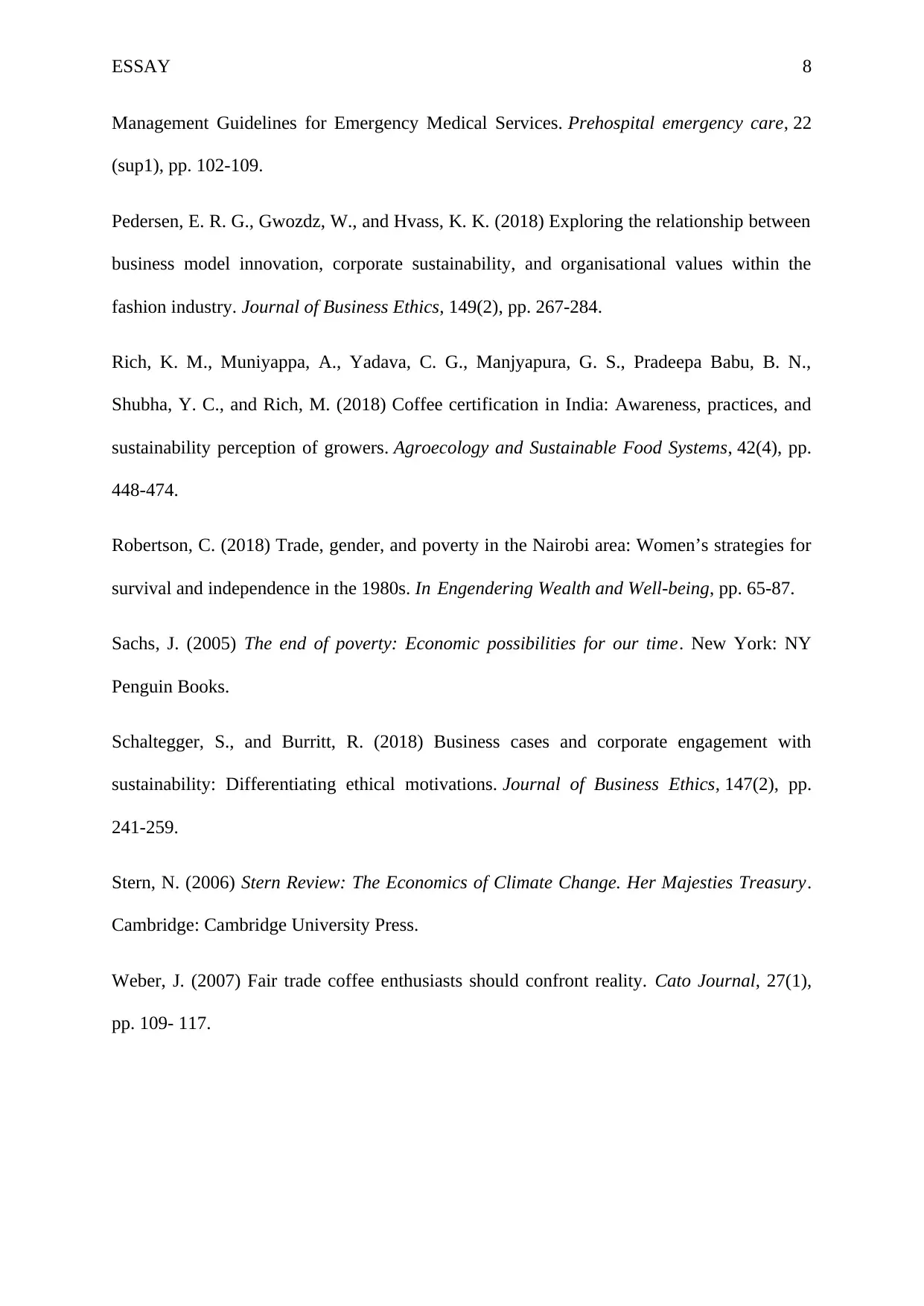
ESSAY 8
Management Guidelines for Emergency Medical Services. Prehospital emergency care, 22
(sup1), pp. 102-109.
Pedersen, E. R. G., Gwozdz, W., and Hvass, K. K. (2018) Exploring the relationship between
business model innovation, corporate sustainability, and organisational values within the
fashion industry. Journal of Business Ethics, 149(2), pp. 267-284.
Rich, K. M., Muniyappa, A., Yadava, C. G., Manjyapura, G. S., Pradeepa Babu, B. N.,
Shubha, Y. C., and Rich, M. (2018) Coffee certification in India: Awareness, practices, and
sustainability perception of growers. Agroecology and Sustainable Food Systems, 42(4), pp.
448-474.
Robertson, C. (2018) Trade, gender, and poverty in the Nairobi area: Women’s strategies for
survival and independence in the 1980s. In Engendering Wealth and Well-being, pp. 65-87.
Sachs, J. (2005) The end of poverty: Economic possibilities for our time. New York: NY
Penguin Books.
Schaltegger, S., and Burritt, R. (2018) Business cases and corporate engagement with
sustainability: Differentiating ethical motivations. Journal of Business Ethics, 147(2), pp.
241-259.
Stern, N. (2006) Stern Review: The Economics of Climate Change. Her Majesties Treasury.
Cambridge: Cambridge University Press.
Weber, J. (2007) Fair trade coffee enthusiasts should confront reality. Cato Journal, 27(1),
pp. 109- 117.
Management Guidelines for Emergency Medical Services. Prehospital emergency care, 22
(sup1), pp. 102-109.
Pedersen, E. R. G., Gwozdz, W., and Hvass, K. K. (2018) Exploring the relationship between
business model innovation, corporate sustainability, and organisational values within the
fashion industry. Journal of Business Ethics, 149(2), pp. 267-284.
Rich, K. M., Muniyappa, A., Yadava, C. G., Manjyapura, G. S., Pradeepa Babu, B. N.,
Shubha, Y. C., and Rich, M. (2018) Coffee certification in India: Awareness, practices, and
sustainability perception of growers. Agroecology and Sustainable Food Systems, 42(4), pp.
448-474.
Robertson, C. (2018) Trade, gender, and poverty in the Nairobi area: Women’s strategies for
survival and independence in the 1980s. In Engendering Wealth and Well-being, pp. 65-87.
Sachs, J. (2005) The end of poverty: Economic possibilities for our time. New York: NY
Penguin Books.
Schaltegger, S., and Burritt, R. (2018) Business cases and corporate engagement with
sustainability: Differentiating ethical motivations. Journal of Business Ethics, 147(2), pp.
241-259.
Stern, N. (2006) Stern Review: The Economics of Climate Change. Her Majesties Treasury.
Cambridge: Cambridge University Press.
Weber, J. (2007) Fair trade coffee enthusiasts should confront reality. Cato Journal, 27(1),
pp. 109- 117.
⊘ This is a preview!⊘
Do you want full access?
Subscribe today to unlock all pages.
Trusted by 1+ million students worldwide

1 out of 9


Your All-in-One AI-Powered Toolkit for Academic Success.
+13062052269
info@desklib.com
Available 24*7 on WhatsApp / Email
![[object Object]](/_next/static/media/star-bottom.7253800d.svg)
Unlock your academic potential
Copyright © 2020–2026 A2Z Services. All Rights Reserved. Developed and managed by ZUCOL.