Exploration of Faith and Freedom in Christian Theology

Verified

Added on  2020/05/04

|7
|890
|95
Essay
AI Summary
This essay delves into the intricate relationship between faith and freedom in Christian theology. It examines perspectives from Rudolph Bultmann and Soren Kierkegaard, focusing on how these concepts influence human existence and spiritual life. Bultmann highlights that true freedom is a gift from God, essential for living authentically, while Kierkegaard underscores the primacy of lived experience in faith over theoretical constructs. The essay concludes by affirming Christianity as a transformative journey towards a new life, validated through varied theological approaches.
Document Page
Running head: FAITH AND FREEDOM IN CHRISTIANITY
FAITH AND FREEDOM IN CHRISTIANITY
Name of the Student
Name of the University
Author note
tabler-icon-diamond-filled.svg

Paraphrase This Document

Need a fresh take? Get an instant paraphrase of this document with our AI Paraphraser
Document Page
1FAITH AND FREEDON IN CHRISTIANITY
Executive Summary:
Aim of the report is to discuss the study of two different authors on the matter of faith and
freedom in Christianity. Upon the discussion, major points have been noted and it is found
that both the authors have come to a same kind of conclusion from different perspectives.
Document Page
2FAITH AND FREEDON IN CHRISTIANITY
Table of Contents
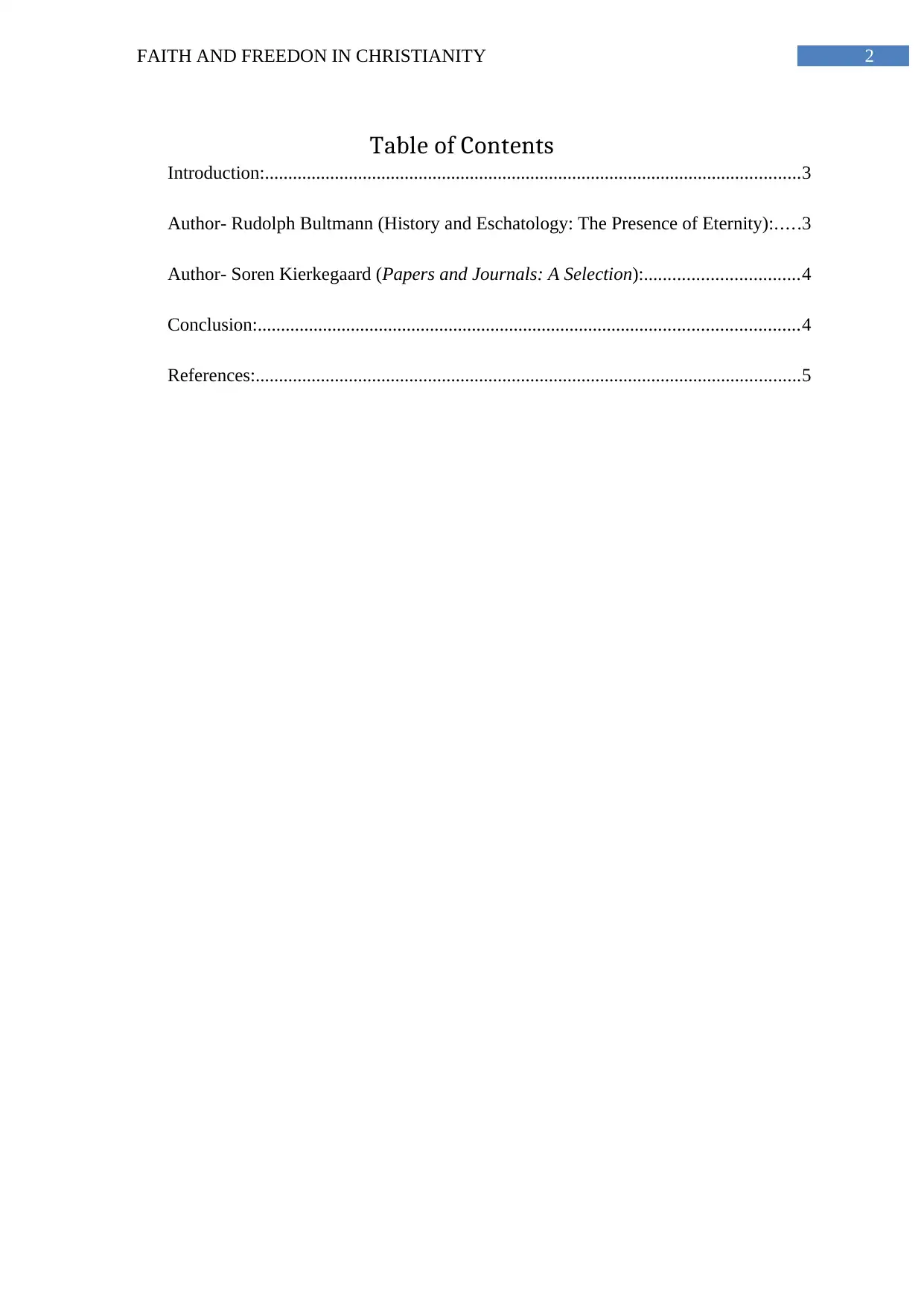
Introduction:...................................................................................................................3
Author- Rudolph Bultmann (History and Eschatology: The Presence of Eternity):.....3
Author- Soren Kierkegaard (Papers and Journals: A Selection):.................................4
Conclusion:....................................................................................................................4
References:.....................................................................................................................5
Document Page
3FAITH AND FREEDON IN CHRISTIANITY
Introduction:
Faith and freedom are the two pillars human life those provide strength and support in
the most hard and darkest period of life. In the following discussion, analysis has been
provided on the studies of Christian Faith and Freedom.
Author- Rudolph Bultmann (History and Eschatology: The Presence of Eternity):
Human actions are the results of purposes and intentions of them and that gives the
proof that the direction of the progression of the human life is always towards future. Present
can never satisfy a human completely as he remain discontent with the present to some
extent. All the expectations, hopes, intentions and fears of human are linked with his future.
None can rest by acknowledging that the present is the best moment. It seems that life always
remain a step ahead for human and every time it has to be understood and captured
(Bultmann 1962). Therefore all the actions become unpredictable for future and the essence is
revealed in future. However, the fact that demand of the life brings the realisation of the
genuineness of the life to a human, at the present time.
It is believed by Christian faith that a man does not have the freedom on the basis of
presumption of historical decisions. According to the author, the features of a man is
acknowledged form the past. The duty of fulfilling the responsibilities comes from the
relative freedom in decision making for everyone but the freedom remains relative then it will
be something which is barred with past. Radical freedom makes a person to understand
himself from the perspective of future (Migliore 2014). Historicity of a man misleads him
and brings the illusion of having power of disposal. Only a radical human can fulfil
responsibilities, though without guarantee. The freedom that a man requires from himself can
tabler-icon-diamond-filled.svg

Paraphrase This Document

Need a fresh take? Get an instant paraphrase of this document with our AI Paraphraser
Document Page
4FAITH AND FREEDON IN CHRISTIANITY
only be come as a gift according to Christian faith. The idea is to lose one’s life so that he can
find it back and it only happens by the grace of God.
The legitimation of this message comes from the disclosure of the grace of God by
Jesus Christ. The action of God, the eschatological event is the arrival of Jesus Christ, which
is mentioned in the New Testament so the old world can come to an end. It can be judged that
an old man has reached his end and there arrived a new, free man.
Author- Soren Kierkegaard (Papers and Journals: A Selection):
Theory cannot be built for something that does not exist. Therefore, at first comes the
art or the work of the art and afterwards comes the theory for explanation. The similarity has
been acknowledged by the author in case of life and theory and the life always comes before
theory (Kierkegaard 1996). However, there is a third matter, which is an attempt for
formation of a life according to the theory ad at the end comes the parody, the end of the
process and the platform from where a new life begins.
The above theory shows a similarity between it and Christianity, which came as a life
full of utter bravery that can accept any consequences and risks in its path towards faith.
Christianity is a belief, a theory of trust regarding the living (Niebuhr 2013). The belief or
‘doctrine’ life and death disputes and matters of vitality among the living. The course of the
existence of human being is determined by this doctrine of Christianity. The beginning of a
fresh life is the key element of Christianity.
Conclusion:
Therefore, concluding the discussion, it can be mentioned that Christianity is a
prospect of a new life. Different theoretical approaches have proved the same point from
different perspectives.
Document Page
5FAITH AND FREEDON IN CHRISTIANITY
Document Page
6FAITH AND FREEDON IN CHRISTIANITY
References:
Bultmann, R.K., 1962. History and Eschatology the Presence of Eternity; the Gifford
Lectures 1955.
Kierkegaard, S., 1996. Papers and journals: A selection. Penguin.
Migliore, D.L., 2014. Faith seeking understanding: An introduction to Christian theology.
Wm. B. Eerdmans Publishing.
Niebuhr, R., 2013. Faith and History-A Comparison of Christian and Modern Views of
History. Read Books Ltd.
chevron_up_icon
1 out of 7
circle_padding
hide_on_mobile
zoom_out_icon
[object Object]