Report: Influences of Environment on Behavior and the Family System
VerifiedAdded on 2021/05/31
|6
|1041
|62
Report
AI Summary
This report examines the impact of environmental influences on family systems, focusing on a case study involving a retired school teacher, Sandra, and her family. The analysis explores how her husband's health issues, abusive behavior, and the resulting emotional stress affect her decisions and well-being. The report delves into potential solutions, including the role of a Human Services Professional (HSP) in managing stress and trauma through techniques like visualization and talk therapy. It also assesses the impact of involving adult children in her struggles and the benefits of seeking help from Union Family Services for emotional healing and family therapy. The report concludes with an overview of multigenerational family practice, emphasizing its role in promoting health and development across generations through multidisciplinary approaches and community-based partnerships.
Running head: ENVIRONMENT AND THE FAMILY SYSTEM
1
Influences of Environment on Behavior and the Family System
Student’s Name
Institutional Affiliation
Date
1
Influences of Environment on Behavior and the Family System
Student’s Name
Institutional Affiliation
Date
Paraphrase This Document
Need a fresh take? Get an instant paraphrase of this document with our AI Paraphraser

ENVIRONMENT AND THE FAMILY SYSTEM
2
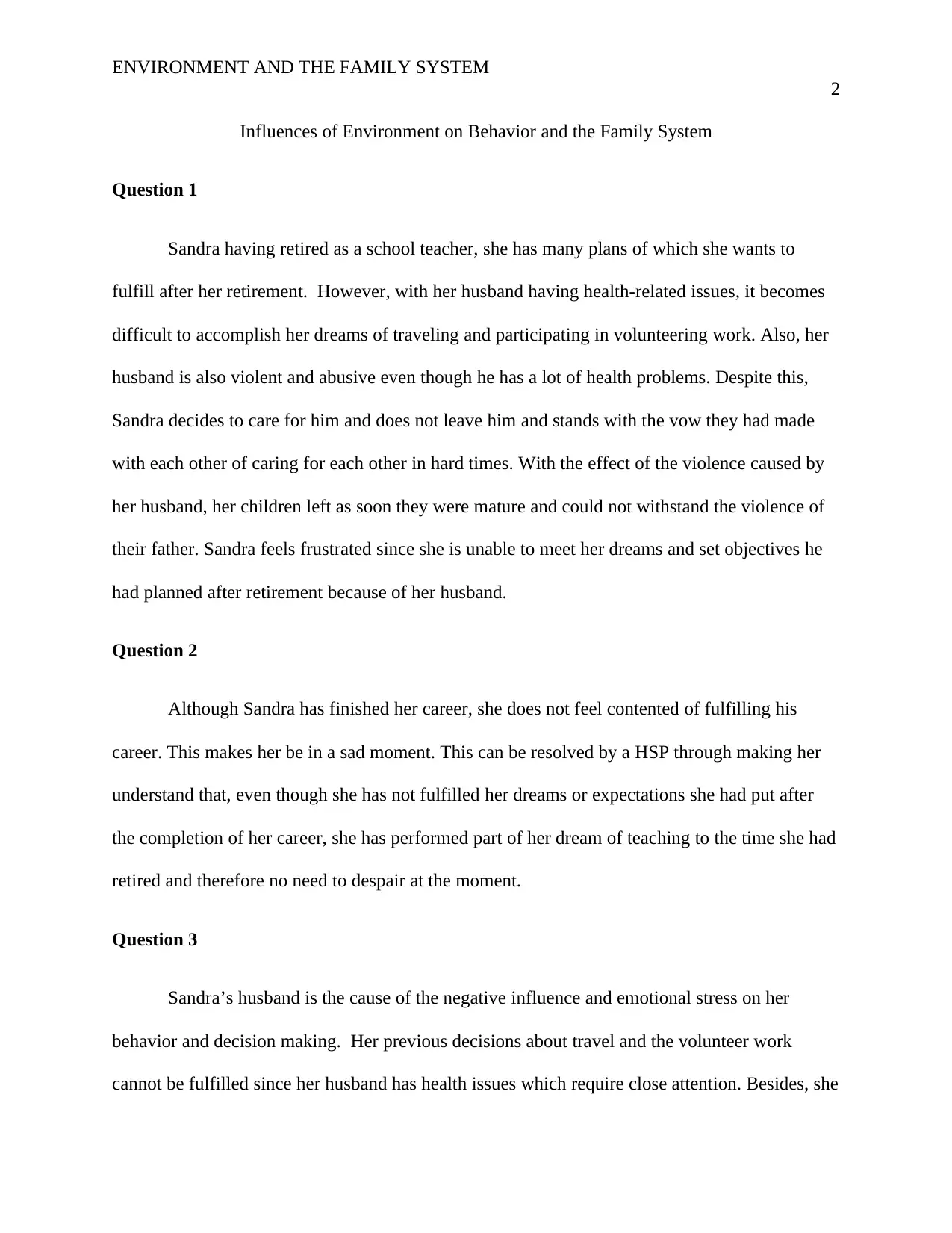
Influences of Environment on Behavior and the Family System
Question 1
Sandra having retired as a school teacher, she has many plans of which she wants to
fulfill after her retirement. However, with her husband having health-related issues, it becomes
difficult to accomplish her dreams of traveling and participating in volunteering work. Also, her
husband is also violent and abusive even though he has a lot of health problems. Despite this,
Sandra decides to care for him and does not leave him and stands with the vow they had made
with each other of caring for each other in hard times. With the effect of the violence caused by
her husband, her children left as soon they were mature and could not withstand the violence of
their father. Sandra feels frustrated since she is unable to meet her dreams and set objectives he
had planned after retirement because of her husband.
Question 2
Although Sandra has finished her career, she does not feel contented of fulfilling his
career. This makes her be in a sad moment. This can be resolved by a HSP through making her
understand that, even though she has not fulfilled her dreams or expectations she had put after
the completion of her career, she has performed part of her dream of teaching to the time she had
retired and therefore no need to despair at the moment.
Question 3
Sandra’s husband is the cause of the negative influence and emotional stress on her
behavior and decision making. Her previous decisions about travel and the volunteer work
cannot be fulfilled since her husband has health issues which require close attention. Besides, she
2
Influences of Environment on Behavior and the Family System
Question 1
Sandra having retired as a school teacher, she has many plans of which she wants to
fulfill after her retirement. However, with her husband having health-related issues, it becomes
difficult to accomplish her dreams of traveling and participating in volunteering work. Also, her
husband is also violent and abusive even though he has a lot of health problems. Despite this,
Sandra decides to care for him and does not leave him and stands with the vow they had made
with each other of caring for each other in hard times. With the effect of the violence caused by
her husband, her children left as soon they were mature and could not withstand the violence of
their father. Sandra feels frustrated since she is unable to meet her dreams and set objectives he
had planned after retirement because of her husband.
Question 2
Although Sandra has finished her career, she does not feel contented of fulfilling his
career. This makes her be in a sad moment. This can be resolved by a HSP through making her
understand that, even though she has not fulfilled her dreams or expectations she had put after
the completion of her career, she has performed part of her dream of teaching to the time she had
retired and therefore no need to despair at the moment.
Question 3
Sandra’s husband is the cause of the negative influence and emotional stress on her
behavior and decision making. Her previous decisions about travel and the volunteer work
cannot be fulfilled since her husband has health issues which require close attention. Besides, she

ENVIRONMENT AND THE FAMILY SYSTEM
3
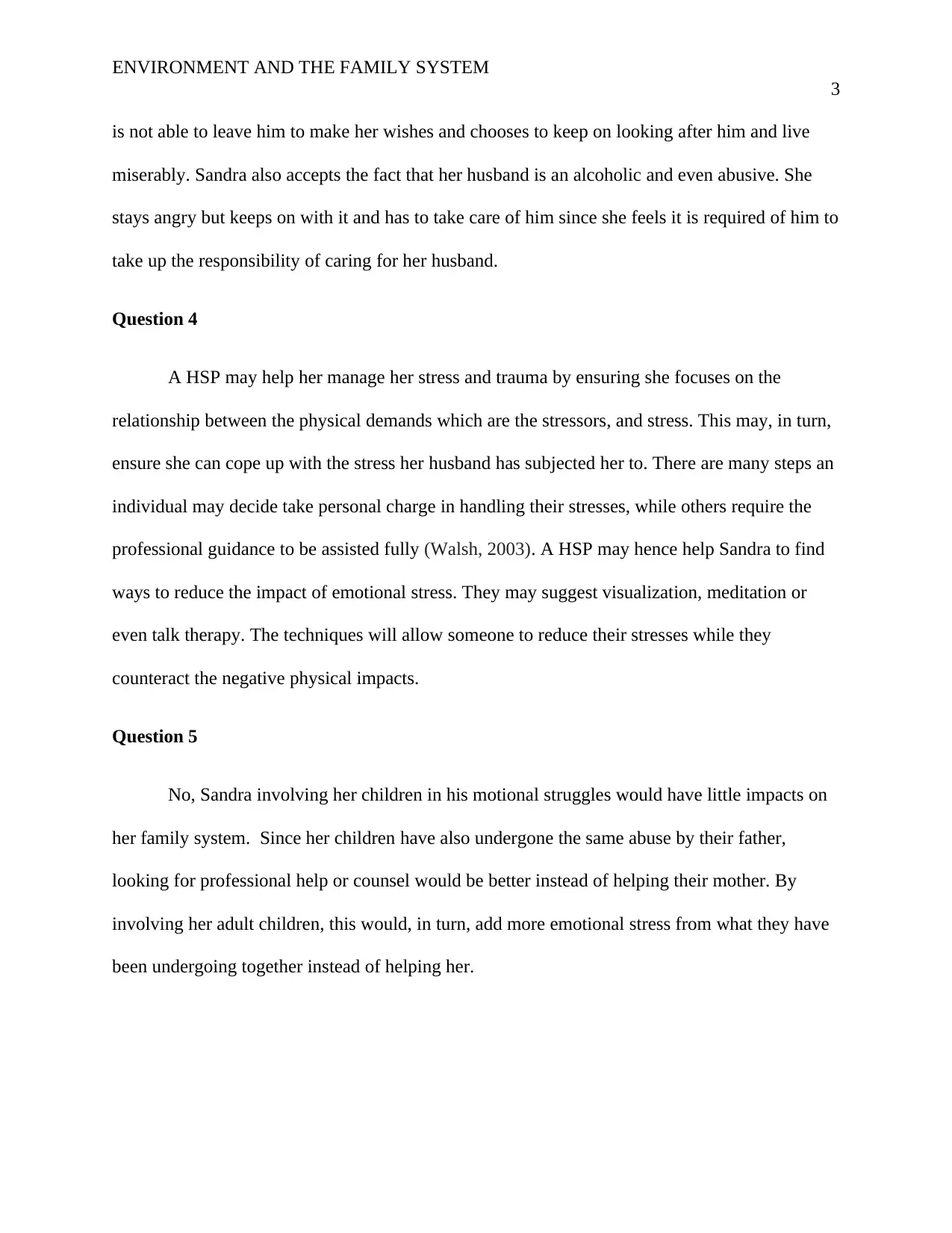
is not able to leave him to make her wishes and chooses to keep on looking after him and live
miserably. Sandra also accepts the fact that her husband is an alcoholic and even abusive. She
stays angry but keeps on with it and has to take care of him since she feels it is required of him to
take up the responsibility of caring for her husband.
Question 4
A HSP may help her manage her stress and trauma by ensuring she focuses on the
relationship between the physical demands which are the stressors, and stress. This may, in turn,
ensure she can cope up with the stress her husband has subjected her to. There are many steps an
individual may decide take personal charge in handling their stresses, while others require the
professional guidance to be assisted fully (Walsh, 2003). A HSP may hence help Sandra to find
ways to reduce the impact of emotional stress. They may suggest visualization, meditation or
even talk therapy. The techniques will allow someone to reduce their stresses while they
counteract the negative physical impacts.
Question 5
No, Sandra involving her children in his motional struggles would have little impacts on
her family system. Since her children have also undergone the same abuse by their father,
looking for professional help or counsel would be better instead of helping their mother. By
involving her adult children, this would, in turn, add more emotional stress from what they have
been undergoing together instead of helping her.
3
is not able to leave him to make her wishes and chooses to keep on looking after him and live
miserably. Sandra also accepts the fact that her husband is an alcoholic and even abusive. She
stays angry but keeps on with it and has to take care of him since she feels it is required of him to
take up the responsibility of caring for her husband.
Question 4
A HSP may help her manage her stress and trauma by ensuring she focuses on the
relationship between the physical demands which are the stressors, and stress. This may, in turn,
ensure she can cope up with the stress her husband has subjected her to. There are many steps an
individual may decide take personal charge in handling their stresses, while others require the
professional guidance to be assisted fully (Walsh, 2003). A HSP may hence help Sandra to find
ways to reduce the impact of emotional stress. They may suggest visualization, meditation or
even talk therapy. The techniques will allow someone to reduce their stresses while they
counteract the negative physical impacts.
Question 5
No, Sandra involving her children in his motional struggles would have little impacts on
her family system. Since her children have also undergone the same abuse by their father,
looking for professional help or counsel would be better instead of helping their mother. By
involving her adult children, this would, in turn, add more emotional stress from what they have
been undergoing together instead of helping her.
⊘ This is a preview!⊘
Do you want full access?
Subscribe today to unlock all pages.

Trusted by 1+ million students worldwide

ENVIRONMENT AND THE FAMILY SYSTEM
4
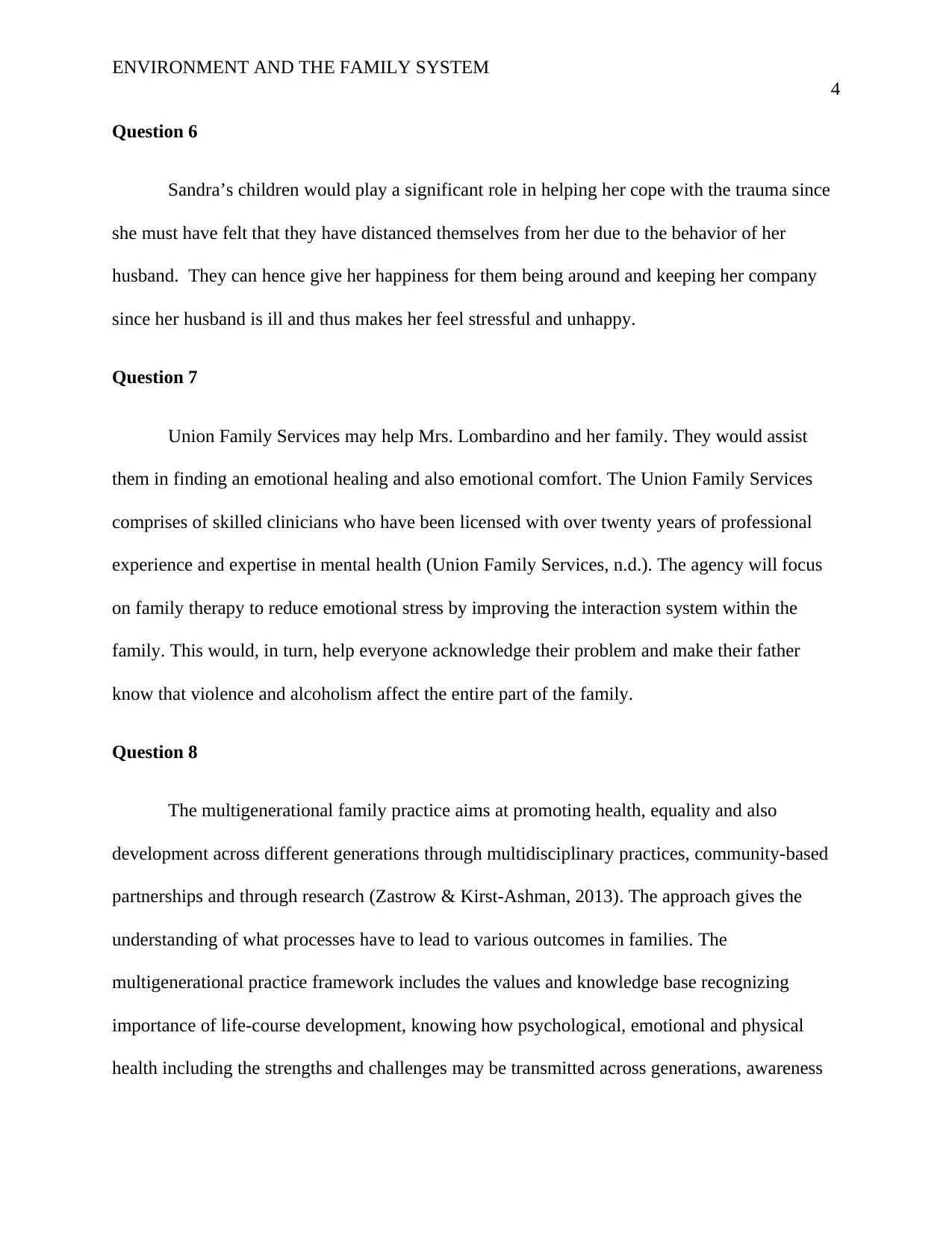
Question 6
Sandra’s children would play a significant role in helping her cope with the trauma since
she must have felt that they have distanced themselves from her due to the behavior of her
husband. They can hence give her happiness for them being around and keeping her company
since her husband is ill and thus makes her feel stressful and unhappy.
Question 7
Union Family Services may help Mrs. Lombardino and her family. They would assist
them in finding an emotional healing and also emotional comfort. The Union Family Services
comprises of skilled clinicians who have been licensed with over twenty years of professional
experience and expertise in mental health (Union Family Services, n.d.). The agency will focus
on family therapy to reduce emotional stress by improving the interaction system within the
family. This would, in turn, help everyone acknowledge their problem and make their father
know that violence and alcoholism affect the entire part of the family.
Question 8
The multigenerational family practice aims at promoting health, equality and also
development across different generations through multidisciplinary practices, community-based
partnerships and through research (Zastrow & Kirst-Ashman, 2013). The approach gives the
understanding of what processes have to lead to various outcomes in families. The
multigenerational practice framework includes the values and knowledge base recognizing
importance of life-course development, knowing how psychological, emotional and physical
health including the strengths and challenges may be transmitted across generations, awareness
4
Question 6
Sandra’s children would play a significant role in helping her cope with the trauma since
she must have felt that they have distanced themselves from her due to the behavior of her
husband. They can hence give her happiness for them being around and keeping her company
since her husband is ill and thus makes her feel stressful and unhappy.
Question 7
Union Family Services may help Mrs. Lombardino and her family. They would assist
them in finding an emotional healing and also emotional comfort. The Union Family Services
comprises of skilled clinicians who have been licensed with over twenty years of professional
experience and expertise in mental health (Union Family Services, n.d.). The agency will focus
on family therapy to reduce emotional stress by improving the interaction system within the
family. This would, in turn, help everyone acknowledge their problem and make their father
know that violence and alcoholism affect the entire part of the family.
Question 8
The multigenerational family practice aims at promoting health, equality and also
development across different generations through multidisciplinary practices, community-based
partnerships and through research (Zastrow & Kirst-Ashman, 2013). The approach gives the
understanding of what processes have to lead to various outcomes in families. The
multigenerational practice framework includes the values and knowledge base recognizing
importance of life-course development, knowing how psychological, emotional and physical
health including the strengths and challenges may be transmitted across generations, awareness
Paraphrase This Document
Need a fresh take? Get an instant paraphrase of this document with our AI Paraphraser

ENVIRONMENT AND THE FAMILY SYSTEM
5
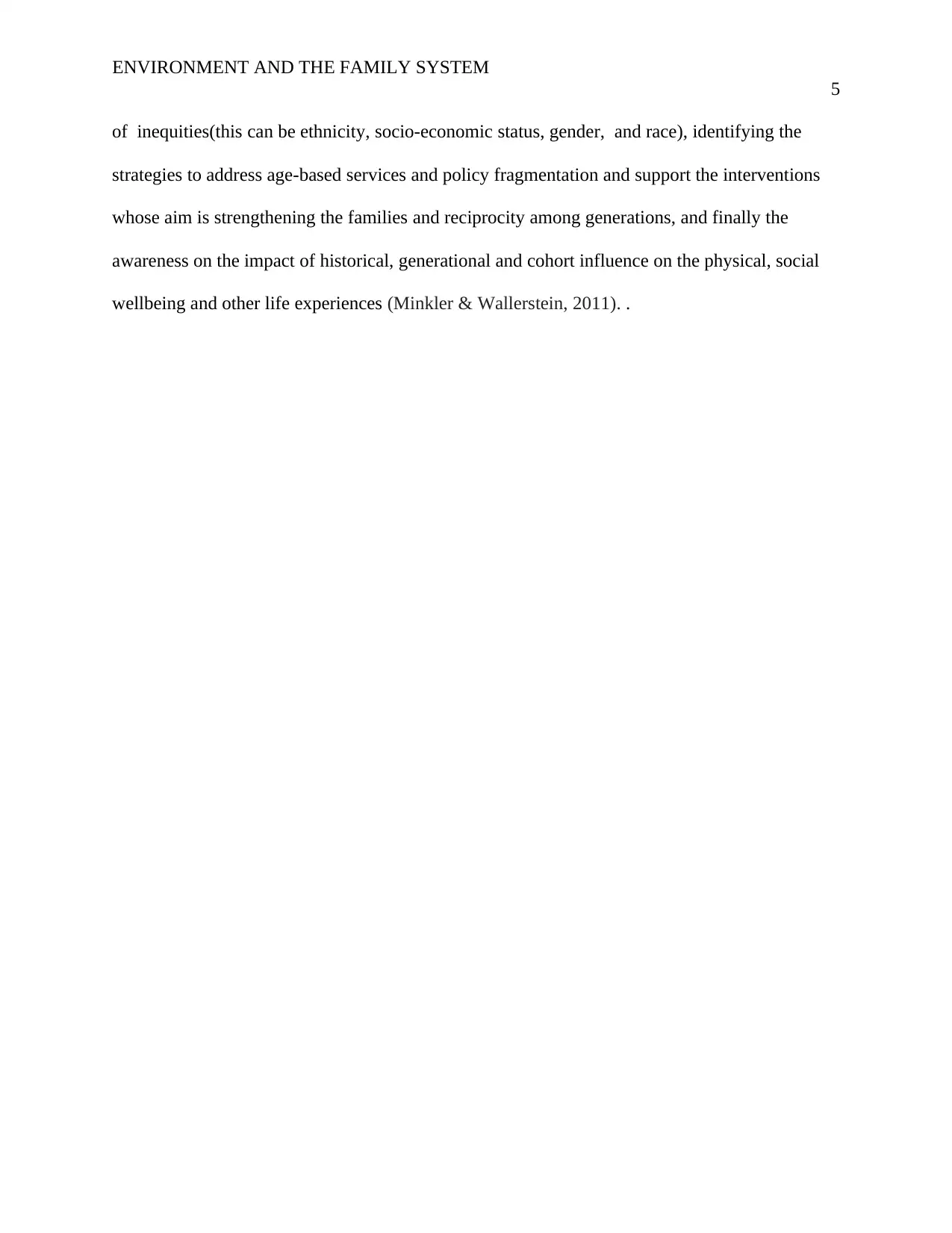
of inequities(this can be ethnicity, socio-economic status, gender, and race), identifying the
strategies to address age-based services and policy fragmentation and support the interventions
whose aim is strengthening the families and reciprocity among generations, and finally the
awareness on the impact of historical, generational and cohort influence on the physical, social
wellbeing and other life experiences (Minkler & Wallerstein, 2011). .
5
of inequities(this can be ethnicity, socio-economic status, gender, and race), identifying the
strategies to address age-based services and policy fragmentation and support the interventions
whose aim is strengthening the families and reciprocity among generations, and finally the
awareness on the impact of historical, generational and cohort influence on the physical, social
wellbeing and other life experiences (Minkler & Wallerstein, 2011). .

ENVIRONMENT AND THE FAMILY SYSTEM
6
References
Minkler, M., & Wallerstein, N. (Eds.). (2011). Community-based participatory research for
health: From process to outcomes. John Wiley & Sons.
Union Family Services. (n.d.). Retrieved from
https://www.psychologytoday.com/us/therapists/union-family-services-
monroe-nc/292449
Walsh, F. (2003). Clinical views of family normality, health, and dysfunction. Normal family
processes, 27-57.
Zastrow. C, Kirst-Ashman. K. (2013). Understanding Human Behavior and the Social
Environment (9th ed). Brooks/Cole Empowerment Series.
6
References
Minkler, M., & Wallerstein, N. (Eds.). (2011). Community-based participatory research for
health: From process to outcomes. John Wiley & Sons.
Union Family Services. (n.d.). Retrieved from
https://www.psychologytoday.com/us/therapists/union-family-services-
monroe-nc/292449
Walsh, F. (2003). Clinical views of family normality, health, and dysfunction. Normal family
processes, 27-57.
Zastrow. C, Kirst-Ashman. K. (2013). Understanding Human Behavior and the Social
Environment (9th ed). Brooks/Cole Empowerment Series.
⊘ This is a preview!⊘
Do you want full access?
Subscribe today to unlock all pages.

Trusted by 1+ million students worldwide
1 out of 6
Related Documents
Your All-in-One AI-Powered Toolkit for Academic Success.
+13062052269
info@desklib.com
Available 24*7 on WhatsApp / Email
Unlock your academic potential
Copyright © 2020–2026 A2Z Services. All Rights Reserved. Developed and managed by ZUCOL.