Family-Centered Care Report: Genogram Analysis, Reflection, and Theory
VerifiedAdded on 2023/03/20
|9
|2301
|68
Report
AI Summary
This report delves into the concept of family-centered care, utilizing a genogram as a central tool for analysis. Part A examines the relevance of genograms in depicting family dynamics and their significance in healthcare, particularly in identifying patterns of illness and enhancing patient care. It explores how genograms can be used to create a comprehensive understanding of a patient's condition and improve family involvement in care. The report then applies Erik Erikson's lifespan development theory to explain how genograms can inform and enhance a family-centered approach. Part B presents a reflection using Gibbs' reflective cycle, discussing personal learning and insights gained from the analysis. The reflection covers feelings, evaluation, conclusions, and an action plan for improved nursing practices, emphasizing the importance of family involvement and understanding patient needs in providing effective healthcare. The report provides valuable insights for healthcare professionals seeking to improve patient outcomes through family-centered care.
Family-centered care by a
genogram
Link of the item:
http://in.bgu.ac.il/en/fohs/communityhealth/Family/Documents/genograms.pdf
https://www.simplypsychology.org/Erik-Erikson.html
https://www.researchgate.net/profile/Froma_Walsh/publication/
311659867_Applying_a_Family_Resilience_Framework_in_Training_Practice_and_Res
earch_Mastering_the_Art_of_the_Possible/links/59f89602aca272607e2f57ec/Applying-
a-Family-Resilience-Framework-in-Training-Practice-and-Research-Mastering-the-Art-
of-the-Possible.pdf
genogram
Link of the item:
http://in.bgu.ac.il/en/fohs/communityhealth/Family/Documents/genograms.pdf
https://www.simplypsychology.org/Erik-Erikson.html
https://www.researchgate.net/profile/Froma_Walsh/publication/
311659867_Applying_a_Family_Resilience_Framework_in_Training_Practice_and_Res
earch_Mastering_the_Art_of_the_Possible/links/59f89602aca272607e2f57ec/Applying-
a-Family-Resilience-Framework-in-Training-Practice-and-Research-Mastering-the-Art-
of-the-Possible.pdf

Paraphrase This Document
Need a fresh take? Get an instant paraphrase of this document with our AI Paraphraser
1
Table of Contents
Part A..........................................................................................................................................................2
Genogram and its relevance to family-centered care......................................................................2
Significance of genogram in enhancing the family-centered care of the patients........................3
Part B..........................................................................................................................................................4
Reflection...............................................................................................................................................4
References................................................................................................................................................7
Table of Contents
Part A..........................................................................................................................................................2
Genogram and its relevance to family-centered care......................................................................2
Significance of genogram in enhancing the family-centered care of the patients........................3
Part B..........................................................................................................................................................4
Reflection...............................................................................................................................................4
References................................................................................................................................................7
2
Part A
Genogram and its relevance to family-centered care
A genogram is considered as a family map, which is used for describing the major
events, dynamics, and the relationship of a family over multiple generations (Walsh,
2016). With the help of genogram, the nursing professionals identifies the patterns of
physical and mental illness such as cancer, bipolar disorder, depression, and other
genetic diseases. A genogram is a graphical presentation that determines the
relationship of family members and this helps the medical professionals to understand
the generation of these diseases (Libbon et al., 2019). Many patients suffers from
various genetic diseases and this can be determined by the nursing professionals with
the help of this genogram.
The main role of a genogram is to provide a holistic and comprehensive picture of the
patient’s condition which helps in improving the family-centered care. It is considered as
an intervention strategy as well as an assessment tool which helps both the nursing
professionals and the family members to understand the best treatment required for the
concerned patient (Wong, Wan and Ng, 2016). In family-centered care, genogram helps
the nursing professionals to create a psychological factor and visualizes a pattern which
affects their relationships with the patients. By visualizing the negative effect, they can
make a proper strategy which does not offend the patient by the caring procedure.
According to the nursing professionals, family plays an important role in the lives of
patient and with the help of this genogram assessment tool, the professionals are able
to provide best services for the patients.
Moreover, they convince the family members to contribute their efforts in enhancing the
patient’s life. The extreme moral support from the family members helps in providing
motivation to the patient (Lise et al., 2018). Genogram enhances the family-centered
care by strengthening their prolonged and continuing care to the patient. Many scholars
suggested that by using genogram, the health professionals have become successful in
demonstrating the cause of health problems of the patient to their family members. By
using this approach, the nursing professionals are able to improve the family-centered
care or services towards the patient those who are suffering from severe disease. In
Part A
Genogram and its relevance to family-centered care
A genogram is considered as a family map, which is used for describing the major
events, dynamics, and the relationship of a family over multiple generations (Walsh,
2016). With the help of genogram, the nursing professionals identifies the patterns of
physical and mental illness such as cancer, bipolar disorder, depression, and other
genetic diseases. A genogram is a graphical presentation that determines the
relationship of family members and this helps the medical professionals to understand
the generation of these diseases (Libbon et al., 2019). Many patients suffers from
various genetic diseases and this can be determined by the nursing professionals with
the help of this genogram.
The main role of a genogram is to provide a holistic and comprehensive picture of the
patient’s condition which helps in improving the family-centered care. It is considered as
an intervention strategy as well as an assessment tool which helps both the nursing
professionals and the family members to understand the best treatment required for the
concerned patient (Wong, Wan and Ng, 2016). In family-centered care, genogram helps
the nursing professionals to create a psychological factor and visualizes a pattern which
affects their relationships with the patients. By visualizing the negative effect, they can
make a proper strategy which does not offend the patient by the caring procedure.
According to the nursing professionals, family plays an important role in the lives of
patient and with the help of this genogram assessment tool, the professionals are able
to provide best services for the patients.
Moreover, they convince the family members to contribute their efforts in enhancing the
patient’s life. The extreme moral support from the family members helps in providing
motivation to the patient (Lise et al., 2018). Genogram enhances the family-centered
care by strengthening their prolonged and continuing care to the patient. Many scholars
suggested that by using genogram, the health professionals have become successful in
demonstrating the cause of health problems of the patient to their family members. By
using this approach, the nursing professionals are able to improve the family-centered
care or services towards the patient those who are suffering from severe disease. In
⊘ This is a preview!⊘
Do you want full access?
Subscribe today to unlock all pages.

Trusted by 1+ million students worldwide
3
addition, with the help of this assessment tool, the family members understand the
historical track of the patient in terms of their health condition (Ribeiro et al., 2015).
Hence, by understanding the mental and physical state of the patient, the family
members, and nursing professionals can easily improve their services towards the
patient.
Significance of genogram in enhancing the family-centered care of the patients
According to Erik Erikson’s, lifespan development theory, there are eight stages of
psychological development, and this results in either a positive or negative outcome on
their health effects. The eight stages are trust versus mistrust, initiative versus guilt,
autonomy versus shame, identity versus confusion, industry versus inferiority, intimacy
versus isolation, integrity versus despair and generativity versus stagnation (Paipa et
al., 2015). Based on these stages the physiological state of a person can be determined
which either affects their mind negatively or positively. Finally, with the help of this
theory the nursing professionals are able to influence the positive outcome of the patient
mind so that they can cure themselves from the current health effects. With the help of
this theory, the nursing professionals can maintain family-oriented care to their patients
and this influences them to cure their health issue as fast as possible (Ma et al., 2018).
Based on this theory, many scholars suggested that there are various ways by which
the genogram enhances the family-centered care approach for caring the patients.
There are ways that increase the family-centered care of health professional and family
members by using this genogram, they are as follows:
Genogram mainly focuses on collecting the information of family, and it helps the
nursing professionals as well as healthcare experts to understand the main
reason for causing this health issue. For collecting the information the
professionals primarily studied the family history which enables them to
understand the particular type of family-centered care that should be needed for
this patient (DiGiacomo et al., 2019). In order to enhance their family-centered
care, they interact with the patient and their families so that they can identify the
caring pattern that is beneficial for the patient. Hence it is considered as one of
addition, with the help of this assessment tool, the family members understand the
historical track of the patient in terms of their health condition (Ribeiro et al., 2015).
Hence, by understanding the mental and physical state of the patient, the family
members, and nursing professionals can easily improve their services towards the
patient.
Significance of genogram in enhancing the family-centered care of the patients
According to Erik Erikson’s, lifespan development theory, there are eight stages of
psychological development, and this results in either a positive or negative outcome on
their health effects. The eight stages are trust versus mistrust, initiative versus guilt,
autonomy versus shame, identity versus confusion, industry versus inferiority, intimacy
versus isolation, integrity versus despair and generativity versus stagnation (Paipa et
al., 2015). Based on these stages the physiological state of a person can be determined
which either affects their mind negatively or positively. Finally, with the help of this
theory the nursing professionals are able to influence the positive outcome of the patient
mind so that they can cure themselves from the current health effects. With the help of
this theory, the nursing professionals can maintain family-oriented care to their patients
and this influences them to cure their health issue as fast as possible (Ma et al., 2018).
Based on this theory, many scholars suggested that there are various ways by which
the genogram enhances the family-centered care approach for caring the patients.
There are ways that increase the family-centered care of health professional and family
members by using this genogram, they are as follows:
Genogram mainly focuses on collecting the information of family, and it helps the
nursing professionals as well as healthcare experts to understand the main
reason for causing this health issue. For collecting the information the
professionals primarily studied the family history which enables them to
understand the particular type of family-centered care that should be needed for
this patient (DiGiacomo et al., 2019). In order to enhance their family-centered
care, they interact with the patient and their families so that they can identify the
caring pattern that is beneficial for the patient. Hence it is considered as one of
Paraphrase This Document
Need a fresh take? Get an instant paraphrase of this document with our AI Paraphraser
4
the ways by which genogram help in enhancing the family-centered care for the
patients
With the help of genogram, the nursing, as well as the healthcare professionals,
get an idea regarding the patient hereditary pattern. The visual documents helps
them to track the history of the current physical and mental conditions of the
patient. After understanding the patient's condition, if the nurses are clear that the
health issues are quite severe then automatically they can improve their caring
approach into family-centered care by treating both the families and patient as
their partners (Russell, Beckmeyer and Su-Russell, 2018). By this way, the
nursing and healthcare professionals will not only enhance their family-centered
care but will also determine the needs of the patient as well as patient-party.
Therefore, after changing the caring approach, the nurses are able to decrease
their gap with the patients and this influences them to give their best treatment to
the patients.
Genogram enables the nurses to act in the way by which the family members as
well as a patient both get satisfied by their care. A genogram is the family tree
that defines emotional and physical relationships with each other in a family
(Foster and Shields, 2018). After understanding the priority of family members
towards the patients and also their conditions, the professionals encourage the
participation of family members in a caring approach. The clinical staff generally
uses this method not only to improve their family-centered care but also to cure
the patient as fast as possible
Part B
Reflection
Description
After reviewing various articles on nursing professionals, I have learned that family-
centered care is an important element that helps the nurses to improve their health care
products and services towards their patients. The family-centered care module helped
me to understand the importance of this type of care towards the patient. With the help
of this family-centered care, both the healthcare professionals as well as the family
the ways by which genogram help in enhancing the family-centered care for the
patients
With the help of genogram, the nursing, as well as the healthcare professionals,
get an idea regarding the patient hereditary pattern. The visual documents helps
them to track the history of the current physical and mental conditions of the
patient. After understanding the patient's condition, if the nurses are clear that the
health issues are quite severe then automatically they can improve their caring
approach into family-centered care by treating both the families and patient as
their partners (Russell, Beckmeyer and Su-Russell, 2018). By this way, the
nursing and healthcare professionals will not only enhance their family-centered
care but will also determine the needs of the patient as well as patient-party.
Therefore, after changing the caring approach, the nurses are able to decrease
their gap with the patients and this influences them to give their best treatment to
the patients.
Genogram enables the nurses to act in the way by which the family members as
well as a patient both get satisfied by their care. A genogram is the family tree
that defines emotional and physical relationships with each other in a family
(Foster and Shields, 2018). After understanding the priority of family members
towards the patients and also their conditions, the professionals encourage the
participation of family members in a caring approach. The clinical staff generally
uses this method not only to improve their family-centered care but also to cure
the patient as fast as possible
Part B
Reflection
Description
After reviewing various articles on nursing professionals, I have learned that family-
centered care is an important element that helps the nurses to improve their health care
products and services towards their patients. The family-centered care module helped
me to understand the importance of this type of care towards the patient. With the help
of this family-centered care, both the healthcare professionals as well as the family
5
members will work together to plan, provide and evaluate the proper care that is
necessary for the patient (Foster and Shields, 2018). According to my view, families are
the one who can provide the best treatment to their family member. The nursing
professionals should include this type of care to the patients as it automatically
improves the patient’s condition within certain time.
Feelings
I feel that all the nursing professionals should incorporate family-centered care in their
caring approach so that they can provide the best treatment to the patients. However,
professional collaborating should facilitate the caring approach, but along with this, they
must understand the patient’s emotional context properly. The nursing professionals
should interact with their family members, and this approach will help them to identify
the condition of the patient before admitting in the center (Voltelen, Konradsen and
Østergaard, 2016). Hence, it helps them to strategize appropriate caring aspect that
should be advantageous for this patient. Besides this, I feel that all families want that
their family members should be treated properly and they should reduce their health
problems as fast as possible. I can say that the families always behave in a supportive
manner with the nursing professionals by which they can treat their patients with the
best medicine and care.
Evaluation
From these prospects, it is evaluated that family strengths are considered to be the best
option for curing a patient. Thus it is necessary for the healthcare and nursing
professionals to understand the needs of the patient and behave with them as a family
member. It reduces the gap between nurses and patients, and it allows the patient to
easily explain their problem and condition without any hesitation (Wong, Wan and Ng,
2016).
Conclusions
I should conclude that nurses must incorporate family-centered care by using various
assessment tools so that they can cure the patient before the mentioned time. Use of
proper communication helps the family members to understand the patient’s problem
members will work together to plan, provide and evaluate the proper care that is
necessary for the patient (Foster and Shields, 2018). According to my view, families are
the one who can provide the best treatment to their family member. The nursing
professionals should include this type of care to the patients as it automatically
improves the patient’s condition within certain time.
Feelings
I feel that all the nursing professionals should incorporate family-centered care in their
caring approach so that they can provide the best treatment to the patients. However,
professional collaborating should facilitate the caring approach, but along with this, they
must understand the patient’s emotional context properly. The nursing professionals
should interact with their family members, and this approach will help them to identify
the condition of the patient before admitting in the center (Voltelen, Konradsen and
Østergaard, 2016). Hence, it helps them to strategize appropriate caring aspect that
should be advantageous for this patient. Besides this, I feel that all families want that
their family members should be treated properly and they should reduce their health
problems as fast as possible. I can say that the families always behave in a supportive
manner with the nursing professionals by which they can treat their patients with the
best medicine and care.
Evaluation
From these prospects, it is evaluated that family strengths are considered to be the best
option for curing a patient. Thus it is necessary for the healthcare and nursing
professionals to understand the needs of the patient and behave with them as a family
member. It reduces the gap between nurses and patients, and it allows the patient to
easily explain their problem and condition without any hesitation (Wong, Wan and Ng,
2016).
Conclusions
I should conclude that nurses must incorporate family-centered care by using various
assessment tools so that they can cure the patient before the mentioned time. Use of
proper communication helps the family members to understand the patient’s problem
⊘ This is a preview!⊘
Do you want full access?
Subscribe today to unlock all pages.
Trusted by 1+ million students worldwide
6
easily, and in this way, they can provide the necessary treatment that is essential for
every particular patient. In other words, the nursing professionals should interact with
the patient’s family members which enables them to understand the condition of the
patient before admitting in the healthcare center.
Action plan
In order to improve my nursing practices, it is necessary for me to treat the patient by
following nursing rules. This approach not only improves by nursing practices but it also
influences me to provide family-centered care to the patient. In other words, for the
patient with the severe condition, I will maintain a friendly relation with them so that they
easily express their problem to me without any hesitation. Hence, this aspect has
enhanced my nursing practices, and also it encourages the family members to support
the patient in all conditions. In addition, I should treat every patient equally keeping
aside their racial, religion and community. By this way, I can improve my nursing
practice in the future as well as change my caring technique into family-centered care.
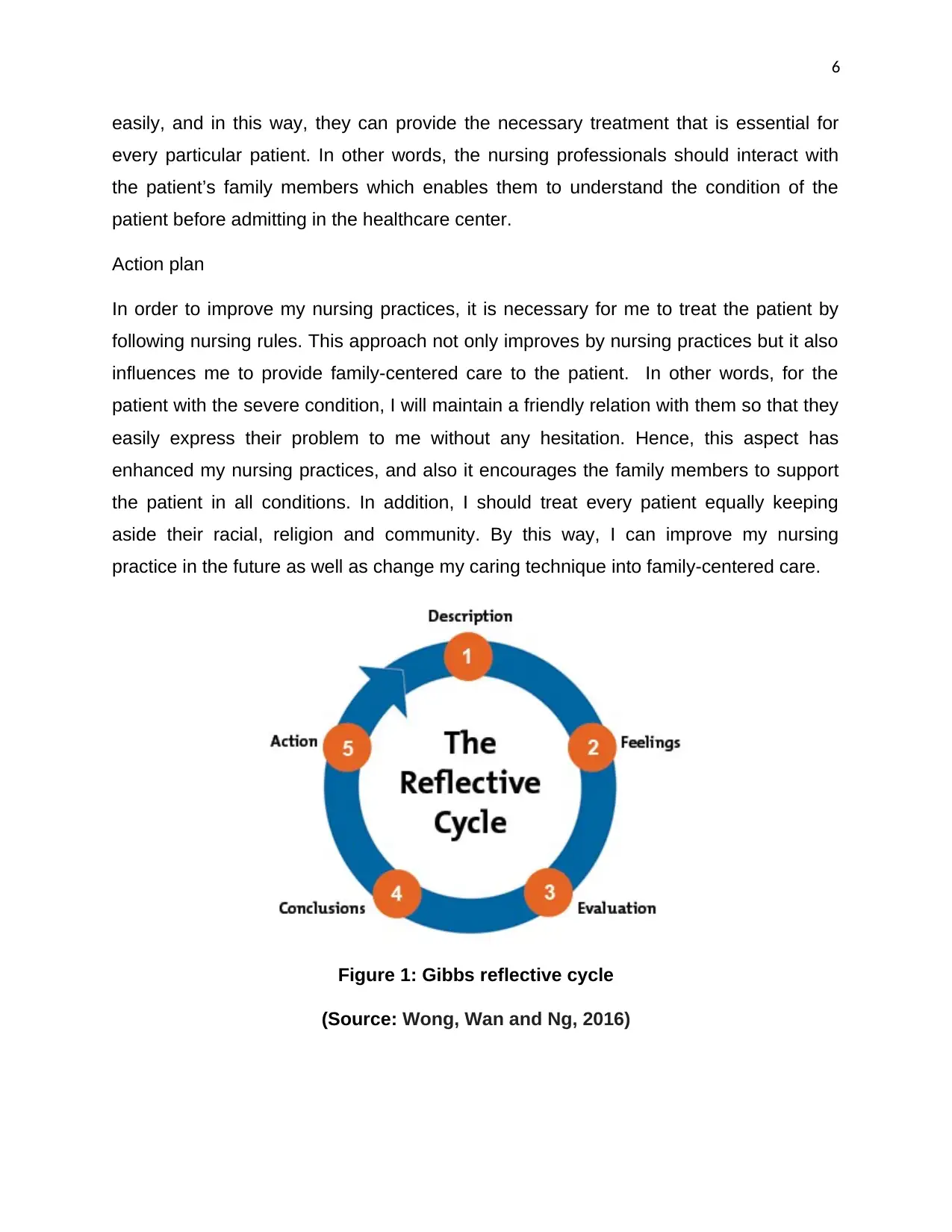
Figure 1: Gibbs reflective cycle
(Source: Wong, Wan and Ng, 2016)
easily, and in this way, they can provide the necessary treatment that is essential for
every particular patient. In other words, the nursing professionals should interact with
the patient’s family members which enables them to understand the condition of the
patient before admitting in the healthcare center.
Action plan
In order to improve my nursing practices, it is necessary for me to treat the patient by
following nursing rules. This approach not only improves by nursing practices but it also
influences me to provide family-centered care to the patient. In other words, for the
patient with the severe condition, I will maintain a friendly relation with them so that they
easily express their problem to me without any hesitation. Hence, this aspect has
enhanced my nursing practices, and also it encourages the family members to support
the patient in all conditions. In addition, I should treat every patient equally keeping
aside their racial, religion and community. By this way, I can improve my nursing
practice in the future as well as change my caring technique into family-centered care.
Figure 1: Gibbs reflective cycle
(Source: Wong, Wan and Ng, 2016)
Paraphrase This Document
Need a fresh take? Get an instant paraphrase of this document with our AI Paraphraser
7
References
DiGiacomo, M., Kochovska, S., Cahill, P., Virdun, C. and Phillips, J.L., 2019. Family-
Focused Care Span. Textbook of Palliative Care, pp.779-797.
Foster, M. and Shields, L., 2018. Bridging the Child and Family-Centered Care Gap:
Therapeutic Conversations with Children and Families. Comprehensive child and
adolescent nursing, pp.1-8.
Libbon, R., Triana, J., Heru, A. and Berman, E., 2019. Family Skills for the Resident
Toolbox: the 10-min Genogram, Ecomap, and Prescribing Homework. Academic
Psychiatry, pp.1-5.
Lise, F., Schwartz, E., Milbrath, V.M., dos Santos, B.P., Buss, E. and Heck, R.M., 2018.
Child in conservative renal treatment: maternal interactions with the social support
network. Acta Scientiarum. Health Sciences, 40, p.e36924.
Ma, J.L., Yuan, R.R., Leung, T.Y. and Wong, O.L., 2018. Learning Outcome of a Family
Therapy Training Course for Psychiatric Nurses in a Chinese Context. Contemporary
Family Therapy, 40(2), pp.119-127.
Paipa, K., Cram, F., Kennedy, V. and Pipi, K., 2015. Culturally responsive methods for
family-centered evaluation. Continuing the journey to reposition culture and cultural
context in evaluation theory and practice, pp.151-178.
Ribeiro, S.B., e Souza, A.M.A., Monteiro, A.R.M., Penaforte, K.L., de Sousa Feitoza,
S.M., Cestari, V.R.F., Monteiro, F.P.M., Sobral, M.G.V., Araújo, S.T., da Silva, M.G. and
Bruno, M.L.M., 2015. Family organization in the care of pediatric heart transplant
patients: the genogram as an investigative tool. Health, 7(11), pp.1409-1418.
Russell, L.T., Beckmeyer, J.J. and Su-Russell, C., 2018. Family-centered care and
positive developmental outcomes for youth with special health care needs: Variations
across family structures. Journal of family nursing, 24(1), pp.29-59.
References
DiGiacomo, M., Kochovska, S., Cahill, P., Virdun, C. and Phillips, J.L., 2019. Family-
Focused Care Span. Textbook of Palliative Care, pp.779-797.
Foster, M. and Shields, L., 2018. Bridging the Child and Family-Centered Care Gap:
Therapeutic Conversations with Children and Families. Comprehensive child and
adolescent nursing, pp.1-8.
Libbon, R., Triana, J., Heru, A. and Berman, E., 2019. Family Skills for the Resident
Toolbox: the 10-min Genogram, Ecomap, and Prescribing Homework. Academic
Psychiatry, pp.1-5.
Lise, F., Schwartz, E., Milbrath, V.M., dos Santos, B.P., Buss, E. and Heck, R.M., 2018.
Child in conservative renal treatment: maternal interactions with the social support
network. Acta Scientiarum. Health Sciences, 40, p.e36924.
Ma, J.L., Yuan, R.R., Leung, T.Y. and Wong, O.L., 2018. Learning Outcome of a Family
Therapy Training Course for Psychiatric Nurses in a Chinese Context. Contemporary
Family Therapy, 40(2), pp.119-127.
Paipa, K., Cram, F., Kennedy, V. and Pipi, K., 2015. Culturally responsive methods for
family-centered evaluation. Continuing the journey to reposition culture and cultural
context in evaluation theory and practice, pp.151-178.
Ribeiro, S.B., e Souza, A.M.A., Monteiro, A.R.M., Penaforte, K.L., de Sousa Feitoza,
S.M., Cestari, V.R.F., Monteiro, F.P.M., Sobral, M.G.V., Araújo, S.T., da Silva, M.G. and
Bruno, M.L.M., 2015. Family organization in the care of pediatric heart transplant
patients: the genogram as an investigative tool. Health, 7(11), pp.1409-1418.
Russell, L.T., Beckmeyer, J.J. and Su-Russell, C., 2018. Family-centered care and
positive developmental outcomes for youth with special health care needs: Variations
across family structures. Journal of family nursing, 24(1), pp.29-59.
8
Voltelen, B., Konradsen, H. and Østergaard, B., 2016. Family nursing therapeutic
conversations in heart failure outpatient clinics in Denmark: Nurses’
experiences. Journal of family nursing, 22(2), pp.172-198.
Walsh, F., 2016. Applying a family resilience framework in training, practice, and
research: Mastering the art of the possible. Family Process, 55(4), pp.616-632.
Wong, O.L., Wan, E.S.F. and Ng, M.L.T., 2016. Family-centered care in adults’ mental
health: Challenges in clinical social work practice. Social Work in Mental Health, 14(5),
pp.445-464.
Voltelen, B., Konradsen, H. and Østergaard, B., 2016. Family nursing therapeutic
conversations in heart failure outpatient clinics in Denmark: Nurses’
experiences. Journal of family nursing, 22(2), pp.172-198.
Walsh, F., 2016. Applying a family resilience framework in training, practice, and
research: Mastering the art of the possible. Family Process, 55(4), pp.616-632.
Wong, O.L., Wan, E.S.F. and Ng, M.L.T., 2016. Family-centered care in adults’ mental
health: Challenges in clinical social work practice. Social Work in Mental Health, 14(5),
pp.445-464.
⊘ This is a preview!⊘
Do you want full access?
Subscribe today to unlock all pages.
Trusted by 1+ million students worldwide

1 out of 9


Related Documents


Your All-in-One AI-Powered Toolkit for Academic Success.
+13062052269
info@desklib.com
Available 24*7 on WhatsApp / Email
![[object Object]](/_next/static/media/star-bottom.7253800d.svg)
Unlock your academic potential
Copyright © 2020–2026 A2Z Services. All Rights Reserved. Developed and managed by ZUCOL.