NRS-429VN Family Health Assessment Report: Case Study Analysis
VerifiedAdded on 2023/01/12
|11
|2228
|69
Report
AI Summary
This report presents a family health assessment based on an interview with a family where a member (patient X) is diagnosed with schizophrenia. The report explores the family's structure, health behaviors, and functional health patterns, including rest, sleep, and role relationships. It identifies barriers to health, such as sexually-reproductive patterns, self-concept, and activity-exercise patterns, and the impact of consanguineous marriages. The report also discusses the family systems theory, emphasizing the interconnectedness of family members and the importance of emotional interdependence. The conclusion highlights the significance of family-centered care and the application of the family systems theory to improve the health and well-being of the patient and her family. The report also includes an interview questionnaire covering various aspects of family health, such as health perception, elimination, nutrition, activity, sleep, cognition, relationships, self-perception, sexuality, values, and coping mechanisms.

Running head: INTERVIEW
Family health assessment 1
Name of the Student
Name of the University
Author note
Family health assessment 1
Name of the Student
Name of the University
Author note

Paraphrase This Document
Need a fresh take? Get an instant paraphrase of this document with our AI Paraphraser
1INTERVIEW
Table of Contents
Introduction................................................................................................................................2
Family structure.....................................................................................................................2
Health behaviour....................................................................................................................2
Functional health patterns......................................................................................................3
Family systems theory............................................................................................................4
Conclusion..............................................................................................................................5
References..................................................................................................................................6
Appendices.................................................................................................................................8
Table of Contents
Introduction................................................................................................................................2
Family structure.....................................................................................................................2
Health behaviour....................................................................................................................2
Functional health patterns......................................................................................................3
Family systems theory............................................................................................................4
Conclusion..............................................................................................................................5
References..................................................................................................................................6
Appendices.................................................................................................................................8
2INTERVIEW
Introduction
Family-centered care forms a crucial aspect of the care giving process owing to the
fact that it is based on the primary objective of the healthcare professionals and family
members working together for evaluating the care that is delivered to patients (Davidson et
al., 2017). This type of care approach recognizes that families are constant in the lives of all
individuals, while the healthcare personnel and service systems might fluctuate. In addition,
sharing necessary health information with the family in a supportive manner, on a continuous
basis helps in taking the best decisions related to the care for particular patients. This report
will analyze the findings obtained after conduction of an interview with a family of a patient
X (pseudonym), suffering from schizophrenia.
Family structure
A plethora of family structure-associated factors, such as, family size, age differences
to relations, birth order, and parental age, have been identified as major risk factors for the
onset and progress of diseases (Kaakinen, Coehlo, Steele & Robinson, 2018). The family that
had been interviewed were practicing orthodox Muslims. The term family composition
commonly refers to identification of the members who fit in the outline of a family. The
family was a large one and comprised of ten members namely, the patient X (aged 20 years),
her brother, father, mother, grand-father, grand-mother, uncle, aunt, and two cousins. They
belong to a moderate socioeconomic status and had been living in the US for two generations.
They believed that their religion Islam was a universal and complete form of a primordial
faith. In addition, they also considered caring for the environment as an essential aspect of
their faith and practices.
Introduction
Family-centered care forms a crucial aspect of the care giving process owing to the
fact that it is based on the primary objective of the healthcare professionals and family
members working together for evaluating the care that is delivered to patients (Davidson et
al., 2017). This type of care approach recognizes that families are constant in the lives of all
individuals, while the healthcare personnel and service systems might fluctuate. In addition,
sharing necessary health information with the family in a supportive manner, on a continuous
basis helps in taking the best decisions related to the care for particular patients. This report
will analyze the findings obtained after conduction of an interview with a family of a patient
X (pseudonym), suffering from schizophrenia.
Family structure
A plethora of family structure-associated factors, such as, family size, age differences
to relations, birth order, and parental age, have been identified as major risk factors for the
onset and progress of diseases (Kaakinen, Coehlo, Steele & Robinson, 2018). The family that
had been interviewed were practicing orthodox Muslims. The term family composition
commonly refers to identification of the members who fit in the outline of a family. The
family was a large one and comprised of ten members namely, the patient X (aged 20 years),
her brother, father, mother, grand-father, grand-mother, uncle, aunt, and two cousins. They
belong to a moderate socioeconomic status and had been living in the US for two generations.
They believed that their religion Islam was a universal and complete form of a primordial
faith. In addition, they also considered caring for the environment as an essential aspect of
their faith and practices.
⊘ This is a preview!⊘
Do you want full access?
Subscribe today to unlock all pages.

Trusted by 1+ million students worldwide
3INTERVIEW
Health behavior
Taking into account the fact that Islam prohibits smoking and alcohol consumption,
the family manifested a health behavior that was based on maintenance and promotion of a
healthy lifestyle (Pieri, Woodward, Yahya, Hassan & Rohmaniyah, 2014). Some of the good
health behaviors that were manifested by the family members included good sleeping habits,
and hydration habits. However, the current health status of the family comprised of presence
of depression in the grandfather, diabetes in the father, and hypertension in the uncle, in
addition to schizophrenia in patient X. The common symptoms of schizophrenia that include
hallucinations, delusions, and disorganized thought were quite prevalent in X. Time and
again it has been found that prevalence of overweight and a sedentary lifestyle are common
risk factors for the onset of schizophrenia (Janney et al., 2015). The same was manifested in
the family who reported spending little or no time in physical activities, and most of them
were overweight. In addition, the family has a history of consanguineous marriage between
the parents and grandparents of X. The effect of such marriages on the onset of mental issues
are well-established (Dahdouh, Taleb, Blecha & Benyamina, 2016).
Functional health patterns
Two functional health pattern strengths found from the findings were namely, pattern
of rest, sleep, and relaxation, and role relationship patterns. According to Musiek and
Holtzman (2016) proper pattern of sleep and rest helped ensured the maintenance of an
appropriate circadian rhythm, which in turn is imperative for optimal health outcomes. In
addition, the family demonstrated presence of adequate caregiving responsibilities for both
the parents and children that helped in reducing stress for the patient. Three barriers to health
were related to sexually-reproductive pattern, self-concept and self-perception, and activity-
exercise pattern. There is mounting evidence for the fact that with high rates of
consanguinity, there occurs a noteworthy increase in the incidence and prevalence of mental
Health behavior
Taking into account the fact that Islam prohibits smoking and alcohol consumption,
the family manifested a health behavior that was based on maintenance and promotion of a
healthy lifestyle (Pieri, Woodward, Yahya, Hassan & Rohmaniyah, 2014). Some of the good
health behaviors that were manifested by the family members included good sleeping habits,
and hydration habits. However, the current health status of the family comprised of presence
of depression in the grandfather, diabetes in the father, and hypertension in the uncle, in
addition to schizophrenia in patient X. The common symptoms of schizophrenia that include
hallucinations, delusions, and disorganized thought were quite prevalent in X. Time and
again it has been found that prevalence of overweight and a sedentary lifestyle are common
risk factors for the onset of schizophrenia (Janney et al., 2015). The same was manifested in
the family who reported spending little or no time in physical activities, and most of them
were overweight. In addition, the family has a history of consanguineous marriage between
the parents and grandparents of X. The effect of such marriages on the onset of mental issues
are well-established (Dahdouh, Taleb, Blecha & Benyamina, 2016).
Functional health patterns
Two functional health pattern strengths found from the findings were namely, pattern
of rest, sleep, and relaxation, and role relationship patterns. According to Musiek and
Holtzman (2016) proper pattern of sleep and rest helped ensured the maintenance of an
appropriate circadian rhythm, which in turn is imperative for optimal health outcomes. In
addition, the family demonstrated presence of adequate caregiving responsibilities for both
the parents and children that helped in reducing stress for the patient. Three barriers to health
were related to sexually-reproductive pattern, self-concept and self-perception, and activity-
exercise pattern. There is mounting evidence for the fact that with high rates of
consanguinity, there occurs a noteworthy increase in the incidence and prevalence of mental
Paraphrase This Document
Need a fresh take? Get an instant paraphrase of this document with our AI Paraphraser
4INTERVIEW
diseases, including schizophrenia (Seidman et al., 2015). Taking into account the substantial
evidence that schizophrenia is caused due to genetic and environmental factors, inbreeding
might have resulted in expression of recessive and rare genes that had been inherited from a
common ancestor in the family (Fareed & Afzal, 2017). Conducting an assessment of the
usual exercise patterns of a patient helps in providing cues to the general health-associated
lifestyle of a patient, besides evaluating any extremes. Thus, the negligible amount of
physical activity was another potential barrier to their health patterns since sedentary lifestyle
has been associated with depression, hypertension, and schizophrenia (de Rezende, Lopes,
Rey-Lopez, Matsudo & do Carmo Luiz, 2014). In addition, perception of people about
themselves depends on their insight of the meanings of drug therapy. The family member
suffering from hypertension denied and refused to comply with the recommended drug
regimen. Furthermore, X also refused to show compliance to schizophrenia medications at
college to prevent others from knowing about her mental state.
Family systems theory
The Family systems theory places an emphasis on the fact that individuals cannot be
understood, when kept in isolation from each other. However, they can be easily understood
when they remain a part of emotional unit, commonly known as the family. Owing to the fact
that family acts as a system where all members have unique roles and responsibilities, in
relation to responding to one another in a manner that is governed by relationship agreement,
the theory should be implemented to foster positive behavior (Titelman, 2014). During
implementation of the theory, each family member will be provided with the opportunity to
express their feelings and thoughts on how illness in the family affects them. Formation of a
triangle where one person is in conflict, with the other two in harmony will facilitate
management of clinical issues (Becvar & Becvar, 2017). Efforts also need to be taken for
increasing emotional interdependence to promote cooperation and cohesiveness among the
diseases, including schizophrenia (Seidman et al., 2015). Taking into account the substantial
evidence that schizophrenia is caused due to genetic and environmental factors, inbreeding
might have resulted in expression of recessive and rare genes that had been inherited from a
common ancestor in the family (Fareed & Afzal, 2017). Conducting an assessment of the
usual exercise patterns of a patient helps in providing cues to the general health-associated
lifestyle of a patient, besides evaluating any extremes. Thus, the negligible amount of
physical activity was another potential barrier to their health patterns since sedentary lifestyle
has been associated with depression, hypertension, and schizophrenia (de Rezende, Lopes,
Rey-Lopez, Matsudo & do Carmo Luiz, 2014). In addition, perception of people about
themselves depends on their insight of the meanings of drug therapy. The family member
suffering from hypertension denied and refused to comply with the recommended drug
regimen. Furthermore, X also refused to show compliance to schizophrenia medications at
college to prevent others from knowing about her mental state.
Family systems theory
The Family systems theory places an emphasis on the fact that individuals cannot be
understood, when kept in isolation from each other. However, they can be easily understood
when they remain a part of emotional unit, commonly known as the family. Owing to the fact
that family acts as a system where all members have unique roles and responsibilities, in
relation to responding to one another in a manner that is governed by relationship agreement,
the theory should be implemented to foster positive behavior (Titelman, 2014). During
implementation of the theory, each family member will be provided with the opportunity to
express their feelings and thoughts on how illness in the family affects them. Formation of a
triangle where one person is in conflict, with the other two in harmony will facilitate
management of clinical issues (Becvar & Becvar, 2017). Efforts also need to be taken for
increasing emotional interdependence to promote cooperation and cohesiveness among the
5INTERVIEW
members. Increasing emotional connectedness, and resolving conflicts between members will
help in disease management.
Conclusion
To conclude, health behavior is an umbrella term that encompasses the actions and
beliefs of a person related to their wellbeing and health. Family health patterns provide an all-
inclusive nursing assessment for a particular patient that is typically based on assessment of
questions related to the health practices and individual health status. Thus, the family systems
theory need to be implemented in a manner that helps in enhancing the overall health and
wellbeing of X and her family members.
members. Increasing emotional connectedness, and resolving conflicts between members will
help in disease management.
Conclusion
To conclude, health behavior is an umbrella term that encompasses the actions and
beliefs of a person related to their wellbeing and health. Family health patterns provide an all-
inclusive nursing assessment for a particular patient that is typically based on assessment of
questions related to the health practices and individual health status. Thus, the family systems
theory need to be implemented in a manner that helps in enhancing the overall health and
wellbeing of X and her family members.
⊘ This is a preview!⊘
Do you want full access?
Subscribe today to unlock all pages.
Trusted by 1+ million students worldwide
6INTERVIEW
References
Becvar, R. J., & Becvar, D. S. (2017). Systems theory and family therapy: A primer. Rowman
& Littlefield. Retrieved from https://books.google.co.in/books?
hl=en&lr=&id=uUE7DwAAQBAJ&oi=fnd&pg=PR5&dq=Family+systems+theory&
ots=nLzKDGSWcj&sig=k1BKRidfLGxv2qL1Ej2cDaNPfgQ#v=onepage&q=Family
%20systems%20theory&f=false
Dahdouh, A., Taleb, M., Blecha, L., & Benyamina, A. (2016). Genetics and psychotic
disorders: A fresh look at consanguinity. European journal of medical genetics, 59(2),
104-110. https://doi.org/10.1016/j.ejmg.2015.12.010
Davidson, J. E., Aslakson, R. A., Long, A. C., Puntillo, K. A., Kross, E. K., Hart, J., ... &
Netzer, G. (2017). Guidelines for family-centered care in the neonatal, pediatric, and
adult ICU. Critical care medicine, 45(1), 103-128.
https://doi.org/10.1097/CCM.0000000000002169
de Rezende, L. F. M., Lopes, M. R., Rey-Lopez, J. P., Matsudo, V. K. R., & do Carmo Luiz,
O. (2014). Sedentary behavior and health outcomes: an overview of systematic
reviews. PloS one, 9(8), e105620. https://doi.org/10.1371/journal.pone.0105620
Fareed, M., & Afzal, M. (2017). Genetics of consanguinity and inbreeding in health and
disease. Annals of human biology, 44(2), 99-107.
https://doi.org/10.1080/03014460.2016.1265148
Janney, C. A., Ganguli, R., Tang, G., Cauley, J. A., Holleman, R. G., Richardson, C. R., &
Kriska, A. M. (2015). Physical activity and sedentary behavior measured objectively
and subjectively in overweight and obese adults with schizophrenia or schizoaffective
References
Becvar, R. J., & Becvar, D. S. (2017). Systems theory and family therapy: A primer. Rowman
& Littlefield. Retrieved from https://books.google.co.in/books?
hl=en&lr=&id=uUE7DwAAQBAJ&oi=fnd&pg=PR5&dq=Family+systems+theory&
ots=nLzKDGSWcj&sig=k1BKRidfLGxv2qL1Ej2cDaNPfgQ#v=onepage&q=Family
%20systems%20theory&f=false
Dahdouh, A., Taleb, M., Blecha, L., & Benyamina, A. (2016). Genetics and psychotic
disorders: A fresh look at consanguinity. European journal of medical genetics, 59(2),
104-110. https://doi.org/10.1016/j.ejmg.2015.12.010
Davidson, J. E., Aslakson, R. A., Long, A. C., Puntillo, K. A., Kross, E. K., Hart, J., ... &
Netzer, G. (2017). Guidelines for family-centered care in the neonatal, pediatric, and
adult ICU. Critical care medicine, 45(1), 103-128.
https://doi.org/10.1097/CCM.0000000000002169
de Rezende, L. F. M., Lopes, M. R., Rey-Lopez, J. P., Matsudo, V. K. R., & do Carmo Luiz,
O. (2014). Sedentary behavior and health outcomes: an overview of systematic
reviews. PloS one, 9(8), e105620. https://doi.org/10.1371/journal.pone.0105620
Fareed, M., & Afzal, M. (2017). Genetics of consanguinity and inbreeding in health and
disease. Annals of human biology, 44(2), 99-107.
https://doi.org/10.1080/03014460.2016.1265148
Janney, C. A., Ganguli, R., Tang, G., Cauley, J. A., Holleman, R. G., Richardson, C. R., &
Kriska, A. M. (2015). Physical activity and sedentary behavior measured objectively
and subjectively in overweight and obese adults with schizophrenia or schizoaffective
Paraphrase This Document
Need a fresh take? Get an instant paraphrase of this document with our AI Paraphraser
7INTERVIEW
disorders. The Journal of clinical psychiatry, 76(10), e1277-84.
DOI: 10.4088/JCP.14m09330
Kaakinen, J. R., Coehlo, D. P., Steele, R., & Robinson, M. (2018). Family health care
nursing: Theory, practice, and research. FA Davis. Retrieved from
https://books.google.co.in/books?
hl=en&lr=&id=wNFJDwAAQBAJ&oi=fnd&pg=PR1&dq=family+structural+theory
+in+nursing&ots=28jQln6uq5&sig=ENP-KID5bYUV_H-
zbcV573ie38M#v=onepage&q=family%20structural%20theory%20in
%20nursing&f=false
Musiek, E. S., & Holtzman, D. M. (2016). Mechanisms linking circadian clocks, sleep, and
neurodegeneration. Science, 354(6315), 1004-1008. DOI: 10.1126/science.aah4968
Pieri, Z. P., Woodward, M., Yahya, M., Hassan, I. H., & Rohmaniyah, I. (2014).
Commanding good and prohibiting evil in contemporary Islam: cases from Britain,
Nigeria, and Southeast Asia. Contemporary Islam, 8(1), 37-55.
https://doi.org/10.1007/s11562-013-0256-9
Seidman, L. J., Hellemann, G., Nuechterlein, K. H., Greenwood, T. A., Braff, D. L.,
Cadenhead, K. S., ... & Lazzeroni, L. C. (2015). Factor structure and heritability of
endophenotypes in schizophrenia: findings from the Consortium on the Genetics of
Schizophrenia (COGS-1). Schizophrenia research, 163(1-3), 73-79.
https://doi.org/10.1016/j.schres.2015.01.027
Titelman, P. (2014). Clinical applications of Bowen family systems theory. Routledge.
https://doi.org/10.4324/9781315809717
disorders. The Journal of clinical psychiatry, 76(10), e1277-84.
DOI: 10.4088/JCP.14m09330
Kaakinen, J. R., Coehlo, D. P., Steele, R., & Robinson, M. (2018). Family health care
nursing: Theory, practice, and research. FA Davis. Retrieved from
https://books.google.co.in/books?
hl=en&lr=&id=wNFJDwAAQBAJ&oi=fnd&pg=PR1&dq=family+structural+theory
+in+nursing&ots=28jQln6uq5&sig=ENP-KID5bYUV_H-
zbcV573ie38M#v=onepage&q=family%20structural%20theory%20in
%20nursing&f=false
Musiek, E. S., & Holtzman, D. M. (2016). Mechanisms linking circadian clocks, sleep, and
neurodegeneration. Science, 354(6315), 1004-1008. DOI: 10.1126/science.aah4968
Pieri, Z. P., Woodward, M., Yahya, M., Hassan, I. H., & Rohmaniyah, I. (2014).
Commanding good and prohibiting evil in contemporary Islam: cases from Britain,
Nigeria, and Southeast Asia. Contemporary Islam, 8(1), 37-55.
https://doi.org/10.1007/s11562-013-0256-9
Seidman, L. J., Hellemann, G., Nuechterlein, K. H., Greenwood, T. A., Braff, D. L.,
Cadenhead, K. S., ... & Lazzeroni, L. C. (2015). Factor structure and heritability of
endophenotypes in schizophrenia: findings from the Consortium on the Genetics of
Schizophrenia (COGS-1). Schizophrenia research, 163(1-3), 73-79.
https://doi.org/10.1016/j.schres.2015.01.027
Titelman, P. (2014). Clinical applications of Bowen family systems theory. Routledge.
https://doi.org/10.4324/9781315809717
8INTERVIEW
Appendices
Pattern of Health Perception and Health Management
1. Is there a family history for medical problems or disease?
2. Please rate your overall health
3. Have you taken any action to advance or preserve your health?
Pattern of Elimination
1. Can you define your bowel movements?
2. At what intervals do you urinate everyday?
3. Do you have odor problem or excessive perspiration?
Nutritional – Metabolic Pattern
1. How many times do you eat a day?
2. Are you well nourished?
3. What are your favoured food choices?
Pattern of Activity and Exercise
1. How often do you participate in physical activity each week?
2. What activity do you perform?
3. What is the screen time that you spend each day?
Pattern of Sleep and Rest
1. How many sleep hours do you get every day?
2. Do you feel refreshed after sleep?
3. Do you suffer from any sleep onset or sudden awakening problems?
Cognitive – Perceptual Pattern
Appendices
Pattern of Health Perception and Health Management
1. Is there a family history for medical problems or disease?
2. Please rate your overall health
3. Have you taken any action to advance or preserve your health?
Pattern of Elimination
1. Can you define your bowel movements?
2. At what intervals do you urinate everyday?
3. Do you have odor problem or excessive perspiration?
Nutritional – Metabolic Pattern
1. How many times do you eat a day?
2. Are you well nourished?
3. What are your favoured food choices?
Pattern of Activity and Exercise
1. How often do you participate in physical activity each week?
2. What activity do you perform?
3. What is the screen time that you spend each day?
Pattern of Sleep and Rest
1. How many sleep hours do you get every day?
2. Do you feel refreshed after sleep?
3. Do you suffer from any sleep onset or sudden awakening problems?
Cognitive – Perceptual Pattern
⊘ This is a preview!⊘
Do you want full access?
Subscribe today to unlock all pages.
Trusted by 1+ million students worldwide
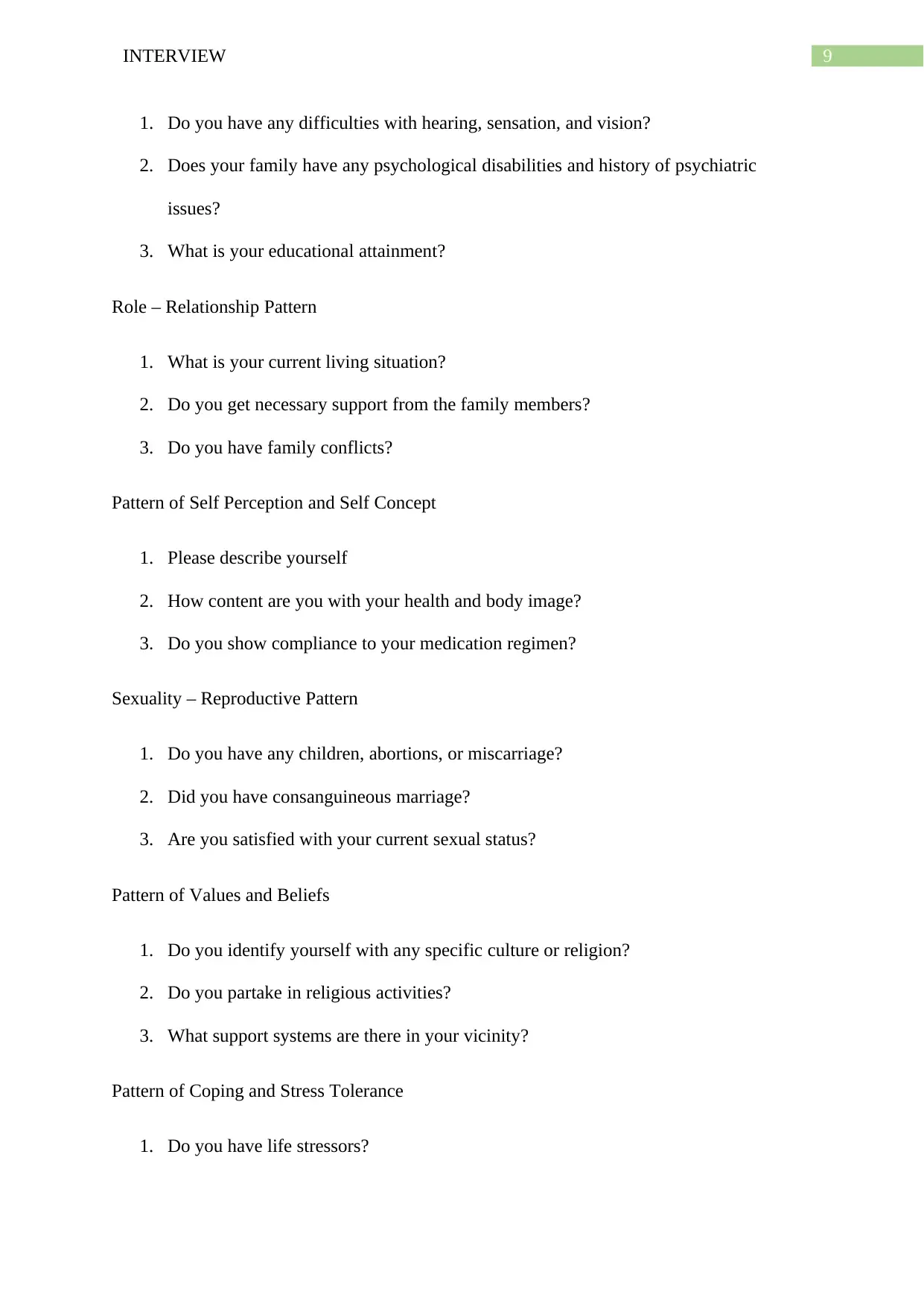
9INTERVIEW
1. Do you have any difficulties with hearing, sensation, and vision?
2. Does your family have any psychological disabilities and history of psychiatric
issues?
3. What is your educational attainment?
Role – Relationship Pattern
1. What is your current living situation?
2. Do you get necessary support from the family members?
3. Do you have family conflicts?
Pattern of Self Perception and Self Concept
1. Please describe yourself
2. How content are you with your health and body image?
3. Do you show compliance to your medication regimen?
Sexuality – Reproductive Pattern
1. Do you have any children, abortions, or miscarriage?
2. Did you have consanguineous marriage?
3. Are you satisfied with your current sexual status?
Pattern of Values and Beliefs
1. Do you identify yourself with any specific culture or religion?
2. Do you partake in religious activities?
3. What support systems are there in your vicinity?
Pattern of Coping and Stress Tolerance
1. Do you have life stressors?
1. Do you have any difficulties with hearing, sensation, and vision?
2. Does your family have any psychological disabilities and history of psychiatric
issues?
3. What is your educational attainment?
Role – Relationship Pattern
1. What is your current living situation?
2. Do you get necessary support from the family members?
3. Do you have family conflicts?
Pattern of Self Perception and Self Concept
1. Please describe yourself
2. How content are you with your health and body image?
3. Do you show compliance to your medication regimen?
Sexuality – Reproductive Pattern
1. Do you have any children, abortions, or miscarriage?
2. Did you have consanguineous marriage?
3. Are you satisfied with your current sexual status?
Pattern of Values and Beliefs
1. Do you identify yourself with any specific culture or religion?
2. Do you partake in religious activities?
3. What support systems are there in your vicinity?
Pattern of Coping and Stress Tolerance
1. Do you have life stressors?
Paraphrase This Document
Need a fresh take? Get an instant paraphrase of this document with our AI Paraphraser

10INTERVIEW
2. Do you smoke, drink alcohol or take drugs?
3. What helps you to cope with stress?
2. Do you smoke, drink alcohol or take drugs?
3. What helps you to cope with stress?

1 out of 11


Your All-in-One AI-Powered Toolkit for Academic Success.
+13062052269
info@desklib.com
Available 24*7 on WhatsApp / Email
![[object Object]](/_next/static/media/star-bottom.7253800d.svg)
Unlock your academic potential
Copyright © 2020–2026 A2Z Services. All Rights Reserved. Developed and managed by ZUCOL.