A Family Nursing Perspective on Vaccination: Concept Paper
VerifiedAdded on 2023/05/29
|6
|1107
|238
Essay
AI Summary
This essay presents a family nursing concept paper exploring the multifaceted aspects of vaccination. It delves into the advantages of vaccination, highlighting its role in preventing life-threatening diseases, protecting vulnerable populations, and reducing healthcare costs. It also addresses the potential disadvantages, such as allergic reactions and other complications, while acknowledging the lack of scientific evidence supporting claims of links to developmental disorders like autism. The paper further outlines nursing diagnoses related to vaccination, including allergic reactions and pain, and proposes relevant interventions. The author concludes by emphasizing the overall benefits of vaccination and the treatable nature of potential complications, drawing lessons on the scientific advancements in medicine and the importance of vaccination in combating communicable diseases. Desklib provides access to similar essays and resources for students.
Running head: FAMILY NURSING CONCEPT PAPER 1
To Vaccinate or Not Vaccinate?
Student’s Full Name
Institution
To Vaccinate or Not Vaccinate?
Student’s Full Name
Institution
Paraphrase This Document
Need a fresh take? Get an instant paraphrase of this document with our AI Paraphraser

FAMILY NURSING CONCEPT PAPER 2
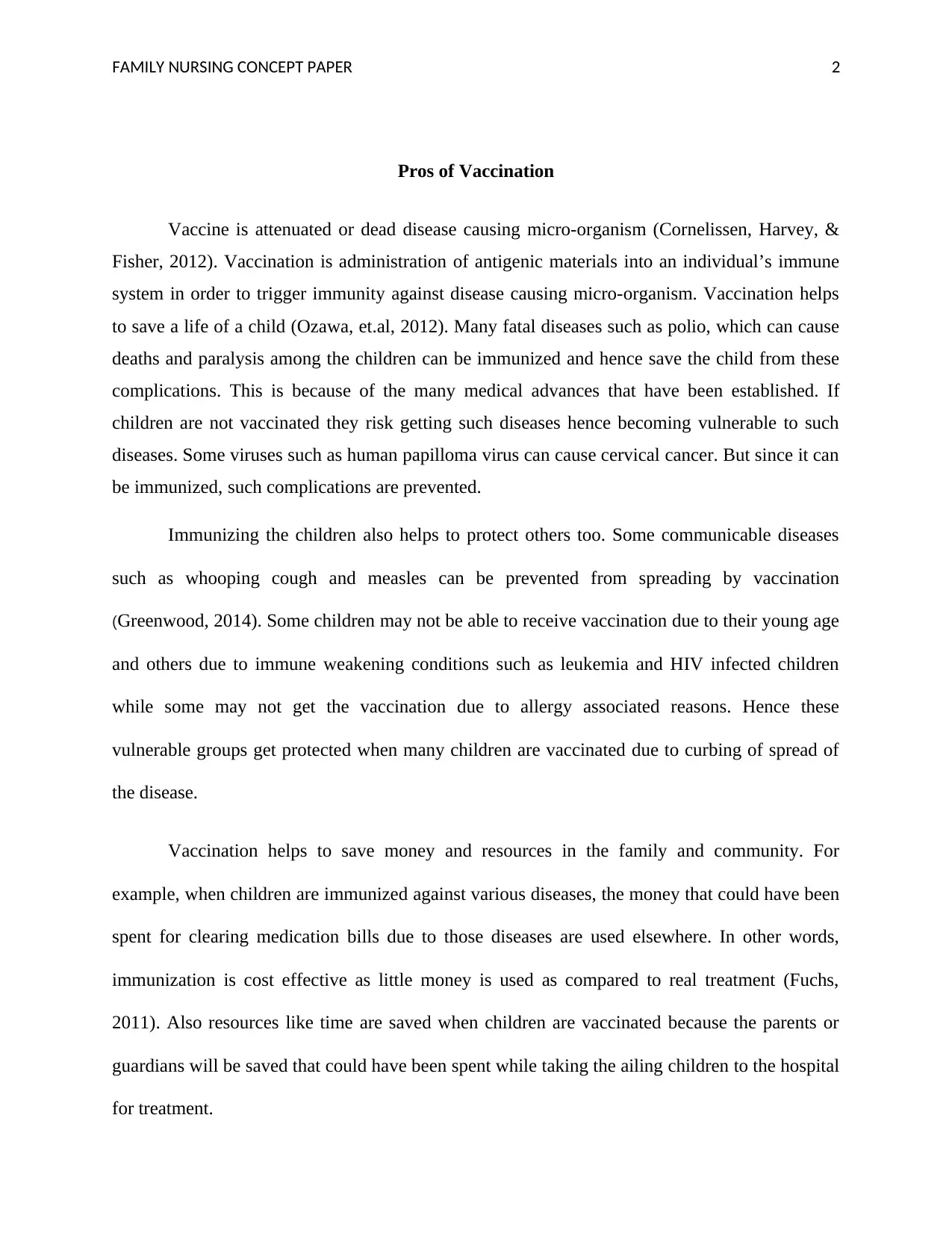
Pros of Vaccination
Vaccine is attenuated or dead disease causing micro-organism (Cornelissen, Harvey, &
Fisher, 2012). Vaccination is administration of antigenic materials into an individual’s immune
system in order to trigger immunity against disease causing micro-organism. Vaccination helps
to save a life of a child (Ozawa, et.al, 2012). Many fatal diseases such as polio, which can cause
deaths and paralysis among the children can be immunized and hence save the child from these
complications. This is because of the many medical advances that have been established. If
children are not vaccinated they risk getting such diseases hence becoming vulnerable to such
diseases. Some viruses such as human papilloma virus can cause cervical cancer. But since it can
be immunized, such complications are prevented.
Immunizing the children also helps to protect others too. Some communicable diseases
such as whooping cough and measles can be prevented from spreading by vaccination
(Greenwood, 2014). Some children may not be able to receive vaccination due to their young age
and others due to immune weakening conditions such as leukemia and HIV infected children
while some may not get the vaccination due to allergy associated reasons. Hence these
vulnerable groups get protected when many children are vaccinated due to curbing of spread of
the disease.
Vaccination helps to save money and resources in the family and community. For
example, when children are immunized against various diseases, the money that could have been
spent for clearing medication bills due to those diseases are used elsewhere. In other words,
immunization is cost effective as little money is used as compared to real treatment (Fuchs,
2011). Also resources like time are saved when children are vaccinated because the parents or
guardians will be saved that could have been spent while taking the ailing children to the hospital
for treatment.
Pros of Vaccination
Vaccine is attenuated or dead disease causing micro-organism (Cornelissen, Harvey, &
Fisher, 2012). Vaccination is administration of antigenic materials into an individual’s immune
system in order to trigger immunity against disease causing micro-organism. Vaccination helps
to save a life of a child (Ozawa, et.al, 2012). Many fatal diseases such as polio, which can cause
deaths and paralysis among the children can be immunized and hence save the child from these
complications. This is because of the many medical advances that have been established. If
children are not vaccinated they risk getting such diseases hence becoming vulnerable to such
diseases. Some viruses such as human papilloma virus can cause cervical cancer. But since it can
be immunized, such complications are prevented.
Immunizing the children also helps to protect others too. Some communicable diseases
such as whooping cough and measles can be prevented from spreading by vaccination
(Greenwood, 2014). Some children may not be able to receive vaccination due to their young age
and others due to immune weakening conditions such as leukemia and HIV infected children
while some may not get the vaccination due to allergy associated reasons. Hence these
vulnerable groups get protected when many children are vaccinated due to curbing of spread of
the disease.
Vaccination helps to save money and resources in the family and community. For
example, when children are immunized against various diseases, the money that could have been
spent for clearing medication bills due to those diseases are used elsewhere. In other words,
immunization is cost effective as little money is used as compared to real treatment (Fuchs,
2011). Also resources like time are saved when children are vaccinated because the parents or
guardians will be saved that could have been spent while taking the ailing children to the hospital
for treatment.

FAMILY NURSING CONCEPT PAPER 3
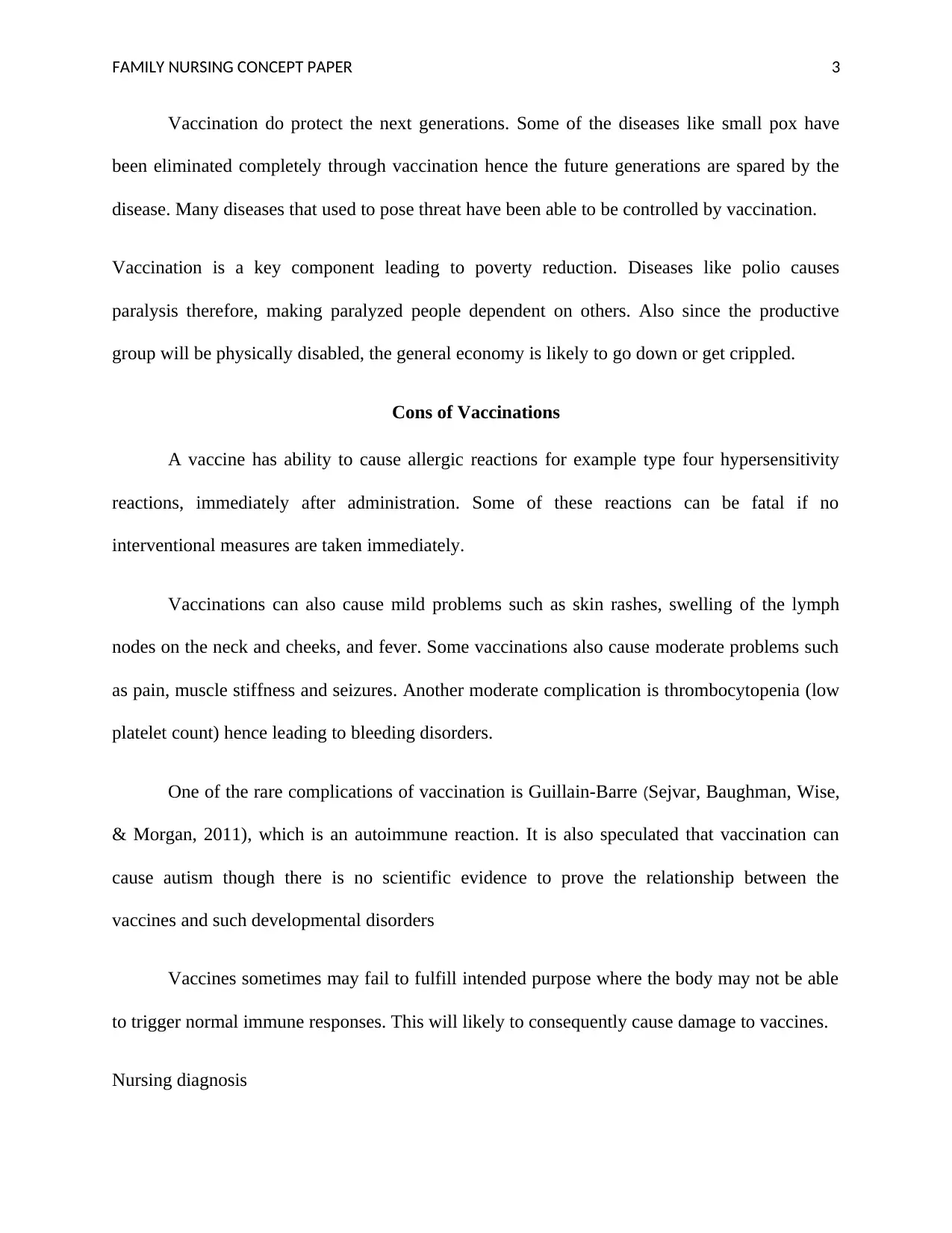
Vaccination do protect the next generations. Some of the diseases like small pox have
been eliminated completely through vaccination hence the future generations are spared by the
disease. Many diseases that used to pose threat have been able to be controlled by vaccination.
Vaccination is a key component leading to poverty reduction. Diseases like polio causes
paralysis therefore, making paralyzed people dependent on others. Also since the productive
group will be physically disabled, the general economy is likely to go down or get crippled.
Cons of Vaccinations
A vaccine has ability to cause allergic reactions for example type four hypersensitivity
reactions, immediately after administration. Some of these reactions can be fatal if no
interventional measures are taken immediately.
Vaccinations can also cause mild problems such as skin rashes, swelling of the lymph
nodes on the neck and cheeks, and fever. Some vaccinations also cause moderate problems such
as pain, muscle stiffness and seizures. Another moderate complication is thrombocytopenia (low
platelet count) hence leading to bleeding disorders.
One of the rare complications of vaccination is Guillain-Barre (Sejvar, Baughman, Wise,
& Morgan, 2011), which is an autoimmune reaction. It is also speculated that vaccination can
cause autism though there is no scientific evidence to prove the relationship between the
vaccines and such developmental disorders
Vaccines sometimes may fail to fulfill intended purpose where the body may not be able
to trigger normal immune responses. This will likely to consequently cause damage to vaccines.
Nursing diagnosis
Vaccination do protect the next generations. Some of the diseases like small pox have
been eliminated completely through vaccination hence the future generations are spared by the
disease. Many diseases that used to pose threat have been able to be controlled by vaccination.
Vaccination is a key component leading to poverty reduction. Diseases like polio causes
paralysis therefore, making paralyzed people dependent on others. Also since the productive
group will be physically disabled, the general economy is likely to go down or get crippled.
Cons of Vaccinations
A vaccine has ability to cause allergic reactions for example type four hypersensitivity
reactions, immediately after administration. Some of these reactions can be fatal if no
interventional measures are taken immediately.
Vaccinations can also cause mild problems such as skin rashes, swelling of the lymph
nodes on the neck and cheeks, and fever. Some vaccinations also cause moderate problems such
as pain, muscle stiffness and seizures. Another moderate complication is thrombocytopenia (low
platelet count) hence leading to bleeding disorders.
One of the rare complications of vaccination is Guillain-Barre (Sejvar, Baughman, Wise,
& Morgan, 2011), which is an autoimmune reaction. It is also speculated that vaccination can
cause autism though there is no scientific evidence to prove the relationship between the
vaccines and such developmental disorders
Vaccines sometimes may fail to fulfill intended purpose where the body may not be able
to trigger normal immune responses. This will likely to consequently cause damage to vaccines.
Nursing diagnosis
⊘ This is a preview!⊘
Do you want full access?
Subscribe today to unlock all pages.

Trusted by 1+ million students worldwide

FAMILY NURSING CONCEPT PAPER 4
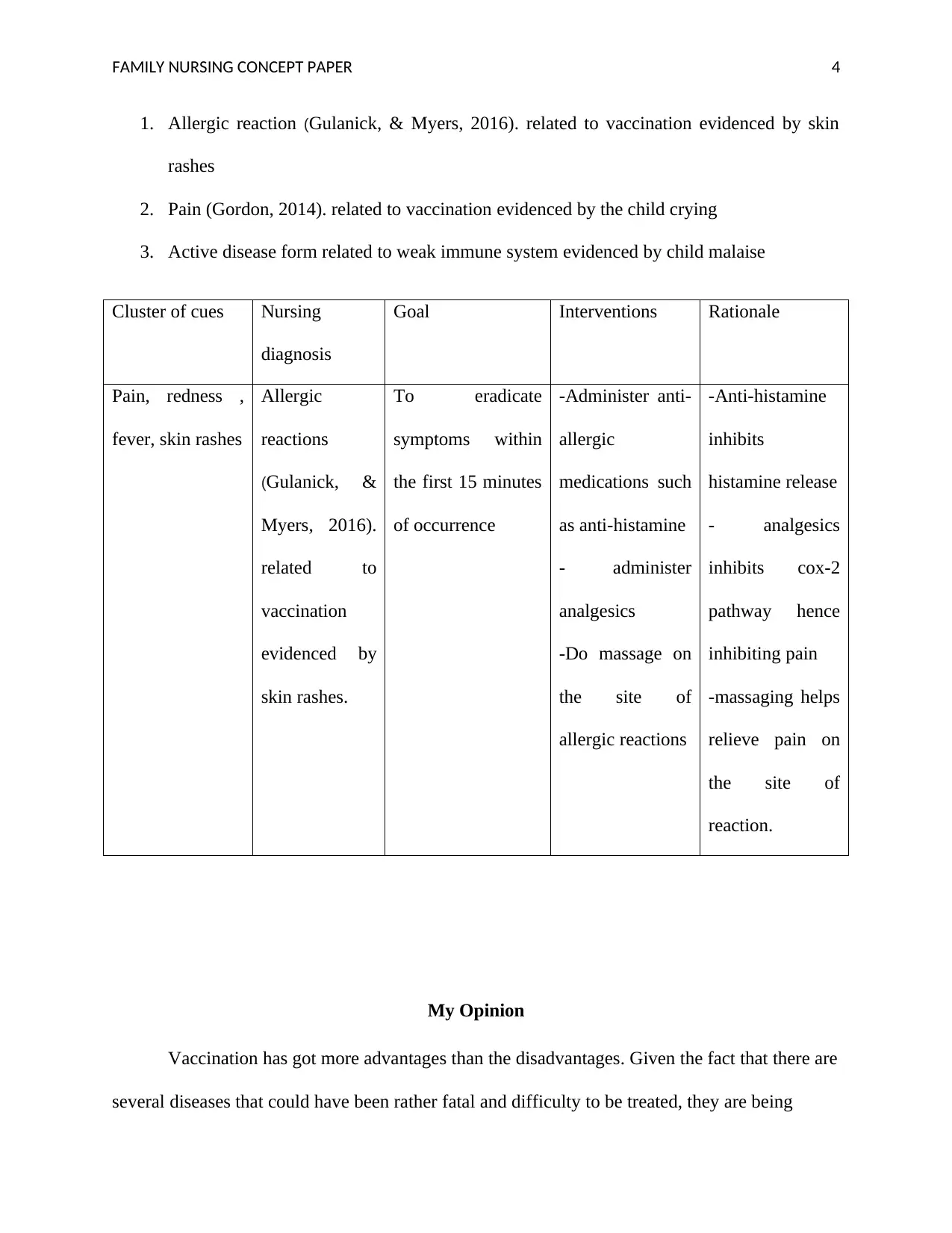
1. Allergic reaction (Gulanick, & Myers, 2016). related to vaccination evidenced by skin
rashes
2. Pain (Gordon, 2014). related to vaccination evidenced by the child crying
3. Active disease form related to weak immune system evidenced by child malaise
Cluster of cues Nursing
diagnosis
Goal Interventions Rationale
Pain, redness ,
fever, skin rashes
Allergic
reactions
(Gulanick, &
Myers, 2016).
related to
vaccination
evidenced by
skin rashes.
To eradicate
symptoms within
the first 15 minutes
of occurrence
-Administer anti-
allergic
medications such
as anti-histamine
- administer
analgesics
-Do massage on
the site of
allergic reactions
-Anti-histamine
inhibits
histamine release
- analgesics
inhibits cox-2
pathway hence
inhibiting pain
-massaging helps
relieve pain on
the site of
reaction.
My Opinion
Vaccination has got more advantages than the disadvantages. Given the fact that there are
several diseases that could have been rather fatal and difficulty to be treated, they are being
1. Allergic reaction (Gulanick, & Myers, 2016). related to vaccination evidenced by skin
rashes
2. Pain (Gordon, 2014). related to vaccination evidenced by the child crying
3. Active disease form related to weak immune system evidenced by child malaise
Cluster of cues Nursing
diagnosis
Goal Interventions Rationale
Pain, redness ,
fever, skin rashes
Allergic
reactions
(Gulanick, &
Myers, 2016).
related to
vaccination
evidenced by
skin rashes.
To eradicate
symptoms within
the first 15 minutes
of occurrence
-Administer anti-
allergic
medications such
as anti-histamine
- administer
analgesics
-Do massage on
the site of
allergic reactions
-Anti-histamine
inhibits
histamine release
- analgesics
inhibits cox-2
pathway hence
inhibiting pain
-massaging helps
relieve pain on
the site of
reaction.
My Opinion
Vaccination has got more advantages than the disadvantages. Given the fact that there are
several diseases that could have been rather fatal and difficulty to be treated, they are being
Paraphrase This Document
Need a fresh take? Get an instant paraphrase of this document with our AI Paraphraser

FAMILY NURSING CONCEPT PAPER 5
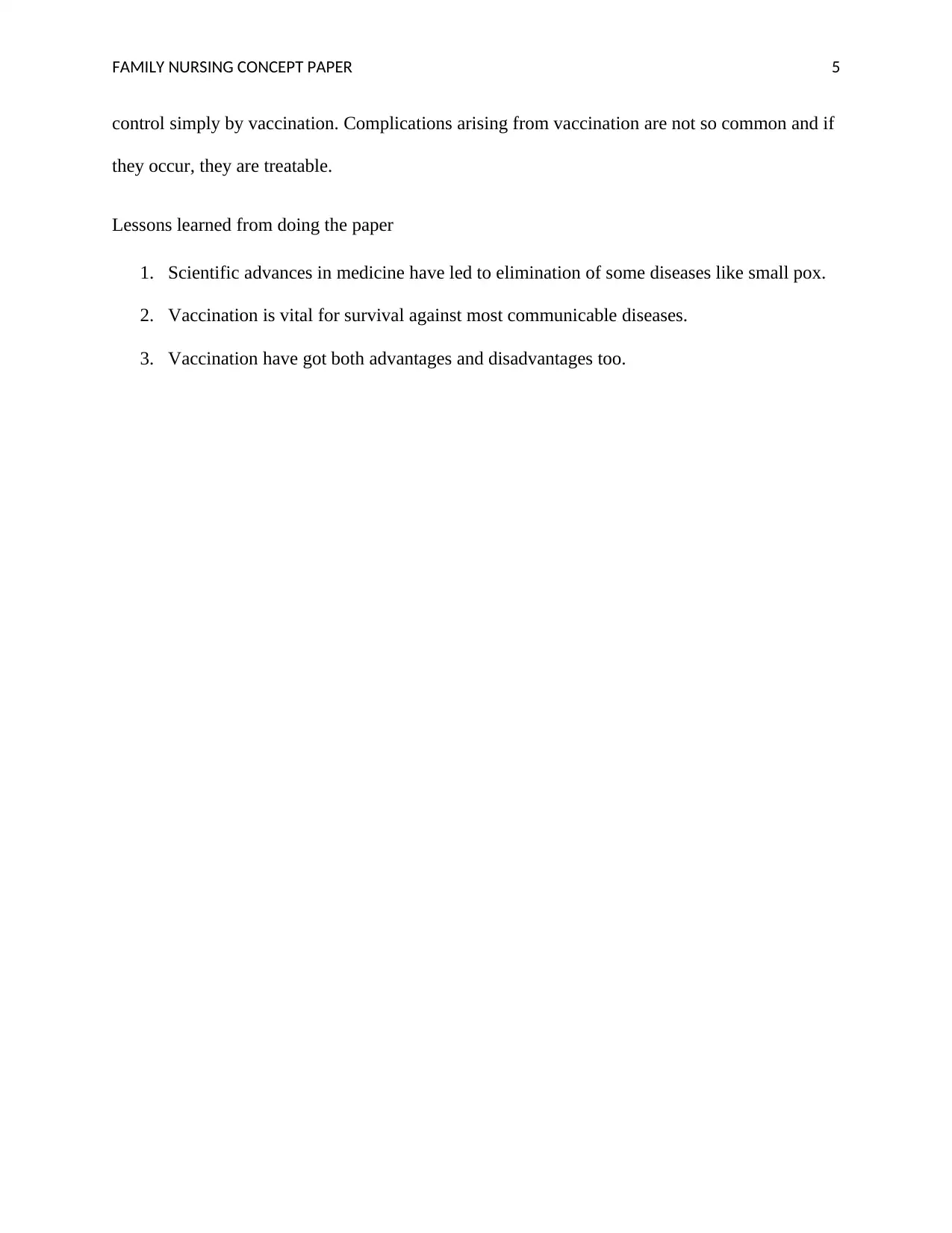
control simply by vaccination. Complications arising from vaccination are not so common and if
they occur, they are treatable.
Lessons learned from doing the paper
1. Scientific advances in medicine have led to elimination of some diseases like small pox.
2. Vaccination is vital for survival against most communicable diseases.
3. Vaccination have got both advantages and disadvantages too.
control simply by vaccination. Complications arising from vaccination are not so common and if
they occur, they are treatable.
Lessons learned from doing the paper
1. Scientific advances in medicine have led to elimination of some diseases like small pox.
2. Vaccination is vital for survival against most communicable diseases.
3. Vaccination have got both advantages and disadvantages too.

FAMILY NURSING CONCEPT PAPER 6
References
Cornelissen, C. N., Harvey, R. A., & Fisher, B. D. (2012). Microbiology (Vol. 3). Lippincott Williams &
Wilkins.
Fuchs, V. R. (2011). Who shall live?: health, economics and social choice. World Scientific.
Gordon, M. (2014). Manual of nursing diagnosis. Jones & Bartlett Publishers.
Gulanick, M., & Myers, J. L. (2016). Nursing Care Plans: Diagnoses, Interventions, and Outcomes.
Elsevier Health Sciences.
Ozawa, S., Stack, M. L., Bishai, D. M., Mirelman, A., Friberg, I. K., Niessen, L., ... & Levine, O. S.
(2011). During the ‘decade of vaccines,’the lives of 6.4 million children valued at $231 billion
could be saved. Health affairs, 30(6), 1010-1020.
Sejvar, J. J., Baughman, A. L., Wise, M., & Morgan, O. W. (2011). Population incidence of Guillain-
Barré syndrome: a systematic review and meta-analysis. Neuroepidemiology, 36(2), 123-133.
References
Cornelissen, C. N., Harvey, R. A., & Fisher, B. D. (2012). Microbiology (Vol. 3). Lippincott Williams &
Wilkins.
Fuchs, V. R. (2011). Who shall live?: health, economics and social choice. World Scientific.
Gordon, M. (2014). Manual of nursing diagnosis. Jones & Bartlett Publishers.
Gulanick, M., & Myers, J. L. (2016). Nursing Care Plans: Diagnoses, Interventions, and Outcomes.
Elsevier Health Sciences.
Ozawa, S., Stack, M. L., Bishai, D. M., Mirelman, A., Friberg, I. K., Niessen, L., ... & Levine, O. S.
(2011). During the ‘decade of vaccines,’the lives of 6.4 million children valued at $231 billion
could be saved. Health affairs, 30(6), 1010-1020.
Sejvar, J. J., Baughman, A. L., Wise, M., & Morgan, O. W. (2011). Population incidence of Guillain-
Barré syndrome: a systematic review and meta-analysis. Neuroepidemiology, 36(2), 123-133.
⊘ This is a preview!⊘
Do you want full access?
Subscribe today to unlock all pages.

Trusted by 1+ million students worldwide
1 out of 6
Related Documents
Your All-in-One AI-Powered Toolkit for Academic Success.
+13062052269
info@desklib.com
Available 24*7 on WhatsApp / Email
Unlock your academic potential
Copyright © 2020–2025 A2Z Services. All Rights Reserved. Developed and managed by ZUCOL.