Law Assignment: Family Law, Wills, and Property Distribution Analysis
VerifiedAdded on 2019/09/21
|8
|1712
|162
Homework Assignment
AI Summary
This law assignment delves into various aspects of family law, including the grounds for divorce, legal processes involved in marriage dissolution, and the intricacies of wills and inheritance. The assignment covers topics such as adultery, domestic violence, and the legal preconditions for divorce. It explores issues related to child custody, alimony, and the impact of marriage dissolution on relationships. Furthermore, the assignment examines the legal procedures following a person's death, including the registration of death and the identification of beneficiaries. The document addresses joint tenancy, the requirements for creating a will, and assets that cannot be determined within a will. It also discusses void marriages and the distribution of assets when a will is absent, referencing relevant legal rules and providing a specific case study to illustrate the application of these rules.
Running Head: THE LAW AND YOU
law
ASSIGNMENT
law
ASSIGNMENT
Paraphrase This Document
Need a fresh take? Get an instant paraphrase of this document with our AI Paraphraser

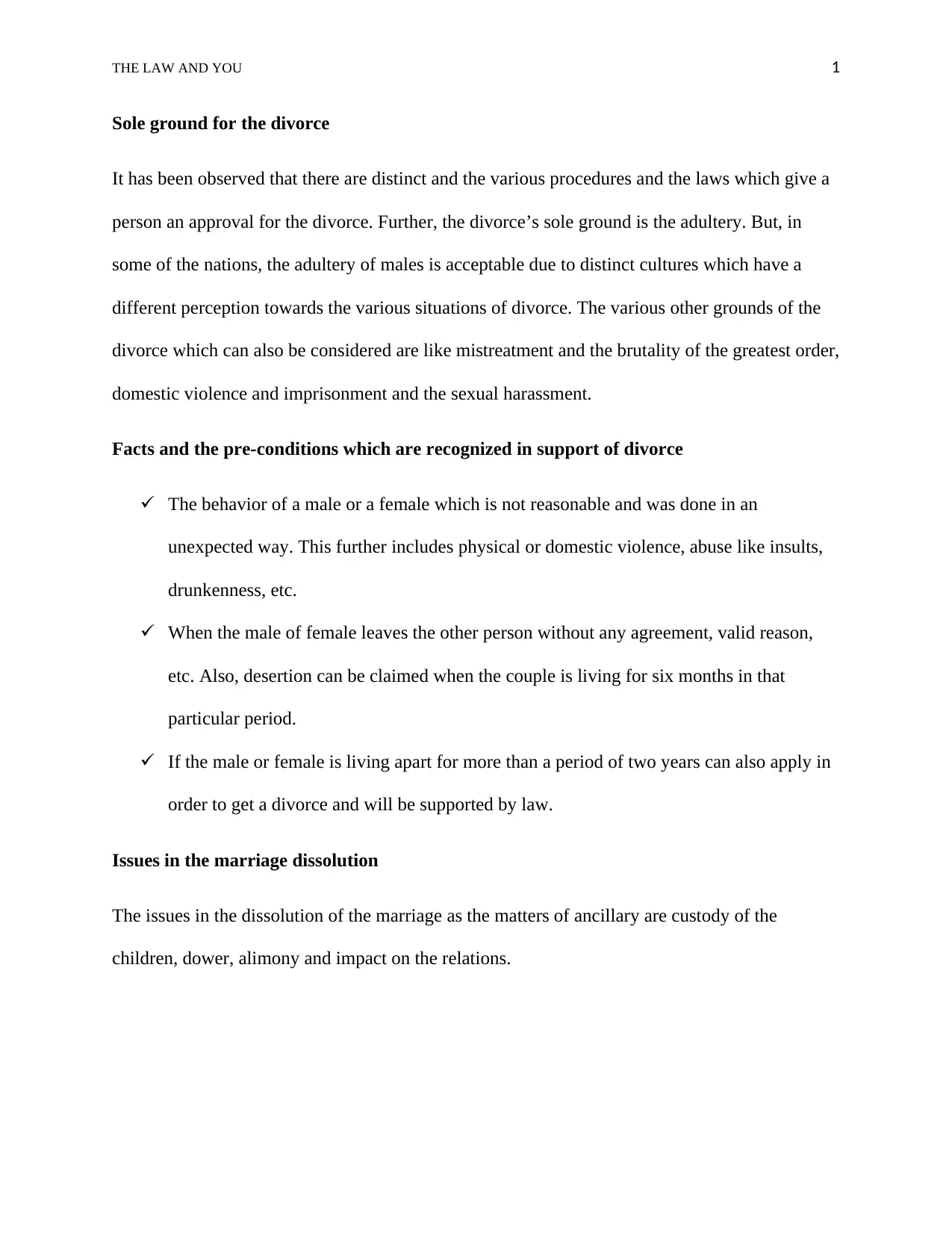
THE LAW AND YOU 1
Sole ground for the divorce
It has been observed that there are distinct and the various procedures and the laws which give a
person an approval for the divorce. Further, the divorce’s sole ground is the adultery. But, in
some of the nations, the adultery of males is acceptable due to distinct cultures which have a
different perception towards the various situations of divorce. The various other grounds of the
divorce which can also be considered are like mistreatment and the brutality of the greatest order,
domestic violence and imprisonment and the sexual harassment.
Facts and the pre-conditions which are recognized in support of divorce
The behavior of a male or a female which is not reasonable and was done in an
unexpected way. This further includes physical or domestic violence, abuse like insults,
drunkenness, etc.
When the male of female leaves the other person without any agreement, valid reason,
etc. Also, desertion can be claimed when the couple is living for six months in that
particular period.
If the male or female is living apart for more than a period of two years can also apply in
order to get a divorce and will be supported by law.
Issues in the marriage dissolution
The issues in the dissolution of the marriage as the matters of ancillary are custody of the
children, dower, alimony and impact on the relations.
Sole ground for the divorce
It has been observed that there are distinct and the various procedures and the laws which give a
person an approval for the divorce. Further, the divorce’s sole ground is the adultery. But, in
some of the nations, the adultery of males is acceptable due to distinct cultures which have a
different perception towards the various situations of divorce. The various other grounds of the
divorce which can also be considered are like mistreatment and the brutality of the greatest order,
domestic violence and imprisonment and the sexual harassment.
Facts and the pre-conditions which are recognized in support of divorce
The behavior of a male or a female which is not reasonable and was done in an
unexpected way. This further includes physical or domestic violence, abuse like insults,
drunkenness, etc.
When the male of female leaves the other person without any agreement, valid reason,
etc. Also, desertion can be claimed when the couple is living for six months in that
particular period.
If the male or female is living apart for more than a period of two years can also apply in
order to get a divorce and will be supported by law.
Issues in the marriage dissolution
The issues in the dissolution of the marriage as the matters of ancillary are custody of the
children, dower, alimony and impact on the relations.

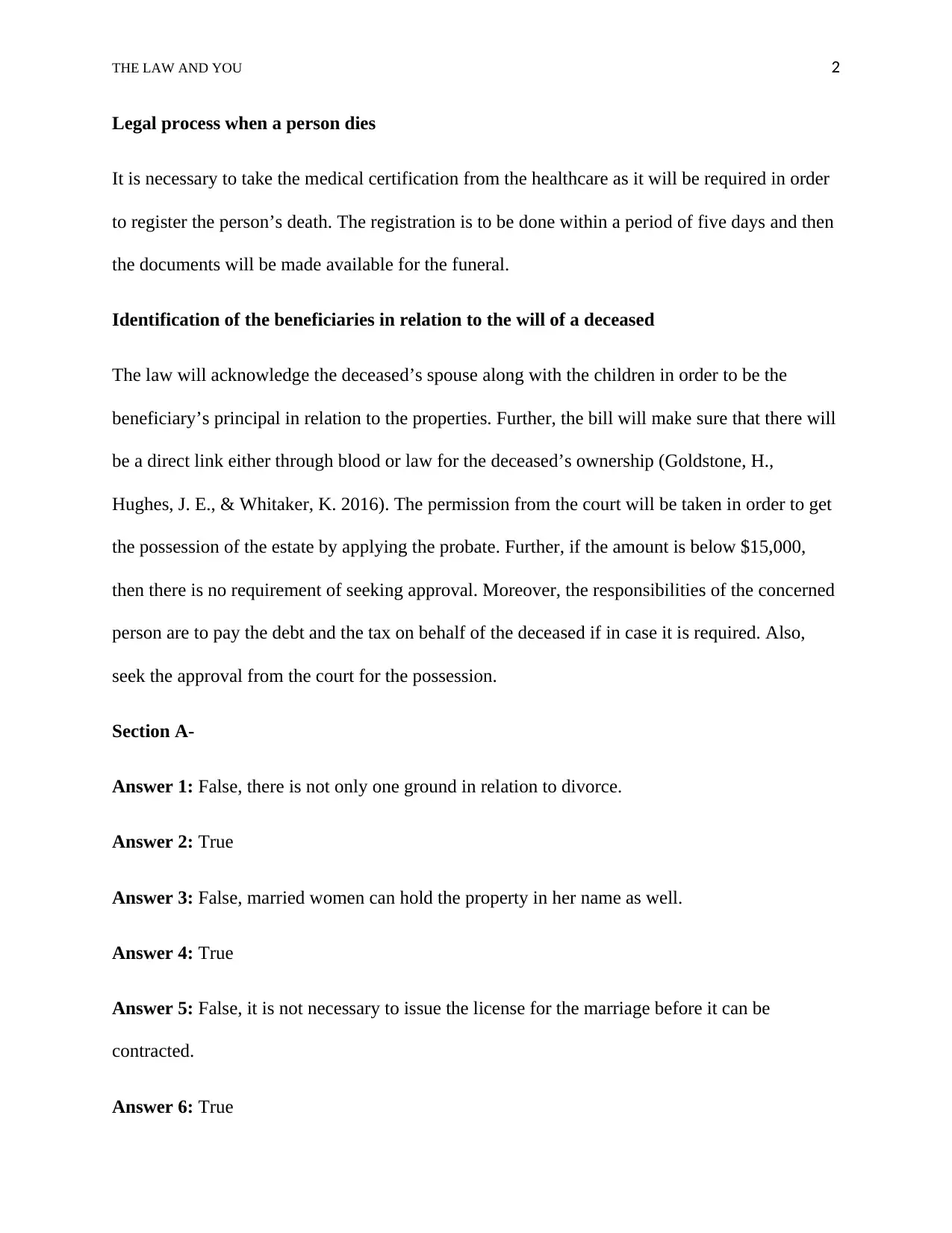
THE LAW AND YOU 2
Legal process when a person dies
It is necessary to take the medical certification from the healthcare as it will be required in order
to register the person’s death. The registration is to be done within a period of five days and then
the documents will be made available for the funeral.
Identification of the beneficiaries in relation to the will of a deceased
The law will acknowledge the deceased’s spouse along with the children in order to be the
beneficiary’s principal in relation to the properties. Further, the bill will make sure that there will
be a direct link either through blood or law for the deceased’s ownership (Goldstone, H.,
Hughes, J. E., & Whitaker, K. 2016). The permission from the court will be taken in order to get
the possession of the estate by applying the probate. Further, if the amount is below $15,000,
then there is no requirement of seeking approval. Moreover, the responsibilities of the concerned
person are to pay the debt and the tax on behalf of the deceased if in case it is required. Also,
seek the approval from the court for the possession.
Section A-
Answer 1: False, there is not only one ground in relation to divorce.
Answer 2: True
Answer 3: False, married women can hold the property in her name as well.
Answer 4: True
Answer 5: False, it is not necessary to issue the license for the marriage before it can be
contracted.
Answer 6: True
Legal process when a person dies
It is necessary to take the medical certification from the healthcare as it will be required in order
to register the person’s death. The registration is to be done within a period of five days and then
the documents will be made available for the funeral.
Identification of the beneficiaries in relation to the will of a deceased
The law will acknowledge the deceased’s spouse along with the children in order to be the
beneficiary’s principal in relation to the properties. Further, the bill will make sure that there will
be a direct link either through blood or law for the deceased’s ownership (Goldstone, H.,
Hughes, J. E., & Whitaker, K. 2016). The permission from the court will be taken in order to get
the possession of the estate by applying the probate. Further, if the amount is below $15,000,
then there is no requirement of seeking approval. Moreover, the responsibilities of the concerned
person are to pay the debt and the tax on behalf of the deceased if in case it is required. Also,
seek the approval from the court for the possession.
Section A-
Answer 1: False, there is not only one ground in relation to divorce.
Answer 2: True
Answer 3: False, married women can hold the property in her name as well.
Answer 4: True
Answer 5: False, it is not necessary to issue the license for the marriage before it can be
contracted.
Answer 6: True
⊘ This is a preview!⊘
Do you want full access?
Subscribe today to unlock all pages.

Trusted by 1+ million students worldwide

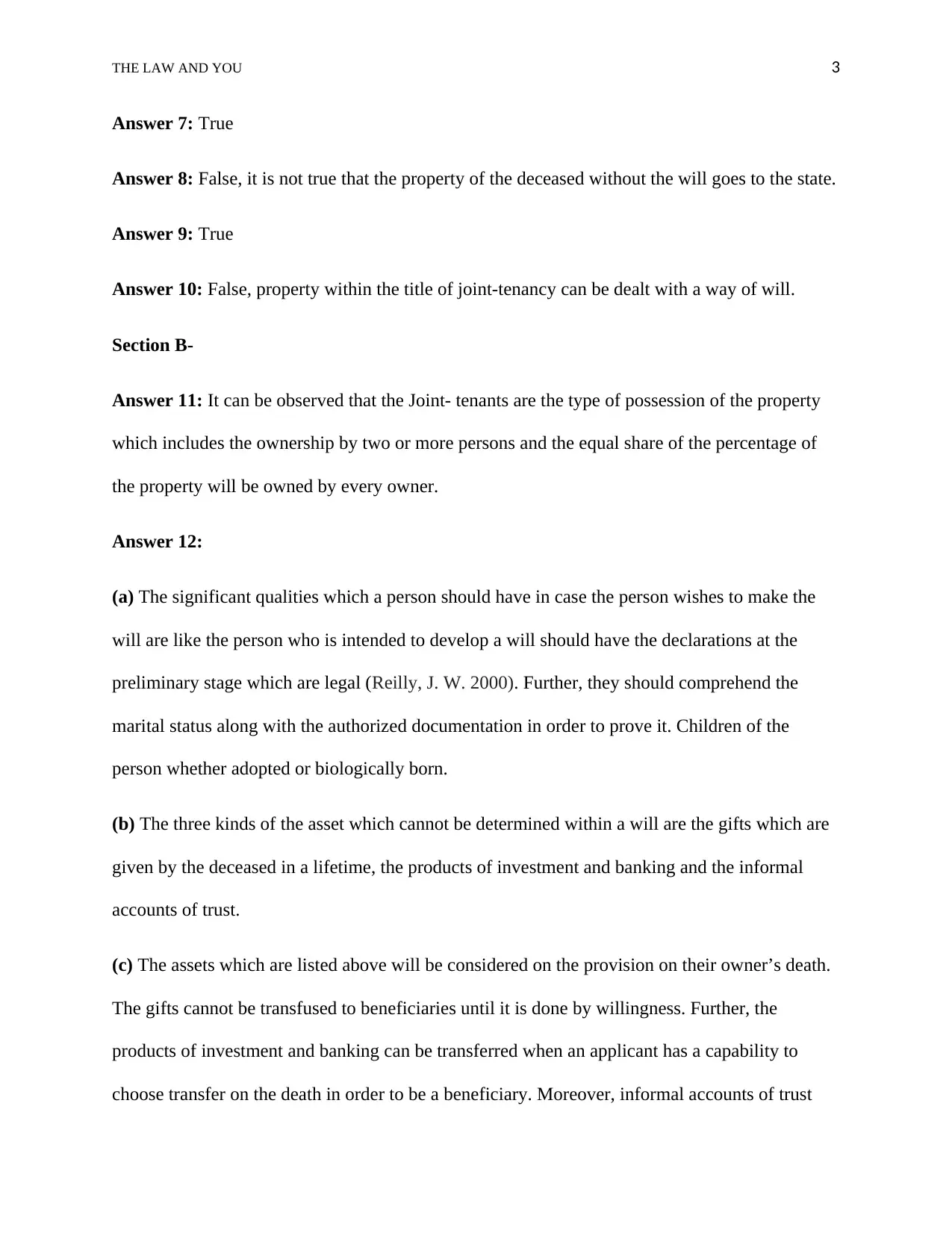
THE LAW AND YOU 3
Answer 7: True
Answer 8: False, it is not true that the property of the deceased without the will goes to the state.
Answer 9: True
Answer 10: False, property within the title of joint-tenancy can be dealt with a way of will.
Section B-
Answer 11: It can be observed that the Joint- tenants are the type of possession of the property
which includes the ownership by two or more persons and the equal share of the percentage of
the property will be owned by every owner.
Answer 12:
(a) The significant qualities which a person should have in case the person wishes to make the
will are like the person who is intended to develop a will should have the declarations at the
preliminary stage which are legal (Reilly, J. W. 2000). Further, they should comprehend the
marital status along with the authorized documentation in order to prove it. Children of the
person whether adopted or biologically born.
(b) The three kinds of the asset which cannot be determined within a will are the gifts which are
given by the deceased in a lifetime, the products of investment and banking and the informal
accounts of trust.
(c) The assets which are listed above will be considered on the provision on their owner’s death.
The gifts cannot be transfused to beneficiaries until it is done by willingness. Further, the
products of investment and banking can be transferred when an applicant has a capability to
choose transfer on the death in order to be a beneficiary. Moreover, informal accounts of trust
Answer 7: True
Answer 8: False, it is not true that the property of the deceased without the will goes to the state.
Answer 9: True
Answer 10: False, property within the title of joint-tenancy can be dealt with a way of will.
Section B-
Answer 11: It can be observed that the Joint- tenants are the type of possession of the property
which includes the ownership by two or more persons and the equal share of the percentage of
the property will be owned by every owner.
Answer 12:
(a) The significant qualities which a person should have in case the person wishes to make the
will are like the person who is intended to develop a will should have the declarations at the
preliminary stage which are legal (Reilly, J. W. 2000). Further, they should comprehend the
marital status along with the authorized documentation in order to prove it. Children of the
person whether adopted or biologically born.
(b) The three kinds of the asset which cannot be determined within a will are the gifts which are
given by the deceased in a lifetime, the products of investment and banking and the informal
accounts of trust.
(c) The assets which are listed above will be considered on the provision on their owner’s death.
The gifts cannot be transfused to beneficiaries until it is done by willingness. Further, the
products of investment and banking can be transferred when an applicant has a capability to
choose transfer on the death in order to be a beneficiary. Moreover, informal accounts of trust
Paraphrase This Document
Need a fresh take? Get an instant paraphrase of this document with our AI Paraphraser

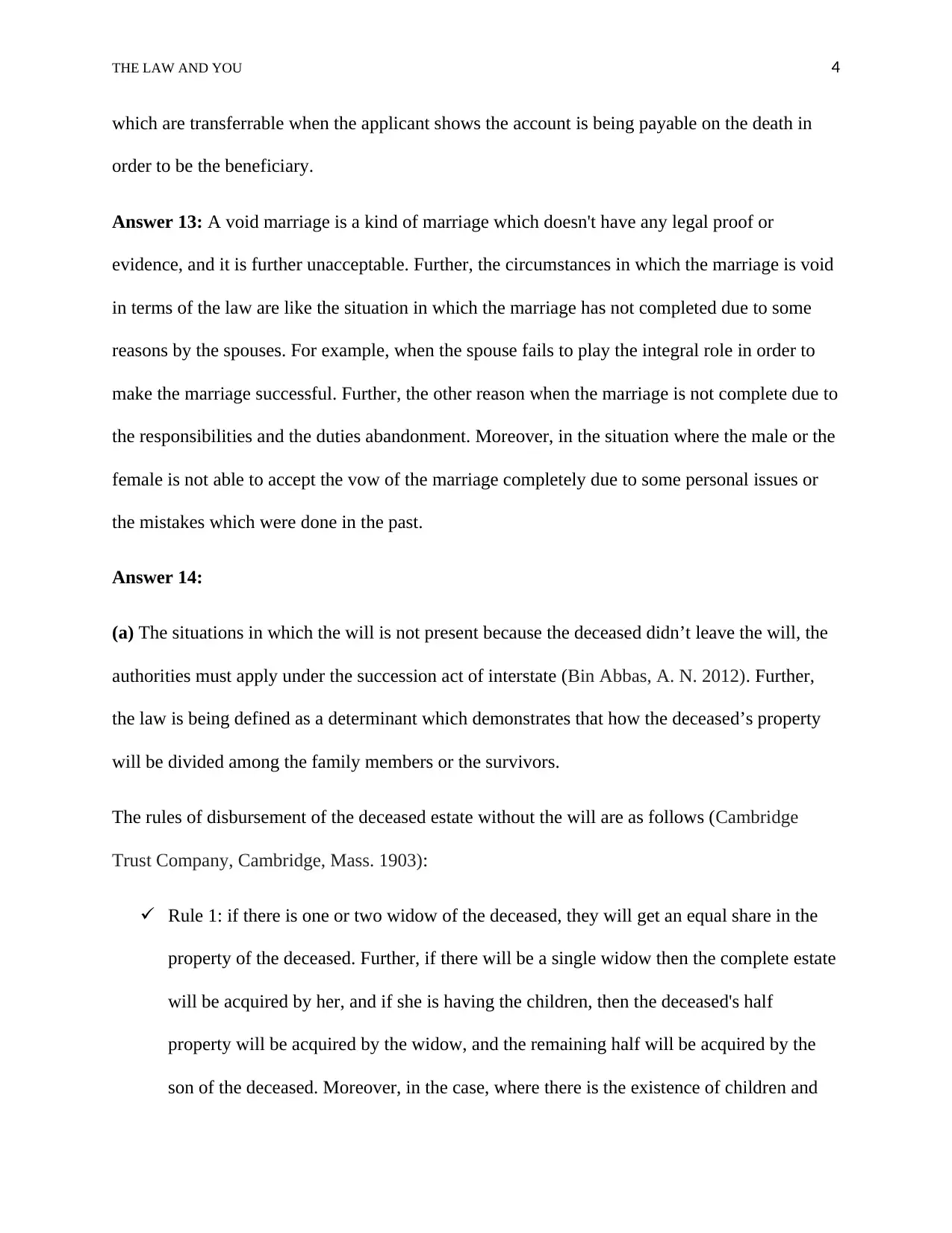
THE LAW AND YOU 4
which are transferrable when the applicant shows the account is being payable on the death in
order to be the beneficiary.
Answer 13: A void marriage is a kind of marriage which doesn't have any legal proof or
evidence, and it is further unacceptable. Further, the circumstances in which the marriage is void
in terms of the law are like the situation in which the marriage has not completed due to some
reasons by the spouses. For example, when the spouse fails to play the integral role in order to
make the marriage successful. Further, the other reason when the marriage is not complete due to
the responsibilities and the duties abandonment. Moreover, in the situation where the male or the
female is not able to accept the vow of the marriage completely due to some personal issues or
the mistakes which were done in the past.
Answer 14:
(a) The situations in which the will is not present because the deceased didn’t leave the will, the
authorities must apply under the succession act of interstate (Bin Abbas, A. N. 2012). Further,
the law is being defined as a determinant which demonstrates that how the deceased’s property
will be divided among the family members or the survivors.
The rules of disbursement of the deceased estate without the will are as follows (Cambridge
Trust Company, Cambridge, Mass. 1903):
Rule 1: if there is one or two widow of the deceased, they will get an equal share in the
property of the deceased. Further, if there will be a single widow then the complete estate
will be acquired by her, and if she is having the children, then the deceased's half
property will be acquired by the widow, and the remaining half will be acquired by the
son of the deceased. Moreover, in the case, where there is the existence of children and
which are transferrable when the applicant shows the account is being payable on the death in
order to be the beneficiary.
Answer 13: A void marriage is a kind of marriage which doesn't have any legal proof or
evidence, and it is further unacceptable. Further, the circumstances in which the marriage is void
in terms of the law are like the situation in which the marriage has not completed due to some
reasons by the spouses. For example, when the spouse fails to play the integral role in order to
make the marriage successful. Further, the other reason when the marriage is not complete due to
the responsibilities and the duties abandonment. Moreover, in the situation where the male or the
female is not able to accept the vow of the marriage completely due to some personal issues or
the mistakes which were done in the past.
Answer 14:
(a) The situations in which the will is not present because the deceased didn’t leave the will, the
authorities must apply under the succession act of interstate (Bin Abbas, A. N. 2012). Further,
the law is being defined as a determinant which demonstrates that how the deceased’s property
will be divided among the family members or the survivors.
The rules of disbursement of the deceased estate without the will are as follows (Cambridge
Trust Company, Cambridge, Mass. 1903):
Rule 1: if there is one or two widow of the deceased, they will get an equal share in the
property of the deceased. Further, if there will be a single widow then the complete estate
will be acquired by her, and if she is having the children, then the deceased's half
property will be acquired by the widow, and the remaining half will be acquired by the
son of the deceased. Moreover, in the case, where there is the existence of children and

THE LAW AND YOU 5
more than one widow, then the widows will acquire half of the share in the property and
the remaining half will be divided among the children equally.
Rule 2: the deceased’s children along with the mother should acquire a share in the estate.
Further, these two rules state that the deceased’s estate should be divisible in the equal
proportionate among the children no matter the children are adopted or born.
Rule 3: among the daughters and sons of the deceased an interstate will acquire a share
among them. Only, when the mother acquires her share. The remaining stock will be
acquired by the children of deceased.
Rule 4: it discusses the distribution of the share which is remaining. If the deceased was
having more than one wife, the deceased's children from both wives would be liable in
order to get the share of the estate in order to distribute among the heirs.
Rule 5: for the purpose of equality in the distribution of the share in the property, no
difference will be there among the relatives of the deceased from the side of the mother
and the father.
Rule 6: if there will be no existence of kin, then the siblings and the parents of the
deceased will have the equal share of the estate.
(b) In the situation of Daisy, there is the existence of some rules which should be followed by
her sister in order to acquire the estate which is being left by Daisy. Further, in this case, there is
no existence of the spouse. So, according to the rule, the estate will be shared equally among the
parents and the siblings of Daisy. Further, the sister of Daisy will be the first individual in order
to acquire the land, and she will acquire half portion of the estate. Moreover, the remaining
portion will be allocated to the children of the sibling of Daisy who died and the portion will be
more than one widow, then the widows will acquire half of the share in the property and
the remaining half will be divided among the children equally.
Rule 2: the deceased’s children along with the mother should acquire a share in the estate.
Further, these two rules state that the deceased’s estate should be divisible in the equal
proportionate among the children no matter the children are adopted or born.
Rule 3: among the daughters and sons of the deceased an interstate will acquire a share
among them. Only, when the mother acquires her share. The remaining stock will be
acquired by the children of deceased.
Rule 4: it discusses the distribution of the share which is remaining. If the deceased was
having more than one wife, the deceased's children from both wives would be liable in
order to get the share of the estate in order to distribute among the heirs.
Rule 5: for the purpose of equality in the distribution of the share in the property, no
difference will be there among the relatives of the deceased from the side of the mother
and the father.
Rule 6: if there will be no existence of kin, then the siblings and the parents of the
deceased will have the equal share of the estate.
(b) In the situation of Daisy, there is the existence of some rules which should be followed by
her sister in order to acquire the estate which is being left by Daisy. Further, in this case, there is
no existence of the spouse. So, according to the rule, the estate will be shared equally among the
parents and the siblings of Daisy. Further, the sister of Daisy will be the first individual in order
to acquire the land, and she will acquire half portion of the estate. Moreover, the remaining
portion will be allocated to the children of the sibling of Daisy who died and the portion will be
⊘ This is a preview!⊘
Do you want full access?
Subscribe today to unlock all pages.

Trusted by 1+ million students worldwide

THE LAW AND YOU 6
shared with three children and a wife. Therefore, the wife will acquire the half share of the
remaining portion and the children will acquire half of the share of the mother.
shared with three children and a wife. Therefore, the wife will acquire the half share of the
remaining portion and the children will acquire half of the share of the mother.
Paraphrase This Document
Need a fresh take? Get an instant paraphrase of this document with our AI Paraphraser

THE LAW AND YOU 7
REFERENCES
Bin Abbas, A. N. (2012). Islamic Legal System in Singapore, The. Pac. Rim L. & Polly J., 21,
163.
Cambridge Trust Company, Cambridge, Mass. (1903). Information Concerning Wills,
Settlement, and Distribution of Estates. University Press.
Goldstone, H., Hughes, J. E., & Whitaker, K. (2016). Family trusts: A guide for beneficiaries,
trustees, trust protectors, and trust creators.
Reilly, J. W. (2000). The language of real estate. Dearborn Real Estate.
REFERENCES
Bin Abbas, A. N. (2012). Islamic Legal System in Singapore, The. Pac. Rim L. & Polly J., 21,
163.
Cambridge Trust Company, Cambridge, Mass. (1903). Information Concerning Wills,
Settlement, and Distribution of Estates. University Press.
Goldstone, H., Hughes, J. E., & Whitaker, K. (2016). Family trusts: A guide for beneficiaries,
trustees, trust protectors, and trust creators.
Reilly, J. W. (2000). The language of real estate. Dearborn Real Estate.
1 out of 8
Your All-in-One AI-Powered Toolkit for Academic Success.
+13062052269
info@desklib.com
Available 24*7 on WhatsApp / Email
Unlock your academic potential
Copyright © 2020–2025 A2Z Services. All Rights Reserved. Developed and managed by ZUCOL.