Faraday Steel Manufacturing: Mobile App Development Business Case
VerifiedAdded on 2023/06/03
|22
|7838
|285
Report
AI Summary
This report presents a business case for mobile application development at Faraday Steel Manufacturing, aiming to address challenges in communication, tracking, and monitoring of manufacturing components. The proposed mobile app will provide real-time information on spare parts and product stocks, integrate an in-app chat module for improved communication, and facilitate remote asset management and tracking. The report includes a cost analysis, strategic alignment with business and IT strategies, a value proposition, project management and control considerations, infrastructure requirements, development platform details, software design and development methodologies, internalization strategies, social media integration strategies, risk management, integration and deployment strategies, user acceptance and change management plans, maintenance considerations, and future opportunities for enhancement. The mobile application is designed for technicians, floor managers, administrators, and top management to ensure timely machine maintenance, prevent material shortages, provide asset visibility, enable paperless reporting, and facilitate seamless information distribution.
MOBILE APPLICATION DEVELOPMENT 1
Mobile Application Development
Student Name
Institutional Affiliation
Mobile Application Development
Student Name
Institutional Affiliation

Paraphrase This Document
Need a fresh take? Get an instant paraphrase of this document with our AI Paraphraser
MOBILE APPLICATION DEVELOPMENT 2
Executive Summary
Manufacturing industries require efficiency and flexibility in order to maintain competitive
advantage in the industry of operation. Facilitating cooperative and mobile work for the engineers
is a critical success factor. Many IT systems in engineering are monolithic desktop software with
multifunction and complex front-end constraints the enhancement of engineering process through
IT driven methodologies.
Faraday Steel Manufacturing is a company that deals with the manufacturing of steel products and
is based in Brisbane, Queensland. The company wants to adopt a mobile application that will
address the challenges of communication, tracking, and monitoring on the status of the
manufacturing components. The mobile application will offer the company with the latest
information regarding the spare parts and products that are in stock. Secondly, it will integrate and
in-app chat that will allow the employees to communicate and share information easily and
quickly. Thirdly, the application will allow management of the company assets and provide remote
tacking and monitoring. This paper will propose and discuss how Faraday Steel Manufacturing
Industry will employ the use of a mobile application to notify technicians on the status of all the
machines, give the latest information on spare-part and product stocks, integrate in-app chat
module to improve communication amongst the employees, and provide easy management of all
the company assets.
Executive Summary
Manufacturing industries require efficiency and flexibility in order to maintain competitive
advantage in the industry of operation. Facilitating cooperative and mobile work for the engineers
is a critical success factor. Many IT systems in engineering are monolithic desktop software with
multifunction and complex front-end constraints the enhancement of engineering process through
IT driven methodologies.
Faraday Steel Manufacturing is a company that deals with the manufacturing of steel products and
is based in Brisbane, Queensland. The company wants to adopt a mobile application that will
address the challenges of communication, tracking, and monitoring on the status of the
manufacturing components. The mobile application will offer the company with the latest
information regarding the spare parts and products that are in stock. Secondly, it will integrate and
in-app chat that will allow the employees to communicate and share information easily and
quickly. Thirdly, the application will allow management of the company assets and provide remote
tacking and monitoring. This paper will propose and discuss how Faraday Steel Manufacturing
Industry will employ the use of a mobile application to notify technicians on the status of all the
machines, give the latest information on spare-part and product stocks, integrate in-app chat
module to improve communication amongst the employees, and provide easy management of all
the company assets.
MOBILE APPLICATION DEVELOPMENT 3
Table of Contents
Executive Summary............................................................................................................................2
Introduction........................................................................................................................................4
Background Information.....................................................................................................................5
Proposed solution...............................................................................................................................6
Cost Analysis......................................................................................................................................7
Strategic Alignment between Business and IT strategies...................................................................8
Value Proposition.............................................................................................................................12
Project Management and Control.....................................................................................................13
Infrastructure Requirements.............................................................................................................14
Development Platform..................................................................................................................14
Coding Language and Tools.........................................................................................................14
Cloud Services..............................................................................................................................14
Software Design, Development Methodologies and Testing Strategies..........................................15
Internalization...................................................................................................................................16
Social Media Integration Strategies..................................................................................................16
Risk Management.............................................................................................................................16
Integration and Deployment Strategies............................................................................................17
User Acceptance and Change Management.....................................................................................18
Maintenance......................................................................................................................................18
Future Opportunities and Enhancements..........................................................................................19
Recommendation and Conclusion....................................................................................................19
References List.................................................................................................................................19
Table of Contents
Executive Summary............................................................................................................................2
Introduction........................................................................................................................................4
Background Information.....................................................................................................................5
Proposed solution...............................................................................................................................6
Cost Analysis......................................................................................................................................7
Strategic Alignment between Business and IT strategies...................................................................8
Value Proposition.............................................................................................................................12
Project Management and Control.....................................................................................................13
Infrastructure Requirements.............................................................................................................14
Development Platform..................................................................................................................14
Coding Language and Tools.........................................................................................................14
Cloud Services..............................................................................................................................14
Software Design, Development Methodologies and Testing Strategies..........................................15
Internalization...................................................................................................................................16
Social Media Integration Strategies..................................................................................................16
Risk Management.............................................................................................................................16
Integration and Deployment Strategies............................................................................................17
User Acceptance and Change Management.....................................................................................18
Maintenance......................................................................................................................................18
Future Opportunities and Enhancements..........................................................................................19
Recommendation and Conclusion....................................................................................................19
References List.................................................................................................................................19
⊘ This is a preview!⊘
Do you want full access?
Subscribe today to unlock all pages.

Trusted by 1+ million students worldwide
MOBILE APPLICATION DEVELOPMENT 4
Introduction
Technology evolution and revolution has brought major changes in the engineering industry. The
increasing complexities in the engineering system has led to the need to employ technology
concepts. In today’s engineering environment, engineers and other engineering professionals
require applications and systems that will enable them to continuously update and develop their
knowledge and skills. In addition, the rise of mobile technology and online tools is gradually
bringing effectiveness and efficiency in the engineering environment which are key benefits in
increasing productivity and performance (Charland and LeRoux, 2011, p. 20). According to Yu,
Zhou, Gong and Chien (2015 p. 280), engineers are getting more constraint in the process of
application development because of the progressively accelerating and advancing technology
while budgets and timelines remaining the same. Because of this reason, engineers need to be
innovative and efficient and this can only be achieved through adoption of technology.
Competitive engineering companies are continuously seeking to deploy new technologies in their
operations which are necessary in simplifying and enhancing the design process. One of the major
objectives of mobile technology is to improve communications and sharing of critical information
within the company (Dong-Hoon and Jun-Yeob, 2013, p. 18). Adoption of mobile based
application has been welcomed by the engineering industry because of its ability to facilitate
remote communication and web accessibility to the design tools.
Individualization and globalization have led to higher complexities, shorter product life cycle, and
different products. These aspects require efficiency and flexibility in order to maintain competitive
advantage in the industry of operation. In such context, enabling cooperative and mobile work for
the engineers is a critical success factor. Many IT systems in engineering are monolithic desktop
software with multifunction and complex front-end constraints the enhancement of engineering
process through IT driven methodologies. With the rise of mobile computing (tablets and
smart[hones), the emergence of mobile application has facilitated anytime and anywhere properties
which are very essential in process optimization in the engineering industry (Eshet, 2012, p. 14).
Additionally, exploiting this technology offer a big potential for improved efficiency and
flexibility in engineering tasks. Technicians are getting real time notifications about the various
engineering processes that require their attention. In this paper, we discuss how Faraday Steel
Manufacturing Industry will employ the use of a mobile application to notify technicians on the
status of all the machines, give the latest information on spare-part and product stocks, integrate
in-app chat module to improve communication amongst the employees, and provide easy
management of all the company assets.
Introduction
Technology evolution and revolution has brought major changes in the engineering industry. The
increasing complexities in the engineering system has led to the need to employ technology
concepts. In today’s engineering environment, engineers and other engineering professionals
require applications and systems that will enable them to continuously update and develop their
knowledge and skills. In addition, the rise of mobile technology and online tools is gradually
bringing effectiveness and efficiency in the engineering environment which are key benefits in
increasing productivity and performance (Charland and LeRoux, 2011, p. 20). According to Yu,
Zhou, Gong and Chien (2015 p. 280), engineers are getting more constraint in the process of
application development because of the progressively accelerating and advancing technology
while budgets and timelines remaining the same. Because of this reason, engineers need to be
innovative and efficient and this can only be achieved through adoption of technology.
Competitive engineering companies are continuously seeking to deploy new technologies in their
operations which are necessary in simplifying and enhancing the design process. One of the major
objectives of mobile technology is to improve communications and sharing of critical information
within the company (Dong-Hoon and Jun-Yeob, 2013, p. 18). Adoption of mobile based
application has been welcomed by the engineering industry because of its ability to facilitate
remote communication and web accessibility to the design tools.
Individualization and globalization have led to higher complexities, shorter product life cycle, and
different products. These aspects require efficiency and flexibility in order to maintain competitive
advantage in the industry of operation. In such context, enabling cooperative and mobile work for
the engineers is a critical success factor. Many IT systems in engineering are monolithic desktop
software with multifunction and complex front-end constraints the enhancement of engineering
process through IT driven methodologies. With the rise of mobile computing (tablets and
smart[hones), the emergence of mobile application has facilitated anytime and anywhere properties
which are very essential in process optimization in the engineering industry (Eshet, 2012, p. 14).
Additionally, exploiting this technology offer a big potential for improved efficiency and
flexibility in engineering tasks. Technicians are getting real time notifications about the various
engineering processes that require their attention. In this paper, we discuss how Faraday Steel
Manufacturing Industry will employ the use of a mobile application to notify technicians on the
status of all the machines, give the latest information on spare-part and product stocks, integrate
in-app chat module to improve communication amongst the employees, and provide easy
management of all the company assets.
Paraphrase This Document
Need a fresh take? Get an instant paraphrase of this document with our AI Paraphraser
MOBILE APPLICATION DEVELOPMENT 5
Background Information
Faraday Steel Manufacturing is a company that deals with the manufacturing of steel products, the
company was founded in 1989 and currently has a total of 1500 employees. The major products
the company deals with include steel pipe, steel plate among other. It is currently located in
Brisbane, Queensland-Australia. For several years, the company has been depending on employees
to monitor and notify on the status of critical processes and machines within the company. This
has been an ineffective way to manage the operations within the company and has reduced
productivity and overall performance of the industry. Also, the company has been depending on
email and notice board communication to pass information across the company. As such, the to
have a mobile application to address these challenges arose. The company seeks to implement a
mobile application that will facilitate notification of machine status, provide information about
spare parts and product stocks, asset management and ease communication through the in-chat
feature. The major purpose of the application is to improve communication and flow of
information within the firm through piggy backing today’s Bring Your Own Device (BYOD)
trend.
One of the opportunities being explored is creating a mobile application that will offer the
employees within Faraday easy communication platform (He, 2011). The days when workers had
to monitor the various processes and machines manually though bulky and large computer
workstation are slowly disappearing. Technology advancement such as desktop virtualization has
facilitated application access that employees need to achieve a particular objective or complete a
task through the use of more portable computing devices such as smartphones and tablets.
Moreover, the trend towards facilitating predictive service and maintenance of critical components
in production to improve performance and production speed (Huenerfauth, 2014, p. 20). Both plant
manufacturers and operators will focus on installing sensor equipment to the manufacturing
machines. The mobile application will further enable tracing and tracking of equipment and
products remotely and the safety of employees working in the factory. The attention is now
shifting to quality management where functions and processes like real time tracking of products,
functional assignment, and chain production.
The integration of SMS group platform services (in-app chat) is the basis of digital, intelligence
service competence. The platform offers the company a simple and secure way to electronically
exchange and share information. eService solution is one of the SMS group e-functions that enable
the users to reliably and quickly determine spare parts and access files such as service guidelines,
data sheets, and operation manuals (Ibhadode, 2012). The application will offer an intuitive
environment that the plant will use directly to correct or identify the correct spare part component
and facilitate initiation of procurement process in a click of a button through the ordering
procedure.
Background Information
Faraday Steel Manufacturing is a company that deals with the manufacturing of steel products, the
company was founded in 1989 and currently has a total of 1500 employees. The major products
the company deals with include steel pipe, steel plate among other. It is currently located in
Brisbane, Queensland-Australia. For several years, the company has been depending on employees
to monitor and notify on the status of critical processes and machines within the company. This
has been an ineffective way to manage the operations within the company and has reduced
productivity and overall performance of the industry. Also, the company has been depending on
email and notice board communication to pass information across the company. As such, the to
have a mobile application to address these challenges arose. The company seeks to implement a
mobile application that will facilitate notification of machine status, provide information about
spare parts and product stocks, asset management and ease communication through the in-chat
feature. The major purpose of the application is to improve communication and flow of
information within the firm through piggy backing today’s Bring Your Own Device (BYOD)
trend.
One of the opportunities being explored is creating a mobile application that will offer the
employees within Faraday easy communication platform (He, 2011). The days when workers had
to monitor the various processes and machines manually though bulky and large computer
workstation are slowly disappearing. Technology advancement such as desktop virtualization has
facilitated application access that employees need to achieve a particular objective or complete a
task through the use of more portable computing devices such as smartphones and tablets.
Moreover, the trend towards facilitating predictive service and maintenance of critical components
in production to improve performance and production speed (Huenerfauth, 2014, p. 20). Both plant
manufacturers and operators will focus on installing sensor equipment to the manufacturing
machines. The mobile application will further enable tracing and tracking of equipment and
products remotely and the safety of employees working in the factory. The attention is now
shifting to quality management where functions and processes like real time tracking of products,
functional assignment, and chain production.
The integration of SMS group platform services (in-app chat) is the basis of digital, intelligence
service competence. The platform offers the company a simple and secure way to electronically
exchange and share information. eService solution is one of the SMS group e-functions that enable
the users to reliably and quickly determine spare parts and access files such as service guidelines,
data sheets, and operation manuals (Ibhadode, 2012). The application will offer an intuitive
environment that the plant will use directly to correct or identify the correct spare part component
and facilitate initiation of procurement process in a click of a button through the ordering
procedure.
MOBILE APPLICATION DEVELOPMENT 6
Proposed solution
The application seeks to address the challenges of communication, tracking, and monitoring on the
status of the manufacturing components. The mobile application will offer the company with the
latest information regarding the spare parts and products that are in stock. Secondly, it will
integrate and in-app chat that will allow the employees to communicate and share information
easily and quickly. Thirdly, the application will allow management of the company assets and
provide remote tacking and monitoring.
Two decades ago, such concepts would have sounded impossible to many industries and but
because of the advent in technology, mobile technology perceptions have changed and is now
being embraced (Lee, 2013). By employing this technology Faraday will be able to take advantage
and increase its competitiveness in the industry through effective and efficient production,
tracking, and monitoring of production processes and equipment. Often, tools that are
indispensable in private life are anticipated to be available naturally in the working environment.
This is why the manufacturing industry is progressively adopting mobile devices so as to enable
managers, technicians, and operators to maintain connectivity and completely take controls of all
the plant processes anywhere and anytime (Nunes and Simões-Marques, 2015). There exist other
essential factors of mobile devices beyond mobility that render them useful and interesting in the
manufacturing environment.
The application will be expected to enhance portability by allowing use of lightweight and easy to
use devices such as tablets and smartphones which are greatly effective in consultation lists such
as inventory, production orders, maintenance operations among other or where technicians are
needed to gather data manually and fill in the correct form like quality control check list.
Application portability allows the users to view the production data and status of every
manufacturing component from anywhere and add notes that can be shared with other employees
regardless of their location (Qiu and Ju, 2012). A technician or operator at Faraday Manufacturing
company can be able to refer to manuals, guides, electrical and mechanical schematics directly
from the mobile device and enabling them to carry along a whole library of materials on the tablet
or smartphone without the need of carrying the physical files or documentation.
Secondly, the application will enhance availability by ensuring production flexibility in
departments with independent components or several islands. Additionally, the mobile application
will facilitate eradication of fixed control and supervisory stations while making sure that
technicians and operators can enter and receive required production information (Seliger, 2012).
When compare to computer workstations that have to be installed in the company for the purpose
of tracking, monitoring, and communication, the mobile devices are cheaper and affordable.
Furthermore, the have better performance and is easy to use. Replacement or maintenance cost of
Proposed solution
The application seeks to address the challenges of communication, tracking, and monitoring on the
status of the manufacturing components. The mobile application will offer the company with the
latest information regarding the spare parts and products that are in stock. Secondly, it will
integrate and in-app chat that will allow the employees to communicate and share information
easily and quickly. Thirdly, the application will allow management of the company assets and
provide remote tacking and monitoring.
Two decades ago, such concepts would have sounded impossible to many industries and but
because of the advent in technology, mobile technology perceptions have changed and is now
being embraced (Lee, 2013). By employing this technology Faraday will be able to take advantage
and increase its competitiveness in the industry through effective and efficient production,
tracking, and monitoring of production processes and equipment. Often, tools that are
indispensable in private life are anticipated to be available naturally in the working environment.
This is why the manufacturing industry is progressively adopting mobile devices so as to enable
managers, technicians, and operators to maintain connectivity and completely take controls of all
the plant processes anywhere and anytime (Nunes and Simões-Marques, 2015). There exist other
essential factors of mobile devices beyond mobility that render them useful and interesting in the
manufacturing environment.
The application will be expected to enhance portability by allowing use of lightweight and easy to
use devices such as tablets and smartphones which are greatly effective in consultation lists such
as inventory, production orders, maintenance operations among other or where technicians are
needed to gather data manually and fill in the correct form like quality control check list.
Application portability allows the users to view the production data and status of every
manufacturing component from anywhere and add notes that can be shared with other employees
regardless of their location (Qiu and Ju, 2012). A technician or operator at Faraday Manufacturing
company can be able to refer to manuals, guides, electrical and mechanical schematics directly
from the mobile device and enabling them to carry along a whole library of materials on the tablet
or smartphone without the need of carrying the physical files or documentation.
Secondly, the application will enhance availability by ensuring production flexibility in
departments with independent components or several islands. Additionally, the mobile application
will facilitate eradication of fixed control and supervisory stations while making sure that
technicians and operators can enter and receive required production information (Seliger, 2012).
When compare to computer workstations that have to be installed in the company for the purpose
of tracking, monitoring, and communication, the mobile devices are cheaper and affordable.
Furthermore, the have better performance and is easy to use. Replacement or maintenance cost of
⊘ This is a preview!⊘
Do you want full access?
Subscribe today to unlock all pages.
Trusted by 1+ million students worldwide
MOBILE APPLICATION DEVELOPMENT 7
the mobile devices are more reasonable and the fact that the users pay more attention to such
devices reduces the risk of theft or breakage (Wu, 2011).
This application is mainly designed to be used by filed technicians, floor managers and staff,
administrators, and top management. The app will ensure timely maintenance of machines, no
shorts in materials and spare parts, view the conditions of the various assets, paperless reports, and
seamless distribution of information. It is crucial that this app is designed and developed because
by don doing so, the process of production is delayed, no timely reports, inconsistent flow of
information, more errors because of manual operations, and so on (Stillström and Jackson, 2013, p.
189).
Cost Analysis
The table below shows the cost summary of the hybrid application development for Faraday
Manufacturing industry running both on android and iOS.
Faraday Cost Summary for Hybrid application development for iOS and Android
Task Cost
Wireframing and discovery $6,000
Design of application interface $6,000
App development $75,000
Back-end design, APIs, and databases $22,000
Administration of the application $20,000
Refinements and quality assurance $14,000
Deployment (cloud) $4,000
Total (Android & iOS) $147,000
The following factors were considered during the cost analysis:
Application environment and platform: the cost is increased by the fact that the application has to
be build for both iOS and android. This is because android uses java programming while iOS uses
swift programming language o Objective-C and windows uses C#. The cost and time if app
development will increase if the developer choses to develop the app for all the platforms using
individual native languages. However, hybrid technology allows developers to build one app for
all the platforms using PhoneGap, HTML5, JavaScript, and CSS to prepare the application for all
platforms.
the mobile devices are more reasonable and the fact that the users pay more attention to such
devices reduces the risk of theft or breakage (Wu, 2011).
This application is mainly designed to be used by filed technicians, floor managers and staff,
administrators, and top management. The app will ensure timely maintenance of machines, no
shorts in materials and spare parts, view the conditions of the various assets, paperless reports, and
seamless distribution of information. It is crucial that this app is designed and developed because
by don doing so, the process of production is delayed, no timely reports, inconsistent flow of
information, more errors because of manual operations, and so on (Stillström and Jackson, 2013, p.
189).
Cost Analysis
The table below shows the cost summary of the hybrid application development for Faraday
Manufacturing industry running both on android and iOS.
Faraday Cost Summary for Hybrid application development for iOS and Android
Task Cost
Wireframing and discovery $6,000
Design of application interface $6,000
App development $75,000
Back-end design, APIs, and databases $22,000
Administration of the application $20,000
Refinements and quality assurance $14,000
Deployment (cloud) $4,000
Total (Android & iOS) $147,000
The following factors were considered during the cost analysis:
Application environment and platform: the cost is increased by the fact that the application has to
be build for both iOS and android. This is because android uses java programming while iOS uses
swift programming language o Objective-C and windows uses C#. The cost and time if app
development will increase if the developer choses to develop the app for all the platforms using
individual native languages. However, hybrid technology allows developers to build one app for
all the platforms using PhoneGap, HTML5, JavaScript, and CSS to prepare the application for all
platforms.
Paraphrase This Document
Need a fresh take? Get an instant paraphrase of this document with our AI Paraphraser
MOBILE APPLICATION DEVELOPMENT 8
Secondly, customization of the application through standard application convention and widgets
increases the cost and time needed to develop the app. Every development platform has specific
widgets for building conventions that are standardized such as changing screens, navigation, user
interaction elements, and animations (Wilke, 2015, p. 13). Cost effectiveness will be realized by
employing the use of standardized convention.
The number of screens required for the application impact directly on the overall cost, that is, the
more the screens needed the more the cost will increase. To achieve cost effectiveness, it is
necessary to build less complex, less busy, and cleaner screens that has simple and easy to use
navigation menu. Since the app should be flexible enough to integrate and work with other systems
in place, the developer will have to link the application to third party APIs. This will need extra
money and time for the developer to learn and implement it correctly.
Building customized interface that will be able to support the different screen resolutions such as
phablets, smartphones, and tablets can be costly and time consuming. Additionally, building an
application that will support all the different types of mobile operating system will be costly. As
such, it is recommended to choose the popular operating systems such as iOS and Android.
Integrating the handoff/ continuity feature will facilitate sharing of data and information and
enable connection among the various devices. Building this feature can be substantially costly and
time consuming.
Strategic Alignment between Business and IT strategies
Strategic alignment refers to the degree at which the IT strategies meets the business objectives,
mission, and vision. It can also be described as the degree to which business strategies are
supported, enabled, and stimulated by information technology strategies (Chaudhry, 2015, p. 53).
It is the ability of the company to automate processes and share information with the relevant
stakeholders that enables the company to survive and remain competitive. Interoperability of the
different manufacturing systems forms the basis of operational aspect of the bigger company
concern, that is, strategic alignment. One of the strategic alignment aspects is to develop a well-
structured exchange of information between the various applications and systems. IT strategies
seeks to positively add value to the company through creation of new opportunities and strategies
and improve on the already existing ones (Grøgaard, 2012, p. 402). This objective can be achieved
by exploring the various ranges and types of information technology capabilities and systems
possibly available for the company. In this paper, the author seeks to explore the alignment
between IT and business strategies by concentrating on the approach of strategy modelling. The
objective is to dispense to a model-driven technique in order to create and weigh the IT and
business alignment within the Faraday Manufacturing Industry.
Secondly, customization of the application through standard application convention and widgets
increases the cost and time needed to develop the app. Every development platform has specific
widgets for building conventions that are standardized such as changing screens, navigation, user
interaction elements, and animations (Wilke, 2015, p. 13). Cost effectiveness will be realized by
employing the use of standardized convention.
The number of screens required for the application impact directly on the overall cost, that is, the
more the screens needed the more the cost will increase. To achieve cost effectiveness, it is
necessary to build less complex, less busy, and cleaner screens that has simple and easy to use
navigation menu. Since the app should be flexible enough to integrate and work with other systems
in place, the developer will have to link the application to third party APIs. This will need extra
money and time for the developer to learn and implement it correctly.
Building customized interface that will be able to support the different screen resolutions such as
phablets, smartphones, and tablets can be costly and time consuming. Additionally, building an
application that will support all the different types of mobile operating system will be costly. As
such, it is recommended to choose the popular operating systems such as iOS and Android.
Integrating the handoff/ continuity feature will facilitate sharing of data and information and
enable connection among the various devices. Building this feature can be substantially costly and
time consuming.
Strategic Alignment between Business and IT strategies
Strategic alignment refers to the degree at which the IT strategies meets the business objectives,
mission, and vision. It can also be described as the degree to which business strategies are
supported, enabled, and stimulated by information technology strategies (Chaudhry, 2015, p. 53).
It is the ability of the company to automate processes and share information with the relevant
stakeholders that enables the company to survive and remain competitive. Interoperability of the
different manufacturing systems forms the basis of operational aspect of the bigger company
concern, that is, strategic alignment. One of the strategic alignment aspects is to develop a well-
structured exchange of information between the various applications and systems. IT strategies
seeks to positively add value to the company through creation of new opportunities and strategies
and improve on the already existing ones (Grøgaard, 2012, p. 402). This objective can be achieved
by exploring the various ranges and types of information technology capabilities and systems
possibly available for the company. In this paper, the author seeks to explore the alignment
between IT and business strategies by concentrating on the approach of strategy modelling. The
objective is to dispense to a model-driven technique in order to create and weigh the IT and
business alignment within the Faraday Manufacturing Industry.
MOBILE APPLICATION DEVELOPMENT 9
The advent of information technology competencies and resources is one of the major pedals for
economic success and efficiency in the manufacturing processes (Hossain, Sohrab, Jamshid, and
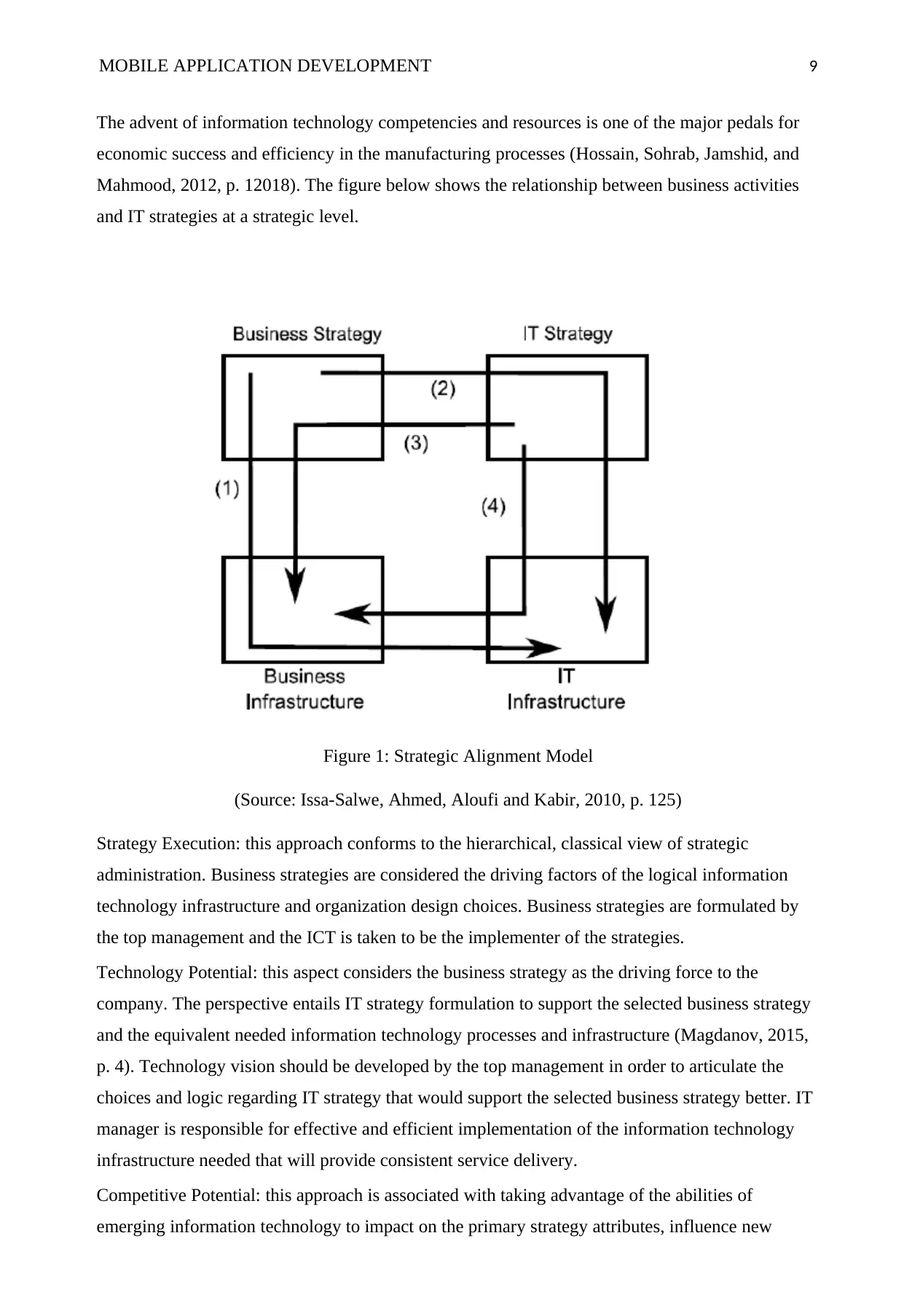
Mahmood, 2012, p. 12018). The figure below shows the relationship between business activities
and IT strategies at a strategic level.
Figure 1: Strategic Alignment Model
(Source: Issa-Salwe, Ahmed, Aloufi and Kabir, 2010, p. 125)
Strategy Execution: this approach conforms to the hierarchical, classical view of strategic
administration. Business strategies are considered the driving factors of the logical information
technology infrastructure and organization design choices. Business strategies are formulated by
the top management and the ICT is taken to be the implementer of the strategies.
Technology Potential: this aspect considers the business strategy as the driving force to the
company. The perspective entails IT strategy formulation to support the selected business strategy
and the equivalent needed information technology processes and infrastructure (Magdanov, 2015,
p. 4). Technology vision should be developed by the top management in order to articulate the
choices and logic regarding IT strategy that would support the selected business strategy better. IT
manager is responsible for effective and efficient implementation of the information technology
infrastructure needed that will provide consistent service delivery.
Competitive Potential: this approach is associated with taking advantage of the abilities of
emerging information technology to impact on the primary strategy attributes, influence new
The advent of information technology competencies and resources is one of the major pedals for
economic success and efficiency in the manufacturing processes (Hossain, Sohrab, Jamshid, and
Mahmood, 2012, p. 12018). The figure below shows the relationship between business activities
and IT strategies at a strategic level.
Figure 1: Strategic Alignment Model
(Source: Issa-Salwe, Ahmed, Aloufi and Kabir, 2010, p. 125)
Strategy Execution: this approach conforms to the hierarchical, classical view of strategic
administration. Business strategies are considered the driving factors of the logical information
technology infrastructure and organization design choices. Business strategies are formulated by
the top management and the ICT is taken to be the implementer of the strategies.
Technology Potential: this aspect considers the business strategy as the driving force to the
company. The perspective entails IT strategy formulation to support the selected business strategy
and the equivalent needed information technology processes and infrastructure (Magdanov, 2015,
p. 4). Technology vision should be developed by the top management in order to articulate the
choices and logic regarding IT strategy that would support the selected business strategy better. IT
manager is responsible for effective and efficient implementation of the information technology
infrastructure needed that will provide consistent service delivery.
Competitive Potential: this approach is associated with taking advantage of the abilities of
emerging information technology to impact on the primary strategy attributes, influence new
⊘ This is a preview!⊘
Do you want full access?
Subscribe today to unlock all pages.
Trusted by 1+ million students worldwide
MOBILE APPLICATION DEVELOPMENT
10
services and products, and create new types of relationships. This perspective unlike the former
two aspects enables the business to use emerging IT abilities to modify business strategy.
Service Level: it concentrates on how to create a sophisticated IT infrastructure within the
company. Business strategy has an indirect responsibility as is often considered not sufficient but
necessary to make sure that IT resources are used effectively and be flexible to the fast changing
and growing user demands (Ravasi and Phillips, 2011, p. 130).
Strategic Alignment model has been considered as the de factor standard for improvement and
measuring strategic alignment. Faraday Manufacturing industry should rate the IT alignment with
the business goals to provide bigger validity and reliability.
The new mobile application should be in-line with Faraday business strategy. This can be achieved
by representing the business strategy using goal-oriented models which are employed to formalize
information technology and business strategies. Many at times, these strategies are determined
through interview conducted through out the company with IT managers and business managers.
This approach depends on comparing two goal models with one describing the IT strategy while
the other representing the business strategy. The concepts o goal modelling better support
modelling of strategy. The culminating models represent strategies in terms of goals, vision, and
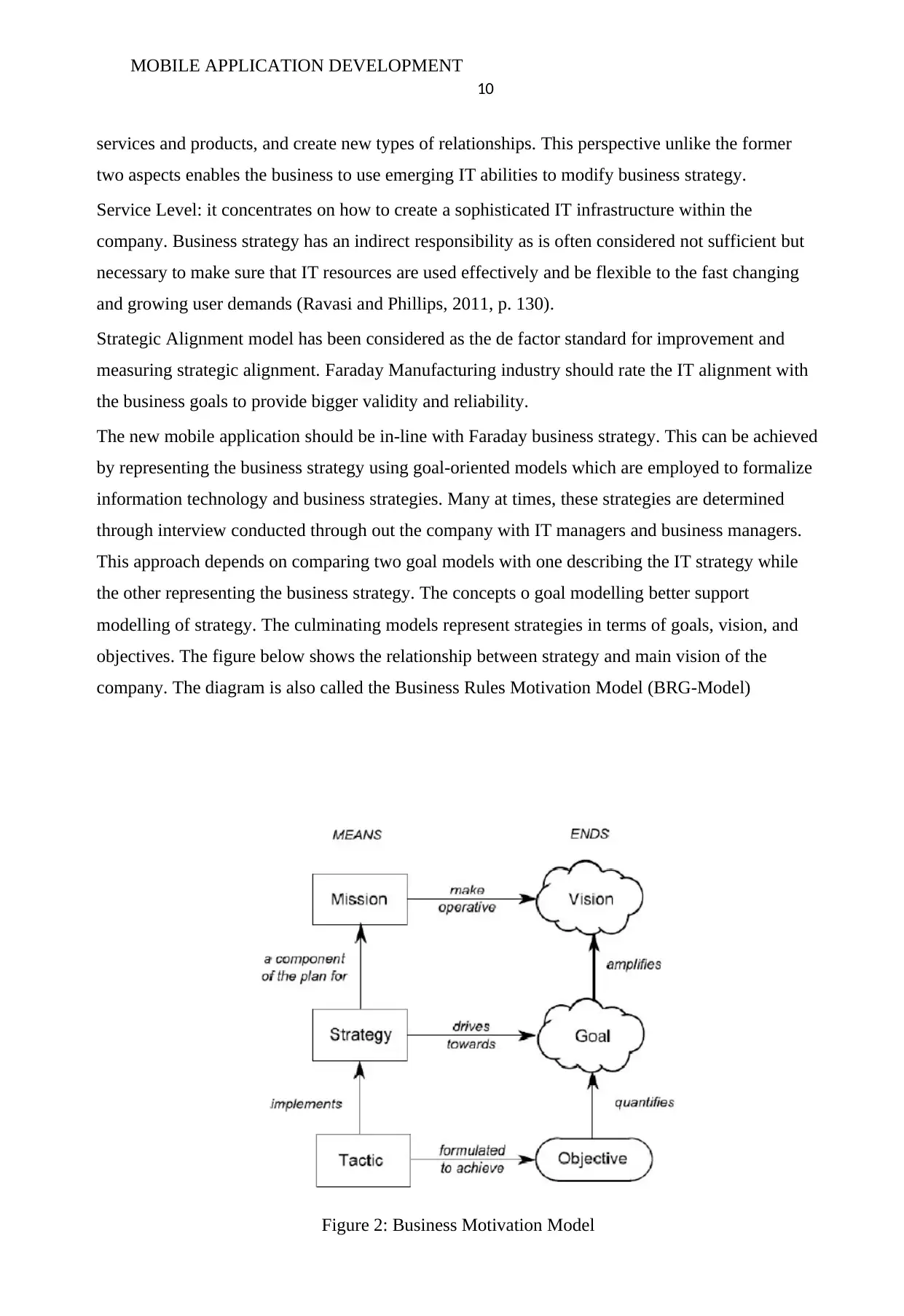
objectives. The figure below shows the relationship between strategy and main vision of the
company. The diagram is also called the Business Rules Motivation Model (BRG-Model)
Figure 2: Business Motivation Model
10
services and products, and create new types of relationships. This perspective unlike the former
two aspects enables the business to use emerging IT abilities to modify business strategy.
Service Level: it concentrates on how to create a sophisticated IT infrastructure within the
company. Business strategy has an indirect responsibility as is often considered not sufficient but
necessary to make sure that IT resources are used effectively and be flexible to the fast changing
and growing user demands (Ravasi and Phillips, 2011, p. 130).
Strategic Alignment model has been considered as the de factor standard for improvement and
measuring strategic alignment. Faraday Manufacturing industry should rate the IT alignment with
the business goals to provide bigger validity and reliability.
The new mobile application should be in-line with Faraday business strategy. This can be achieved
by representing the business strategy using goal-oriented models which are employed to formalize
information technology and business strategies. Many at times, these strategies are determined
through interview conducted through out the company with IT managers and business managers.
This approach depends on comparing two goal models with one describing the IT strategy while
the other representing the business strategy. The concepts o goal modelling better support
modelling of strategy. The culminating models represent strategies in terms of goals, vision, and
objectives. The figure below shows the relationship between strategy and main vision of the
company. The diagram is also called the Business Rules Motivation Model (BRG-Model)
Figure 2: Business Motivation Model
Paraphrase This Document
Need a fresh take? Get an instant paraphrase of this document with our AI Paraphraser
MOBILE APPLICATION DEVELOPMENT
11
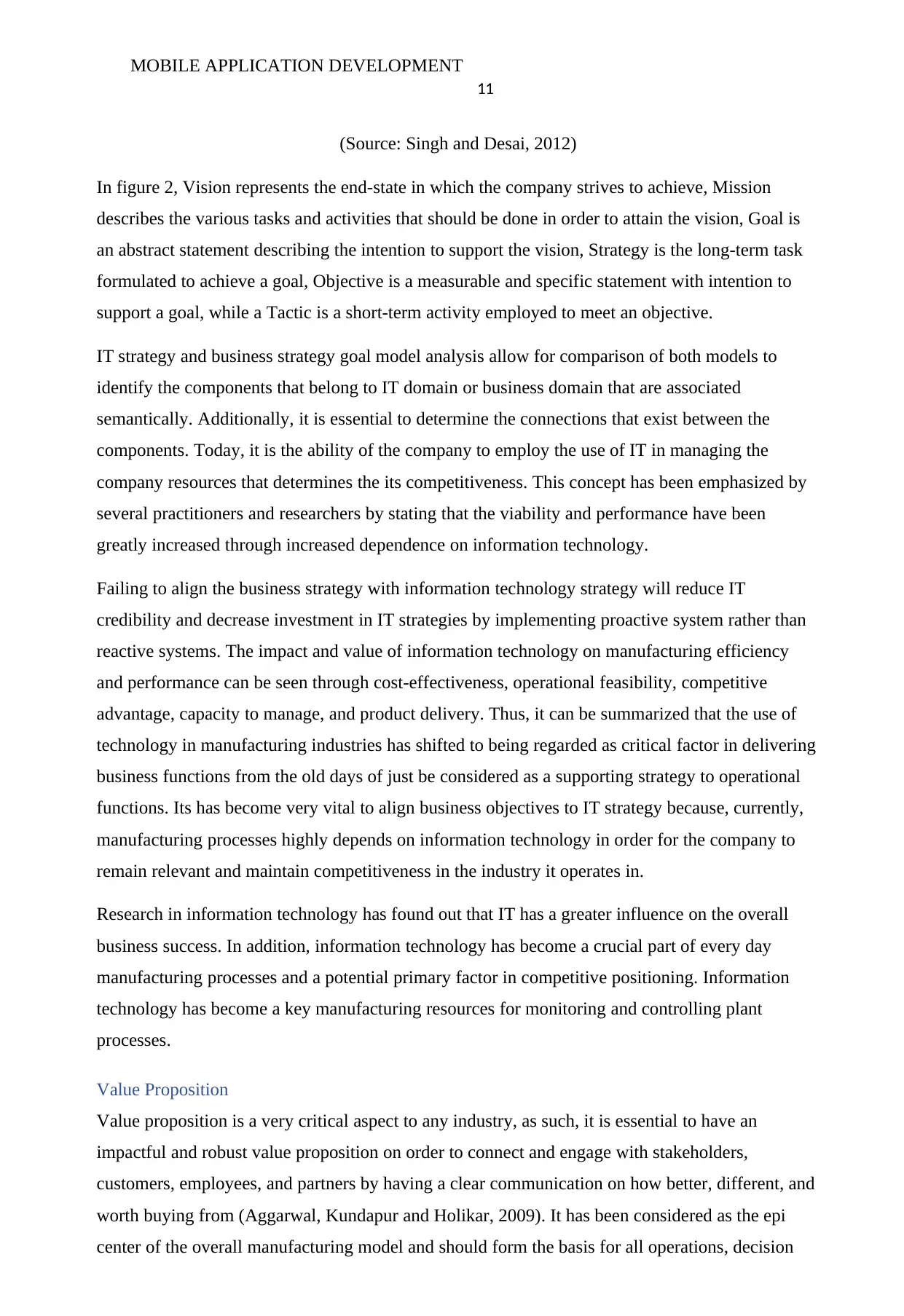
(Source: Singh and Desai, 2012)
In figure 2, Vision represents the end-state in which the company strives to achieve, Mission
describes the various tasks and activities that should be done in order to attain the vision, Goal is
an abstract statement describing the intention to support the vision, Strategy is the long-term task
formulated to achieve a goal, Objective is a measurable and specific statement with intention to
support a goal, while a Tactic is a short-term activity employed to meet an objective.
IT strategy and business strategy goal model analysis allow for comparison of both models to
identify the components that belong to IT domain or business domain that are associated
semantically. Additionally, it is essential to determine the connections that exist between the
components. Today, it is the ability of the company to employ the use of IT in managing the
company resources that determines the its competitiveness. This concept has been emphasized by
several practitioners and researchers by stating that the viability and performance have been
greatly increased through increased dependence on information technology.
Failing to align the business strategy with information technology strategy will reduce IT
credibility and decrease investment in IT strategies by implementing proactive system rather than
reactive systems. The impact and value of information technology on manufacturing efficiency
and performance can be seen through cost-effectiveness, operational feasibility, competitive
advantage, capacity to manage, and product delivery. Thus, it can be summarized that the use of
technology in manufacturing industries has shifted to being regarded as critical factor in delivering
business functions from the old days of just be considered as a supporting strategy to operational
functions. Its has become very vital to align business objectives to IT strategy because, currently,
manufacturing processes highly depends on information technology in order for the company to
remain relevant and maintain competitiveness in the industry it operates in.
Research in information technology has found out that IT has a greater influence on the overall
business success. In addition, information technology has become a crucial part of every day
manufacturing processes and a potential primary factor in competitive positioning. Information
technology has become a key manufacturing resources for monitoring and controlling plant
processes.
Value Proposition
Value proposition is a very critical aspect to any industry, as such, it is essential to have an
impactful and robust value proposition on order to connect and engage with stakeholders,
customers, employees, and partners by having a clear communication on how better, different, and
worth buying from (Aggarwal, Kundapur and Holikar, 2009). It has been considered as the epi
center of the overall manufacturing model and should form the basis for all operations, decision
11
(Source: Singh and Desai, 2012)
In figure 2, Vision represents the end-state in which the company strives to achieve, Mission
describes the various tasks and activities that should be done in order to attain the vision, Goal is
an abstract statement describing the intention to support the vision, Strategy is the long-term task
formulated to achieve a goal, Objective is a measurable and specific statement with intention to
support a goal, while a Tactic is a short-term activity employed to meet an objective.
IT strategy and business strategy goal model analysis allow for comparison of both models to
identify the components that belong to IT domain or business domain that are associated
semantically. Additionally, it is essential to determine the connections that exist between the
components. Today, it is the ability of the company to employ the use of IT in managing the
company resources that determines the its competitiveness. This concept has been emphasized by
several practitioners and researchers by stating that the viability and performance have been
greatly increased through increased dependence on information technology.
Failing to align the business strategy with information technology strategy will reduce IT
credibility and decrease investment in IT strategies by implementing proactive system rather than
reactive systems. The impact and value of information technology on manufacturing efficiency
and performance can be seen through cost-effectiveness, operational feasibility, competitive
advantage, capacity to manage, and product delivery. Thus, it can be summarized that the use of
technology in manufacturing industries has shifted to being regarded as critical factor in delivering
business functions from the old days of just be considered as a supporting strategy to operational
functions. Its has become very vital to align business objectives to IT strategy because, currently,
manufacturing processes highly depends on information technology in order for the company to
remain relevant and maintain competitiveness in the industry it operates in.
Research in information technology has found out that IT has a greater influence on the overall
business success. In addition, information technology has become a crucial part of every day
manufacturing processes and a potential primary factor in competitive positioning. Information
technology has become a key manufacturing resources for monitoring and controlling plant
processes.
Value Proposition
Value proposition is a very critical aspect to any industry, as such, it is essential to have an
impactful and robust value proposition on order to connect and engage with stakeholders,
customers, employees, and partners by having a clear communication on how better, different, and
worth buying from (Aggarwal, Kundapur and Holikar, 2009). It has been considered as the epi
center of the overall manufacturing model and should form the basis for all operations, decision
MOBILE APPLICATION DEVELOPMENT
12
making, and consumer engagement. Value proposition is more that promotion messages or set of
words; it is the foundation for how the company will align its processes and output with the
customer needs in order to deliver a good experience that be attached to money value via value
exchange.
Currently, mobile applications are an enticing technology but many firms and businesses are
getting trapped by designing applications that do not reflect their value (Gopu, 2012, p. 16).
Mobile applications account for over 85 percent of the mobile usage time. If an app does not meet
the users’ requirements, the users will tend to uninstall and abandon them. As such it is important
to develop an app that will add value to the company and increase efficiency and effectiveness in
production and communication.
The proposed application will be able to add value to Faraday Manufacturing company by
automating processes and enhancing communication and resources sharing (Kim and Kwon, 2013,
p. 372). The application will be able to assist the company in collecting critical data regarding the
plant processes and operations. This will enable the company to identify which processes to
improve upon in order to increase productivity and performance. The ability of the app to allow for
social interaction will also make interaction with customers more engaging and their feedback can
be easily capture. It will also allow scheduling of maintenance activities.
The mobile application will offer a unique value proposition to Faraday that makes it outstanding
and competitive in the industry. However, before developing the app it is important to clearly state
and define the unique value proposition (UVP) describing the company, what the company expects
from the app, and target users (Quero and Ventura, 2018). Value proposition is important in
validating the business strategy for the purpose of continuity. The following are some of the
aspects that should be considered when determining, analyzing, and achieving the value
proposition: the mobile application should be able to give direction by defining the target users
from the beginning and then finding and articulating the need that the app should address. A well
define value proposition will aid the company in minimizing or avoiding time wastage, energy,
and money and developing an application that will be irrelevant to the company.
Secondly, it creates focus for the team by determining the fundamental activities, initiatives, and
perspectives of the company that will have positive impact in meeting the company objectives.
The value proposition is considered as the “True North” of the company by concentrating on why,
who, and how you are adding value (Smith, 2015, p. 13). It dictates what you must produce in
order to meet you set objectives and develop an overall remarkable experience to the target users.
12
making, and consumer engagement. Value proposition is more that promotion messages or set of
words; it is the foundation for how the company will align its processes and output with the
customer needs in order to deliver a good experience that be attached to money value via value
exchange.
Currently, mobile applications are an enticing technology but many firms and businesses are
getting trapped by designing applications that do not reflect their value (Gopu, 2012, p. 16).
Mobile applications account for over 85 percent of the mobile usage time. If an app does not meet
the users’ requirements, the users will tend to uninstall and abandon them. As such it is important
to develop an app that will add value to the company and increase efficiency and effectiveness in
production and communication.
The proposed application will be able to add value to Faraday Manufacturing company by
automating processes and enhancing communication and resources sharing (Kim and Kwon, 2013,
p. 372). The application will be able to assist the company in collecting critical data regarding the
plant processes and operations. This will enable the company to identify which processes to
improve upon in order to increase productivity and performance. The ability of the app to allow for
social interaction will also make interaction with customers more engaging and their feedback can
be easily capture. It will also allow scheduling of maintenance activities.
The mobile application will offer a unique value proposition to Faraday that makes it outstanding
and competitive in the industry. However, before developing the app it is important to clearly state
and define the unique value proposition (UVP) describing the company, what the company expects
from the app, and target users (Quero and Ventura, 2018). Value proposition is important in
validating the business strategy for the purpose of continuity. The following are some of the
aspects that should be considered when determining, analyzing, and achieving the value
proposition: the mobile application should be able to give direction by defining the target users
from the beginning and then finding and articulating the need that the app should address. A well
define value proposition will aid the company in minimizing or avoiding time wastage, energy,
and money and developing an application that will be irrelevant to the company.
Secondly, it creates focus for the team by determining the fundamental activities, initiatives, and
perspectives of the company that will have positive impact in meeting the company objectives.
The value proposition is considered as the “True North” of the company by concentrating on why,
who, and how you are adding value (Smith, 2015, p. 13). It dictates what you must produce in
order to meet you set objectives and develop an overall remarkable experience to the target users.
⊘ This is a preview!⊘
Do you want full access?
Subscribe today to unlock all pages.
Trusted by 1+ million students worldwide

1 out of 22


Related Documents


Your All-in-One AI-Powered Toolkit for Academic Success.
+13062052269
info@desklib.com
Available 24*7 on WhatsApp / Email
![[object Object]](/_next/static/media/star-bottom.7253800d.svg)
Unlock your academic potential
Copyright © 2020–2026 A2Z Services. All Rights Reserved. Developed and managed by ZUCOL.