Farrow's Bank Case Study: Analyzing Managerial Hubris and Ethics
VerifiedAdded on 2023/05/27
|5
|1192
|354
Case Study
AI Summary
This case study examines the failure of Farrow's Bank, attributing it to the managerial hubris of Thomas Farrow and the absence of a robust ethical business culture. It explores how Farrow's unchecked power and poor leadership led to mismanagement and fraudulent activities, ultimately causing the bank's collapse. The analysis delves into the impact of corporate culture, leadership styles, and ethical decision-making pressures within the bank. It further discusses how a truly ethical business culture could have mitigated the managerial hubris and potentially altered the bank's fate, drawing parallels with banking regulations implemented in the United States. The study concludes by highlighting the importance of ethical leadership, collaborative decision-making, and a strong management team for organizational success, using Farrow's Bank as a cautionary tale.
Running head: CASE STUDY 1
Case Study
Ashlea Dixon
Columbia Southern University
Case Study
Ashlea Dixon
Columbia Southern University
Paraphrase This Document
Need a fresh take? Get an instant paraphrase of this document with our AI Paraphraser

CASE STUDY 2
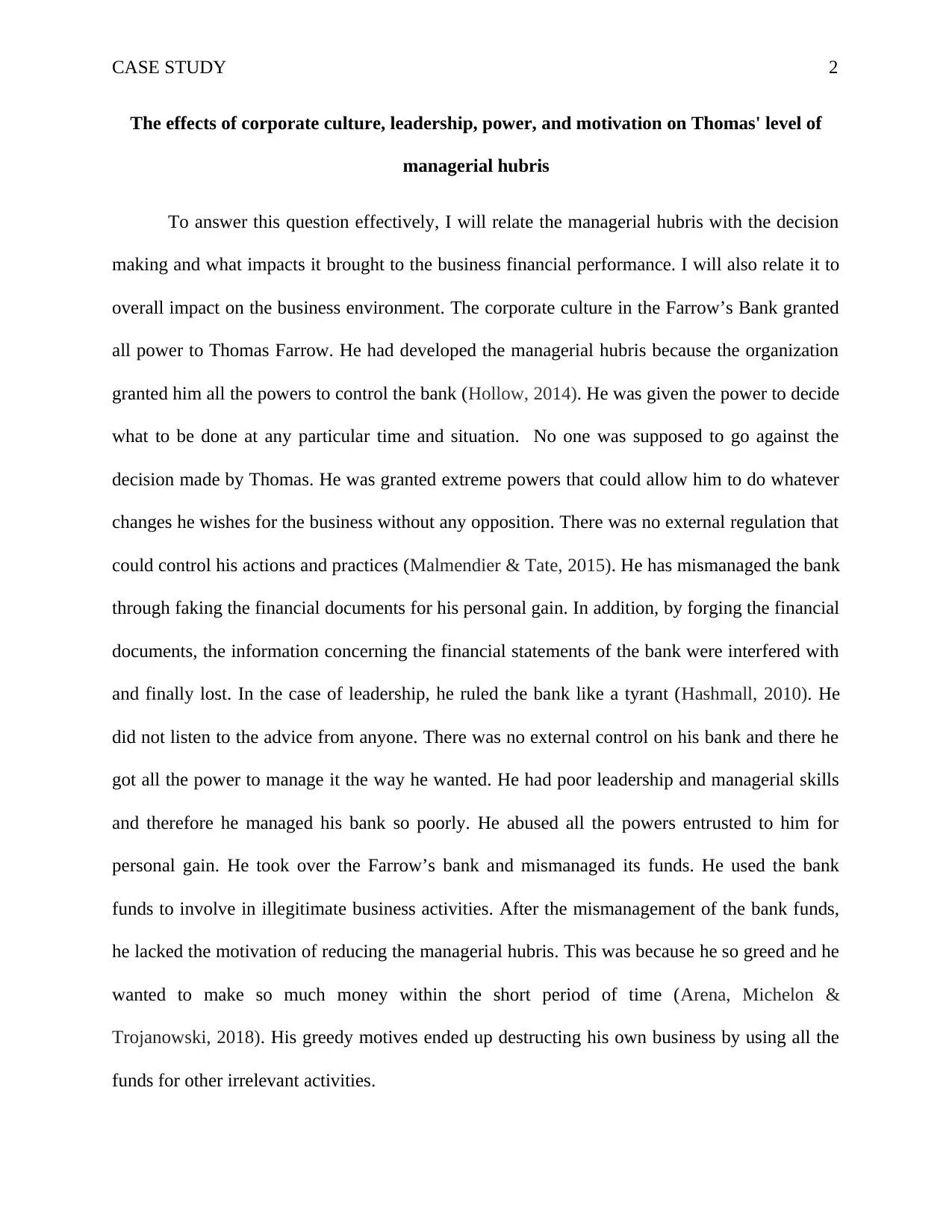
The effects of corporate culture, leadership, power, and motivation on Thomas' level of
managerial hubris
To answer this question effectively, I will relate the managerial hubris with the decision
making and what impacts it brought to the business financial performance. I will also relate it to
overall impact on the business environment. The corporate culture in the Farrow’s Bank granted
all power to Thomas Farrow. He had developed the managerial hubris because the organization
granted him all the powers to control the bank (Hollow, 2014). He was given the power to decide
what to be done at any particular time and situation. No one was supposed to go against the
decision made by Thomas. He was granted extreme powers that could allow him to do whatever
changes he wishes for the business without any opposition. There was no external regulation that
could control his actions and practices (Malmendier & Tate, 2015). He has mismanaged the bank
through faking the financial documents for his personal gain. In addition, by forging the financial
documents, the information concerning the financial statements of the bank were interfered with
and finally lost. In the case of leadership, he ruled the bank like a tyrant (Hashmall, 2010). He
did not listen to the advice from anyone. There was no external control on his bank and there he
got all the power to manage it the way he wanted. He had poor leadership and managerial skills
and therefore he managed his bank so poorly. He abused all the powers entrusted to him for
personal gain. He took over the Farrow’s bank and mismanaged its funds. He used the bank
funds to involve in illegitimate business activities. After the mismanagement of the bank funds,
he lacked the motivation of reducing the managerial hubris. This was because he so greed and he
wanted to make so much money within the short period of time (Arena, Michelon &
Trojanowski, 2018). His greedy motives ended up destructing his own business by using all the
funds for other irrelevant activities.
The effects of corporate culture, leadership, power, and motivation on Thomas' level of
managerial hubris
To answer this question effectively, I will relate the managerial hubris with the decision
making and what impacts it brought to the business financial performance. I will also relate it to
overall impact on the business environment. The corporate culture in the Farrow’s Bank granted
all power to Thomas Farrow. He had developed the managerial hubris because the organization
granted him all the powers to control the bank (Hollow, 2014). He was given the power to decide
what to be done at any particular time and situation. No one was supposed to go against the
decision made by Thomas. He was granted extreme powers that could allow him to do whatever
changes he wishes for the business without any opposition. There was no external regulation that
could control his actions and practices (Malmendier & Tate, 2015). He has mismanaged the bank
through faking the financial documents for his personal gain. In addition, by forging the financial
documents, the information concerning the financial statements of the bank were interfered with
and finally lost. In the case of leadership, he ruled the bank like a tyrant (Hashmall, 2010). He
did not listen to the advice from anyone. There was no external control on his bank and there he
got all the power to manage it the way he wanted. He had poor leadership and managerial skills
and therefore he managed his bank so poorly. He abused all the powers entrusted to him for
personal gain. He took over the Farrow’s bank and mismanaged its funds. He used the bank
funds to involve in illegitimate business activities. After the mismanagement of the bank funds,
he lacked the motivation of reducing the managerial hubris. This was because he so greed and he
wanted to make so much money within the short period of time (Arena, Michelon &
Trojanowski, 2018). His greedy motives ended up destructing his own business by using all the
funds for other irrelevant activities.

CASE STUDY 3
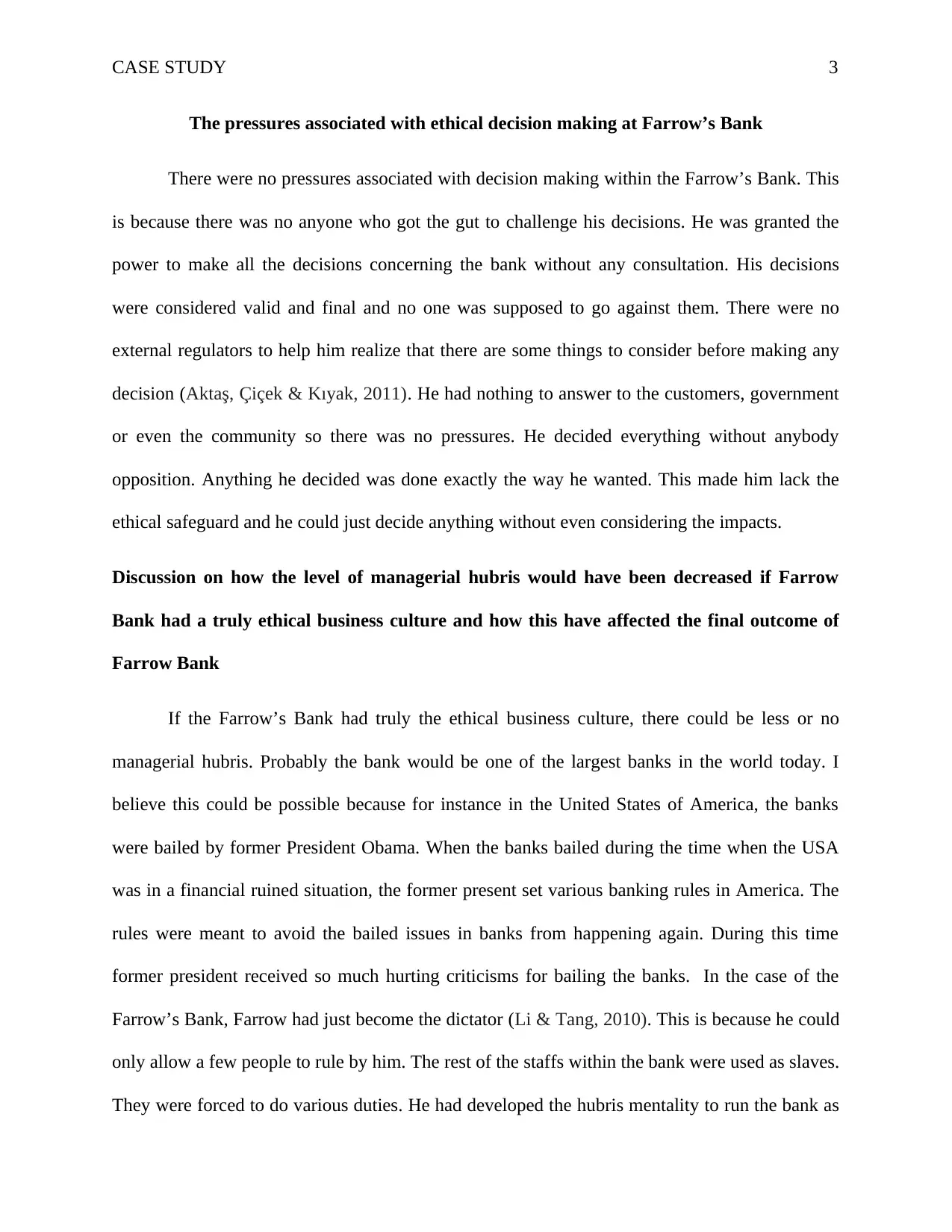
The pressures associated with ethical decision making at Farrow’s Bank
There were no pressures associated with decision making within the Farrow’s Bank. This
is because there was no anyone who got the gut to challenge his decisions. He was granted the
power to make all the decisions concerning the bank without any consultation. His decisions
were considered valid and final and no one was supposed to go against them. There were no
external regulators to help him realize that there are some things to consider before making any
decision (Aktaş, Çiçek & Kıyak, 2011). He had nothing to answer to the customers, government
or even the community so there was no pressures. He decided everything without anybody
opposition. Anything he decided was done exactly the way he wanted. This made him lack the
ethical safeguard and he could just decide anything without even considering the impacts.
Discussion on how the level of managerial hubris would have been decreased if Farrow
Bank had a truly ethical business culture and how this have affected the final outcome of
Farrow Bank
If the Farrow’s Bank had truly the ethical business culture, there could be less or no
managerial hubris. Probably the bank would be one of the largest banks in the world today. I
believe this could be possible because for instance in the United States of America, the banks
were bailed by former President Obama. When the banks bailed during the time when the USA
was in a financial ruined situation, the former present set various banking rules in America. The
rules were meant to avoid the bailed issues in banks from happening again. During this time
former president received so much hurting criticisms for bailing the banks. In the case of the
Farrow’s Bank, Farrow had just become the dictator (Li & Tang, 2010). This is because he could
only allow a few people to rule by him. The rest of the staffs within the bank were used as slaves.
They were forced to do various duties. He had developed the hubris mentality to run the bank as
The pressures associated with ethical decision making at Farrow’s Bank
There were no pressures associated with decision making within the Farrow’s Bank. This
is because there was no anyone who got the gut to challenge his decisions. He was granted the
power to make all the decisions concerning the bank without any consultation. His decisions
were considered valid and final and no one was supposed to go against them. There were no
external regulators to help him realize that there are some things to consider before making any
decision (Aktaş, Çiçek & Kıyak, 2011). He had nothing to answer to the customers, government
or even the community so there was no pressures. He decided everything without anybody
opposition. Anything he decided was done exactly the way he wanted. This made him lack the
ethical safeguard and he could just decide anything without even considering the impacts.
Discussion on how the level of managerial hubris would have been decreased if Farrow
Bank had a truly ethical business culture and how this have affected the final outcome of
Farrow Bank
If the Farrow’s Bank had truly the ethical business culture, there could be less or no
managerial hubris. Probably the bank would be one of the largest banks in the world today. I
believe this could be possible because for instance in the United States of America, the banks
were bailed by former President Obama. When the banks bailed during the time when the USA
was in a financial ruined situation, the former present set various banking rules in America. The
rules were meant to avoid the bailed issues in banks from happening again. During this time
former president received so much hurting criticisms for bailing the banks. In the case of the
Farrow’s Bank, Farrow had just become the dictator (Li & Tang, 2010). This is because he could
only allow a few people to rule by him. The rest of the staffs within the bank were used as slaves.
They were forced to do various duties. He had developed the hubris mentality to run the bank as
⊘ This is a preview!⊘
Do you want full access?
Subscribe today to unlock all pages.

Trusted by 1+ million students worldwide

CASE STUDY 4
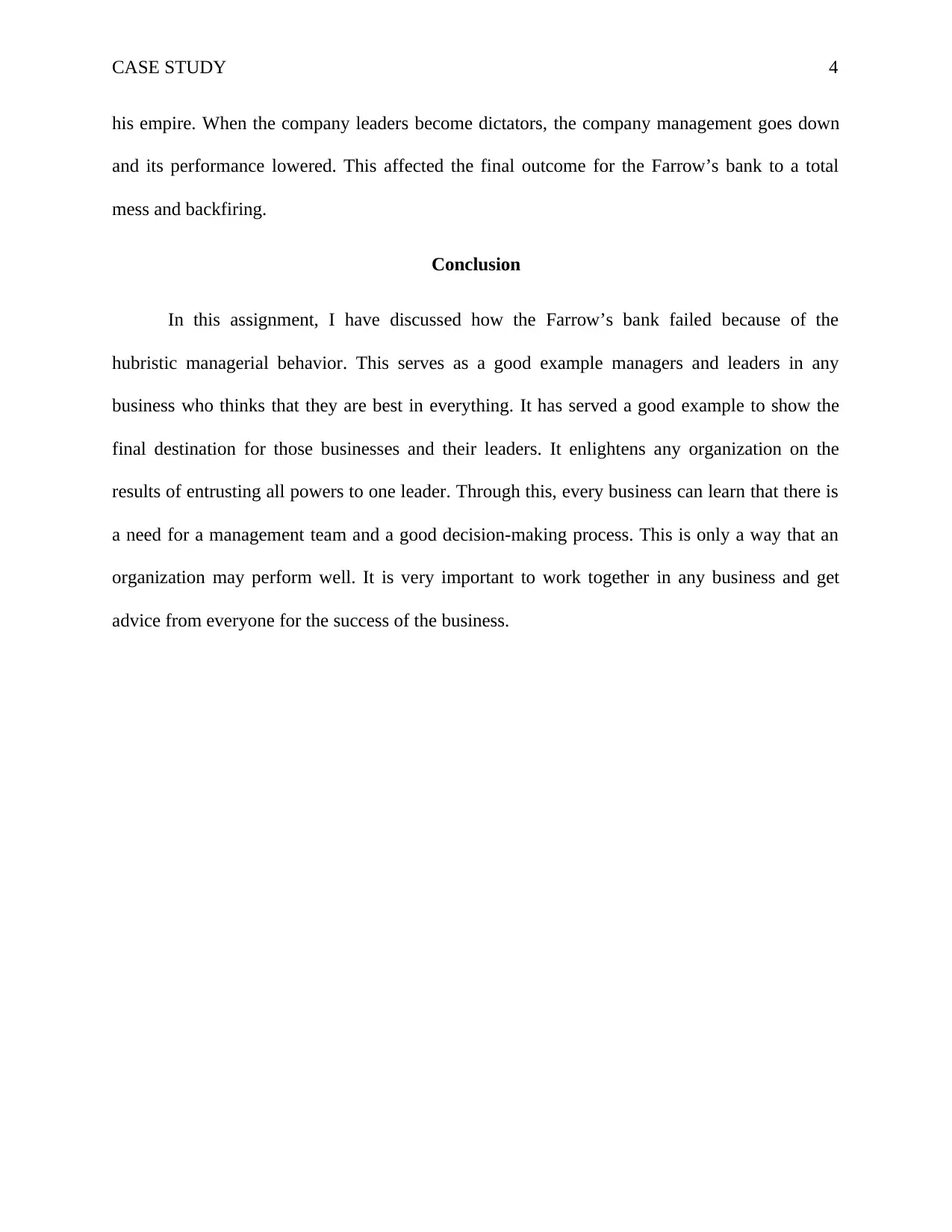
his empire. When the company leaders become dictators, the company management goes down
and its performance lowered. This affected the final outcome for the Farrow’s bank to a total
mess and backfiring.
Conclusion
In this assignment, I have discussed how the Farrow’s bank failed because of the
hubristic managerial behavior. This serves as a good example managers and leaders in any
business who thinks that they are best in everything. It has served a good example to show the
final destination for those businesses and their leaders. It enlightens any organization on the
results of entrusting all powers to one leader. Through this, every business can learn that there is
a need for a management team and a good decision-making process. This is only a way that an
organization may perform well. It is very important to work together in any business and get
advice from everyone for the success of the business.
his empire. When the company leaders become dictators, the company management goes down
and its performance lowered. This affected the final outcome for the Farrow’s bank to a total
mess and backfiring.
Conclusion
In this assignment, I have discussed how the Farrow’s bank failed because of the
hubristic managerial behavior. This serves as a good example managers and leaders in any
business who thinks that they are best in everything. It has served a good example to show the
final destination for those businesses and their leaders. It enlightens any organization on the
results of entrusting all powers to one leader. Through this, every business can learn that there is
a need for a management team and a good decision-making process. This is only a way that an
organization may perform well. It is very important to work together in any business and get
advice from everyone for the success of the business.
Paraphrase This Document
Need a fresh take? Get an instant paraphrase of this document with our AI Paraphraser

CASE STUDY 5
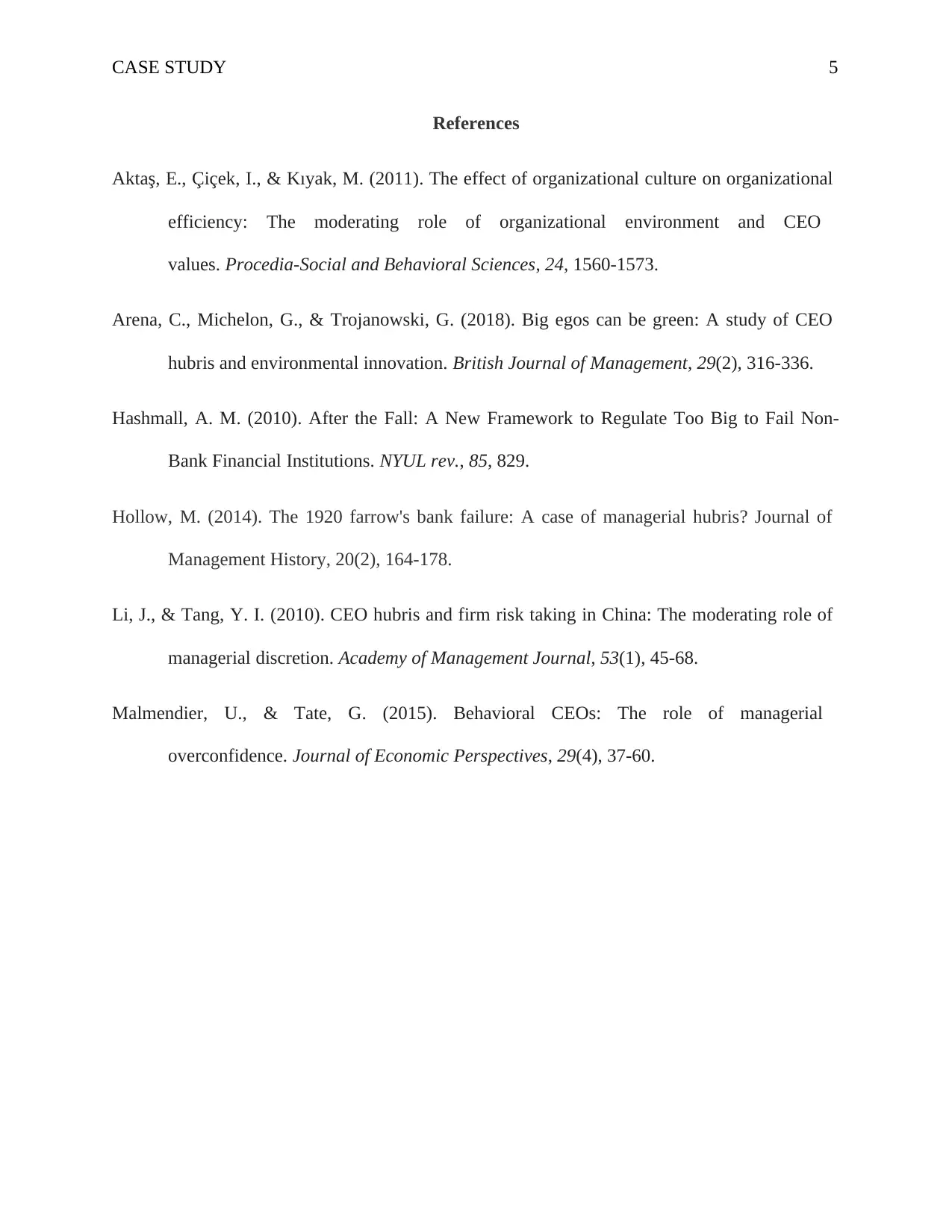
References
Aktaş, E., Çiçek, I., & Kıyak, M. (2011). The effect of organizational culture on organizational
efficiency: The moderating role of organizational environment and CEO
values. Procedia-Social and Behavioral Sciences, 24, 1560-1573.
Arena, C., Michelon, G., & Trojanowski, G. (2018). Big egos can be green: A study of CEO
hubris and environmental innovation. British Journal of Management, 29(2), 316-336.
Hashmall, A. M. (2010). After the Fall: A New Framework to Regulate Too Big to Fail Non-
Bank Financial Institutions. NYUL rev., 85, 829.
Hollow, M. (2014). The 1920 farrow's bank failure: A case of managerial hubris? Journal of
Management History, 20(2), 164-178.
Li, J., & Tang, Y. I. (2010). CEO hubris and firm risk taking in China: The moderating role of
managerial discretion. Academy of Management Journal, 53(1), 45-68.
Malmendier, U., & Tate, G. (2015). Behavioral CEOs: The role of managerial
overconfidence. Journal of Economic Perspectives, 29(4), 37-60.
References
Aktaş, E., Çiçek, I., & Kıyak, M. (2011). The effect of organizational culture on organizational
efficiency: The moderating role of organizational environment and CEO
values. Procedia-Social and Behavioral Sciences, 24, 1560-1573.
Arena, C., Michelon, G., & Trojanowski, G. (2018). Big egos can be green: A study of CEO
hubris and environmental innovation. British Journal of Management, 29(2), 316-336.
Hashmall, A. M. (2010). After the Fall: A New Framework to Regulate Too Big to Fail Non-
Bank Financial Institutions. NYUL rev., 85, 829.
Hollow, M. (2014). The 1920 farrow's bank failure: A case of managerial hubris? Journal of
Management History, 20(2), 164-178.
Li, J., & Tang, Y. I. (2010). CEO hubris and firm risk taking in China: The moderating role of
managerial discretion. Academy of Management Journal, 53(1), 45-68.
Malmendier, U., & Tate, G. (2015). Behavioral CEOs: The role of managerial
overconfidence. Journal of Economic Perspectives, 29(4), 37-60.
1 out of 5
Related Documents
Your All-in-One AI-Powered Toolkit for Academic Success.
+13062052269
info@desklib.com
Available 24*7 on WhatsApp / Email
Unlock your academic potential
Copyright © 2020–2025 A2Z Services. All Rights Reserved. Developed and managed by ZUCOL.