Fascism: Ideology, Totalitarianism, and Its Application in Practice

Verified

Added on  2022/12/09

|4
|457
|41
Homework Assignment
AI Summary
This assignment delves into the ideology of Fascism, exploring its key aspects, such as dictatorial power, suppression of opposition, and the regimentation of society and the economy. It examines the concept of totalitarianism as a core element of Fascism and discusses its potential for empowering a state's people if implemented with equity. The assignment provides historical examples of Fascism in practice, specifically referencing the leadership of Mussolini in Italy and Hitler in Germany, and how the ideology was used to achieve specific goals. The assignment references academic sources to support its analysis.
Document Page
Running head: FASCISM
FASCISM
Name of the University:
Name of the Student:
Author Note:
tabler-icon-diamond-filled.svg

Paraphrase This Document

Need a fresh take? Get an instant paraphrase of this document with our AI Paraphraser
Document Page
1
FASCISM
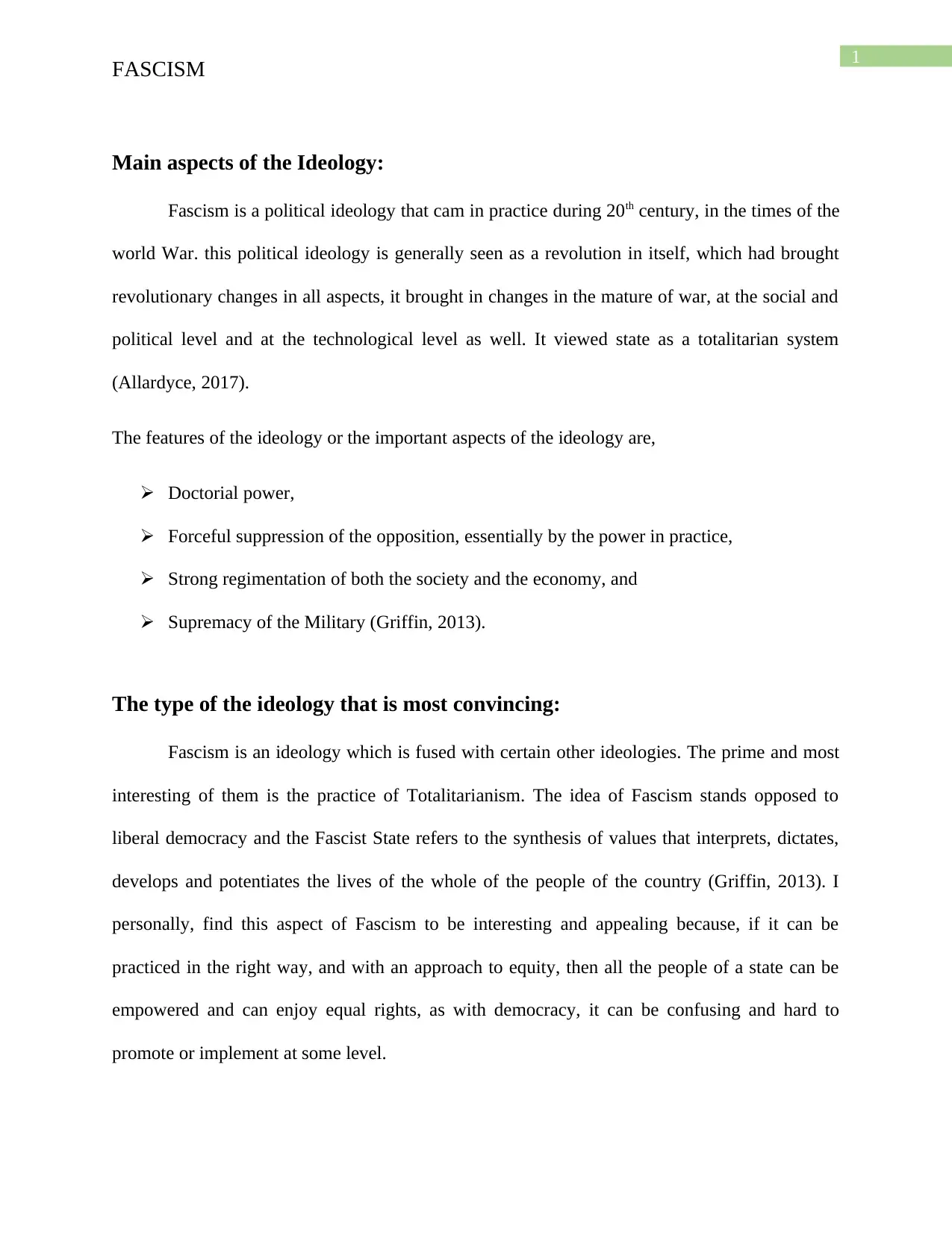
Main aspects of the Ideology:
Fascism is a political ideology that cam in practice during 20th century, in the times of the
world War. this political ideology is generally seen as a revolution in itself, which had brought
revolutionary changes in all aspects, it brought in changes in the mature of war, at the social and
political level and at the technological level as well. It viewed state as a totalitarian system
(Allardyce, 2017).
The features of the ideology or the important aspects of the ideology are,
Doctorial power,
Forceful suppression of the opposition, essentially by the power in practice,
Strong regimentation of both the society and the economy, and
Supremacy of the Military (Griffin, 2013).
The type of the ideology that is most convincing:
Fascism is an ideology which is fused with certain other ideologies. The prime and most
interesting of them is the practice of Totalitarianism. The idea of Fascism stands opposed to
liberal democracy and the Fascist State refers to the synthesis of values that interprets, dictates,
develops and potentiates the lives of the whole of the people of the country (Griffin, 2013). I
personally, find this aspect of Fascism to be interesting and appealing because, if it can be
practiced in the right way, and with an approach to equity, then all the people of a state can be
empowered and can enjoy equal rights, as with democracy, it can be confusing and hard to
promote or implement at some level.
Document Page
2
FASCISM
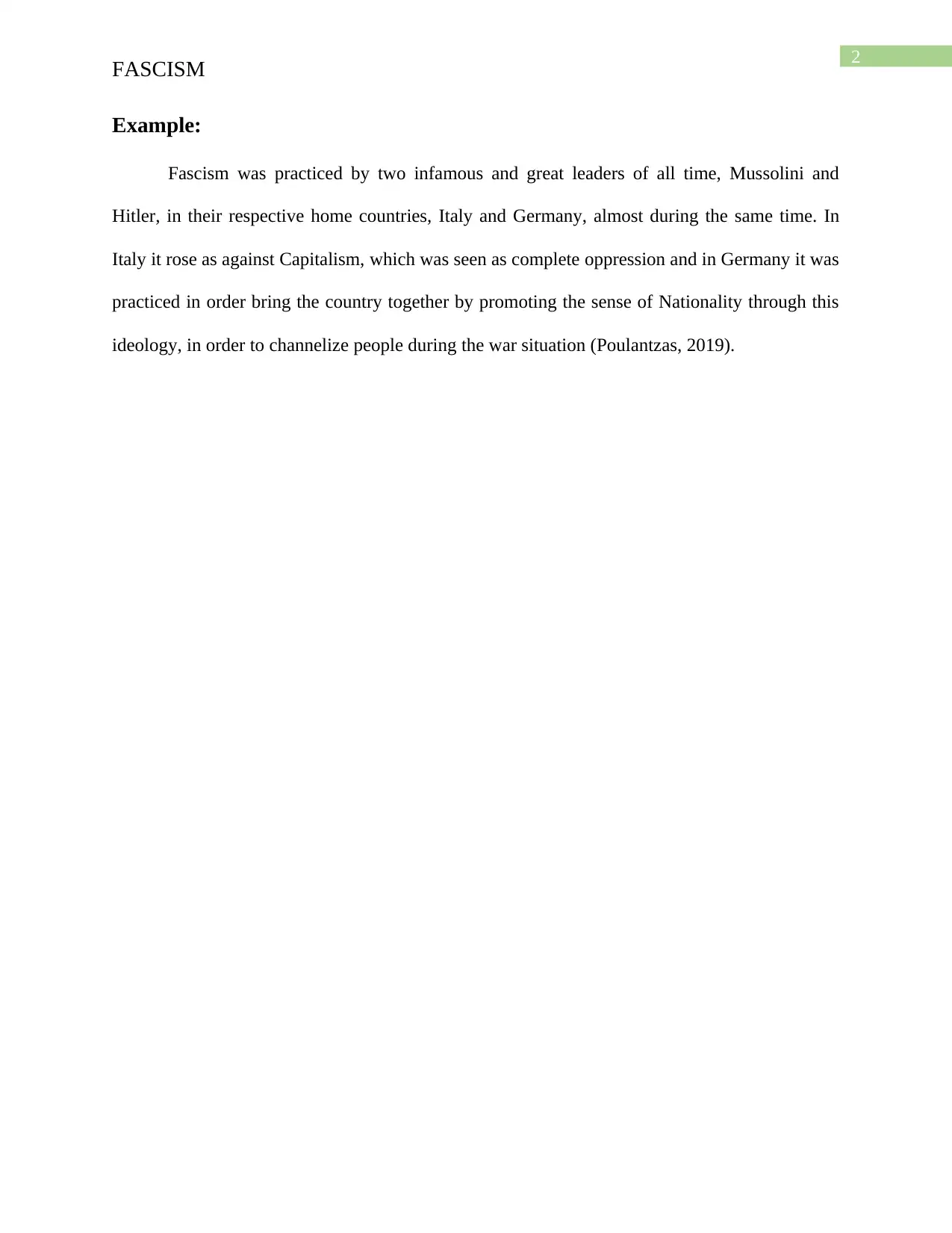
Example:
Fascism was practiced by two infamous and great leaders of all time, Mussolini and
Hitler, in their respective home countries, Italy and Germany, almost during the same time. In
Italy it rose as against Capitalism, which was seen as complete oppression and in Germany it was
practiced in order bring the country together by promoting the sense of Nationality through this
ideology, in order to channelize people during the war situation (Poulantzas, 2019).
Document Page
3
FASCISM
References:
Allardyce, G. (2017). What Fascism is not: Thoughts on the Deflation of a Concept.
In Fascism (pp. 35-56). Routledge.
Griffin, R. (2013). The nature of fascism. Routledge.
Poulantzas, N. (2019). Fascism and Dictatorship: the Third International and the problem of
Fascism. Verso Books.
chevron_up_icon
1 out of 4
circle_padding
hide_on_mobile
zoom_out_icon
[object Object]