Fatherhood in Canada: Analyzing Shifting Roles and Family Impact
VerifiedAdded on 2023/06/11
|9
|1627
|432
Report
AI Summary
This report explores the evolving role of fatherhood in Canada due to changing family dynamics, particularly the increased participation of women in the workplace. Through a qualitative survey of 50 families, the study investigates how these shifts affect fathers' relationships with their children and overall family happiness. The results indicate that increased opportunities for women lead to more flexibility for men to engage with their families, providing emotional support and enabling women to pursue personal interests. The study concludes that increased paternal involvement contributes to a sense of security and happiness within families, highlighting the importance of organizational support for work-life balance. Desklib provides access to similar reports and solved assignments for students.
Running Head: FATHERHOOD IN CANADA
Fatherhood in Canada
Name of the Student
Name of the University
Student ID
Fatherhood in Canada
Name of the Student
Name of the University
Student ID
Paraphrase This Document
Need a fresh take? Get an instant paraphrase of this document with our AI Paraphraser

1FATHERHOOD IN CANADA
Abstract
In the present days, women are given equal rights with men. They are now able to obtain the top
jobs in different organizations and get paid almost equal to that of men. The roles of the
Canadian fathers are greatly influenced by this all round performance of the female family
members. They are able to share the family responsibilities together. The relationship of the
parents with the family are expected to reduce with the involvement of both parents in the work
culture. The results of the analysis show that as the opportunities increases for women, the
opportunities for men also increases and thus are able to provide emotional support to their
families.
Abstract
In the present days, women are given equal rights with men. They are now able to obtain the top
jobs in different organizations and get paid almost equal to that of men. The roles of the
Canadian fathers are greatly influenced by this all round performance of the female family
members. They are able to share the family responsibilities together. The relationship of the
parents with the family are expected to reduce with the involvement of both parents in the work
culture. The results of the analysis show that as the opportunities increases for women, the
opportunities for men also increases and thus are able to provide emotional support to their
families.

2FATHERHOOD IN CANADA
Table of Contents
Introduction......................................................................................................................................4
Research questions...........................................................................................................................4
Research method..............................................................................................................................4
Results..............................................................................................................................................5
Discussion and Conclusion..............................................................................................................7
References........................................................................................................................................9
Table of Contents
Introduction......................................................................................................................................4
Research questions...........................................................................................................................4
Research method..............................................................................................................................4
Results..............................................................................................................................................5
Discussion and Conclusion..............................................................................................................7
References........................................................................................................................................9
⊘ This is a preview!⊘
Do you want full access?
Subscribe today to unlock all pages.

Trusted by 1+ million students worldwide

3FATHERHOOD IN CANADA
Introduction
The role of women in the family is changing with there being more calls for equity of
rights between men and women. More women are having top jobs in their organization, being
paid nearly the same as men and exploring work opportunities similar to those of men which
they would not have had previously. The women are therefore able to access incomes and work
longer hours. This changing dynamic in women roles and position in society is also influencing
the role of the Canadian father. Since there are shared responsibilities between the man and the
woman in the family in the bread winning role, fathers are finding new ways to maintain their
positions in the family. Factors which had affected the nature of the relationship with their
children before are now reducing.
Research questions
The purpose of this research is to find out how these roles of fatherhood are changing and
how it is affecting the family dynamic in terms of the relationships that the fathers now have
with their children and their participation in children affairs. The hypothesis of this study can be
stated as follows:
Null Hypothesis: There is no significant difference in the happiness of the families with the
involvement of fathers in their lives with the changing family dynamic.
Alternate Hypothesis: There are significant differences in the happiness of the families with the
involvement of fathers in their lives with the changing family dynamic.
Research method
This research was conducted through a qualitative research study in order to obtain a
view of how fathers think that the changing family dynamic has contributed towards their role in
Introduction
The role of women in the family is changing with there being more calls for equity of
rights between men and women. More women are having top jobs in their organization, being
paid nearly the same as men and exploring work opportunities similar to those of men which
they would not have had previously. The women are therefore able to access incomes and work
longer hours. This changing dynamic in women roles and position in society is also influencing
the role of the Canadian father. Since there are shared responsibilities between the man and the
woman in the family in the bread winning role, fathers are finding new ways to maintain their
positions in the family. Factors which had affected the nature of the relationship with their
children before are now reducing.
Research questions
The purpose of this research is to find out how these roles of fatherhood are changing and
how it is affecting the family dynamic in terms of the relationships that the fathers now have
with their children and their participation in children affairs. The hypothesis of this study can be
stated as follows:
Null Hypothesis: There is no significant difference in the happiness of the families with the
involvement of fathers in their lives with the changing family dynamic.
Alternate Hypothesis: There are significant differences in the happiness of the families with the
involvement of fathers in their lives with the changing family dynamic.
Research method
This research was conducted through a qualitative research study in order to obtain a
view of how fathers think that the changing family dynamic has contributed towards their role in
Paraphrase This Document
Need a fresh take? Get an instant paraphrase of this document with our AI Paraphraser

4FATHERHOOD IN CANADA
the lives of their children and their families as a whole in making them happier. The research was
conducted in form of a questionnaire survey where qualitative aspects of fatherhood and the
family dynamic has changed asked from 50 families in the neighborhood. The participants of the
study will be selected through random sampling. As much as the sample was random, it involved
selecting families which had a significant male figure in the family whether a nuclear family or a
single father family.
Results
Single Fathers Nuclear families
0
5
10
15
20
25
30
35
Type of families considered in the study
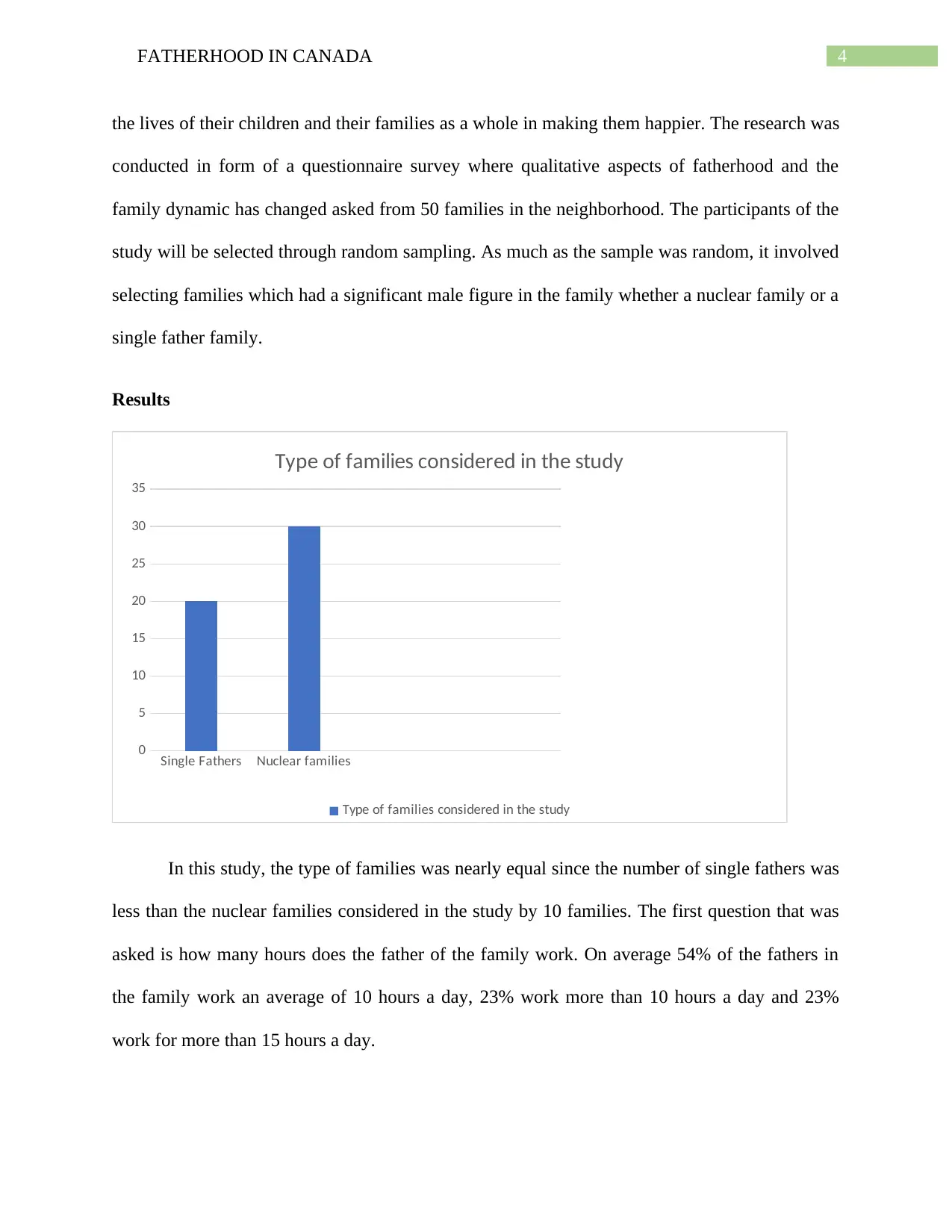
In this study, the type of families was nearly equal since the number of single fathers was
less than the nuclear families considered in the study by 10 families. The first question that was
asked is how many hours does the father of the family work. On average 54% of the fathers in
the family work an average of 10 hours a day, 23% work more than 10 hours a day and 23%
work for more than 15 hours a day.
the lives of their children and their families as a whole in making them happier. The research was
conducted in form of a questionnaire survey where qualitative aspects of fatherhood and the
family dynamic has changed asked from 50 families in the neighborhood. The participants of the
study will be selected through random sampling. As much as the sample was random, it involved
selecting families which had a significant male figure in the family whether a nuclear family or a
single father family.
Results
Single Fathers Nuclear families
0
5
10
15
20
25
30
35
Type of families considered in the study
In this study, the type of families was nearly equal since the number of single fathers was
less than the nuclear families considered in the study by 10 families. The first question that was
asked is how many hours does the father of the family work. On average 54% of the fathers in
the family work an average of 10 hours a day, 23% work more than 10 hours a day and 23%
work for more than 15 hours a day.

5FATHERHOOD IN CANADA
From the survey, 49% of the men revealed that increased participation by women in the
workplace has made it more flexible for them to obtain leave hours or days. Some pointed out
that it created increased capacity for the places that they work in and in turn their work places
were more accommodative towards the male counterparts receiving more leave days.
Do you want your father home more often
Yes No
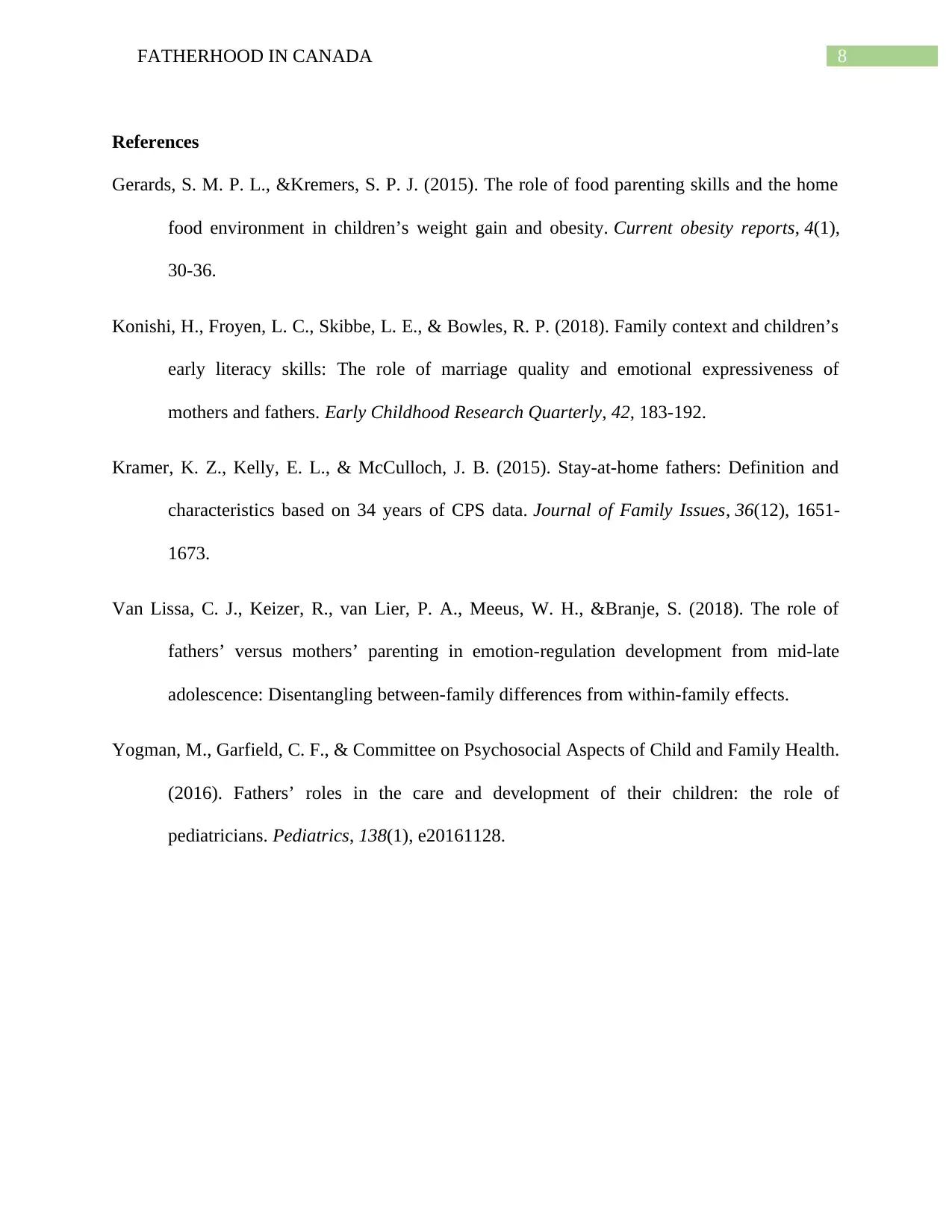
When asked whether the children and the wives would like the fathers home more often,
62% responded yes while 38% responded no. Further, each side was asked to validate why that
was the case. For the ones who would like to have their fathers home longer was because the
presence of a father in the home signified to them a stable home where the children would obtain
emotional support through the physical presence of the father in the home. On the other hand,
families which responded no highlighted that the father presence in the home would mean more
rules (this was mostly highlighted by children in single parent homes).
Preceding questions were asked to understand how individuals in the families feel that
their lives have changed with the increased presence of fathers in the families. In the case of the
From the survey, 49% of the men revealed that increased participation by women in the
workplace has made it more flexible for them to obtain leave hours or days. Some pointed out
that it created increased capacity for the places that they work in and in turn their work places
were more accommodative towards the male counterparts receiving more leave days.
Do you want your father home more often
Yes No
When asked whether the children and the wives would like the fathers home more often,
62% responded yes while 38% responded no. Further, each side was asked to validate why that
was the case. For the ones who would like to have their fathers home longer was because the
presence of a father in the home signified to them a stable home where the children would obtain
emotional support through the physical presence of the father in the home. On the other hand,
families which responded no highlighted that the father presence in the home would mean more
rules (this was mostly highlighted by children in single parent homes).
Preceding questions were asked to understand how individuals in the families feel that
their lives have changed with the increased presence of fathers in the families. In the case of the
⊘ This is a preview!⊘
Do you want full access?
Subscribe today to unlock all pages.

Trusted by 1+ million students worldwide

6FATHERHOOD IN CANADA
wives, they mentioned that it was nice seeing that the fathers were involved in the lives of their
children. Some mentioned that it was good knowing that they were able to pursue other options
such as career or engaging in a business or hobby with the presence of the father in the home to
participate in other roles in the home. They felt more secure to pursue their own personal
interests. Some added that it was lovely to experience dinner time with all members of the family
on one table.
In the case of the children, most mentioned that having more time with their fathers was
good as it provided them a chance to bond more. It also enabled them to learn certain aspects of
their life. For instance, the boys noted that they had a chance to learn fast hand about what it
means to be a man. To the girls in a home, they were able to experience and see their mothers
working which increased the level of ambition they had within them.
Discussion and Conclusion
From the research, it is clear that increased opportunities for women created more
opportunity for men in terms of providing emotional support to their families. Reports showed
that increased presence of men in the home allowed more men to engage more with their families
especially the children of the home. It therefore decreased the burden of emotional support
provided by the mothers of the home (Gerrards & Kremers, 2018). Also, increased father’s
presence provided opportunity for the women of the house to be engaged in other activities other
than the family such as pursuing career interests or other hobbies or business ideas. In this case,
happiness is defined as the ability of individuals to participate in events which add onto their
goals and provide an element of security to their lives. From the study, it can be said that the
individuals who experience more family time from their fathers seem to be happier since they are
able to obtain emotional support and have a feel of a secure family with their fathers present. It
wives, they mentioned that it was nice seeing that the fathers were involved in the lives of their
children. Some mentioned that it was good knowing that they were able to pursue other options
such as career or engaging in a business or hobby with the presence of the father in the home to
participate in other roles in the home. They felt more secure to pursue their own personal
interests. Some added that it was lovely to experience dinner time with all members of the family
on one table.
In the case of the children, most mentioned that having more time with their fathers was
good as it provided them a chance to bond more. It also enabled them to learn certain aspects of
their life. For instance, the boys noted that they had a chance to learn fast hand about what it
means to be a man. To the girls in a home, they were able to experience and see their mothers
working which increased the level of ambition they had within them.
Discussion and Conclusion
From the research, it is clear that increased opportunities for women created more
opportunity for men in terms of providing emotional support to their families. Reports showed
that increased presence of men in the home allowed more men to engage more with their families
especially the children of the home. It therefore decreased the burden of emotional support
provided by the mothers of the home (Gerrards & Kremers, 2018). Also, increased father’s
presence provided opportunity for the women of the house to be engaged in other activities other
than the family such as pursuing career interests or other hobbies or business ideas. In this case,
happiness is defined as the ability of individuals to participate in events which add onto their
goals and provide an element of security to their lives. From the study, it can be said that the
individuals who experience more family time from their fathers seem to be happier since they are
able to obtain emotional support and have a feel of a secure family with their fathers present. It
Paraphrase This Document
Need a fresh take? Get an instant paraphrase of this document with our AI Paraphraser

7FATHERHOOD IN CANADA
should be noted that this comes as a result of increased opportunities for women (Kramer &
McCulloch, 2015).
The results from the study could be used by organizations to recognize the role of
increasing opportunities for women and the impact it would potentially have on families. Further
it also creates opportunity for organizations to recognize that they should allow more off time for
fathers to allow happier societies (Konishi & Bowles, 2018).
should be noted that this comes as a result of increased opportunities for women (Kramer &
McCulloch, 2015).
The results from the study could be used by organizations to recognize the role of
increasing opportunities for women and the impact it would potentially have on families. Further
it also creates opportunity for organizations to recognize that they should allow more off time for
fathers to allow happier societies (Konishi & Bowles, 2018).

8FATHERHOOD IN CANADA
References
Gerards, S. M. P. L., &Kremers, S. P. J. (2015). The role of food parenting skills and the home
food environment in children’s weight gain and obesity. Current obesity reports, 4(1),
30-36.
Konishi, H., Froyen, L. C., Skibbe, L. E., & Bowles, R. P. (2018). Family context and children’s
early literacy skills: The role of marriage quality and emotional expressiveness of
mothers and fathers. Early Childhood Research Quarterly, 42, 183-192.
Kramer, K. Z., Kelly, E. L., & McCulloch, J. B. (2015). Stay-at-home fathers: Definition and
characteristics based on 34 years of CPS data. Journal of Family Issues, 36(12), 1651-
1673.
Van Lissa, C. J., Keizer, R., van Lier, P. A., Meeus, W. H., &Branje, S. (2018). The role of
fathers’ versus mothers’ parenting in emotion-regulation development from mid-late
adolescence: Disentangling between-family differences from within-family effects.
Yogman, M., Garfield, C. F., & Committee on Psychosocial Aspects of Child and Family Health.
(2016). Fathers’ roles in the care and development of their children: the role of
pediatricians. Pediatrics, 138(1), e20161128.
References
Gerards, S. M. P. L., &Kremers, S. P. J. (2015). The role of food parenting skills and the home
food environment in children’s weight gain and obesity. Current obesity reports, 4(1),
30-36.
Konishi, H., Froyen, L. C., Skibbe, L. E., & Bowles, R. P. (2018). Family context and children’s
early literacy skills: The role of marriage quality and emotional expressiveness of
mothers and fathers. Early Childhood Research Quarterly, 42, 183-192.
Kramer, K. Z., Kelly, E. L., & McCulloch, J. B. (2015). Stay-at-home fathers: Definition and
characteristics based on 34 years of CPS data. Journal of Family Issues, 36(12), 1651-
1673.
Van Lissa, C. J., Keizer, R., van Lier, P. A., Meeus, W. H., &Branje, S. (2018). The role of
fathers’ versus mothers’ parenting in emotion-regulation development from mid-late
adolescence: Disentangling between-family differences from within-family effects.
Yogman, M., Garfield, C. F., & Committee on Psychosocial Aspects of Child and Family Health.
(2016). Fathers’ roles in the care and development of their children: the role of
pediatricians. Pediatrics, 138(1), e20161128.
⊘ This is a preview!⊘
Do you want full access?
Subscribe today to unlock all pages.

Trusted by 1+ million students worldwide
1 out of 9
Related Documents
Your All-in-One AI-Powered Toolkit for Academic Success.
+13062052269
info@desklib.com
Available 24*7 on WhatsApp / Email
Unlock your academic potential
Copyright © 2020–2026 A2Z Services. All Rights Reserved. Developed and managed by ZUCOL.