Cross-Cultural Application of False Belief Task & Theory of Mind

Verified

Added on  2023/06/18

|7
|2055
|246
Essay
AI Summary
This essay provides an in-depth analysis of the False Belief Task (FBT) and its significance in evaluating children's understanding of Theory of Mind (ToM). It discusses how the FBT assesses children's ability to recognize that others may hold beliefs different from their own, highlighting its importance in social communication. The essay further explores the cross-cultural applicability of the FBT, examining research that investigates whether the development of ToM is universal or influenced by social and cultural factors. It concludes by emphasizing the role of social interactions, play, and cultural experiences in shaping a child's understanding of others' perspectives, which in turn influences their social functioning and academic success. The report references various books and journals to support its claims and provide a comprehensive overview of the topic.
Document Page
Summative Assessment –
Essay Coursework
tabler-icon-diamond-filled.svg

Paraphrase This Document

Need a fresh take? Get an instant paraphrase of this document with our AI Paraphraser
Document Page
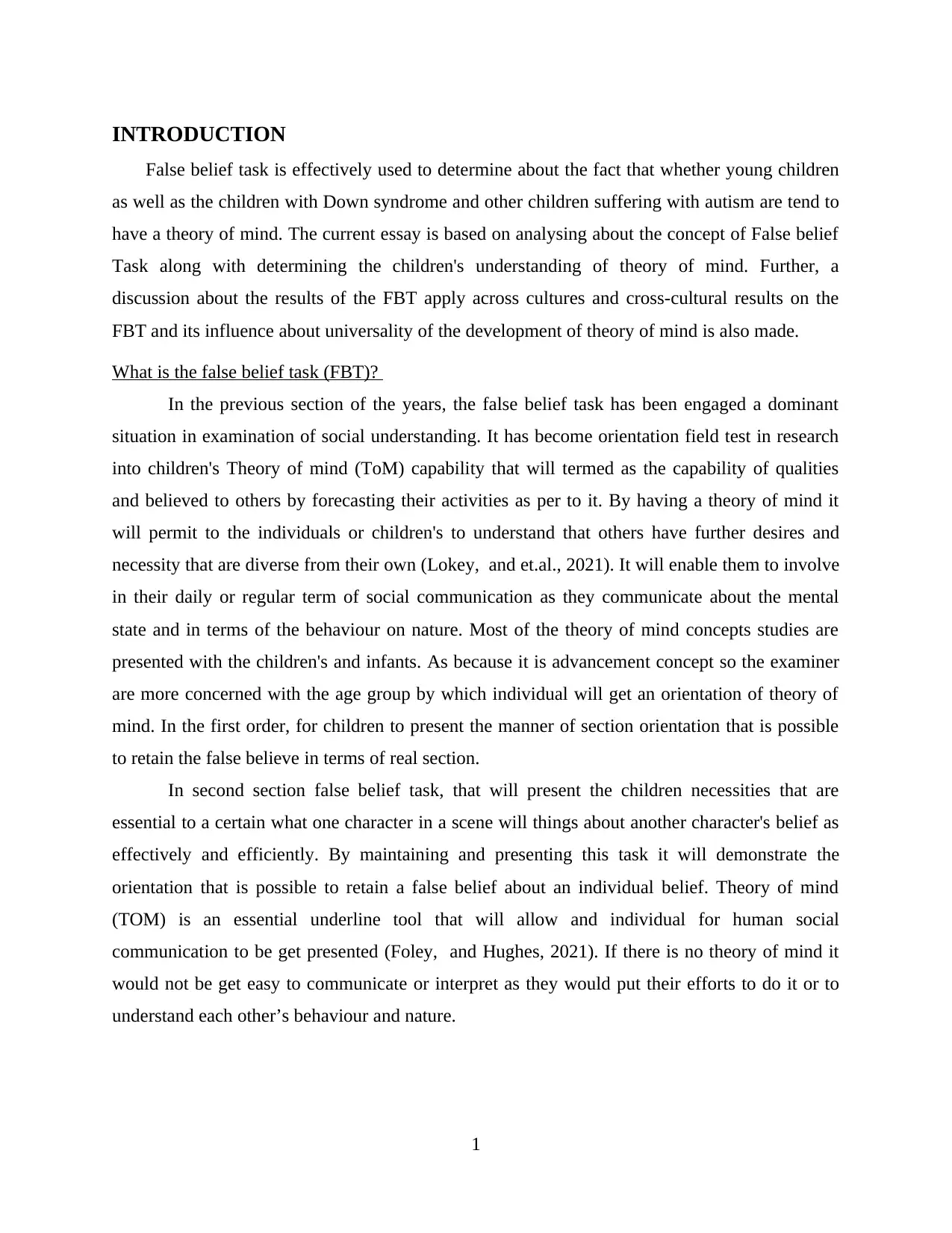
Table of Contents
Document Page
INTRODUCTION
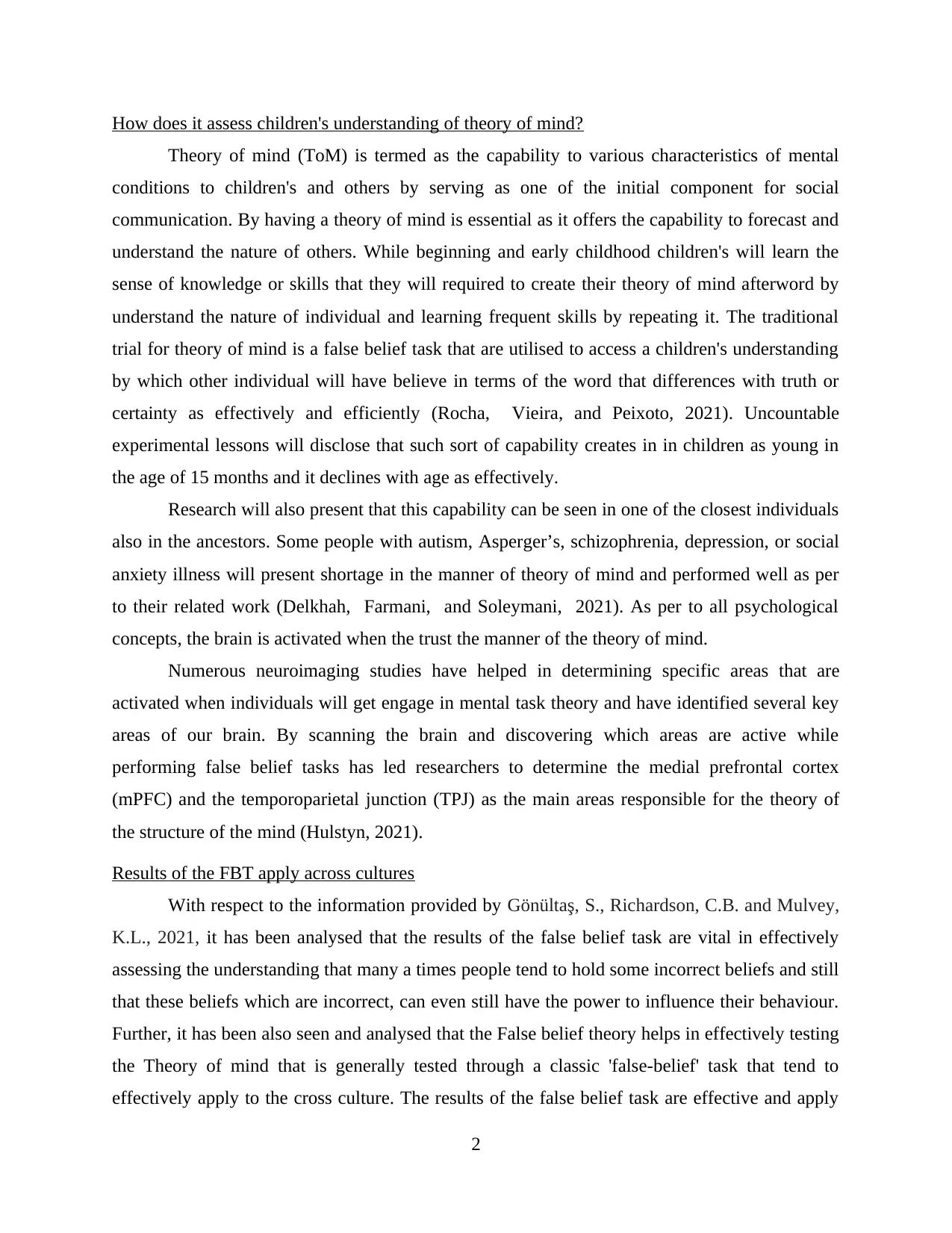
False belief task is effectively used to determine about the fact that whether young children
as well as the children with Down syndrome and other children suffering with autism are tend to
have a theory of mind. The current essay is based on analysing about the concept of False belief
Task along with determining the children's understanding of theory of mind. Further, a
discussion about the results of the FBT apply across cultures and cross-cultural results on the
FBT and its influence about universality of the development of theory of mind is also made.
What is the false belief task (FBT)?
In the previous section of the years, the false belief task has been engaged a dominant
situation in examination of social understanding. It has become orientation field test in research
into children's Theory of mind (ToM) capability that will termed as the capability of qualities
and believed to others by forecasting their activities as per to it. By having a theory of mind it
will permit to the individuals or children's to understand that others have further desires and
necessity that are diverse from their own (Lokey, and et.al., 2021). It will enable them to involve
in their daily or regular term of social communication as they communicate about the mental
state and in terms of the behaviour on nature. Most of the theory of mind concepts studies are
presented with the children's and infants. As because it is advancement concept so the examiner
are more concerned with the age group by which individual will get an orientation of theory of
mind. In the first order, for children to present the manner of section orientation that is possible
to retain the false believe in terms of real section.
In second section false belief task, that will present the children necessities that are
essential to a certain what one character in a scene will things about another character's belief as
effectively and efficiently. By maintaining and presenting this task it will demonstrate the
orientation that is possible to retain a false belief about an individual belief. Theory of mind
(TOM) is an essential underline tool that will allow and individual for human social
communication to be get presented (Foley, and Hughes, 2021). If there is no theory of mind it
would not be get easy to communicate or interpret as they would put their efforts to do it or to
understand each other’s behaviour and nature.
1
Document Page
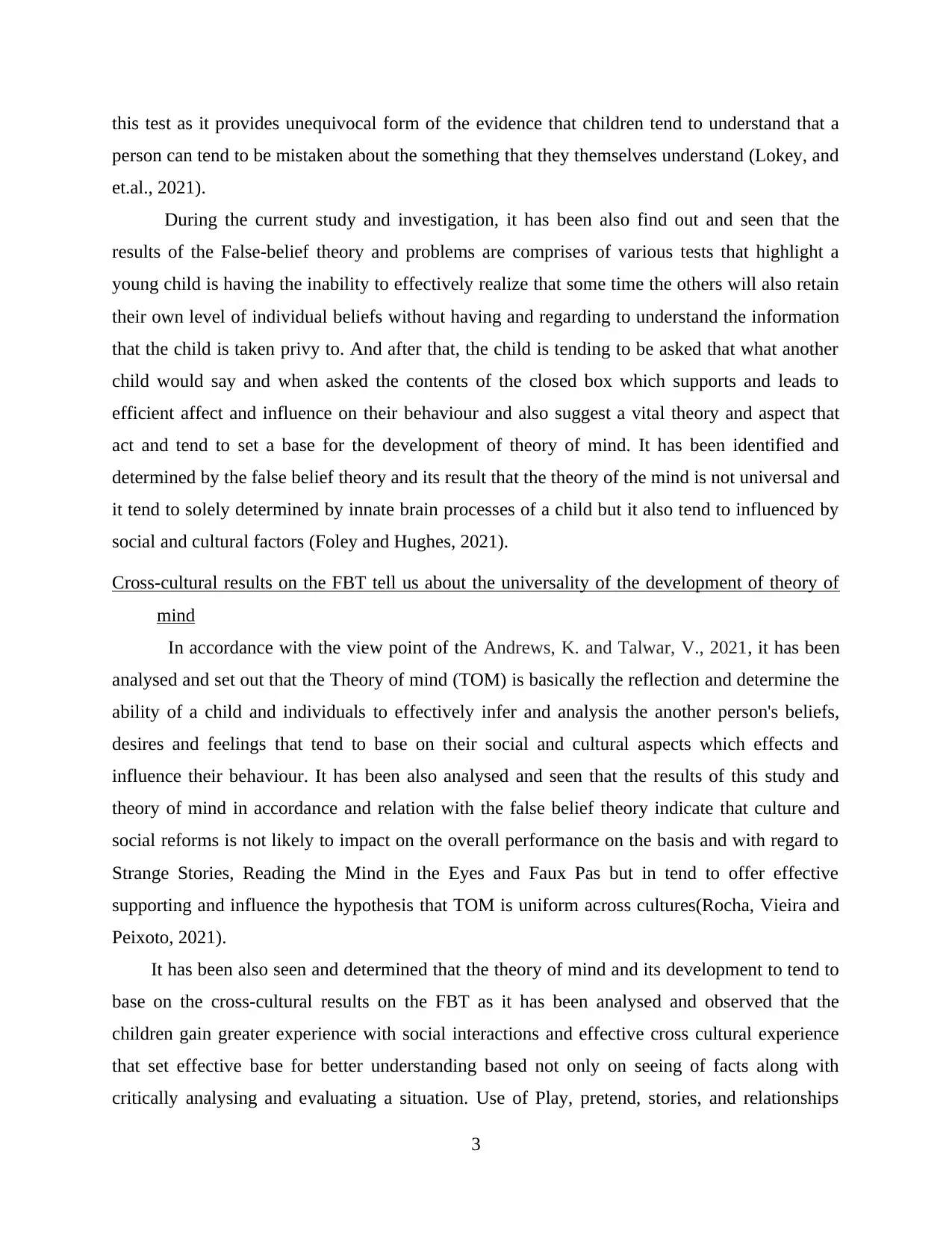
How does it assess children's understanding of theory of mind?
Theory of mind (ToM) is termed as the capability to various characteristics of mental
conditions to children's and others by serving as one of the initial component for social
communication. By having a theory of mind is essential as it offers the capability to forecast and
understand the nature of others. While beginning and early childhood children's will learn the
sense of knowledge or skills that they will required to create their theory of mind afterword by
understand the nature of individual and learning frequent skills by repeating it. The traditional
trial for theory of mind is a false belief task that are utilised to access a children's understanding
by which other individual will have believe in terms of the word that differences with truth or
certainty as effectively and efficiently (Rocha, Vieira, and Peixoto, 2021). Uncountable
experimental lessons will disclose that such sort of capability creates in in children as young in
the age of 15 months and it declines with age as effectively.
Research will also present that this capability can be seen in one of the closest individuals
also in the ancestors. Some people with autism, Asperger’s, schizophrenia, depression, or social
anxiety illness will present shortage in the manner of theory of mind and performed well as per
to their related work (Delkhah, Farmani, and Soleymani, 2021). As per to all psychological
concepts, the brain is activated when the trust the manner of the theory of mind.
Numerous neuroimaging studies have helped in determining specific areas that are
activated when individuals will get engage in mental task theory and have identified several key
areas of our brain. By scanning the brain and discovering which areas are active while
performing false belief tasks has led researchers to determine the medial prefrontal cortex
(mPFC) and the temporoparietal junction (TPJ) as the main areas responsible for the theory of
the structure of the mind (Hulstyn, 2021).
Results of the FBT apply across cultures
With respect to the information provided by Gönültaş, S., Richardson, C.B. and Mulvey,
K.L., 2021, it has been analysed that the results of the false belief task are vital in effectively
assessing the understanding that many a times people tend to hold some incorrect beliefs and still
that these beliefs which are incorrect, can even still have the power to influence their behaviour.
Further, it has been also seen and analysed that the False belief theory helps in effectively testing
the Theory of mind that is generally tested through a classic 'false-belief' task that tend to
effectively apply to the cross culture. The results of the false belief task are effective and apply
2
tabler-icon-diamond-filled.svg

Paraphrase This Document

Need a fresh take? Get an instant paraphrase of this document with our AI Paraphraser
Document Page
this test as it provides unequivocal form of the evidence that children tend to understand that a
person can tend to be mistaken about the something that they themselves understand (Lokey, and
et.al., 2021).
During the current study and investigation, it has been also find out and seen that the
results of the False-belief theory and problems are comprises of various tests that highlight a
young child is having the inability to effectively realize that some time the others will also retain
their own level of individual beliefs without having and regarding to understand the information
that the child is taken privy to. And after that, the child is tending to be asked that what another
child would say and when asked the contents of the closed box which supports and leads to
efficient affect and influence on their behaviour and also suggest a vital theory and aspect that
act and tend to set a base for the development of theory of mind. It has been identified and
determined by the false belief theory and its result that the theory of the mind is not universal and
it tend to solely determined by innate brain processes of a child but it also tend to influenced by
social and cultural factors (Foley and Hughes, 2021).
Cross-cultural results on the FBT tell us about the universality of the development of theory of
mind
In accordance with the view point of the Andrews, K. and Talwar, V., 2021, it has been
analysed and set out that the Theory of mind (TOM) is basically the reflection and determine the
ability of a child and individuals to effectively infer and analysis the another person's beliefs,
desires and feelings that tend to base on their social and cultural aspects which effects and
influence their behaviour. It has been also analysed and seen that the results of this study and
theory of mind in accordance and relation with the false belief theory indicate that culture and
social reforms is not likely to impact on the overall performance on the basis and with regard to
Strange Stories, Reading the Mind in the Eyes and Faux Pas but in tend to offer effective
supporting and influence the hypothesis that TOM is uniform across cultures(Rocha, Vieira and
Peixoto, 2021).
It has been also seen and determined that the theory of mind and its development to tend to
base on the cross-cultural results on the FBT as it has been analysed and observed that the
children gain greater experience with social interactions and effective cross cultural experience
that set effective base for better understanding based not only on seeing of facts along with
critically analysing and evaluating a situation. Use of Play, pretend, stories, and relationships
3
Document Page
along with effective interaction and situation with child and with parents along with peers is also
made based on cross-cultural results on the FBT that allow children to effectively develop and
have a stronger insight about the fact and the ways that how other thinking of the other people
might differ that from their own that sets out and leads out a base for analysing determining the
development of about the universality of the development of theory of mind. It has been also
analysing and find out that the implication of the cross-cultural results on the FBT provides
attention and first underlying a high level of the precursors to have the effective development of
a fully-fledged way of theory of mind. It has been also seen that it involves recognizing and
effectively analysing the fact that seeing is not merely related and associated with looking, but it
also comprises and rather that that includes the way of selectively direct our attention to specific
objects as well as people and the conducted research also shows that theory-of-mind
development tend to have the efficient consequences for the social functioning of the children as
well as on the school success based cross-cultural results on the FBT and supports universality of
the development of theory of mind (Hulstyn, 2021).
CONCLUSION
From the above mentioned report it has been concluded that, the false belief task
occupies a dominant position in the social understanding test. It has become a directional field
test for studying children's theory of mind (ToM) ability that are to be called quality, ability, and
trusting others when predicting their activities in their mind. As on the other side, by having a
theory of mind is essential because it provides the ability to predict and understand the nature of
others. Although beginners and early childhood children will learn the knowledge or skills they
need to create a theory of mind, the epilogue will understand the nature of the individual and
learn frequent skills through repetition.
REFERENCES
Books and journal
4
Document Page
Andrews, K. and Talwar, V., 2021. Considering morally relevant theory of mind through a
Social Domain Theory perspective. Journal of Moral Education, pp.1-15.
Delkhah, Z., Farmani, H.R. and Soleymani, Z., 2021. Language predictors of theory of mind in
cochlear implant children compared to normal-hearing peers. Auditory and Vestibular
Research.
Foley, S. and Hughes, C., 2021. Family influences on theory of mind in middle childhood.
In Theory of Mind in Middle Childhood and Adolescence (pp. 101-121). Routledge.
Gönültaş, S., Richardson, C.B. and Mulvey, K.L., 2021. But they weren’t being careful! Role of
theory of mind in moral judgments about victim and transgressor negligence. Journal of
experimental child psychology, 212, p.105234.
Hulstyn, M., 2021. Theory of Mind and Experimental Autobiography: Alain Robbe-Grillet and
Assia Djebar. Philosophy and Literature. 45(1). pp.185-198.
Lokey, S., and et.al., 2021. Individuals with Schizophrenia Under-Recruit Social Brain Regions
During a Theory of Mind Task. Biological Psychiatry. 89(9). pp.S173-S174.
Rocha, J.A., Vieira, A.C. and Peixoto, V., 2021. Theory of mind in Portuguese school children:
An exploratory study. Revista de Logopedia, Foniatría y Audiología. 41(3). pp.117-123.
5
chevron_up_icon
1 out of 7
circle_padding
hide_on_mobile
zoom_out_icon
[object Object]