U.S. FDA Requirements on Product Labeling for Public Safety

Verified

Added on  2021/04/17

|14
|1005
|107
Report
AI Summary
This report provides an overview of the U.S. Food and Drug Administration's (FDA) requirements for product labeling, focusing on its role in ensuring public safety. It details the two main types of drug labeling: over-the-counter (OTC) and prescription drugs, highlighting the evolution of FDA's labeling initiatives, starting from the 1990s. The report outlines the purpose of drug labeling, which is to provide healthcare professionals with essential information for appropriate drug prescription and to inform consumers. It also covers the key requirements of drug labeling, including statements on limitations, product names, warnings, and adverse reactions. Furthermore, the report discusses the limitations of current labeling practices, such as patient confusion, and explores the application of the FDA Label Database. The conclusion emphasizes the importance of drug labeling in preventing medication errors and promoting informed healthcare decisions, referencing relevant literature and databases.
Document Page
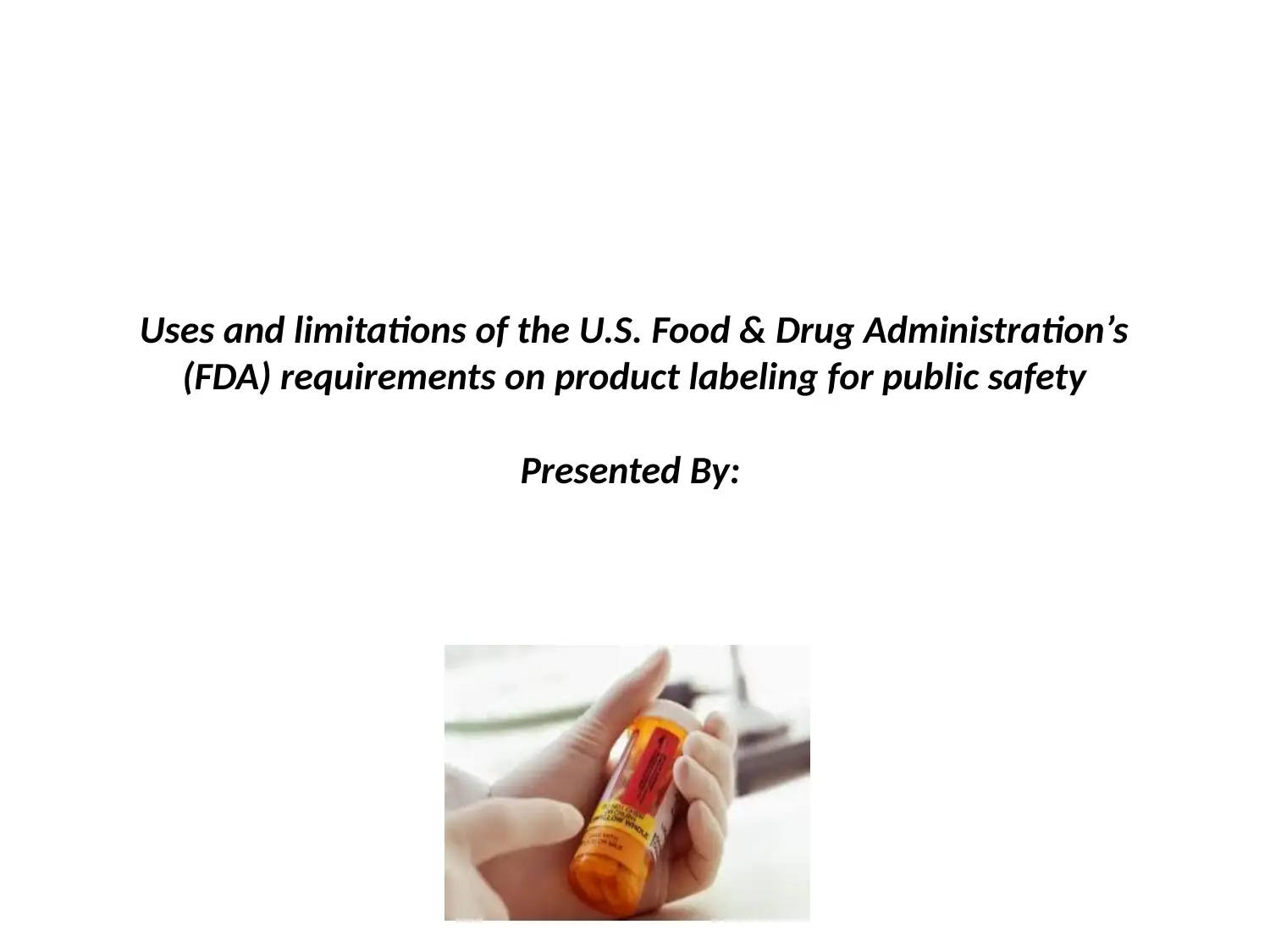
Uses and limitations of the U.S. Food & Drug Administration’s
(FDA) requirements on product labeling for public safety
Presented By:
tabler-icon-diamond-filled.svg

Paraphrase This Document

Need a fresh take? Get an instant paraphrase of this document with our AI Paraphraser
Document Page
Introduction
Display of the information centering
the product on its container or over
its packaging material is known as
product labeling
Drug Labeling is a form of product
labeling
It is FDA's initiative to manage risks
associated with medical product via
minimizing the adverse events (US
Food and Drug Administration,
2017).
Document Page
What is Product or Drug Labeling?
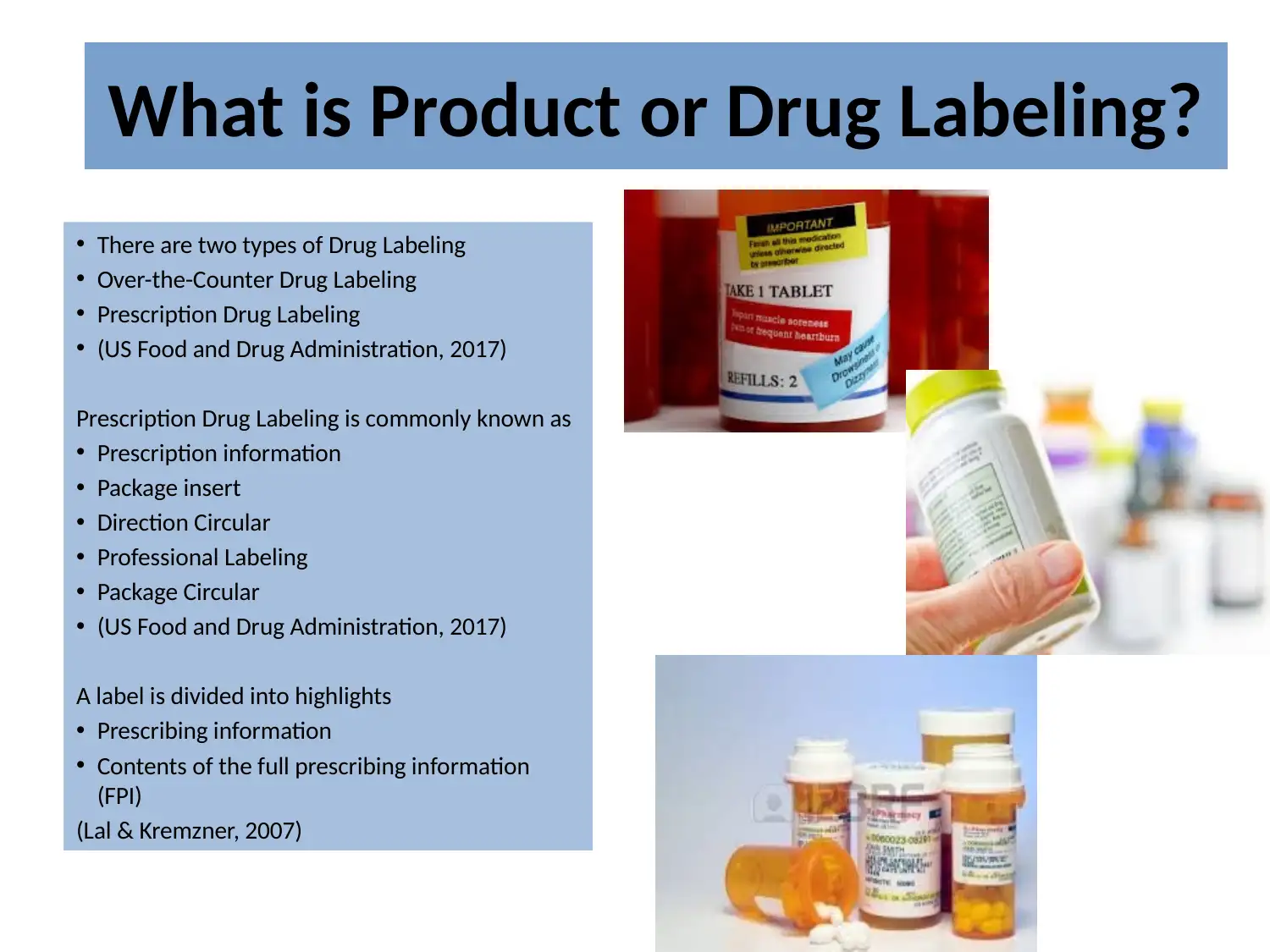
There are two types of Drug Labeling
Over-the-Counter Drug Labeling
Prescription Drug Labeling
(US Food and Drug Administration, 2017)
Prescription Drug Labeling is commonly known as
Prescription information
Package insert
Direction Circular
Professional Labeling
Package Circular
(US Food and Drug Administration, 2017)
A label is divided into highlights
Prescribing information
Contents of the full prescribing information
(FPI)
(Lal & Kremzner, 2007)
Document Page
Advent of the Concept of Drug Labeling
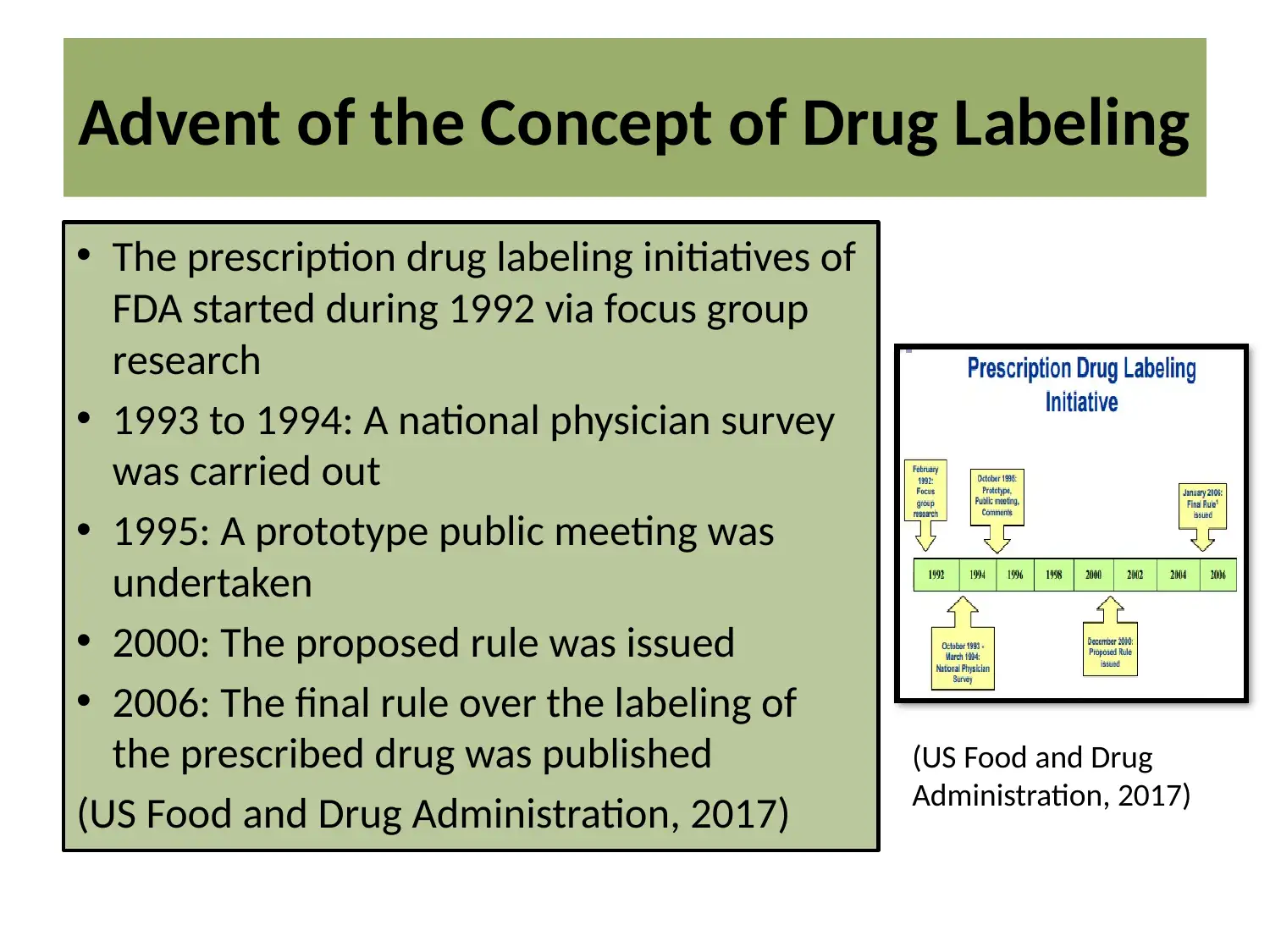
The prescription drug labeling initiatives of
FDA started during 1992 via focus group
research
1993 to 1994: A national physician survey
was carried out
1995: A prototype public meeting was
undertaken
2000: The proposed rule was issued
2006: The final rule over the labeling of
the prescribed drug was published
(US Food and Drug Administration, 2017)
(US Food and Drug
Administration, 2017)
tabler-icon-diamond-filled.svg

Paraphrase This Document

Need a fresh take? Get an instant paraphrase of this document with our AI Paraphraser
Document Page
Purpose of Drug Labeling
Primary function of drug labeling (Prescription
Drug Labeling) is to provide the healthcare
professional the information they need to
prescribe the drug in an appropriate manner.
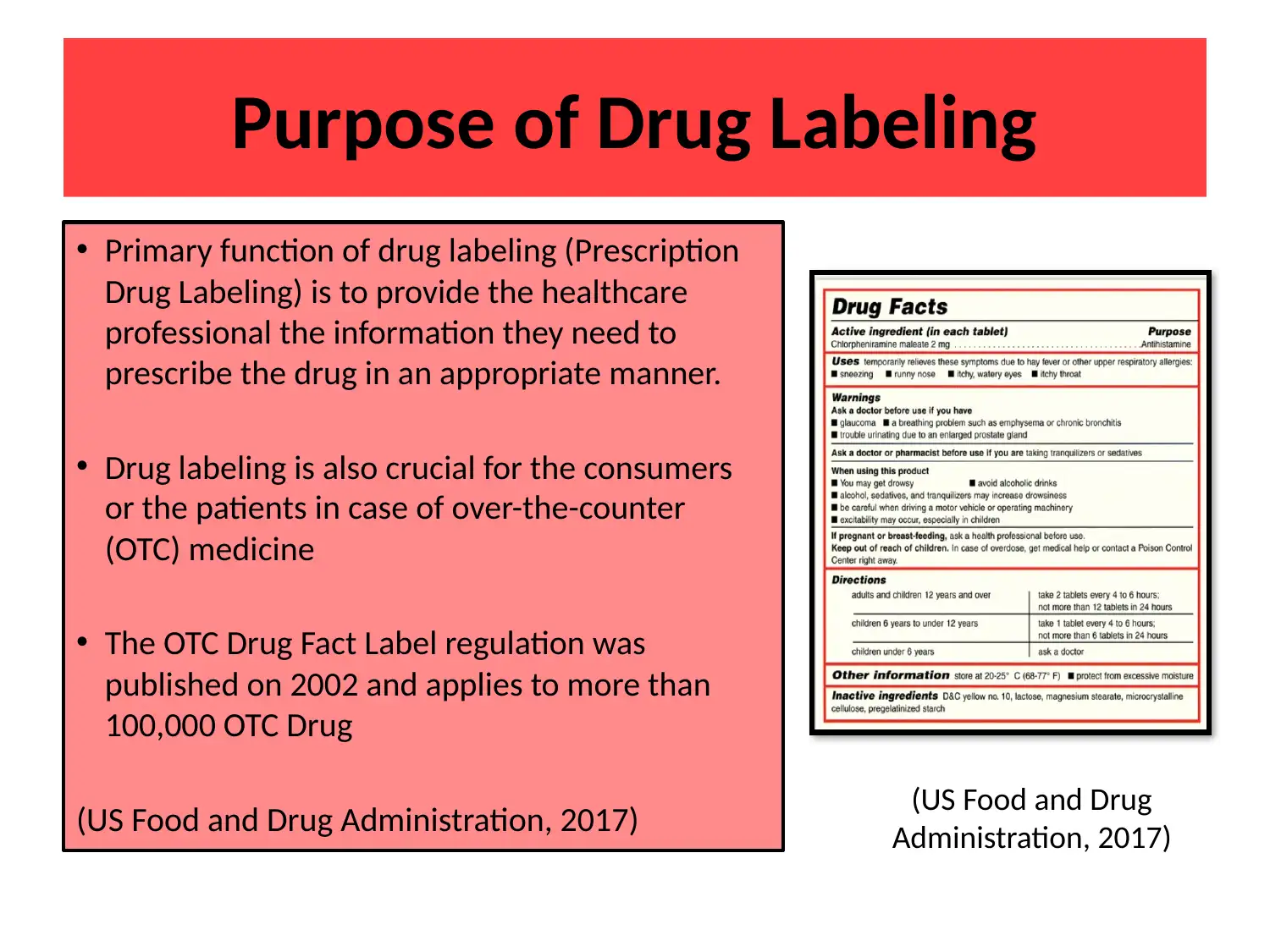
Drug labeling is also crucial for the consumers
or the patients in case of over-the-counter
(OTC) medicine
The OTC Drug Fact Label regulation was
published on 2002 and applies to more than
100,000 OTC Drug
(US Food and Drug Administration, 2017) (US Food and Drug
Administration, 2017)
Document Page
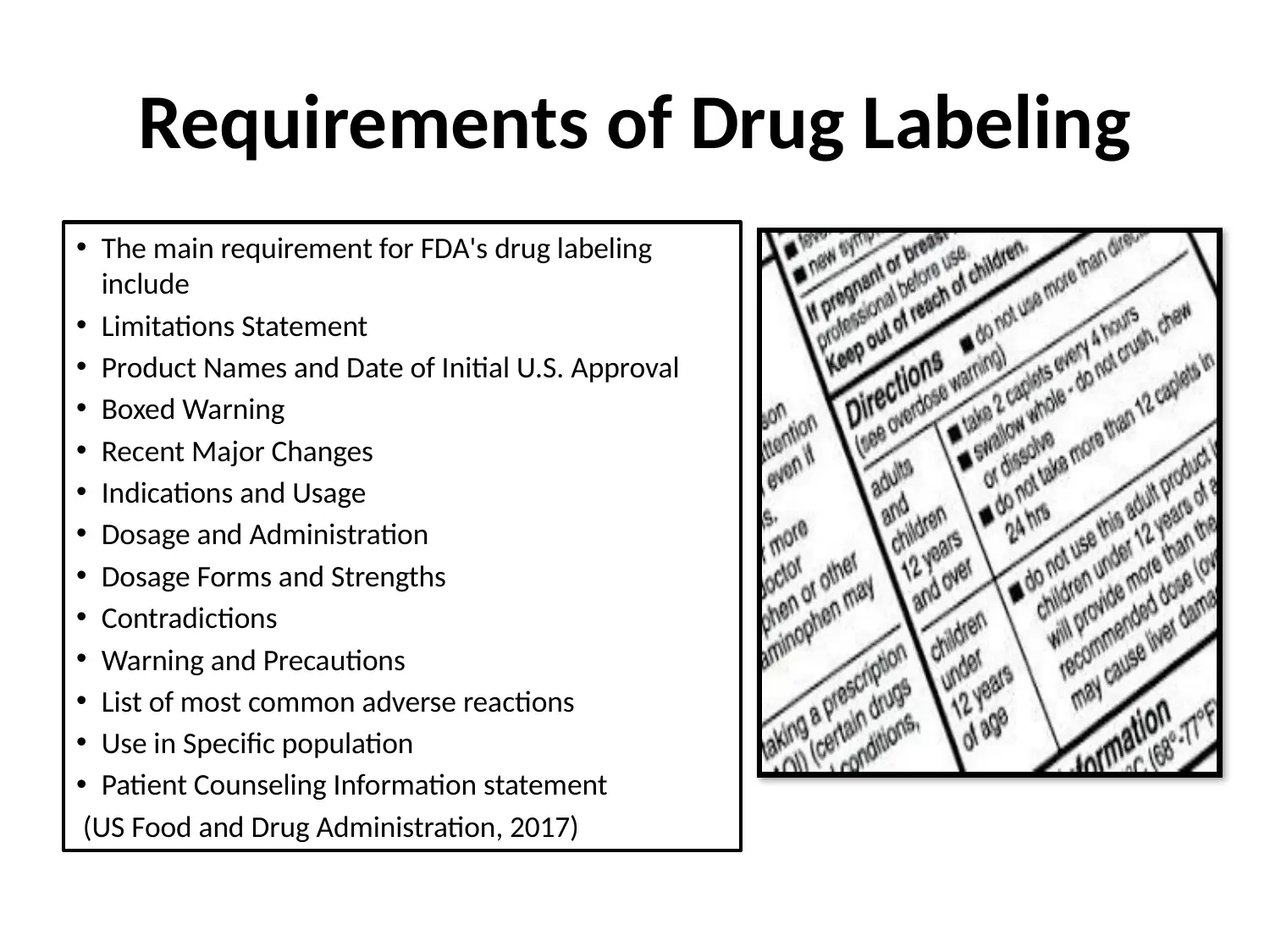
Requirements of Drug Labeling
The main requirement for FDA's drug labeling
include
Limitations Statement
Product Names and Date of Initial U.S. Approval
Boxed Warning
Recent Major Changes
Indications and Usage
Dosage and Administration
Dosage Forms and Strengths
Contradictions
Warning and Precautions
List of most common adverse reactions
Use in Specific population
Patient Counseling Information statement
(US Food and Drug Administration, 2017)
Document Page
Limitations of Drug Labeling
The main limitation of product or drug labeling
under the prescribed format and rule of FDA is
There is confusion among the patients with
the meaning of the words like
Indications
Precautions
Contradictions
In order to avoid confusion, simple terms are
used in order label the OTC drugs
Indications is replace via “Uses”
Precautions” and “contradictions” is replaced
via more easily understood phrases or words
(US Food and Drug Administration, 2017)
tabler-icon-diamond-filled.svg

Paraphrase This Document

Need a fresh take? Get an instant paraphrase of this document with our AI Paraphraser
Document Page
Application of FDA Label Database
Uber et al., (2017) statedd that FDA Label
database (available freely to public) provides a
convenient tool to extract accurate
pharmacogenomics information from the FDA
approved drug.
The information gained from these biomarkers
and drugs will help to enhance the proper
understanding of the pharmacogenomics for
advance precision medicine (Uber et al., 2017).
Document Page
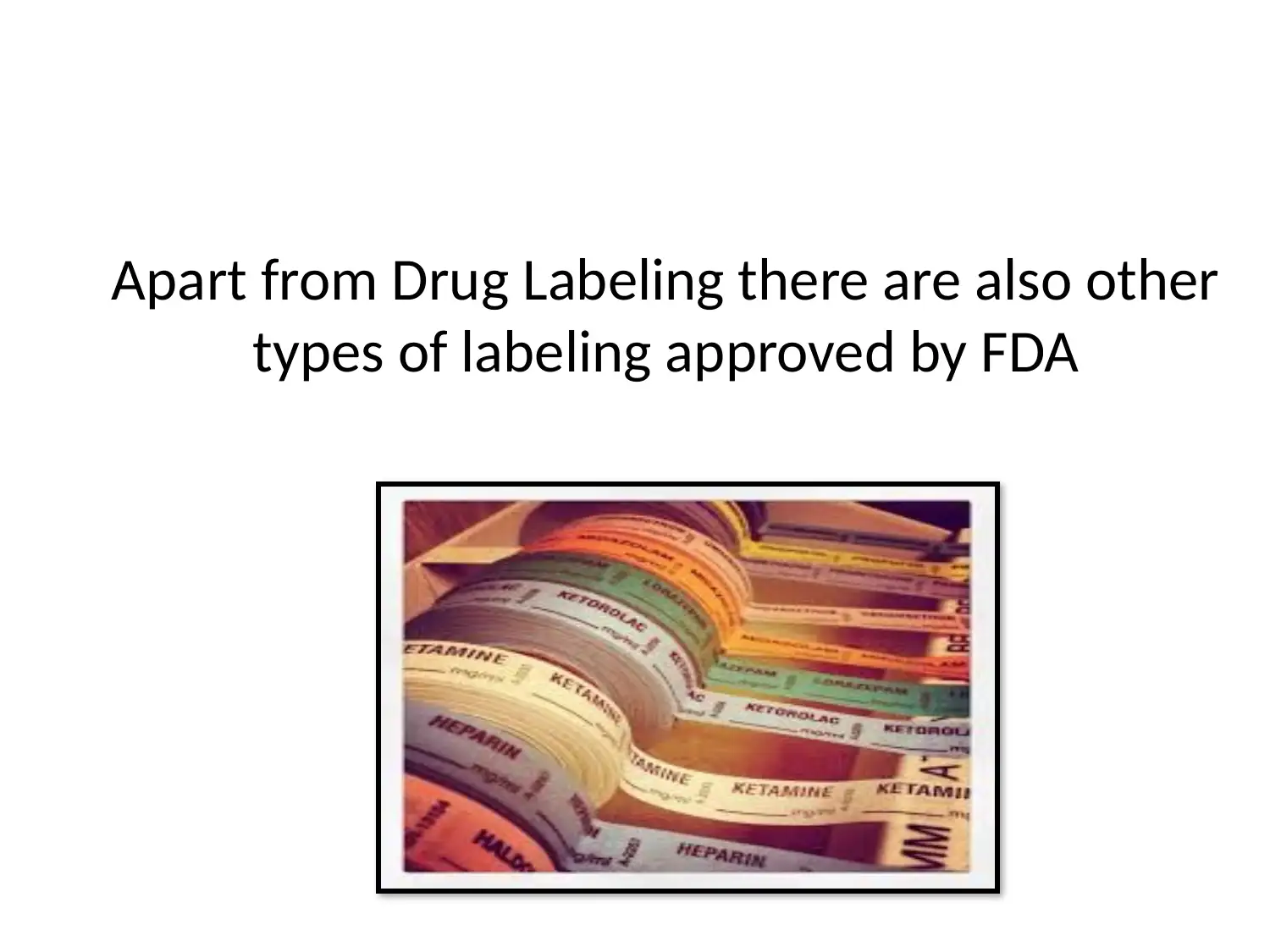
Apart from Drug Labeling there are also other
types of labeling approved by FDA
Document Page
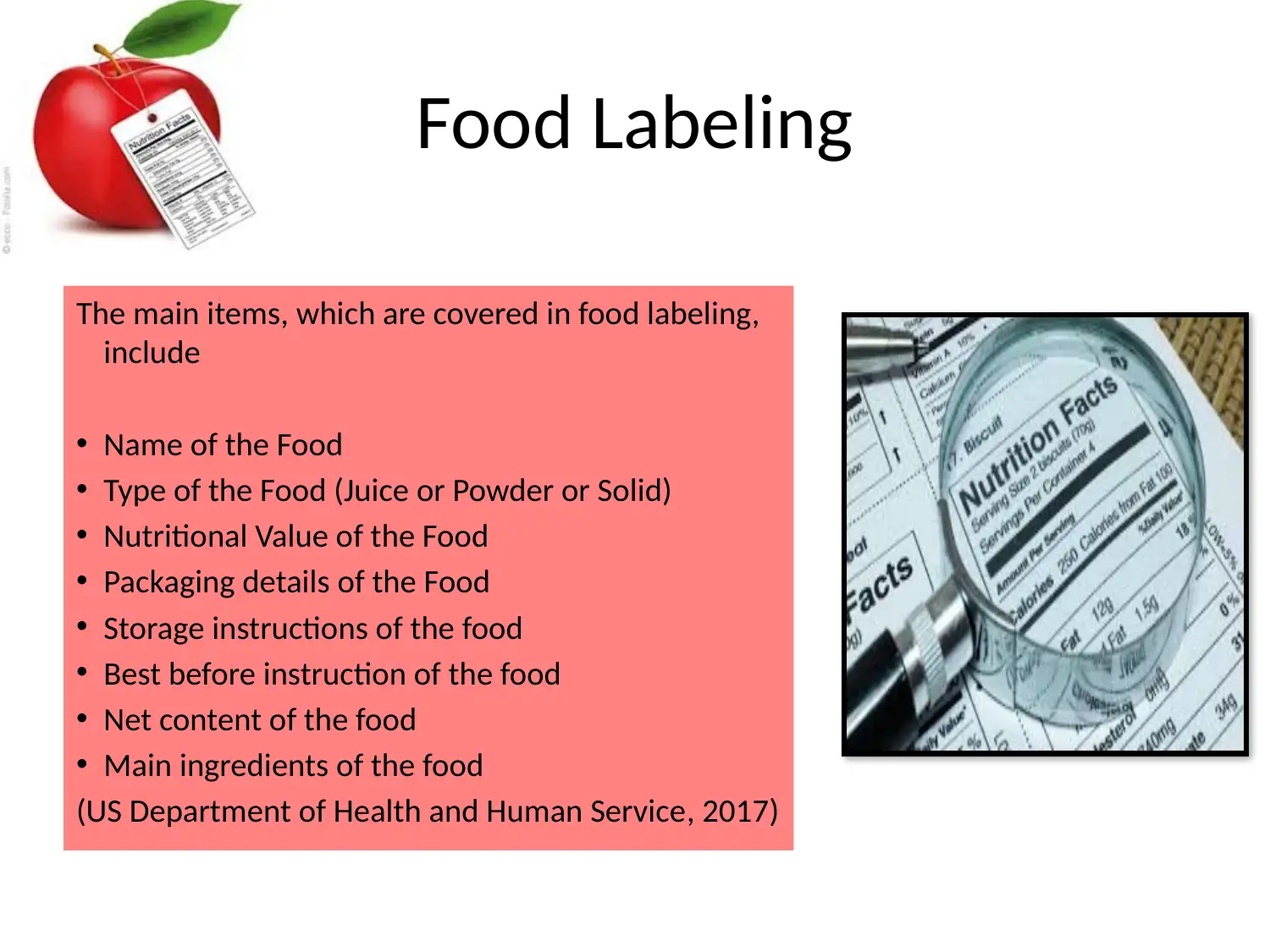
Food Labeling
The main items, which are covered in food labeling,
include
Name of the Food
Type of the Food (Juice or Powder or Solid)
Nutritional Value of the Food
Packaging details of the Food
Storage instructions of the food
Best before instruction of the food
Net content of the food
Main ingredients of the food
(US Department of Health and Human Service, 2017)
tabler-icon-diamond-filled.svg

Paraphrase This Document

Need a fresh take? Get an instant paraphrase of this document with our AI Paraphraser
Document Page
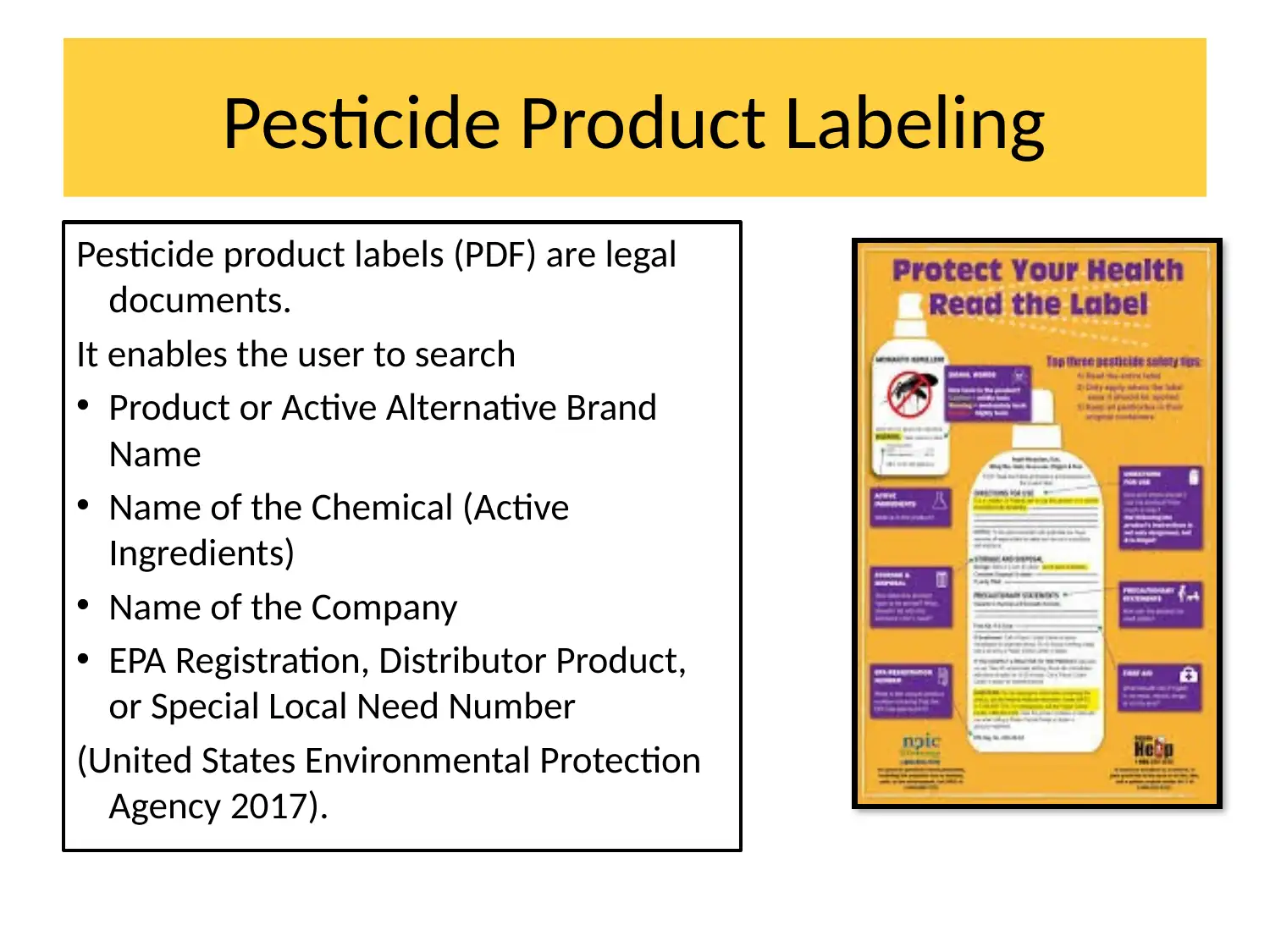
Pesticide Product Labeling
Pesticide product labels (PDF) are legal
documents.
It enables the user to search
Product or Active Alternative Brand
Name
Name of the Chemical (Active
Ingredients)
Name of the Company
EPA Registration, Distributor Product,
or Special Local Need Number
(United States Environmental Protection
Agency 2017).
Document Page
Conclusion
Thus from the above discussion it can be concluded
that
Drug labeling is crucial for overcoming the
medication errors
It helps both the physicians and the consumers to
understand the side-effects, mode of
administration and the dosage of the drugs
At present FDA Label Database is used to modify
the pharmacogenic intervention of the drug
chevron_up_icon
1 out of 14
circle_padding
hide_on_mobile
zoom_out_icon
[object Object]