Federal Court Case Study: ASIC vs. Big Star Energy Ltd - Analysis

Verified

Added on  2022/12/12

|5
|1270
|305
Case Study
AI Summary
This case study report examines the breach of contract case between the Australian Securities and Investments Commission (ASIC) and Big Star Energy Ltd, formerly Antares. The ASIC alleged that Antares failed to disclose crucial information regarding the sale of its assets, specifically the purchaser's identity and financial details, leading to a sudden increase in share price. The report highlights the issue of continuous disclosure, the director's duty, and the court's decision, which favored the ASIC, finding Antares in breach of contract and the director, Mr. Cruickshank, negligent in fulfilling his duties under the Corporations Act. The court emphasized the importance of transparency, due diligence, and the legal repercussions of non-compliance with ASIC regulations. The case also draws a comparison with another case, ASIC v Rich, highlighting the significance of evidence and director's responsibilities in contract law. The final outcome resulted in the Antares complying with the legal obligations and providing the court with the required relief forms.
Document Page
Case study report
1
tabler-icon-diamond-filled.svg

Paraphrase This Document

Need a fresh take? Get an instant paraphrase of this document with our AI Paraphraser
Document Page
FACTS
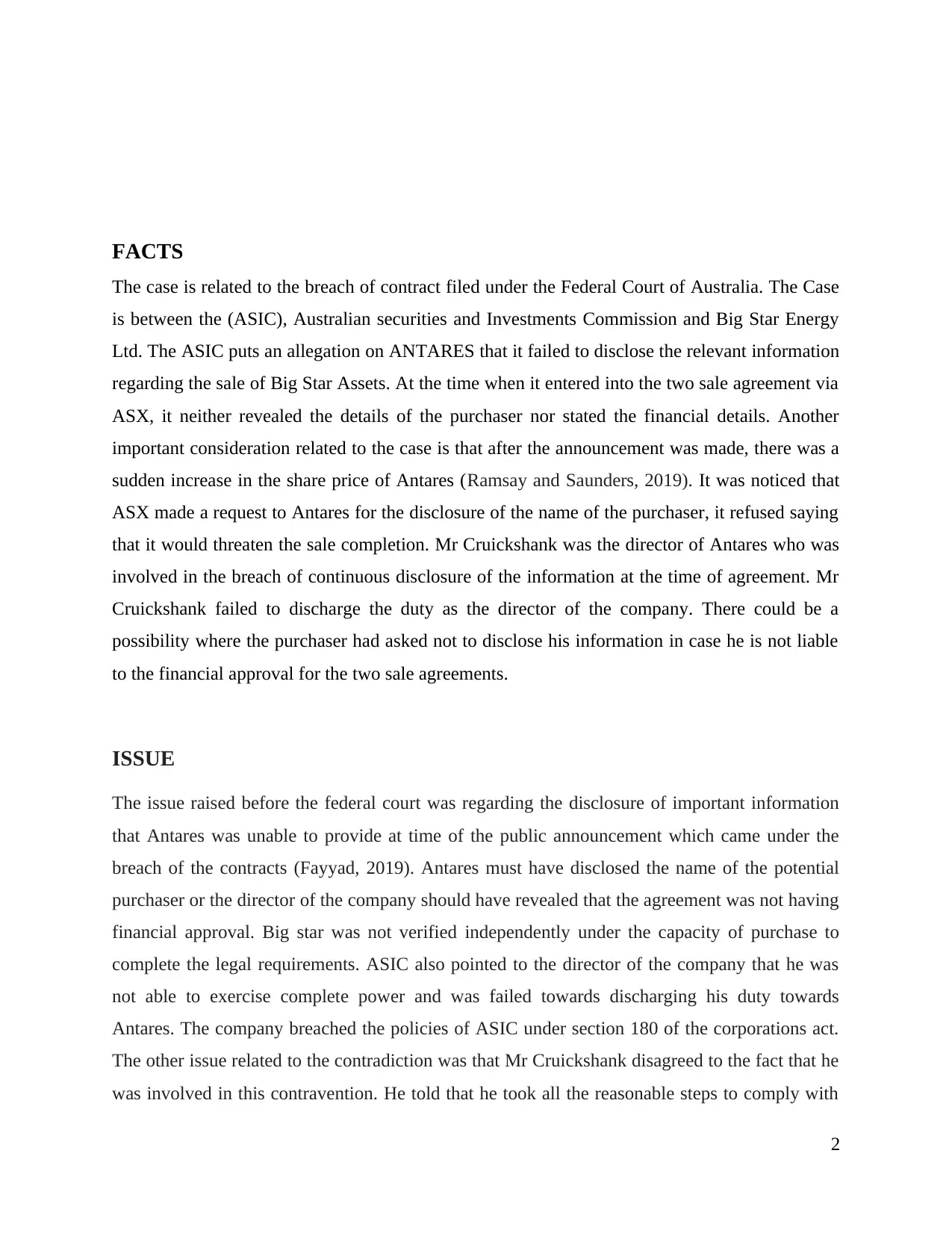
The case is related to the breach of contract filed under the Federal Court of Australia. The Case
is between the (ASIC), Australian securities and Investments Commission and Big Star Energy
Ltd. The ASIC puts an allegation on ANTARES that it failed to disclose the relevant information
regarding the sale of Big Star Assets. At the time when it entered into the two sale agreement via
ASX, it neither revealed the details of the purchaser nor stated the financial details. Another
important consideration related to the case is that after the announcement was made, there was a
sudden increase in the share price of Antares (Ramsay and Saunders, 2019). It was noticed that
ASX made a request to Antares for the disclosure of the name of the purchaser, it refused saying
that it would threaten the sale completion. Mr Cruickshank was the director of Antares who was
involved in the breach of continuous disclosure of the information at the time of agreement. Mr
Cruickshank failed to discharge the duty as the director of the company. There could be a
possibility where the purchaser had asked not to disclose his information in case he is not liable
to the financial approval for the two sale agreements.
ISSUE
The issue raised before the federal court was regarding the disclosure of important information
that Antares was unable to provide at time of the public announcement which came under the
breach of the contracts (Fayyad, 2019). Antares must have disclosed the name of the potential
purchaser or the director of the company should have revealed that the agreement was not having
financial approval. Big star was not verified independently under the capacity of purchase to
complete the legal requirements. ASIC also pointed to the director of the company that he was
not able to exercise complete power and was failed towards discharging his duty towards
Antares. The company breached the policies of ASIC under section 180 of the corporations act.
The other issue related to the contradiction was that Mr Cruickshank disagreed to the fact that he
was involved in this contravention. He told that he took all the reasonable steps to comply with
2
Document Page
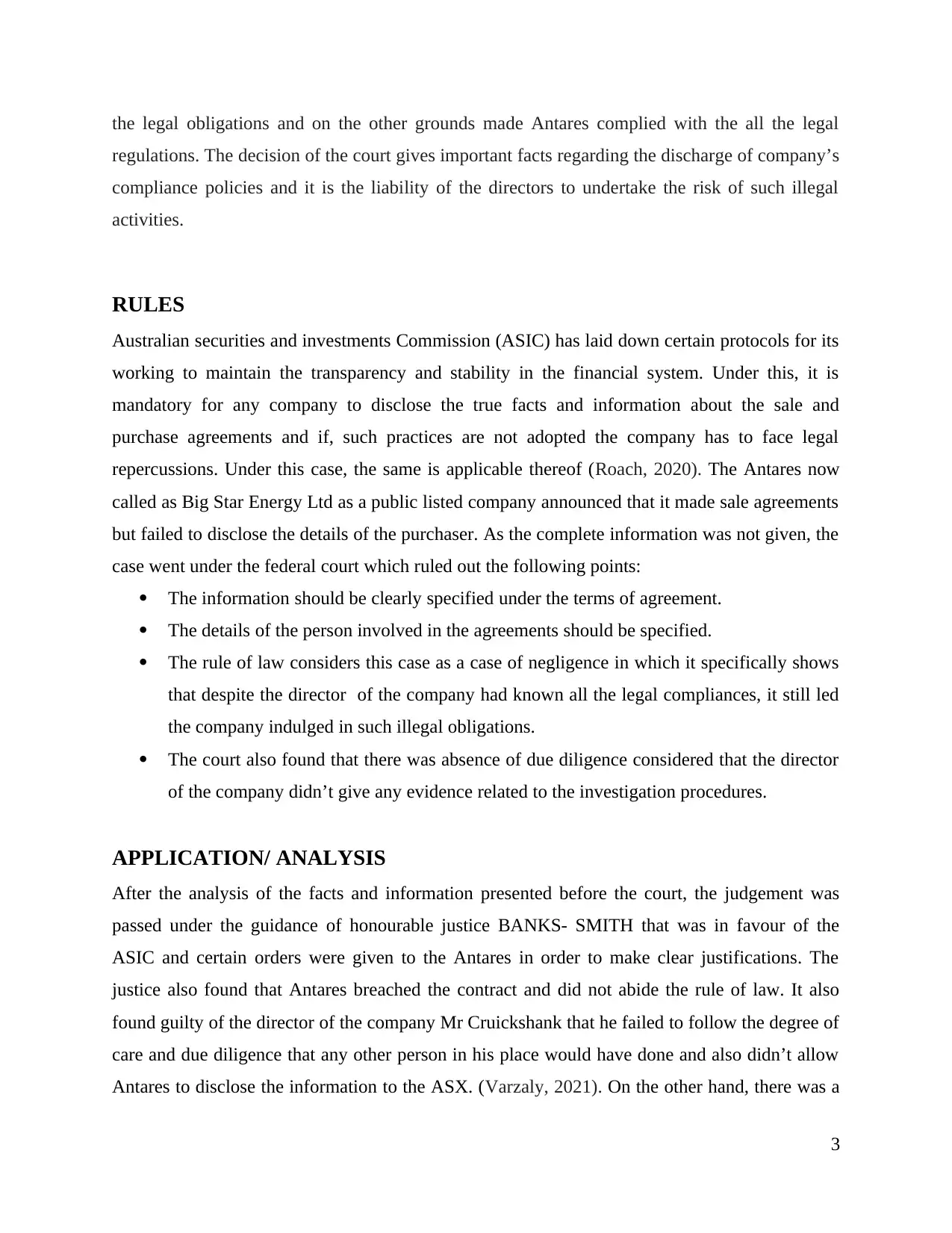
the legal obligations and on the other grounds made Antares complied with the all the legal
regulations. The decision of the court gives important facts regarding the discharge of company’s
compliance policies and it is the liability of the directors to undertake the risk of such illegal
activities.
RULES
Australian securities and investments Commission (ASIC) has laid down certain protocols for its
working to maintain the transparency and stability in the financial system. Under this, it is
mandatory for any company to disclose the true facts and information about the sale and
purchase agreements and if, such practices are not adopted the company has to face legal
repercussions. Under this case, the same is applicable thereof (Roach, 2020). The Antares now
called as Big Star Energy Ltd as a public listed company announced that it made sale agreements
but failed to disclose the details of the purchaser. As the complete information was not given, the
case went under the federal court which ruled out the following points:
The information should be clearly specified under the terms of agreement.
The details of the person involved in the agreements should be specified.
The rule of law considers this case as a case of negligence in which it specifically shows
that despite the director of the company had known all the legal compliances, it still led
the company indulged in such illegal obligations.
The court also found that there was absence of due diligence considered that the director
of the company didn’t give any evidence related to the investigation procedures.
APPLICATION/ ANALYSIS
After the analysis of the facts and information presented before the court, the judgement was
passed under the guidance of honourable justice BANKS- SMITH that was in favour of the
ASIC and certain orders were given to the Antares in order to make clear justifications. The
justice also found that Antares breached the contract and did not abide the rule of law. It also
found guilty of the director of the company Mr Cruickshank that he failed to follow the degree of
care and due diligence that any other person in his place would have done and also didn’t allow
Antares to disclose the information to the ASX. (Varzaly, 2021). On the other hand, there was a
3
Document Page
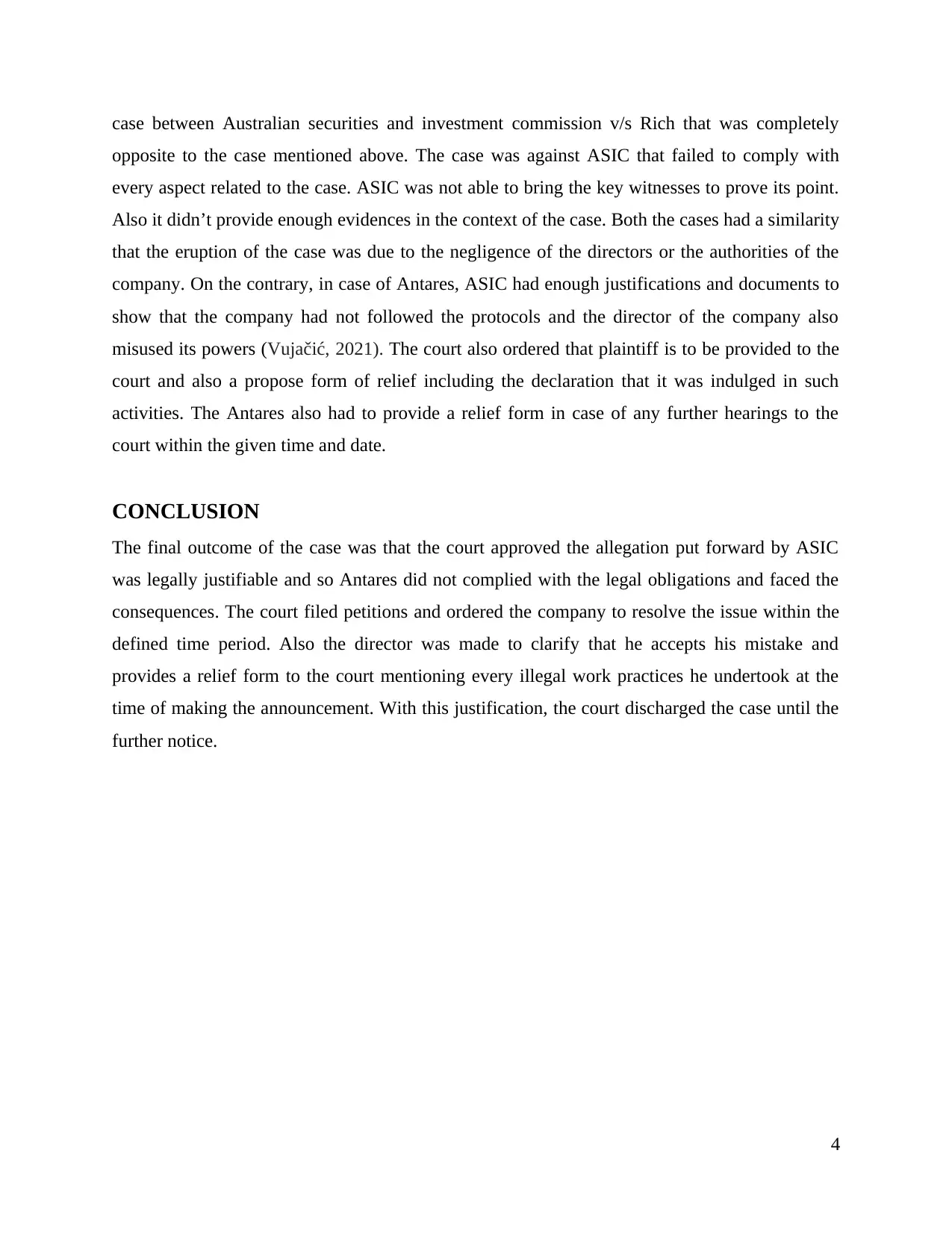
case between Australian securities and investment commission v/s Rich that was completely
opposite to the case mentioned above. The case was against ASIC that failed to comply with
every aspect related to the case. ASIC was not able to bring the key witnesses to prove its point.
Also it didn’t provide enough evidences in the context of the case. Both the cases had a similarity
that the eruption of the case was due to the negligence of the directors or the authorities of the
company. On the contrary, in case of Antares, ASIC had enough justifications and documents to
show that the company had not followed the protocols and the director of the company also
misused its powers (Vujačić, 2021). The court also ordered that plaintiff is to be provided to the
court and also a propose form of relief including the declaration that it was indulged in such
activities. The Antares also had to provide a relief form in case of any further hearings to the
court within the given time and date.
CONCLUSION
The final outcome of the case was that the court approved the allegation put forward by ASIC
was legally justifiable and so Antares did not complied with the legal obligations and faced the
consequences. The court filed petitions and ordered the company to resolve the issue within the
defined time period. Also the director was made to clarify that he accepts his mistake and
provides a relief form to the court mentioning every illegal work practices he undertook at the
time of making the announcement. With this justification, the court discharged the case until the
further notice.
4
tabler-icon-diamond-filled.svg

Paraphrase This Document

Need a fresh take? Get an instant paraphrase of this document with our AI Paraphraser
Document Page
REFERENCES
Fayyad, M., 2019. Fundamental Breach of Contract in Terms of the UN Sales Convention and
Emirates Law: A Comparative Legal Study. Arab Law Quarterly, 33(2). pp. 109-151.
Ramsay, I. and Saunders, B., 2019. An Analysis of the Enforcement of the Statutory Duty of
Care by the Australian Securities and Investments Commission. Company and
Securities Law Journal, 36(6). pp. 497-521.
Roach, L., 2020. Company Law Concentrate: Law Revision and Study Guide. Oxford University
Press.
Varzaly, J., 2021. The effectiveness of disclosure law enforcement in Australia. Journal of
Corporate Law Studies, 21(1). pp. 135-177.
Vujačić, J. S. P., 2021. Anticipatory Breach of Contract in Uniform Contract Law: Overview of
the Solution of the UN Convention on the International Sale of Goods.
5
chevron_up_icon
1 out of 5
circle_padding
hide_on_mobile
zoom_out_icon
[object Object]