Federal Agencies in Homeland Security Preparedness and Planning Report
VerifiedAdded on 2022/11/13
|7
|1962
|119
Report
AI Summary
This report examines the critical aspects of homeland security preparedness and planning in the United States. It focuses on the roles and responsibilities of various federal agencies, with a particular emphasis on the Federal Emergency Management Agency (FEMA) and its involvement in both security operations and disaster management. The report highlights the importance of interagency coordination, risk management, and state-level preparedness efforts. It analyzes the functions of FEMA, comparing its unique operational processes with other security agencies, and emphasizes its role in providing a fast response to incidents, training citizens, and creating public awareness. The report also discusses the historical context of homeland security, including the establishment of the Department of Homeland Security (DHS) after the 9/11 attacks, and concludes that effective security requires an overarching body to coordinate the efforts of all agencies involved.
Homeland security preparedness and planning
Name
Institution
Professor
Course
Date
Name
Institution
Professor
Course
Date
Paraphrase This Document
Need a fresh take? Get an instant paraphrase of this document with our AI Paraphraser

Introduction
Department of Homeland Security (DHS) is mandated with ensuring smooth coordination
of American security. DHS leads other government agencies such as defence, intelligence sector
and civilian in formulation of security policies, standards and guidelines (Kahan, 2015). Since it
is very difficult for a single entity such as DHS to oversee security preparedness and planning,
other entities are involved but should be guided by the federal security laws. Agencies that are
given priority to take part in security matters should report to DHS to ensure there is smooth
coordination among security entities. Due to the increase in security threats, the Federal
government has been allowing different agencies to help in securing the USA. Currently, there
are several agencies which take part in securing the USA, but there have been concerns about the
corporation of some agencies with DHS (United States Department of State, 2019). As a result,
the Federal government have been trying to develop strategies for evaluating which agency
should be allowed to take part in security matters. Some agencies have been observed to have
double standards in the process as they work both as human rights group and security agencies
(Annamalai, Koay & Lee, 2014). This has dramatically compromised operational privacy of
DHS, considering it has to corporate with other agencies such as the Federal Emergency
Management Agency (FEMA). This article would be focusing on local and federal agencies
which can be allowed to take part in security matters of the USA. It also highlights the
parameters which should be considered when permitting such agencies to take part in sensitive
security matters. Finally, the article would focus on the reasons for selecting a specific agency to
take part in security matters.
Department of Homeland Security (DHS) is mandated with ensuring smooth coordination
of American security. DHS leads other government agencies such as defence, intelligence sector
and civilian in formulation of security policies, standards and guidelines (Kahan, 2015). Since it
is very difficult for a single entity such as DHS to oversee security preparedness and planning,
other entities are involved but should be guided by the federal security laws. Agencies that are
given priority to take part in security matters should report to DHS to ensure there is smooth
coordination among security entities. Due to the increase in security threats, the Federal
government has been allowing different agencies to help in securing the USA. Currently, there
are several agencies which take part in securing the USA, but there have been concerns about the
corporation of some agencies with DHS (United States Department of State, 2019). As a result,
the Federal government have been trying to develop strategies for evaluating which agency
should be allowed to take part in security matters. Some agencies have been observed to have
double standards in the process as they work both as human rights group and security agencies
(Annamalai, Koay & Lee, 2014). This has dramatically compromised operational privacy of
DHS, considering it has to corporate with other agencies such as the Federal Emergency
Management Agency (FEMA). This article would be focusing on local and federal agencies
which can be allowed to take part in security matters of the USA. It also highlights the
parameters which should be considered when permitting such agencies to take part in sensitive
security matters. Finally, the article would focus on the reasons for selecting a specific agency to
take part in security matters.

Analysis of security agencies
Different state security agencies have been placed under DHS to make sure there is
smooth coordination of security operations. Most of the security agencies have been dedicated
specific duties such as combating terrorism, formulating security policies and overseeing general
security operations (Collier & Lakoff, 2018). Agencies under DHS are confined and cannot
actively take part in aspects that are not outlined in federal security laws. Among the available
security agencies, FEMA seems to be a suitable agency to take part in homeland security
preparedness and planning. The main goal of the FEMA is to support incident responders,
victims and the general public. As a result, it helps to improve, sustain and prepare the USA to
respond and mitigate all form of incidents swiftly. FEMA defines preparedness as a continuous
process which involves training, evaluating and initiating corrective measures. Important to note
is that neither of the subjected agencies can operate in isolation without the control of DHS. The
main idea of bringing all security agencies under the DHS was to make sure each has defined
roles and responsibilities as outlined in DHS security laws (Jackson & McKay, 2011). Every
agency is required to operate strictly within the prescribed rules and regulations as well as
expedite its operations effectively.
Improving state-level of homeland security
The federal government has been developing security operations and preparedness since
the aftermath of the 11th September attack. At the national level, DHS is forcing some agencies to
operate as intelligence by forming operational communities (Kapucu, 2011). The impact of
implementing security measures at the state level has been delegated to DHS and FEMA is
required to create required awareness to the general public. Before the 11th September attack, the
security of the USA was poorly managed because there was no single state robust and integrated
Different state security agencies have been placed under DHS to make sure there is
smooth coordination of security operations. Most of the security agencies have been dedicated
specific duties such as combating terrorism, formulating security policies and overseeing general
security operations (Collier & Lakoff, 2018). Agencies under DHS are confined and cannot
actively take part in aspects that are not outlined in federal security laws. Among the available
security agencies, FEMA seems to be a suitable agency to take part in homeland security
preparedness and planning. The main goal of the FEMA is to support incident responders,
victims and the general public. As a result, it helps to improve, sustain and prepare the USA to
respond and mitigate all form of incidents swiftly. FEMA defines preparedness as a continuous
process which involves training, evaluating and initiating corrective measures. Important to note
is that neither of the subjected agencies can operate in isolation without the control of DHS. The
main idea of bringing all security agencies under the DHS was to make sure each has defined
roles and responsibilities as outlined in DHS security laws (Jackson & McKay, 2011). Every
agency is required to operate strictly within the prescribed rules and regulations as well as
expedite its operations effectively.
Improving state-level of homeland security
The federal government has been developing security operations and preparedness since
the aftermath of the 11th September attack. At the national level, DHS is forcing some agencies to
operate as intelligence by forming operational communities (Kapucu, 2011). The impact of
implementing security measures at the state level has been delegated to DHS and FEMA is
required to create required awareness to the general public. Before the 11th September attack, the
security of the USA was poorly managed because there was no single state robust and integrated
⊘ This is a preview!⊘
Do you want full access?
Subscribe today to unlock all pages.

Trusted by 1+ million students worldwide

intelligence body. To make sure security operations are active, DHS is required to differentiate
between national and state-level intelligence. Though there exist structured processes of
maintaining federal security, state-level security is dedicated to specific state intelligence
agencies (United States Department of State, 2019). State security agencies are required to
provide national-level threat assessment to facilitate the appropriation of the security budget by
the federal government. Federal government emphasis on preparedness efforts as they are meant
to minimize most of the risks that state governments face. Risk management tools are used by
state-level leaders to prioritize on measures which should be taken once incidents occur
(Sobelson, Wigington, Harp, & Bronson, 2015). In federal and state governments, FEMA is
involved in the process of identifying the possible causes of security lapses and mitigation
measures that DHS and other security agencies should take.
Functions of Federal Emergency Management Agency
FEMA is distributed in all states because it usually offers several preparedness and
response measures. It develops and maintains all state-level emergency preparations and other
related operation plans. It has to make sure all ESF functions are performed as outlined in
emergency operation plans (EOP). It conducts all state-level emergency training and exercises to
ensure citizens are well versed with emergency practices. It develops and implements state-level
mitigation strategies considering each state has different emergency operations (Garnett &
Moore, 2010). Since all operations are defined in Federal laws, it is important for FEMA to make
sure incident responses are performed according to the principles and processes outlined in the
incident command system (ICS). FEMA is also expected to make sure there is coordination of
messaging activities among the general public, and emergency communications are done
effectively. Finally, it has mandated with the responsibility of collecting accurate data related to
between national and state-level intelligence. Though there exist structured processes of
maintaining federal security, state-level security is dedicated to specific state intelligence
agencies (United States Department of State, 2019). State security agencies are required to
provide national-level threat assessment to facilitate the appropriation of the security budget by
the federal government. Federal government emphasis on preparedness efforts as they are meant
to minimize most of the risks that state governments face. Risk management tools are used by
state-level leaders to prioritize on measures which should be taken once incidents occur
(Sobelson, Wigington, Harp, & Bronson, 2015). In federal and state governments, FEMA is
involved in the process of identifying the possible causes of security lapses and mitigation
measures that DHS and other security agencies should take.
Functions of Federal Emergency Management Agency
FEMA is distributed in all states because it usually offers several preparedness and
response measures. It develops and maintains all state-level emergency preparations and other
related operation plans. It has to make sure all ESF functions are performed as outlined in
emergency operation plans (EOP). It conducts all state-level emergency training and exercises to
ensure citizens are well versed with emergency practices. It develops and implements state-level
mitigation strategies considering each state has different emergency operations (Garnett &
Moore, 2010). Since all operations are defined in Federal laws, it is important for FEMA to make
sure incident responses are performed according to the principles and processes outlined in the
incident command system (ICS). FEMA is also expected to make sure there is coordination of
messaging activities among the general public, and emergency communications are done
effectively. Finally, it has mandated with the responsibility of collecting accurate data related to
Paraphrase This Document
Need a fresh take? Get an instant paraphrase of this document with our AI Paraphraser

emergency and provide awareness to all stakeholders, including federal, regional and state
governments (Rewards for Justice, 2019).
Comparison of FEMA with other security agencies
FEMA can be considered to be an exceptional security agency due to its unique operation
processes (Egli, 2013). It serves both in DHS and as a separate security agency by offering
unique services to the general public. The main reason for supporting FEMA is its ability to
provide various services which are not provided by other agencies such as counter-terrorism
units (Combating Terrorism Center at West Point, 2019). FEMA operates in both federal
government and state governments to offer state-level security preparations. On the same note,
during disaster operations, FEMA provides a fast response to help in impact mitigation. It takes
part in training and educating citizens on necessary measures to take when responding to threats
and incidents. Its operations mainly focus on offering a fast level response and making sure all
citizens can avert risks. Important to note is that FEMA operations are not limited to aspects such
as terrorism and cybersecurity (Rose, Murthy, Brooks & Bryant, 2017). It involves all issues
such as disaster recovery, mitigation, and creating awareness among the general public. In this
case, it would be notable for categorizing FEMA as a multipurpose agency which works under
all situations. Mainly, it serves as a security response reinforcement team under all circumstances
in the USA.
Conclusion
Security of the state is susceptible and cannot be maintained by separate entities without
having an overall body. The establishment of DHS after the 11th September attack was meant to
governments (Rewards for Justice, 2019).
Comparison of FEMA with other security agencies
FEMA can be considered to be an exceptional security agency due to its unique operation
processes (Egli, 2013). It serves both in DHS and as a separate security agency by offering
unique services to the general public. The main reason for supporting FEMA is its ability to
provide various services which are not provided by other agencies such as counter-terrorism
units (Combating Terrorism Center at West Point, 2019). FEMA operates in both federal
government and state governments to offer state-level security preparations. On the same note,
during disaster operations, FEMA provides a fast response to help in impact mitigation. It takes
part in training and educating citizens on necessary measures to take when responding to threats
and incidents. Its operations mainly focus on offering a fast level response and making sure all
citizens can avert risks. Important to note is that FEMA operations are not limited to aspects such
as terrorism and cybersecurity (Rose, Murthy, Brooks & Bryant, 2017). It involves all issues
such as disaster recovery, mitigation, and creating awareness among the general public. In this
case, it would be notable for categorizing FEMA as a multipurpose agency which works under
all situations. Mainly, it serves as a security response reinforcement team under all circumstances
in the USA.
Conclusion
Security of the state is susceptible and cannot be maintained by separate entities without
having an overall body. The establishment of DHS after the 11th September attack was meant to

bring all security agencies under one body. Since its establishment, several security agencies
have been incorporated into DHS to take part in securing USA. It is through the establishment of
these security agencies that make it essential to analyze the best security agencies to take part in
security preparedness and planning. Considering the entire process is very sensitive, not all
agencies should be involved in preparation and planning of federal security. It is at this stage
where all operational privacy and procedures are formulated and cannot be left out to any
security agency. Roles and responsibilities performed by FEMA make it a suitable agency to
take part in security preparedness and planning because it cuts across the security and disaster
management. By serving as a body that creates awareness and responds fast to any incident
makes it suitable to be part of the security preparedness and planning processes.
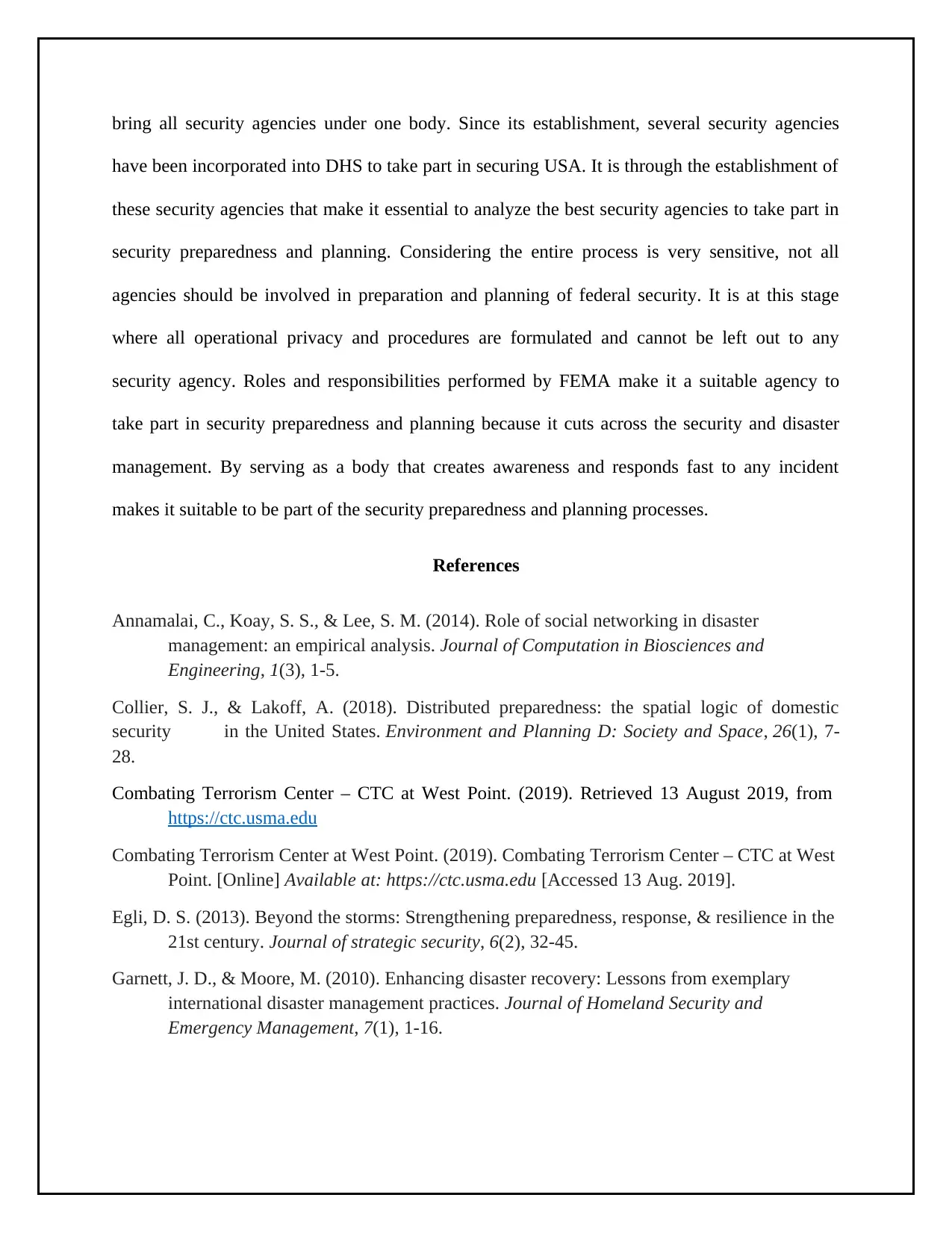
References
Annamalai, C., Koay, S. S., & Lee, S. M. (2014). Role of social networking in disaster
management: an empirical analysis. Journal of Computation in Biosciences and
Engineering, 1(3), 1-5.
Collier, S. J., & Lakoff, A. (2018). Distributed preparedness: the spatial logic of domestic
security in the United States. Environment and Planning D: Society and Space, 26(1), 7-
28.
Combating Terrorism Center – CTC at West Point. (2019). Retrieved 13 August 2019, from
https://ctc.usma.edu
Combating Terrorism Center at West Point. (2019). Combating Terrorism Center – CTC at West
Point. [Online] Available at: https://ctc.usma.edu [Accessed 13 Aug. 2019].
Egli, D. S. (2013). Beyond the storms: Strengthening preparedness, response, & resilience in the
21st century. Journal of strategic security, 6(2), 32-45.
Garnett, J. D., & Moore, M. (2010). Enhancing disaster recovery: Lessons from exemplary
international disaster management practices. Journal of Homeland Security and
Emergency Management, 7(1), 1-16.
have been incorporated into DHS to take part in securing USA. It is through the establishment of
these security agencies that make it essential to analyze the best security agencies to take part in
security preparedness and planning. Considering the entire process is very sensitive, not all
agencies should be involved in preparation and planning of federal security. It is at this stage
where all operational privacy and procedures are formulated and cannot be left out to any
security agency. Roles and responsibilities performed by FEMA make it a suitable agency to
take part in security preparedness and planning because it cuts across the security and disaster
management. By serving as a body that creates awareness and responds fast to any incident
makes it suitable to be part of the security preparedness and planning processes.
References
Annamalai, C., Koay, S. S., & Lee, S. M. (2014). Role of social networking in disaster
management: an empirical analysis. Journal of Computation in Biosciences and
Engineering, 1(3), 1-5.
Collier, S. J., & Lakoff, A. (2018). Distributed preparedness: the spatial logic of domestic
security in the United States. Environment and Planning D: Society and Space, 26(1), 7-
28.
Combating Terrorism Center – CTC at West Point. (2019). Retrieved 13 August 2019, from
https://ctc.usma.edu
Combating Terrorism Center at West Point. (2019). Combating Terrorism Center – CTC at West
Point. [Online] Available at: https://ctc.usma.edu [Accessed 13 Aug. 2019].
Egli, D. S. (2013). Beyond the storms: Strengthening preparedness, response, & resilience in the
21st century. Journal of strategic security, 6(2), 32-45.
Garnett, J. D., & Moore, M. (2010). Enhancing disaster recovery: Lessons from exemplary
international disaster management practices. Journal of Homeland Security and
Emergency Management, 7(1), 1-16.
⊘ This is a preview!⊘
Do you want full access?
Subscribe today to unlock all pages.

Trusted by 1+ million students worldwide

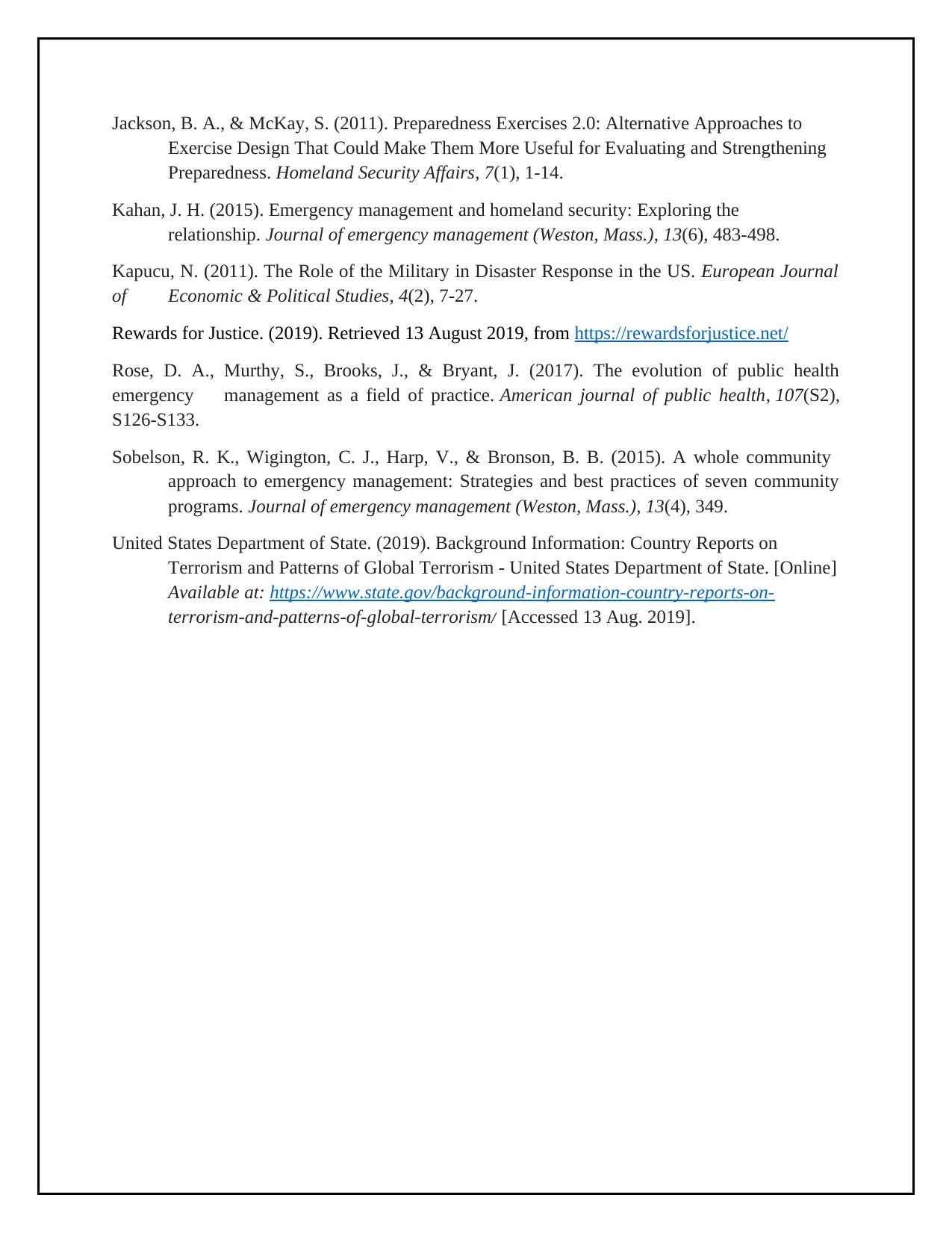
Jackson, B. A., & McKay, S. (2011). Preparedness Exercises 2.0: Alternative Approaches to
Exercise Design That Could Make Them More Useful for Evaluating and Strengthening
Preparedness. Homeland Security Affairs, 7(1), 1-14.
Kahan, J. H. (2015). Emergency management and homeland security: Exploring the
relationship. Journal of emergency management (Weston, Mass.), 13(6), 483-498.
Kapucu, N. (2011). The Role of the Military in Disaster Response in the US. European Journal
of Economic & Political Studies, 4(2), 7-27.
Rewards for Justice. (2019). Retrieved 13 August 2019, from https://rewardsforjustice.net/
Rose, D. A., Murthy, S., Brooks, J., & Bryant, J. (2017). The evolution of public health
emergency management as a field of practice. American journal of public health, 107(S2),
S126-S133.
Sobelson, R. K., Wigington, C. J., Harp, V., & Bronson, B. B. (2015). A whole community
approach to emergency management: Strategies and best practices of seven community
programs. Journal of emergency management (Weston, Mass.), 13(4), 349.
United States Department of State. (2019). Background Information: Country Reports on
Terrorism and Patterns of Global Terrorism - United States Department of State. [Online]
Available at: https://www.state.gov/background-information-country-reports-on-
terrorism-and-patterns-of-global-terrorism/ [Accessed 13 Aug. 2019].
Exercise Design That Could Make Them More Useful for Evaluating and Strengthening
Preparedness. Homeland Security Affairs, 7(1), 1-14.
Kahan, J. H. (2015). Emergency management and homeland security: Exploring the
relationship. Journal of emergency management (Weston, Mass.), 13(6), 483-498.
Kapucu, N. (2011). The Role of the Military in Disaster Response in the US. European Journal
of Economic & Political Studies, 4(2), 7-27.
Rewards for Justice. (2019). Retrieved 13 August 2019, from https://rewardsforjustice.net/
Rose, D. A., Murthy, S., Brooks, J., & Bryant, J. (2017). The evolution of public health
emergency management as a field of practice. American journal of public health, 107(S2),
S126-S133.
Sobelson, R. K., Wigington, C. J., Harp, V., & Bronson, B. B. (2015). A whole community
approach to emergency management: Strategies and best practices of seven community
programs. Journal of emergency management (Weston, Mass.), 13(4), 349.
United States Department of State. (2019). Background Information: Country Reports on
Terrorism and Patterns of Global Terrorism - United States Department of State. [Online]
Available at: https://www.state.gov/background-information-country-reports-on-
terrorism-and-patterns-of-global-terrorism/ [Accessed 13 Aug. 2019].
1 out of 7
Related Documents
Your All-in-One AI-Powered Toolkit for Academic Success.
+13062052269
info@desklib.com
Available 24*7 on WhatsApp / Email
Unlock your academic potential
Copyright © 2020–2025 A2Z Services. All Rights Reserved. Developed and managed by ZUCOL.