BUMGT5928 Strategic Enterprise Planning - Federation Uni, Sem 1 2018

Verified

Added on  2023/06/03

|6
|1360
|302
Essay
AI Summary
This essay provides a personal reflection on strategic enterprise planning, covering various challenges from research to plan implementation. It discusses the benefits and limitations of business planning, conflicting stakeholder expectations, and problems related to accessing core information and decision-making. The author reflects on the importance of disciplined execution, stakeholder buy-in, and tangible goal setting. Key advantages of strategic business planning, such as discharging board responsibility and enabling progress measurement, are highlighted, along with drawbacks like cost and inflexibility. The essay also analyzes challenges in data analysis, decision-making under uncertainty, and the skills developed through strategic processes. It concludes that strategic planning is vital for achieving short and long-term organizational goals, particularly in dynamic global economies.
Document Page
Running head: STRATEGIC ENTERPRISE PLANNING
Strategic Enterprise Planning
Name of the student:
Name of the university:
Author Note
tabler-icon-diamond-filled.svg

Paraphrase This Document

Need a fresh take? Get an instant paraphrase of this document with our AI Paraphraser
Document Page
1STRATEGIC ENTERPRISE PLANNING
Understanding strategic enterprise planning:
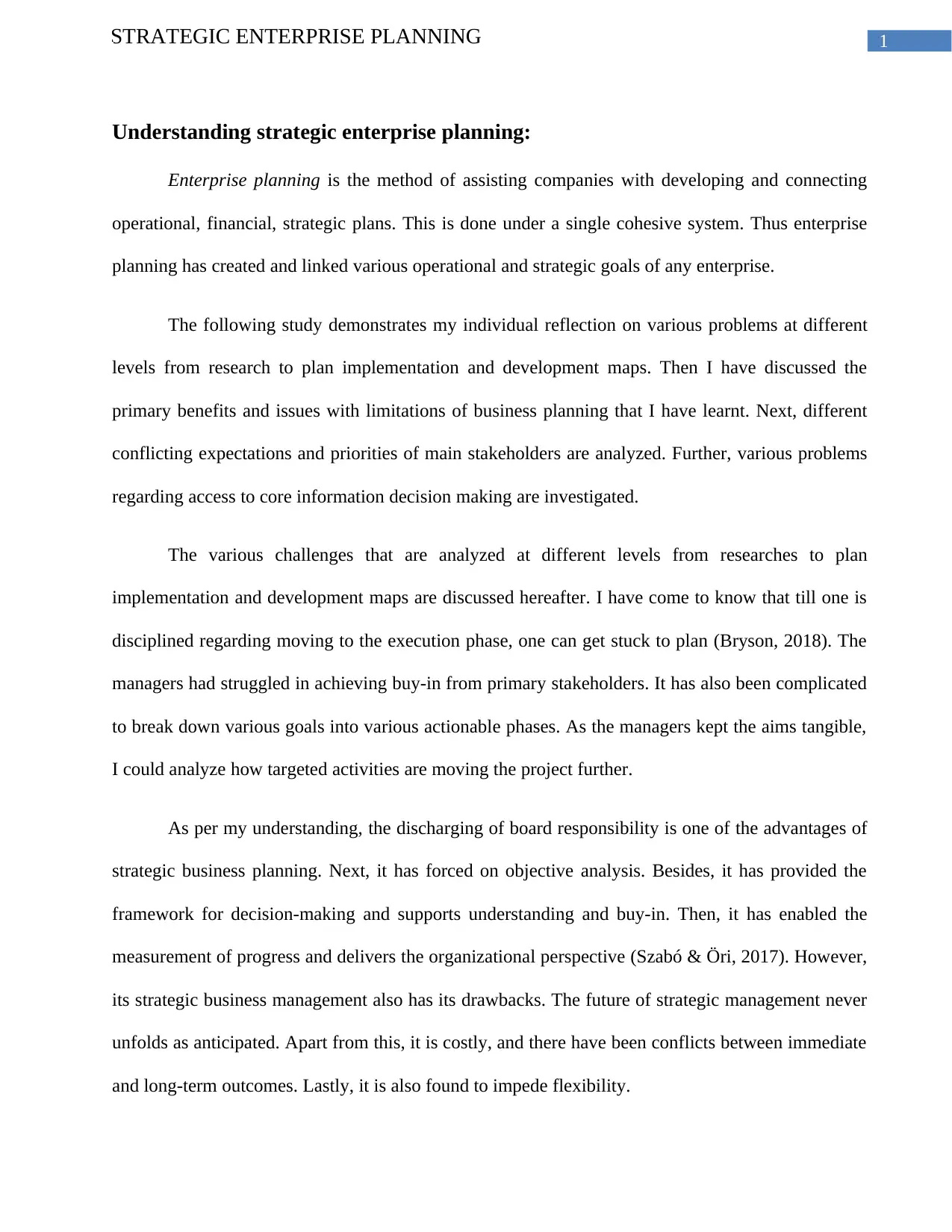
Enterprise planning is the method of assisting companies with developing and connecting
operational, financial, strategic plans. This is done under a single cohesive system. Thus enterprise
planning has created and linked various operational and strategic goals of any enterprise.
The following study demonstrates my individual reflection on various problems at different
levels from research to plan implementation and development maps. Then I have discussed the
primary benefits and issues with limitations of business planning that I have learnt. Next, different
conflicting expectations and priorities of main stakeholders are analyzed. Further, various problems
regarding access to core information decision making are investigated.
The various challenges that are analyzed at different levels from researches to plan
implementation and development maps are discussed hereafter. I have come to know that till one is
disciplined regarding moving to the execution phase, one can get stuck to plan (Bryson, 2018). The
managers had struggled in achieving buy-in from primary stakeholders. It has also been complicated
to break down various goals into various actionable phases. As the managers kept the aims tangible,
I could analyze how targeted activities are moving the project further.
As per my understanding, the discharging of board responsibility is one of the advantages of
strategic business planning. Next, it has forced on objective analysis. Besides, it has provided the
framework for decision-making and supports understanding and buy-in. Then, it has enabled the
measurement of progress and delivers the organizational perspective (Szabó & Öri, 2017). However,
its strategic business management also has its drawbacks. The future of strategic management never
unfolds as anticipated. Apart from this, it is costly, and there have been conflicts between immediate
and long-term outcomes. Lastly, it is also found to impede flexibility.
Document Page
2STRATEGIC ENTERPRISE PLANNING
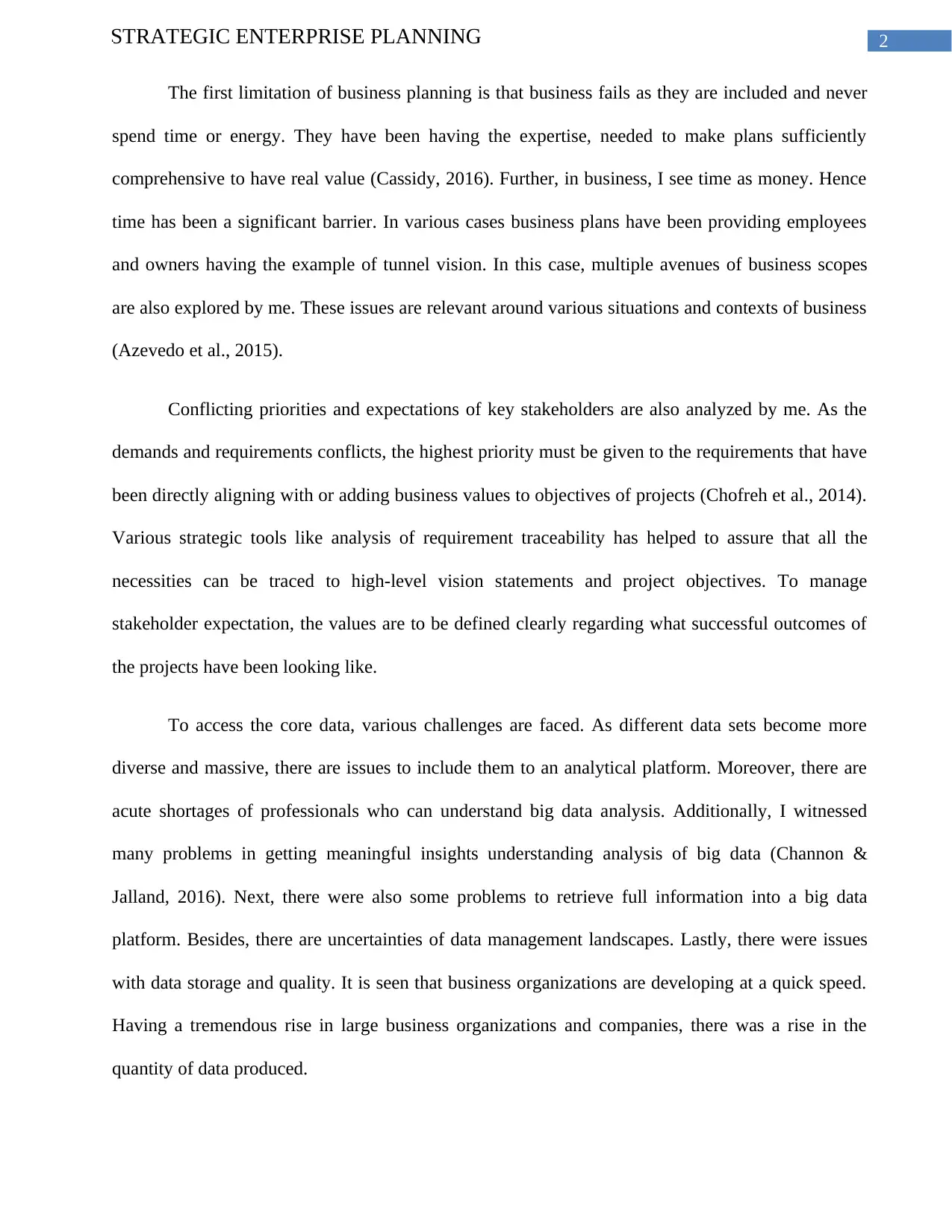
The first limitation of business planning is that business fails as they are included and never
spend time or energy. They have been having the expertise, needed to make plans sufficiently
comprehensive to have real value (Cassidy, 2016). Further, in business, I see time as money. Hence
time has been a significant barrier. In various cases business plans have been providing employees
and owners having the example of tunnel vision. In this case, multiple avenues of business scopes
are also explored by me. These issues are relevant around various situations and contexts of business
(Azevedo et al., 2015).
Conflicting priorities and expectations of key stakeholders are also analyzed by me. As the
demands and requirements conflicts, the highest priority must be given to the requirements that have
been directly aligning with or adding business values to objectives of projects (Chofreh et al., 2014).
Various strategic tools like analysis of requirement traceability has helped to assure that all the
necessities can be traced to high-level vision statements and project objectives. To manage
stakeholder expectation, the values are to be defined clearly regarding what successful outcomes of
the projects have been looking like.
To access the core data, various challenges are faced. As different data sets become more
diverse and massive, there are issues to include them to an analytical platform. Moreover, there are
acute shortages of professionals who can understand big data analysis. Additionally, I witnessed
many problems in getting meaningful insights understanding analysis of big data (Channon &
Jalland, 2016). Next, there were also some problems to retrieve full information into a big data
platform. Besides, there are uncertainties of data management landscapes. Lastly, there were issues
with data storage and quality. It is seen that business organizations are developing at a quick speed.
Having a tremendous rise in large business organizations and companies, there was a rise in the
quantity of data produced.
Document Page
3STRATEGIC ENTERPRISE PLANNING
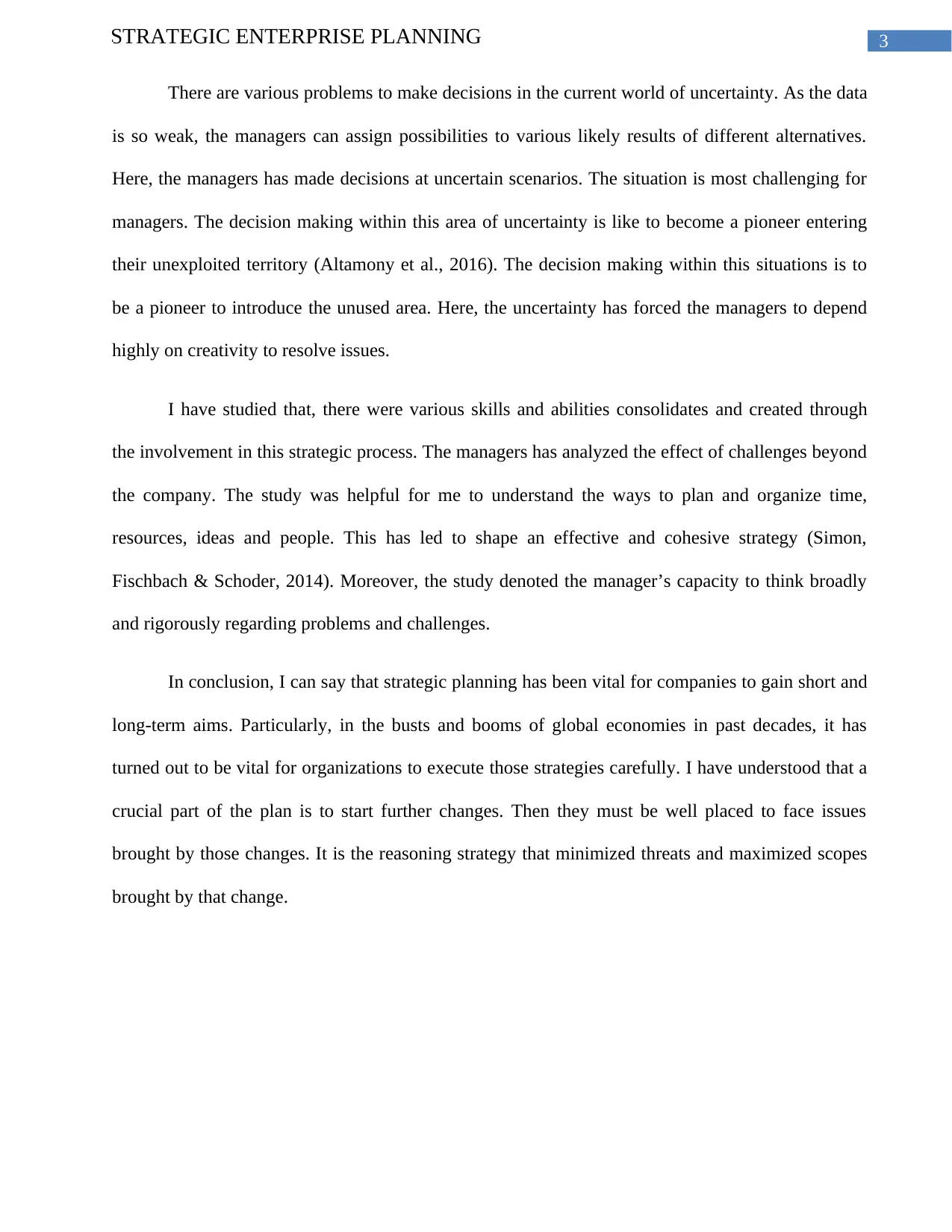
There are various problems to make decisions in the current world of uncertainty. As the data
is so weak, the managers can assign possibilities to various likely results of different alternatives.
Here, the managers has made decisions at uncertain scenarios. The situation is most challenging for
managers. The decision making within this area of uncertainty is like to become a pioneer entering
their unexploited territory (Altamony et al., 2016). The decision making within this situations is to
be a pioneer to introduce the unused area. Here, the uncertainty has forced the managers to depend
highly on creativity to resolve issues.
I have studied that, there were various skills and abilities consolidates and created through
the involvement in this strategic process. The managers has analyzed the effect of challenges beyond
the company. The study was helpful for me to understand the ways to plan and organize time,
resources, ideas and people. This has led to shape an effective and cohesive strategy (Simon,
Fischbach & Schoder, 2014). Moreover, the study denoted the manager’s capacity to think broadly
and rigorously regarding problems and challenges.
In conclusion, I can say that strategic planning has been vital for companies to gain short and
long-term aims. Particularly, in the busts and booms of global economies in past decades, it has
turned out to be vital for organizations to execute those strategies carefully. I have understood that a
crucial part of the plan is to start further changes. Then they must be well placed to face issues
brought by those changes. It is the reasoning strategy that minimized threats and maximized scopes
brought by that change.
tabler-icon-diamond-filled.svg

Paraphrase This Document

Need a fresh take? Get an instant paraphrase of this document with our AI Paraphraser
Document Page
4STRATEGIC ENTERPRISE PLANNING
References:
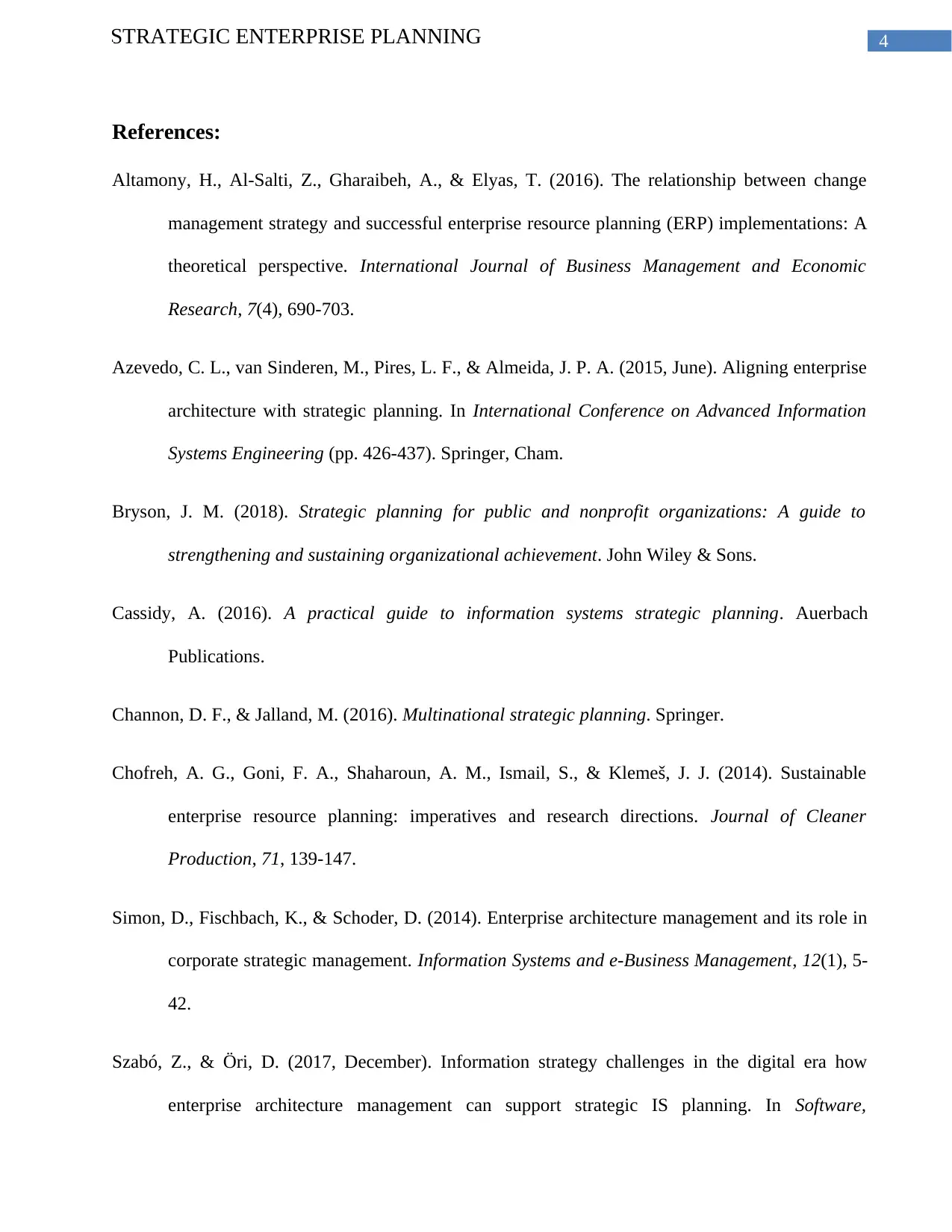
Altamony, H., Al-Salti, Z., Gharaibeh, A., & Elyas, T. (2016). The relationship between change
management strategy and successful enterprise resource planning (ERP) implementations: A
theoretical perspective. International Journal of Business Management and Economic
Research, 7(4), 690-703.
Azevedo, C. L., van Sinderen, M., Pires, L. F., & Almeida, J. P. A. (2015, June). Aligning enterprise
architecture with strategic planning. In International Conference on Advanced Information
Systems Engineering (pp. 426-437). Springer, Cham.
Bryson, J. M. (2018). Strategic planning for public and nonprofit organizations: A guide to
strengthening and sustaining organizational achievement. John Wiley & Sons.
Cassidy, A. (2016). A practical guide to information systems strategic planning. Auerbach
Publications.
Channon, D. F., & Jalland, M. (2016). Multinational strategic planning. Springer.
Chofreh, A. G., Goni, F. A., Shaharoun, A. M., Ismail, S., & Klemeš, J. J. (2014). Sustainable
enterprise resource planning: imperatives and research directions. Journal of Cleaner
Production, 71, 139-147.
Simon, D., Fischbach, K., & Schoder, D. (2014). Enterprise architecture management and its role in
corporate strategic management. Information Systems and e-Business Management, 12(1), 5-
42.
Szabó, Z., & Öri, D. (2017, December). Information strategy challenges in the digital era how
enterprise architecture management can support strategic IS planning. In Software,
Document Page
5STRATEGIC ENTERPRISE PLANNING
Knowledge, Information Management and Applications (SKIMA), 2017 11th International
Conference on (pp. 1-8). IEEE.
chevron_up_icon
1 out of 6
circle_padding
hide_on_mobile
zoom_out_icon
[object Object]