Research Proposal: Female Leadership and Organisational Performance
VerifiedAdded on 2023/01/17
|20
|5963
|44
Report
AI Summary
This document presents a comprehensive research proposal investigating the impact of female leadership on organisational performance. It begins with an introduction, problem statement, and motivation for the study, highlighting the increasing presence of women in leadership roles and their potential influence on business outcomes. The methodology section outlines a mixed-methods approach, combining qualitative and quantitative analysis to gather and analyze primary data. The expected findings include an examination of the unique characteristics of female leaders and their relationship to established leadership theories, with a focus on how these characteristics affect organisational performance. The proposal also addresses limitations, ethical considerations, and the resources required for the research, including a detailed timeline. A critical literature review provides background on leadership styles, gender stereotypes, and the effectiveness of female leaders in various contexts, drawing on existing empirical findings and the Full Range Theory of Leadership. The proposal seeks to contribute to the existing body of knowledge by addressing gaps in current literature and offering valuable insights into the importance of female leaders and their leadership styles, aiming to inform and guide future research in this area.
1
Research Proposal: Female Leadership and its Impact on Organisational Performance
Research Proposal: Female Leadership and its Impact on Organisational Performance

Paraphrase This Document
Need a fresh take? Get an instant paraphrase of this document with our AI Paraphraser
2
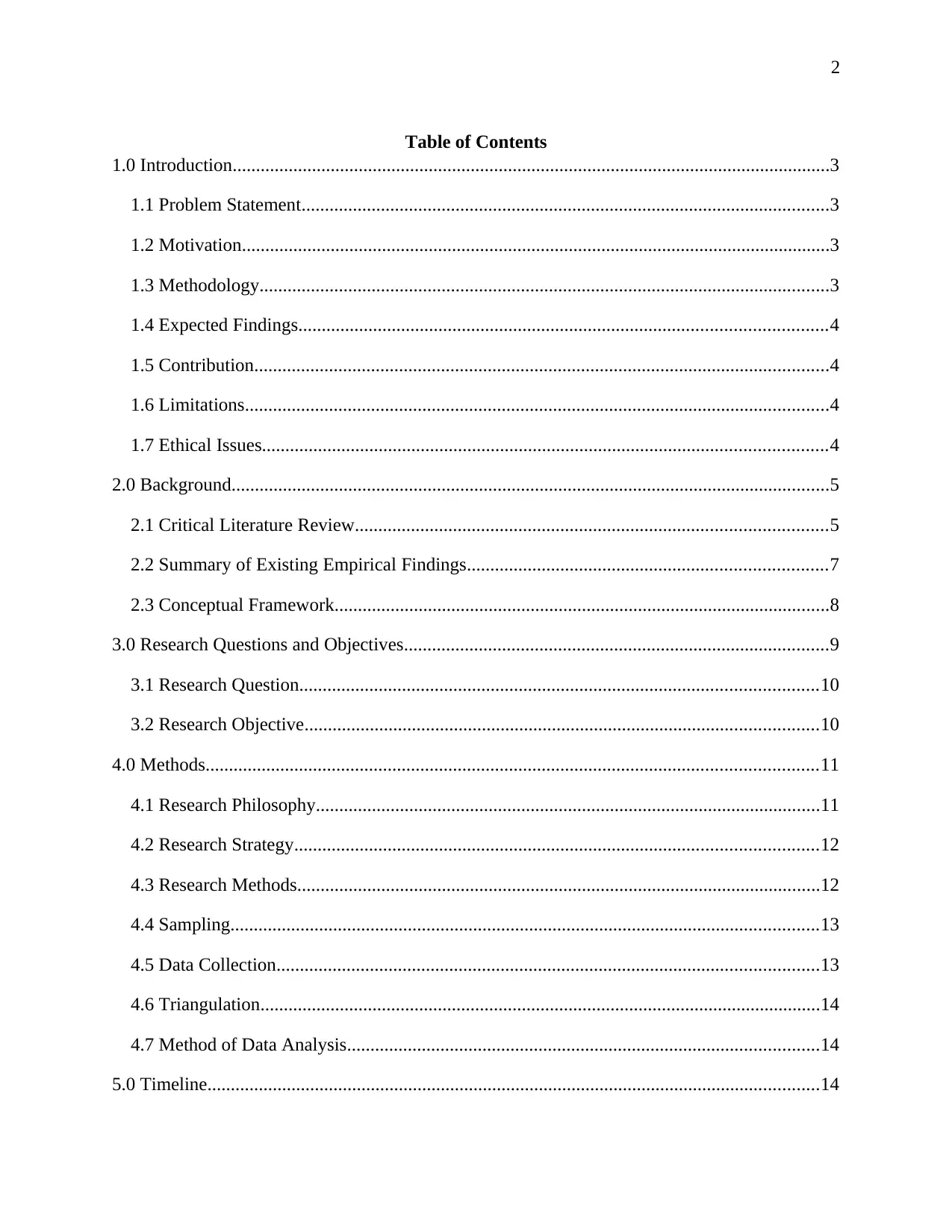
Table of Contents
1.0 Introduction................................................................................................................................3
1.1 Problem Statement.................................................................................................................3
1.2 Motivation..............................................................................................................................3
1.3 Methodology..........................................................................................................................3
1.4 Expected Findings.................................................................................................................4
1.5 Contribution...........................................................................................................................4
1.6 Limitations.............................................................................................................................4
1.7 Ethical Issues.........................................................................................................................4
2.0 Background................................................................................................................................5
2.1 Critical Literature Review.....................................................................................................5
2.2 Summary of Existing Empirical Findings.............................................................................7
2.3 Conceptual Framework..........................................................................................................8
3.0 Research Questions and Objectives...........................................................................................9
3.1 Research Question...............................................................................................................10
3.2 Research Objective..............................................................................................................10
4.0 Methods...................................................................................................................................11
4.1 Research Philosophy............................................................................................................11
4.2 Research Strategy................................................................................................................12
4.3 Research Methods................................................................................................................12
4.4 Sampling..............................................................................................................................13
4.5 Data Collection....................................................................................................................13
4.6 Triangulation........................................................................................................................14
4.7 Method of Data Analysis.....................................................................................................14
5.0 Timeline...................................................................................................................................14
Table of Contents
1.0 Introduction................................................................................................................................3
1.1 Problem Statement.................................................................................................................3
1.2 Motivation..............................................................................................................................3
1.3 Methodology..........................................................................................................................3
1.4 Expected Findings.................................................................................................................4
1.5 Contribution...........................................................................................................................4
1.6 Limitations.............................................................................................................................4
1.7 Ethical Issues.........................................................................................................................4
2.0 Background................................................................................................................................5
2.1 Critical Literature Review.....................................................................................................5
2.2 Summary of Existing Empirical Findings.............................................................................7
2.3 Conceptual Framework..........................................................................................................8
3.0 Research Questions and Objectives...........................................................................................9
3.1 Research Question...............................................................................................................10
3.2 Research Objective..............................................................................................................10
4.0 Methods...................................................................................................................................11
4.1 Research Philosophy............................................................................................................11
4.2 Research Strategy................................................................................................................12
4.3 Research Methods................................................................................................................12
4.4 Sampling..............................................................................................................................13
4.5 Data Collection....................................................................................................................13
4.6 Triangulation........................................................................................................................14
4.7 Method of Data Analysis.....................................................................................................14
5.0 Timeline...................................................................................................................................14

3
6.0 Resources.................................................................................................................................15
6.1 Types....................................................................................................................................15
6.2 Availability..........................................................................................................................15
Reference List................................................................................................................................17
6.0 Resources.................................................................................................................................15
6.1 Types....................................................................................................................................15
6.2 Availability..........................................................................................................................15
Reference List................................................................................................................................17
⊘ This is a preview!⊘
Do you want full access?
Subscribe today to unlock all pages.

Trusted by 1+ million students worldwide
4
1.0 Introduction
The following section discusses in great detail a proposal on the research topic “Female
Leadership and its Impact on Organisational Performance”. The research report thereby
enlightens on the primary factors that has resulted in the selection of the research topic along
with the methods to be used for the successful accomplishment of the problem statement
identified for the purpose.
1.1 Problem Statement
The rapid advancements made in the global business context has witnessed some of the
phenomenon changes, one of them being women taking up organisational leadership roles. The
widespread transition observed in relation to women coming out of their traditional barriers to
occupying distinctive positions in corporate sector is a significant factor to be enlightened upon
(Murrell, 2018). Therefore, the problem statement identified in relation to the research study is to
gain immense information as to how the diversified female leadership style is critical to helping
organisations in accomplishing high performance standards.
1.2 Motivation
The primary motivational factor underling the selection of the research topic is that a large
number of organisations operating in the modern-day context are found to rely more on female
leaders for experiencing increased performance effectiveness. For instance, the United States
based automobile manufacturer Tesla broke all stereotypes with the appointment of a female
chairman Robyn Denholm (McKinley, 2018). The female leader was entitled with the
responsibility of handling the security fraud issues experienced by the organisation in due course
of its operational activities. Tesla is one of the few examples where women has come forward to
take the front role in leadership and management. The same has been experienced in a large
number of operational sectors, retail, FMCG and information technology all over the world. The
widespread emergence of female leaders all across the globe is thereby identified as one of the
motivational factors to go ahead with the research work on the topic.
1.3 Methodology
The research study will go ahead in accordance to the principles of a mixed method. In this
regard, both qualitative and quantitative analysis of the study will be done. Primary data will be
1.0 Introduction
The following section discusses in great detail a proposal on the research topic “Female
Leadership and its Impact on Organisational Performance”. The research report thereby
enlightens on the primary factors that has resulted in the selection of the research topic along
with the methods to be used for the successful accomplishment of the problem statement
identified for the purpose.
1.1 Problem Statement
The rapid advancements made in the global business context has witnessed some of the
phenomenon changes, one of them being women taking up organisational leadership roles. The
widespread transition observed in relation to women coming out of their traditional barriers to
occupying distinctive positions in corporate sector is a significant factor to be enlightened upon
(Murrell, 2018). Therefore, the problem statement identified in relation to the research study is to
gain immense information as to how the diversified female leadership style is critical to helping
organisations in accomplishing high performance standards.
1.2 Motivation
The primary motivational factor underling the selection of the research topic is that a large
number of organisations operating in the modern-day context are found to rely more on female
leaders for experiencing increased performance effectiveness. For instance, the United States
based automobile manufacturer Tesla broke all stereotypes with the appointment of a female
chairman Robyn Denholm (McKinley, 2018). The female leader was entitled with the
responsibility of handling the security fraud issues experienced by the organisation in due course
of its operational activities. Tesla is one of the few examples where women has come forward to
take the front role in leadership and management. The same has been experienced in a large
number of operational sectors, retail, FMCG and information technology all over the world. The
widespread emergence of female leaders all across the globe is thereby identified as one of the
motivational factors to go ahead with the research work on the topic.
1.3 Methodology
The research study will go ahead in accordance to the principles of a mixed method. In this
regard, both qualitative and quantitative analysis of the study will be done. Primary data will be
Paraphrase This Document
Need a fresh take? Get an instant paraphrase of this document with our AI Paraphraser
5
used so that information gained for the study are up to data, fresh and appropriate in terms of
enlightening on the relative impact generated by female leaders on the performance capability of
organisations.
1.4 Expected Findings
The expected findings of the research study comprise of the role played by female as leaders in
the operational context of modern-day business environment. The typical and unique
characteristics possessed by female leaders as well as its relationship with the widespread
theories of leadership are likely to be established. Additionally, the research report is looked
forward to enlightening on the primary factors of organisational operational as well as
performance that the female leaders tends to impact on.
1.5 Contribution
The research study will go ahead with overcoming the gap existing in the present literature scope
of female leadership and its effectiveness on performance capability of organisations. The
research findings are critical to providing valuable insights onto the importance of female leaders
as well as their leadership style.
1.6 Limitations
Due to the severe constraints in time, the research study has been limited only to England and the
selected sample respondents are comparatively less to gain widespread insight into the research
topic. The consideration of a larger sample ranging across different organisations operating in
England could have provided valuable yet meaningful insight into the problem are thus
identified.
1.7 Ethical Issues
The research study is likely to suffer from ethical issues in relation to collecting secondary data
for literature review as well as the final mixed analysis to be conducted upon primary data. The
information collected from research work conducted by other authors and journals used for the
purpose of preparing literature review must be properly acknowledged and referenced to avoid
any form of ethical issues (Wester, 2011). Furthermore, the study must ensure protecting the
anonymity and confidentiality of the respondents who have shared valuable feedback for
accomplishing the research study. The feedback and information obtained in the process must
not be used for nay purpose other than this particular research study (Roberts and Allen, 2015). It
used so that information gained for the study are up to data, fresh and appropriate in terms of
enlightening on the relative impact generated by female leaders on the performance capability of
organisations.
1.4 Expected Findings
The expected findings of the research study comprise of the role played by female as leaders in
the operational context of modern-day business environment. The typical and unique
characteristics possessed by female leaders as well as its relationship with the widespread
theories of leadership are likely to be established. Additionally, the research report is looked
forward to enlightening on the primary factors of organisational operational as well as
performance that the female leaders tends to impact on.
1.5 Contribution
The research study will go ahead with overcoming the gap existing in the present literature scope
of female leadership and its effectiveness on performance capability of organisations. The
research findings are critical to providing valuable insights onto the importance of female leaders
as well as their leadership style.
1.6 Limitations
Due to the severe constraints in time, the research study has been limited only to England and the
selected sample respondents are comparatively less to gain widespread insight into the research
topic. The consideration of a larger sample ranging across different organisations operating in
England could have provided valuable yet meaningful insight into the problem are thus
identified.
1.7 Ethical Issues
The research study is likely to suffer from ethical issues in relation to collecting secondary data
for literature review as well as the final mixed analysis to be conducted upon primary data. The
information collected from research work conducted by other authors and journals used for the
purpose of preparing literature review must be properly acknowledged and referenced to avoid
any form of ethical issues (Wester, 2011). Furthermore, the study must ensure protecting the
anonymity and confidentiality of the respondents who have shared valuable feedback for
accomplishing the research study. The feedback and information obtained in the process must
not be used for nay purpose other than this particular research study (Roberts and Allen, 2015). It
6
also requires avoiding the ethical issues relating to gaining prior permission of the respondents
before involving them for the data collection process.
2.0 Background
The position of women in present male dominated corporate sector is identified to experience
high degree of biasness. It is mainly observed in situations when women are not provided with
job roles suited to their skills and competencies. According to Alimo-Metcalfe (2010), women
are primarily looked forward to suitable for organisational positions that are less stressful and
does not involve application of technological excellence and skills. However, the present
business environment is found to have witnessed a completely different scenario. Females are
found to successfully overcome typical gender stereotypes in organisational setting followed by
occupation of positions and job roles that were initially perceived to be suitable for men.
Furthermore, women are also exhibiting immense effectiveness in competing with men in same
operational platform followed by exhibition of increased effectiveness in generating increased
motivation and high performing capability among subordinate employees (Murrell, 2018). As a
result, the study has gone ahead with consideration of determining the effectiveness of female
leadership in shaping performance capability of organisations. In this regard, a critical analysis
of the existing literatures available in this context has been taken into consideration. The
following section provides a detailed background study of the selected research topic by taking
into consideration previous studies, journals and information relating to female leadership style
and its effectiveness in organisational performance.
2.1 Critical Literature Review
The leadership style of an organisation depicts its overall effectiveness in accomplishing
business goals by taking into consideration the skills and knowledge set of the over workforce. In
this regard, the role played by a leader is of immense significance in motivating and encouraging
subordinates to work towards organisational goals (Salahuddin, 2010). On the other hand,
leadership is also perceived as the process by which an organisation goes ahead with instilling
the strategic vision among employees, in lieu of their dedication and encouragement towards
accomplishing organisational goals (Oberfield, 2012). The existing literature context is found to
be enriched with widespread theories relating to leadership, notable being transformational and
transactional leaders. One of the primary factors underlying the consideration of the mentioned
also requires avoiding the ethical issues relating to gaining prior permission of the respondents
before involving them for the data collection process.
2.0 Background
The position of women in present male dominated corporate sector is identified to experience
high degree of biasness. It is mainly observed in situations when women are not provided with
job roles suited to their skills and competencies. According to Alimo-Metcalfe (2010), women
are primarily looked forward to suitable for organisational positions that are less stressful and
does not involve application of technological excellence and skills. However, the present
business environment is found to have witnessed a completely different scenario. Females are
found to successfully overcome typical gender stereotypes in organisational setting followed by
occupation of positions and job roles that were initially perceived to be suitable for men.
Furthermore, women are also exhibiting immense effectiveness in competing with men in same
operational platform followed by exhibition of increased effectiveness in generating increased
motivation and high performing capability among subordinate employees (Murrell, 2018). As a
result, the study has gone ahead with consideration of determining the effectiveness of female
leadership in shaping performance capability of organisations. In this regard, a critical analysis
of the existing literatures available in this context has been taken into consideration. The
following section provides a detailed background study of the selected research topic by taking
into consideration previous studies, journals and information relating to female leadership style
and its effectiveness in organisational performance.
2.1 Critical Literature Review
The leadership style of an organisation depicts its overall effectiveness in accomplishing
business goals by taking into consideration the skills and knowledge set of the over workforce. In
this regard, the role played by a leader is of immense significance in motivating and encouraging
subordinates to work towards organisational goals (Salahuddin, 2010). On the other hand,
leadership is also perceived as the process by which an organisation goes ahead with instilling
the strategic vision among employees, in lieu of their dedication and encouragement towards
accomplishing organisational goals (Oberfield, 2012). The existing literature context is found to
be enriched with widespread theories relating to leadership, notable being transformational and
transactional leaders. One of the primary factors underlying the consideration of the mentioned
⊘ This is a preview!⊘
Do you want full access?
Subscribe today to unlock all pages.
Trusted by 1+ million students worldwide
7
leadership styles is that female leadership style is perceived to held resemblance to both
transformational and transactional leadership attributes.
The role played by a female individual as a leader within an organisational context is largely
described in the literature in terms of gender orientation. The Full Range Theory of Leadership in
this regard is found to be highly significant. Men and women differ vastly in terms of their
behavioural characteristics and eventually in their approach of leading an organisation.
According to Singh, Nadim and Ezzedeen (2012) women leadership is identified as exhibition of
a soft, rational, compassionate, warm, and expressible attitude in dealing with organisational
activities. Furthermore, women are largely known for their communal through process and
outlook when it comes to dealing with organisational operational activities. In this regard, the
significant behavioural characteristics of female leaders are identified to be helpful, sympathetic,
nurturing, gentle, king and affectionate (Coder and Spiller, 2013). Based on the typical
characteristics of women in the position of leader thereby resulted in its consideration to be an
effective combination of both transactional and transformation roles (Stempel, Rigotti and Mohr,
2015).
The gender stereotypes predominantly significant in relation to female leadership is found to
have strong association as well as significance with that of transformational leadership style.
Women are perceived to be highly motivational and influencing when it comes to managing
employee. Furthermore, female leadership also exhibit sin great detail high degree of affinity
towards innovation, creativity as well as self-recognition to be primary factors in an
organisational context (Vinkenburg et al., 2011). On the other hand, Bellou (2011) ahs stated that
the notable transformational leadership style observed among a female leaser is that
consideration of a contingent based reward policy when it comes to motivate and encourage
employees to accomplish organisational tasks.
The effectiveness of female leadership in relation to impacting the performance standards of an
organisation seems to be highly significant. The primary role played by women in this regard is
found to developing a positive work environment, where employees experience high degree of
motivation as well as satisfaction to the present job role (Peachey and Burton, 2011). On the
other hand, Duff (2013) stated that the application scope of female leadership in terms of
witnessing high performance standards is not only restricted to employee motivation, instead the
leadership styles is that female leadership style is perceived to held resemblance to both
transformational and transactional leadership attributes.
The role played by a female individual as a leader within an organisational context is largely
described in the literature in terms of gender orientation. The Full Range Theory of Leadership in
this regard is found to be highly significant. Men and women differ vastly in terms of their
behavioural characteristics and eventually in their approach of leading an organisation.
According to Singh, Nadim and Ezzedeen (2012) women leadership is identified as exhibition of
a soft, rational, compassionate, warm, and expressible attitude in dealing with organisational
activities. Furthermore, women are largely known for their communal through process and
outlook when it comes to dealing with organisational operational activities. In this regard, the
significant behavioural characteristics of female leaders are identified to be helpful, sympathetic,
nurturing, gentle, king and affectionate (Coder and Spiller, 2013). Based on the typical
characteristics of women in the position of leader thereby resulted in its consideration to be an
effective combination of both transactional and transformation roles (Stempel, Rigotti and Mohr,
2015).
The gender stereotypes predominantly significant in relation to female leadership is found to
have strong association as well as significance with that of transformational leadership style.
Women are perceived to be highly motivational and influencing when it comes to managing
employee. Furthermore, female leadership also exhibit sin great detail high degree of affinity
towards innovation, creativity as well as self-recognition to be primary factors in an
organisational context (Vinkenburg et al., 2011). On the other hand, Bellou (2011) ahs stated that
the notable transformational leadership style observed among a female leaser is that
consideration of a contingent based reward policy when it comes to motivate and encourage
employees to accomplish organisational tasks.
The effectiveness of female leadership in relation to impacting the performance standards of an
organisation seems to be highly significant. The primary role played by women in this regard is
found to developing a positive work environment, where employees experience high degree of
motivation as well as satisfaction to the present job role (Peachey and Burton, 2011). On the
other hand, Duff (2013) stated that the application scope of female leadership in terms of
witnessing high performance standards is not only restricted to employee motivation, instead the
Paraphrase This Document
Need a fresh take? Get an instant paraphrase of this document with our AI Paraphraser
8
impact is much deeper rooted and significant. Women leaders are found to exhibit increased
effectiveness in enhancing the knowledge capability of the employees through undertaking o
strategies looking forward to effectively managing them within an organisational context.
According to Rahim and Malik (2010), a primary significance of female leaders is that their
primary objectives lies in helping the organisation to successfully reach the highest performance
standards.
The existing literature context in this regard has also enlightened in great detail both the positive
and negative sides of female leadership within an organisational setting. Women leaders are
looked forward to help organisations in experiencing positive results even in the most uncertain
and toughest of situations (Peachey and Burton, 2011). It is mainly due to the fact that the
innovative and compassionate outlook of women looks forward to helping them in dealing with
the organisational problems in a comparatively easier manner. This along with the diversified
thought process of the customers seems to help women leaders in perceiving organisations
operational process from multiple angles. This results in women leaders to experience
widespread success in delivering high performance standards. According to Rosette and Toast
(2010), women leaders are perceived as highly ethical in their work approach along with
adherence to high degree of sustainability in each of the business processes. On the other hand,
the disadvantages associated with women leaders seems to be significant in situations where it
requires taking upon the responsibility of a job role signifying adequate degree of male
characteristics. In such a situation, the soft and kind-hearted nature of women leaders fails
significantly in relation to exercising necessary power and control over the subordinates
(Peachey and Burton, 2011). This along with the high degree of biasness existing within the
business operational environment of an organisation goes ahead with enlightening on the
negative side of women leadership. The non-cooperation experienced by female employees in a
business environmental setting also results in signifying the negative side of women leadership
in an organisational context.
2.2 Summary of Existing Empirical Findings
Based on the literature review conducted in the above section, it can be largely said that female
leadership is gradually gaining increased attention in the business environmental context. The
women leaders are found to be highly competent in dealing with organisational issues with high
impact is much deeper rooted and significant. Women leaders are found to exhibit increased
effectiveness in enhancing the knowledge capability of the employees through undertaking o
strategies looking forward to effectively managing them within an organisational context.
According to Rahim and Malik (2010), a primary significance of female leaders is that their
primary objectives lies in helping the organisation to successfully reach the highest performance
standards.
The existing literature context in this regard has also enlightened in great detail both the positive
and negative sides of female leadership within an organisational setting. Women leaders are
looked forward to help organisations in experiencing positive results even in the most uncertain
and toughest of situations (Peachey and Burton, 2011). It is mainly due to the fact that the
innovative and compassionate outlook of women looks forward to helping them in dealing with
the organisational problems in a comparatively easier manner. This along with the diversified
thought process of the customers seems to help women leaders in perceiving organisations
operational process from multiple angles. This results in women leaders to experience
widespread success in delivering high performance standards. According to Rosette and Toast
(2010), women leaders are perceived as highly ethical in their work approach along with
adherence to high degree of sustainability in each of the business processes. On the other hand,
the disadvantages associated with women leaders seems to be significant in situations where it
requires taking upon the responsibility of a job role signifying adequate degree of male
characteristics. In such a situation, the soft and kind-hearted nature of women leaders fails
significantly in relation to exercising necessary power and control over the subordinates
(Peachey and Burton, 2011). This along with the high degree of biasness existing within the
business operational environment of an organisation goes ahead with enlightening on the
negative side of women leadership. The non-cooperation experienced by female employees in a
business environmental setting also results in signifying the negative side of women leadership
in an organisational context.
2.2 Summary of Existing Empirical Findings
Based on the literature review conducted in the above section, it can be largely said that female
leadership is gradually gaining increased attention in the business environmental context. The
women leaders are found to be highly competent in dealing with organisational issues with high
9
degree of sympathetic, kind and passionate attitude. It has also elaborated in great detail that
there exists huge difference in between the leadership style of men and women significantly. The
role played by women leaders in relation to managing employees and delivering high
performance standards is found to be largely associated with leadership theories. To be precise,
the transformational and transactional theories of leadership are found to constitute the
characteristics and skills of an effective leader. Furthermore, the critical literature review thereby
conducted ensured that the primary organisational performance factors impacted by female
leaders are also identified in great detail. In this regard, the notable factors comprise of
motivation and positive work environment, two of the striking factors relating to experiencing
high degree of employee dedication as well as management. The differential and innovative
operational outlook of women leaders is critical to helping employees experience high degree of
positivity as well as satisfaction in their present job role. This along with the king, caring and
loving attitude of the female leaders seems to be highly significant in generating high degree of
operational effectiveness.
The empirical findings from the literature review further went ahead with highlighting in great
detail the relative advantages as well as disadvantages of women leadership in an organisational
setting. The innovative and unique thought process of female leaders helps organisations in
successfully accomplishing new operational standards. Furthermore, the high degree of
adherence to ethical operational processes is identified to be one of the potential benefits
associated with female leaders in an organisational context. The organisations are found to
operate in a completely new direction and at the same time experience high performance
standards. On the other hand, women leaders are found to experience immense difficulty in
dealing with responsibilities that are perceived to be highly complex and masculine in nature. In
such a situation, women leaders are found to fail considerably. This along with the biased
attitude of present male dominated workforce results in signifying one of notable loopholes of
female leadership and its operational effectiveness.
2.3 Conceptual Framework
The following conceptual framework has been developed for the purpose of going ahead with the
study based on the information as well as notable factors to be considered for the purpose has
been identified.
degree of sympathetic, kind and passionate attitude. It has also elaborated in great detail that
there exists huge difference in between the leadership style of men and women significantly. The
role played by women leaders in relation to managing employees and delivering high
performance standards is found to be largely associated with leadership theories. To be precise,
the transformational and transactional theories of leadership are found to constitute the
characteristics and skills of an effective leader. Furthermore, the critical literature review thereby
conducted ensured that the primary organisational performance factors impacted by female
leaders are also identified in great detail. In this regard, the notable factors comprise of
motivation and positive work environment, two of the striking factors relating to experiencing
high degree of employee dedication as well as management. The differential and innovative
operational outlook of women leaders is critical to helping employees experience high degree of
positivity as well as satisfaction in their present job role. This along with the king, caring and
loving attitude of the female leaders seems to be highly significant in generating high degree of
operational effectiveness.
The empirical findings from the literature review further went ahead with highlighting in great
detail the relative advantages as well as disadvantages of women leadership in an organisational
setting. The innovative and unique thought process of female leaders helps organisations in
successfully accomplishing new operational standards. Furthermore, the high degree of
adherence to ethical operational processes is identified to be one of the potential benefits
associated with female leaders in an organisational context. The organisations are found to
operate in a completely new direction and at the same time experience high performance
standards. On the other hand, women leaders are found to experience immense difficulty in
dealing with responsibilities that are perceived to be highly complex and masculine in nature. In
such a situation, women leaders are found to fail considerably. This along with the biased
attitude of present male dominated workforce results in signifying one of notable loopholes of
female leadership and its operational effectiveness.
2.3 Conceptual Framework
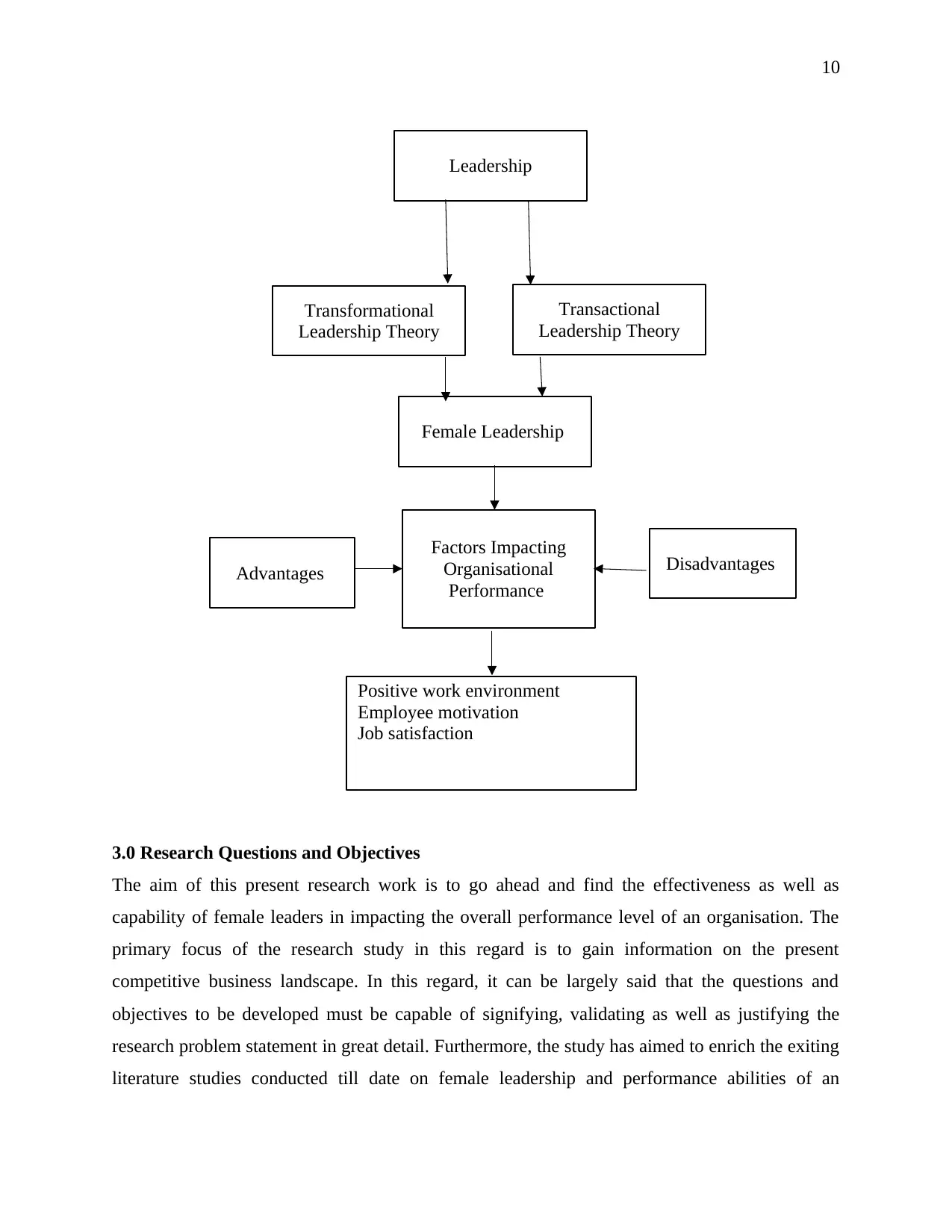
The following conceptual framework has been developed for the purpose of going ahead with the
study based on the information as well as notable factors to be considered for the purpose has
been identified.
⊘ This is a preview!⊘
Do you want full access?
Subscribe today to unlock all pages.
Trusted by 1+ million students worldwide
Leadership
Transformational
Leadership Theory
Transactional
Leadership Theory
Female Leadership
Factors Impacting
Organisational
Performance
Advantages Disadvantages
Positive work environment
Employee motivation
Job satisfaction
10
3.0 Research Questions and Objectives
The aim of this present research work is to go ahead and find the effectiveness as well as
capability of female leaders in impacting the overall performance level of an organisation. The
primary focus of the research study in this regard is to gain information on the present
competitive business landscape. In this regard, it can be largely said that the questions and
objectives to be developed must be capable of signifying, validating as well as justifying the
research problem statement in great detail. Furthermore, the study has aimed to enrich the exiting
literature studies conducted till date on female leadership and performance abilities of an
Transformational
Leadership Theory
Transactional
Leadership Theory
Female Leadership
Factors Impacting
Organisational
Performance
Advantages Disadvantages
Positive work environment
Employee motivation
Job satisfaction
10
3.0 Research Questions and Objectives
The aim of this present research work is to go ahead and find the effectiveness as well as
capability of female leaders in impacting the overall performance level of an organisation. The
primary focus of the research study in this regard is to gain information on the present
competitive business landscape. In this regard, it can be largely said that the questions and
objectives to be developed must be capable of signifying, validating as well as justifying the
research problem statement in great detail. Furthermore, the study has aimed to enrich the exiting
literature studies conducted till date on female leadership and performance abilities of an
Paraphrase This Document
Need a fresh take? Get an instant paraphrase of this document with our AI Paraphraser
11
organisation. It is mainly due to the fact that a widespread gap has been determined in terms of
providing the impact of business competitiveness and operational effectiveness in the backdrop
of female leadership. As a result, the present research study has emphasised on conducting the
study in real-life present competitive and globalised business environment, which has
specifically witnessed a large number of women occupying top leadership positions. In this
regard, the effectiveness of female leaders to strengthen as well as impact the operational
effectiveness of an organisation seems to be highly significant. It is mainly due to the fact that
women leaders are generally perceived as individuals who possess immense capability in helping
organisations to exhibit adherence to ethical principles, effectively handle risks as well develop
suitable strategies to gradually proceed further. Primarily, the research study has focussed on
effectiveness of female leaders in helping an organisation to gradually procced further by
overcoming the obstructions that is likely to come in due course of operation in the present
business environmental context.
3.1 Research Question
The research questions developed for the study focussing on female leadership and its impact on
performance level of an organisation is as follows:
What is the role played by female leaders in helping an organisation to exhibit high
operational performance standards?
What are the distinctive characteristics of female leaders identified within the present
organisational scenario?
What are primary factors that female leaders tend to impact when it comes to
determining organisational performance?
What are the relative advantages and disadvantages experienced by organisations in
relation to a female leader?
How female leaders tends to handle work roles that are traditionally considered beyond
the scope of female stereotypes?
3.2 Research Objective
Based on the research aim and the objective thus defined, the following set of objectives has
been framed for the study:
organisation. It is mainly due to the fact that a widespread gap has been determined in terms of
providing the impact of business competitiveness and operational effectiveness in the backdrop
of female leadership. As a result, the present research study has emphasised on conducting the
study in real-life present competitive and globalised business environment, which has
specifically witnessed a large number of women occupying top leadership positions. In this
regard, the effectiveness of female leaders to strengthen as well as impact the operational
effectiveness of an organisation seems to be highly significant. It is mainly due to the fact that
women leaders are generally perceived as individuals who possess immense capability in helping
organisations to exhibit adherence to ethical principles, effectively handle risks as well develop
suitable strategies to gradually proceed further. Primarily, the research study has focussed on
effectiveness of female leaders in helping an organisation to gradually procced further by
overcoming the obstructions that is likely to come in due course of operation in the present
business environmental context.
3.1 Research Question
The research questions developed for the study focussing on female leadership and its impact on
performance level of an organisation is as follows:
What is the role played by female leaders in helping an organisation to exhibit high
operational performance standards?
What are the distinctive characteristics of female leaders identified within the present
organisational scenario?
What are primary factors that female leaders tend to impact when it comes to
determining organisational performance?
What are the relative advantages and disadvantages experienced by organisations in
relation to a female leader?
How female leaders tends to handle work roles that are traditionally considered beyond
the scope of female stereotypes?
3.2 Research Objective
Based on the research aim and the objective thus defined, the following set of objectives has
been framed for the study:
12
To determine the role played by female leaders in enhancing performance capability of
organisations.
To study the typical characteristics of female leaders.
To identify the factors that female leaders’ impact in relation to organisational
performance.
To identify the advantages and disadvantages of female leaders in handling
organisational responsibility.
To determine the effectiveness of female leaders in handling organisational situations that
are considered to be far beyond typical female stereotypes.
4.0 Methods
The methods in the context of a research goes ahead with defining the pathway to be used for the
purpose of identifying the processes associated with gaining information relating to the identified
problem statement. Each of the diversified process relating to data identification, selection,
collection, analysis, interpretation and processing is being done with the help of selection of
suitable research methods (Hughes and Sharrock, 2016). It is also integral to signifying in great
detail the validity and reliability of each of the processes used for the purpose of data collection
followed by its analysis. Furthermore, a significant factor relating to methods in the context of
research study is that the process goes head with selection of appropriate data collection as well
as analysis process based on the information and data obtained during the literature review
process (Flick, 2015). The methods in the context of a research study comprises of a large
number of sub parts, notably being philosophy, strategy, methods, sampling, data collection and
analysis process. The subparts of each of these different factors encompassing the methods are
selected based on the relevance of data obtained from literature review.
The methods to be used by the present research study on effectiveness of women leadership on
performance of an organisation are described in great detail in the following section. It has also
ensured that the method thus selected for the purpose has been justified in accordance to the
present needs and demands relating to the study.
4.1 Research Philosophy
The nature of information as well as the source from which data is likely to be collected for the
study is defined with the help of research philosophy (Jonker and Pennink, 2010). The primary
To determine the role played by female leaders in enhancing performance capability of
organisations.
To study the typical characteristics of female leaders.
To identify the factors that female leaders’ impact in relation to organisational
performance.
To identify the advantages and disadvantages of female leaders in handling
organisational responsibility.
To determine the effectiveness of female leaders in handling organisational situations that
are considered to be far beyond typical female stereotypes.
4.0 Methods
The methods in the context of a research goes ahead with defining the pathway to be used for the
purpose of identifying the processes associated with gaining information relating to the identified
problem statement. Each of the diversified process relating to data identification, selection,
collection, analysis, interpretation and processing is being done with the help of selection of
suitable research methods (Hughes and Sharrock, 2016). It is also integral to signifying in great
detail the validity and reliability of each of the processes used for the purpose of data collection
followed by its analysis. Furthermore, a significant factor relating to methods in the context of
research study is that the process goes head with selection of appropriate data collection as well
as analysis process based on the information and data obtained during the literature review
process (Flick, 2015). The methods in the context of a research study comprises of a large
number of sub parts, notably being philosophy, strategy, methods, sampling, data collection and
analysis process. The subparts of each of these different factors encompassing the methods are
selected based on the relevance of data obtained from literature review.
The methods to be used by the present research study on effectiveness of women leadership on
performance of an organisation are described in great detail in the following section. It has also
ensured that the method thus selected for the purpose has been justified in accordance to the
present needs and demands relating to the study.
4.1 Research Philosophy
The nature of information as well as the source from which data is likely to be collected for the
study is defined with the help of research philosophy (Jonker and Pennink, 2010). The primary
⊘ This is a preview!⊘
Do you want full access?
Subscribe today to unlock all pages.
Trusted by 1+ million students worldwide

1 out of 20


Related Documents


Your All-in-One AI-Powered Toolkit for Academic Success.
+13062052269
info@desklib.com
Available 24*7 on WhatsApp / Email
![[object Object]](/_next/static/media/star-bottom.7253800d.svg)
Unlock your academic potential
Copyright © 2020–2026 A2Z Services. All Rights Reserved. Developed and managed by ZUCOL.