Exploring Feminism in Sandra Cisneros' The House on Mango Street
VerifiedAdded on 2022/08/12
|33
|10787
|150
Essay
AI Summary
This essay provides a comprehensive analysis of Sandra Cisneros' "The House on Mango Street" from a feminist perspective. It begins with an introduction to Cisneros and her work, highlighting the themes of cultural suppression, poverty, and gender roles prevalent in her writing. The essay then explores the significance of the study, focusing on the construction of Esperanza's subjectivity and the challenges faced by Mexican women in pursuit of self-discovery. A literature review examines existing studies on the novel, both internationally and domestically, including works that focus on self-consciousness, patriarchy, gender identity, and racial discrimination. The essay discusses the critical reception of the novel, including the impact of the 'house' as a symbol and the concept of 'othering'. Overall, the essay provides a detailed overview of the feminist themes, cultural identity, and the protagonist's journey within the context of the novel, supported by existing scholarly research and critical analysis.
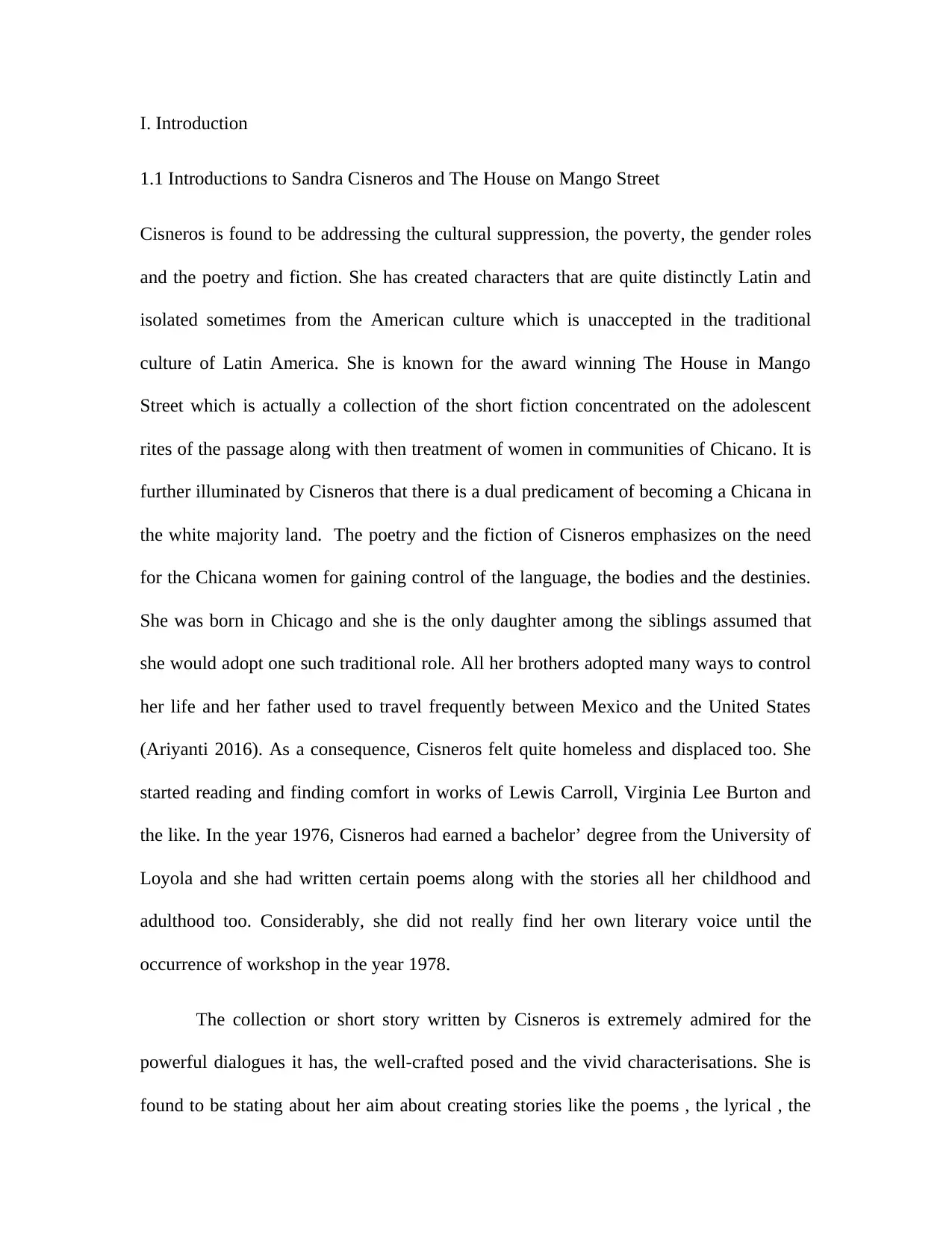
I. Introduction
1.1 Introductions to Sandra Cisneros and The House on Mango Street
Cisneros is found to be addressing the cultural suppression, the poverty, the gender roles
and the poetry and fiction. She has created characters that are quite distinctly Latin and
isolated sometimes from the American culture which is unaccepted in the traditional
culture of Latin America. She is known for the award winning The House in Mango
Street which is actually a collection of the short fiction concentrated on the adolescent
rites of the passage along with then treatment of women in communities of Chicano. It is
further illuminated by Cisneros that there is a dual predicament of becoming a Chicana in
the white majority land. The poetry and the fiction of Cisneros emphasizes on the need
for the Chicana women for gaining control of the language, the bodies and the destinies.
She was born in Chicago and she is the only daughter among the siblings assumed that
she would adopt one such traditional role. All her brothers adopted many ways to control
her life and her father used to travel frequently between Mexico and the United States
(Ariyanti 2016). As a consequence, Cisneros felt quite homeless and displaced too. She
started reading and finding comfort in works of Lewis Carroll, Virginia Lee Burton and
the like. In the year 1976, Cisneros had earned a bachelor’ degree from the University of
Loyola and she had written certain poems along with the stories all her childhood and
adulthood too. Considerably, she did not really find her own literary voice until the
occurrence of workshop in the year 1978.
The collection or short story written by Cisneros is extremely admired for the
powerful dialogues it has, the well-crafted posed and the vivid characterisations. She is
found to be stating about her aim about creating stories like the poems , the lyrical , the
1.1 Introductions to Sandra Cisneros and The House on Mango Street
Cisneros is found to be addressing the cultural suppression, the poverty, the gender roles
and the poetry and fiction. She has created characters that are quite distinctly Latin and
isolated sometimes from the American culture which is unaccepted in the traditional
culture of Latin America. She is known for the award winning The House in Mango
Street which is actually a collection of the short fiction concentrated on the adolescent
rites of the passage along with then treatment of women in communities of Chicano. It is
further illuminated by Cisneros that there is a dual predicament of becoming a Chicana in
the white majority land. The poetry and the fiction of Cisneros emphasizes on the need
for the Chicana women for gaining control of the language, the bodies and the destinies.
She was born in Chicago and she is the only daughter among the siblings assumed that
she would adopt one such traditional role. All her brothers adopted many ways to control
her life and her father used to travel frequently between Mexico and the United States
(Ariyanti 2016). As a consequence, Cisneros felt quite homeless and displaced too. She
started reading and finding comfort in works of Lewis Carroll, Virginia Lee Burton and
the like. In the year 1976, Cisneros had earned a bachelor’ degree from the University of
Loyola and she had written certain poems along with the stories all her childhood and
adulthood too. Considerably, she did not really find her own literary voice until the
occurrence of workshop in the year 1978.
The collection or short story written by Cisneros is extremely admired for the
powerful dialogues it has, the well-crafted posed and the vivid characterisations. She is
found to be stating about her aim about creating stories like the poems , the lyrical , the

Paraphrase This Document
Need a fresh take? Get an instant paraphrase of this document with our AI Paraphraser
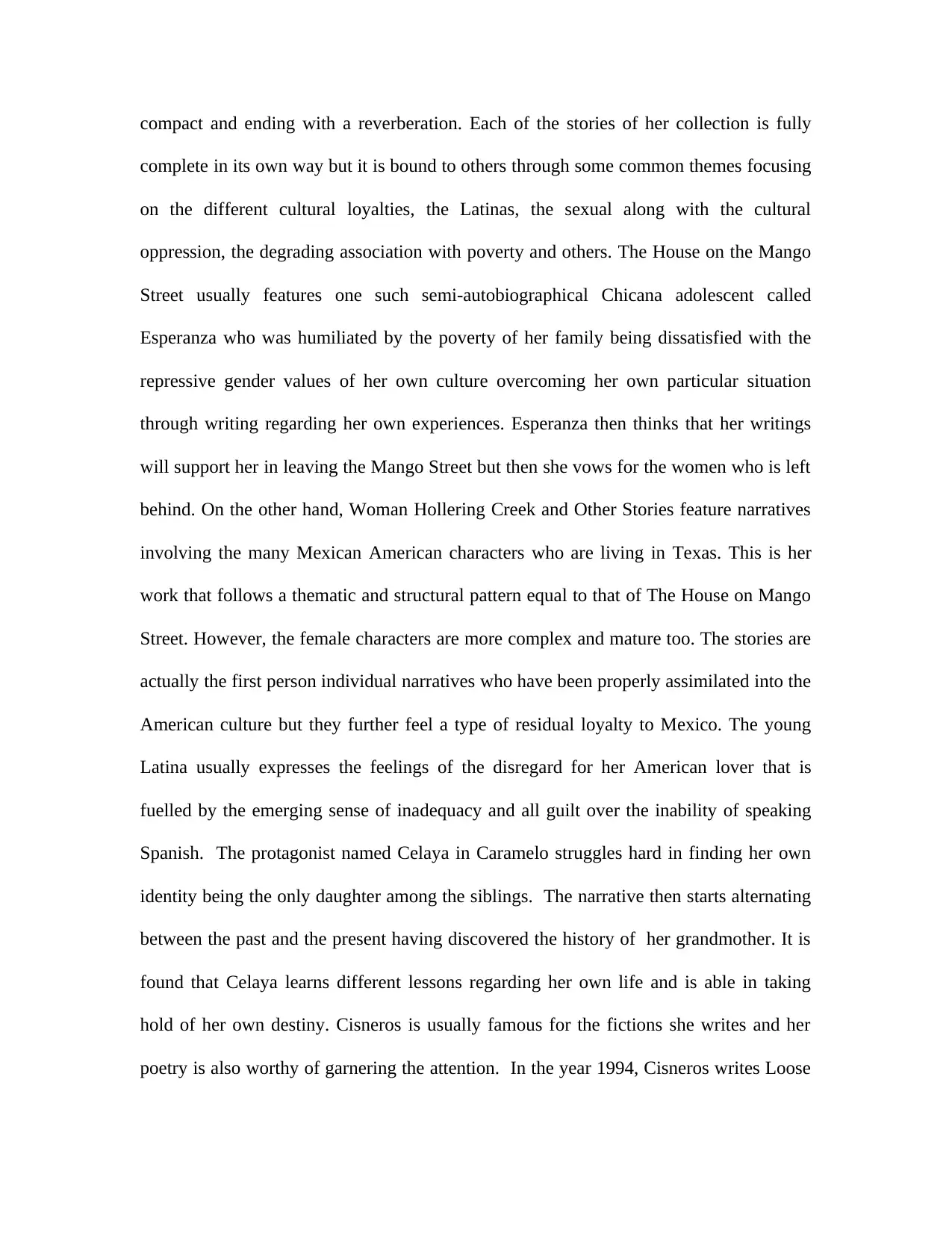
compact and ending with a reverberation. Each of the stories of her collection is fully
complete in its own way but it is bound to others through some common themes focusing
on the different cultural loyalties, the Latinas, the sexual along with the cultural
oppression, the degrading association with poverty and others. The House on the Mango
Street usually features one such semi-autobiographical Chicana adolescent called
Esperanza who was humiliated by the poverty of her family being dissatisfied with the
repressive gender values of her own culture overcoming her own particular situation
through writing regarding her own experiences. Esperanza then thinks that her writings
will support her in leaving the Mango Street but then she vows for the women who is left
behind. On the other hand, Woman Hollering Creek and Other Stories feature narratives
involving the many Mexican American characters who are living in Texas. This is her
work that follows a thematic and structural pattern equal to that of The House on Mango
Street. However, the female characters are more complex and mature too. The stories are
actually the first person individual narratives who have been properly assimilated into the
American culture but they further feel a type of residual loyalty to Mexico. The young
Latina usually expresses the feelings of the disregard for her American lover that is
fuelled by the emerging sense of inadequacy and all guilt over the inability of speaking
Spanish. The protagonist named Celaya in Caramelo struggles hard in finding her own
identity being the only daughter among the siblings. The narrative then starts alternating
between the past and the present having discovered the history of her grandmother. It is
found that Celaya learns different lessons regarding her own life and is able in taking
hold of her own destiny. Cisneros is usually famous for the fictions she writes and her
poetry is also worthy of garnering the attention. In the year 1994, Cisneros writes Loose
complete in its own way but it is bound to others through some common themes focusing
on the different cultural loyalties, the Latinas, the sexual along with the cultural
oppression, the degrading association with poverty and others. The House on the Mango
Street usually features one such semi-autobiographical Chicana adolescent called
Esperanza who was humiliated by the poverty of her family being dissatisfied with the
repressive gender values of her own culture overcoming her own particular situation
through writing regarding her own experiences. Esperanza then thinks that her writings
will support her in leaving the Mango Street but then she vows for the women who is left
behind. On the other hand, Woman Hollering Creek and Other Stories feature narratives
involving the many Mexican American characters who are living in Texas. This is her
work that follows a thematic and structural pattern equal to that of The House on Mango
Street. However, the female characters are more complex and mature too. The stories are
actually the first person individual narratives who have been properly assimilated into the
American culture but they further feel a type of residual loyalty to Mexico. The young
Latina usually expresses the feelings of the disregard for her American lover that is
fuelled by the emerging sense of inadequacy and all guilt over the inability of speaking
Spanish. The protagonist named Celaya in Caramelo struggles hard in finding her own
identity being the only daughter among the siblings. The narrative then starts alternating
between the past and the present having discovered the history of her grandmother. It is
found that Celaya learns different lessons regarding her own life and is able in taking
hold of her own destiny. Cisneros is usually famous for the fictions she writes and her
poetry is also worthy of garnering the attention. In the year 1994, Cisneros writes Loose
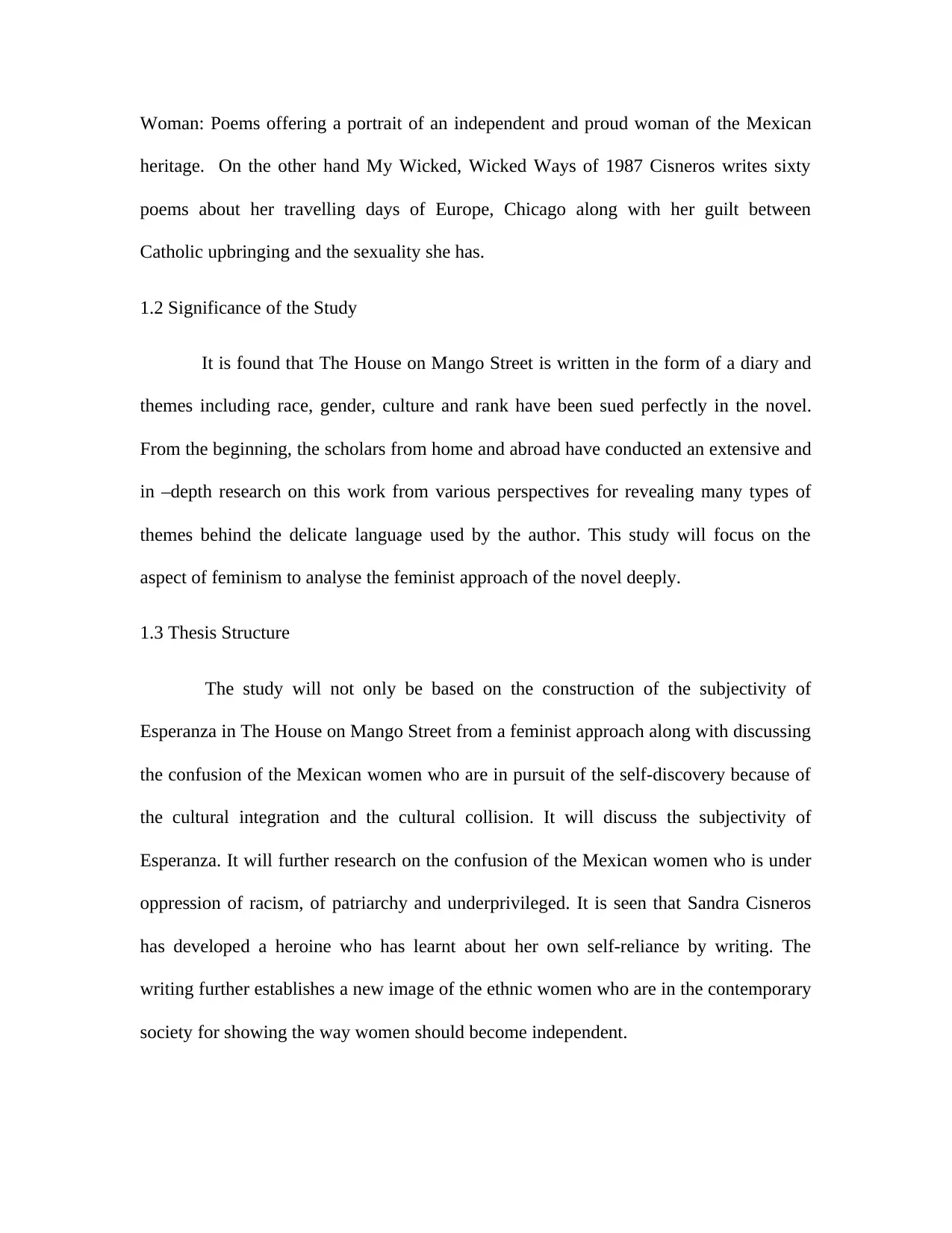
Woman: Poems offering a portrait of an independent and proud woman of the Mexican
heritage. On the other hand My Wicked, Wicked Ways of 1987 Cisneros writes sixty
poems about her travelling days of Europe, Chicago along with her guilt between
Catholic upbringing and the sexuality she has.
1.2 Significance of the Study
It is found that The House on Mango Street is written in the form of a diary and
themes including race, gender, culture and rank have been sued perfectly in the novel.
From the beginning, the scholars from home and abroad have conducted an extensive and
in –depth research on this work from various perspectives for revealing many types of
themes behind the delicate language used by the author. This study will focus on the
aspect of feminism to analyse the feminist approach of the novel deeply.
1.3 Thesis Structure
The study will not only be based on the construction of the subjectivity of
Esperanza in The House on Mango Street from a feminist approach along with discussing
the confusion of the Mexican women who are in pursuit of the self-discovery because of
the cultural integration and the cultural collision. It will discuss the subjectivity of
Esperanza. It will further research on the confusion of the Mexican women who is under
oppression of racism, of patriarchy and underprivileged. It is seen that Sandra Cisneros
has developed a heroine who has learnt about her own self-reliance by writing. The
writing further establishes a new image of the ethnic women who are in the contemporary
society for showing the way women should become independent.
heritage. On the other hand My Wicked, Wicked Ways of 1987 Cisneros writes sixty
poems about her travelling days of Europe, Chicago along with her guilt between
Catholic upbringing and the sexuality she has.
1.2 Significance of the Study
It is found that The House on Mango Street is written in the form of a diary and
themes including race, gender, culture and rank have been sued perfectly in the novel.
From the beginning, the scholars from home and abroad have conducted an extensive and
in –depth research on this work from various perspectives for revealing many types of
themes behind the delicate language used by the author. This study will focus on the
aspect of feminism to analyse the feminist approach of the novel deeply.
1.3 Thesis Structure
The study will not only be based on the construction of the subjectivity of
Esperanza in The House on Mango Street from a feminist approach along with discussing
the confusion of the Mexican women who are in pursuit of the self-discovery because of
the cultural integration and the cultural collision. It will discuss the subjectivity of
Esperanza. It will further research on the confusion of the Mexican women who is under
oppression of racism, of patriarchy and underprivileged. It is seen that Sandra Cisneros
has developed a heroine who has learnt about her own self-reliance by writing. The
writing further establishes a new image of the ethnic women who are in the contemporary
society for showing the way women should become independent.
⊘ This is a preview!⊘
Do you want full access?
Subscribe today to unlock all pages.

Trusted by 1+ million students worldwide
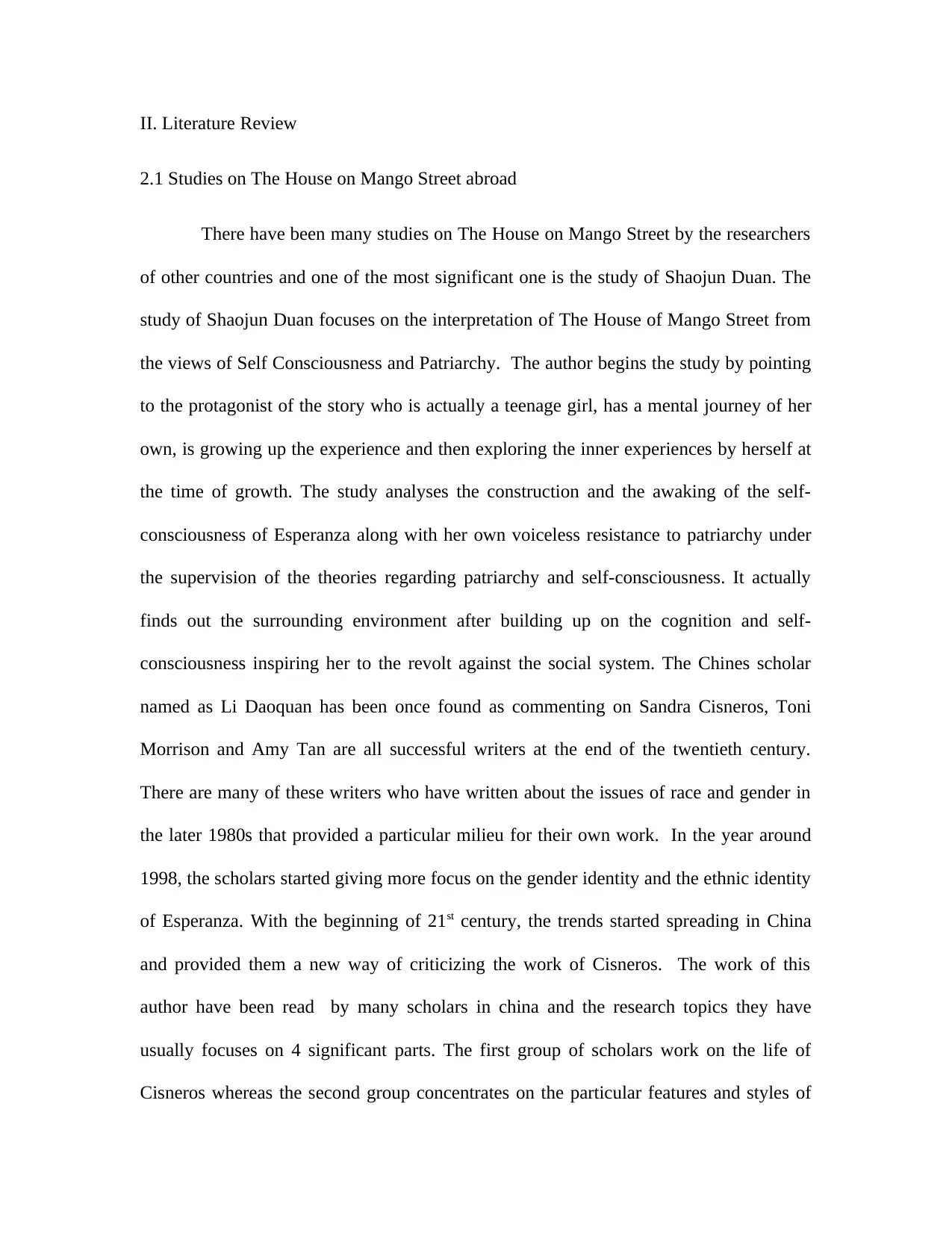
II. Literature Review
2.1 Studies on The House on Mango Street abroad
There have been many studies on The House on Mango Street by the researchers
of other countries and one of the most significant one is the study of Shaojun Duan. The
study of Shaojun Duan focuses on the interpretation of The House of Mango Street from
the views of Self Consciousness and Patriarchy. The author begins the study by pointing
to the protagonist of the story who is actually a teenage girl, has a mental journey of her
own, is growing up the experience and then exploring the inner experiences by herself at
the time of growth. The study analyses the construction and the awaking of the self-
consciousness of Esperanza along with her own voiceless resistance to patriarchy under
the supervision of the theories regarding patriarchy and self-consciousness. It actually
finds out the surrounding environment after building up on the cognition and self-
consciousness inspiring her to the revolt against the social system. The Chines scholar
named as Li Daoquan has been once found as commenting on Sandra Cisneros, Toni
Morrison and Amy Tan are all successful writers at the end of the twentieth century.
There are many of these writers who have written about the issues of race and gender in
the later 1980s that provided a particular milieu for their own work. In the year around
1998, the scholars started giving more focus on the gender identity and the ethnic identity
of Esperanza. With the beginning of 21st century, the trends started spreading in China
and provided them a new way of criticizing the work of Cisneros. The work of this
author have been read by many scholars in china and the research topics they have
usually focuses on 4 significant parts. The first group of scholars work on the life of
Cisneros whereas the second group concentrates on the particular features and styles of
2.1 Studies on The House on Mango Street abroad
There have been many studies on The House on Mango Street by the researchers
of other countries and one of the most significant one is the study of Shaojun Duan. The
study of Shaojun Duan focuses on the interpretation of The House of Mango Street from
the views of Self Consciousness and Patriarchy. The author begins the study by pointing
to the protagonist of the story who is actually a teenage girl, has a mental journey of her
own, is growing up the experience and then exploring the inner experiences by herself at
the time of growth. The study analyses the construction and the awaking of the self-
consciousness of Esperanza along with her own voiceless resistance to patriarchy under
the supervision of the theories regarding patriarchy and self-consciousness. It actually
finds out the surrounding environment after building up on the cognition and self-
consciousness inspiring her to the revolt against the social system. The Chines scholar
named as Li Daoquan has been once found as commenting on Sandra Cisneros, Toni
Morrison and Amy Tan are all successful writers at the end of the twentieth century.
There are many of these writers who have written about the issues of race and gender in
the later 1980s that provided a particular milieu for their own work. In the year around
1998, the scholars started giving more focus on the gender identity and the ethnic identity
of Esperanza. With the beginning of 21st century, the trends started spreading in China
and provided them a new way of criticizing the work of Cisneros. The work of this
author have been read by many scholars in china and the research topics they have
usually focuses on 4 significant parts. The first group of scholars work on the life of
Cisneros whereas the second group concentrates on the particular features and styles of
Paraphrase This Document
Need a fresh take? Get an instant paraphrase of this document with our AI Paraphraser
her writing (Burcar 2018). The third group is aimed at the feminism theme, role of
women and the growing up of Esperanza in The House on Mango Street using the theory
of feminist perspective. The last group of scholars are busy in exploring social problems
such as racial discrimination, gender inequality, female freedom and female awareness
about patriarchy and going against patriarchy. In Ya-hui Irenna Chang’ book titled as
Sandra Cisneros’ The House on Mango Street: How Your Body Determines the Space
You Occupy” where the ‘house’ is not given any less importance than the characters in
the book. The strains of criticism have developed from analysing the house and the dream
house of the protagonist. One of the strains sees the story as the continuation, the
expansion and the alteration of the feminist discourse which has been started in A Room
of One’ Own by Virginia Woolf. It is the importance of one’ own house or the private
space along with its impact on the writing of women. The second strain of the study
interprets the ideal house of Esperanza in the form of a linguistic sign with psychological
space instead of a geographical space. Also, the third strain discusses as the combination
of the previous two strains. These three strains of the criticism is different from each
other in terms of the interpreting the family and the dream house of Esperanza
concentrating on the critical attention on the need for a private room that is beyond the
ideologies of patriarchy. The study of Chang is aimed at expanding this specific critical
discussion having turned the critical attention to the geographical spaces in the
neighbourhood of Esperanza. This approach aims ay showing the way Esperanza focuses
on writing skills that are nourished by obtaining a private space, opening a public space
for the Latino immigrants highly discriminated due to their racialised body structures.
women and the growing up of Esperanza in The House on Mango Street using the theory
of feminist perspective. The last group of scholars are busy in exploring social problems
such as racial discrimination, gender inequality, female freedom and female awareness
about patriarchy and going against patriarchy. In Ya-hui Irenna Chang’ book titled as
Sandra Cisneros’ The House on Mango Street: How Your Body Determines the Space
You Occupy” where the ‘house’ is not given any less importance than the characters in
the book. The strains of criticism have developed from analysing the house and the dream
house of the protagonist. One of the strains sees the story as the continuation, the
expansion and the alteration of the feminist discourse which has been started in A Room
of One’ Own by Virginia Woolf. It is the importance of one’ own house or the private
space along with its impact on the writing of women. The second strain of the study
interprets the ideal house of Esperanza in the form of a linguistic sign with psychological
space instead of a geographical space. Also, the third strain discusses as the combination
of the previous two strains. These three strains of the criticism is different from each
other in terms of the interpreting the family and the dream house of Esperanza
concentrating on the critical attention on the need for a private room that is beyond the
ideologies of patriarchy. The study of Chang is aimed at expanding this specific critical
discussion having turned the critical attention to the geographical spaces in the
neighbourhood of Esperanza. This approach aims ay showing the way Esperanza focuses
on writing skills that are nourished by obtaining a private space, opening a public space
for the Latino immigrants highly discriminated due to their racialised body structures.
The study of Matava Vichiensing (2018) is of the view that The House on Mango
Street is a story regarding the Latino experience in the United States. The concept of
‘othering’ has originally become a part of the post-colonial theory. This specific concept
can become highly related with the Marxist and the feminist perspectives too. It is
associated with many of the academic fields such as literature. In this novel, the
construction of ‘othering’ can become well manifested in certain forms of linguistic,
mimicry, unhomeliness, the socioeconomic class, the gender roles and many others. The
study shows that there are many negative impacts of the ‘othering’ practice where
affecting of the economical, the psychological and the sociocultural dimensions are there.
2.2 Studies on The House on Mango at home
On the other hand, the criticism of The House on Mango Street in the home
country is not even less starting from the 1990s. Critique Allen Michaela Ken has
proposed that Sandra Cisneros has changed the traditional structures of the male writing
of growth novel and has written from the feminist perspective in pursuit of a collective
recognition. In the year 1992, De Valdes has confirmed that the author’ experience and
the heroine of the novel are extremely relevant. The focus of criticism has further shifted
to the double marginalization and the theme of growth. In the early part of 1994,
Jacqueline Doyle has been found as publishing an article where she has concentrated on
the issue of minority ethnic. She has compared the novel of Cisneros with Virginia
Woolf’ ‘A Room of One’ Own’ having pointed out that the female writers belonging to
the minority ethnics face more difficulty than the female writers who are white. Ann O
Eysturoy (1996) has discussed about the gender, the identity and the class at the time of
the self-creation of heroine. The study of Lilijana Burcar provides a systematic critique of
Street is a story regarding the Latino experience in the United States. The concept of
‘othering’ has originally become a part of the post-colonial theory. This specific concept
can become highly related with the Marxist and the feminist perspectives too. It is
associated with many of the academic fields such as literature. In this novel, the
construction of ‘othering’ can become well manifested in certain forms of linguistic,
mimicry, unhomeliness, the socioeconomic class, the gender roles and many others. The
study shows that there are many negative impacts of the ‘othering’ practice where
affecting of the economical, the psychological and the sociocultural dimensions are there.
2.2 Studies on The House on Mango at home
On the other hand, the criticism of The House on Mango Street in the home
country is not even less starting from the 1990s. Critique Allen Michaela Ken has
proposed that Sandra Cisneros has changed the traditional structures of the male writing
of growth novel and has written from the feminist perspective in pursuit of a collective
recognition. In the year 1992, De Valdes has confirmed that the author’ experience and
the heroine of the novel are extremely relevant. The focus of criticism has further shifted
to the double marginalization and the theme of growth. In the early part of 1994,
Jacqueline Doyle has been found as publishing an article where she has concentrated on
the issue of minority ethnic. She has compared the novel of Cisneros with Virginia
Woolf’ ‘A Room of One’ Own’ having pointed out that the female writers belonging to
the minority ethnics face more difficulty than the female writers who are white. Ann O
Eysturoy (1996) has discussed about the gender, the identity and the class at the time of
the self-creation of heroine. The study of Lilijana Burcar provides a systematic critique of
⊘ This is a preview!⊘
Do you want full access?
Subscribe today to unlock all pages.
Trusted by 1+ million students worldwide
the recognition and the intersectionality that dominates today’s world, the mainstream
Western literary theory, the literary production of the Anglo –Saxon having brought
about an overcooked critical intervention on the part of the materialist system of the
Western Marxist feminists and the theorists. Then, it is seen to be dissecting the ways
through which the identity trappings and the upgradation of the intersectionality is
manifested in The House on Mango Street of Sandra Cisneros with class in the triad of
the class, gender and race that has weakened with the passage of time and has removed
from the view. The novel is considered as one of the best literary texts representing the
othering practices in the Latino community specifically. It is presented as a storytelling of
the Latino experiences in the form of the minority groups in the entire United States. The
story is mainly about Diasporas that is the brown people from an original homeland of
the United States. The story is narrated through the lens of the narrator where Esperanza
tells a story revolving around a mundane life , friends, social environment along with the
neighbours who have come and gone on the Mango street. Esperanza has provided
special importance to the house from the beginning and throughout the end of the story.
The story then manifests the idea of othering in the American homeland. It manifests the
idea of some related concepts which are crucial in the society presented by Sandra
Cisnenos. It is also found that living inside of the home of others as the people of brown
colour or black colour are seen to be marginalized and the alienated group. They also
perceive themselves in the form of inferior and lonely people and seen as interacting
among the same group mostly (Duan 2018). At the same time, they dream of lifting their
lives to the level of white people consisting of the lifestyle, the usage of language and
others. These are the difficulties of life that the coloured people come across specifically
Western literary theory, the literary production of the Anglo –Saxon having brought
about an overcooked critical intervention on the part of the materialist system of the
Western Marxist feminists and the theorists. Then, it is seen to be dissecting the ways
through which the identity trappings and the upgradation of the intersectionality is
manifested in The House on Mango Street of Sandra Cisneros with class in the triad of
the class, gender and race that has weakened with the passage of time and has removed
from the view. The novel is considered as one of the best literary texts representing the
othering practices in the Latino community specifically. It is presented as a storytelling of
the Latino experiences in the form of the minority groups in the entire United States. The
story is mainly about Diasporas that is the brown people from an original homeland of
the United States. The story is narrated through the lens of the narrator where Esperanza
tells a story revolving around a mundane life , friends, social environment along with the
neighbours who have come and gone on the Mango street. Esperanza has provided
special importance to the house from the beginning and throughout the end of the story.
The story then manifests the idea of othering in the American homeland. It manifests the
idea of some related concepts which are crucial in the society presented by Sandra
Cisnenos. It is also found that living inside of the home of others as the people of brown
colour or black colour are seen to be marginalized and the alienated group. They also
perceive themselves in the form of inferior and lonely people and seen as interacting
among the same group mostly (Duan 2018). At the same time, they dream of lifting their
lives to the level of white people consisting of the lifestyle, the usage of language and
others. These are the difficulties of life that the coloured people come across specifically
Paraphrase This Document
Need a fresh take? Get an instant paraphrase of this document with our AI Paraphraser
the Latino people. The House on Mango Street might not be considered as a prominent
novel but it reflects on certain issues of the society in the human relations.
III. Theoretical Framework
The theories are well developed by the researchers for explaining the phenomena,
drawing the connections and then making some predictions. These are founded on the
existing observations, the knowledge and the ideas. In a thesis or the dissertation, the
theoretical framework is where one defines, discusses and then evaluates the theories
which are relevant to the research problem. A strong theoretical framework shows why
one has selected a specific approach for answering the research question. It then provides
a clear foundation for the interpretation and the understanding of the relevance of the
findings. The goal of the theoretical framework is to show that one’ research has a strong
rational base founded on the previous knowledge and research. The selected definitions
and the models provide a direction to the project and one can develop on these selections
in the later years. One is supposed to explore the ideas, the theories and the models
having refined the research questions and the problem statements. The theoretical
framework is for defining the key concepts, evaluating, selecting and combining the
relevant theories and explaining the assumptions along with the expectations. It is
actually a collection of the interrelated topics such as theories (Chang 2020). It guides a
particular research having determined things that one measures and the statistical
connections one is looking for. The theoretical frameworks are quite critical in terms of
the deductive studies where the testing of the theories usually take place. In these types of
studies, the theoretical framework has to become extremely specific and well determined.
novel but it reflects on certain issues of the society in the human relations.
III. Theoretical Framework
The theories are well developed by the researchers for explaining the phenomena,
drawing the connections and then making some predictions. These are founded on the
existing observations, the knowledge and the ideas. In a thesis or the dissertation, the
theoretical framework is where one defines, discusses and then evaluates the theories
which are relevant to the research problem. A strong theoretical framework shows why
one has selected a specific approach for answering the research question. It then provides
a clear foundation for the interpretation and the understanding of the relevance of the
findings. The goal of the theoretical framework is to show that one’ research has a strong
rational base founded on the previous knowledge and research. The selected definitions
and the models provide a direction to the project and one can develop on these selections
in the later years. One is supposed to explore the ideas, the theories and the models
having refined the research questions and the problem statements. The theoretical
framework is for defining the key concepts, evaluating, selecting and combining the
relevant theories and explaining the assumptions along with the expectations. It is
actually a collection of the interrelated topics such as theories (Chang 2020). It guides a
particular research having determined things that one measures and the statistical
connections one is looking for. The theoretical frameworks are quite critical in terms of
the deductive studies where the testing of the theories usually take place. In these types of
studies, the theoretical framework has to become extremely specific and well determined.
It is quite surprising that theoretical frameworks are extremely significant in the
exploratory studies where one does not know much about whatever is going on.
3.1 Introduction to Feminism
It is said that feminism is an intellectual commitment along with being a political
movement which seeks justice for the females at the edge of end of sexism in different
forms. It is to be noted that most of the feminists are not ready to agree on the fact that
there is the sexism inherent in feminism and they completely disagree about what it
means to become a man or a woman and what are the political and social implications of
gender (Broude and Garrard 2018). The feminists inquiry about the quest for the social
justice having provided a wide range of views on the cultural, the social and the political
aspects. There are few important topics related with the feminist theory such as class,
work, family, globalisation, disability, race and racism, human rights, reproduction and
others. It is further found that feminism has brought different aspects in the field of
philosophy consisting of a variety of specific political and the moral claims along with
methods of asking and then answering certain queries. The contributions of feminists to
the mainstream debates on philosophy thay are done under the entries of feminists
interventions. This concerns certain philosophical issues emerging with the articulation of
sexism by the feminists. It further leads to criticizing about the cultural practices, the
social practices having developed the alternative visions of the whole world. There are
controversial and different approaches to the philosophy of feminism as it is quite
instructive of beginning through asking whatever the feminists are committed to. It is
about the considering few controversies over whatever feminism are provided with to see
exploratory studies where one does not know much about whatever is going on.
3.1 Introduction to Feminism
It is said that feminism is an intellectual commitment along with being a political
movement which seeks justice for the females at the edge of end of sexism in different
forms. It is to be noted that most of the feminists are not ready to agree on the fact that
there is the sexism inherent in feminism and they completely disagree about what it
means to become a man or a woman and what are the political and social implications of
gender (Broude and Garrard 2018). The feminists inquiry about the quest for the social
justice having provided a wide range of views on the cultural, the social and the political
aspects. There are few important topics related with the feminist theory such as class,
work, family, globalisation, disability, race and racism, human rights, reproduction and
others. It is further found that feminism has brought different aspects in the field of
philosophy consisting of a variety of specific political and the moral claims along with
methods of asking and then answering certain queries. The contributions of feminists to
the mainstream debates on philosophy thay are done under the entries of feminists
interventions. This concerns certain philosophical issues emerging with the articulation of
sexism by the feminists. It further leads to criticizing about the cultural practices, the
social practices having developed the alternative visions of the whole world. There are
controversial and different approaches to the philosophy of feminism as it is quite
instructive of beginning through asking whatever the feminists are committed to. It is
about the considering few controversies over whatever feminism are provided with to see
⊘ This is a preview!⊘
Do you want full access?
Subscribe today to unlock all pages.
Trusted by 1+ million students worldwide
the way the commitment of feminism can generate a host of the philosophical topics
specifically the commitments.
3.1.1 The History of Feminism
As far as the history of feminism is concerned, it consists of the narratives of the
movements along with the ideologies having aimed at the equal right for women. The
time when the feminists of the world differ in terms of goals, causes and the intentions
based on the culture, time and country, most of the feminist from Western countries
assert in about all of the movements which work for obtaining rights of women. The
history of the modern western feminism is split conventionally into three such time
periods such as First wave, second wave and third wave. The first wave of feminism
started in the 19th and the 20th centuries concentrating on the issues of the women’
suffering such as inequalities. The second wave of feminism started in the 1960s and
lasted till 1980s boarding the debate for including the gender norms, the cultural
inequalities and the role of women in the society. Lastly, the third wave of feminism
spanning 1990s -2000s referred to the diverse strains of the feminist activities that are
seen by the third wavers as a continuation of the second wave along with a response to
the failures (Broude 2018). There are various uses of feminism and the meanings are
sometimes conflicting with each other. Taken for example, there are some writers using
the term ‘feminism’ for referring to a specific political movement in the whole Europe
and USA. On the other hand, there are writers who make use of it for referring to the
belief of injustice against women. There is no such consensus on the correct list of such
injustices and some of the central uses of the term are quite interesting and necessary to
be evaluated. During the middle of the 1800s, feminism as a term was used properly for
specifically the commitments.
3.1.1 The History of Feminism
As far as the history of feminism is concerned, it consists of the narratives of the
movements along with the ideologies having aimed at the equal right for women. The
time when the feminists of the world differ in terms of goals, causes and the intentions
based on the culture, time and country, most of the feminist from Western countries
assert in about all of the movements which work for obtaining rights of women. The
history of the modern western feminism is split conventionally into three such time
periods such as First wave, second wave and third wave. The first wave of feminism
started in the 19th and the 20th centuries concentrating on the issues of the women’
suffering such as inequalities. The second wave of feminism started in the 1960s and
lasted till 1980s boarding the debate for including the gender norms, the cultural
inequalities and the role of women in the society. Lastly, the third wave of feminism
spanning 1990s -2000s referred to the diverse strains of the feminist activities that are
seen by the third wavers as a continuation of the second wave along with a response to
the failures (Broude 2018). There are various uses of feminism and the meanings are
sometimes conflicting with each other. Taken for example, there are some writers using
the term ‘feminism’ for referring to a specific political movement in the whole Europe
and USA. On the other hand, there are writers who make use of it for referring to the
belief of injustice against women. There is no such consensus on the correct list of such
injustices and some of the central uses of the term are quite interesting and necessary to
be evaluated. During the middle of the 1800s, feminism as a term was used properly for
Paraphrase This Document
Need a fresh take? Get an instant paraphrase of this document with our AI Paraphraser
referring to the female qualities. The occurrence of the First International Women’
Conference in 1892 in Paris that helped the term ‘feministe‘ become deeply rooted in the
movement of the US and the Europe starting with the mobilization of suffering at the
time of late 19th and also the early 20th century. Notably, this movement was named as
‘First Wave ‘feminism and those people who had employed this history sometimes
elaborate on feminists as a warning between two of the world wars for becoming revived
in the later part of the 1960s and the early part of the 1970s. The evolution of the
feminism in the past years have been called as the ‘Third Wave’ feminism. There are
some other feminist scholars who are aimed at the identification of feminism with some
specific moments of the political activism. It is in the grounds that going in this way can
eclipse the fact that there is resistance of the females to the male dominance that should
become considered as the ‘feminist’ through the entire cultures and the history. It can be
said that the feminism is not exactly confined to the women of the West through the past
centuries. There is some of the current efforts on resisting the dominance of men in the
United States and the Europe on the First and the Second wave of feminism after
ignoring the gong resistance to the domination of men between the 1920s and the 1960s.
The resistance is outside of the mainstream politics specifically by the coloured women
and the working class women. One can ask too solve the issues through emphasizing on
the political ideas feminism was coined for capturing such as the commitment to the
equal rights of women. The criterion of equal rights for the women is not confined to the
Liberation Movement of women in the entire West but it increases the controversy
having framed feminism in a broadly Liberal approach of the economic and the political
life. It is found that most of the feminists probably agree to the fact that there is one such
Conference in 1892 in Paris that helped the term ‘feministe‘ become deeply rooted in the
movement of the US and the Europe starting with the mobilization of suffering at the
time of late 19th and also the early 20th century. Notably, this movement was named as
‘First Wave ‘feminism and those people who had employed this history sometimes
elaborate on feminists as a warning between two of the world wars for becoming revived
in the later part of the 1960s and the early part of the 1970s. The evolution of the
feminism in the past years have been called as the ‘Third Wave’ feminism. There are
some other feminist scholars who are aimed at the identification of feminism with some
specific moments of the political activism. It is in the grounds that going in this way can
eclipse the fact that there is resistance of the females to the male dominance that should
become considered as the ‘feminist’ through the entire cultures and the history. It can be
said that the feminism is not exactly confined to the women of the West through the past
centuries. There is some of the current efforts on resisting the dominance of men in the
United States and the Europe on the First and the Second wave of feminism after
ignoring the gong resistance to the domination of men between the 1920s and the 1960s.
The resistance is outside of the mainstream politics specifically by the coloured women
and the working class women. One can ask too solve the issues through emphasizing on
the political ideas feminism was coined for capturing such as the commitment to the
equal rights of women. The criterion of equal rights for the women is not confined to the
Liberation Movement of women in the entire West but it increases the controversy
having framed feminism in a broadly Liberal approach of the economic and the political
life. It is found that most of the feminists probably agree to the fact that there is one such
sense of the rights based on which the achievement of the equal rights is extremely
important a condition for the feminism to succeed. This is due to the fact that women’
oppression under the dominance of men consists of the deprivation of women of the
rights on legal and the political grounds. It also extends the structure of the society along
with the culture content that permeates the consciousness of individual. There are
undoubtedly many controversies on the term ‘feminism’ where the politics are properly
circumscribing the hurdles of a specific social movement (de Sousa and Correia 2020).
Notably, it is extremely fascinating to think that there is one such point in the demanding
of a particular definition of the term that is beyond a specific set of disjunctions capturing
various instances. Surprisingly, at the same time it can become valuable both politically
and intellectually having a schematic framework enabling people in terms of mapping
minimum of some points of disagreement and agreement. There are some activists found
who usually discus about the advancement of women’ equality before the occurrence of
feminist movements labelled sometimes as the ‘protofeminist’. There are also some
scholars who are seen to be criticizing the term because of believing on the fact that it
destroys the significance of early contributions or they believe that there the feminism
does not have any such linear and single history that is implied by terms such as
protofeminist or the postfeminist. It had been argued years ago that in order to gain
complete equality for women both in the political and the sexual terms, they need to be
given proper position in society having acknowledged their role in shaping humanity.
3.1.2 The Development of Feminism
Feminism as a term actually describes the cultural, the political and the economic
movements which aim at establishing equal rights along with legal protection for the
important a condition for the feminism to succeed. This is due to the fact that women’
oppression under the dominance of men consists of the deprivation of women of the
rights on legal and the political grounds. It also extends the structure of the society along
with the culture content that permeates the consciousness of individual. There are
undoubtedly many controversies on the term ‘feminism’ where the politics are properly
circumscribing the hurdles of a specific social movement (de Sousa and Correia 2020).
Notably, it is extremely fascinating to think that there is one such point in the demanding
of a particular definition of the term that is beyond a specific set of disjunctions capturing
various instances. Surprisingly, at the same time it can become valuable both politically
and intellectually having a schematic framework enabling people in terms of mapping
minimum of some points of disagreement and agreement. There are some activists found
who usually discus about the advancement of women’ equality before the occurrence of
feminist movements labelled sometimes as the ‘protofeminist’. There are also some
scholars who are seen to be criticizing the term because of believing on the fact that it
destroys the significance of early contributions or they believe that there the feminism
does not have any such linear and single history that is implied by terms such as
protofeminist or the postfeminist. It had been argued years ago that in order to gain
complete equality for women both in the political and the sexual terms, they need to be
given proper position in society having acknowledged their role in shaping humanity.
3.1.2 The Development of Feminism
Feminism as a term actually describes the cultural, the political and the economic
movements which aim at establishing equal rights along with legal protection for the
⊘ This is a preview!⊘
Do you want full access?
Subscribe today to unlock all pages.
Trusted by 1+ million students worldwide

1 out of 33


Your All-in-One AI-Powered Toolkit for Academic Success.
+13062052269
info@desklib.com
Available 24*7 on WhatsApp / Email
![[object Object]](/_next/static/media/star-bottom.7253800d.svg)
Unlock your academic potential
Copyright © 2020–2026 A2Z Services. All Rights Reserved. Developed and managed by ZUCOL.