In-depth Report on Fentanyl Transdermal Patch: Usage & Innovation
VerifiedAdded on 2023/06/07
|19
|4155
|331
Report
AI Summary
This report provides a detailed overview of Fentanyl transdermal patches, a medication used for relieving severe pain over a long period. It covers aspects such as manufacturing countries, active ingredients (Fentanyl in varying quantities), excipients, and the rationale behind its novel transdermal delivery system. The report also discusses relevant drug characteristics, design features of both matrix and reservoir patch systems, advantages offered including increased patient satisfaction and convenience, and sales data in various countries. It further explores competition from other pain relief options, limitations, pharmacy-related information, intellectual property position, and potential for innovation. The report concludes by summarizing the effectiveness and utility of Fentanyl transdermal patches in chronic pain management.

Running head: FENTANYL TRANSDERMAL PATCH
Fentanyl Transdermal Patch
Name of the Student:
Name of the University:
Author Note:
Fentanyl Transdermal Patch
Name of the Student:
Name of the University:
Author Note:

Paraphrase This Document
Need a fresh take? Get an instant paraphrase of this document with our AI Paraphraser
1FENTANYL TRANSDERMAL PATCH
Executive summary
Transdermal Fentanyl patches are used to relieve severe pain in people that require medication
for a long time period. Transdermal Fentanyl patches are useful for the people for whom other
medication are not applicable. The Fentanyl containing drug which is sold in Australia is called
APO-Fentanyl and it has the active ingredient of Fentanyl with the quantity of 12 micrograms
per hour, 25 micrograms per hour, 37 micrograms per hour, 50 micrograms per hour, 75
micrograms per hour, and 100 micrograms per hour. In the clinical setting, fentanyl drug directly
affects the central nervous system. The primary therapeutic actions of fentanyl are sedation and
analgesic. This drug constricts the pupils, cough reflex and depresses the respiratory centre.
Executive summary
Transdermal Fentanyl patches are used to relieve severe pain in people that require medication
for a long time period. Transdermal Fentanyl patches are useful for the people for whom other
medication are not applicable. The Fentanyl containing drug which is sold in Australia is called
APO-Fentanyl and it has the active ingredient of Fentanyl with the quantity of 12 micrograms
per hour, 25 micrograms per hour, 37 micrograms per hour, 50 micrograms per hour, 75
micrograms per hour, and 100 micrograms per hour. In the clinical setting, fentanyl drug directly
affects the central nervous system. The primary therapeutic actions of fentanyl are sedation and
analgesic. This drug constricts the pupils, cough reflex and depresses the respiratory centre.
2FENTANYL TRANSDERMAL PATCH
Table of Contents
Introduction......................................................................................................................................3
Manufactured or marketed by countries where available................................................................3
Active ingredient and quantity.........................................................................................................4
Excipients........................................................................................................................................5
Rationale for novel delivery system................................................................................................5
Relevant drug characteristics; physical, chemical and biological...................................................6
Design features of Fentanyl transdermal patch...............................................................................8
Advantages offered..........................................................................................................................9
Sales data in various countries.........................................................................................................9
Competition: options that healthcare professionals have while prescribing the drug...................10
Limitation......................................................................................................................................11
Pharmacy related information........................................................................................................11
Intellectual property position. Current or expired patents, countries, inventors, claims, licensing
.......................................................................................................................................................12
Potential for innovation that can generate new intellectual property............................................12
Conclusion.....................................................................................................................................14
Reference.......................................................................................................................................15
Table of Contents
Introduction......................................................................................................................................3
Manufactured or marketed by countries where available................................................................3
Active ingredient and quantity.........................................................................................................4
Excipients........................................................................................................................................5
Rationale for novel delivery system................................................................................................5
Relevant drug characteristics; physical, chemical and biological...................................................6
Design features of Fentanyl transdermal patch...............................................................................8
Advantages offered..........................................................................................................................9
Sales data in various countries.........................................................................................................9
Competition: options that healthcare professionals have while prescribing the drug...................10
Limitation......................................................................................................................................11
Pharmacy related information........................................................................................................11
Intellectual property position. Current or expired patents, countries, inventors, claims, licensing
.......................................................................................................................................................12
Potential for innovation that can generate new intellectual property............................................12
Conclusion.....................................................................................................................................14
Reference.......................................................................................................................................15
⊘ This is a preview!⊘
Do you want full access?
Subscribe today to unlock all pages.

Trusted by 1+ million students worldwide
3FENTANYL TRANSDERMAL PATCH
Introduction
Fentanyl can be described as a depressant drug which reduces the movement of the
signals to and fro from the brain to the body. Fentanyl belongs to the groups of the drugs that are
considered as opioids. This drug is prescribed for the reduction of pain caused due to major
trauma, back injury, nerve damage, pain due to cancer and chronic pain management or other
causes. In Australia this drug is used as schedule 8 drug and Fentanyl is about eighty to hundred
time stronger than morphine. Fentanyl is available in various forms and it is used in the
management of chronic and acute pain. However, the illegal usage of the drug has increased and
it used as an illegal drug in the illegal market (adf.org.au 2018). Transdermal Fentanyl patches
are used to relieve severe pain in people that require medication for a long time period.
Transdermal Fentanyl patches are useful for the people for whom other medication are not
applicable. It is applied over the skin and is generally applied over the skin for about 72 hours
(Medlineplus.gov 2018). This study is based on the novel delivery system of drug called
Transdermal Fentanyl patches. This drug is manufactured in Australia the drug name of APO-
Fentanyl Patches.
Manufactured or marketed by countries where available
Drug usage statistics are one of the biggest source of delivering that message that either
fentanyl is marketed or is manufactured in a particular country. The different countries where
Fentanyl drug is used are United States, Germany, Spain, United Kingdom, France, Canada,
Netherlands, Italy, Belgium, Japan and other countries in the decreasing order of usage. The
different drug names that are used in the marketing of the Fentanyl are: Lazanda, Abstral,
Instanyl, Onsolis, Haldid, Matrifen, Fentora, Durasegic, Actiq (statista.com 2018).
Introduction
Fentanyl can be described as a depressant drug which reduces the movement of the
signals to and fro from the brain to the body. Fentanyl belongs to the groups of the drugs that are
considered as opioids. This drug is prescribed for the reduction of pain caused due to major
trauma, back injury, nerve damage, pain due to cancer and chronic pain management or other
causes. In Australia this drug is used as schedule 8 drug and Fentanyl is about eighty to hundred
time stronger than morphine. Fentanyl is available in various forms and it is used in the
management of chronic and acute pain. However, the illegal usage of the drug has increased and
it used as an illegal drug in the illegal market (adf.org.au 2018). Transdermal Fentanyl patches
are used to relieve severe pain in people that require medication for a long time period.
Transdermal Fentanyl patches are useful for the people for whom other medication are not
applicable. It is applied over the skin and is generally applied over the skin for about 72 hours
(Medlineplus.gov 2018). This study is based on the novel delivery system of drug called
Transdermal Fentanyl patches. This drug is manufactured in Australia the drug name of APO-
Fentanyl Patches.
Manufactured or marketed by countries where available
Drug usage statistics are one of the biggest source of delivering that message that either
fentanyl is marketed or is manufactured in a particular country. The different countries where
Fentanyl drug is used are United States, Germany, Spain, United Kingdom, France, Canada,
Netherlands, Italy, Belgium, Japan and other countries in the decreasing order of usage. The
different drug names that are used in the marketing of the Fentanyl are: Lazanda, Abstral,
Instanyl, Onsolis, Haldid, Matrifen, Fentora, Durasegic, Actiq (statista.com 2018).
Paraphrase This Document
Need a fresh take? Get an instant paraphrase of this document with our AI Paraphraser

4FENTANYL TRANSDERMAL PATCH
Figure 1: Comparison of the global consumption of Fentanyl in the year 2016 [source:
statista.com 2018]
Active ingredient and quantity
The Fentanyl containing drug which is sold in Australia is called APO-Fentanyl and it
has the active ingredient of Fentanyl with the quantity of 12 micrograms per hour, 25
micrograms per hour, 37 micrograms per hour, 50 micrograms per hour, 75 micrograms per
hour, and 100 micrograms per hour (Medicines.org.au 2018). The chemical name the drug is
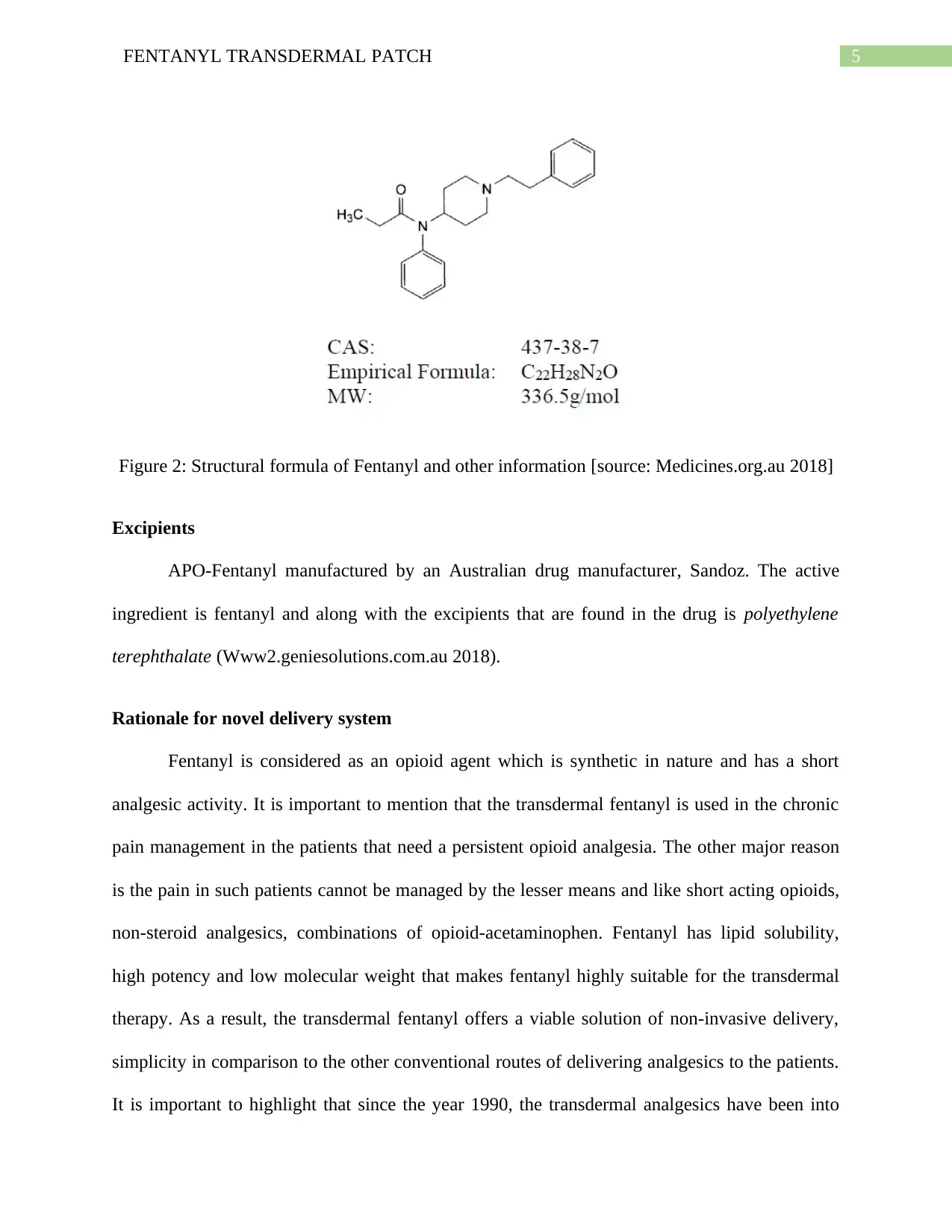
Chemical name: N-phenyl-N- [1-(2-phenylethyl)- 4-piperidinyl] propanamide.
Figure 1: Comparison of the global consumption of Fentanyl in the year 2016 [source:
statista.com 2018]
Active ingredient and quantity
The Fentanyl containing drug which is sold in Australia is called APO-Fentanyl and it
has the active ingredient of Fentanyl with the quantity of 12 micrograms per hour, 25
micrograms per hour, 37 micrograms per hour, 50 micrograms per hour, 75 micrograms per
hour, and 100 micrograms per hour (Medicines.org.au 2018). The chemical name the drug is
Chemical name: N-phenyl-N- [1-(2-phenylethyl)- 4-piperidinyl] propanamide.
5FENTANYL TRANSDERMAL PATCH
Figure 2: Structural formula of Fentanyl and other information [source: Medicines.org.au 2018]
Excipients
APO-Fentanyl manufactured by an Australian drug manufacturer, Sandoz. The active
ingredient is fentanyl and along with the excipients that are found in the drug is polyethylene
terephthalate (Www2.geniesolutions.com.au 2018).
Rationale for novel delivery system
Fentanyl is considered as an opioid agent which is synthetic in nature and has a short
analgesic activity. It is important to mention that the transdermal fentanyl is used in the chronic
pain management in the patients that need a persistent opioid analgesia. The other major reason
is the pain in such patients cannot be managed by the lesser means and like short acting opioids,
non-steroid analgesics, combinations of opioid-acetaminophen. Fentanyl has lipid solubility,
high potency and low molecular weight that makes fentanyl highly suitable for the transdermal
therapy. As a result, the transdermal fentanyl offers a viable solution of non-invasive delivery,
simplicity in comparison to the other conventional routes of delivering analgesics to the patients.
It is important to highlight that since the year 1990, the transdermal analgesics have been into
Figure 2: Structural formula of Fentanyl and other information [source: Medicines.org.au 2018]
Excipients
APO-Fentanyl manufactured by an Australian drug manufacturer, Sandoz. The active
ingredient is fentanyl and along with the excipients that are found in the drug is polyethylene
terephthalate (Www2.geniesolutions.com.au 2018).
Rationale for novel delivery system
Fentanyl is considered as an opioid agent which is synthetic in nature and has a short
analgesic activity. It is important to mention that the transdermal fentanyl is used in the chronic
pain management in the patients that need a persistent opioid analgesia. The other major reason
is the pain in such patients cannot be managed by the lesser means and like short acting opioids,
non-steroid analgesics, combinations of opioid-acetaminophen. Fentanyl has lipid solubility,
high potency and low molecular weight that makes fentanyl highly suitable for the transdermal
therapy. As a result, the transdermal fentanyl offers a viable solution of non-invasive delivery,
simplicity in comparison to the other conventional routes of delivering analgesics to the patients.
It is important to highlight that since the year 1990, the transdermal analgesics have been into
⊘ This is a preview!⊘
Do you want full access?
Subscribe today to unlock all pages.
Trusted by 1+ million students worldwide
6FENTANYL TRANSDERMAL PATCH
clinical use and it has proven to be convenient and an effective means of pain relief (Lane 2013).
When the transdermal fentanyl is applied on the skin, the concentrates of fentanyl slowly
concentrates into the upper layers of the skin. Then the fentanyl readily becomes available for the
systematic circulation system and then fentanyl undergoes metabolism in the liver. Fentanyl then
transforms to non-fentanyl through the oxidative N-dealkylation in liver and there are also other
inactive metabolites that are formed. Initially the application of the serum fentanyl, the
concentration of serum fentanyl increases gradually within the twenty-four hours and this
remains relatively constant in the later part. However, there are fluctuation that are noticed after
the remainder 72 hours of application. The most widely used technology in the application
transdermal fentanyl is the reservoir technology (Kukanich and Clark 2012).
Relevant drug characteristics; physical, chemical and biological
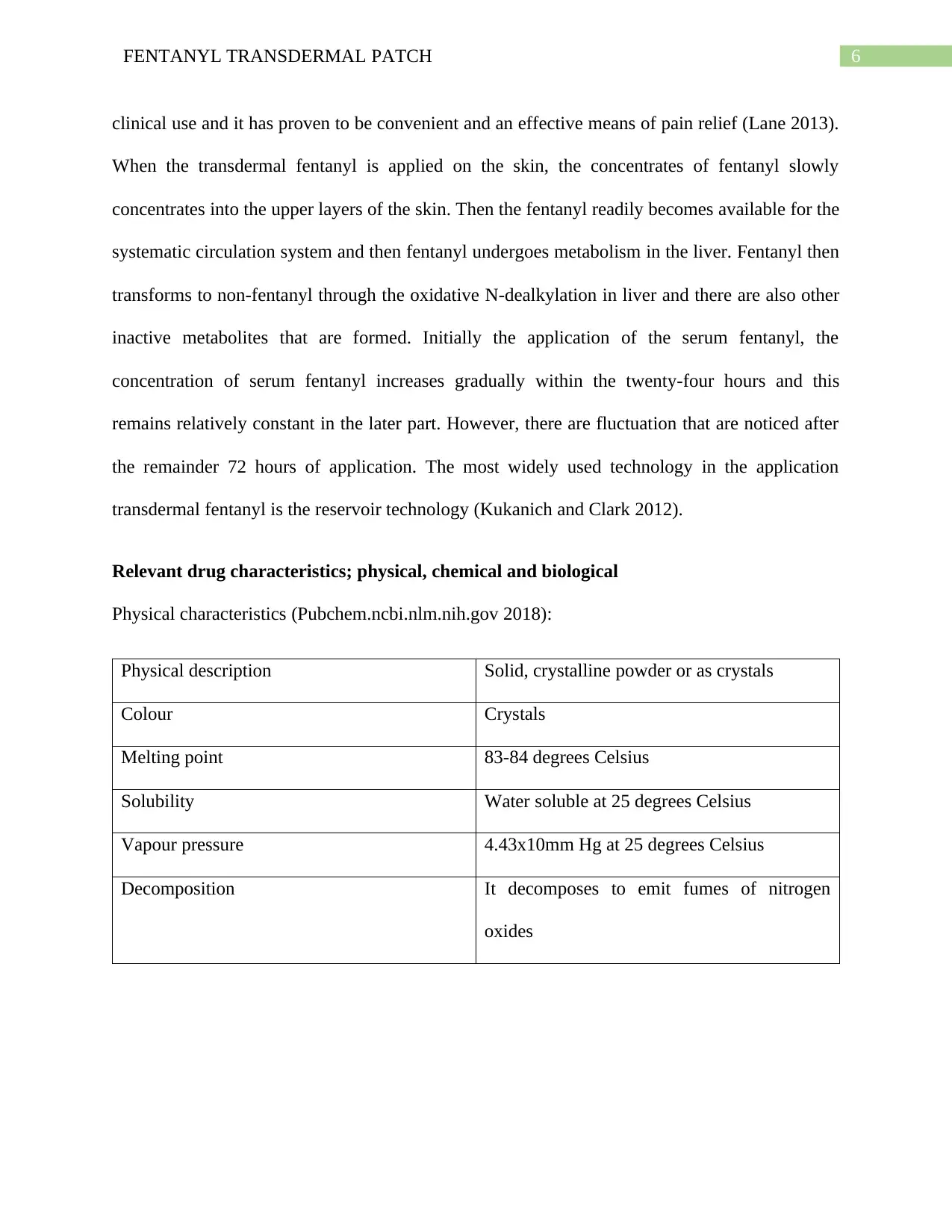
Physical characteristics (Pubchem.ncbi.nlm.nih.gov 2018):
Physical description Solid, crystalline powder or as crystals
Colour Crystals
Melting point 83-84 degrees Celsius
Solubility Water soluble at 25 degrees Celsius
Vapour pressure 4.43x10mm Hg at 25 degrees Celsius
Decomposition It decomposes to emit fumes of nitrogen
oxides
clinical use and it has proven to be convenient and an effective means of pain relief (Lane 2013).
When the transdermal fentanyl is applied on the skin, the concentrates of fentanyl slowly
concentrates into the upper layers of the skin. Then the fentanyl readily becomes available for the
systematic circulation system and then fentanyl undergoes metabolism in the liver. Fentanyl then
transforms to non-fentanyl through the oxidative N-dealkylation in liver and there are also other
inactive metabolites that are formed. Initially the application of the serum fentanyl, the
concentration of serum fentanyl increases gradually within the twenty-four hours and this
remains relatively constant in the later part. However, there are fluctuation that are noticed after
the remainder 72 hours of application. The most widely used technology in the application
transdermal fentanyl is the reservoir technology (Kukanich and Clark 2012).
Relevant drug characteristics; physical, chemical and biological
Physical characteristics (Pubchem.ncbi.nlm.nih.gov 2018):
Physical description Solid, crystalline powder or as crystals
Colour Crystals
Melting point 83-84 degrees Celsius
Solubility Water soluble at 25 degrees Celsius
Vapour pressure 4.43x10mm Hg at 25 degrees Celsius
Decomposition It decomposes to emit fumes of nitrogen
oxides
Paraphrase This Document
Need a fresh take? Get an instant paraphrase of this document with our AI Paraphraser
7FENTANYL TRANSDERMAL PATCH
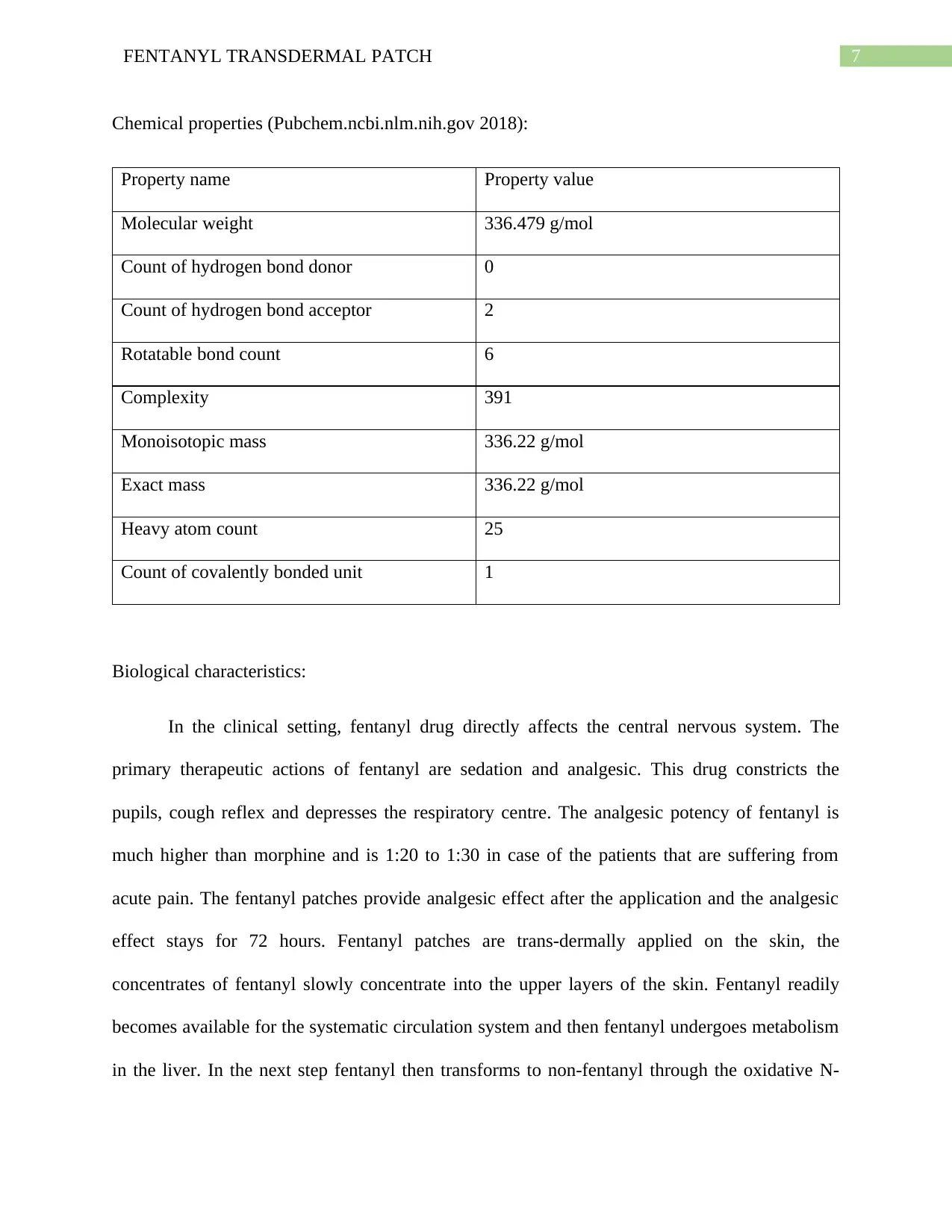
Chemical properties (Pubchem.ncbi.nlm.nih.gov 2018):
Property name Property value
Molecular weight 336.479 g/mol
Count of hydrogen bond donor 0
Count of hydrogen bond acceptor 2
Rotatable bond count 6
Complexity 391
Monoisotopic mass 336.22 g/mol
Exact mass 336.22 g/mol
Heavy atom count 25
Count of covalently bonded unit 1
Biological characteristics:
In the clinical setting, fentanyl drug directly affects the central nervous system. The
primary therapeutic actions of fentanyl are sedation and analgesic. This drug constricts the
pupils, cough reflex and depresses the respiratory centre. The analgesic potency of fentanyl is
much higher than morphine and is 1:20 to 1:30 in case of the patients that are suffering from
acute pain. The fentanyl patches provide analgesic effect after the application and the analgesic
effect stays for 72 hours. Fentanyl patches are trans-dermally applied on the skin, the
concentrates of fentanyl slowly concentrate into the upper layers of the skin. Fentanyl readily
becomes available for the systematic circulation system and then fentanyl undergoes metabolism
in the liver. In the next step fentanyl then transforms to non-fentanyl through the oxidative N-
Chemical properties (Pubchem.ncbi.nlm.nih.gov 2018):
Property name Property value
Molecular weight 336.479 g/mol
Count of hydrogen bond donor 0
Count of hydrogen bond acceptor 2
Rotatable bond count 6
Complexity 391
Monoisotopic mass 336.22 g/mol
Exact mass 336.22 g/mol
Heavy atom count 25
Count of covalently bonded unit 1
Biological characteristics:
In the clinical setting, fentanyl drug directly affects the central nervous system. The
primary therapeutic actions of fentanyl are sedation and analgesic. This drug constricts the
pupils, cough reflex and depresses the respiratory centre. The analgesic potency of fentanyl is
much higher than morphine and is 1:20 to 1:30 in case of the patients that are suffering from
acute pain. The fentanyl patches provide analgesic effect after the application and the analgesic
effect stays for 72 hours. Fentanyl patches are trans-dermally applied on the skin, the
concentrates of fentanyl slowly concentrate into the upper layers of the skin. Fentanyl readily
becomes available for the systematic circulation system and then fentanyl undergoes metabolism
in the liver. In the next step fentanyl then transforms to non-fentanyl through the oxidative N-
8FENTANYL TRANSDERMAL PATCH
dealkylation in liver and into other inactive metabolites. Initially the application of the serum
fentanyl, the concentration of serum fentanyl increases gradually within the twenty-four hours
and this remains relatively constant in the later part. However, there are fluctuation that are
noticed after the remainder 72 hours of application (Medicines.org.au 2018).
Design features of Fentanyl transdermal patch
The are two major type of transdermal patch systems for the drug delivery of fentanyl.
Matrix patch system- in this system, fentanyl is embedded within the adhesive
layer/matrix. When the patch is applied over the skin, through the adhesive fentanyl diffuses into
the skin and then in to bloodstream. Thus, it is important to note that the amount of the drug
delivered into the bloodstream is directly dependent on the size of the patch. If the patch is cut,
then there is a reduction in the amount of the drug delivered. If he medication leaks to the
surrounding, then it might cause irritation to the skin. In the matrix patch, fentanyl is dissolved in
a semi solid formulation (Wiedersberg and Guy 2014).
Reservoir patch system- this system can be described as a semi-permeable system and
this membrane controls the release of medication into the skin. The reservoir layer consists of
several parts: a backing layer that protects the patch from the external environment; a limiting
layer that control the rate of flow of the drug; an adhesive layer that secures the fentanyl patch on
the skin; a release liner. This patch system delivers drug for a period of 72 hours and the rate is
fairly uniform. The amount of fentanyl diffused is directly dependent on the surface of the
absorption area (Pastore et al. 2015).
dealkylation in liver and into other inactive metabolites. Initially the application of the serum
fentanyl, the concentration of serum fentanyl increases gradually within the twenty-four hours
and this remains relatively constant in the later part. However, there are fluctuation that are
noticed after the remainder 72 hours of application (Medicines.org.au 2018).
Design features of Fentanyl transdermal patch
The are two major type of transdermal patch systems for the drug delivery of fentanyl.
Matrix patch system- in this system, fentanyl is embedded within the adhesive
layer/matrix. When the patch is applied over the skin, through the adhesive fentanyl diffuses into
the skin and then in to bloodstream. Thus, it is important to note that the amount of the drug
delivered into the bloodstream is directly dependent on the size of the patch. If the patch is cut,
then there is a reduction in the amount of the drug delivered. If he medication leaks to the
surrounding, then it might cause irritation to the skin. In the matrix patch, fentanyl is dissolved in
a semi solid formulation (Wiedersberg and Guy 2014).
Reservoir patch system- this system can be described as a semi-permeable system and
this membrane controls the release of medication into the skin. The reservoir layer consists of
several parts: a backing layer that protects the patch from the external environment; a limiting
layer that control the rate of flow of the drug; an adhesive layer that secures the fentanyl patch on
the skin; a release liner. This patch system delivers drug for a period of 72 hours and the rate is
fairly uniform. The amount of fentanyl diffused is directly dependent on the surface of the
absorption area (Pastore et al. 2015).
⊘ This is a preview!⊘
Do you want full access?
Subscribe today to unlock all pages.
Trusted by 1+ million students worldwide
9FENTANYL TRANSDERMAL PATCH
Advantages offered
Fentanyl is an effective and widely used opioid analgesic which is used to treat chronic
malignant and non-malignant conditions and is used depending on the patient’s condition and the
degree of pain (Ho et al. 2012). The advantages that the drug offers includes the increased patient
satisfaction, increases the patient’s ability to comply with the care process and provide
convenience results, improves the quality of life and decreases the impact of adverse effects of
similar analgesic drugs such as vomiting, nausea and drowsiness (Lammers et al. 2014). This
drug is beneficial analgesic for terminally ill cancer patients as it help them in a situation when
they are unable to swallow because of their gastrointestinal issues (Smith et al. 2012). However,
prior to application of this transdermal medication, the level of pain and need of opioids should
be assessed as it helps patients who require continuous opioids due to their chronic pain. the
primary advantage of this drug is related to its half-life which is 16 to 22 hours due to which it
can provide help to patients for a longer time period compared to other analgesics that could
control or manage the chronic pain of patients for 5 to 10 hours only (Morphine, naloxone and so
on) (Ho et al. 2012).
Sales data in various countries
While analyzing the sales data of drug fentanyl, data of countries such as Australia,
United States of America, United Kingdom, Germany and Spain will be assessed. From the data
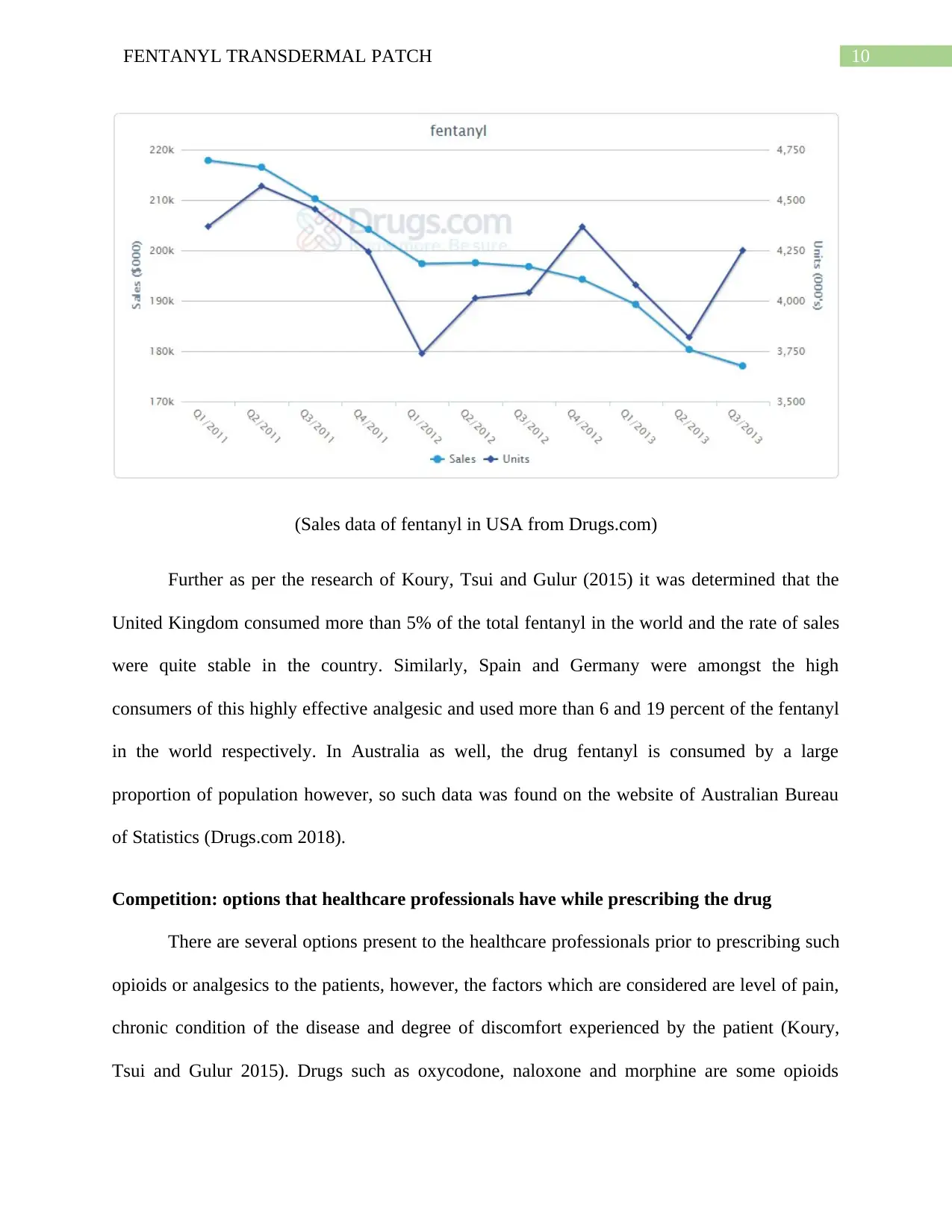
collected from USA, it was observed that the sales of fentanyl in unstable in the country as the
sales fluctuate from lows to highs. In the year 2013, the sales of fentanyl drug in quarter 3 was
4250 units which was 432 units more than the previous quarter of that year. The graphical
representation is presented below (Drugs.com 2018).
Advantages offered
Fentanyl is an effective and widely used opioid analgesic which is used to treat chronic
malignant and non-malignant conditions and is used depending on the patient’s condition and the
degree of pain (Ho et al. 2012). The advantages that the drug offers includes the increased patient
satisfaction, increases the patient’s ability to comply with the care process and provide
convenience results, improves the quality of life and decreases the impact of adverse effects of
similar analgesic drugs such as vomiting, nausea and drowsiness (Lammers et al. 2014). This
drug is beneficial analgesic for terminally ill cancer patients as it help them in a situation when
they are unable to swallow because of their gastrointestinal issues (Smith et al. 2012). However,
prior to application of this transdermal medication, the level of pain and need of opioids should
be assessed as it helps patients who require continuous opioids due to their chronic pain. the
primary advantage of this drug is related to its half-life which is 16 to 22 hours due to which it
can provide help to patients for a longer time period compared to other analgesics that could
control or manage the chronic pain of patients for 5 to 10 hours only (Morphine, naloxone and so
on) (Ho et al. 2012).
Sales data in various countries
While analyzing the sales data of drug fentanyl, data of countries such as Australia,
United States of America, United Kingdom, Germany and Spain will be assessed. From the data
collected from USA, it was observed that the sales of fentanyl in unstable in the country as the
sales fluctuate from lows to highs. In the year 2013, the sales of fentanyl drug in quarter 3 was
4250 units which was 432 units more than the previous quarter of that year. The graphical
representation is presented below (Drugs.com 2018).
Paraphrase This Document
Need a fresh take? Get an instant paraphrase of this document with our AI Paraphraser
10FENTANYL TRANSDERMAL PATCH
(Sales data of fentanyl in USA from Drugs.com)
Further as per the research of Koury, Tsui and Gulur (2015) it was determined that the
United Kingdom consumed more than 5% of the total fentanyl in the world and the rate of sales
were quite stable in the country. Similarly, Spain and Germany were amongst the high
consumers of this highly effective analgesic and used more than 6 and 19 percent of the fentanyl
in the world respectively. In Australia as well, the drug fentanyl is consumed by a large
proportion of population however, so such data was found on the website of Australian Bureau
of Statistics (Drugs.com 2018).
Competition: options that healthcare professionals have while prescribing the drug
There are several options present to the healthcare professionals prior to prescribing such
opioids or analgesics to the patients, however, the factors which are considered are level of pain,
chronic condition of the disease and degree of discomfort experienced by the patient (Koury,
Tsui and Gulur 2015). Drugs such as oxycodone, naloxone and morphine are some opioids
(Sales data of fentanyl in USA from Drugs.com)
Further as per the research of Koury, Tsui and Gulur (2015) it was determined that the
United Kingdom consumed more than 5% of the total fentanyl in the world and the rate of sales
were quite stable in the country. Similarly, Spain and Germany were amongst the high
consumers of this highly effective analgesic and used more than 6 and 19 percent of the fentanyl
in the world respectively. In Australia as well, the drug fentanyl is consumed by a large
proportion of population however, so such data was found on the website of Australian Bureau
of Statistics (Drugs.com 2018).
Competition: options that healthcare professionals have while prescribing the drug
There are several options present to the healthcare professionals prior to prescribing such
opioids or analgesics to the patients, however, the factors which are considered are level of pain,
chronic condition of the disease and degree of discomfort experienced by the patient (Koury,
Tsui and Gulur 2015). Drugs such as oxycodone, naloxone and morphine are some opioids
11FENTANYL TRANSDERMAL PATCH
which could be provided to patients to relieve their chronic pain. However, if the patient is
terminally ill and suffering from pain related to malignancy or non-malignancy then the drug
fentanyl should be prescribed due to its greater half-life and ability to relieve the pain instantly as
other drugs such as morphine or naloxone will not be able to relief the pain in such limited time
period (Bäckberg et al. 2015). Therefore, the competition between such opioids not only depend
on their activity, but also depends on their application in different situations and degree of pain
(Ho et al. 2012).
Limitation
There are several limitations of using the highly effective analgesic in patients suffering
from extreme pain (Koury, Tsui and Gulur 2015). The adverse effects ranges from asthenia,
nausea, anxiety, apnea, depression, diarrhea, constipation, delirium, sweating, abdominal pain,
vomiting, fatigue, euphoria, hallucinations, headache, dizziness, influenza, agitation, bronchitis
and so on (Szabo 2013). Besides these, the patient feels increased body temperature, muscle
spasm and numbness in her body (Anselmo and Mitragotri 2014). The patient also develops
signs of allergy and hives and etching and swelling and this local rashes and patches the patient
feels weak and tired. These are the limitations or adverse effects of using fentanyl in patients
affected with chronic pain (Morad et al. 2012).
Pharmacy related information
Fentanyl is a drug which is derived from 4-anilinopiperidine and the physical appearance
of the drug looks like a white to off-white solid (Mayer et al. 2016). This drug is partially soluble
in water and alkaline solutions, whereas in acidic solution and organic solution, it is highly
soluble. It has a pH of 11 and the pKa of 8.4 that makes it highly effective opioids among others.
This drug has the capability to release its active molecule continuously till 72 hours and then it
which could be provided to patients to relieve their chronic pain. However, if the patient is
terminally ill and suffering from pain related to malignancy or non-malignancy then the drug
fentanyl should be prescribed due to its greater half-life and ability to relieve the pain instantly as
other drugs such as morphine or naloxone will not be able to relief the pain in such limited time
period (Bäckberg et al. 2015). Therefore, the competition between such opioids not only depend
on their activity, but also depends on their application in different situations and degree of pain
(Ho et al. 2012).
Limitation
There are several limitations of using the highly effective analgesic in patients suffering
from extreme pain (Koury, Tsui and Gulur 2015). The adverse effects ranges from asthenia,
nausea, anxiety, apnea, depression, diarrhea, constipation, delirium, sweating, abdominal pain,
vomiting, fatigue, euphoria, hallucinations, headache, dizziness, influenza, agitation, bronchitis
and so on (Szabo 2013). Besides these, the patient feels increased body temperature, muscle
spasm and numbness in her body (Anselmo and Mitragotri 2014). The patient also develops
signs of allergy and hives and etching and swelling and this local rashes and patches the patient
feels weak and tired. These are the limitations or adverse effects of using fentanyl in patients
affected with chronic pain (Morad et al. 2012).
Pharmacy related information
Fentanyl is a drug which is derived from 4-anilinopiperidine and the physical appearance
of the drug looks like a white to off-white solid (Mayer et al. 2016). This drug is partially soluble
in water and alkaline solutions, whereas in acidic solution and organic solution, it is highly
soluble. It has a pH of 11 and the pKa of 8.4 that makes it highly effective opioids among others.
This drug has the capability to release its active molecule continuously till 72 hours and then it
⊘ This is a preview!⊘
Do you want full access?
Subscribe today to unlock all pages.
Trusted by 1+ million students worldwide

1 out of 19


Your All-in-One AI-Powered Toolkit for Academic Success.
+13062052269
info@desklib.com
Available 24*7 on WhatsApp / Email
![[object Object]](/_next/static/media/star-bottom.7253800d.svg)
Unlock your academic potential
Copyright © 2020–2026 A2Z Services. All Rights Reserved. Developed and managed by ZUCOL.