Comprehensive Analysis: The Ffowcs Williams-Hawkings Analogy
VerifiedAdded on 2023/06/10
|10
|1382
|125
Report
AI Summary
This report provides a detailed examination of the Ffowcs Williams-Hawkings analogy, building upon the work of Lighthill and addressing the complexities of flow sound generation. It explores the analogy's core objective of dealing with solid surface interactions, with specific applications to sources like helicopter rotors and aircraft engines. The report elucidates the analogy's equations, assumptions, and the use of Huygens sources to determine thickness and loading sources. It differentiates the Ffowcs Williams-Hawkings approach as a comprehensive method, especially considering the interactions with moving boundaries. The analysis includes the derivation of key equations, the handling of both moving and stationary parts, and the consideration of subsonic and supersonic speeds. Furthermore, it touches upon modifications to handle stationary boundaries in moving media, and it references relevant publications. This report is designed to enhance understanding of advanced acoustics principles and their engineering applications. The assignment also includes the assignment brief which provides the context of the report and the scope of the study.
THE FFOWCS WILLIAMS-HAWKINGS ANALOGY
By Name
Course
Instructor
Institution
Location
Date
By Name
Course
Instructor
Institution
Location
Date
Paraphrase This Document
Need a fresh take? Get an instant paraphrase of this document with our AI Paraphraser

The Ffowcs Williams-Hawking work of analysis and comparison is an
extension of the work that was done by Lighthill. The analogy of Lighthill
takes into consideration the effects of changing the position of the
boundaries under the guidance of the Huygens sources. The Huygens
sources consist of the surface monopole source distribution qws that is
commonly known for the determination of the thickness source and the
dipole source distribution fws commonly known for the loading source.
The analogy borrows the characteristic equations, assumptions and the
starting points of the Ligththill alongside the expressions for the Huygens
sources.
The core objective is to deal with the solid surfaces interactions that are
involved directly in the flow sound generation. The sources of the flow
sound are including the helicopters rotors, aeroplane propellers, the
compressors and the turbines of the aircraft engines. The Ffowcs
Williams-Hawkings analogy has been therefore considered as
comprehensive exploitation method as opposed to the previously
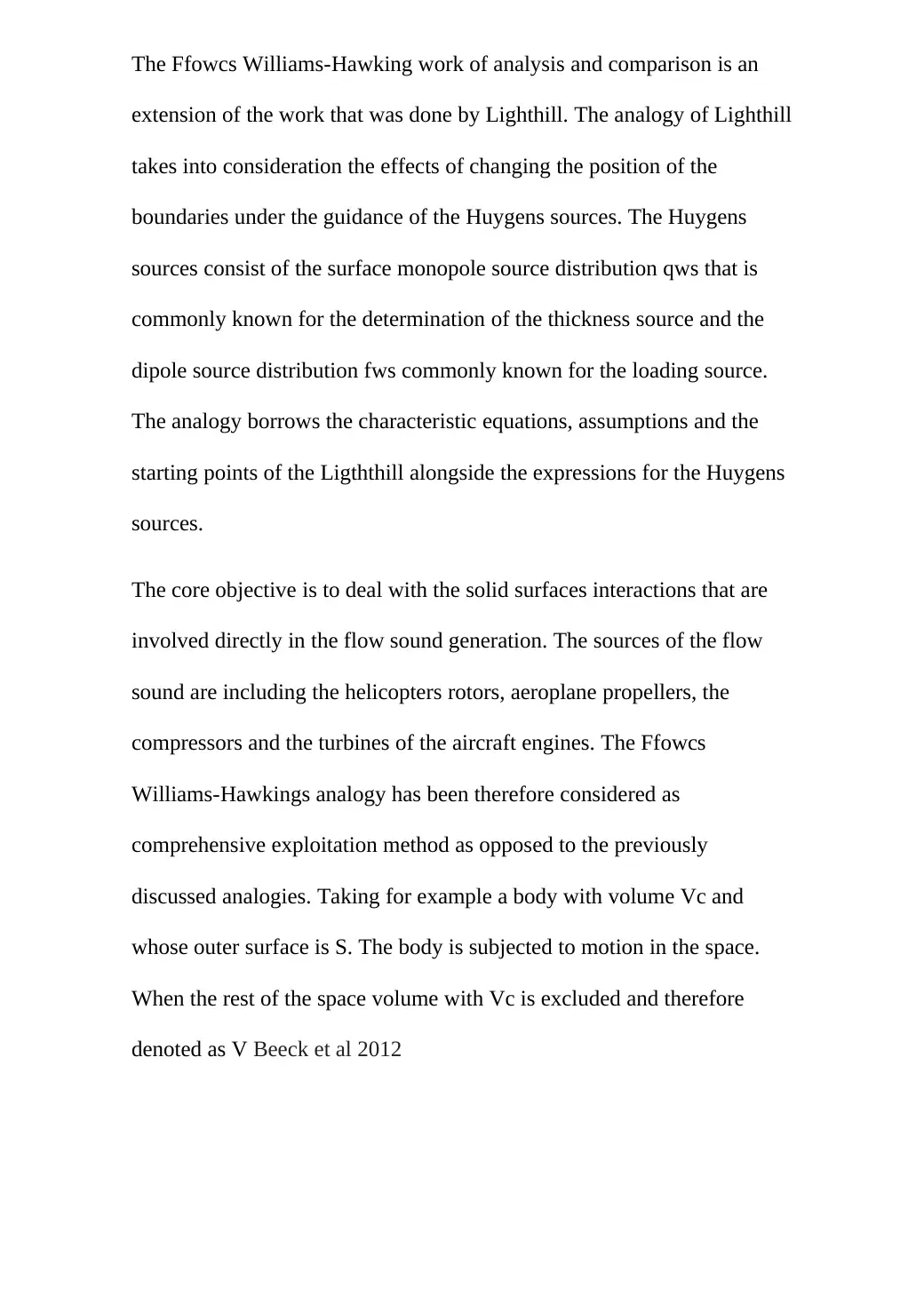
discussed analogies. Taking for example a body with volume Vc and
whose outer surface is S. The body is subjected to motion in the space.
When the rest of the space volume with Vc is excluded and therefore
denoted as V Beeck et al 2012
extension of the work that was done by Lighthill. The analogy of Lighthill
takes into consideration the effects of changing the position of the
boundaries under the guidance of the Huygens sources. The Huygens
sources consist of the surface monopole source distribution qws that is
commonly known for the determination of the thickness source and the
dipole source distribution fws commonly known for the loading source.
The analogy borrows the characteristic equations, assumptions and the
starting points of the Ligththill alongside the expressions for the Huygens
sources.
The core objective is to deal with the solid surfaces interactions that are
involved directly in the flow sound generation. The sources of the flow
sound are including the helicopters rotors, aeroplane propellers, the
compressors and the turbines of the aircraft engines. The Ffowcs
Williams-Hawkings analogy has been therefore considered as
comprehensive exploitation method as opposed to the previously
discussed analogies. Taking for example a body with volume Vc and
whose outer surface is S. The body is subjected to motion in the space.
When the rest of the space volume with Vc is excluded and therefore
denoted as V Beeck et al 2012

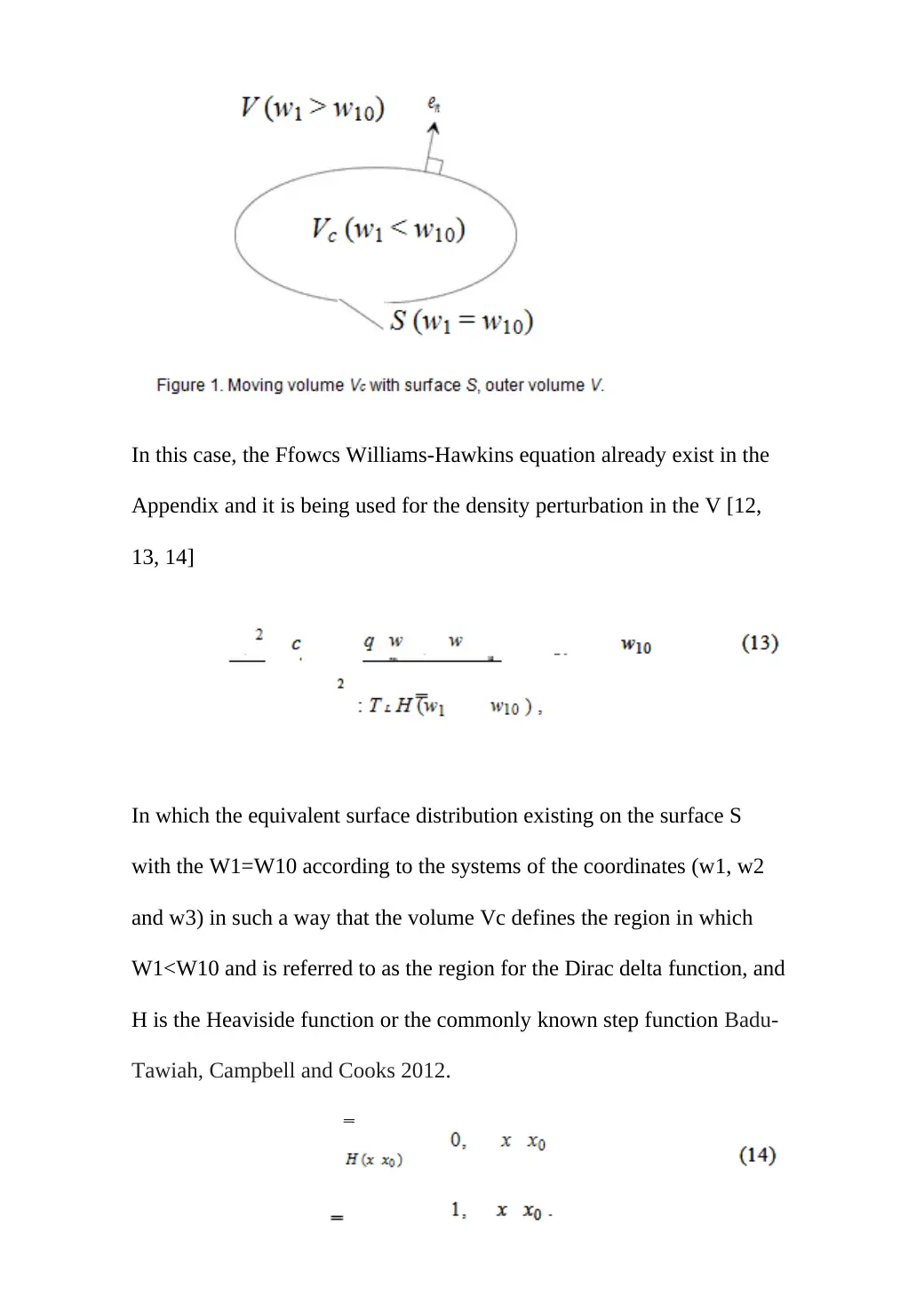
In this case, the Ffowcs Williams-Hawkins equation already exist in the
Appendix and it is being used for the density perturbation in the V [12,
13, 14]
In which the equivalent surface distribution existing on the surface S
with the W1=W10 according to the systems of the coordinates (w1, w2
and w3) in such a way that the volume Vc defines the region in which
W1<W10 and is referred to as the region for the Dirac delta function, and
H is the Heaviside function or the commonly known step function Badu-
Tawiah, Campbell and Cooks 2012.
Appendix and it is being used for the density perturbation in the V [12,
13, 14]
In which the equivalent surface distribution existing on the surface S
with the W1=W10 according to the systems of the coordinates (w1, w2
and w3) in such a way that the volume Vc defines the region in which
W1<W10 and is referred to as the region for the Dirac delta function, and
H is the Heaviside function or the commonly known step function Badu-
Tawiah, Campbell and Cooks 2012.
⊘ This is a preview!⊘
Do you want full access?
Subscribe today to unlock all pages.

Trusted by 1+ million students worldwide

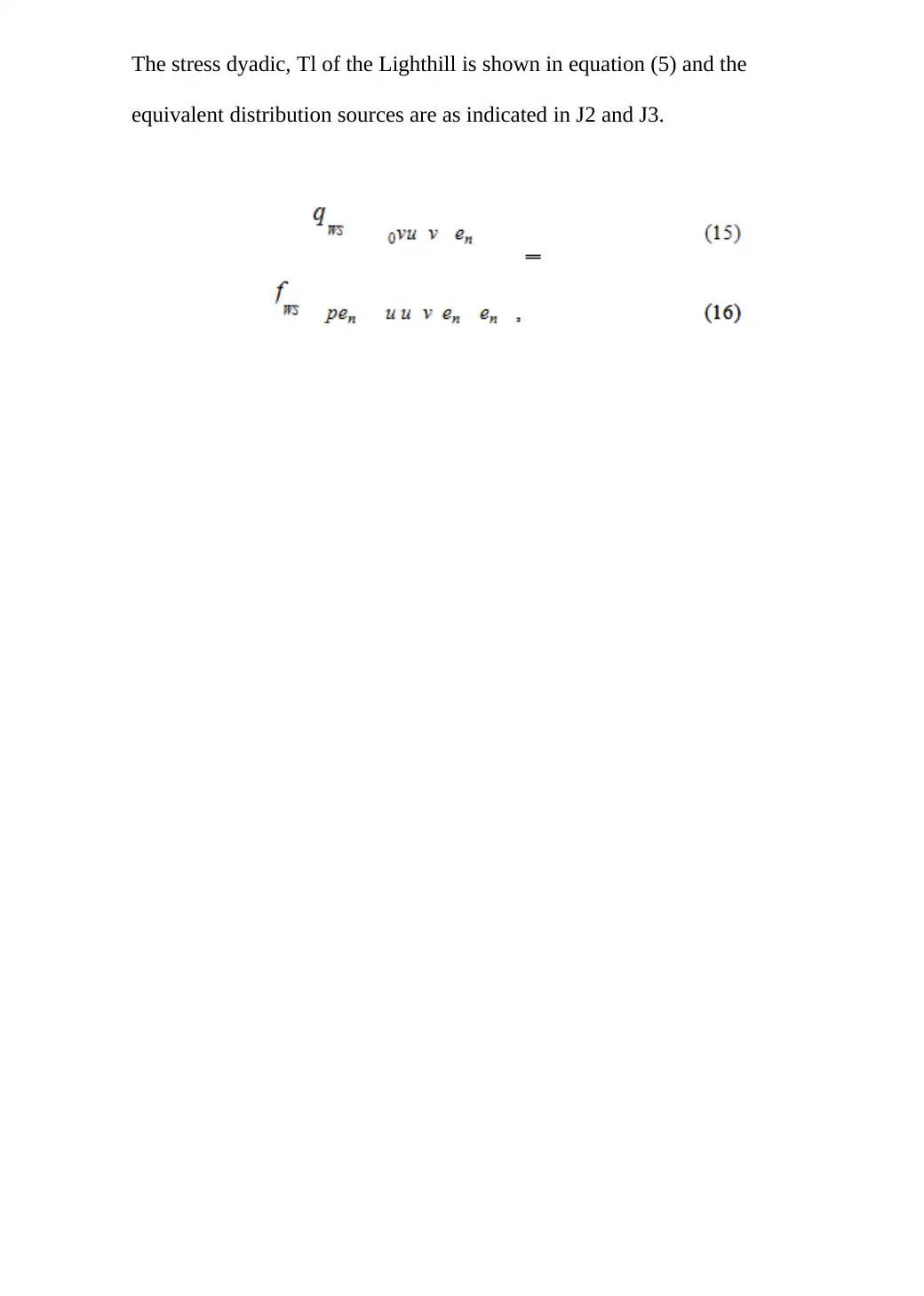
The stress dyadic, Tl of the Lighthill is shown in equation (5) and the
equivalent distribution sources are as indicated in J2 and J3.
Paraphrase This Document
Need a fresh take? Get an instant paraphrase of this document with our AI Paraphraser

In which en is just but a unit normal vector at S pointing away from Volume is the speed of
the surfaces, and the perturbation particle velocity is taken as u with the static velocity being
0 Frey-Law et al 2014 The obvious assumptions that were made when the equation (13) was
being obtained are the same as those used in the obtaining equation of the Lighthill (4).
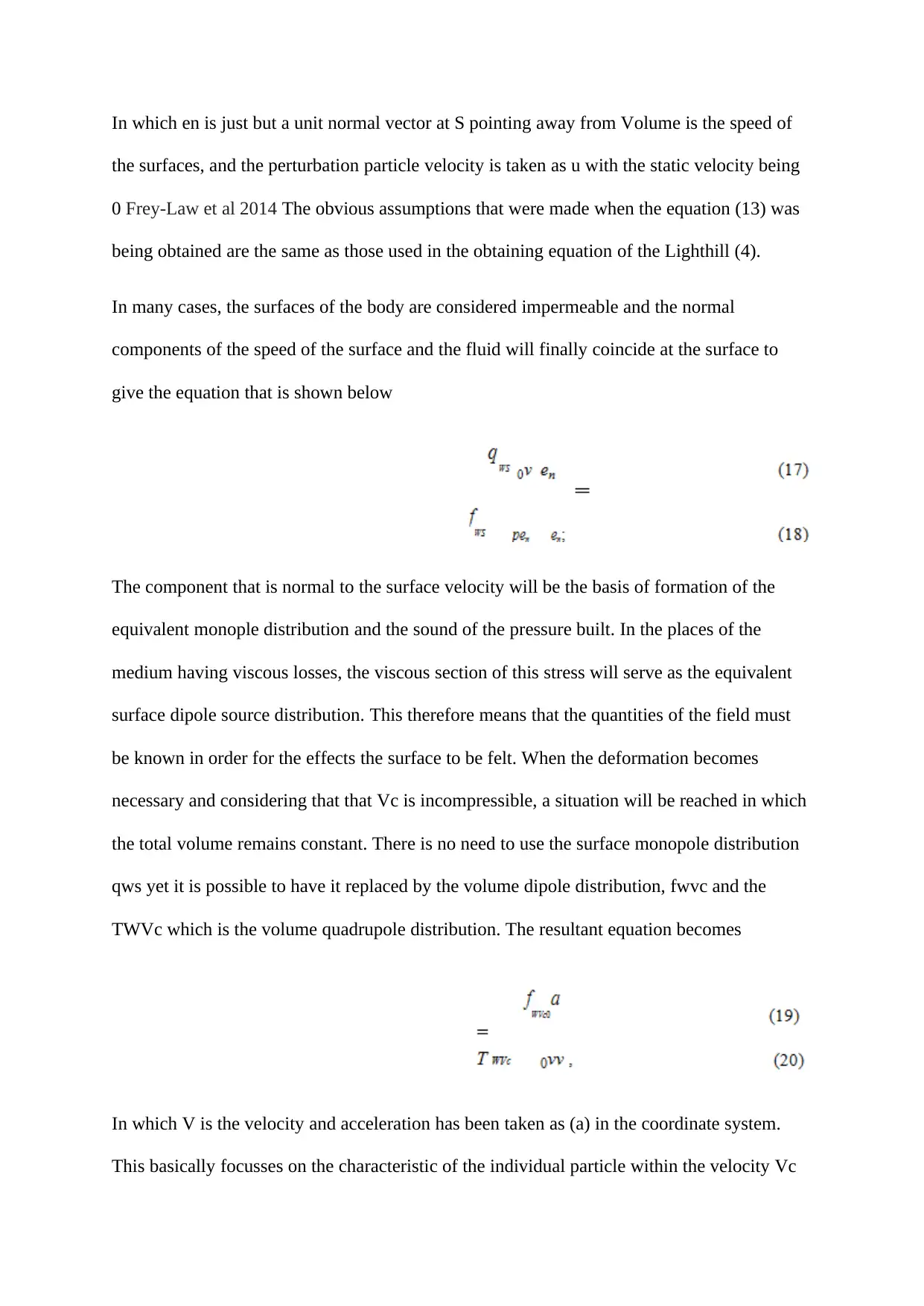
In many cases, the surfaces of the body are considered impermeable and the normal
components of the speed of the surface and the fluid will finally coincide at the surface to
give the equation that is shown below
The component that is normal to the surface velocity will be the basis of formation of the
equivalent monople distribution and the sound of the pressure built. In the places of the
medium having viscous losses, the viscous section of this stress will serve as the equivalent
surface dipole source distribution. This therefore means that the quantities of the field must
be known in order for the effects the surface to be felt. When the deformation becomes
necessary and considering that that Vc is incompressible, a situation will be reached in which
the total volume remains constant. There is no need to use the surface monopole distribution
qws yet it is possible to have it replaced by the volume dipole distribution, fwvc and the
TWVc which is the volume quadrupole distribution. The resultant equation becomes
In which V is the velocity and acceleration has been taken as (a) in the coordinate system.
This basically focusses on the characteristic of the individual particle within the velocity Vc
the surfaces, and the perturbation particle velocity is taken as u with the static velocity being
0 Frey-Law et al 2014 The obvious assumptions that were made when the equation (13) was
being obtained are the same as those used in the obtaining equation of the Lighthill (4).
In many cases, the surfaces of the body are considered impermeable and the normal
components of the speed of the surface and the fluid will finally coincide at the surface to
give the equation that is shown below
The component that is normal to the surface velocity will be the basis of formation of the
equivalent monople distribution and the sound of the pressure built. In the places of the
medium having viscous losses, the viscous section of this stress will serve as the equivalent
surface dipole source distribution. This therefore means that the quantities of the field must
be known in order for the effects the surface to be felt. When the deformation becomes
necessary and considering that that Vc is incompressible, a situation will be reached in which
the total volume remains constant. There is no need to use the surface monopole distribution
qws yet it is possible to have it replaced by the volume dipole distribution, fwvc and the
TWVc which is the volume quadrupole distribution. The resultant equation becomes
In which V is the velocity and acceleration has been taken as (a) in the coordinate system.
This basically focusses on the characteristic of the individual particle within the velocity Vc

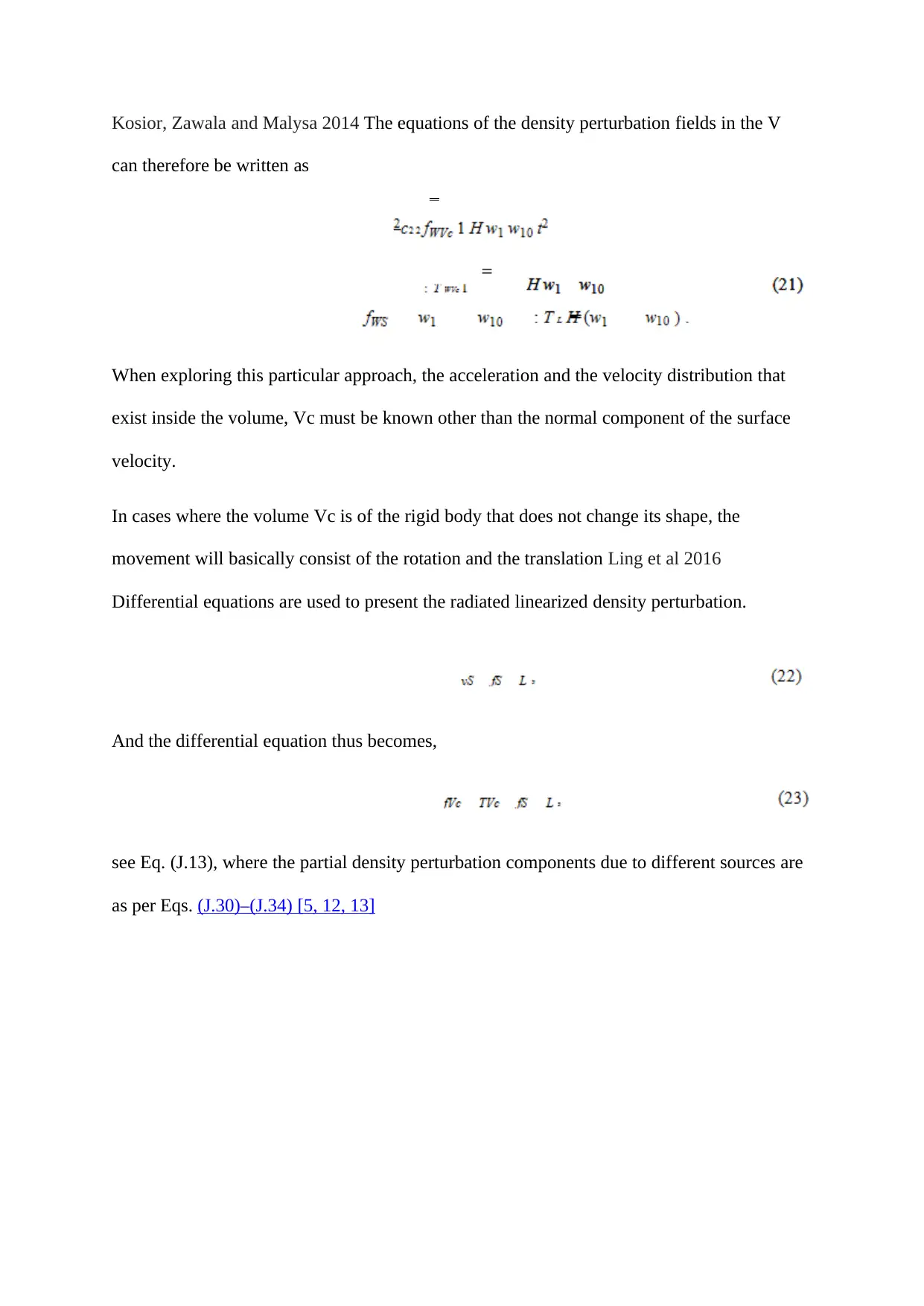
Kosior, Zawala and Malysa 2014 The equations of the density perturbation fields in the V
can therefore be written as
When exploring this particular approach, the acceleration and the velocity distribution that
exist inside the volume, Vc must be known other than the normal component of the surface
velocity.
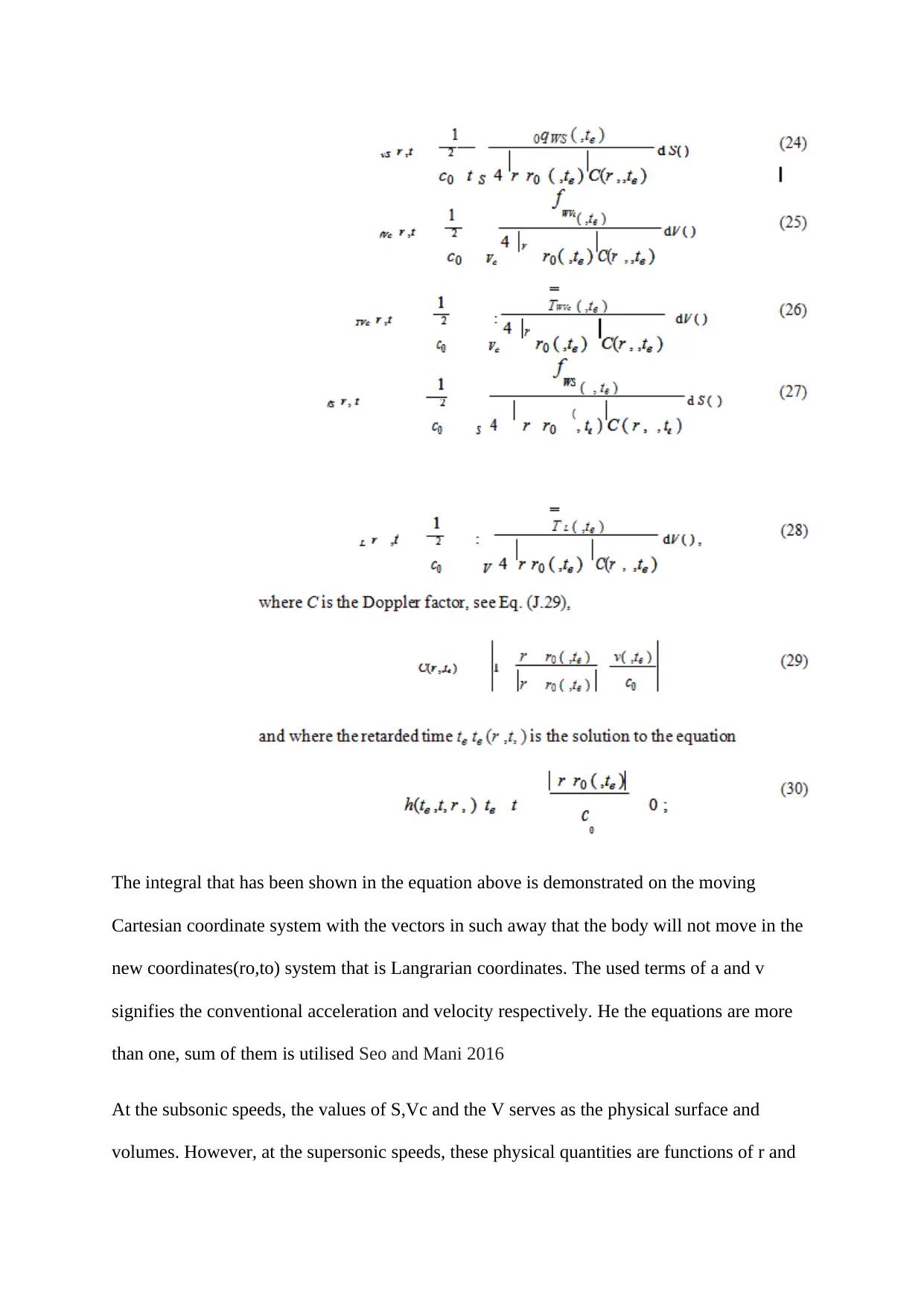
In cases where the volume Vc is of the rigid body that does not change its shape, the
movement will basically consist of the rotation and the translation Ling et al 2016
Differential equations are used to present the radiated linearized density perturbation.
And the differential equation thus becomes,
see Eq. (J.13), where the partial density perturbation components due to different sources are
as per Eqs. (J.30)–(J.34) [5, 12, 13]
can therefore be written as
When exploring this particular approach, the acceleration and the velocity distribution that
exist inside the volume, Vc must be known other than the normal component of the surface
velocity.
In cases where the volume Vc is of the rigid body that does not change its shape, the
movement will basically consist of the rotation and the translation Ling et al 2016
Differential equations are used to present the radiated linearized density perturbation.
And the differential equation thus becomes,
see Eq. (J.13), where the partial density perturbation components due to different sources are
as per Eqs. (J.30)–(J.34) [5, 12, 13]
⊘ This is a preview!⊘
Do you want full access?
Subscribe today to unlock all pages.

Trusted by 1+ million students worldwide

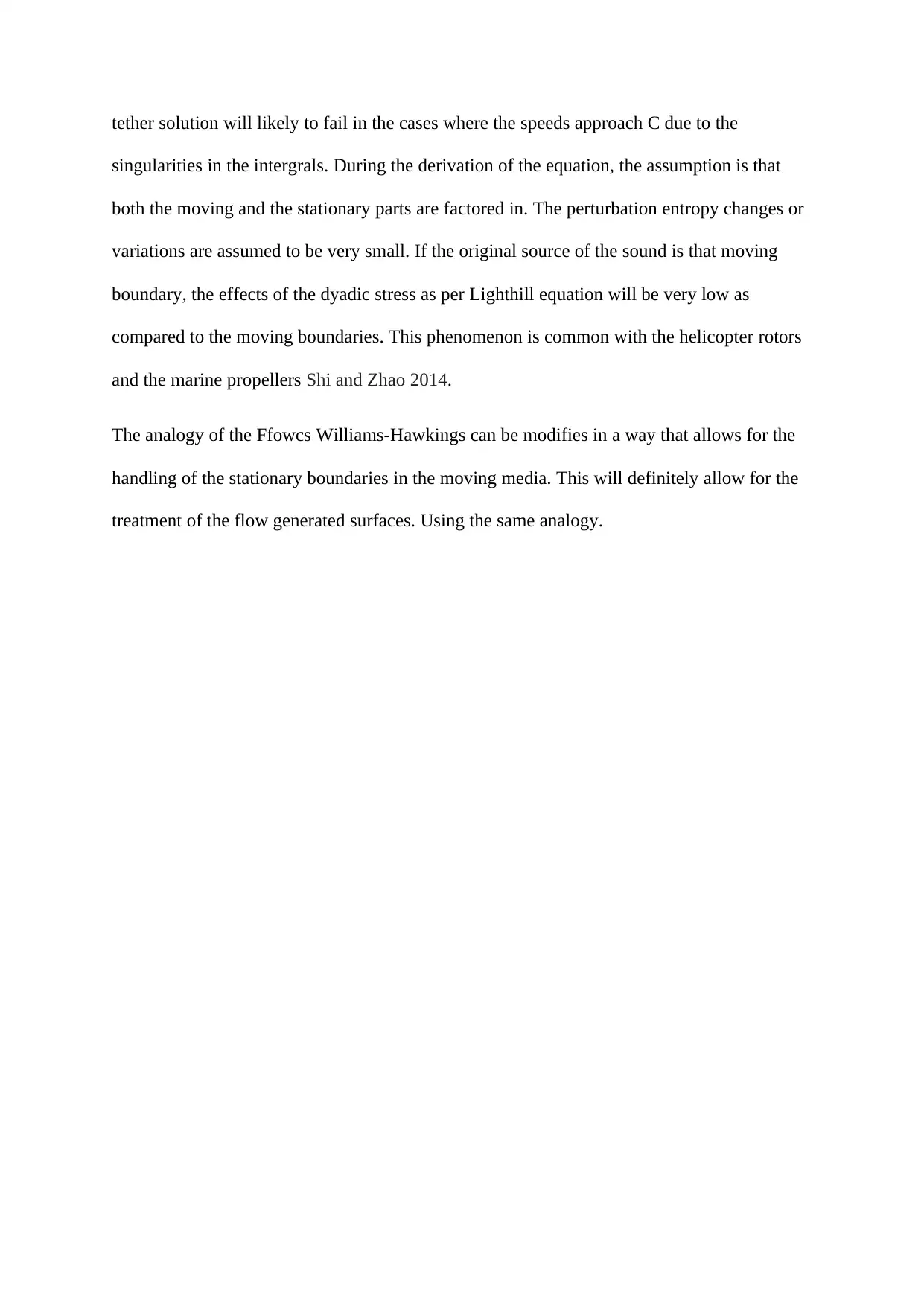
The integral that has been shown in the equation above is demonstrated on the moving
Cartesian coordinate system with the vectors in such away that the body will not move in the
new coordinates(ro,to) system that is Langrarian coordinates. The used terms of a and v
signifies the conventional acceleration and velocity respectively. He the equations are more
than one, sum of them is utilised Seo and Mani 2016
At the subsonic speeds, the values of S,Vc and the V serves as the physical surface and
volumes. However, at the supersonic speeds, these physical quantities are functions of r and
Cartesian coordinate system with the vectors in such away that the body will not move in the
new coordinates(ro,to) system that is Langrarian coordinates. The used terms of a and v
signifies the conventional acceleration and velocity respectively. He the equations are more
than one, sum of them is utilised Seo and Mani 2016
At the subsonic speeds, the values of S,Vc and the V serves as the physical surface and
volumes. However, at the supersonic speeds, these physical quantities are functions of r and
Paraphrase This Document
Need a fresh take? Get an instant paraphrase of this document with our AI Paraphraser

tether solution will likely to fail in the cases where the speeds approach C due to the
singularities in the intergrals. During the derivation of the equation, the assumption is that
both the moving and the stationary parts are factored in. The perturbation entropy changes or
variations are assumed to be very small. If the original source of the sound is that moving
boundary, the effects of the dyadic stress as per Lighthill equation will be very low as
compared to the moving boundaries. This phenomenon is common with the helicopter rotors
and the marine propellers Shi and Zhao 2014.
The analogy of the Ffowcs Williams-Hawkings can be modifies in a way that allows for the
handling of the stationary boundaries in the moving media. This will definitely allow for the
treatment of the flow generated surfaces. Using the same analogy.
singularities in the intergrals. During the derivation of the equation, the assumption is that
both the moving and the stationary parts are factored in. The perturbation entropy changes or
variations are assumed to be very small. If the original source of the sound is that moving
boundary, the effects of the dyadic stress as per Lighthill equation will be very low as
compared to the moving boundaries. This phenomenon is common with the helicopter rotors
and the marine propellers Shi and Zhao 2014.
The analogy of the Ffowcs Williams-Hawkings can be modifies in a way that allows for the
handling of the stationary boundaries in the moving media. This will definitely allow for the
treatment of the flow generated surfaces. Using the same analogy.

References
Badu-Tawiah, A.K., Campbell, D.I. and Cooks, R.G., 2012. Reactions of microsolvated
organic compounds at ambient surfaces: droplet velocity, charge state, and solvent
effects. Journal of the American Society for Mass Spectrometry, 23(6), pp.1077-1084.
Beeck, B., Collet, R., Steffen, M., Asplund, M., Cameron, R.H., Freytag, B., Hayek, W.,
Ludwig, H.G. and Schüssler, M., 2012. Simulations of the solar near-surface layers with the
CO5BOLD, MURaM, and Stagger codes. Astronomy & Astrophysics, 539, p.A121.
Frey-Law, L.A., Laake, A., Avin, K.G., Heitsman, J., Marler, T. and Abdel-Malek, K., 2012.
Knee and elbow 3D strength surfaces: peak torque-angle-velocity relationships. Journal of
applied biomechanics, 28(6), pp.726-737.
Kosior, D., Zawala, J. and Malysa, K., 2014. Influence of n-octanol on the bubble impact
velocity, bouncing and the three-phase contact formation at hydrophobic solid
surfaces. Colloids and Surfaces A: Physicochemical and Engineering Aspects, 441, pp.788-
795.
Ling, H., Srinivasan, S., Golovin, K., McKinley, G.H., Tuteja, A. and Katz, J., 2016. High-
resolution velocity measurement in the inner part of turbulent boundary layers over super-
hydrophobic surfaces. Journal of Fluid Mechanics, 801, pp.670-703.
Nishimoto, S. and Bhushan, B., 2013. Bioinspired self-cleaning surfaces with
superhydrophobicity, superoleophobicity, and superhydrophilicity. Rsc Advances, 3(3),
pp.671-690.
Seo, J. and Mani, A., 2016. On the scaling of the slip velocity in turbulent flows over
superhydrophobic surfaces. Physics of Fluids, 28(2), p.025110.
Badu-Tawiah, A.K., Campbell, D.I. and Cooks, R.G., 2012. Reactions of microsolvated
organic compounds at ambient surfaces: droplet velocity, charge state, and solvent
effects. Journal of the American Society for Mass Spectrometry, 23(6), pp.1077-1084.
Beeck, B., Collet, R., Steffen, M., Asplund, M., Cameron, R.H., Freytag, B., Hayek, W.,
Ludwig, H.G. and Schüssler, M., 2012. Simulations of the solar near-surface layers with the
CO5BOLD, MURaM, and Stagger codes. Astronomy & Astrophysics, 539, p.A121.
Frey-Law, L.A., Laake, A., Avin, K.G., Heitsman, J., Marler, T. and Abdel-Malek, K., 2012.
Knee and elbow 3D strength surfaces: peak torque-angle-velocity relationships. Journal of
applied biomechanics, 28(6), pp.726-737.
Kosior, D., Zawala, J. and Malysa, K., 2014. Influence of n-octanol on the bubble impact
velocity, bouncing and the three-phase contact formation at hydrophobic solid
surfaces. Colloids and Surfaces A: Physicochemical and Engineering Aspects, 441, pp.788-
795.
Ling, H., Srinivasan, S., Golovin, K., McKinley, G.H., Tuteja, A. and Katz, J., 2016. High-
resolution velocity measurement in the inner part of turbulent boundary layers over super-
hydrophobic surfaces. Journal of Fluid Mechanics, 801, pp.670-703.
Nishimoto, S. and Bhushan, B., 2013. Bioinspired self-cleaning surfaces with
superhydrophobicity, superoleophobicity, and superhydrophilicity. Rsc Advances, 3(3),
pp.671-690.
Seo, J. and Mani, A., 2016. On the scaling of the slip velocity in turbulent flows over
superhydrophobic surfaces. Physics of Fluids, 28(2), p.025110.
⊘ This is a preview!⊘
Do you want full access?
Subscribe today to unlock all pages.

Trusted by 1+ million students worldwide

1 out of 10
Your All-in-One AI-Powered Toolkit for Academic Success.
+13062052269
info@desklib.com
Available 24*7 on WhatsApp / Email
Unlock your academic potential
Copyright © 2020–2026 A2Z Services. All Rights Reserved. Developed and managed by ZUCOL.