Analysis and Experimentation of Fiber Optic Communication Systems

Verified

Added on  2023/06/12

|10
|478
|121
Report
AI Summary
This report provides an in-depth understanding of fiber optic communication systems, combining theoretical analysis with a lab experiment focused on splitting and combining fiber optic signals. It identifies measurable physical quantities using fiber optics technology, classifies optical fiber-based sensors, and explains their operating principles. The report also discusses the advantages and disadvantages of fiber optic sensors compared to traditional techniques. Furthermore, it addresses multiplexing and demultiplexing light wavelengths for commercial infrared-based communication systems, emphasizing loss minimization. The report includes a power budget analysis, implementation details, and recommendations for improving micro bending sensor detection. Concluding that fiber communication systems are efficient for long-distance information delivery, particularly in hostile environments, and highlighting the performance improvements achieved through multiplexing and demultiplexing.
Document Page
FIBER OPTIC
COMMUNICATION SYSTEMS
PRESENTED BY
STUDENT NAME
STUDENT ID NUMBER
tabler-icon-diamond-filled.svg

Paraphrase This Document

Need a fresh take? Get an instant paraphrase of this document with our AI Paraphraser
Document Page
EXECUTIVE SUMMARY
The aim of the assignment is to allow one to acquire an in-depth
understanding of the technical aspects of the fiber optic-based
communication system.
The theoretical analysis of the communication system is followed up
by the lab experiment which reviews the splitting and combining of
fiber optic signals in the communication system
Document Page
INTRODUCTION
A link refers to the signal pathway between two points using some kind of generic
cable.
A simple intercom, for instance, one that consists of the sending station and the wire
over which the signals are transmitted and the receiving station. There are several
types of links based on different kind of material and operating at different data rates.
Document Page
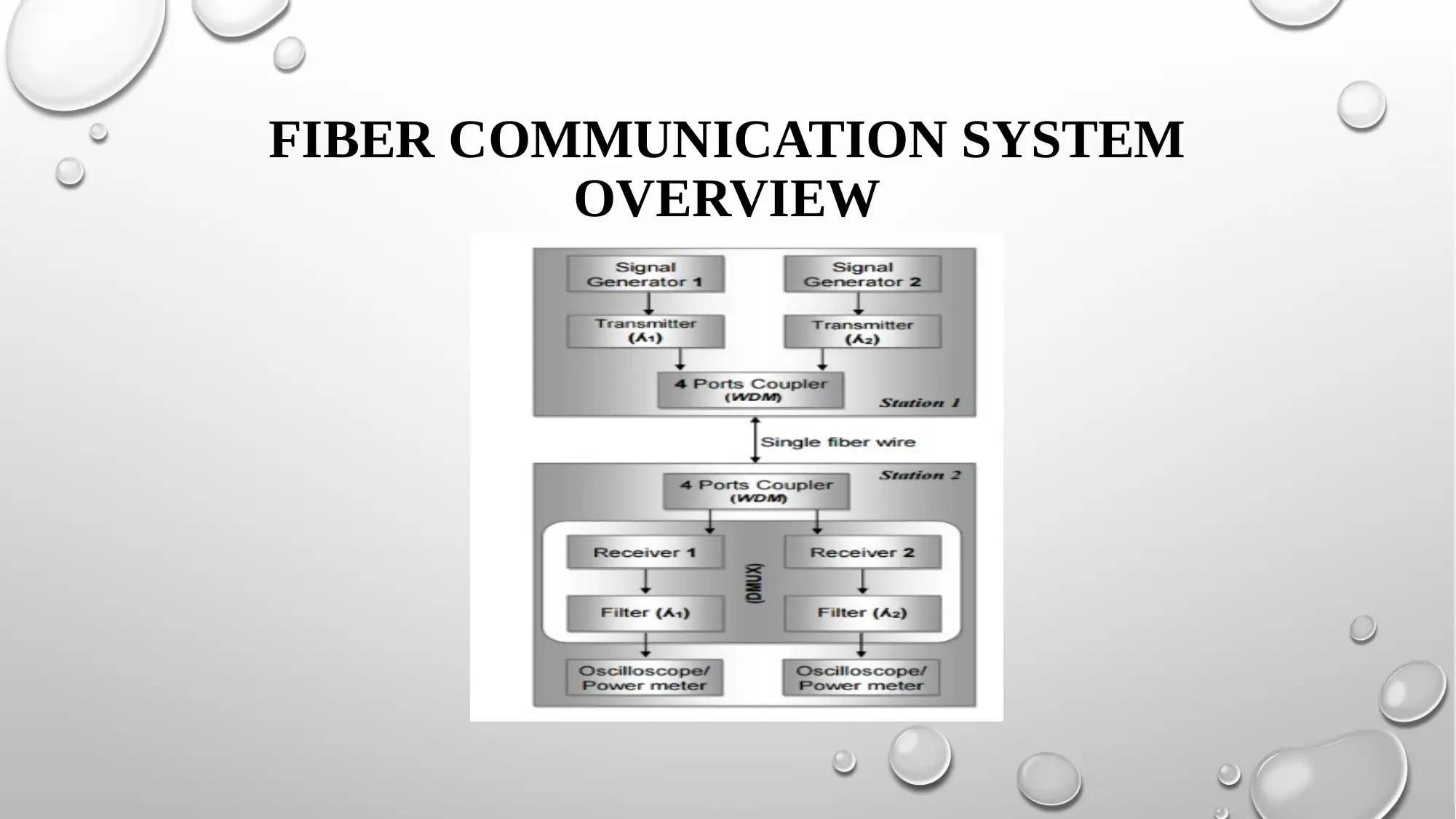
FIBER COMMUNICATION SYSTEM
OVERVIEW
tabler-icon-diamond-filled.svg

Paraphrase This Document

Need a fresh take? Get an instant paraphrase of this document with our AI Paraphraser
Document Page
LAB EXPERIMENT
1. To identify all the physical quantities that can be measured using fiber optics technology
2. To classify the optical fiber-based sensors based on their technical operating principles.
3. To explain in detail the principles of operation of the fiber optics-based sensors used to measure
such quantities.
4. To discuss the performance, advantages and disadvantages of using the fiber optics-based
sensors in comparison to the traditional sensing techniques.
5. To multiplex and de-multiplex the different light wavelengths for commercial infrared-based
communications systems, specialized components; minimizing the losses.
Document Page
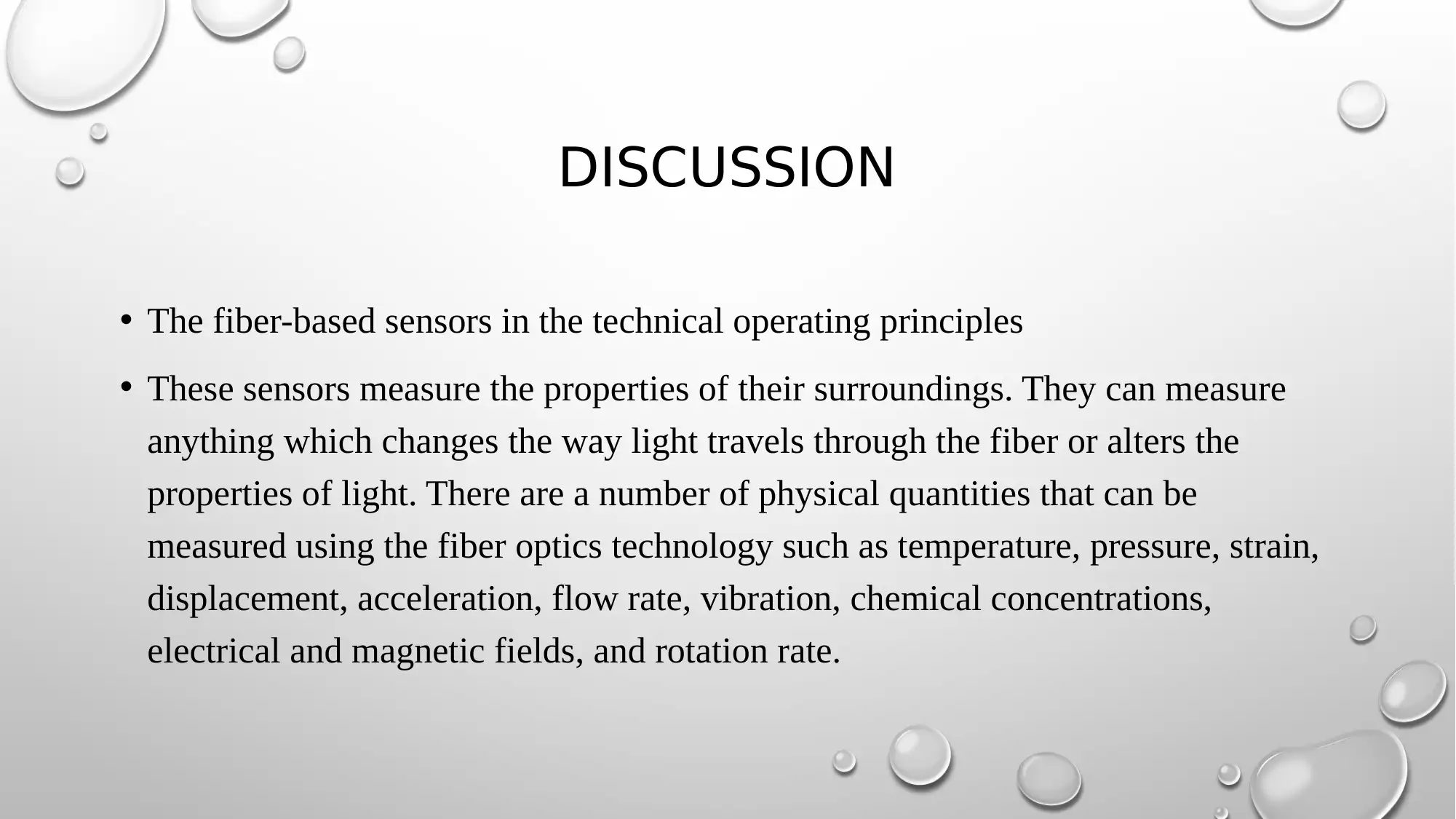
DISCUSSION
The fiber-based sensors in the technical operating principles
These sensors measure the properties of their surroundings. They can measure
anything which changes the way light travels through the fiber or alters the
properties of light. There are a number of physical quantities that can be
measured using the fiber optics technology such as temperature, pressure, strain,
displacement, acceleration, flow rate, vibration, chemical concentrations,
electrical and magnetic fields, and rotation rate.
Document Page
POWER BUDGET ANALYSIS
POWER BUDGET IMPLEMENTATION
WHERE
tabler-icon-diamond-filled.svg

Paraphrase This Document

Need a fresh take? Get an instant paraphrase of this document with our AI Paraphraser
Document Page
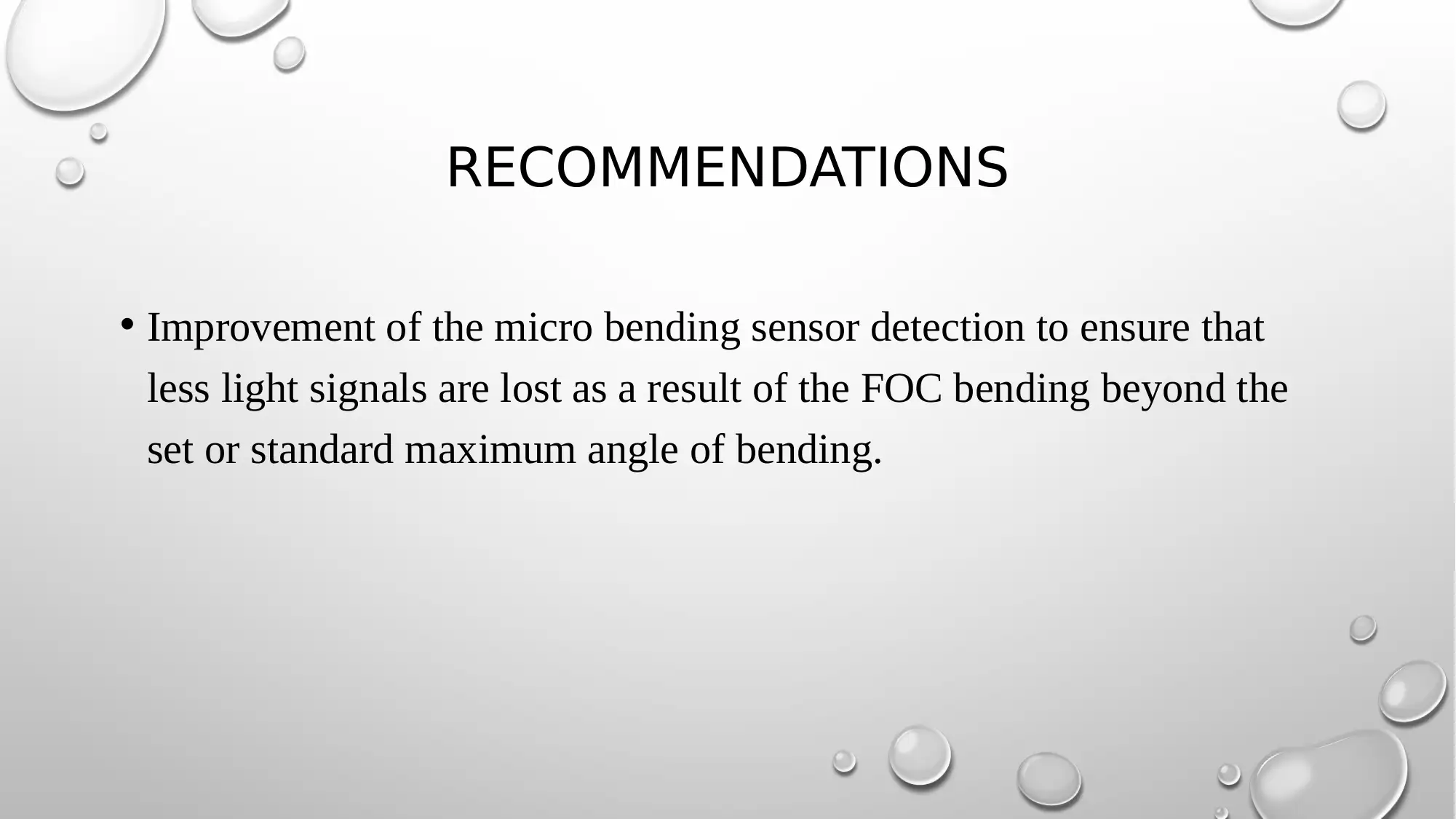
RECOMMENDATIONS
Improvement of the micro bending sensor detection to ensure that
less light signals are lost as a result of the FOC bending beyond the
set or standard maximum angle of bending.
Document Page
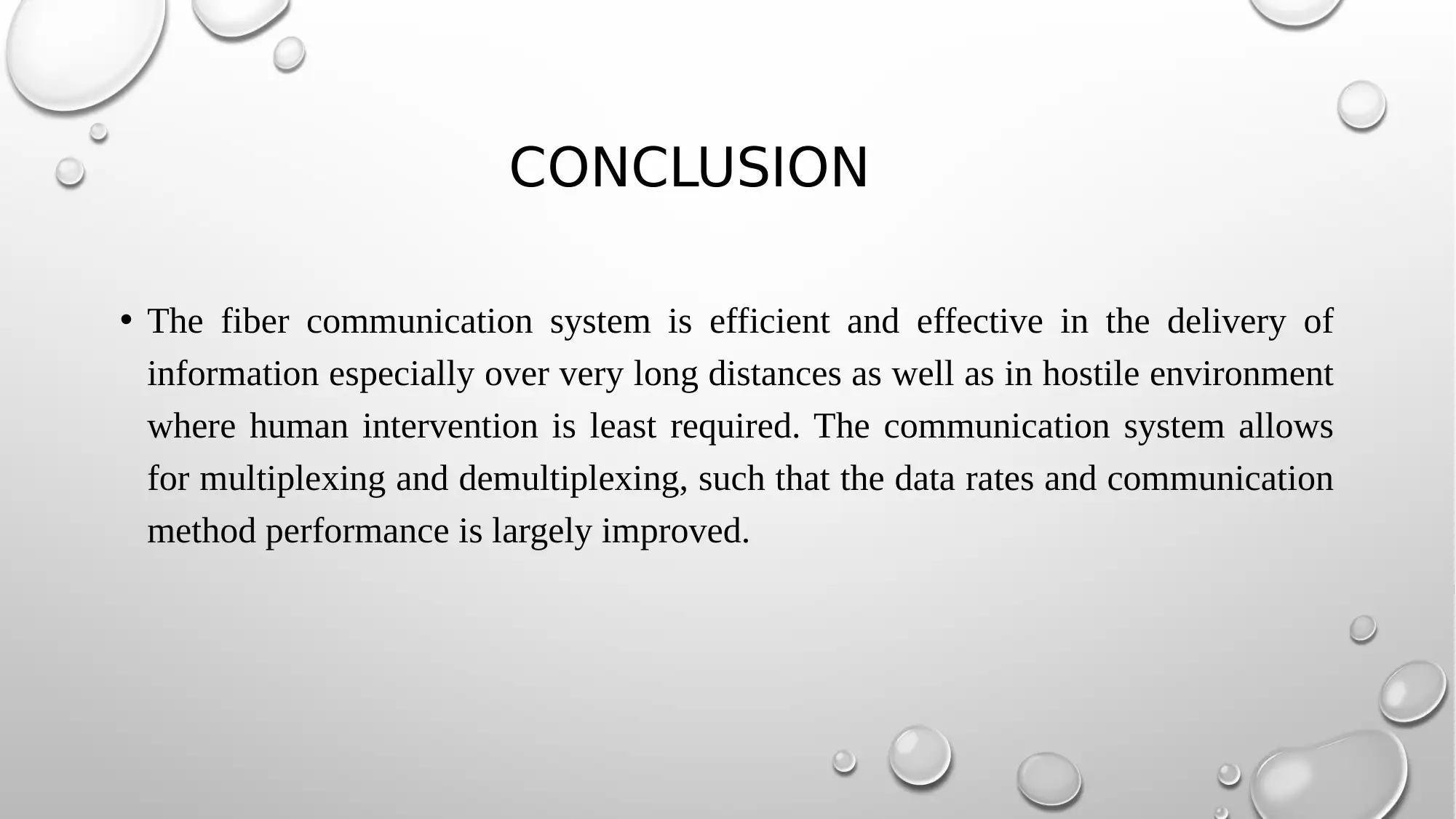
CONCLUSION
The fiber communication system is efficient and effective in the delivery of
information especially over very long distances as well as in hostile environment
where human intervention is least required. The communication system allows
for multiplexing and demultiplexing, such that the data rates and communication
method performance is largely improved.
Document Page
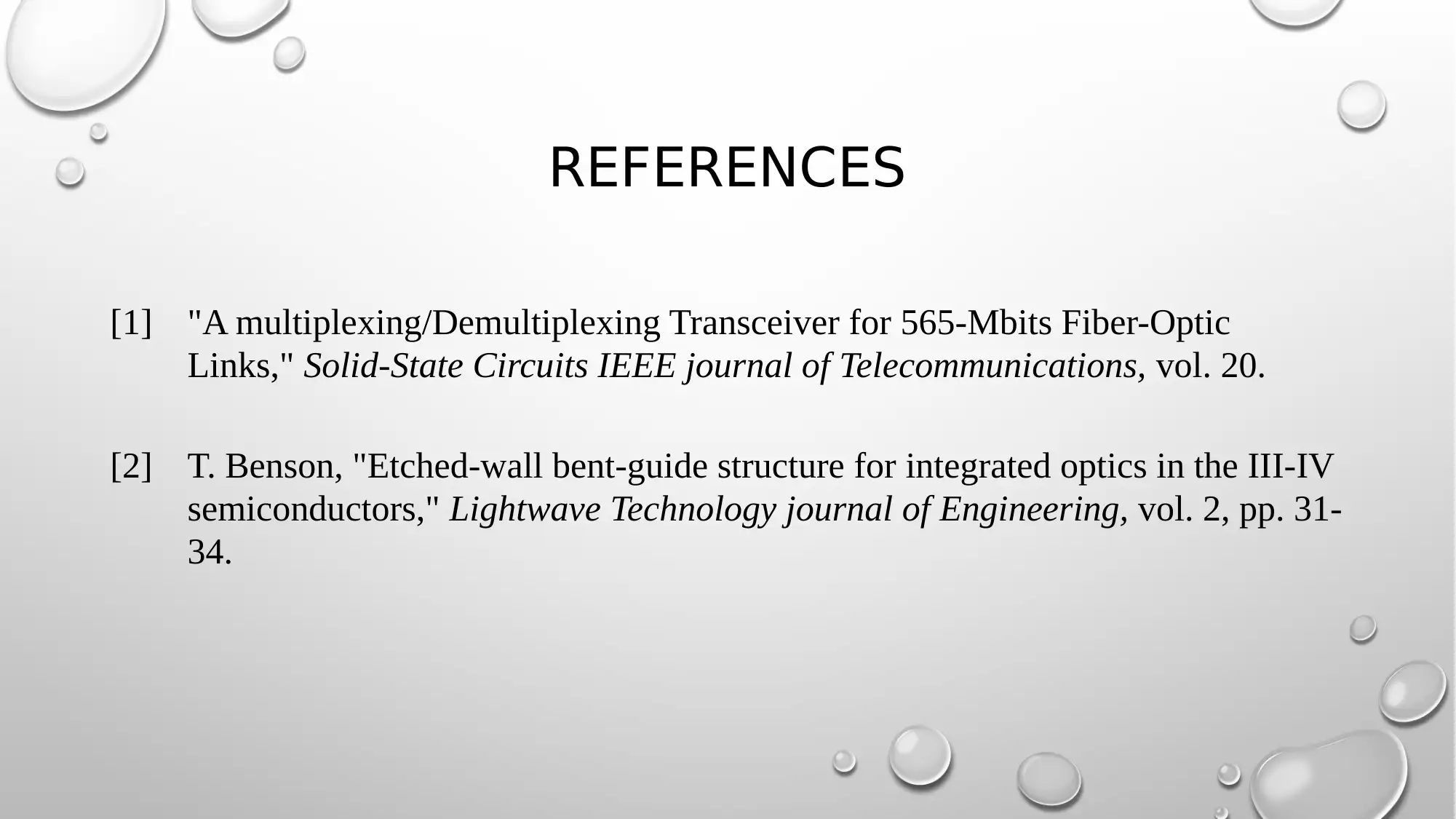
REFERENCES
[1] "A multiplexing/Demultiplexing Transceiver for 565-Mbits Fiber-Optic
Links," Solid-State Circuits IEEE journal of Telecommunications, vol. 20.
[2] T. Benson, "Etched-wall bent-guide structure for integrated optics in the III-IV
semiconductors," Lightwave Technology journal of Engineering, vol. 2, pp. 31-
34.
chevron_up_icon
1 out of 10
circle_padding
hide_on_mobile
zoom_out_icon
[object Object]