Analysis of Fiji Airports Limited's Sustainability and Performance
VerifiedAdded on 2023/01/10
|10
|2822
|75
Report
AI Summary
This report provides a detailed analysis of Fiji Airports Limited (FAL), focusing on its sustainability practices, managerial accounting, and financial performance. It begins with an introduction to sustainability in management accounting, emphasizing the importance of environmental management and performance metrics. The report then provides background information on FAL, including its establishment, operational structure, and key responsibilities. It outlines the organization's performance criteria, highlighting key performance indicators (KPIs) such as operating revenue, return on equity (ROE), capital investment, and dividends. The report also discusses the various awards achieved by FAL, such as the Skytrax World Airport Awards and the Prime Minister's Award, recognizing its commitment to customer satisfaction and service excellence. Personal recommendations are provided, suggesting improvements in areas such as the development of non-profitable airports, enhancing safety measures, and aligning with ICAO standards. The report further includes a financial analysis, using ratios like Return on Sales and Investment Turnover. It examines the bonus declaration to employees and utilizes a Du Pont chart to assess financial performance. Finally, the report explores special tools for measuring financial and non-financial performance, including customer retention and achievements. The analysis highlights FAL's growth and its commitment to sustainable practices and effective managerial operations.
SUSTAINABILITY
AND MANAGERIAL
ACCOUNTING
AND MANAGERIAL
ACCOUNTING

Paraphrase This Document
Need a fresh take? Get an instant paraphrase of this document with our AI Paraphraser

TABLE OF CONTENTS
INTRODUCTION
Sustainability and management accounting ensures the techniques and approaches that
helps the decision makers in the betterment of sustainability performance of the organization. It
involves the environmental management accounting the helps in assessing and managing their
sustainability performance by measuring environmental effects. It also helps by defining
sustainable performance metrics, by evaluating costs and savings along with risks and
opportunities associated with the operation of the organizations (Lee, Noh, Choi & Rha (2017)).
As similar in case of Fiji Airports Limited [FAL] elaborates the world with the example of
sustainable and effective managerial performance by reducing its carbon emission.
PART- A
1. INFORMATION REGARDING THE BACKGROUND OF FIJI AIRPORT LIMITED
Fiji Airports (FA) was established on 12 April 1999. It is monitored and controlled by
Government commercial company. FA is obligatory to deliver 10% return over the stakeholder’s
fund. The organization performs under the double reporting system that why the company has to
report to the Ministry of Public enterprises in response to its sustainable and commercial
performances and to Ministry of Aviation regarding its managerial policies related to the aviation
of its industrial works.
This organization monitors and controls the Nadi International Airports as well as
Nausori international Airport according to the guidelines of government. Besides this, FA also
manages 13 more outer island airports.
FA ensures the Air Traffic management (ATM) facilities at Nadi Flight Informative
system which covers the area of 6 million square kilometers. The regions like New Caledonia,
Tuvalu, Kiribati area also falls under its limits. Furthermore, FA businesses include;
International airport facilities and their safe as well as effective operations.
World’s best Air navigation facilities in vast area of Nadi Flight information region.
Managing the sustainable and commercial activities with the help of the ascertainment of
organizational assets.
FA controls its 15 airports throughout the world and along with the strength of 539 employees
working at these airports and having the total assets of $177 million. The BODs of FA
governs the direction strategically with the only aim to accomplish the desired goals and
objectives (Di Vai & Varriale (2018).
2. SPECIFICATION OF PERFORMANCE CRITERIA OF FA
It is essential for each and every organization to measure and ascertain the performance
of the organization in order to achieve the desired goals and objectives. The performance
Sustainability and management accounting ensures the techniques and approaches that
helps the decision makers in the betterment of sustainability performance of the organization. It
involves the environmental management accounting the helps in assessing and managing their
sustainability performance by measuring environmental effects. It also helps by defining
sustainable performance metrics, by evaluating costs and savings along with risks and
opportunities associated with the operation of the organizations (Lee, Noh, Choi & Rha (2017)).
As similar in case of Fiji Airports Limited [FAL] elaborates the world with the example of
sustainable and effective managerial performance by reducing its carbon emission.
PART- A
1. INFORMATION REGARDING THE BACKGROUND OF FIJI AIRPORT LIMITED
Fiji Airports (FA) was established on 12 April 1999. It is monitored and controlled by
Government commercial company. FA is obligatory to deliver 10% return over the stakeholder’s
fund. The organization performs under the double reporting system that why the company has to
report to the Ministry of Public enterprises in response to its sustainable and commercial
performances and to Ministry of Aviation regarding its managerial policies related to the aviation
of its industrial works.
This organization monitors and controls the Nadi International Airports as well as
Nausori international Airport according to the guidelines of government. Besides this, FA also
manages 13 more outer island airports.
FA ensures the Air Traffic management (ATM) facilities at Nadi Flight Informative
system which covers the area of 6 million square kilometers. The regions like New Caledonia,
Tuvalu, Kiribati area also falls under its limits. Furthermore, FA businesses include;
International airport facilities and their safe as well as effective operations.
World’s best Air navigation facilities in vast area of Nadi Flight information region.
Managing the sustainable and commercial activities with the help of the ascertainment of
organizational assets.
FA controls its 15 airports throughout the world and along with the strength of 539 employees
working at these airports and having the total assets of $177 million. The BODs of FA
governs the direction strategically with the only aim to accomplish the desired goals and
objectives (Di Vai & Varriale (2018).
2. SPECIFICATION OF PERFORMANCE CRITERIA OF FA
It is essential for each and every organization to measure and ascertain the performance
of the organization in order to achieve the desired goals and objectives. The performance
⊘ This is a preview!⊘
Do you want full access?
Subscribe today to unlock all pages.

Trusted by 1+ million students worldwide
criteria o any organization can only evaluate on the basis of its Key performance Indicators
(KPI). KPIs are required t set up by each organizations for ascertain of performances as well as
to make their annual reports more reliable and ascertainable (Savino & Shafiq (2018). Some key
performance indicators are also setup and maintained by FA also which are as follows.
Operating Revenue: Basically, it refers to the revenue earned by the organization from
the man business activities. It can easily calculate and compared year over year in order
to ascertain the performances of the organizations like FA. This organization generates
$138million in year 2017 and $116.1 million in year 2016.
Return on Equity (ROE): It is the measure which depicts the financial situation of the
organizations like FA. It also depicts the efficiency of management in order to use the
assets of the organization to generate profits. In year 2017, FA generated 29.0% ROE and
in 2016 24.4%. The increasing ROE depicts the ascertaining financial performance of the
organization.
Capital Investment: It means the total amount of capital invested by the organization for
attaining the desired revenues. The increasing capital investment year by year depicts the
growing performance of the organization and vice-versa. As in case of FA the capital
investment of FA in year 2017 was $45.1 million and in 2016 $46.9 million.
Dividends: It refers to the return over the equity invested by the stakeholders in an
organization like FA. In case of Fiji Airports Limited, the declared annual dividend is
also increasing year by year. That is in 2017, it was $45.0 million and in 2016 30.0
million.
These all performance indicators are describing the growing and sound performance of the
Fiji Airport Limited.
3. DIFFERENT LEVELS OF AWARDS ACHIEVED BY FIJI AIRPORT LIMITED
It must be the primary objective of each and every organization to works within their
sustainable limits and keep growing with the sustainable development. The organization
performs with sustainability and effective managerial skills become more successful and
profitable. Such organizations are awarded for their inspirational works in order to motivating
their members by appreciating their potentials. Fiji Airport Limited is also awarded several times
for their inspirational works and fabulous managerial skills. Such as in 2018, AFL awarded with
the Skytrax World Airport Awards because of drastic improvement at Nadi international
Airport.
Prime Ministers Award (2017) was also achieved by the AFL in 2017. This award is
recognized by the organization which is continuously proves itself in satisfying its customers
fully that is why this award is also known as Excellence in Service Award.
(KPI). KPIs are required t set up by each organizations for ascertain of performances as well as
to make their annual reports more reliable and ascertainable (Savino & Shafiq (2018). Some key
performance indicators are also setup and maintained by FA also which are as follows.
Operating Revenue: Basically, it refers to the revenue earned by the organization from
the man business activities. It can easily calculate and compared year over year in order
to ascertain the performances of the organizations like FA. This organization generates
$138million in year 2017 and $116.1 million in year 2016.
Return on Equity (ROE): It is the measure which depicts the financial situation of the
organizations like FA. It also depicts the efficiency of management in order to use the
assets of the organization to generate profits. In year 2017, FA generated 29.0% ROE and
in 2016 24.4%. The increasing ROE depicts the ascertaining financial performance of the
organization.
Capital Investment: It means the total amount of capital invested by the organization for
attaining the desired revenues. The increasing capital investment year by year depicts the
growing performance of the organization and vice-versa. As in case of FA the capital
investment of FA in year 2017 was $45.1 million and in 2016 $46.9 million.
Dividends: It refers to the return over the equity invested by the stakeholders in an
organization like FA. In case of Fiji Airports Limited, the declared annual dividend is
also increasing year by year. That is in 2017, it was $45.0 million and in 2016 30.0
million.
These all performance indicators are describing the growing and sound performance of the
Fiji Airport Limited.
3. DIFFERENT LEVELS OF AWARDS ACHIEVED BY FIJI AIRPORT LIMITED
It must be the primary objective of each and every organization to works within their
sustainable limits and keep growing with the sustainable development. The organization
performs with sustainability and effective managerial skills become more successful and
profitable. Such organizations are awarded for their inspirational works in order to motivating
their members by appreciating their potentials. Fiji Airport Limited is also awarded several times
for their inspirational works and fabulous managerial skills. Such as in 2018, AFL awarded with
the Skytrax World Airport Awards because of drastic improvement at Nadi international
Airport.
Prime Ministers Award (2017) was also achieved by the AFL in 2017. This award is
recognized by the organization which is continuously proves itself in satisfying its customers
fully that is why this award is also known as Excellence in Service Award.
Paraphrase This Document
Need a fresh take? Get an instant paraphrase of this document with our AI Paraphraser
The Skytrax World Airport Award achieved by AFL in year 2018, termed as most
prestigious accolades in universal airport industry. The Nadi Airport named as most improved
airport in world with $129million as the cost of improvement (Awasthi, Govindan & Gold
(2018).
Besides this, In 2019 FAL also receives Silver Award in Asia Pacific for Green
Airports as well as level 2 Carbon accreditation Certificates.
4. PERSONAL RECOMMENDATIONS FOR THE HIGHEST ACHEIVEMENT OF FAL
In my perusal opinion FAL is working fantastically and with sustainability. As biggest
awards achieved by FAL are evidences its sustainable development and effective managerial
operations. But I think that there are still some week point which affects the progress of the FAL
which required to focus by the management of AFL. Some recommendations for more
betterment of FAL are as follows.
Development of non profitable airports: As per the annual reports of 2017 the FAL
incurs the operational losses of $2.4 million due to non profitable airports like Nausori and 13
other outer island airports. Which affect its the profitability of the organization as well as the
sustainability standards of developing airports regions. As the organization made the $8.44
million capital expenditure for the development of such non profitable airports along with this
FAL also develops the effective management systems at these airport. Besides this, flight
charges are required to be more reasonable and equitable in order to attract more passengers.
This all helps FAL from overcoming the losses incurs from these non profitable airports.
Ascertaining safety: The organization also required to made expense over the more
safety equipments as well as for the betterment of the safety staff trainings. Besides this, it is also
required to aware the passengers about the use of safety equipments with the help of safety staff
and displaying videos at airport regarding the uses of safety equipments.
Recommendations regarding FAL vision: The organization is required to make the non
profitable or less crowded airports more safe and secure. Fees and charges of flights are required
to be reasonable and fair that attracts the middle class passengers more. Not only this, the
organizations is required to meet the ICAO standards fully as well as try to overcome the
customers satisfaction (Truant, Corazza and Scagnelli, 2017). This all helps AFL in becoming
the leading small international airport as well as air traffic management service renderer with
securing their heritage.
prestigious accolades in universal airport industry. The Nadi Airport named as most improved
airport in world with $129million as the cost of improvement (Awasthi, Govindan & Gold
(2018).
Besides this, In 2019 FAL also receives Silver Award in Asia Pacific for Green
Airports as well as level 2 Carbon accreditation Certificates.
4. PERSONAL RECOMMENDATIONS FOR THE HIGHEST ACHEIVEMENT OF FAL
In my perusal opinion FAL is working fantastically and with sustainability. As biggest
awards achieved by FAL are evidences its sustainable development and effective managerial
operations. But I think that there are still some week point which affects the progress of the FAL
which required to focus by the management of AFL. Some recommendations for more
betterment of FAL are as follows.
Development of non profitable airports: As per the annual reports of 2017 the FAL
incurs the operational losses of $2.4 million due to non profitable airports like Nausori and 13
other outer island airports. Which affect its the profitability of the organization as well as the
sustainability standards of developing airports regions. As the organization made the $8.44
million capital expenditure for the development of such non profitable airports along with this
FAL also develops the effective management systems at these airport. Besides this, flight
charges are required to be more reasonable and equitable in order to attract more passengers.
This all helps FAL from overcoming the losses incurs from these non profitable airports.
Ascertaining safety: The organization also required to made expense over the more
safety equipments as well as for the betterment of the safety staff trainings. Besides this, it is also
required to aware the passengers about the use of safety equipments with the help of safety staff
and displaying videos at airport regarding the uses of safety equipments.
Recommendations regarding FAL vision: The organization is required to make the non
profitable or less crowded airports more safe and secure. Fees and charges of flights are required
to be reasonable and fair that attracts the middle class passengers more. Not only this, the
organizations is required to meet the ICAO standards fully as well as try to overcome the
customers satisfaction (Truant, Corazza and Scagnelli, 2017). This all helps AFL in becoming
the leading small international airport as well as air traffic management service renderer with
securing their heritage.
PART –B
5. RATIOS ANALYSIS
RETURN ON SALES:
It refers to the operating margin or operating income margin, operating profit margin
EBIT margin. It is the ratio of operating income to net sales generally depicted in percent.
Operating income = $80174274
Operating revenues= $130264311
Return on sales/ operating margin (2017) = total operating income/operating revenues
= $80174274 /$130264311= 0.61% (return on sales)
Return on sales (2016)= operating income/operating revenues
=65279123/111216194 = 0.58% (return on sales)
INVESTMENT TURNOVER
It refers to the financial tool that which depicts the debt and equity used by the company
in order to generate the revenues.
Investment turnover (2017) = Net sales / owner’s equity
Net sales = $130264311
FAL has the owner equity = $221727397
Long term borrowings =$70635951
Short term borrowings = $10437205
Investment turnover ratio= $130264311/221727397+70635951+10437205
Hence, investment turnover ratio = 0.43
Investment turnover (2016) = Net sales / owner’s equity
Net sales =$111216194
FAL has the owner equity = $202648737
Long term borrowings =$62352370
Short term borrowings = $3384505
Investment turnover ratio= $ 111216194/202648737+62352370+3384505
5. RATIOS ANALYSIS
RETURN ON SALES:
It refers to the operating margin or operating income margin, operating profit margin
EBIT margin. It is the ratio of operating income to net sales generally depicted in percent.
Operating income = $80174274
Operating revenues= $130264311
Return on sales/ operating margin (2017) = total operating income/operating revenues
= $80174274 /$130264311= 0.61% (return on sales)
Return on sales (2016)= operating income/operating revenues
=65279123/111216194 = 0.58% (return on sales)
INVESTMENT TURNOVER
It refers to the financial tool that which depicts the debt and equity used by the company
in order to generate the revenues.
Investment turnover (2017) = Net sales / owner’s equity
Net sales = $130264311
FAL has the owner equity = $221727397
Long term borrowings =$70635951
Short term borrowings = $10437205
Investment turnover ratio= $130264311/221727397+70635951+10437205
Hence, investment turnover ratio = 0.43
Investment turnover (2016) = Net sales / owner’s equity
Net sales =$111216194
FAL has the owner equity = $202648737
Long term borrowings =$62352370
Short term borrowings = $3384505
Investment turnover ratio= $ 111216194/202648737+62352370+3384505
⊘ This is a preview!⊘
Do you want full access?
Subscribe today to unlock all pages.
Trusted by 1+ million students worldwide
Hence, investment turnover ratio = 0.41
RETURN ON INVESTMENT
It refers to the ratio between net profit and cost of investment. Higher ROI depicts the
investment returns are favorable to its costs.
Return on investment (2017) = Net income/ Net investment *100
=$3459027/8453793*100=40.91%
ROI (2016)= Net income/ Net investment *100
=$61246423/8709302*100= 42.4%
Above calculations of financial ratios depicts the growing and sound performance of
FAL. These are considered as the major analysis for analyzing and comparison of the
performances of the origination with the previous year’s performances. Therefore, it is concluded
that FAL is growing as well as leading organization which is ascertaining its financial
performance year by year (Nicolescu & Nicolescu (2017).
6. DECLARATION OF THE BONUS TO EMPLOYEES BY FIJI AIRPORT LIMITED
FAL declared $1,135,000 as bonuses to their 540 employees of executive level (Average
$2,100 /employee). Bonus payment was made into three different ways that begun with $1,500,
$2,000 and 6% of salary. But the declaration excludes senior executives who are not entitled for
the board bonuses.
There are some advantages and disadvantages for such kind of declaration.
Advantages Disadvantages
This kind of declaration of
bonus ensures employees to
work with their full potentials
for achievement of
organizational goals.
This unexpected payment of
bonus helps in maintaining the
better coordination between
the levels of management of
FAL (top level to bottom
level).
Overall such bonus payment
helps in creating healthy
relationships between higher
authority and junior executives
of FAL and enhances their
loyalty also(Ogunsola,
Payment of such kind of huge
amount of bonuses directly
affects the profitability of the
organizations like FAL.
As per report, the senior
executives are excluded from
the bonus. This all kind of
unfair declaration leads to
jealously between senior level
executives and junior level
executives.
Declaration of bonus in three
different tiers to the same level
of executives creates unhealthy
relations and affects the
coordination of teams of
same level within the
RETURN ON INVESTMENT
It refers to the ratio between net profit and cost of investment. Higher ROI depicts the
investment returns are favorable to its costs.
Return on investment (2017) = Net income/ Net investment *100
=$3459027/8453793*100=40.91%
ROI (2016)= Net income/ Net investment *100
=$61246423/8709302*100= 42.4%
Above calculations of financial ratios depicts the growing and sound performance of
FAL. These are considered as the major analysis for analyzing and comparison of the
performances of the origination with the previous year’s performances. Therefore, it is concluded
that FAL is growing as well as leading organization which is ascertaining its financial
performance year by year (Nicolescu & Nicolescu (2017).
6. DECLARATION OF THE BONUS TO EMPLOYEES BY FIJI AIRPORT LIMITED
FAL declared $1,135,000 as bonuses to their 540 employees of executive level (Average
$2,100 /employee). Bonus payment was made into three different ways that begun with $1,500,
$2,000 and 6% of salary. But the declaration excludes senior executives who are not entitled for
the board bonuses.
There are some advantages and disadvantages for such kind of declaration.
Advantages Disadvantages
This kind of declaration of
bonus ensures employees to
work with their full potentials
for achievement of
organizational goals.
This unexpected payment of
bonus helps in maintaining the
better coordination between
the levels of management of
FAL (top level to bottom
level).
Overall such bonus payment
helps in creating healthy
relationships between higher
authority and junior executives
of FAL and enhances their
loyalty also(Ogunsola,
Payment of such kind of huge
amount of bonuses directly
affects the profitability of the
organizations like FAL.
As per report, the senior
executives are excluded from
the bonus. This all kind of
unfair declaration leads to
jealously between senior level
executives and junior level
executives.
Declaration of bonus in three
different tiers to the same level
of executives creates unhealthy
relations and affects the
coordination of teams of
same level within the
Paraphrase This Document
Need a fresh take? Get an instant paraphrase of this document with our AI Paraphraser
(2017). organization like FAL.
7. DU PONT CHART FOR BETTERMENT OF FAL
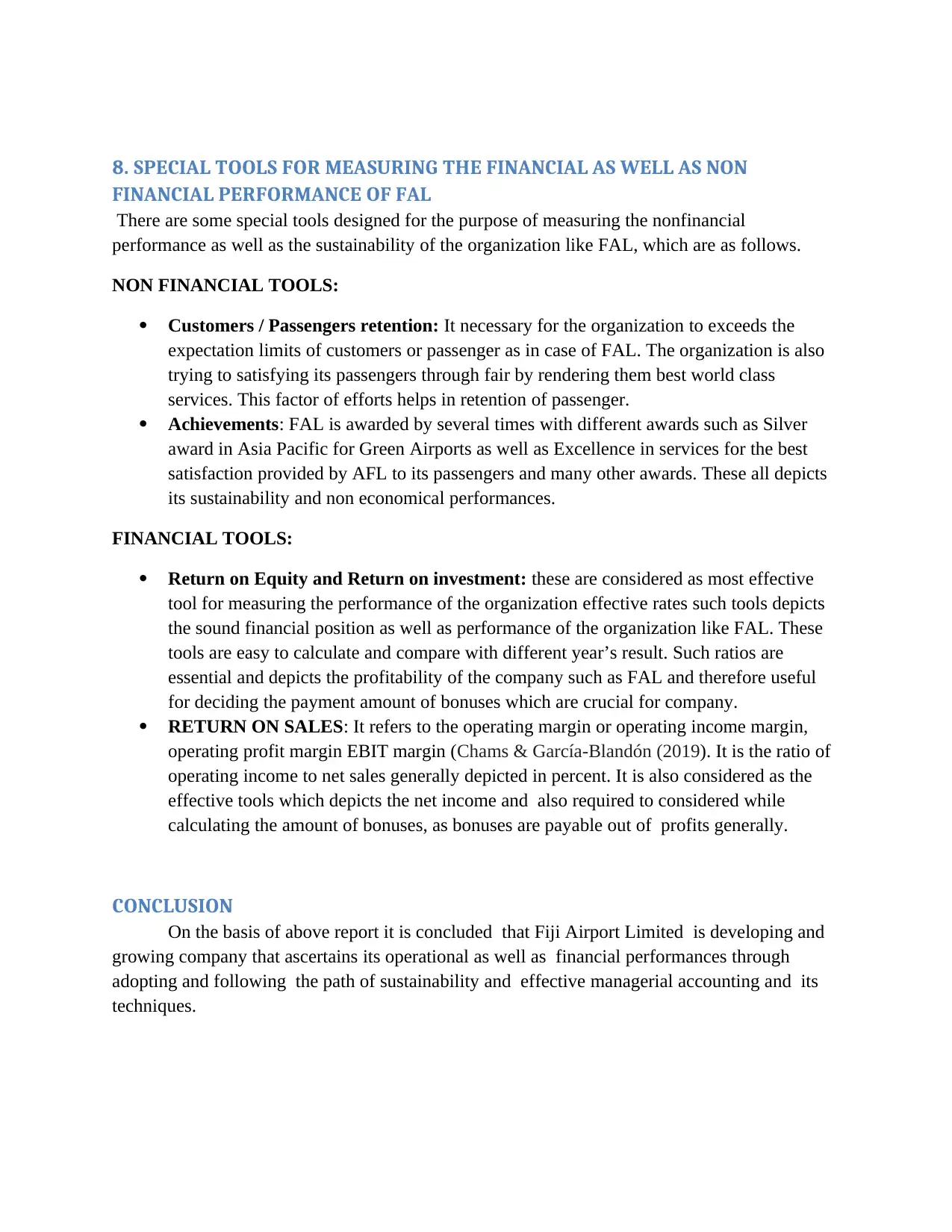
Above Du pont chart helps in ascertaining the understandability of the financial measures
or tools of financial performance of any organization like FAL. It is also known as Du pont
framework or model. With the help of this identities can be clearly seen and easy to understand.
ROE= (PROFIT MARGIN)*(ASSET TURNOVER)*(EQUITY MULTIPLIER) = (NET
PROFIT /SALES)*(AVERAGE TOTAL ASSETS/AVERAGE EQUITY) which is equal to the
Net profit /Equity.
Moreover, (Profit /Sales*sales)/assets=profit/Assets*Assets/equity)
Or ROS*AT=ROA*leverage=ROE
With the help of above identities and chart key measures such as profitability can be easily
measured through Profit margin, Assets turnover depicts the efficient use of assets. Not only this,
the financial leverage of FAL can be easily evaluated through equity multiplier.
7. DU PONT CHART FOR BETTERMENT OF FAL
Above Du pont chart helps in ascertaining the understandability of the financial measures
or tools of financial performance of any organization like FAL. It is also known as Du pont
framework or model. With the help of this identities can be clearly seen and easy to understand.
ROE= (PROFIT MARGIN)*(ASSET TURNOVER)*(EQUITY MULTIPLIER) = (NET
PROFIT /SALES)*(AVERAGE TOTAL ASSETS/AVERAGE EQUITY) which is equal to the
Net profit /Equity.
Moreover, (Profit /Sales*sales)/assets=profit/Assets*Assets/equity)
Or ROS*AT=ROA*leverage=ROE
With the help of above identities and chart key measures such as profitability can be easily
measured through Profit margin, Assets turnover depicts the efficient use of assets. Not only this,
the financial leverage of FAL can be easily evaluated through equity multiplier.
8. SPECIAL TOOLS FOR MEASURING THE FINANCIAL AS WELL AS NON
FINANCIAL PERFORMANCE OF FAL
There are some special tools designed for the purpose of measuring the nonfinancial
performance as well as the sustainability of the organization like FAL, which are as follows.
NON FINANCIAL TOOLS:
Customers / Passengers retention: It necessary for the organization to exceeds the
expectation limits of customers or passenger as in case of FAL. The organization is also
trying to satisfying its passengers through fair by rendering them best world class
services. This factor of efforts helps in retention of passenger.
Achievements: FAL is awarded by several times with different awards such as Silver
award in Asia Pacific for Green Airports as well as Excellence in services for the best
satisfaction provided by AFL to its passengers and many other awards. These all depicts
its sustainability and non economical performances.
FINANCIAL TOOLS:
Return on Equity and Return on investment: these are considered as most effective
tool for measuring the performance of the organization effective rates such tools depicts
the sound financial position as well as performance of the organization like FAL. These
tools are easy to calculate and compare with different year’s result. Such ratios are
essential and depicts the profitability of the company such as FAL and therefore useful
for deciding the payment amount of bonuses which are crucial for company.
RETURN ON SALES: It refers to the operating margin or operating income margin,
operating profit margin EBIT margin (Chams & García-Blandón (2019). It is the ratio of
operating income to net sales generally depicted in percent. It is also considered as the
effective tools which depicts the net income and also required to considered while
calculating the amount of bonuses, as bonuses are payable out of profits generally.
CONCLUSION
On the basis of above report it is concluded that Fiji Airport Limited is developing and
growing company that ascertains its operational as well as financial performances through
adopting and following the path of sustainability and effective managerial accounting and its
techniques.
FINANCIAL PERFORMANCE OF FAL
There are some special tools designed for the purpose of measuring the nonfinancial
performance as well as the sustainability of the organization like FAL, which are as follows.
NON FINANCIAL TOOLS:
Customers / Passengers retention: It necessary for the organization to exceeds the
expectation limits of customers or passenger as in case of FAL. The organization is also
trying to satisfying its passengers through fair by rendering them best world class
services. This factor of efforts helps in retention of passenger.
Achievements: FAL is awarded by several times with different awards such as Silver
award in Asia Pacific for Green Airports as well as Excellence in services for the best
satisfaction provided by AFL to its passengers and many other awards. These all depicts
its sustainability and non economical performances.
FINANCIAL TOOLS:
Return on Equity and Return on investment: these are considered as most effective
tool for measuring the performance of the organization effective rates such tools depicts
the sound financial position as well as performance of the organization like FAL. These
tools are easy to calculate and compare with different year’s result. Such ratios are
essential and depicts the profitability of the company such as FAL and therefore useful
for deciding the payment amount of bonuses which are crucial for company.
RETURN ON SALES: It refers to the operating margin or operating income margin,
operating profit margin EBIT margin (Chams & García-Blandón (2019). It is the ratio of
operating income to net sales generally depicted in percent. It is also considered as the
effective tools which depicts the net income and also required to considered while
calculating the amount of bonuses, as bonuses are payable out of profits generally.
CONCLUSION
On the basis of above report it is concluded that Fiji Airport Limited is developing and
growing company that ascertains its operational as well as financial performances through
adopting and following the path of sustainability and effective managerial accounting and its
techniques.
⊘ This is a preview!⊘
Do you want full access?
Subscribe today to unlock all pages.
Trusted by 1+ million students worldwide
REFERENCES
Lee, S. M., Noh, Y., Choi, D., & Rha, J. S. (2017). Environmental policy performances for
sustainable development: from the perspective of ISO 14001 certification. Corporate
Social Responsibility and Environmental Management, 24(2), 108-120.
Di Vaio, A., & Varriale, L. (2018). Management innovation for environmental sustainability in
seaports: Managerial accounting instruments and training for competitive green ports
beyond the regulations. Sustainability, 10(3), 783.
Savino, M. M., & Shafiq, M. (2018). An extensive study to assess the sustainability drivers of
production performances using a resource-based view and contingency analysis. Journal of
cleaner production, 204, 744-752.
Awasthi, A., Govindan, K., & Gold, S. (2018). Multi-tier sustainable global supplier selection
using a fuzzy AHP-VIKOR based approach. International Journal of Production
Economics, 195, 106-117.
Truant, E., Corazza, L. and Scagnelli, S.D., 2017. Sustainability and risk disclosure: An
exploratory study on sustainability reports. Sustainability, 9(4), p.636.
Nicolescu, O., & Nicolescu, C. (2017, June). New Approach–Quadrangle of Knowledge Based
Sustainability. In International conference KNOWLEDGE-BASED ORGANIZATION (Vol.
23, No. 1, pp. 411-417). Sciendo.
Ogunsola, S. A. (2017). Evaluating managerial competence of small, medium and micro
entrepreneurs to ensure sustainable economic development in eThekwini Municipal area
(Doctoral dissertation).
Chams, N., & García-Blandón, J. (2019). On the importance of sustainable human resource
management for the adoption of sustainable development goals. Resources, Conservation
and Recycling, 141, 109-122.
Lee, S. M., Noh, Y., Choi, D., & Rha, J. S. (2017). Environmental policy performances for
sustainable development: from the perspective of ISO 14001 certification. Corporate
Social Responsibility and Environmental Management, 24(2), 108-120.
Di Vaio, A., & Varriale, L. (2018). Management innovation for environmental sustainability in
seaports: Managerial accounting instruments and training for competitive green ports
beyond the regulations. Sustainability, 10(3), 783.
Savino, M. M., & Shafiq, M. (2018). An extensive study to assess the sustainability drivers of
production performances using a resource-based view and contingency analysis. Journal of
cleaner production, 204, 744-752.
Awasthi, A., Govindan, K., & Gold, S. (2018). Multi-tier sustainable global supplier selection
using a fuzzy AHP-VIKOR based approach. International Journal of Production
Economics, 195, 106-117.
Truant, E., Corazza, L. and Scagnelli, S.D., 2017. Sustainability and risk disclosure: An
exploratory study on sustainability reports. Sustainability, 9(4), p.636.
Nicolescu, O., & Nicolescu, C. (2017, June). New Approach–Quadrangle of Knowledge Based
Sustainability. In International conference KNOWLEDGE-BASED ORGANIZATION (Vol.
23, No. 1, pp. 411-417). Sciendo.
Ogunsola, S. A. (2017). Evaluating managerial competence of small, medium and micro
entrepreneurs to ensure sustainable economic development in eThekwini Municipal area
(Doctoral dissertation).
Chams, N., & García-Blandón, J. (2019). On the importance of sustainable human resource
management for the adoption of sustainable development goals. Resources, Conservation
and Recycling, 141, 109-122.

1 out of 10


Your All-in-One AI-Powered Toolkit for Academic Success.
+13062052269
info@desklib.com
Available 24*7 on WhatsApp / Email
![[object Object]](/_next/static/media/star-bottom.7253800d.svg)
Unlock your academic potential
Copyright © 2020–2026 A2Z Services. All Rights Reserved. Developed and managed by ZUCOL.