Report: Analysis of Main Economic Indicators for Fiji Over 10 Years
VerifiedAdded on 2021/02/19
|12
|2967
|148
Report
AI Summary
This report provides an analysis of Fiji's main economic indicators over the past 10 years. It begins with an introduction to economic indicators and their significance in assessing a country's macroeconomic situation. The main body of the report focuses on leading, lagging, and coincident indicators, specifically examining factors like business start-up costs, GDP, and unemployment rates in Fiji. The analysis includes data from the past decade, represented through charts and figures, to illustrate trends and fluctuations in these indicators. For each indicator type, the report discusses the factors measured, data analysis, and implications for the Fijian economy, along with recommendations to address identified issues. The report concludes with a summary of the findings and provides recommendations to policymakers in Fiji to improve the country's economic performance. The assignment is contributed by a student and is available on Desklib, a platform that provides AI-based study tools for students.
Analysis of the main
Economic Indicators for the
country of my choice over
the past 10 years
Economic Indicators for the
country of my choice over
the past 10 years

Paraphrase This Document
Need a fresh take? Get an instant paraphrase of this document with our AI Paraphraser
ACKNOWLEDGEMENT
This report would not have been completed without various people who are my teachers,
group members etc. I would like to express my sincere thanks to all of them as they have
provided me proper guidance to complete this project successfully.
I would also like to extend my gratitude to the other tutors who have guided me to
complete the assignment in systematic manner. All the facilities at college were provided by
them to me which was beneficial for me.
This report would not have been completed without various people who are my teachers,
group members etc. I would like to express my sincere thanks to all of them as they have
provided me proper guidance to complete this project successfully.
I would also like to extend my gratitude to the other tutors who have guided me to
complete the assignment in systematic manner. All the facilities at college were provided by
them to me which was beneficial for me.

DECLARATION
I hereby declare that the project on “Analysis of main economic indicators of Fiji” is my
own work and it is not copied from any other source such as websites, books etc. I further
declare that it is completed by me by following all the specific guidelines which were mentioned
by tutor.
I hereby declare that the project on “Analysis of main economic indicators of Fiji” is my
own work and it is not copied from any other source such as websites, books etc. I further
declare that it is completed by me by following all the specific guidelines which were mentioned
by tutor.
⊘ This is a preview!⊘
Do you want full access?
Subscribe today to unlock all pages.

Trusted by 1+ million students worldwide
AIMS AND OBJECTIVES
Aim: To develop understanding regarding the way in which economic indicators helps to
determine economic conditions.
Objectives:
To enhance knowledge regarding different indicators such as leading, lagging and
coincident.
To analyse the factors which are affecting economy of Fiji.
To determine different issues which are faced by Fiji due to changes in indicators.
Aim: To develop understanding regarding the way in which economic indicators helps to
determine economic conditions.
Objectives:
To enhance knowledge regarding different indicators such as leading, lagging and
coincident.
To analyse the factors which are affecting economy of Fiji.
To determine different issues which are faced by Fiji due to changes in indicators.
Paraphrase This Document
Need a fresh take? Get an instant paraphrase of this document with our AI Paraphraser
Table of Contents
ACKNOWLEDGEMENT...............................................................................................................2
DECLARATION.............................................................................................................................3
AIMS AND OBJECTIVES.............................................................................................................4
INTRODUCTION...........................................................................................................................1
MAIN BODY...................................................................................................................................1
Analysis of different economic indicators of Fiji........................................................................1
CONCLUSION AND RECOMMENDATIONS............................................................................5
Recommendations........................................................................................................................6
REFERENCES................................................................................................................................7
ACKNOWLEDGEMENT...............................................................................................................2
DECLARATION.............................................................................................................................3
AIMS AND OBJECTIVES.............................................................................................................4
INTRODUCTION...........................................................................................................................1
MAIN BODY...................................................................................................................................1
Analysis of different economic indicators of Fiji........................................................................1
CONCLUSION AND RECOMMENDATIONS............................................................................5
Recommendations........................................................................................................................6
REFERENCES................................................................................................................................7
INTRODUCTION
Economic indicators can be defined as the statistical elements which are used to analyse
performance of the economy for future decisions and strategies. Main purpose of them is to
monitor business cycle (Cabauatan, Manalo and Uy, 2016). This report is based upon analysis of
different economic indicators. For this purpose the country which is selected is Fiji which is an
island nation in Melanesia. This assignment covers various topics such as leading, lagging and
coincident indicators and the aspects which are measured by them. Along with this, the way in
which they are constructed, analysis of last 10 year's data and use of all of them to assess current
macroeconomic situations are also discussed under this project.
MAIN BODY
Analysis of different economic indicators of Fiji
Economic indicators are considered as part of economic data which are used for the
purpose of determining macro economic situations of a country. Main purpose of them is to
determine effect of different factors such as inflation, deflation, foreign exchange rates etc. on
the economy of a specific nation. Fiji is a country in the area of south pacific and it is considered
as one of the happiest countries in the world (Sroypetch, 2015). There are various types of them
which are used by economists of countries. Explanation of all of them is as follows:
Leading indicator: It can be defined as an indicator which changes before the economy
starts to go in a specific direction. With the help of it economists and observers forecast specific
changes in the economy (Leading and lagging indicators, 2019). The results which are generated
with the help of them are not accurate all the times. Main purpose of using this type of indicator
is to determine changes prior to the large economic adjustments so that future trends could be
predicted. There are different types of it which are stock market, manufacturing activity, retail
sales, inventory level, housing market building permits and level of business start-ups. Policy
makers in Fiji analyse cost of business start up procedure in order to analyse the impact of it on
the economy. With the help of this indicator different things are measured such as time,
procedures, paid in minimum capital and cost which is required for start up businesses and
execute all the operational activities. The chart below shows fluctuation in the cost of business
start up procedures:
1
Economic indicators can be defined as the statistical elements which are used to analyse
performance of the economy for future decisions and strategies. Main purpose of them is to
monitor business cycle (Cabauatan, Manalo and Uy, 2016). This report is based upon analysis of
different economic indicators. For this purpose the country which is selected is Fiji which is an
island nation in Melanesia. This assignment covers various topics such as leading, lagging and
coincident indicators and the aspects which are measured by them. Along with this, the way in
which they are constructed, analysis of last 10 year's data and use of all of them to assess current
macroeconomic situations are also discussed under this project.
MAIN BODY
Analysis of different economic indicators of Fiji
Economic indicators are considered as part of economic data which are used for the
purpose of determining macro economic situations of a country. Main purpose of them is to
determine effect of different factors such as inflation, deflation, foreign exchange rates etc. on
the economy of a specific nation. Fiji is a country in the area of south pacific and it is considered
as one of the happiest countries in the world (Sroypetch, 2015). There are various types of them
which are used by economists of countries. Explanation of all of them is as follows:
Leading indicator: It can be defined as an indicator which changes before the economy
starts to go in a specific direction. With the help of it economists and observers forecast specific
changes in the economy (Leading and lagging indicators, 2019). The results which are generated
with the help of them are not accurate all the times. Main purpose of using this type of indicator
is to determine changes prior to the large economic adjustments so that future trends could be
predicted. There are different types of it which are stock market, manufacturing activity, retail
sales, inventory level, housing market building permits and level of business start-ups. Policy
makers in Fiji analyse cost of business start up procedure in order to analyse the impact of it on
the economy. With the help of this indicator different things are measured such as time,
procedures, paid in minimum capital and cost which is required for start up businesses and
execute all the operational activities. The chart below shows fluctuation in the cost of business
start up procedures:
1
⊘ This is a preview!⊘
Do you want full access?
Subscribe today to unlock all pages.
Trusted by 1+ million students worldwide
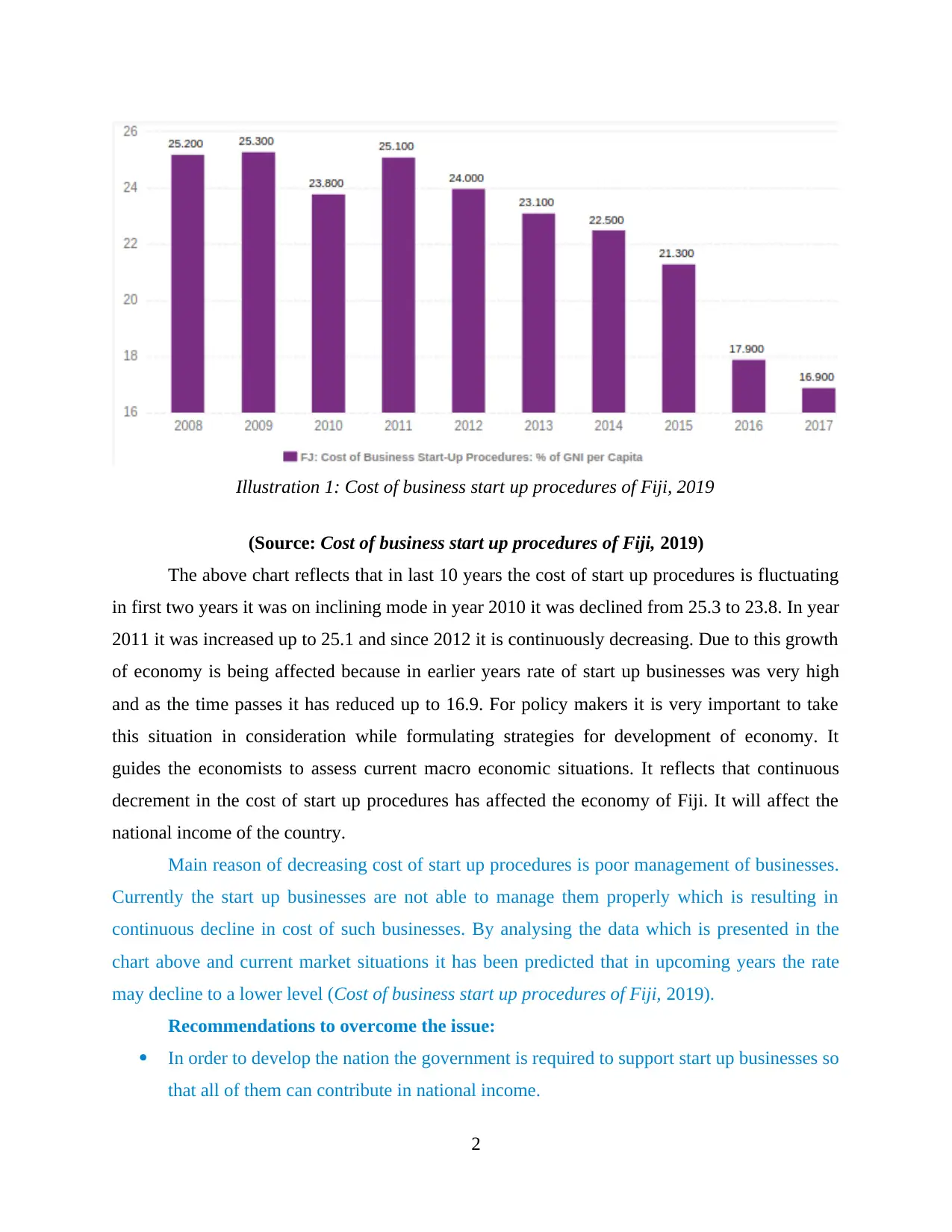
Illustration 1: Cost of business start up procedures of Fiji, 2019
(Source: Cost of business start up procedures of Fiji, 2019)
The above chart reflects that in last 10 years the cost of start up procedures is fluctuating
in first two years it was on inclining mode in year 2010 it was declined from 25.3 to 23.8. In year
2011 it was increased up to 25.1 and since 2012 it is continuously decreasing. Due to this growth
of economy is being affected because in earlier years rate of start up businesses was very high
and as the time passes it has reduced up to 16.9. For policy makers it is very important to take
this situation in consideration while formulating strategies for development of economy. It
guides the economists to assess current macro economic situations. It reflects that continuous
decrement in the cost of start up procedures has affected the economy of Fiji. It will affect the
national income of the country.
Main reason of decreasing cost of start up procedures is poor management of businesses.
Currently the start up businesses are not able to manage them properly which is resulting in
continuous decline in cost of such businesses. By analysing the data which is presented in the
chart above and current market situations it has been predicted that in upcoming years the rate
may decline to a lower level (Cost of business start up procedures of Fiji, 2019).
Recommendations to overcome the issue:
In order to develop the nation the government is required to support start up businesses so
that all of them can contribute in national income.
2
(Source: Cost of business start up procedures of Fiji, 2019)
The above chart reflects that in last 10 years the cost of start up procedures is fluctuating
in first two years it was on inclining mode in year 2010 it was declined from 25.3 to 23.8. In year
2011 it was increased up to 25.1 and since 2012 it is continuously decreasing. Due to this growth
of economy is being affected because in earlier years rate of start up businesses was very high
and as the time passes it has reduced up to 16.9. For policy makers it is very important to take
this situation in consideration while formulating strategies for development of economy. It
guides the economists to assess current macro economic situations. It reflects that continuous
decrement in the cost of start up procedures has affected the economy of Fiji. It will affect the
national income of the country.
Main reason of decreasing cost of start up procedures is poor management of businesses.
Currently the start up businesses are not able to manage them properly which is resulting in
continuous decline in cost of such businesses. By analysing the data which is presented in the
chart above and current market situations it has been predicted that in upcoming years the rate
may decline to a lower level (Cost of business start up procedures of Fiji, 2019).
Recommendations to overcome the issue:
In order to develop the nation the government is required to support start up businesses so
that all of them can contribute in national income.
2
Paraphrase This Document
Need a fresh take? Get an instant paraphrase of this document with our AI Paraphraser
Government of Fiji should formulate policies to support start up businesses so that they
can contribute a higher amount in national income of the country. With the help of it
governmental funds will be enhanced which are beneficial for development of
infrastructure and economy of country.
Lagging indicator: It can be defined as a factor of economy which could be measured.
When economy starts to follow a specific trend or pattern then it changes with it. It is used by
policy makers to monitor the strength of the trend which is followed by the economy of a nation.
It is easy to measure but very difficult to influence or improve. It reflects changes in the
economic factors rather than the direction in which economy is heading. Main purpose behind
using it is to identify the long term trends (Chand Prasad, 2014). There are various types of it
which are analysed by observers in order to determine the macro economic situations. These are
gross domestic product, income, wages, rate of unemployment, consumer price index, interest
rates, currency strength, balance of trade, value of commodity substitutes and corporate profits.
In order to determine macro economic conditions policy makers in Fiji are analysing all of them.
With the help of it they forecast future situations and economic changes. One of the main lagging
indicator is GDP which is vital to be analysed by economists so that growth and development of
the country could be analysed. Gross domestic product is a monetary value of the market value
of different products and services which are manufactured or produced in a specific time period.
It measures total value of products and services produced in a particular nation. The line chart
below may reflect the changes in GDP of Fiji:
Illustration 2: 10 years data of GDP of Fiji, 2019
3
can contribute a higher amount in national income of the country. With the help of it
governmental funds will be enhanced which are beneficial for development of
infrastructure and economy of country.
Lagging indicator: It can be defined as a factor of economy which could be measured.
When economy starts to follow a specific trend or pattern then it changes with it. It is used by
policy makers to monitor the strength of the trend which is followed by the economy of a nation.
It is easy to measure but very difficult to influence or improve. It reflects changes in the
economic factors rather than the direction in which economy is heading. Main purpose behind
using it is to identify the long term trends (Chand Prasad, 2014). There are various types of it
which are analysed by observers in order to determine the macro economic situations. These are
gross domestic product, income, wages, rate of unemployment, consumer price index, interest
rates, currency strength, balance of trade, value of commodity substitutes and corporate profits.
In order to determine macro economic conditions policy makers in Fiji are analysing all of them.
With the help of it they forecast future situations and economic changes. One of the main lagging
indicator is GDP which is vital to be analysed by economists so that growth and development of
the country could be analysed. Gross domestic product is a monetary value of the market value
of different products and services which are manufactured or produced in a specific time period.
It measures total value of products and services produced in a particular nation. The line chart
below may reflect the changes in GDP of Fiji:
Illustration 2: 10 years data of GDP of Fiji, 2019
3
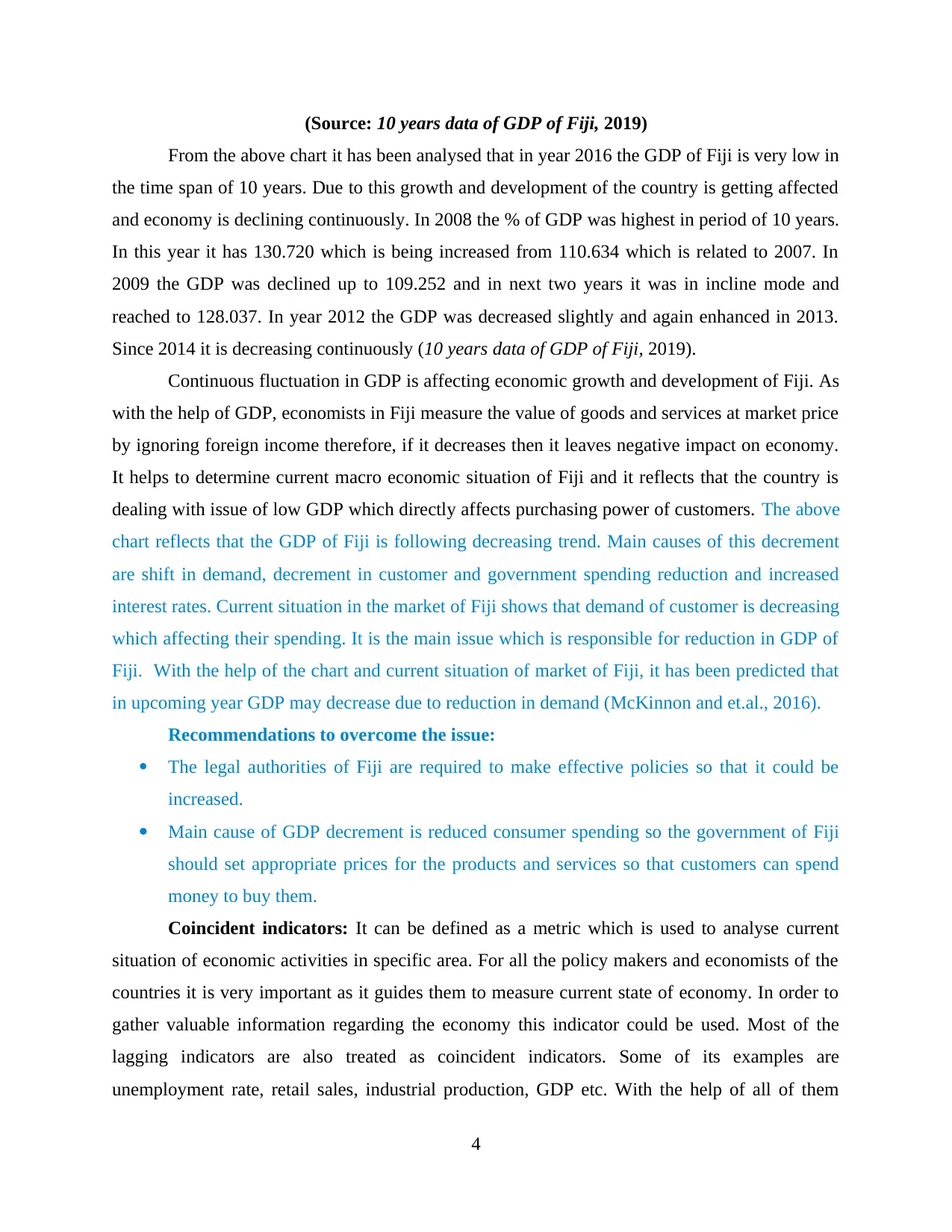
(Source: 10 years data of GDP of Fiji, 2019)
From the above chart it has been analysed that in year 2016 the GDP of Fiji is very low in
the time span of 10 years. Due to this growth and development of the country is getting affected
and economy is declining continuously. In 2008 the % of GDP was highest in period of 10 years.
In this year it has 130.720 which is being increased from 110.634 which is related to 2007. In
2009 the GDP was declined up to 109.252 and in next two years it was in incline mode and
reached to 128.037. In year 2012 the GDP was decreased slightly and again enhanced in 2013.
Since 2014 it is decreasing continuously (10 years data of GDP of Fiji, 2019).
Continuous fluctuation in GDP is affecting economic growth and development of Fiji. As
with the help of GDP, economists in Fiji measure the value of goods and services at market price
by ignoring foreign income therefore, if it decreases then it leaves negative impact on economy.
It helps to determine current macro economic situation of Fiji and it reflects that the country is
dealing with issue of low GDP which directly affects purchasing power of customers. The above
chart reflects that the GDP of Fiji is following decreasing trend. Main causes of this decrement
are shift in demand, decrement in customer and government spending reduction and increased
interest rates. Current situation in the market of Fiji shows that demand of customer is decreasing
which affecting their spending. It is the main issue which is responsible for reduction in GDP of
Fiji. With the help of the chart and current situation of market of Fiji, it has been predicted that
in upcoming year GDP may decrease due to reduction in demand (McKinnon and et.al., 2016).
Recommendations to overcome the issue:
The legal authorities of Fiji are required to make effective policies so that it could be
increased.
Main cause of GDP decrement is reduced consumer spending so the government of Fiji
should set appropriate prices for the products and services so that customers can spend
money to buy them.
Coincident indicators: It can be defined as a metric which is used to analyse current
situation of economic activities in specific area. For all the policy makers and economists of the
countries it is very important as it guides them to measure current state of economy. In order to
gather valuable information regarding the economy this indicator could be used. Most of the
lagging indicators are also treated as coincident indicators. Some of its examples are
unemployment rate, retail sales, industrial production, GDP etc. With the help of all of them
4
From the above chart it has been analysed that in year 2016 the GDP of Fiji is very low in
the time span of 10 years. Due to this growth and development of the country is getting affected
and economy is declining continuously. In 2008 the % of GDP was highest in period of 10 years.
In this year it has 130.720 which is being increased from 110.634 which is related to 2007. In
2009 the GDP was declined up to 109.252 and in next two years it was in incline mode and
reached to 128.037. In year 2012 the GDP was decreased slightly and again enhanced in 2013.
Since 2014 it is decreasing continuously (10 years data of GDP of Fiji, 2019).
Continuous fluctuation in GDP is affecting economic growth and development of Fiji. As
with the help of GDP, economists in Fiji measure the value of goods and services at market price
by ignoring foreign income therefore, if it decreases then it leaves negative impact on economy.
It helps to determine current macro economic situation of Fiji and it reflects that the country is
dealing with issue of low GDP which directly affects purchasing power of customers. The above
chart reflects that the GDP of Fiji is following decreasing trend. Main causes of this decrement
are shift in demand, decrement in customer and government spending reduction and increased
interest rates. Current situation in the market of Fiji shows that demand of customer is decreasing
which affecting their spending. It is the main issue which is responsible for reduction in GDP of
Fiji. With the help of the chart and current situation of market of Fiji, it has been predicted that
in upcoming year GDP may decrease due to reduction in demand (McKinnon and et.al., 2016).
Recommendations to overcome the issue:
The legal authorities of Fiji are required to make effective policies so that it could be
increased.
Main cause of GDP decrement is reduced consumer spending so the government of Fiji
should set appropriate prices for the products and services so that customers can spend
money to buy them.
Coincident indicators: It can be defined as a metric which is used to analyse current
situation of economic activities in specific area. For all the policy makers and economists of the
countries it is very important as it guides them to measure current state of economy. In order to
gather valuable information regarding the economy this indicator could be used. Most of the
lagging indicators are also treated as coincident indicators. Some of its examples are
unemployment rate, retail sales, industrial production, GDP etc. With the help of all of them
4
⊘ This is a preview!⊘
Do you want full access?
Subscribe today to unlock all pages.
Trusted by 1+ million students worldwide
policy makers try to formulate such strategies which may result in development of the economy
(Peimer and et.al., 2017). In Fiji economists use unemployment rate to measure that the economy
is developing or declining. It is mainly used to monitor the number of individuals who are not
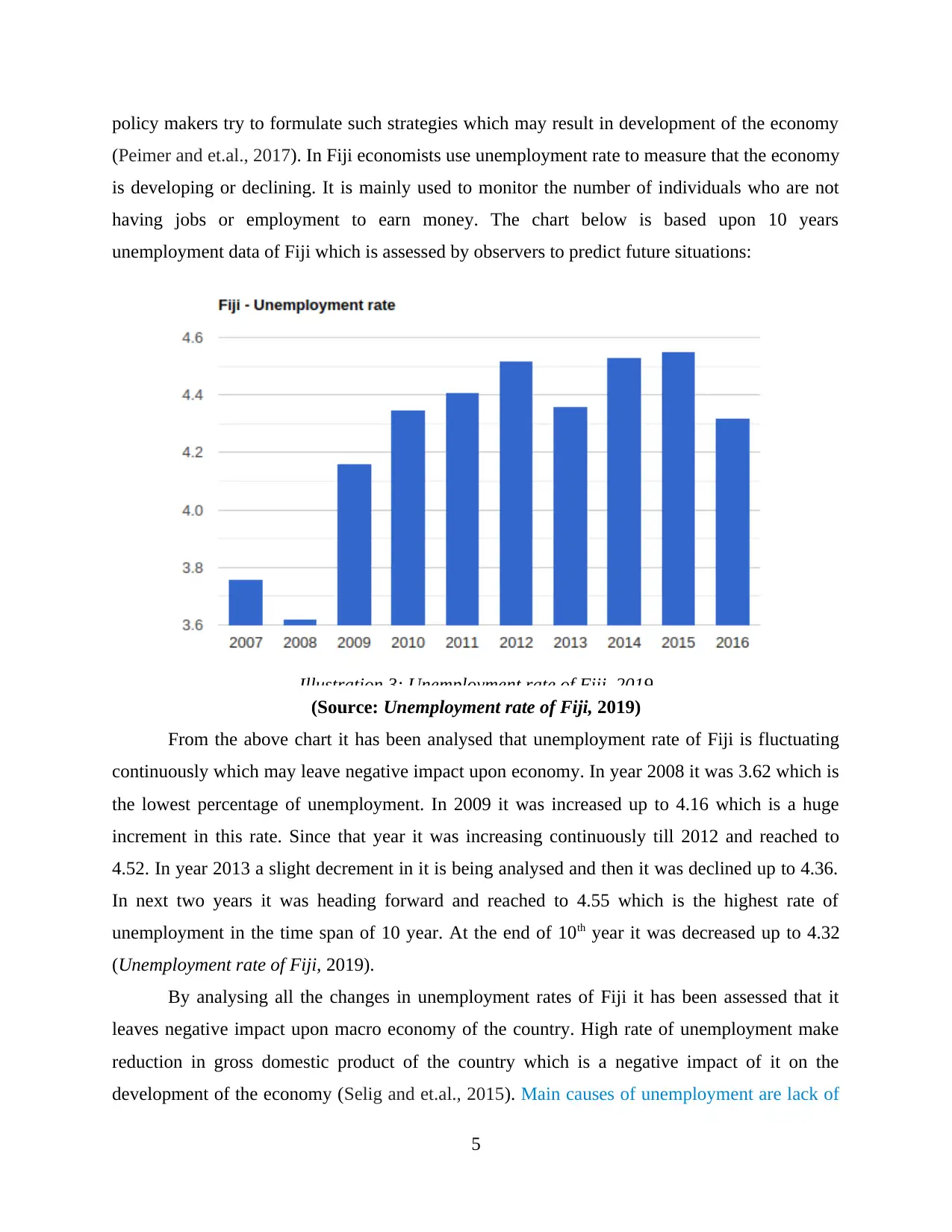
having jobs or employment to earn money. The chart below is based upon 10 years
unemployment data of Fiji which is assessed by observers to predict future situations:
Illustration 3: Unemployment rate of Fiji, 2019
(Source: Unemployment rate of Fiji, 2019)
From the above chart it has been analysed that unemployment rate of Fiji is fluctuating
continuously which may leave negative impact upon economy. In year 2008 it was 3.62 which is
the lowest percentage of unemployment. In 2009 it was increased up to 4.16 which is a huge
increment in this rate. Since that year it was increasing continuously till 2012 and reached to
4.52. In year 2013 a slight decrement in it is being analysed and then it was declined up to 4.36.
In next two years it was heading forward and reached to 4.55 which is the highest rate of
unemployment in the time span of 10 year. At the end of 10th year it was decreased up to 4.32
(Unemployment rate of Fiji, 2019).
By analysing all the changes in unemployment rates of Fiji it has been assessed that it
leaves negative impact upon macro economy of the country. High rate of unemployment make
reduction in gross domestic product of the country which is a negative impact of it on the
development of the economy (Selig and et.al., 2015). Main causes of unemployment are lack of
5
(Peimer and et.al., 2017). In Fiji economists use unemployment rate to measure that the economy
is developing or declining. It is mainly used to monitor the number of individuals who are not
having jobs or employment to earn money. The chart below is based upon 10 years
unemployment data of Fiji which is assessed by observers to predict future situations:
Illustration 3: Unemployment rate of Fiji, 2019
(Source: Unemployment rate of Fiji, 2019)
From the above chart it has been analysed that unemployment rate of Fiji is fluctuating
continuously which may leave negative impact upon economy. In year 2008 it was 3.62 which is
the lowest percentage of unemployment. In 2009 it was increased up to 4.16 which is a huge
increment in this rate. Since that year it was increasing continuously till 2012 and reached to
4.52. In year 2013 a slight decrement in it is being analysed and then it was declined up to 4.36.
In next two years it was heading forward and reached to 4.55 which is the highest rate of
unemployment in the time span of 10 year. At the end of 10th year it was decreased up to 4.32
(Unemployment rate of Fiji, 2019).
By analysing all the changes in unemployment rates of Fiji it has been assessed that it
leaves negative impact upon macro economy of the country. High rate of unemployment make
reduction in gross domestic product of the country which is a negative impact of it on the
development of the economy (Selig and et.al., 2015). Main causes of unemployment are lack of
5
Paraphrase This Document
Need a fresh take? Get an instant paraphrase of this document with our AI Paraphraser
education, global recession etc. These are the main issues which are resulting in increasing trend
of unemployment. Currently there is lack of education in Fiji which is one of the biggest market
situation and it creates unemployment. By analysing the current situation and the chart above it
has been analysed that as it is continuously fluctuating so it may increase or decrease in future
but there is a high possibility of increment in it because of the economic situation of Fiji.
Due to higher rate of unemployment the economy of Fiji is facing various challenges
because it demonstrates that the economy is operating below the full capacity and it is highly
inefficient. The main issue which may take place due to this is lower income and output of the
country. If there is a high number of jobless individuals in the nation then it can result in
decreased taxes. As it is the main source of governmental income therefore the legal authorities
will not be able to spend monetary resources on the development of economy (Seniloli and
Tawake, 2015).
Recommendations to overcome the issue:
Legal authorities in Fiji can create employment by supporting new businesses to execute
all their operations in appropriate manner.
Government in Fiji should conduct education programs so that the causes such as lack of
education and recession of unemployment could be removed.
From all the above described indicators it has been analysed that economy of Fiji is
declining continuously due to unemployment, decreased GDP and cost of start ups. It is also
resulting in reduced national income and governmental funds which are spent by legal authorities
for enhancement of infrastructure of the country (Sroypetch and Caldicott, 2017).
CONCLUSION
From the above project report it has been concluded that economic indicators could be
defined as the elements which are used for the purpose of analysing changes in an economy.
There are three main types of them which are leading, lagging and coincident indicators.
Examples of them are start up rate, GDP, retail sales, unemployment rate etc. By analysing all
these aspects it has been analysed that economy of Fiji is dealing with various issues such as
decreased GDP, high unemployment etc. For governmental body of the country it is very
important to formulate effective policies which may result in resolution of all the economic
challenges.
6
of unemployment. Currently there is lack of education in Fiji which is one of the biggest market
situation and it creates unemployment. By analysing the current situation and the chart above it
has been analysed that as it is continuously fluctuating so it may increase or decrease in future
but there is a high possibility of increment in it because of the economic situation of Fiji.
Due to higher rate of unemployment the economy of Fiji is facing various challenges
because it demonstrates that the economy is operating below the full capacity and it is highly
inefficient. The main issue which may take place due to this is lower income and output of the
country. If there is a high number of jobless individuals in the nation then it can result in
decreased taxes. As it is the main source of governmental income therefore the legal authorities
will not be able to spend monetary resources on the development of economy (Seniloli and
Tawake, 2015).
Recommendations to overcome the issue:
Legal authorities in Fiji can create employment by supporting new businesses to execute
all their operations in appropriate manner.
Government in Fiji should conduct education programs so that the causes such as lack of
education and recession of unemployment could be removed.
From all the above described indicators it has been analysed that economy of Fiji is
declining continuously due to unemployment, decreased GDP and cost of start ups. It is also
resulting in reduced national income and governmental funds which are spent by legal authorities
for enhancement of infrastructure of the country (Sroypetch and Caldicott, 2017).
CONCLUSION
From the above project report it has been concluded that economic indicators could be
defined as the elements which are used for the purpose of analysing changes in an economy.
There are three main types of them which are leading, lagging and coincident indicators.
Examples of them are start up rate, GDP, retail sales, unemployment rate etc. By analysing all
these aspects it has been analysed that economy of Fiji is dealing with various issues such as
decreased GDP, high unemployment etc. For governmental body of the country it is very
important to formulate effective policies which may result in resolution of all the economic
challenges.
6
REFERENCES
Books and Journals:
Cabauatan, R. R., Manalo, R. A. and Uy, C., 2016. Analysing the effects of selected economic
indicators on education and on the causality between education and economic growth of
the Philippines. Science and Technology Development Journal. 19(3). pp.57-69.
Chand Prasad, B., 2014. Why Fiji is not the “Mauritius” of the Pacific? Lessons for small island
nations in the Pacific. International Journal of Social Economics. 41(6). pp.467-481.
McKinnon, K. and et.al., 2016. Gender equality and economic empowerment in the Solomon
Islands and Fiji: a place-based approach. Gender, Place & Culture. 23(10). pp.1376-
1391.
Peimer, A. W. and et.al., 2017. National-level wetland policy specificity and goals vary
according to political and economic indicators. Environmental management. 59(1).
pp.141-153.
Selig, E. R. and et.al., 2015. Measuring indicators of ocean health for an island nation: The ocean
health index for Fiji. Ecosystem services. 16. pp.403-412.
Seniloli, K. L. and Tawake, R. B., 2015. The health status of the silver generation in Fiji. The
Journal of Pacific Studies. 35(3). pp.168-187.
Sroypetch, S. and Caldicott, R., 2017. Backpacker tourism in Fiji as a sustainability intervention:
Will they sink or swim?. In Tourism, Resilience and Sustainability (pp. 260-279).
Routledge.
Sroypetch, S., 2015. Host and guest perceptions of backpacker tourism impacts on local
communities: a case study of the Yasawa group of Islands, Fiji (Doctoral dissertation,
University of Otago).
Online
Leading and lagging indicators. 2019. [Online]. Available through:
<https://www.moneycrashers.com/leading-lagging-economic-indicators/>
Cost of business start up procedures of Fiji. 2019. [Online]. Available through:
<https://www.ceicdata.com/en/fiji/company-statistics/fj-cost-of-business-startup-
procedures--of-gni-per-capita>
10 years data of GDP of Fiji. 2019. [Online]. Available through:
<https://www.ceicdata.com/en/fiji/gross-domestic-product-share-of-gdp/fj-gdp--of-gdp-
trade>
Unemployment rate of Fiji. 2019. [Online]. Available through:
<https://www.theglobaleconomy.com/Fiji/Unemployment_rate/>
7
Books and Journals:
Cabauatan, R. R., Manalo, R. A. and Uy, C., 2016. Analysing the effects of selected economic
indicators on education and on the causality between education and economic growth of
the Philippines. Science and Technology Development Journal. 19(3). pp.57-69.
Chand Prasad, B., 2014. Why Fiji is not the “Mauritius” of the Pacific? Lessons for small island
nations in the Pacific. International Journal of Social Economics. 41(6). pp.467-481.
McKinnon, K. and et.al., 2016. Gender equality and economic empowerment in the Solomon
Islands and Fiji: a place-based approach. Gender, Place & Culture. 23(10). pp.1376-
1391.
Peimer, A. W. and et.al., 2017. National-level wetland policy specificity and goals vary
according to political and economic indicators. Environmental management. 59(1).
pp.141-153.
Selig, E. R. and et.al., 2015. Measuring indicators of ocean health for an island nation: The ocean
health index for Fiji. Ecosystem services. 16. pp.403-412.
Seniloli, K. L. and Tawake, R. B., 2015. The health status of the silver generation in Fiji. The
Journal of Pacific Studies. 35(3). pp.168-187.
Sroypetch, S. and Caldicott, R., 2017. Backpacker tourism in Fiji as a sustainability intervention:
Will they sink or swim?. In Tourism, Resilience and Sustainability (pp. 260-279).
Routledge.
Sroypetch, S., 2015. Host and guest perceptions of backpacker tourism impacts on local
communities: a case study of the Yasawa group of Islands, Fiji (Doctoral dissertation,
University of Otago).
Online
Leading and lagging indicators. 2019. [Online]. Available through:
<https://www.moneycrashers.com/leading-lagging-economic-indicators/>
Cost of business start up procedures of Fiji. 2019. [Online]. Available through:
<https://www.ceicdata.com/en/fiji/company-statistics/fj-cost-of-business-startup-
procedures--of-gni-per-capita>
10 years data of GDP of Fiji. 2019. [Online]. Available through:
<https://www.ceicdata.com/en/fiji/gross-domestic-product-share-of-gdp/fj-gdp--of-gdp-
trade>
Unemployment rate of Fiji. 2019. [Online]. Available through:
<https://www.theglobaleconomy.com/Fiji/Unemployment_rate/>
7
⊘ This is a preview!⊘
Do you want full access?
Subscribe today to unlock all pages.
Trusted by 1+ million students worldwide

1 out of 12


Related Documents


Your All-in-One AI-Powered Toolkit for Academic Success.
+13062052269
info@desklib.com
Available 24*7 on WhatsApp / Email
![[object Object]](/_next/static/media/star-bottom.7253800d.svg)
Unlock your academic potential
Copyright © 2020–2026 A2Z Services. All Rights Reserved. Developed and managed by ZUCOL.