Film Criticism Essay: Examining Disability Rights in 'Able Lives' Film

Verified

Added on  2023/06/03

|4
|543
|238
Essay
AI Summary
This essay provides a critical analysis of the documentary film "Able Lives - History of Disability Rights / Language," which explores the evolution of social perceptions and the rights of disabled individuals. The film, part of a larger project, highlights the experiences of individuals who have faced social stigma and advocates for equal rights and opportunities for disabled people worldwide. The analysis acknowledges the film's focus on the challenges faced by disabled individuals, including institutionalization, verbal abuse, and the impact on their dignity. However, it also points out the film's limitation in not adequately addressing the changes in legal policies and procedures aimed at improving the lives of disabled individuals. The essay concludes by emphasizing the need for continued societal awareness and advocacy to combat discrimination and promote the rights of disabled persons while also recognizing the importance of evolving legal frameworks.
Document Page
Running head: FILM CRITICISM
Civil Rights
Name of the Student
Name of the University
Author note
tabler-icon-diamond-filled.svg

Paraphrase This Document

Need a fresh take? Get an instant paraphrase of this document with our AI Paraphraser
Document Page
1FILM CRITICISM
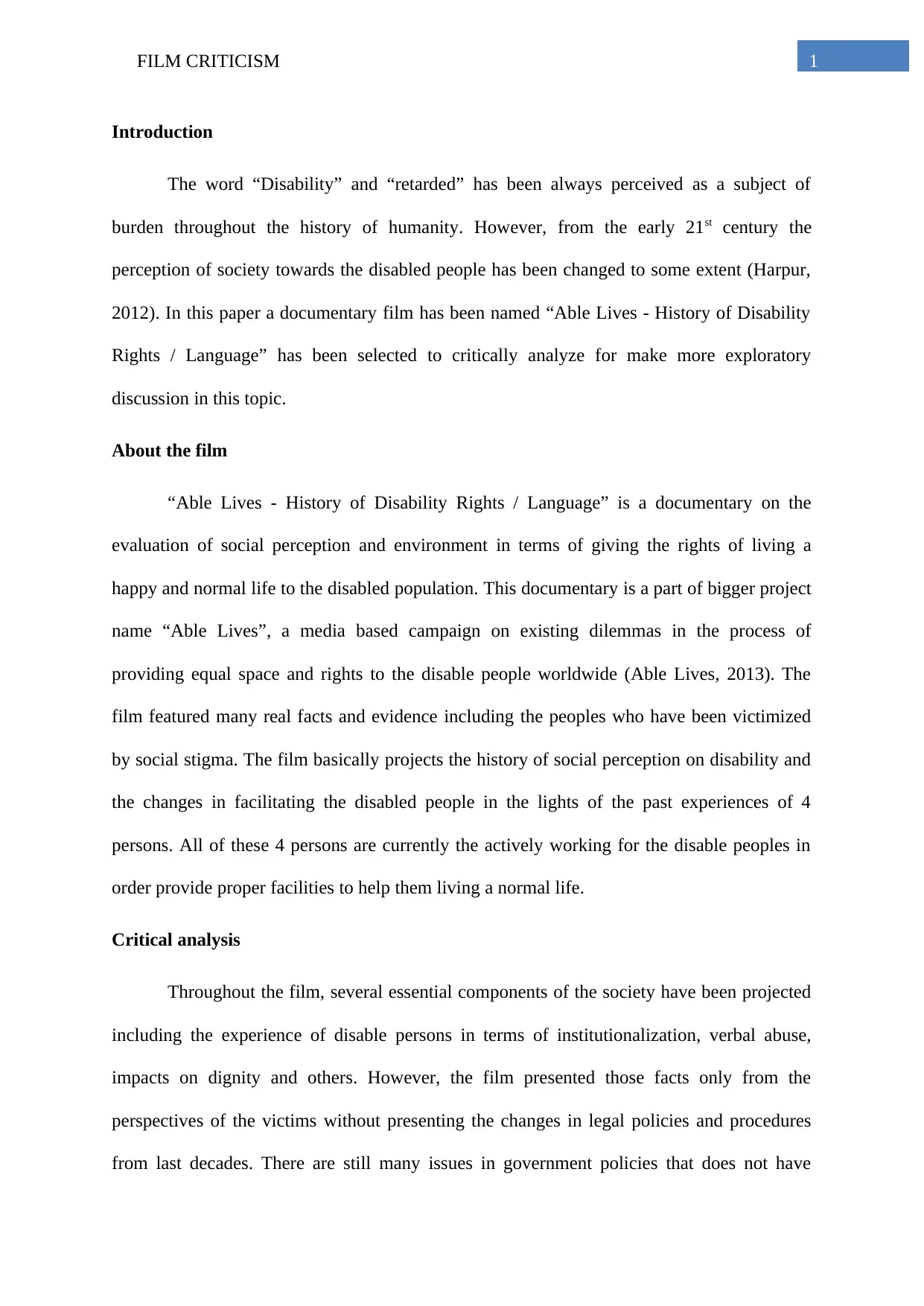
Introduction
The word “Disability” and “retarded” has been always perceived as a subject of
burden throughout the history of humanity. However, from the early 21st century the
perception of society towards the disabled people has been changed to some extent (Harpur,
2012). In this paper a documentary film has been named “Able Lives - History of Disability
Rights / Language” has been selected to critically analyze for make more exploratory
discussion in this topic.
About the film
“Able Lives - History of Disability Rights / Language” is a documentary on the
evaluation of social perception and environment in terms of giving the rights of living a
happy and normal life to the disabled population. This documentary is a part of bigger project
name “Able Lives”, a media based campaign on existing dilemmas in the process of
providing equal space and rights to the disable people worldwide (Able Lives, 2013). The
film featured many real facts and evidence including the peoples who have been victimized
by social stigma. The film basically projects the history of social perception on disability and
the changes in facilitating the disabled people in the lights of the past experiences of 4
persons. All of these 4 persons are currently the actively working for the disable peoples in
order provide proper facilities to help them living a normal life.
Critical analysis
Throughout the film, several essential components of the society have been projected
including the experience of disable persons in terms of institutionalization, verbal abuse,
impacts on dignity and others. However, the film presented those facts only from the
perspectives of the victims without presenting the changes in legal policies and procedures
from last decades. There are still many issues in government policies that does not have
Document Page
2FILM CRITICISM
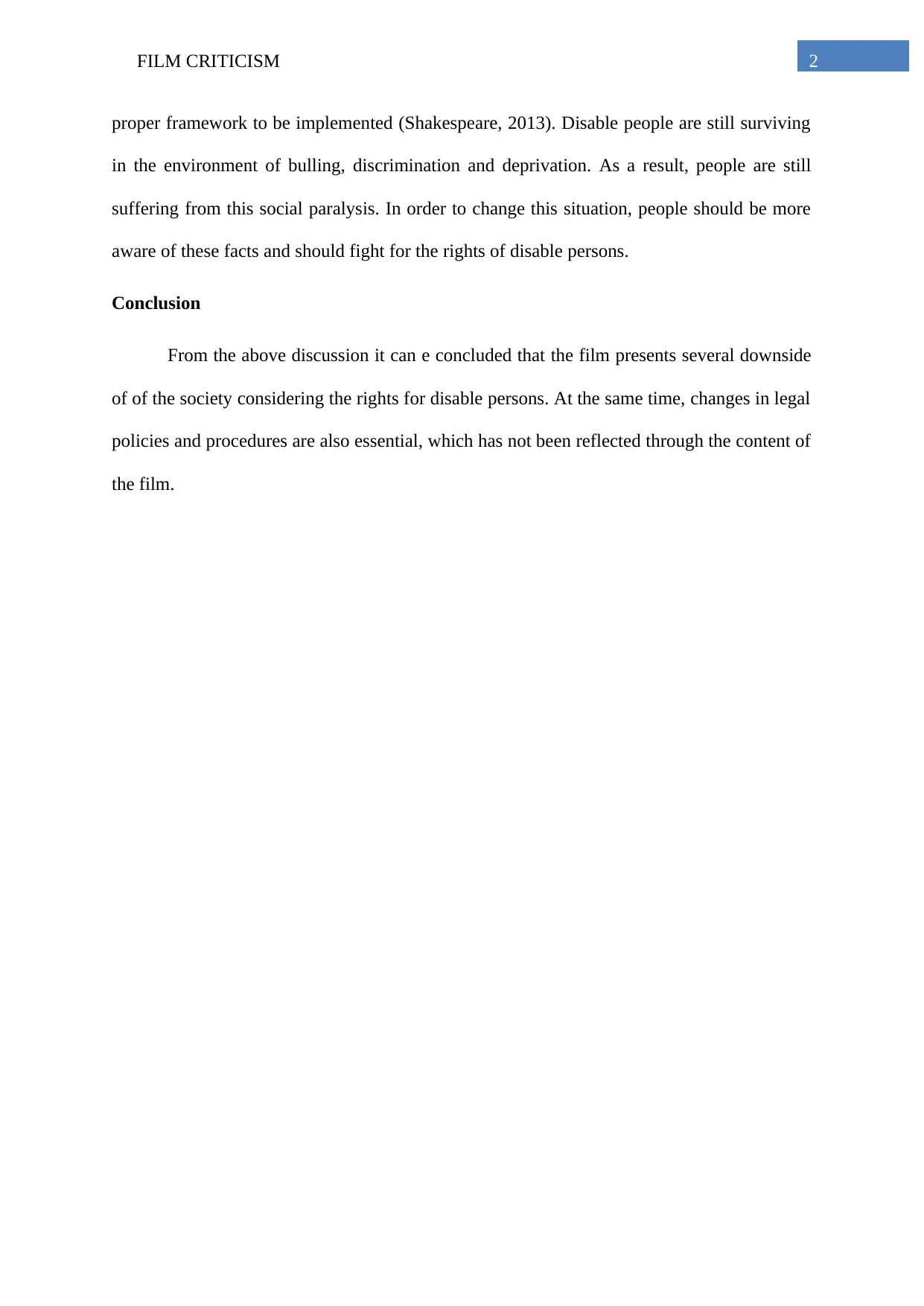
proper framework to be implemented (Shakespeare, 2013). Disable people are still surviving
in the environment of bulling, discrimination and deprivation. As a result, people are still
suffering from this social paralysis. In order to change this situation, people should be more
aware of these facts and should fight for the rights of disable persons.
Conclusion
From the above discussion it can e concluded that the film presents several downside
of of the society considering the rights for disable persons. At the same time, changes in legal
policies and procedures are also essential, which has not been reflected through the content of
the film.
Document Page
3FILM CRITICISM
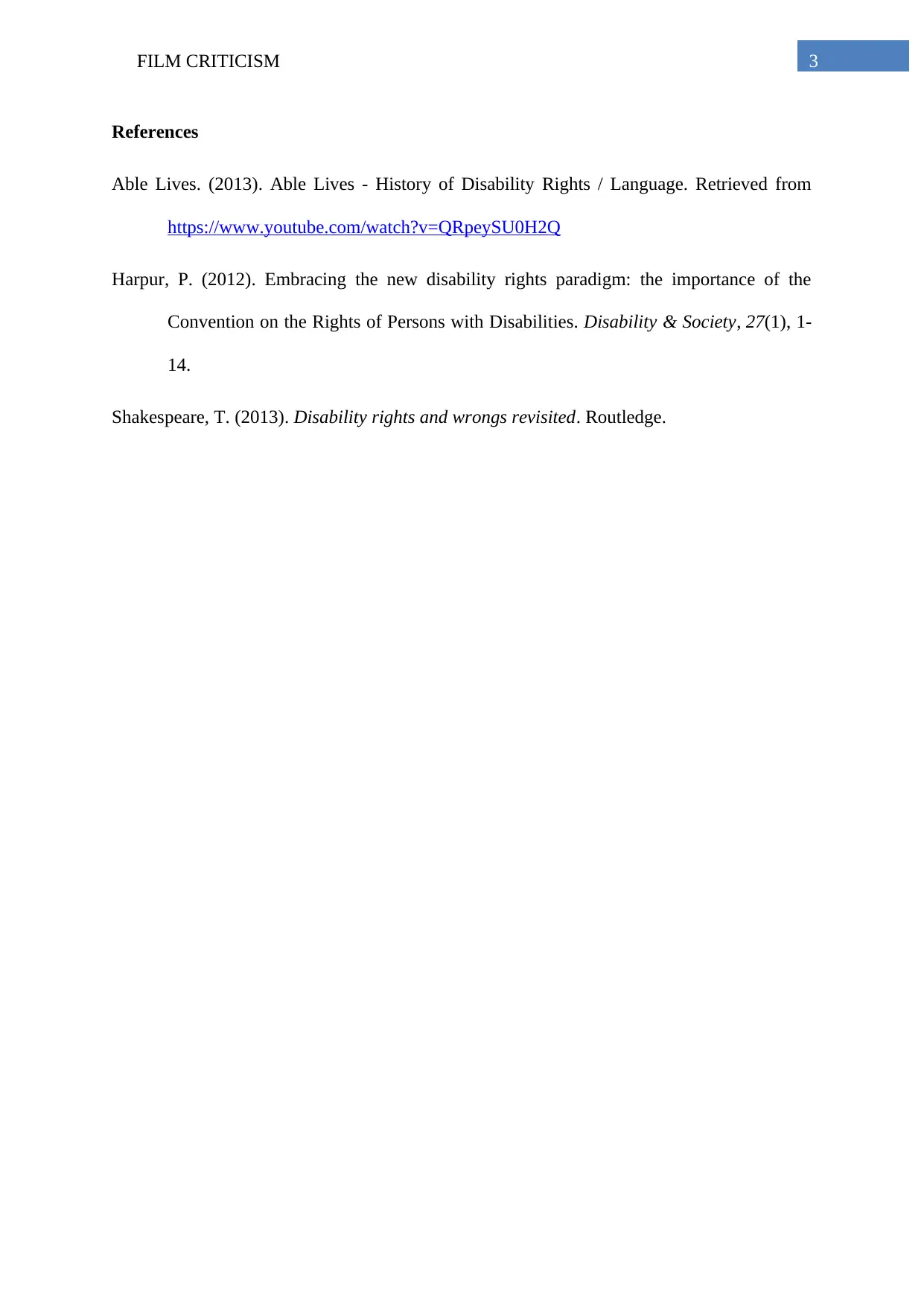
References
Able Lives. (2013). Able Lives - History of Disability Rights / Language. Retrieved from
https://www.youtube.com/watch?v=QRpeySU0H2Q
Harpur, P. (2012). Embracing the new disability rights paradigm: the importance of the
Convention on the Rights of Persons with Disabilities. Disability & Society, 27(1), 1-
14.
Shakespeare, T. (2013). Disability rights and wrongs revisited. Routledge.
chevron_up_icon
1 out of 4
circle_padding
hide_on_mobile
zoom_out_icon
[object Object]