Analysis of Film Essay Abstracts: Five Examples in Film Studies
VerifiedAdded on 2019/09/16
|3
|1160
|395
Essay
AI Summary
This document presents five film essay abstracts, each exploring different aspects of filmmaking and cultural impact. The first abstract analyzes the use of music and violence in Stanley Kubrick's 'A Clockwork Orange,' highlighting the film's juxtapositional soundtrack. The second examines 'The Simpsons' and its contribution to American culture wars, considering the creators' viewpoints and the show's representation of social changes. The third abstract investigates the manipulation of time through non-linear narrative structures in Christopher Nolan's films, using 'Memento' and 'Inception' as case studies. The fourth analyzes how Lucille Ball defied 1950s domesticity in 'I Love Lucy' using male comedy conventions. Finally, the fifth abstract explores New Zealand's impact on Peter Jackson's 'The Lord of the Rings' trilogy, considering its role as both landscape and culture, and the use of CGI and the filmmakers' influence.
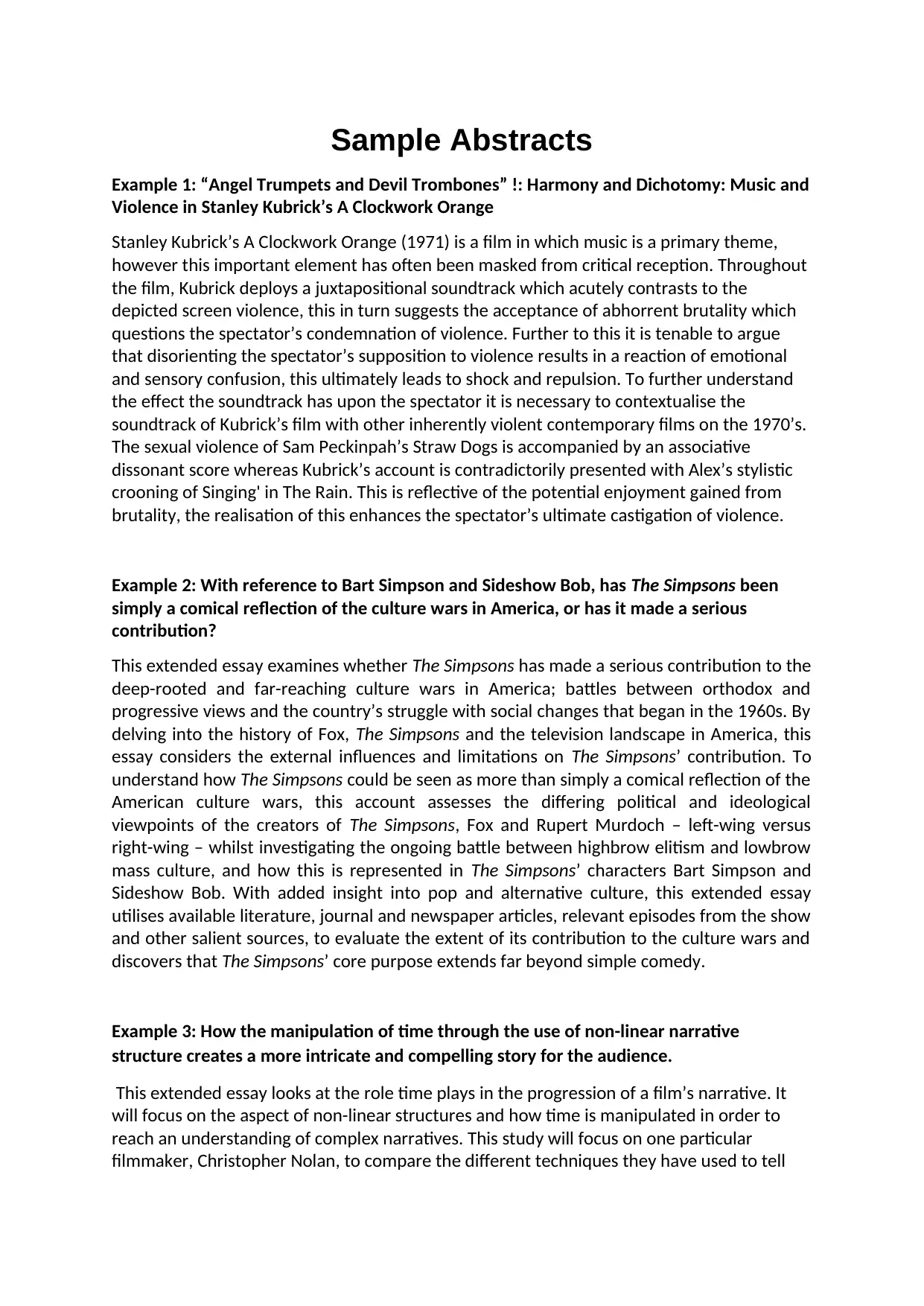
Sample Abstracts
Example 1: “Angel Trumpets and Devil Trombones” !: Harmony and Dichotomy: Music and
Violence in Stanley Kubrick’s A Clockwork Orange
Stanley Kubrick’s A Clockwork Orange (1971) is a film in which music is a primary theme,
however this important element has often been masked from critical reception. Throughout
the film, Kubrick deploys a juxtapositional soundtrack which acutely contrasts to the
depicted screen violence, this in turn suggests the acceptance of abhorrent brutality which
questions the spectator’s condemnation of violence. Further to this it is tenable to argue
that disorienting the spectator’s supposition to violence results in a reaction of emotional
and sensory confusion, this ultimately leads to shock and repulsion. To further understand
the effect the soundtrack has upon the spectator it is necessary to contextualise the
soundtrack of Kubrick’s film with other inherently violent contemporary films on the 1970’s.
The sexual violence of Sam Peckinpah’s Straw Dogs is accompanied by an associative
dissonant score whereas Kubrick’s account is contradictorily presented with Alex’s stylistic
crooning of Singing' in The Rain. This is reflective of the potential enjoyment gained from
brutality, the realisation of this enhances the spectator’s ultimate castigation of violence.
Example 2: With reference to Bart Simpson and Sideshow Bob, has The Simpsons been
simply a comical reflection of the culture wars in America, or has it made a serious
contribution?
This extended essay examines whether The Simpsons has made a serious contribution to the
deep-rooted and far-reaching culture wars in America; battles between orthodox and
progressive views and the country’s struggle with social changes that began in the 1960s. By
delving into the history of Fox, The Simpsons and the television landscape in America, this
essay considers the external influences and limitations on The Simpsons’ contribution. To
understand how The Simpsons could be seen as more than simply a comical reflection of the
American culture wars, this account assesses the differing political and ideological
viewpoints of the creators of The Simpsons, Fox and Rupert Murdoch – left-wing versus
right-wing – whilst investigating the ongoing battle between highbrow elitism and lowbrow
mass culture, and how this is represented in The Simpsons’ characters Bart Simpson and
Sideshow Bob. With added insight into pop and alternative culture, this extended essay
utilises available literature, journal and newspaper articles, relevant episodes from the show
and other salient sources, to evaluate the extent of its contribution to the culture wars and
discovers that The Simpsons’ core purpose extends far beyond simple comedy.
Example 3: How the manipulation of time through the use of non-linear narrative
structure creates a more intricate and compelling story for the audience.
This extended essay looks at the role time plays in the progression of a film’s narrative. It
will focus on the aspect of non-linear structures and how time is manipulated in order to
reach an understanding of complex narratives. This study will focus on one particular
filmmaker, Christopher Nolan, to compare the different techniques they have used to tell
Example 1: “Angel Trumpets and Devil Trombones” !: Harmony and Dichotomy: Music and
Violence in Stanley Kubrick’s A Clockwork Orange
Stanley Kubrick’s A Clockwork Orange (1971) is a film in which music is a primary theme,
however this important element has often been masked from critical reception. Throughout
the film, Kubrick deploys a juxtapositional soundtrack which acutely contrasts to the
depicted screen violence, this in turn suggests the acceptance of abhorrent brutality which
questions the spectator’s condemnation of violence. Further to this it is tenable to argue
that disorienting the spectator’s supposition to violence results in a reaction of emotional
and sensory confusion, this ultimately leads to shock and repulsion. To further understand
the effect the soundtrack has upon the spectator it is necessary to contextualise the
soundtrack of Kubrick’s film with other inherently violent contemporary films on the 1970’s.
The sexual violence of Sam Peckinpah’s Straw Dogs is accompanied by an associative
dissonant score whereas Kubrick’s account is contradictorily presented with Alex’s stylistic
crooning of Singing' in The Rain. This is reflective of the potential enjoyment gained from
brutality, the realisation of this enhances the spectator’s ultimate castigation of violence.
Example 2: With reference to Bart Simpson and Sideshow Bob, has The Simpsons been
simply a comical reflection of the culture wars in America, or has it made a serious
contribution?
This extended essay examines whether The Simpsons has made a serious contribution to the
deep-rooted and far-reaching culture wars in America; battles between orthodox and
progressive views and the country’s struggle with social changes that began in the 1960s. By
delving into the history of Fox, The Simpsons and the television landscape in America, this
essay considers the external influences and limitations on The Simpsons’ contribution. To
understand how The Simpsons could be seen as more than simply a comical reflection of the
American culture wars, this account assesses the differing political and ideological
viewpoints of the creators of The Simpsons, Fox and Rupert Murdoch – left-wing versus
right-wing – whilst investigating the ongoing battle between highbrow elitism and lowbrow
mass culture, and how this is represented in The Simpsons’ characters Bart Simpson and
Sideshow Bob. With added insight into pop and alternative culture, this extended essay
utilises available literature, journal and newspaper articles, relevant episodes from the show
and other salient sources, to evaluate the extent of its contribution to the culture wars and
discovers that The Simpsons’ core purpose extends far beyond simple comedy.
Example 3: How the manipulation of time through the use of non-linear narrative
structure creates a more intricate and compelling story for the audience.
This extended essay looks at the role time plays in the progression of a film’s narrative. It
will focus on the aspect of non-linear structures and how time is manipulated in order to
reach an understanding of complex narratives. This study will focus on one particular
filmmaker, Christopher Nolan, to compare the different techniques they have used to tell
Paraphrase This Document
Need a fresh take? Get an instant paraphrase of this document with our AI Paraphraser

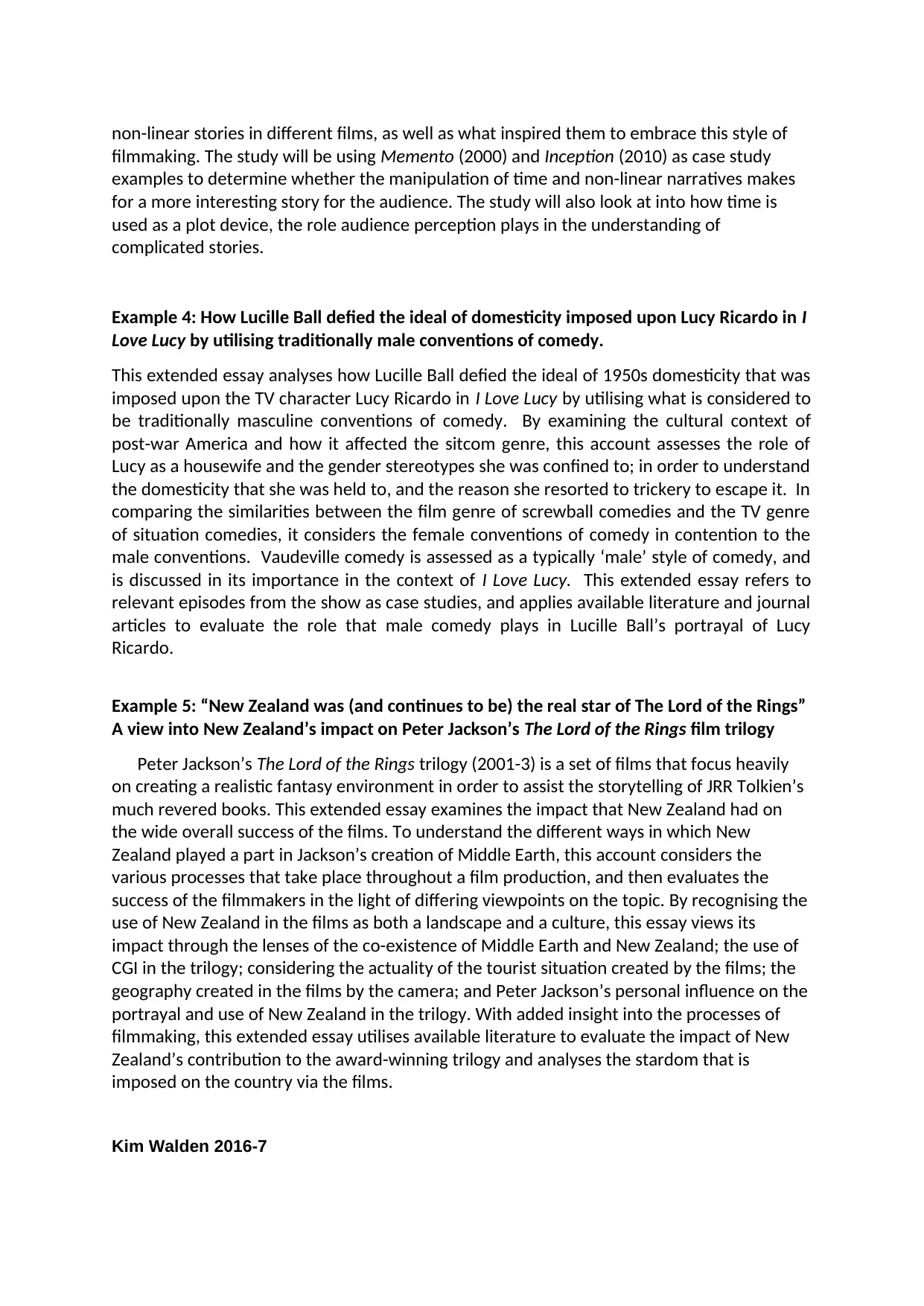
non-linear stories in different films, as well as what inspired them to embrace this style of
filmmaking. The study will be using Memento (2000) and Inception (2010) as case study
examples to determine whether the manipulation of time and non-linear narratives makes
for a more interesting story for the audience. The study will also look at into how time is
used as a plot device, the role audience perception plays in the understanding of
complicated stories.
Example 4: How Lucille Ball defied the ideal of domesticity imposed upon Lucy Ricardo in I
Love Lucy by utilising traditionally male conventions of comedy.
This extended essay analyses how Lucille Ball defied the ideal of 1950s domesticity that was
imposed upon the TV character Lucy Ricardo in I Love Lucy by utilising what is considered to
be traditionally masculine conventions of comedy. By examining the cultural context of
post-war America and how it affected the sitcom genre, this account assesses the role of
Lucy as a housewife and the gender stereotypes she was confined to; in order to understand
the domesticity that she was held to, and the reason she resorted to trickery to escape it. In
comparing the similarities between the film genre of screwball comedies and the TV genre
of situation comedies, it considers the female conventions of comedy in contention to the
male conventions. Vaudeville comedy is assessed as a typically ‘male’ style of comedy, and
is discussed in its importance in the context of I Love Lucy. This extended essay refers to
relevant episodes from the show as case studies, and applies available literature and journal
articles to evaluate the role that male comedy plays in Lucille Ball’s portrayal of Lucy
Ricardo.
Example 5: “New Zealand was (and continues to be) the real star of The Lord of the Rings”
A view into New Zealand’s impact on Peter Jackson’s The Lord of the Rings film trilogy
Peter Jackson’s The Lord of the Rings trilogy (2001-3) is a set of films that focus heavily
on creating a realistic fantasy environment in order to assist the storytelling of JRR Tolkien’s
much revered books. This extended essay examines the impact that New Zealand had on
the wide overall success of the films. To understand the different ways in which New
Zealand played a part in Jackson’s creation of Middle Earth, this account considers the
various processes that take place throughout a film production, and then evaluates the
success of the filmmakers in the light of differing viewpoints on the topic. By recognising the
use of New Zealand in the films as both a landscape and a culture, this essay views its
impact through the lenses of the co-existence of Middle Earth and New Zealand; the use of
CGI in the trilogy; considering the actuality of the tourist situation created by the films; the
geography created in the films by the camera; and Peter Jackson’s personal influence on the
portrayal and use of New Zealand in the trilogy. With added insight into the processes of
filmmaking, this extended essay utilises available literature to evaluate the impact of New
Zealand’s contribution to the award-winning trilogy and analyses the stardom that is
imposed on the country via the films.
Kim Walden 2016-7
filmmaking. The study will be using Memento (2000) and Inception (2010) as case study
examples to determine whether the manipulation of time and non-linear narratives makes
for a more interesting story for the audience. The study will also look at into how time is
used as a plot device, the role audience perception plays in the understanding of
complicated stories.
Example 4: How Lucille Ball defied the ideal of domesticity imposed upon Lucy Ricardo in I
Love Lucy by utilising traditionally male conventions of comedy.
This extended essay analyses how Lucille Ball defied the ideal of 1950s domesticity that was
imposed upon the TV character Lucy Ricardo in I Love Lucy by utilising what is considered to
be traditionally masculine conventions of comedy. By examining the cultural context of
post-war America and how it affected the sitcom genre, this account assesses the role of
Lucy as a housewife and the gender stereotypes she was confined to; in order to understand
the domesticity that she was held to, and the reason she resorted to trickery to escape it. In
comparing the similarities between the film genre of screwball comedies and the TV genre
of situation comedies, it considers the female conventions of comedy in contention to the
male conventions. Vaudeville comedy is assessed as a typically ‘male’ style of comedy, and
is discussed in its importance in the context of I Love Lucy. This extended essay refers to
relevant episodes from the show as case studies, and applies available literature and journal
articles to evaluate the role that male comedy plays in Lucille Ball’s portrayal of Lucy
Ricardo.
Example 5: “New Zealand was (and continues to be) the real star of The Lord of the Rings”
A view into New Zealand’s impact on Peter Jackson’s The Lord of the Rings film trilogy
Peter Jackson’s The Lord of the Rings trilogy (2001-3) is a set of films that focus heavily
on creating a realistic fantasy environment in order to assist the storytelling of JRR Tolkien’s
much revered books. This extended essay examines the impact that New Zealand had on
the wide overall success of the films. To understand the different ways in which New
Zealand played a part in Jackson’s creation of Middle Earth, this account considers the
various processes that take place throughout a film production, and then evaluates the
success of the filmmakers in the light of differing viewpoints on the topic. By recognising the
use of New Zealand in the films as both a landscape and a culture, this essay views its
impact through the lenses of the co-existence of Middle Earth and New Zealand; the use of
CGI in the trilogy; considering the actuality of the tourist situation created by the films; the
geography created in the films by the camera; and Peter Jackson’s personal influence on the
portrayal and use of New Zealand in the trilogy. With added insight into the processes of
filmmaking, this extended essay utilises available literature to evaluate the impact of New
Zealand’s contribution to the award-winning trilogy and analyses the stardom that is
imposed on the country via the films.
Kim Walden 2016-7

⊘ This is a preview!⊘
Do you want full access?
Subscribe today to unlock all pages.

Trusted by 1+ million students worldwide
1 out of 3
Your All-in-One AI-Powered Toolkit for Academic Success.
+13062052269
info@desklib.com
Available 24*7 on WhatsApp / Email
Unlock your academic potential
Copyright © 2020–2026 A2Z Services. All Rights Reserved. Developed and managed by ZUCOL.