FIN 302 - Equity and Fixed Income Investments: Assignment Analysis

Verified

Added on  2022/11/28

|7
|1342
|157
Homework Assignment
AI Summary
This finance assignment provides a detailed analysis of equity and fixed income investments. It begins by comparing the net tangible assets and price-to-sales valuation methods, highlighting their respective strengths and weaknesses. The assignment then delves into the valuation of a company using the dividend discount model, explaining the application of growth factors and the capital asset pricing model for determining the required rate of return. Finally, it examines the valuation of convertible bonds versus straight bonds, emphasizing the impact of embedded options and interest rate changes on bond prices. The assignment incorporates relevant formulas and concepts, offering a comprehensive understanding of the subject matter.
Document Page
Running head: FINANCE
Finance
Name of the Student:
Name of the University:
Author’s Note:
tabler-icon-diamond-filled.svg

Paraphrase This Document

Need a fresh take? Get an instant paraphrase of this document with our AI Paraphraser
Document Page
1FINANCE
Table of Contents
Assignment 2...................................................................................................................................2
Question 1........................................................................................................................................2
Question 2........................................................................................................................................4
References........................................................................................................................................6
Document Page
2FINANCE
Assignment 2
Question 1
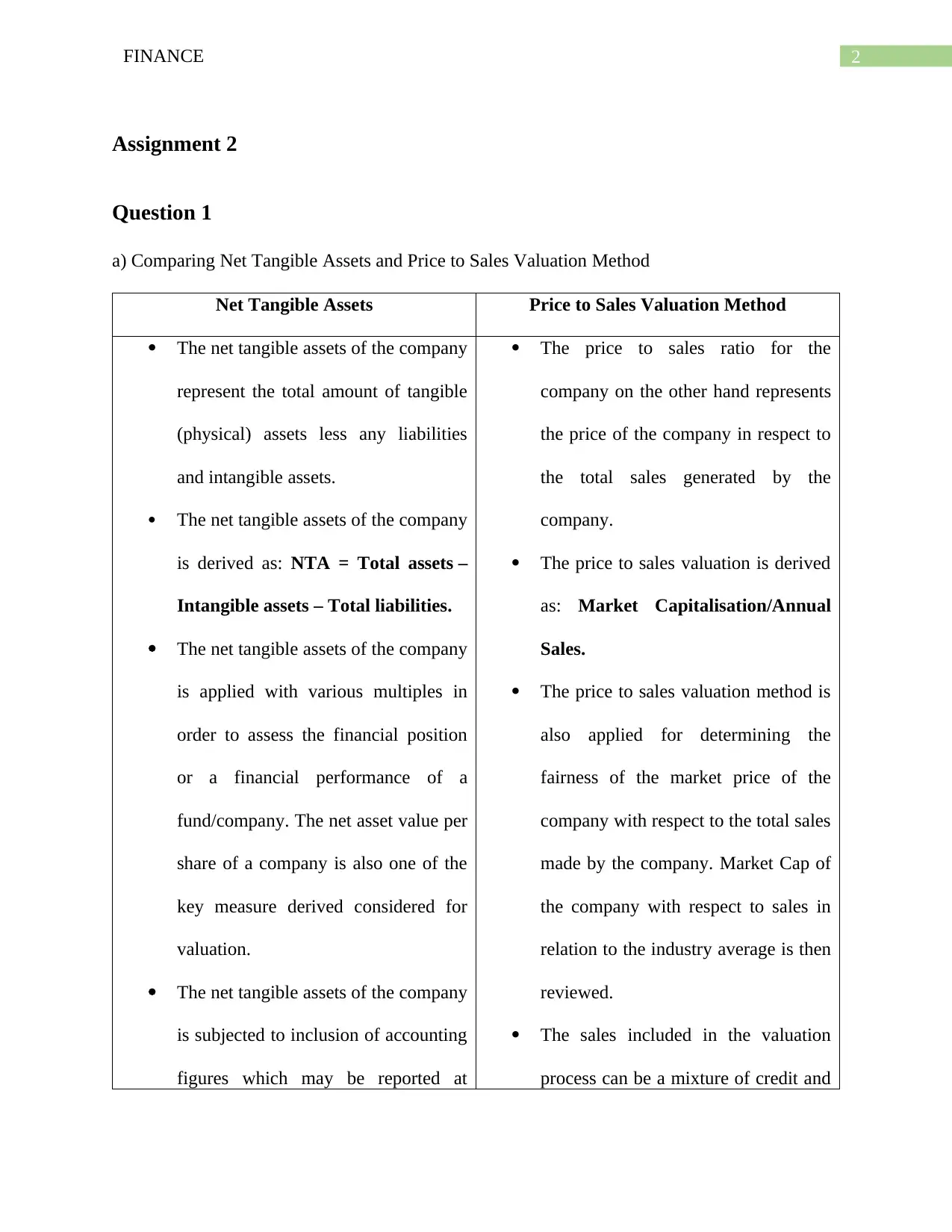
a) Comparing Net Tangible Assets and Price to Sales Valuation Method
Net Tangible Assets Price to Sales Valuation Method
The net tangible assets of the company
represent the total amount of tangible
(physical) assets less any liabilities
and intangible assets.
The net tangible assets of the company
is derived as: NTA = Total assets
Intangible assets – Total liabilities.
The net tangible assets of the company
is applied with various multiples in
order to assess the financial position
or a financial performance of a
fund/company. The net asset value per
share of a company is also one of the
key measure derived considered for
valuation.
The net tangible assets of the company
is subjected to inclusion of accounting
figures which may be reported at
The price to sales ratio for the
company on the other hand represents
the price of the company in respect to
the total sales generated by the
company.
The price to sales valuation is derived
as: Market Capitalisation/Annual
Sales.
The price to sales valuation method is
also applied for determining the
fairness of the market price of the
company with respect to the total sales
made by the company. Market Cap of
the company with respect to sales in
relation to the industry average is then
reviewed.
The sales included in the valuation
process can be a mixture of credit and
Document Page
3FINANCE
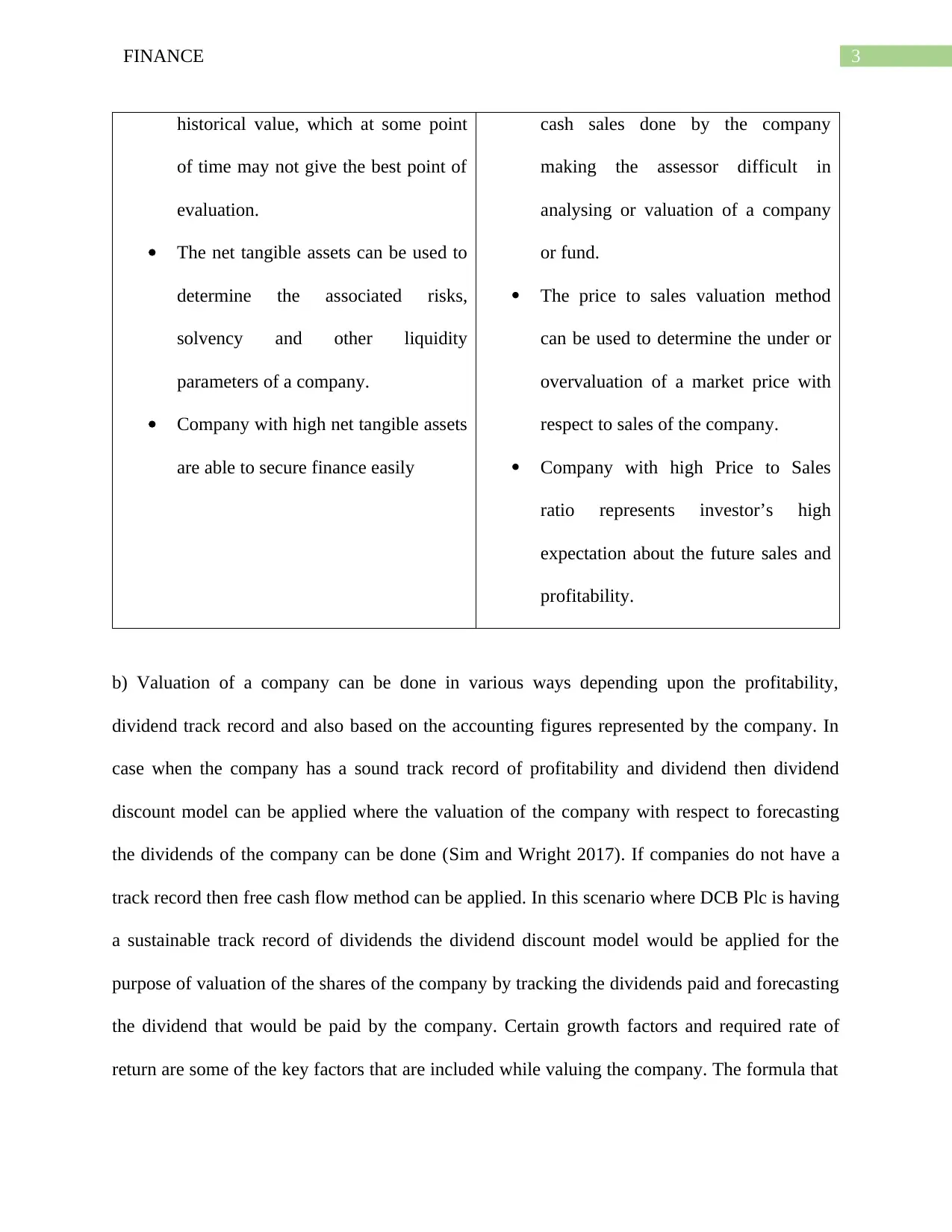
historical value, which at some point
of time may not give the best point of
evaluation.
The net tangible assets can be used to
determine the associated risks,
solvency and other liquidity
parameters of a company.
Company with high net tangible assets
are able to secure finance easily
cash sales done by the company
making the assessor difficult in
analysing or valuation of a company
or fund.
The price to sales valuation method
can be used to determine the under or
overvaluation of a market price with
respect to sales of the company.
Company with high Price to Sales
ratio represents investor’s high
expectation about the future sales and
profitability.
b) Valuation of a company can be done in various ways depending upon the profitability,
dividend track record and also based on the accounting figures represented by the company. In
case when the company has a sound track record of profitability and dividend then dividend
discount model can be applied where the valuation of the company with respect to forecasting
the dividends of the company can be done (Sim and Wright 2017). If companies do not have a
track record then free cash flow method can be applied. In this scenario where DCB Plc is having
a sustainable track record of dividends the dividend discount model would be applied for the
purpose of valuation of the shares of the company by tracking the dividends paid and forecasting
the dividend that would be paid by the company. Certain growth factors and required rate of
return are some of the key factors that are included while valuing the company. The formula that
tabler-icon-diamond-filled.svg

Paraphrase This Document

Need a fresh take? Get an instant paraphrase of this document with our AI Paraphraser
Document Page
4FINANCE
is applied for the purpose of valuing the company as per Dividend Discount Model:
Do*(1+g)/(Required Rate of Return- Growth Factor) (Florig, Ulrich and Schoemer 2019).
The growth factor can be determined with the help of the retention rate done by the company
multiplied by the return on equity. Growth Factor: Retention Rate*Return on Equity. On the
other hand the required rate of return for the company can be determined with the help of the
Capital Asset Pricing Model- Re: Risk Free Rate of Return+(Return on Market Index-Risk
Free Rate of Return)*Beta. Thus, the above model will help the investor value the shares of the
company and render the fairness on the market price of the company (Lazzati and Menichini
2015).
Question 2
The convertible bond would have a higher value than the straight bond as the convertible
bond gives an option to the bondholder of the company to convert the bonds of the company into
equity shares of the company (García 2017). On the other hand, in the case of straight bond there
is as such no option, the bond holders get the fixed coupon rate and the principal amount at the
date of maturity. The formula for pricing or valuing a convertible bond is as follows:
Price of Callable Bond (P.C.B): Price of Straight Bond + Call Option (Co)
From the above formula, it can be well said that the convertible bond is more or less like
a straight bond except that it has call option on the shares of the company. If the share price of
the company rises, then the call option embedded in the PCB will rise and ultimately the PCB
will rise. Investors buys bond in anticipation of enjoying higher returns by securing the risk in
the primary stage usually go for this type of bond (Trigeorgis and Baldi 2016). Obviously, in this
type of case the convertible rate that is also called as the number of shares the bondholder would
get in exchange for a unit of shares. If the share price of the company rises and the bondholders
Document Page
5FINANCE
expect that it can move further they opt for converting the bond into shares of the company. On
the other hand if the share price of the company starts falling the bondholder has the option of
selling the bond at the maturity and getting the principal value back. It depends upon the option
that is embedded in the bond and is enjoyed by whom. If the embedded option is enjoyed by the
bondholder of the company then the value of the call option will be paid by the bondholders
making price of the bond go up. On the other hand it is also important to discuss about the
interest rate changes that can simultaneously affect the price of the bond. Interest Rate and Prices
of the bond have an inverse relation if the interest rate goes down then the share price of the
company rises and vice versa. Thus, it is important to analyse and look into various factors while
valuing or introspecting a bond in terms of feature offered by each kind of bond (Dong,
Dutordoir and Veld 2018).
Document Page
6FINANCE
References
Dong, M., Dutordoir, M. and Veld, C., 2018. Why Do Firms Issue Convertible Bonds?. Critical
Finance Review, 7.
Florig, S., Ulrich, M. and Schoemer, S., 2019. A Macro-Finance Term Structure Model for Bond
and Dividend Discount Rates. Available at SSRN 3394850.
García, M.R., 2017. Financial Valuation of Luxury Brands. In New Luxury Management (pp. 85-
102). Palgrave Macmillan, Cham.
Lazzati, N. and Menichini, A.A., 2015. A dynamic approach to the dividend discount model.
Review of Pacific Basin Financial Markets and Policies, 18(03), p.1550018.
Sim, T. and Wright, R.H., 2017. Stock valuation using the dividend discount model: An internal
rate of return Approach. In Growing Presence of Real Options in Global Financial Markets (pp.
19-32). Emerald Publishing Limited.
Trigeorgis, L. and Baldi, F., 2016. Valuing brand strategies with real options. Brand Strategies.
chevron_up_icon
1 out of 7
circle_padding
hide_on_mobile
zoom_out_icon
[object Object]