Preparing and Analyzing Final Accounts: Sole Trader & Partnerships
VerifiedAdded on 2020/11/12
|20
|4013
|197
Report
AI Summary
This report delves into the preparation of final accounts for both sole trader and partnership businesses, covering essential aspects of financial accounting. It begins by explaining the reasons for closing accounts and preparing trial balances, followed by the procedures for creating final statements. The report also details methodologies for handling incomplete records, addressing issues arising from incorrect double entries and inconsistent data. Task 2 focuses on practical applications, including preparing accounting records from incomplete data, calculating cash/bank balances, and preparing sales and purchase ledger control accounts. Task 3 outlines the components of final accounts for sole traders, including profit and loss accounts and balance sheets. The report then moves on to partnership accounting, examining key elements of partnership agreements and accounting procedures. Task 5 demonstrates the preparation of a profit and loss appropriation account and profit distribution, while Task 6 addresses the calculation of closing balances for partner capital and current accounts, culminating in the preparation of a balance sheet in compliance with partnership agreements. The report is a comprehensive guide to understanding and preparing final accounts.
PRPARATION OF FINAL
ACCOUNTS OF SOLE
TRADER-SHIP AND
PARTNERSHIP
BUSINESSES
Table of Contents
INTRODUCTION...........................................................................................................................1
ACCOUNTS OF SOLE
TRADER-SHIP AND
PARTNERSHIP
BUSINESSES
Table of Contents
INTRODUCTION...........................................................................................................................1

Paraphrase This Document
Need a fresh take? Get an instant paraphrase of this document with our AI Paraphraser
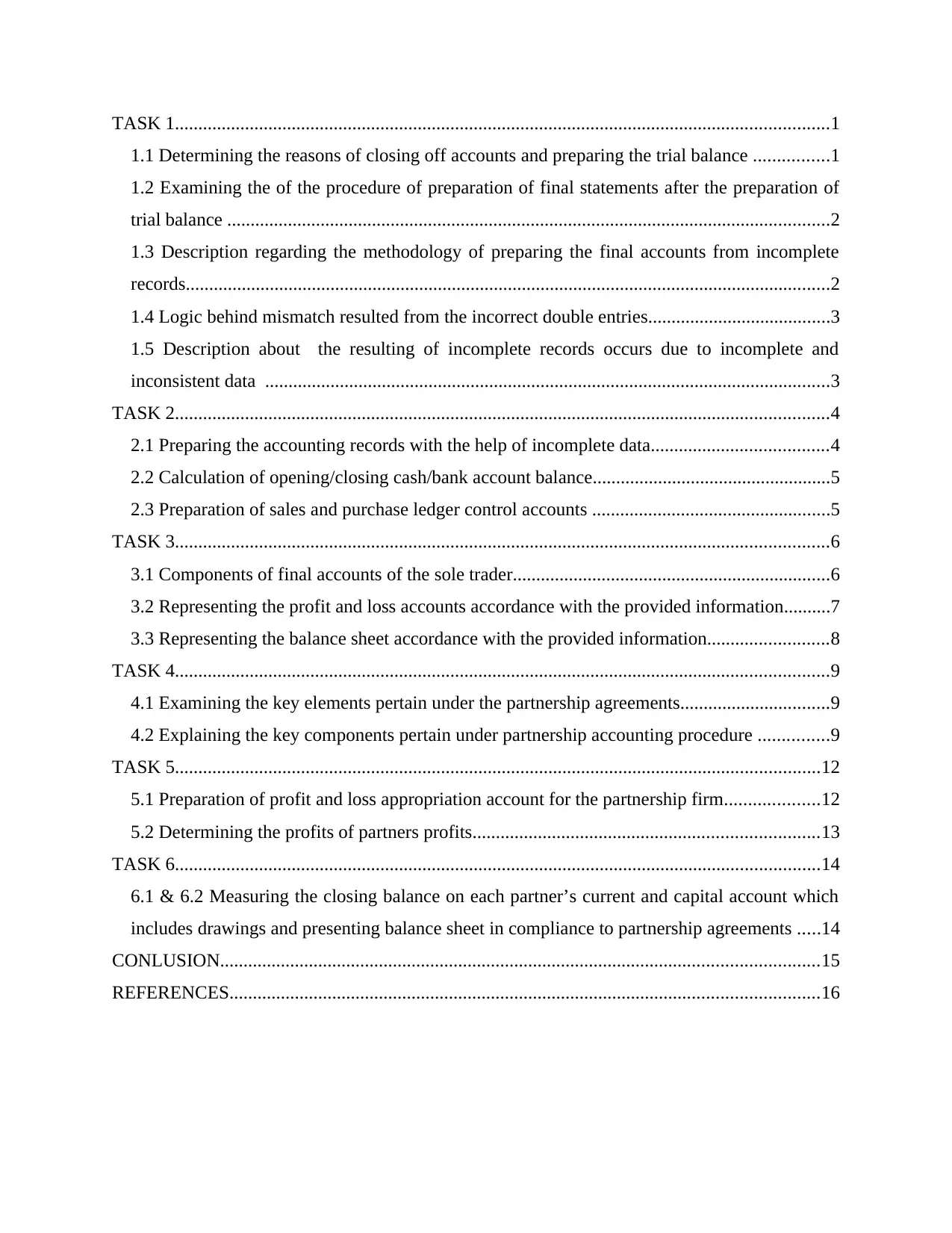
TASK 1............................................................................................................................................1
1.1 Determining the reasons of closing off accounts and preparing the trial balance ................1
1.2 Examining the of the procedure of preparation of final statements after the preparation of
trial balance .................................................................................................................................2
1.3 Description regarding the methodology of preparing the final accounts from incomplete
records..........................................................................................................................................2
1.4 Logic behind mismatch resulted from the incorrect double entries.......................................3
1.5 Description about the resulting of incomplete records occurs due to incomplete and
inconsistent data .........................................................................................................................3
TASK 2............................................................................................................................................4
2.1 Preparing the accounting records with the help of incomplete data......................................4
2.2 Calculation of opening/closing cash/bank account balance...................................................5
2.3 Preparation of sales and purchase ledger control accounts ...................................................5
TASK 3............................................................................................................................................6
3.1 Components of final accounts of the sole trader....................................................................6
3.2 Representing the profit and loss accounts accordance with the provided information..........7
3.3 Representing the balance sheet accordance with the provided information..........................8
TASK 4............................................................................................................................................9
4.1 Examining the key elements pertain under the partnership agreements................................9
4.2 Explaining the key components pertain under partnership accounting procedure ...............9
TASK 5..........................................................................................................................................12
5.1 Preparation of profit and loss appropriation account for the partnership firm....................12
5.2 Determining the profits of partners profits..........................................................................13
TASK 6..........................................................................................................................................14
6.1 & 6.2 Measuring the closing balance on each partner’s current and capital account which
includes drawings and presenting balance sheet in compliance to partnership agreements .....14
CONLUSION................................................................................................................................15
REFERENCES..............................................................................................................................16
1.1 Determining the reasons of closing off accounts and preparing the trial balance ................1
1.2 Examining the of the procedure of preparation of final statements after the preparation of
trial balance .................................................................................................................................2
1.3 Description regarding the methodology of preparing the final accounts from incomplete
records..........................................................................................................................................2
1.4 Logic behind mismatch resulted from the incorrect double entries.......................................3
1.5 Description about the resulting of incomplete records occurs due to incomplete and
inconsistent data .........................................................................................................................3
TASK 2............................................................................................................................................4
2.1 Preparing the accounting records with the help of incomplete data......................................4
2.2 Calculation of opening/closing cash/bank account balance...................................................5
2.3 Preparation of sales and purchase ledger control accounts ...................................................5
TASK 3............................................................................................................................................6
3.1 Components of final accounts of the sole trader....................................................................6
3.2 Representing the profit and loss accounts accordance with the provided information..........7
3.3 Representing the balance sheet accordance with the provided information..........................8
TASK 4............................................................................................................................................9
4.1 Examining the key elements pertain under the partnership agreements................................9
4.2 Explaining the key components pertain under partnership accounting procedure ...............9
TASK 5..........................................................................................................................................12
5.1 Preparation of profit and loss appropriation account for the partnership firm....................12
5.2 Determining the profits of partners profits..........................................................................13
TASK 6..........................................................................................................................................14
6.1 & 6.2 Measuring the closing balance on each partner’s current and capital account which
includes drawings and presenting balance sheet in compliance to partnership agreements .....14
CONLUSION................................................................................................................................15
REFERENCES..............................................................................................................................16

⊘ This is a preview!⊘
Do you want full access?
Subscribe today to unlock all pages.

Trusted by 1+ million students worldwide

Paraphrase This Document
Need a fresh take? Get an instant paraphrase of this document with our AI Paraphraser
INTRODUCTION
Financial accounts are considered as the integral part of the accounting terminology and
it's procedure. As no business can operates without the perfect evaluation of the operations of the
business organisation in context of monetary terms(Kennedy, 2011). Only for this reason it is
inevitable to prepare the final accounts accordance with it's principle and concepts. Furthermore
the final accounts of any kind of organisation either sole trading or partnership or company, it
depicts the true financial performance of the organisation. For the purpose of preparing final
accounts all the accounts of debit and credit balance are required to be settle by closing off and
then the process of final accounts begins with the preparation of trial balance that depicts the
accurate amounts all accounts. This report comprises with the description regarding the
preparation of the consolidate statement of profit and loss accounts and the consolidate statement
of balance sheet. Overall, the report pertains the knowledge about the final accounts for sole
trading and partnership businesses.
TASK 1
1.1 Determining the reasons of closing off accounts and preparing the trial balance
At the time of closing of accounting period, the income and expenses accounts must be
transfer to trial balance for the execution. This, is because by doing this, all the revenues and
expenses accounts can be settled with their closing balances at the closing of accounting era. So
from the new accounting era the new accounts or the existing accounts can be starts with their
closing balances and closing off accounts are also beneficial in preparation of P&L account for
the calculation of the Net profit as well as for the preparation of the Balance sheet to know the
accurate and whole business performances(World Bank, 2014). After the preparation of journal
and ledger all the temporary accounts considered to close off, as it is required for preparing of
trial balance.
The Consolidate Trail Balance refers to category of final account kind of statement that is
to be prepare with an aim of recording all monetary transactions which are recorded in journal
the during accounting era and amounts are required to be equal together at the each side. The
reason behind the preparation of trial balance is to quantify the balances of the temporary
accounts that are closed off properly and total of credits and debits are required to be equal in the
closing entries made under the accounting procedure.
1
Financial accounts are considered as the integral part of the accounting terminology and
it's procedure. As no business can operates without the perfect evaluation of the operations of the
business organisation in context of monetary terms(Kennedy, 2011). Only for this reason it is
inevitable to prepare the final accounts accordance with it's principle and concepts. Furthermore
the final accounts of any kind of organisation either sole trading or partnership or company, it
depicts the true financial performance of the organisation. For the purpose of preparing final
accounts all the accounts of debit and credit balance are required to be settle by closing off and
then the process of final accounts begins with the preparation of trial balance that depicts the
accurate amounts all accounts. This report comprises with the description regarding the
preparation of the consolidate statement of profit and loss accounts and the consolidate statement
of balance sheet. Overall, the report pertains the knowledge about the final accounts for sole
trading and partnership businesses.
TASK 1
1.1 Determining the reasons of closing off accounts and preparing the trial balance
At the time of closing of accounting period, the income and expenses accounts must be
transfer to trial balance for the execution. This, is because by doing this, all the revenues and
expenses accounts can be settled with their closing balances at the closing of accounting era. So
from the new accounting era the new accounts or the existing accounts can be starts with their
closing balances and closing off accounts are also beneficial in preparation of P&L account for
the calculation of the Net profit as well as for the preparation of the Balance sheet to know the
accurate and whole business performances(World Bank, 2014). After the preparation of journal
and ledger all the temporary accounts considered to close off, as it is required for preparing of
trial balance.
The Consolidate Trail Balance refers to category of final account kind of statement that is
to be prepare with an aim of recording all monetary transactions which are recorded in journal
the during accounting era and amounts are required to be equal together at the each side. The
reason behind the preparation of trial balance is to quantify the balances of the temporary
accounts that are closed off properly and total of credits and debits are required to be equal in the
closing entries made under the accounting procedure.
1
1.2 Examining the of the procedure of preparation of final statements after the preparation of trial
balance
` “The trial balance depicts the equality of debit balance and credit balances”. The Trial
balance refers to the statement of ledger accounts and their debit and credit balances for the
determination of recording procedure as the debit side and credit side must pertain the equal
balances(Carter, 2013). Trial balance can be termed as the paltry for preparing the further final
accounts. The trial balance accounts is required to be prepare in such a manner that, assets,
liabilities, equity, dividends, revenues and expenses. The appropriate procedure of trial balance
benefited for quantifying the accurate amounts of aspects of Balance sheet and P&L statement
not only this, it helpful in identification of several kinds of errors. The procedure of preparing the
final accounts from the trail balance described underneath:
Understand the nature and adjustments of trail balance transactions and adjustments.
Recording of all debit transactions which are to be recorded in the consolidate statement
of trail balance either on expense side of Trading account or in P&L account account.
Recording of all the credit transactions which are to be recorded in the consolidate
statement of trail balance either on income side of trading account or in P&L or may be
as liabilities in balance sheet must be considered for analysis for preparation of final
statements(Bergkamp and Kogan, 2013).
Posting of all the items, but only after confirming all relevant adjustments of each items
twice as each transaction has two fold effects.
Balancing of trading as well as the P&L A/c for the determination of the Gross profit /
loss and the Net profit/Net Loss .
Add the resulted profit with the balance of capital on the liabilities side of the consolidate
statement of balance sheet.
Take the total of the balance sheet.
1.3 Description regarding the methodology of preparing the final accounts from incomplete
records
Basically only three methods are evolved for the preparation of the final accounts from
the Incomplete records, which are mentioned underneath.
2
balance
` “The trial balance depicts the equality of debit balance and credit balances”. The Trial
balance refers to the statement of ledger accounts and their debit and credit balances for the
determination of recording procedure as the debit side and credit side must pertain the equal
balances(Carter, 2013). Trial balance can be termed as the paltry for preparing the further final
accounts. The trial balance accounts is required to be prepare in such a manner that, assets,
liabilities, equity, dividends, revenues and expenses. The appropriate procedure of trial balance
benefited for quantifying the accurate amounts of aspects of Balance sheet and P&L statement
not only this, it helpful in identification of several kinds of errors. The procedure of preparing the
final accounts from the trail balance described underneath:
Understand the nature and adjustments of trail balance transactions and adjustments.
Recording of all debit transactions which are to be recorded in the consolidate statement
of trail balance either on expense side of Trading account or in P&L account account.
Recording of all the credit transactions which are to be recorded in the consolidate
statement of trail balance either on income side of trading account or in P&L or may be
as liabilities in balance sheet must be considered for analysis for preparation of final
statements(Bergkamp and Kogan, 2013).
Posting of all the items, but only after confirming all relevant adjustments of each items
twice as each transaction has two fold effects.
Balancing of trading as well as the P&L A/c for the determination of the Gross profit /
loss and the Net profit/Net Loss .
Add the resulted profit with the balance of capital on the liabilities side of the consolidate
statement of balance sheet.
Take the total of the balance sheet.
1.3 Description regarding the methodology of preparing the final accounts from incomplete
records
Basically only three methods are evolved for the preparation of the final accounts from
the Incomplete records, which are mentioned underneath.
2
⊘ This is a preview!⊘
Do you want full access?
Subscribe today to unlock all pages.
Trusted by 1+ million students worldwide
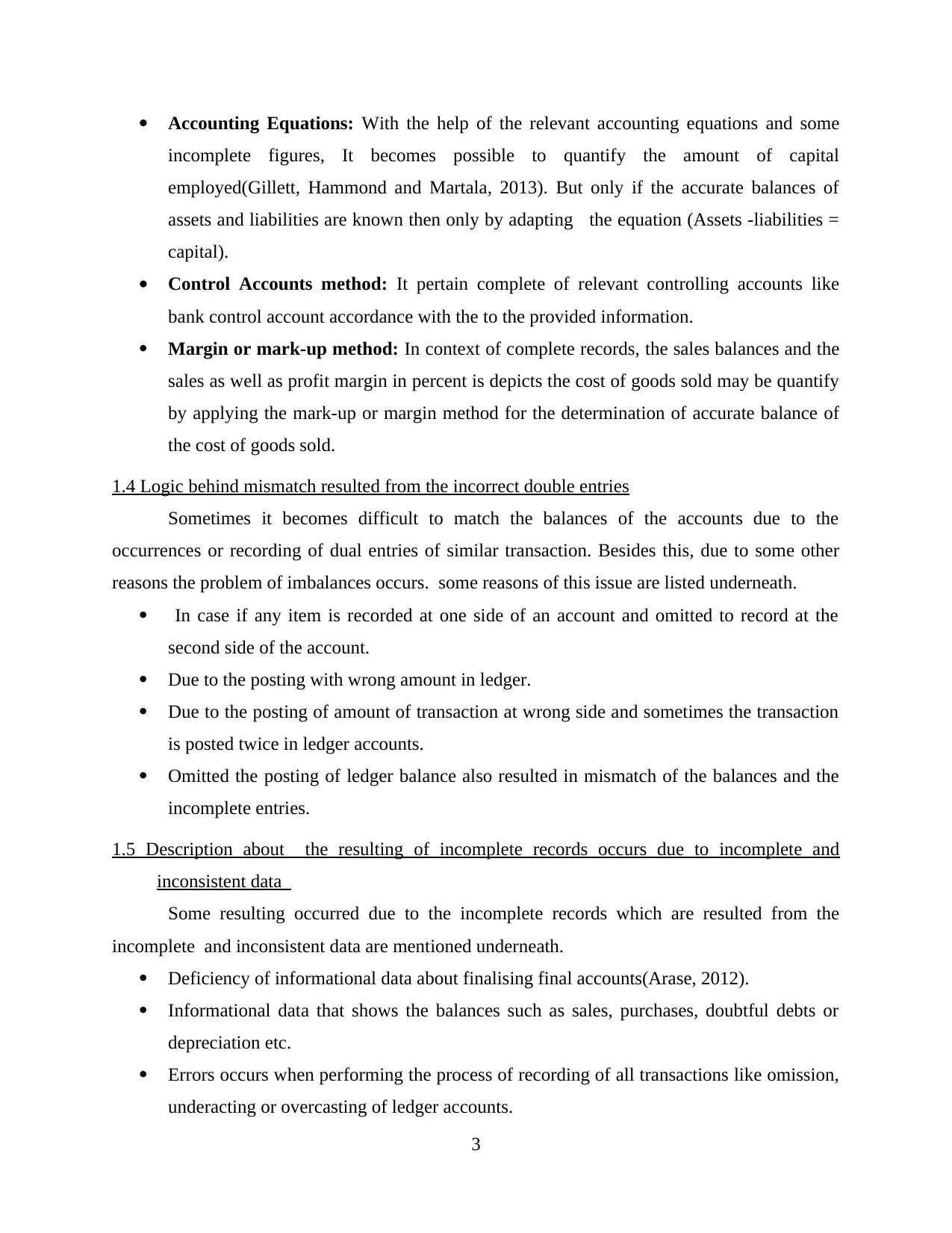
Accounting Equations: With the help of the relevant accounting equations and some
incomplete figures, It becomes possible to quantify the amount of capital
employed(Gillett, Hammond and Martala, 2013). But only if the accurate balances of
assets and liabilities are known then only by adapting the equation (Assets -liabilities =
capital).
Control Accounts method: It pertain complete of relevant controlling accounts like
bank control account accordance with the to the provided information.
Margin or mark-up method: In context of complete records, the sales balances and the
sales as well as profit margin in percent is depicts the cost of goods sold may be quantify
by applying the mark-up or margin method for the determination of accurate balance of
the cost of goods sold.
1.4 Logic behind mismatch resulted from the incorrect double entries
Sometimes it becomes difficult to match the balances of the accounts due to the
occurrences or recording of dual entries of similar transaction. Besides this, due to some other
reasons the problem of imbalances occurs. some reasons of this issue are listed underneath.
In case if any item is recorded at one side of an account and omitted to record at the
second side of the account.
Due to the posting with wrong amount in ledger.
Due to the posting of amount of transaction at wrong side and sometimes the transaction
is posted twice in ledger accounts.
Omitted the posting of ledger balance also resulted in mismatch of the balances and the
incomplete entries.
1.5 Description about the resulting of incomplete records occurs due to incomplete and
inconsistent data
Some resulting occurred due to the incomplete records which are resulted from the
incomplete and inconsistent data are mentioned underneath.
Deficiency of informational data about finalising final accounts(Arase, 2012).
Informational data that shows the balances such as sales, purchases, doubtful debts or
depreciation etc.
Errors occurs when performing the process of recording of all transactions like omission,
underacting or overcasting of ledger accounts.
3
incomplete figures, It becomes possible to quantify the amount of capital
employed(Gillett, Hammond and Martala, 2013). But only if the accurate balances of
assets and liabilities are known then only by adapting the equation (Assets -liabilities =
capital).
Control Accounts method: It pertain complete of relevant controlling accounts like
bank control account accordance with the to the provided information.
Margin or mark-up method: In context of complete records, the sales balances and the
sales as well as profit margin in percent is depicts the cost of goods sold may be quantify
by applying the mark-up or margin method for the determination of accurate balance of
the cost of goods sold.
1.4 Logic behind mismatch resulted from the incorrect double entries
Sometimes it becomes difficult to match the balances of the accounts due to the
occurrences or recording of dual entries of similar transaction. Besides this, due to some other
reasons the problem of imbalances occurs. some reasons of this issue are listed underneath.
In case if any item is recorded at one side of an account and omitted to record at the
second side of the account.
Due to the posting with wrong amount in ledger.
Due to the posting of amount of transaction at wrong side and sometimes the transaction
is posted twice in ledger accounts.
Omitted the posting of ledger balance also resulted in mismatch of the balances and the
incomplete entries.
1.5 Description about the resulting of incomplete records occurs due to incomplete and
inconsistent data
Some resulting occurred due to the incomplete records which are resulted from the
incomplete and inconsistent data are mentioned underneath.
Deficiency of informational data about finalising final accounts(Arase, 2012).
Informational data that shows the balances such as sales, purchases, doubtful debts or
depreciation etc.
Errors occurs when performing the process of recording of all transactions like omission,
underacting or overcasting of ledger accounts.
3
Paraphrase This Document
Need a fresh take? Get an instant paraphrase of this document with our AI Paraphraser
Sometimes occurrences of the errors due to wrong evaluation or quantification of
balances comes under the equity and liabilities side as well as on assets side in
revaluation accounts and in balance sheet.
TASK 2
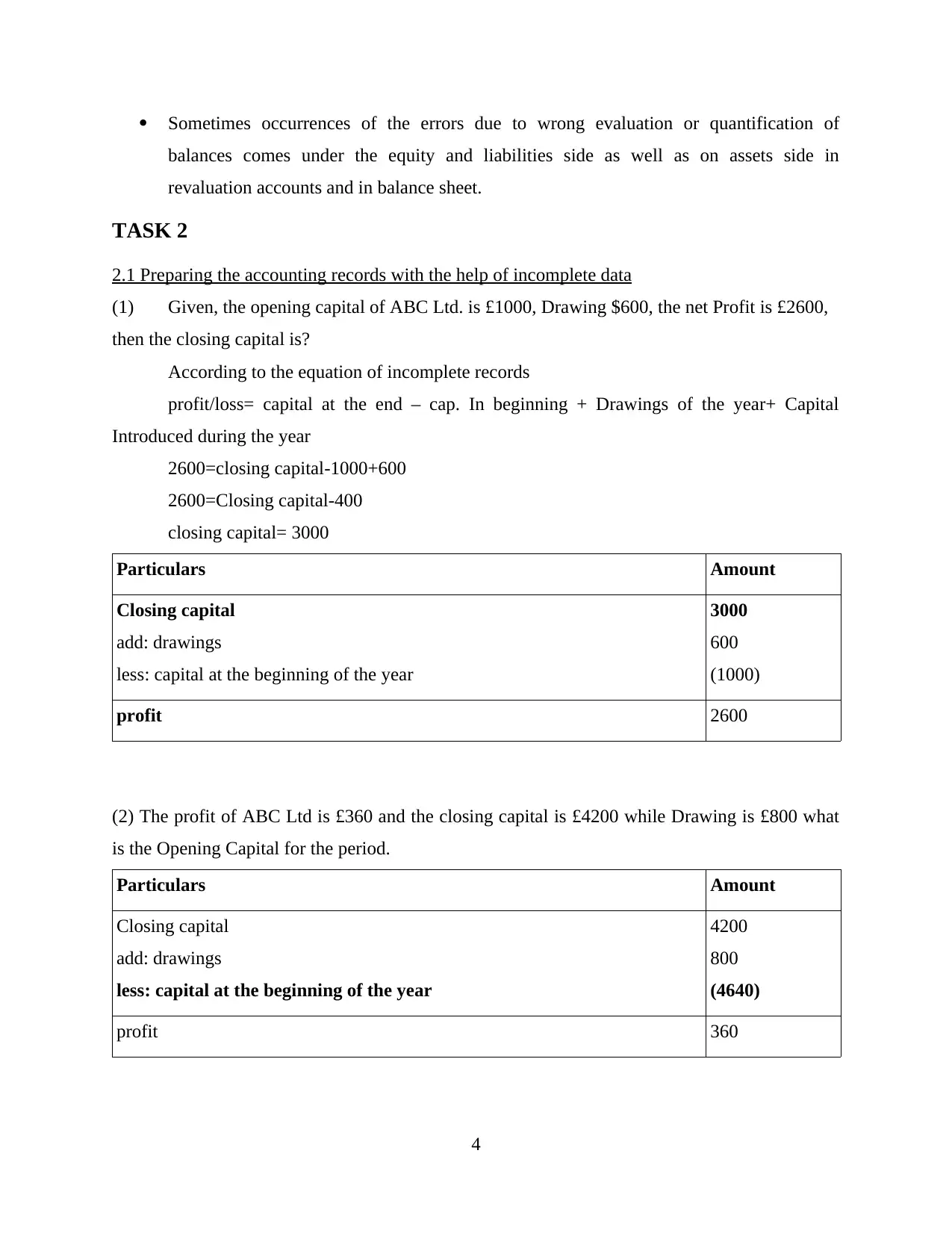
2.1 Preparing the accounting records with the help of incomplete data
(1) Given, the opening capital of ABC Ltd. is £1000, Drawing $600, the net Profit is £2600,
then the closing capital is?
According to the equation of incomplete records
profit/loss= capital at the end – cap. In beginning + Drawings of the year+ Capital
Introduced during the year
2600=closing capital-1000+600
2600=Closing capital-400
closing capital= 3000
Particulars Amount
Closing capital
add: drawings
less: capital at the beginning of the year
3000
600
(1000)
profit 2600
(2) The profit of ABC Ltd is £360 and the closing capital is £4200 while Drawing is £800 what
is the Opening Capital for the period.
Particulars Amount
Closing capital
add: drawings
less: capital at the beginning of the year
4200
800
(4640)
profit 360
4
balances comes under the equity and liabilities side as well as on assets side in
revaluation accounts and in balance sheet.
TASK 2
2.1 Preparing the accounting records with the help of incomplete data
(1) Given, the opening capital of ABC Ltd. is £1000, Drawing $600, the net Profit is £2600,
then the closing capital is?
According to the equation of incomplete records
profit/loss= capital at the end – cap. In beginning + Drawings of the year+ Capital
Introduced during the year
2600=closing capital-1000+600
2600=Closing capital-400
closing capital= 3000
Particulars Amount
Closing capital
add: drawings
less: capital at the beginning of the year
3000
600
(1000)
profit 2600
(2) The profit of ABC Ltd is £360 and the closing capital is £4200 while Drawing is £800 what
is the Opening Capital for the period.
Particulars Amount
Closing capital
add: drawings
less: capital at the beginning of the year
4200
800
(4640)
profit 360
4
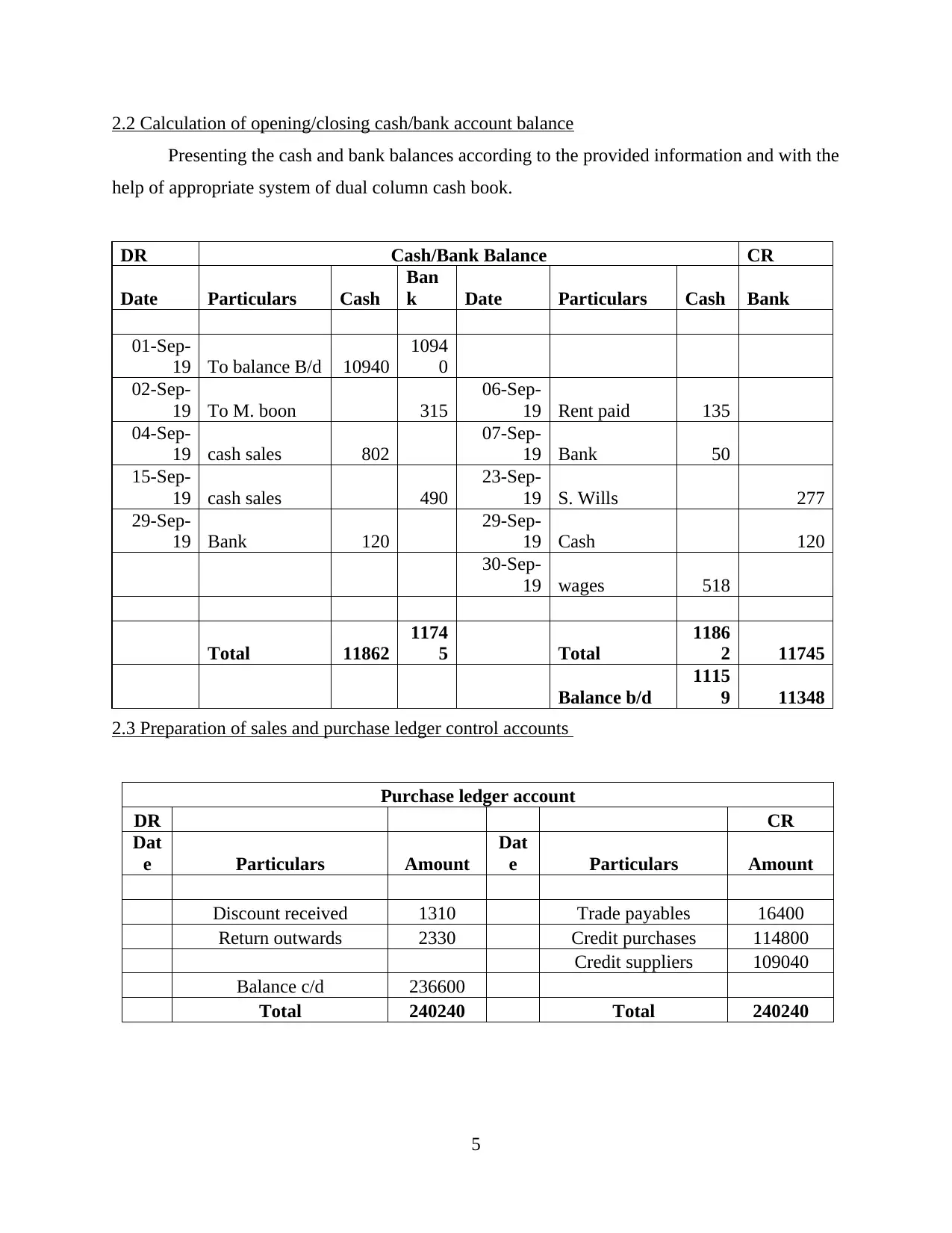
2.2 Calculation of opening/closing cash/bank account balance
Presenting the cash and bank balances according to the provided information and with the
help of appropriate system of dual column cash book.
DR Cash/Bank Balance CR
Date Particulars Cash
Ban
k Date Particulars Cash Bank
01-Sep-
19 To balance B/d 10940
1094
0
02-Sep-
19 To M. boon 315
06-Sep-
19 Rent paid 135
04-Sep-
19 cash sales 802
07-Sep-
19 Bank 50
15-Sep-
19 cash sales 490
23-Sep-
19 S. Wills 277
29-Sep-
19 Bank 120
29-Sep-
19 Cash 120
30-Sep-
19 wages 518
Total 11862
1174
5 Total
1186
2 11745
Balance b/d
1115
9 11348
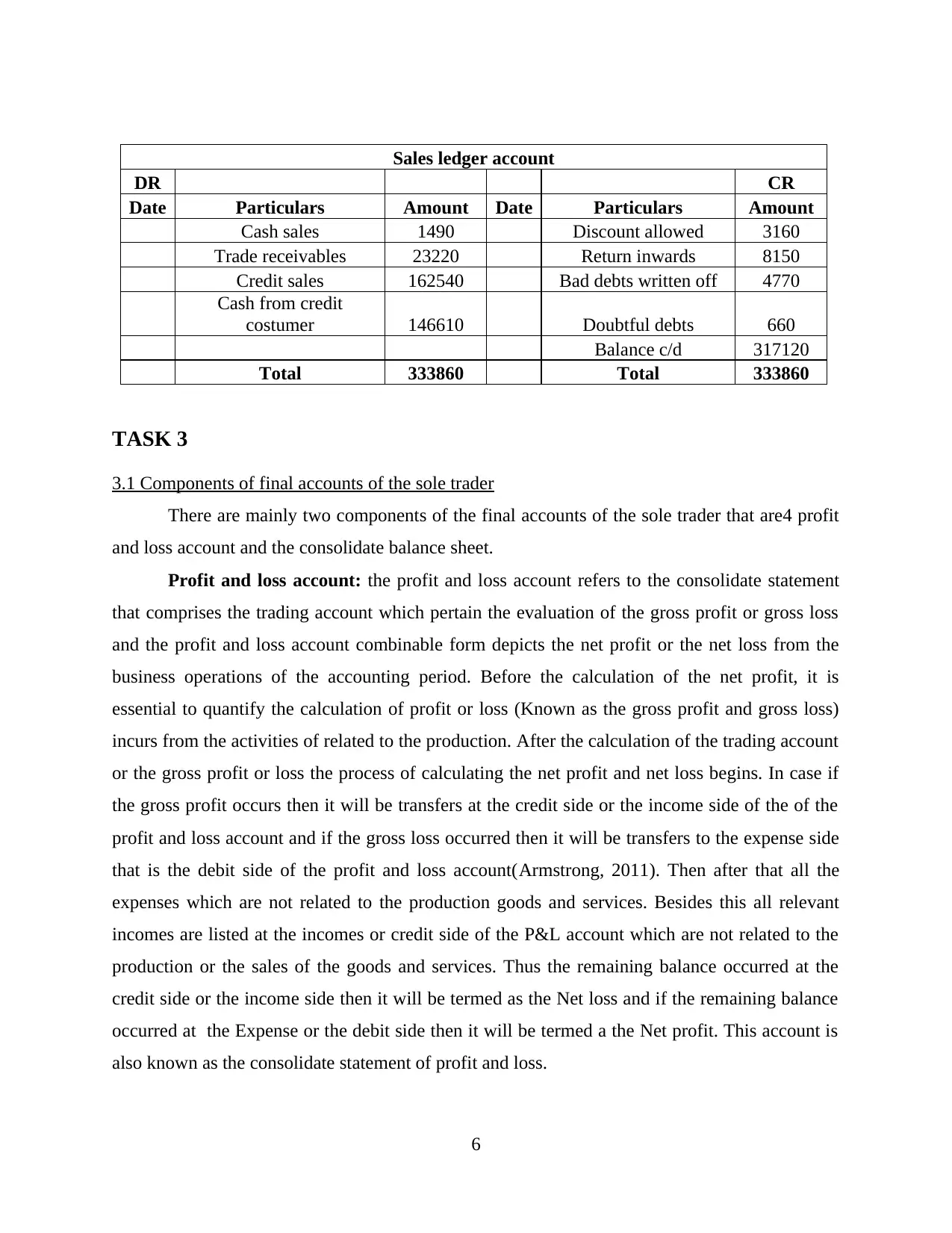
2.3 Preparation of sales and purchase ledger control accounts
Purchase ledger account
DR CR
Dat
e Particulars Amount
Dat
e Particulars Amount
Discount received 1310 Trade payables 16400
Return outwards 2330 Credit purchases 114800
Credit suppliers 109040
Balance c/d 236600
Total 240240 Total 240240
5
Presenting the cash and bank balances according to the provided information and with the
help of appropriate system of dual column cash book.
DR Cash/Bank Balance CR
Date Particulars Cash
Ban
k Date Particulars Cash Bank
01-Sep-
19 To balance B/d 10940
1094
0
02-Sep-
19 To M. boon 315
06-Sep-
19 Rent paid 135
04-Sep-
19 cash sales 802
07-Sep-
19 Bank 50
15-Sep-
19 cash sales 490
23-Sep-
19 S. Wills 277
29-Sep-
19 Bank 120
29-Sep-
19 Cash 120
30-Sep-
19 wages 518
Total 11862
1174
5 Total
1186
2 11745
Balance b/d
1115
9 11348
2.3 Preparation of sales and purchase ledger control accounts
Purchase ledger account
DR CR
Dat
e Particulars Amount
Dat
e Particulars Amount
Discount received 1310 Trade payables 16400
Return outwards 2330 Credit purchases 114800
Credit suppliers 109040
Balance c/d 236600
Total 240240 Total 240240
5
⊘ This is a preview!⊘
Do you want full access?
Subscribe today to unlock all pages.
Trusted by 1+ million students worldwide
Sales ledger account
DR CR
Date Particulars Amount Date Particulars Amount
Cash sales 1490 Discount allowed 3160
Trade receivables 23220 Return inwards 8150
Credit sales 162540 Bad debts written off 4770
Cash from credit
costumer 146610 Doubtful debts 660
Balance c/d 317120
Total 333860 Total 333860
TASK 3
3.1 Components of final accounts of the sole trader
There are mainly two components of the final accounts of the sole trader that are4 profit
and loss account and the consolidate balance sheet.
Profit and loss account: the profit and loss account refers to the consolidate statement
that comprises the trading account which pertain the evaluation of the gross profit or gross loss
and the profit and loss account combinable form depicts the net profit or the net loss from the
business operations of the accounting period. Before the calculation of the net profit, it is
essential to quantify the calculation of profit or loss (Known as the gross profit and gross loss)
incurs from the activities of related to the production. After the calculation of the trading account
or the gross profit or loss the process of calculating the net profit and net loss begins. In case if
the gross profit occurs then it will be transfers at the credit side or the income side of the of the
profit and loss account and if the gross loss occurred then it will be transfers to the expense side
that is the debit side of the profit and loss account(Armstrong, 2011). Then after that all the
expenses which are not related to the production goods and services. Besides this all relevant
incomes are listed at the incomes or credit side of the P&L account which are not related to the
production or the sales of the goods and services. Thus the remaining balance occurred at the
credit side or the income side then it will be termed as the Net loss and if the remaining balance
occurred at the Expense or the debit side then it will be termed a the Net profit. This account is
also known as the consolidate statement of profit and loss.
6
DR CR
Date Particulars Amount Date Particulars Amount
Cash sales 1490 Discount allowed 3160
Trade receivables 23220 Return inwards 8150
Credit sales 162540 Bad debts written off 4770
Cash from credit
costumer 146610 Doubtful debts 660
Balance c/d 317120
Total 333860 Total 333860
TASK 3
3.1 Components of final accounts of the sole trader
There are mainly two components of the final accounts of the sole trader that are4 profit
and loss account and the consolidate balance sheet.
Profit and loss account: the profit and loss account refers to the consolidate statement
that comprises the trading account which pertain the evaluation of the gross profit or gross loss
and the profit and loss account combinable form depicts the net profit or the net loss from the
business operations of the accounting period. Before the calculation of the net profit, it is
essential to quantify the calculation of profit or loss (Known as the gross profit and gross loss)
incurs from the activities of related to the production. After the calculation of the trading account
or the gross profit or loss the process of calculating the net profit and net loss begins. In case if
the gross profit occurs then it will be transfers at the credit side or the income side of the of the
profit and loss account and if the gross loss occurred then it will be transfers to the expense side
that is the debit side of the profit and loss account(Armstrong, 2011). Then after that all the
expenses which are not related to the production goods and services. Besides this all relevant
incomes are listed at the incomes or credit side of the P&L account which are not related to the
production or the sales of the goods and services. Thus the remaining balance occurred at the
credit side or the income side then it will be termed as the Net loss and if the remaining balance
occurred at the Expense or the debit side then it will be termed a the Net profit. This account is
also known as the consolidate statement of profit and loss.
6
Paraphrase This Document
Need a fresh take? Get an instant paraphrase of this document with our AI Paraphraser
Balance sheet: This financial statement also known as the consolidate statement of
balance sheet that depicts the financial performance of the business entity by depicting the exact
values of assets and liabilities as well as the owners’ equity or owner's capital to show the the net
worth or financial position of the business entity. Mainly the balance sheet pertain two sides that
are mainly concerned with assets and liabilities. The assets side involves the items such as
premises, prepaid expenses, fictitious assets, inventories, or all the valuable assets held with the
business organisation and the liabilities sides involves the items like the equity after the
adjustment of net profit or loss and drawings etc(Otsuki, 2011). outstanding expenses and all
other obligatory items held with the organisation. The amount of the both assets and liabilities
must be equal then only it will considered as the accurate procedure is followed.
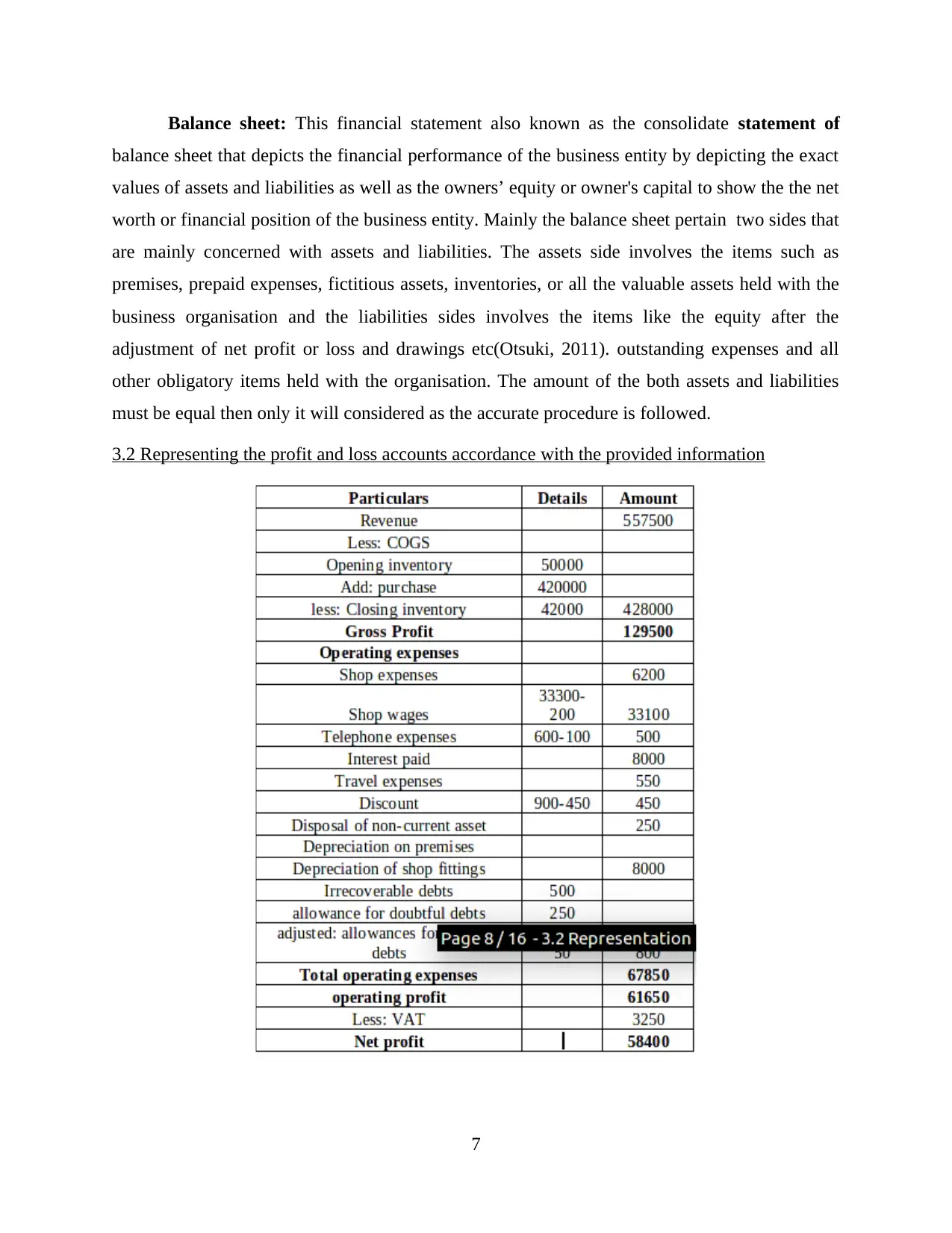
3.2 Representing the profit and loss accounts accordance with the provided information
7
balance sheet that depicts the financial performance of the business entity by depicting the exact
values of assets and liabilities as well as the owners’ equity or owner's capital to show the the net
worth or financial position of the business entity. Mainly the balance sheet pertain two sides that
are mainly concerned with assets and liabilities. The assets side involves the items such as
premises, prepaid expenses, fictitious assets, inventories, or all the valuable assets held with the
business organisation and the liabilities sides involves the items like the equity after the
adjustment of net profit or loss and drawings etc(Otsuki, 2011). outstanding expenses and all
other obligatory items held with the organisation. The amount of the both assets and liabilities
must be equal then only it will considered as the accurate procedure is followed.
3.2 Representing the profit and loss accounts accordance with the provided information
7
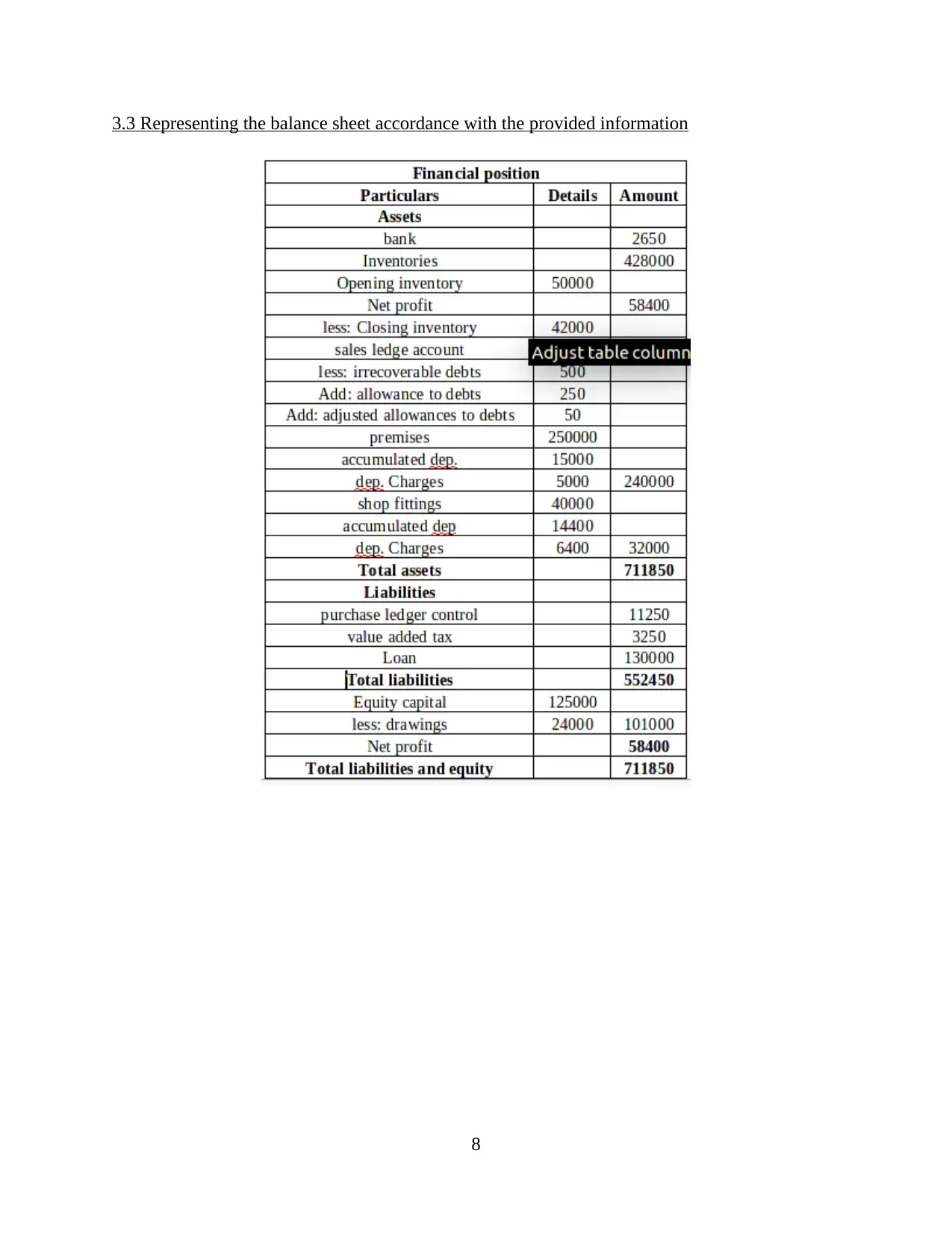
3.3 Representing the balance sheet accordance with the provided information
8
8
⊘ This is a preview!⊘
Do you want full access?
Subscribe today to unlock all pages.
Trusted by 1+ million students worldwide

1 out of 20


Related Documents


Your All-in-One AI-Powered Toolkit for Academic Success.
+13062052269
info@desklib.com
Available 24*7 on WhatsApp / Email
![[object Object]](/_next/static/media/star-bottom.7253800d.svg)
Unlock your academic potential
Copyright © 2020–2026 A2Z Services. All Rights Reserved. Developed and managed by ZUCOL.