Preparing Final Accounts of Sole Traders and Partnerships Report
VerifiedAdded on 2020/12/26
|22
|4266
|412
Report
AI Summary
This comprehensive report delves into the intricacies of preparing final accounts for both sole traders and partnerships. It begins by outlining the reasons for closing accounts and producing a trial balance, discussing the process and limitations of preparing final accounts from a trial balance, and exploring methods for constructing accounts from incomplete records. The report further addresses imbalances resulting from incorrect double entries and incomplete records. It then guides the reader through calculating opening and closing capital, cash/bank balances, and preparing sales and purchase ledger control accounts. The report also covers the preparation of statements of profit or loss and financial positions for sole traders, followed by a detailed examination of partnership agreements, partnership accounts, and the statement of profit or loss appropriation account. Finally, it provides guidance on calculating closing balances for partners and preparing the statement of financial position in compliance with the partnership agreement. The report provides a thorough understanding of the processes involved in preparing final accounts for these business structures.

Prepare Final Accounts
of Sole Traders and
Partnership
of Sole Traders and
Partnership

Paraphrase This Document
Need a fresh take? Get an instant paraphrase of this document with our AI Paraphraser
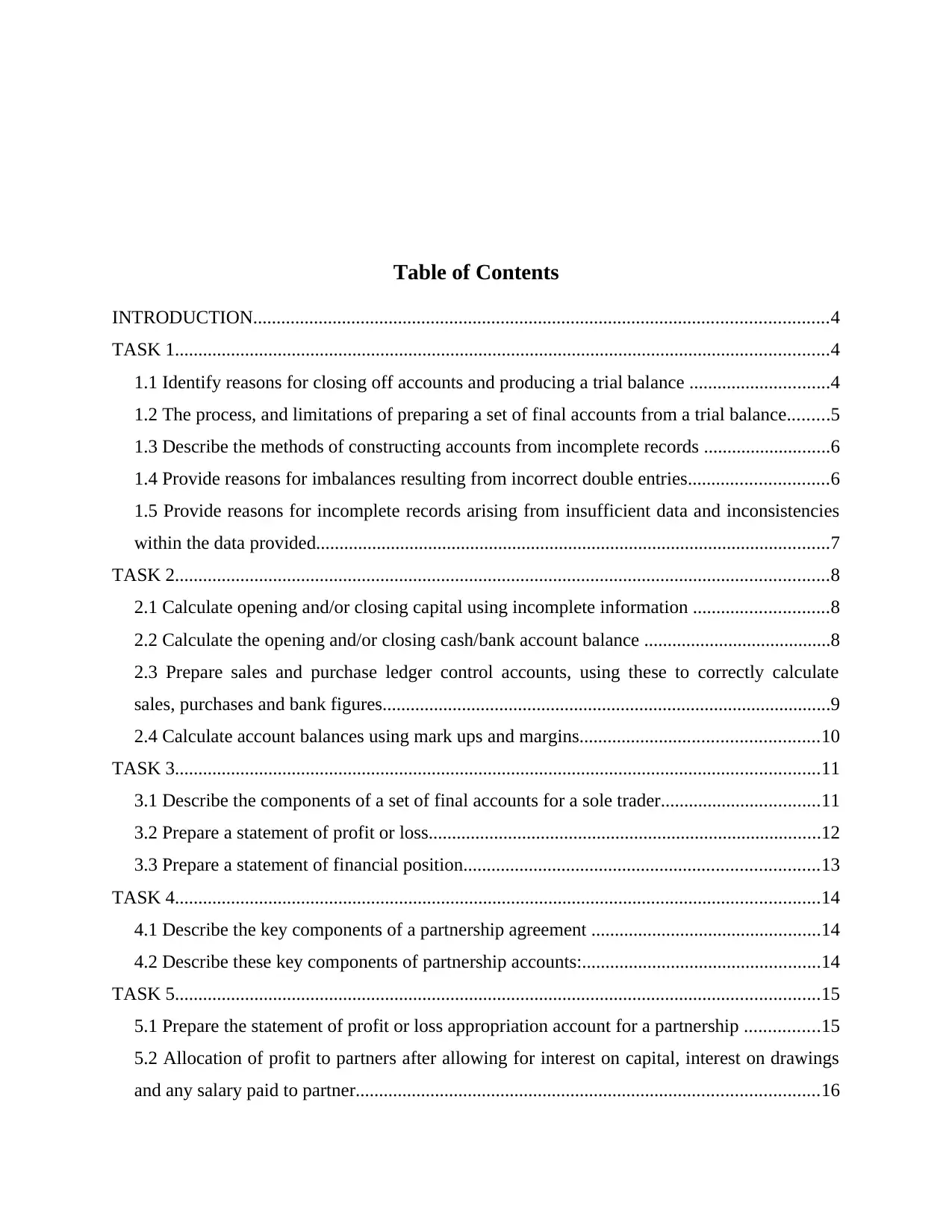
Table of Contents
INTRODUCTION...........................................................................................................................4
TASK 1............................................................................................................................................4
1.1 Identify reasons for closing off accounts and producing a trial balance ..............................4
1.2 The process, and limitations of preparing a set of final accounts from a trial balance.........5
1.3 Describe the methods of constructing accounts from incomplete records ...........................6
1.4 Provide reasons for imbalances resulting from incorrect double entries..............................6
1.5 Provide reasons for incomplete records arising from insufficient data and inconsistencies
within the data provided..............................................................................................................7
TASK 2............................................................................................................................................8
2.1 Calculate opening and/or closing capital using incomplete information .............................8
2.2 Calculate the opening and/or closing cash/bank account balance ........................................8
2.3 Prepare sales and purchase ledger control accounts, using these to correctly calculate
sales, purchases and bank figures................................................................................................9
2.4 Calculate account balances using mark ups and margins...................................................10
TASK 3..........................................................................................................................................11
3.1 Describe the components of a set of final accounts for a sole trader..................................11
3.2 Prepare a statement of profit or loss....................................................................................12
3.3 Prepare a statement of financial position............................................................................13
TASK 4..........................................................................................................................................14
4.1 Describe the key components of a partnership agreement .................................................14
4.2 Describe these key components of partnership accounts:...................................................14
TASK 5..........................................................................................................................................15
5.1 Prepare the statement of profit or loss appropriation account for a partnership ................15
5.2 Allocation of profit to partners after allowing for interest on capital, interest on drawings
and any salary paid to partner...................................................................................................16
INTRODUCTION...........................................................................................................................4
TASK 1............................................................................................................................................4
1.1 Identify reasons for closing off accounts and producing a trial balance ..............................4
1.2 The process, and limitations of preparing a set of final accounts from a trial balance.........5
1.3 Describe the methods of constructing accounts from incomplete records ...........................6
1.4 Provide reasons for imbalances resulting from incorrect double entries..............................6
1.5 Provide reasons for incomplete records arising from insufficient data and inconsistencies
within the data provided..............................................................................................................7
TASK 2............................................................................................................................................8
2.1 Calculate opening and/or closing capital using incomplete information .............................8
2.2 Calculate the opening and/or closing cash/bank account balance ........................................8
2.3 Prepare sales and purchase ledger control accounts, using these to correctly calculate
sales, purchases and bank figures................................................................................................9
2.4 Calculate account balances using mark ups and margins...................................................10
TASK 3..........................................................................................................................................11
3.1 Describe the components of a set of final accounts for a sole trader..................................11
3.2 Prepare a statement of profit or loss....................................................................................12
3.3 Prepare a statement of financial position............................................................................13
TASK 4..........................................................................................................................................14
4.1 Describe the key components of a partnership agreement .................................................14
4.2 Describe these key components of partnership accounts:...................................................14
TASK 5..........................................................................................................................................15
5.1 Prepare the statement of profit or loss appropriation account for a partnership ................15
5.2 Allocation of profit to partners after allowing for interest on capital, interest on drawings
and any salary paid to partner...................................................................................................16
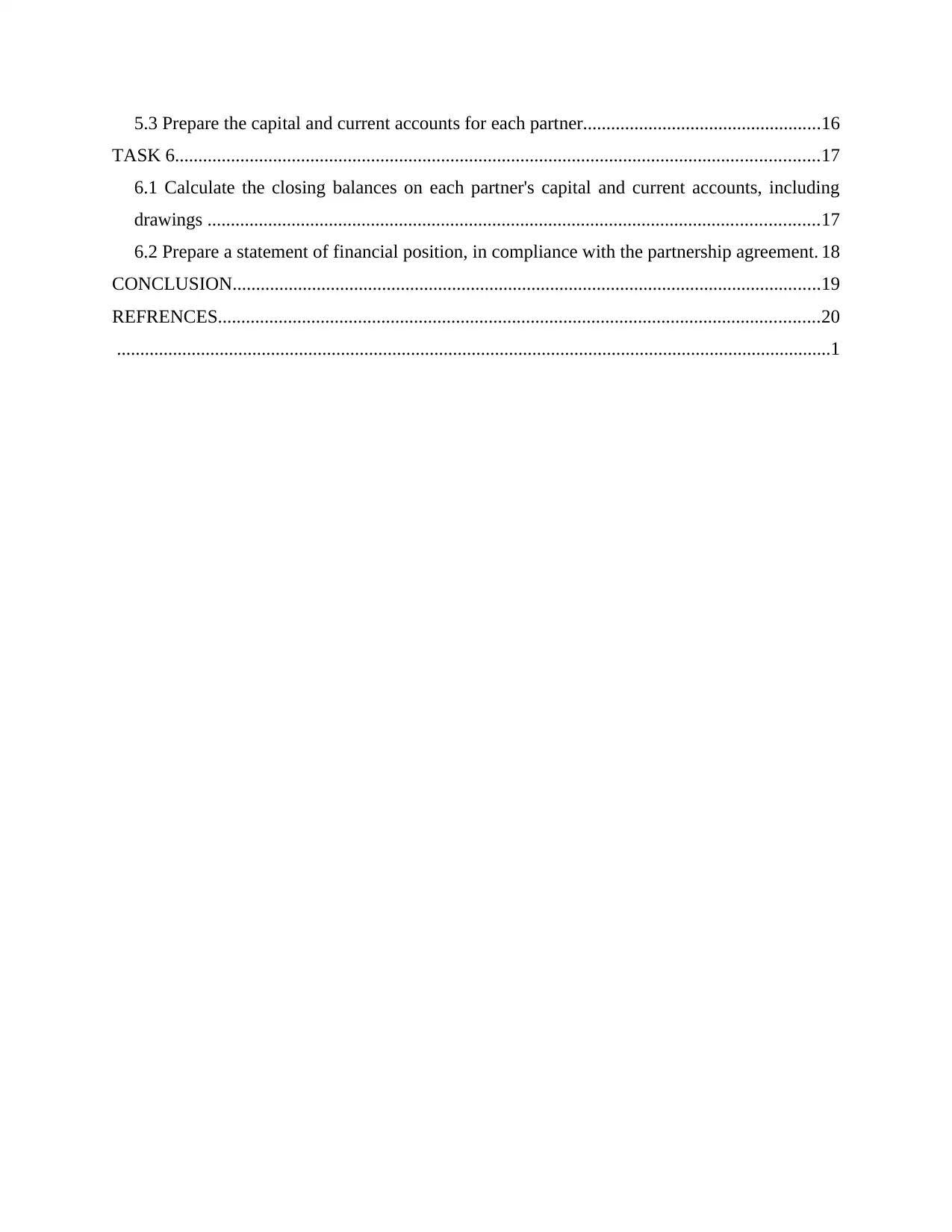
5.3 Prepare the capital and current accounts for each partner...................................................16
TASK 6..........................................................................................................................................17
6.1 Calculate the closing balances on each partner's capital and current accounts, including
drawings ...................................................................................................................................17
6.2 Prepare a statement of financial position, in compliance with the partnership agreement. 18
CONCLUSION..............................................................................................................................19
REFRENCES.................................................................................................................................20
.........................................................................................................................................................1
TASK 6..........................................................................................................................................17
6.1 Calculate the closing balances on each partner's capital and current accounts, including
drawings ...................................................................................................................................17
6.2 Prepare a statement of financial position, in compliance with the partnership agreement. 18
CONCLUSION..............................................................................................................................19
REFRENCES.................................................................................................................................20
.........................................................................................................................................................1
⊘ This is a preview!⊘
Do you want full access?
Subscribe today to unlock all pages.

Trusted by 1+ million students worldwide
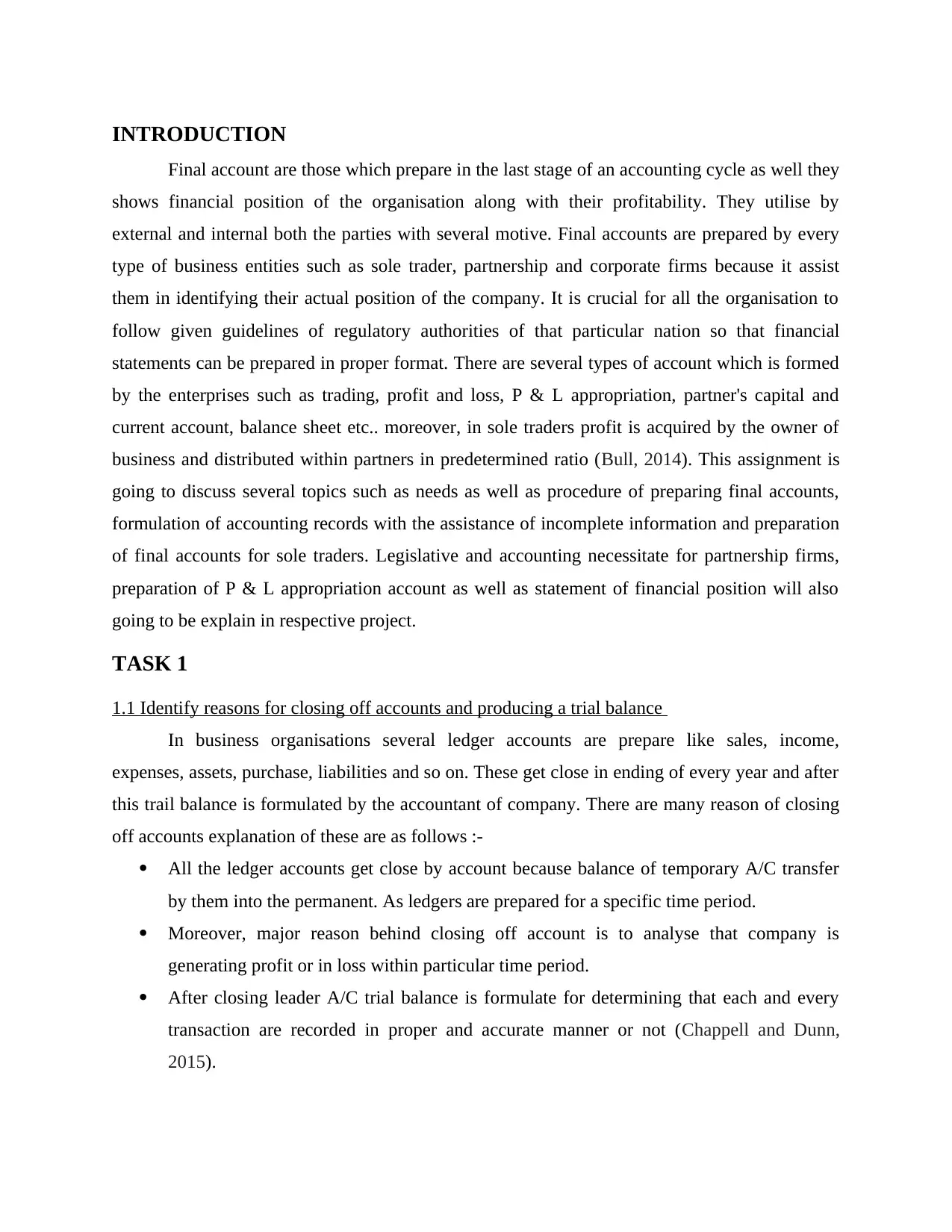
INTRODUCTION
Final account are those which prepare in the last stage of an accounting cycle as well they
shows financial position of the organisation along with their profitability. They utilise by
external and internal both the parties with several motive. Final accounts are prepared by every
type of business entities such as sole trader, partnership and corporate firms because it assist
them in identifying their actual position of the company. It is crucial for all the organisation to
follow given guidelines of regulatory authorities of that particular nation so that financial
statements can be prepared in proper format. There are several types of account which is formed
by the enterprises such as trading, profit and loss, P & L appropriation, partner's capital and
current account, balance sheet etc.. moreover, in sole traders profit is acquired by the owner of
business and distributed within partners in predetermined ratio (Bull, 2014). This assignment is
going to discuss several topics such as needs as well as procedure of preparing final accounts,
formulation of accounting records with the assistance of incomplete information and preparation
of final accounts for sole traders. Legislative and accounting necessitate for partnership firms,
preparation of P & L appropriation account as well as statement of financial position will also
going to be explain in respective project.
TASK 1
1.1 Identify reasons for closing off accounts and producing a trial balance
In business organisations several ledger accounts are prepare like sales, income,
expenses, assets, purchase, liabilities and so on. These get close in ending of every year and after
this trail balance is formulated by the accountant of company. There are many reason of closing
off accounts explanation of these are as follows :-
All the ledger accounts get close by account because balance of temporary A/C transfer
by them into the permanent. As ledgers are prepared for a specific time period.
Moreover, major reason behind closing off account is to analyse that company is
generating profit or in loss within particular time period.
After closing leader A/C trial balance is formulate for determining that each and every
transaction are recorded in proper and accurate manner or not (Chappell and Dunn,
2015).
Final account are those which prepare in the last stage of an accounting cycle as well they
shows financial position of the organisation along with their profitability. They utilise by
external and internal both the parties with several motive. Final accounts are prepared by every
type of business entities such as sole trader, partnership and corporate firms because it assist
them in identifying their actual position of the company. It is crucial for all the organisation to
follow given guidelines of regulatory authorities of that particular nation so that financial
statements can be prepared in proper format. There are several types of account which is formed
by the enterprises such as trading, profit and loss, P & L appropriation, partner's capital and
current account, balance sheet etc.. moreover, in sole traders profit is acquired by the owner of
business and distributed within partners in predetermined ratio (Bull, 2014). This assignment is
going to discuss several topics such as needs as well as procedure of preparing final accounts,
formulation of accounting records with the assistance of incomplete information and preparation
of final accounts for sole traders. Legislative and accounting necessitate for partnership firms,
preparation of P & L appropriation account as well as statement of financial position will also
going to be explain in respective project.
TASK 1
1.1 Identify reasons for closing off accounts and producing a trial balance
In business organisations several ledger accounts are prepare like sales, income,
expenses, assets, purchase, liabilities and so on. These get close in ending of every year and after
this trail balance is formulated by the accountant of company. There are many reason of closing
off accounts explanation of these are as follows :-
All the ledger accounts get close by account because balance of temporary A/C transfer
by them into the permanent. As ledgers are prepared for a specific time period.
Moreover, major reason behind closing off account is to analyse that company is
generating profit or in loss within particular time period.
After closing leader A/C trial balance is formulate for determining that each and every
transaction are recorded in proper and accurate manner or not (Chappell and Dunn,
2015).
Paraphrase This Document
Need a fresh take? Get an instant paraphrase of this document with our AI Paraphraser
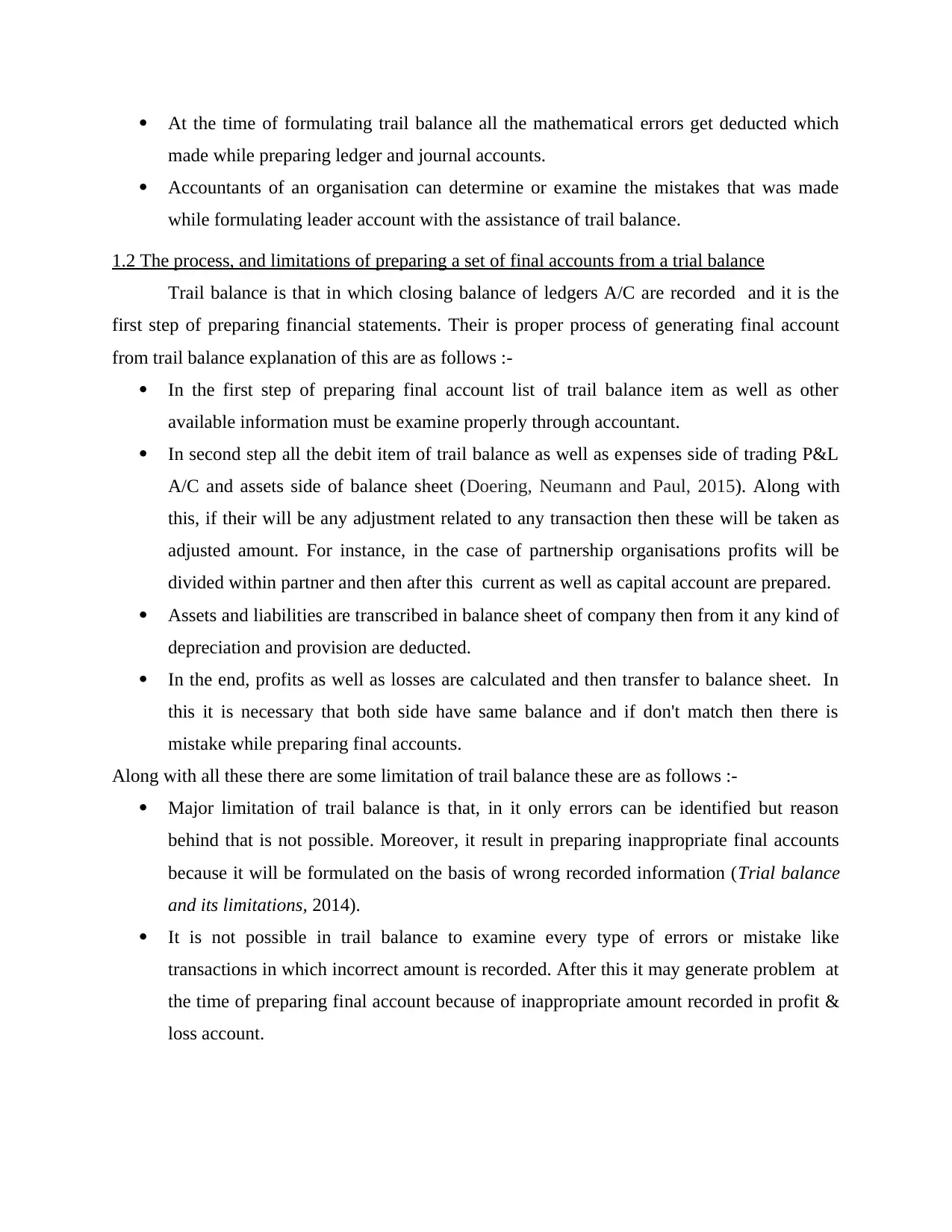
At the time of formulating trail balance all the mathematical errors get deducted which
made while preparing ledger and journal accounts.
Accountants of an organisation can determine or examine the mistakes that was made
while formulating leader account with the assistance of trail balance.
1.2 The process, and limitations of preparing a set of final accounts from a trial balance
Trail balance is that in which closing balance of ledgers A/C are recorded and it is the
first step of preparing financial statements. Their is proper process of generating final account
from trail balance explanation of this are as follows :-
In the first step of preparing final account list of trail balance item as well as other
available information must be examine properly through accountant.
In second step all the debit item of trail balance as well as expenses side of trading P&L
A/C and assets side of balance sheet (Doering, Neumann and Paul, 2015). Along with
this, if their will be any adjustment related to any transaction then these will be taken as
adjusted amount. For instance, in the case of partnership organisations profits will be
divided within partner and then after this current as well as capital account are prepared.
Assets and liabilities are transcribed in balance sheet of company then from it any kind of
depreciation and provision are deducted.
In the end, profits as well as losses are calculated and then transfer to balance sheet. In
this it is necessary that both side have same balance and if don't match then there is
mistake while preparing final accounts.
Along with all these there are some limitation of trail balance these are as follows :-
Major limitation of trail balance is that, in it only errors can be identified but reason
behind that is not possible. Moreover, it result in preparing inappropriate final accounts
because it will be formulated on the basis of wrong recorded information (Trial balance
and its limitations, 2014).
It is not possible in trail balance to examine every type of errors or mistake like
transactions in which incorrect amount is recorded. After this it may generate problem at
the time of preparing final account because of inappropriate amount recorded in profit &
loss account.
made while preparing ledger and journal accounts.
Accountants of an organisation can determine or examine the mistakes that was made
while formulating leader account with the assistance of trail balance.
1.2 The process, and limitations of preparing a set of final accounts from a trial balance
Trail balance is that in which closing balance of ledgers A/C are recorded and it is the
first step of preparing financial statements. Their is proper process of generating final account
from trail balance explanation of this are as follows :-
In the first step of preparing final account list of trail balance item as well as other
available information must be examine properly through accountant.
In second step all the debit item of trail balance as well as expenses side of trading P&L
A/C and assets side of balance sheet (Doering, Neumann and Paul, 2015). Along with
this, if their will be any adjustment related to any transaction then these will be taken as
adjusted amount. For instance, in the case of partnership organisations profits will be
divided within partner and then after this current as well as capital account are prepared.
Assets and liabilities are transcribed in balance sheet of company then from it any kind of
depreciation and provision are deducted.
In the end, profits as well as losses are calculated and then transfer to balance sheet. In
this it is necessary that both side have same balance and if don't match then there is
mistake while preparing final accounts.
Along with all these there are some limitation of trail balance these are as follows :-
Major limitation of trail balance is that, in it only errors can be identified but reason
behind that is not possible. Moreover, it result in preparing inappropriate final accounts
because it will be formulated on the basis of wrong recorded information (Trial balance
and its limitations, 2014).
It is not possible in trail balance to examine every type of errors or mistake like
transactions in which incorrect amount is recorded. After this it may generate problem at
the time of preparing final account because of inappropriate amount recorded in profit &
loss account.
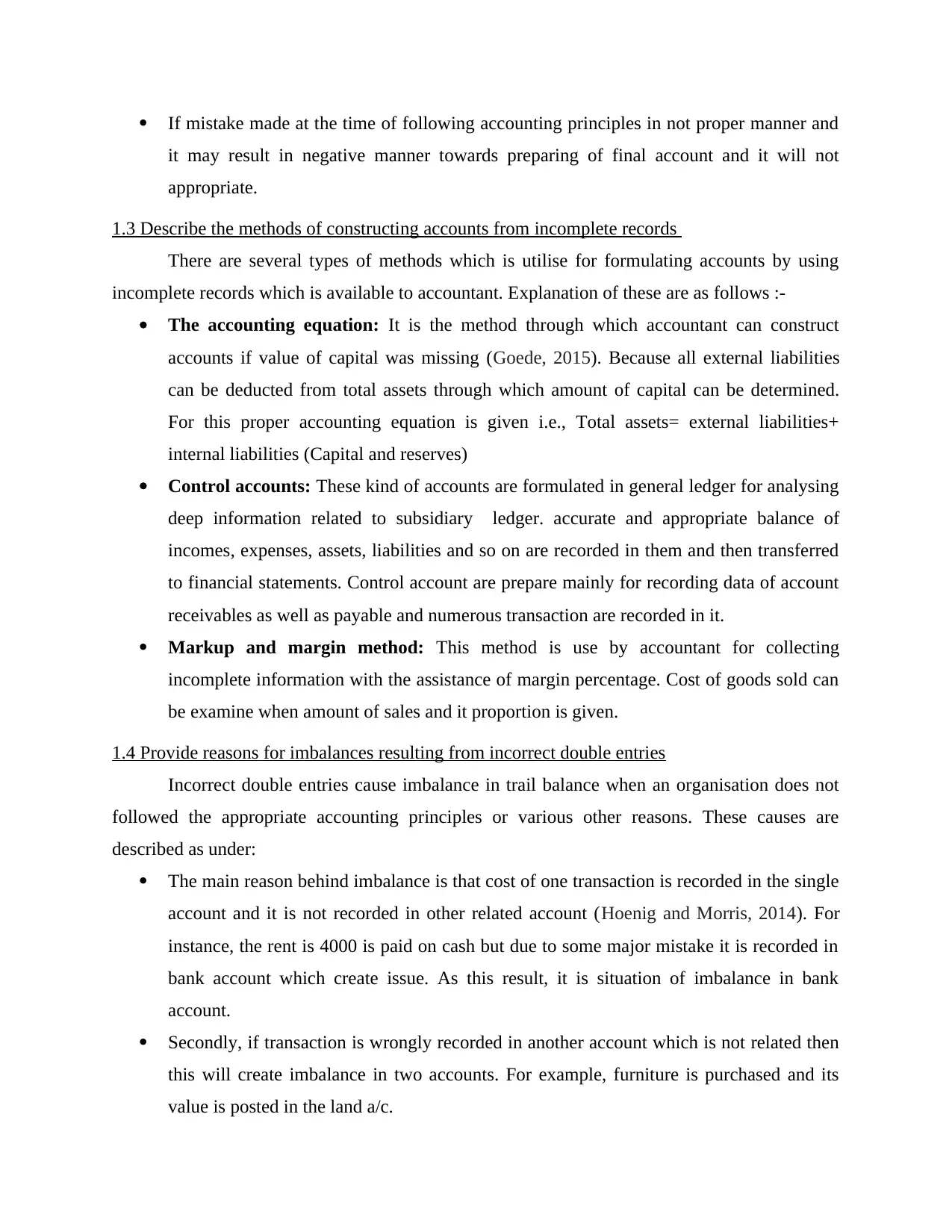
If mistake made at the time of following accounting principles in not proper manner and
it may result in negative manner towards preparing of final account and it will not
appropriate.
1.3 Describe the methods of constructing accounts from incomplete records
There are several types of methods which is utilise for formulating accounts by using
incomplete records which is available to accountant. Explanation of these are as follows :-
The accounting equation: It is the method through which accountant can construct
accounts if value of capital was missing (Goede, 2015). Because all external liabilities
can be deducted from total assets through which amount of capital can be determined.
For this proper accounting equation is given i.e., Total assets= external liabilities+
internal liabilities (Capital and reserves)
Control accounts: These kind of accounts are formulated in general ledger for analysing
deep information related to subsidiary ledger. accurate and appropriate balance of
incomes, expenses, assets, liabilities and so on are recorded in them and then transferred
to financial statements. Control account are prepare mainly for recording data of account
receivables as well as payable and numerous transaction are recorded in it.
Markup and margin method: This method is use by accountant for collecting
incomplete information with the assistance of margin percentage. Cost of goods sold can
be examine when amount of sales and it proportion is given.
1.4 Provide reasons for imbalances resulting from incorrect double entries
Incorrect double entries cause imbalance in trail balance when an organisation does not
followed the appropriate accounting principles or various other reasons. These causes are
described as under:
The main reason behind imbalance is that cost of one transaction is recorded in the single
account and it is not recorded in other related account (Hoenig and Morris, 2014). For
instance, the rent is 4000 is paid on cash but due to some major mistake it is recorded in
bank account which create issue. As this result, it is situation of imbalance in bank
account.
Secondly, if transaction is wrongly recorded in another account which is not related then
this will create imbalance in two accounts. For example, furniture is purchased and its
value is posted in the land a/c.
it may result in negative manner towards preparing of final account and it will not
appropriate.
1.3 Describe the methods of constructing accounts from incomplete records
There are several types of methods which is utilise for formulating accounts by using
incomplete records which is available to accountant. Explanation of these are as follows :-
The accounting equation: It is the method through which accountant can construct
accounts if value of capital was missing (Goede, 2015). Because all external liabilities
can be deducted from total assets through which amount of capital can be determined.
For this proper accounting equation is given i.e., Total assets= external liabilities+
internal liabilities (Capital and reserves)
Control accounts: These kind of accounts are formulated in general ledger for analysing
deep information related to subsidiary ledger. accurate and appropriate balance of
incomes, expenses, assets, liabilities and so on are recorded in them and then transferred
to financial statements. Control account are prepare mainly for recording data of account
receivables as well as payable and numerous transaction are recorded in it.
Markup and margin method: This method is use by accountant for collecting
incomplete information with the assistance of margin percentage. Cost of goods sold can
be examine when amount of sales and it proportion is given.
1.4 Provide reasons for imbalances resulting from incorrect double entries
Incorrect double entries cause imbalance in trail balance when an organisation does not
followed the appropriate accounting principles or various other reasons. These causes are
described as under:
The main reason behind imbalance is that cost of one transaction is recorded in the single
account and it is not recorded in other related account (Hoenig and Morris, 2014). For
instance, the rent is 4000 is paid on cash but due to some major mistake it is recorded in
bank account which create issue. As this result, it is situation of imbalance in bank
account.
Secondly, if transaction is wrongly recorded in another account which is not related then
this will create imbalance in two accounts. For example, furniture is purchased and its
value is posted in the land a/c.
⊘ This is a preview!⊘
Do you want full access?
Subscribe today to unlock all pages.
Trusted by 1+ million students worldwide
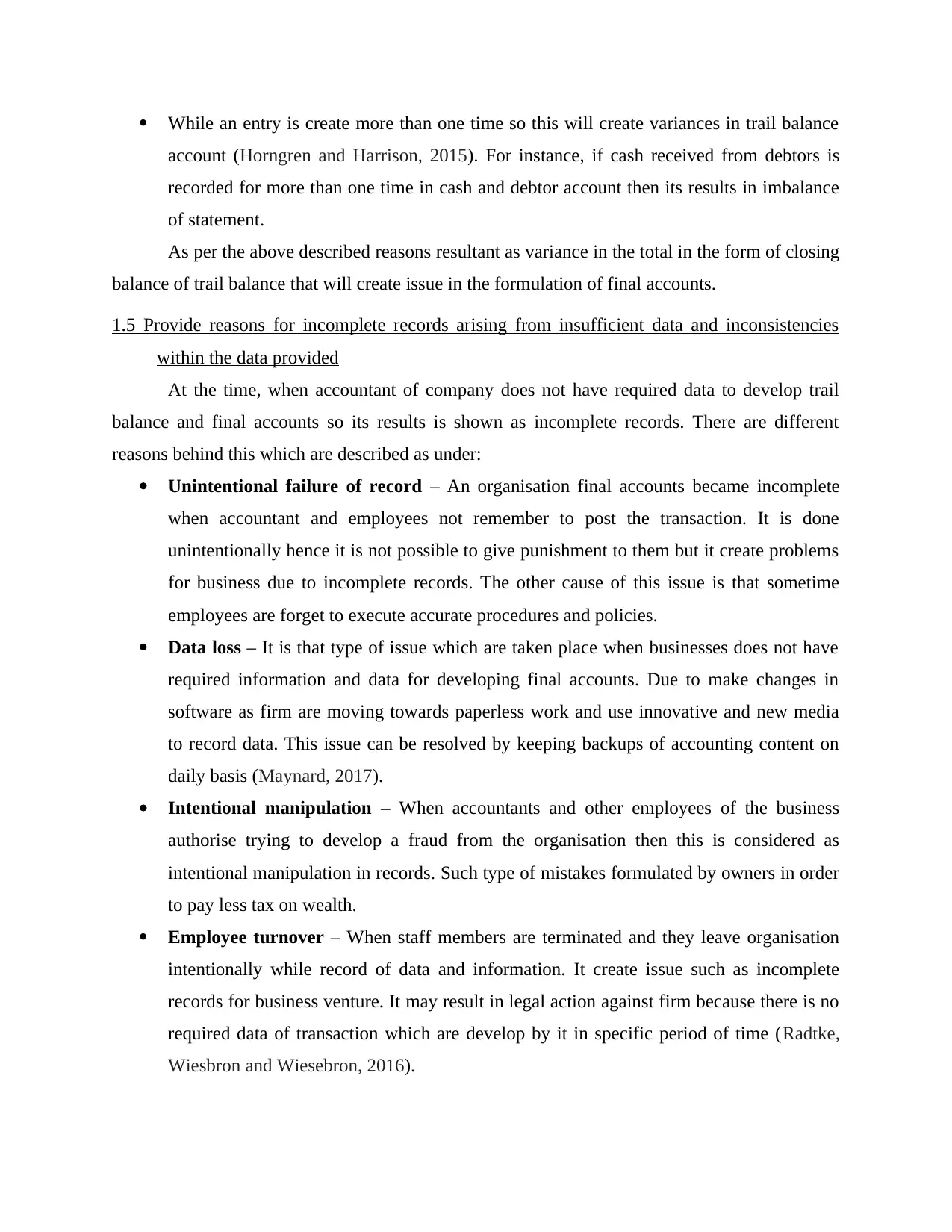
While an entry is create more than one time so this will create variances in trail balance
account (Horngren and Harrison, 2015). For instance, if cash received from debtors is
recorded for more than one time in cash and debtor account then its results in imbalance
of statement.
As per the above described reasons resultant as variance in the total in the form of closing
balance of trail balance that will create issue in the formulation of final accounts.
1.5 Provide reasons for incomplete records arising from insufficient data and inconsistencies
within the data provided
At the time, when accountant of company does not have required data to develop trail
balance and final accounts so its results is shown as incomplete records. There are different
reasons behind this which are described as under:
Unintentional failure of record – An organisation final accounts became incomplete
when accountant and employees not remember to post the transaction. It is done
unintentionally hence it is not possible to give punishment to them but it create problems
for business due to incomplete records. The other cause of this issue is that sometime
employees are forget to execute accurate procedures and policies.
Data loss – It is that type of issue which are taken place when businesses does not have
required information and data for developing final accounts. Due to make changes in
software as firm are moving towards paperless work and use innovative and new media
to record data. This issue can be resolved by keeping backups of accounting content on
daily basis (Maynard, 2017).
Intentional manipulation – When accountants and other employees of the business
authorise trying to develop a fraud from the organisation then this is considered as
intentional manipulation in records. Such type of mistakes formulated by owners in order
to pay less tax on wealth.
Employee turnover – When staff members are terminated and they leave organisation
intentionally while record of data and information. It create issue such as incomplete
records for business venture. It may result in legal action against firm because there is no
required data of transaction which are develop by it in specific period of time (Radtke,
Wiesbron and Wiesebron, 2016).
account (Horngren and Harrison, 2015). For instance, if cash received from debtors is
recorded for more than one time in cash and debtor account then its results in imbalance
of statement.
As per the above described reasons resultant as variance in the total in the form of closing
balance of trail balance that will create issue in the formulation of final accounts.
1.5 Provide reasons for incomplete records arising from insufficient data and inconsistencies
within the data provided
At the time, when accountant of company does not have required data to develop trail
balance and final accounts so its results is shown as incomplete records. There are different
reasons behind this which are described as under:
Unintentional failure of record – An organisation final accounts became incomplete
when accountant and employees not remember to post the transaction. It is done
unintentionally hence it is not possible to give punishment to them but it create problems
for business due to incomplete records. The other cause of this issue is that sometime
employees are forget to execute accurate procedures and policies.
Data loss – It is that type of issue which are taken place when businesses does not have
required information and data for developing final accounts. Due to make changes in
software as firm are moving towards paperless work and use innovative and new media
to record data. This issue can be resolved by keeping backups of accounting content on
daily basis (Maynard, 2017).
Intentional manipulation – When accountants and other employees of the business
authorise trying to develop a fraud from the organisation then this is considered as
intentional manipulation in records. Such type of mistakes formulated by owners in order
to pay less tax on wealth.
Employee turnover – When staff members are terminated and they leave organisation
intentionally while record of data and information. It create issue such as incomplete
records for business venture. It may result in legal action against firm because there is no
required data of transaction which are develop by it in specific period of time (Radtke,
Wiesbron and Wiesebron, 2016).
Paraphrase This Document
Need a fresh take? Get an instant paraphrase of this document with our AI Paraphraser
From the above described points which refers that business enterprises may have
incomplete records due to inadequate data and inconsistency.
TASK 2
2.1 Calculate opening and/or closing capital using incomplete information
Capital account is one of the general ledger account utilise for recording the amount
which paid by an investor in company as well as its contribution in operational activities.
Moreover, balance of respective account are mention in the owner equity, stakeholders equity as
well as partners equity section of balance sheet. Calculation of opening and closing capital are as
follows :-
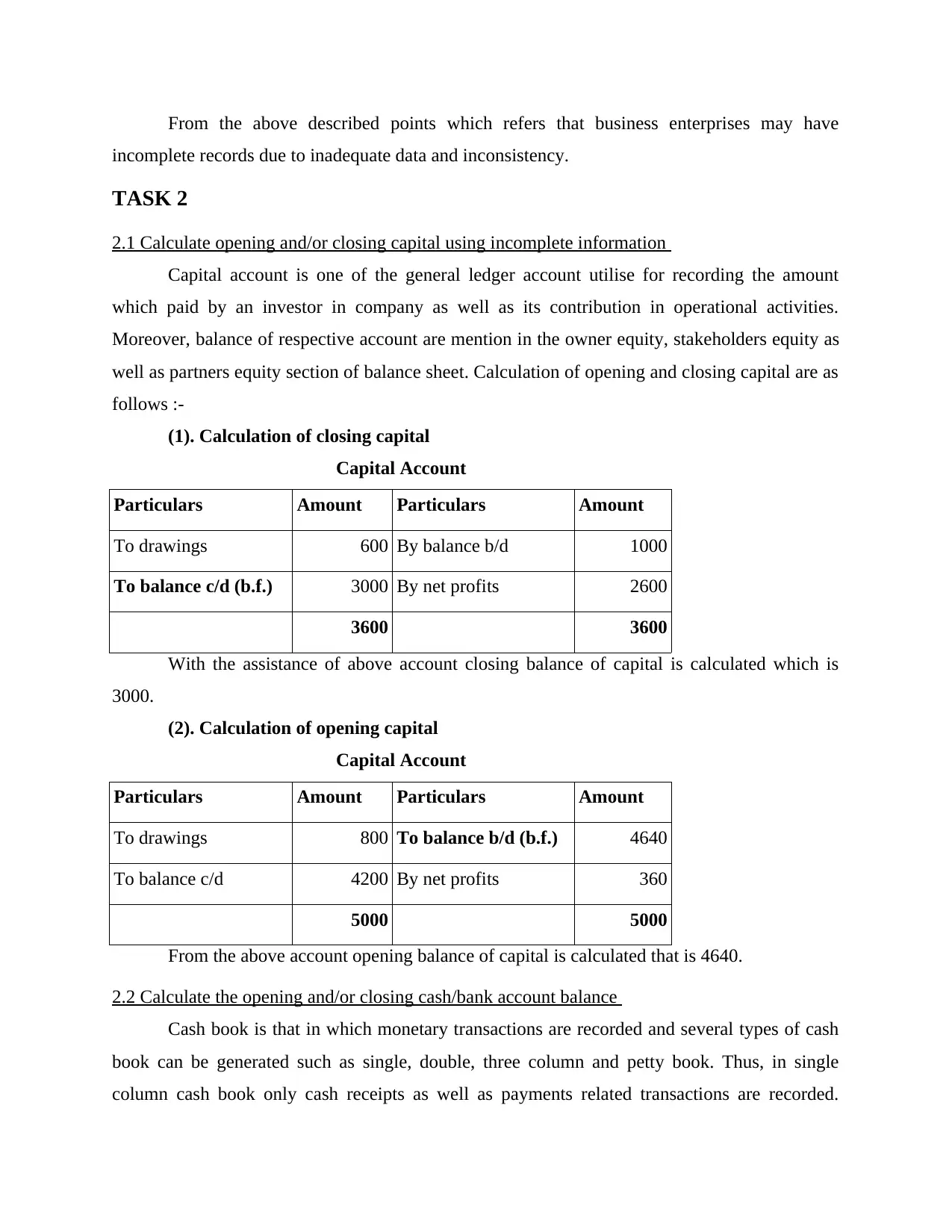
(1). Calculation of closing capital
Capital Account
Particulars Amount Particulars Amount
To drawings 600 By balance b/d 1000
To balance c/d (b.f.) 3000 By net profits 2600
3600 3600
With the assistance of above account closing balance of capital is calculated which is
3000.
(2). Calculation of opening capital
Capital Account
Particulars Amount Particulars Amount
To drawings 800 To balance b/d (b.f.) 4640
To balance c/d 4200 By net profits 360
5000 5000
From the above account opening balance of capital is calculated that is 4640.
2.2 Calculate the opening and/or closing cash/bank account balance
Cash book is that in which monetary transactions are recorded and several types of cash
book can be generated such as single, double, three column and petty book. Thus, in single
column cash book only cash receipts as well as payments related transactions are recorded.
incomplete records due to inadequate data and inconsistency.
TASK 2
2.1 Calculate opening and/or closing capital using incomplete information
Capital account is one of the general ledger account utilise for recording the amount
which paid by an investor in company as well as its contribution in operational activities.
Moreover, balance of respective account are mention in the owner equity, stakeholders equity as
well as partners equity section of balance sheet. Calculation of opening and closing capital are as
follows :-
(1). Calculation of closing capital
Capital Account
Particulars Amount Particulars Amount
To drawings 600 By balance b/d 1000
To balance c/d (b.f.) 3000 By net profits 2600
3600 3600
With the assistance of above account closing balance of capital is calculated which is
3000.
(2). Calculation of opening capital
Capital Account
Particulars Amount Particulars Amount
To drawings 800 To balance b/d (b.f.) 4640
To balance c/d 4200 By net profits 360
5000 5000
From the above account opening balance of capital is calculated that is 4640.
2.2 Calculate the opening and/or closing cash/bank account balance
Cash book is that in which monetary transactions are recorded and several types of cash
book can be generated such as single, double, three column and petty book. Thus, in single
column cash book only cash receipts as well as payments related transactions are recorded.
Whereas, in double column banks and cash related income as well as expenses are recorded.
Moreover, in triple column there are three sections i.e., cash, bank and discount. In petty cash
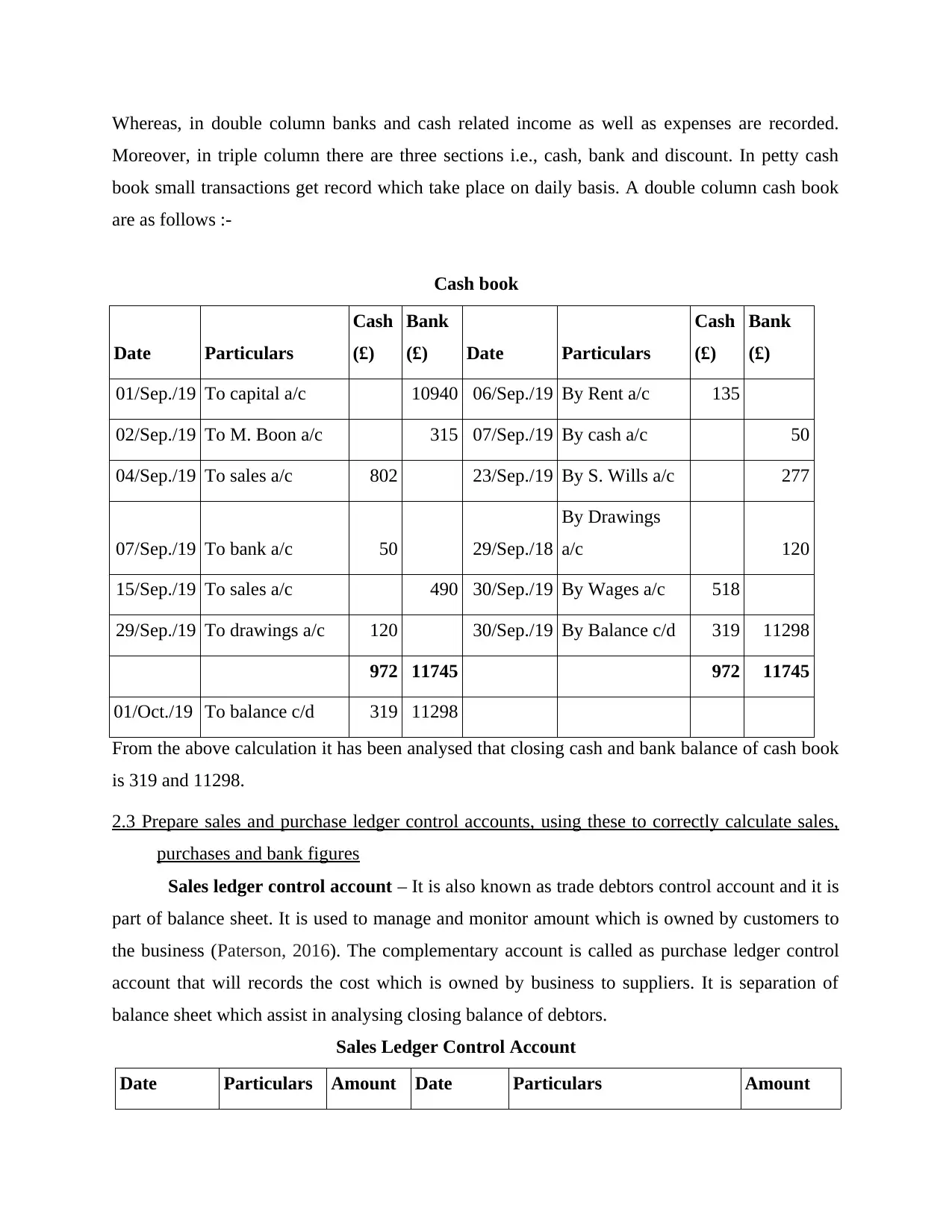
book small transactions get record which take place on daily basis. A double column cash book
are as follows :-
Cash book
Date Particulars
Cash
(£)
Bank
(£) Date Particulars
Cash
(£)
Bank
(£)
01/Sep./19 To capital a/c 10940 06/Sep./19 By Rent a/c 135
02/Sep./19 To M. Boon a/c 315 07/Sep./19 By cash a/c 50
04/Sep./19 To sales a/c 802 23/Sep./19 By S. Wills a/c 277
07/Sep./19 To bank a/c 50 29/Sep./18
By Drawings
a/c 120
15/Sep./19 To sales a/c 490 30/Sep./19 By Wages a/c 518
29/Sep./19 To drawings a/c 120 30/Sep./19 By Balance c/d 319 11298
972 11745 972 11745
01/Oct./19 To balance c/d 319 11298
From the above calculation it has been analysed that closing cash and bank balance of cash book
is 319 and 11298.
2.3 Prepare sales and purchase ledger control accounts, using these to correctly calculate sales,
purchases and bank figures
Sales ledger control account – It is also known as trade debtors control account and it is
part of balance sheet. It is used to manage and monitor amount which is owned by customers to
the business (Paterson, 2016). The complementary account is called as purchase ledger control
account that will records the cost which is owned by business to suppliers. It is separation of
balance sheet which assist in analysing closing balance of debtors.
Sales Ledger Control Account
Date Particulars Amount Date Particulars Amount
Moreover, in triple column there are three sections i.e., cash, bank and discount. In petty cash
book small transactions get record which take place on daily basis. A double column cash book
are as follows :-
Cash book
Date Particulars
Cash
(£)
Bank
(£) Date Particulars
Cash
(£)
Bank
(£)
01/Sep./19 To capital a/c 10940 06/Sep./19 By Rent a/c 135
02/Sep./19 To M. Boon a/c 315 07/Sep./19 By cash a/c 50
04/Sep./19 To sales a/c 802 23/Sep./19 By S. Wills a/c 277
07/Sep./19 To bank a/c 50 29/Sep./18
By Drawings
a/c 120
15/Sep./19 To sales a/c 490 30/Sep./19 By Wages a/c 518
29/Sep./19 To drawings a/c 120 30/Sep./19 By Balance c/d 319 11298
972 11745 972 11745
01/Oct./19 To balance c/d 319 11298
From the above calculation it has been analysed that closing cash and bank balance of cash book
is 319 and 11298.
2.3 Prepare sales and purchase ledger control accounts, using these to correctly calculate sales,
purchases and bank figures
Sales ledger control account – It is also known as trade debtors control account and it is
part of balance sheet. It is used to manage and monitor amount which is owned by customers to
the business (Paterson, 2016). The complementary account is called as purchase ledger control
account that will records the cost which is owned by business to suppliers. It is separation of
balance sheet which assist in analysing closing balance of debtors.
Sales Ledger Control Account
Date Particulars Amount Date Particulars Amount
⊘ This is a preview!⊘
Do you want full access?
Subscribe today to unlock all pages.
Trusted by 1+ million students worldwide
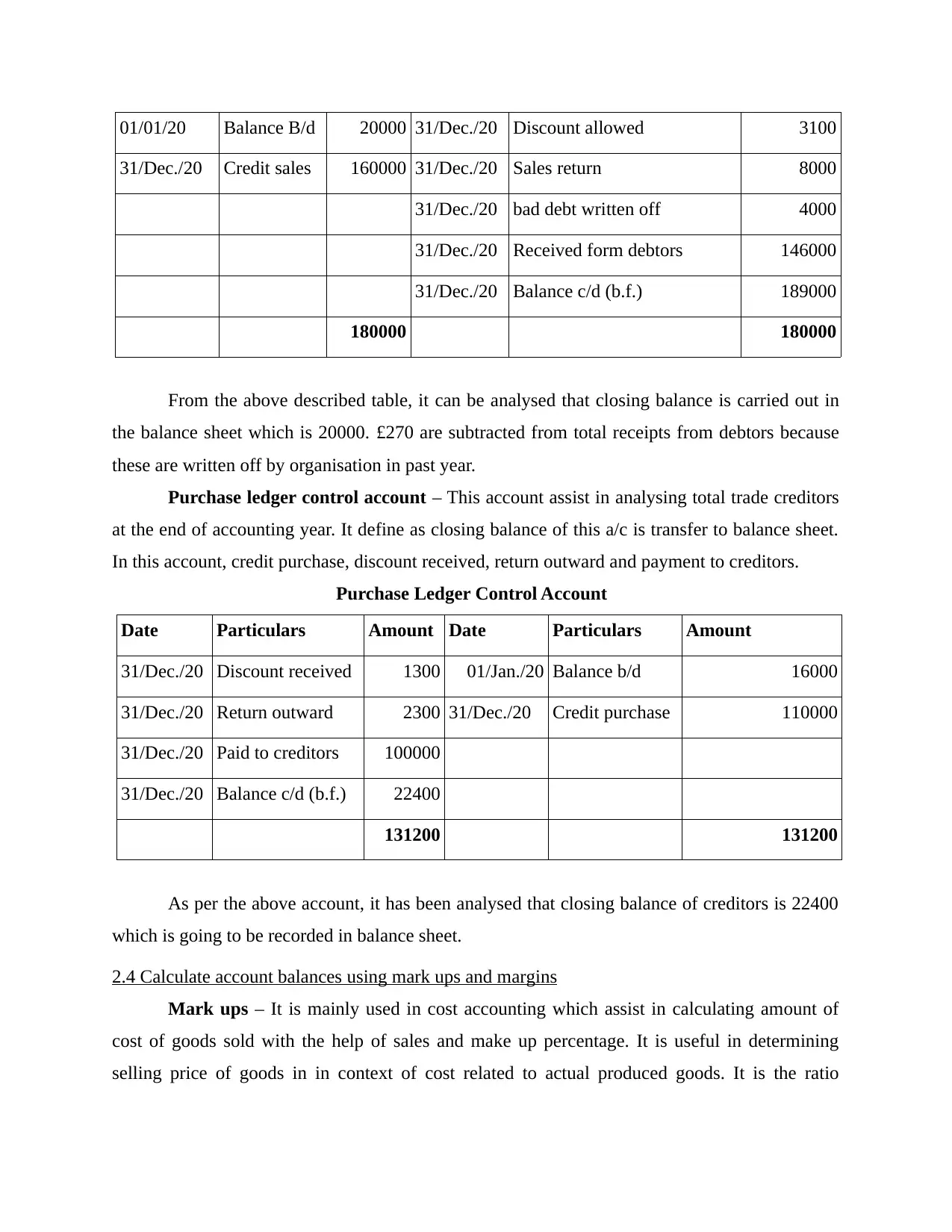
01/01/20 Balance B/d 20000 31/Dec./20 Discount allowed 3100
31/Dec./20 Credit sales 160000 31/Dec./20 Sales return 8000
31/Dec./20 bad debt written off 4000
31/Dec./20 Received form debtors 146000
31/Dec./20 Balance c/d (b.f.) 189000
180000 180000
From the above described table, it can be analysed that closing balance is carried out in
the balance sheet which is 20000. £270 are subtracted from total receipts from debtors because
these are written off by organisation in past year.
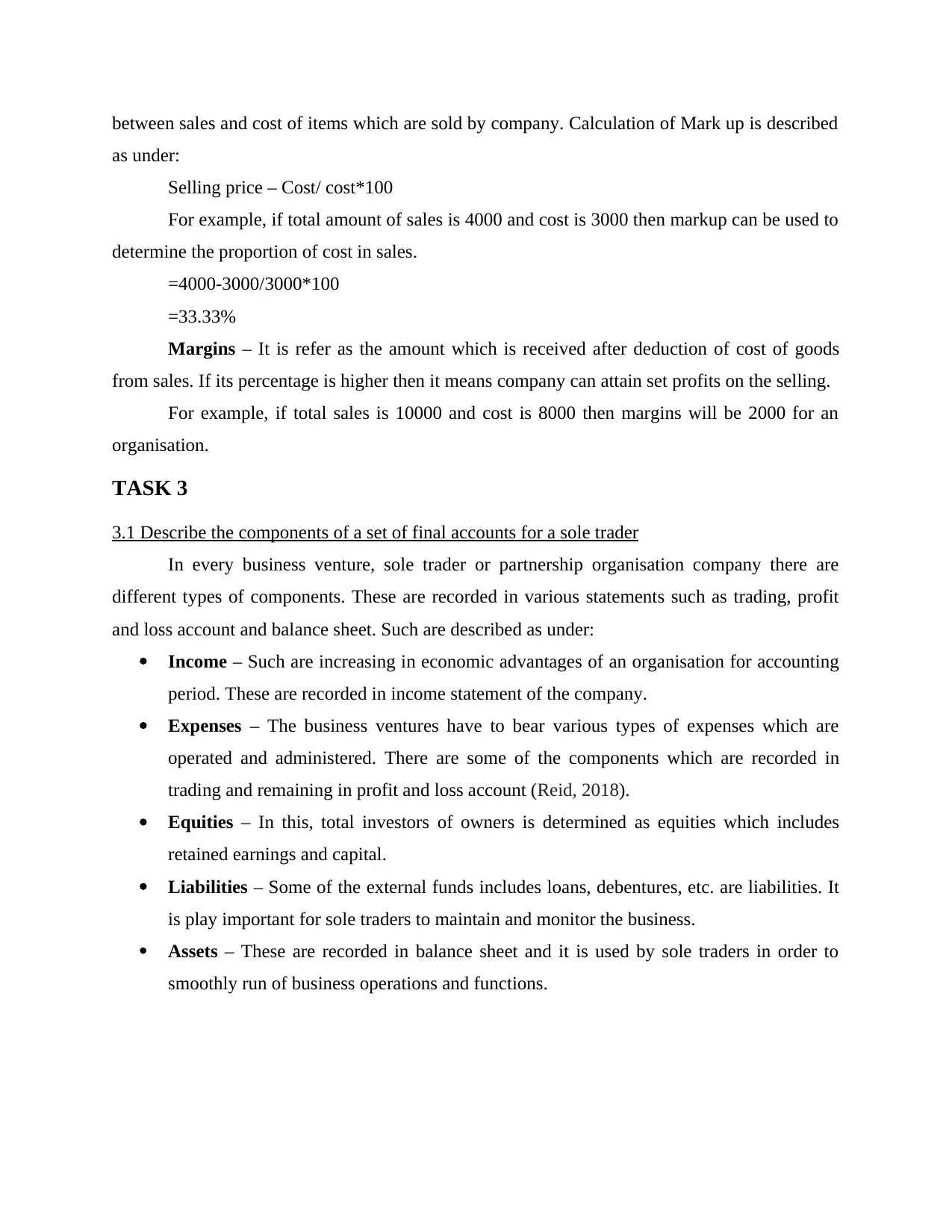
Purchase ledger control account – This account assist in analysing total trade creditors
at the end of accounting year. It define as closing balance of this a/c is transfer to balance sheet.
In this account, credit purchase, discount received, return outward and payment to creditors.
Purchase Ledger Control Account
Date Particulars Amount Date Particulars Amount
31/Dec./20 Discount received 1300 01/Jan./20 Balance b/d 16000
31/Dec./20 Return outward 2300 31/Dec./20 Credit purchase 110000
31/Dec./20 Paid to creditors 100000
31/Dec./20 Balance c/d (b.f.) 22400
131200 131200
As per the above account, it has been analysed that closing balance of creditors is 22400
which is going to be recorded in balance sheet.
2.4 Calculate account balances using mark ups and margins
Mark ups – It is mainly used in cost accounting which assist in calculating amount of
cost of goods sold with the help of sales and make up percentage. It is useful in determining
selling price of goods in in context of cost related to actual produced goods. It is the ratio
31/Dec./20 Credit sales 160000 31/Dec./20 Sales return 8000
31/Dec./20 bad debt written off 4000
31/Dec./20 Received form debtors 146000
31/Dec./20 Balance c/d (b.f.) 189000
180000 180000
From the above described table, it can be analysed that closing balance is carried out in
the balance sheet which is 20000. £270 are subtracted from total receipts from debtors because
these are written off by organisation in past year.
Purchase ledger control account – This account assist in analysing total trade creditors
at the end of accounting year. It define as closing balance of this a/c is transfer to balance sheet.
In this account, credit purchase, discount received, return outward and payment to creditors.
Purchase Ledger Control Account
Date Particulars Amount Date Particulars Amount
31/Dec./20 Discount received 1300 01/Jan./20 Balance b/d 16000
31/Dec./20 Return outward 2300 31/Dec./20 Credit purchase 110000
31/Dec./20 Paid to creditors 100000
31/Dec./20 Balance c/d (b.f.) 22400
131200 131200
As per the above account, it has been analysed that closing balance of creditors is 22400
which is going to be recorded in balance sheet.
2.4 Calculate account balances using mark ups and margins
Mark ups – It is mainly used in cost accounting which assist in calculating amount of
cost of goods sold with the help of sales and make up percentage. It is useful in determining
selling price of goods in in context of cost related to actual produced goods. It is the ratio
Paraphrase This Document
Need a fresh take? Get an instant paraphrase of this document with our AI Paraphraser
between sales and cost of items which are sold by company. Calculation of Mark up is described
as under:
Selling price – Cost/ cost*100
For example, if total amount of sales is 4000 and cost is 3000 then markup can be used to
determine the proportion of cost in sales.
=4000-3000/3000*100
=33.33%
Margins – It is refer as the amount which is received after deduction of cost of goods
from sales. If its percentage is higher then it means company can attain set profits on the selling.
For example, if total sales is 10000 and cost is 8000 then margins will be 2000 for an
organisation.
TASK 3
3.1 Describe the components of a set of final accounts for a sole trader
In every business venture, sole trader or partnership organisation company there are
different types of components. These are recorded in various statements such as trading, profit
and loss account and balance sheet. Such are described as under:
Income – Such are increasing in economic advantages of an organisation for accounting
period. These are recorded in income statement of the company.
Expenses – The business ventures have to bear various types of expenses which are
operated and administered. There are some of the components which are recorded in
trading and remaining in profit and loss account (Reid, 2018).
Equities – In this, total investors of owners is determined as equities which includes
retained earnings and capital.
Liabilities – Some of the external funds includes loans, debentures, etc. are liabilities. It
is play important for sole traders to maintain and monitor the business.
Assets – These are recorded in balance sheet and it is used by sole traders in order to
smoothly run of business operations and functions.
as under:
Selling price – Cost/ cost*100
For example, if total amount of sales is 4000 and cost is 3000 then markup can be used to
determine the proportion of cost in sales.
=4000-3000/3000*100
=33.33%
Margins – It is refer as the amount which is received after deduction of cost of goods
from sales. If its percentage is higher then it means company can attain set profits on the selling.
For example, if total sales is 10000 and cost is 8000 then margins will be 2000 for an
organisation.
TASK 3
3.1 Describe the components of a set of final accounts for a sole trader
In every business venture, sole trader or partnership organisation company there are
different types of components. These are recorded in various statements such as trading, profit
and loss account and balance sheet. Such are described as under:
Income – Such are increasing in economic advantages of an organisation for accounting
period. These are recorded in income statement of the company.
Expenses – The business ventures have to bear various types of expenses which are
operated and administered. There are some of the components which are recorded in
trading and remaining in profit and loss account (Reid, 2018).
Equities – In this, total investors of owners is determined as equities which includes
retained earnings and capital.
Liabilities – Some of the external funds includes loans, debentures, etc. are liabilities. It
is play important for sole traders to maintain and monitor the business.
Assets – These are recorded in balance sheet and it is used by sole traders in order to
smoothly run of business operations and functions.
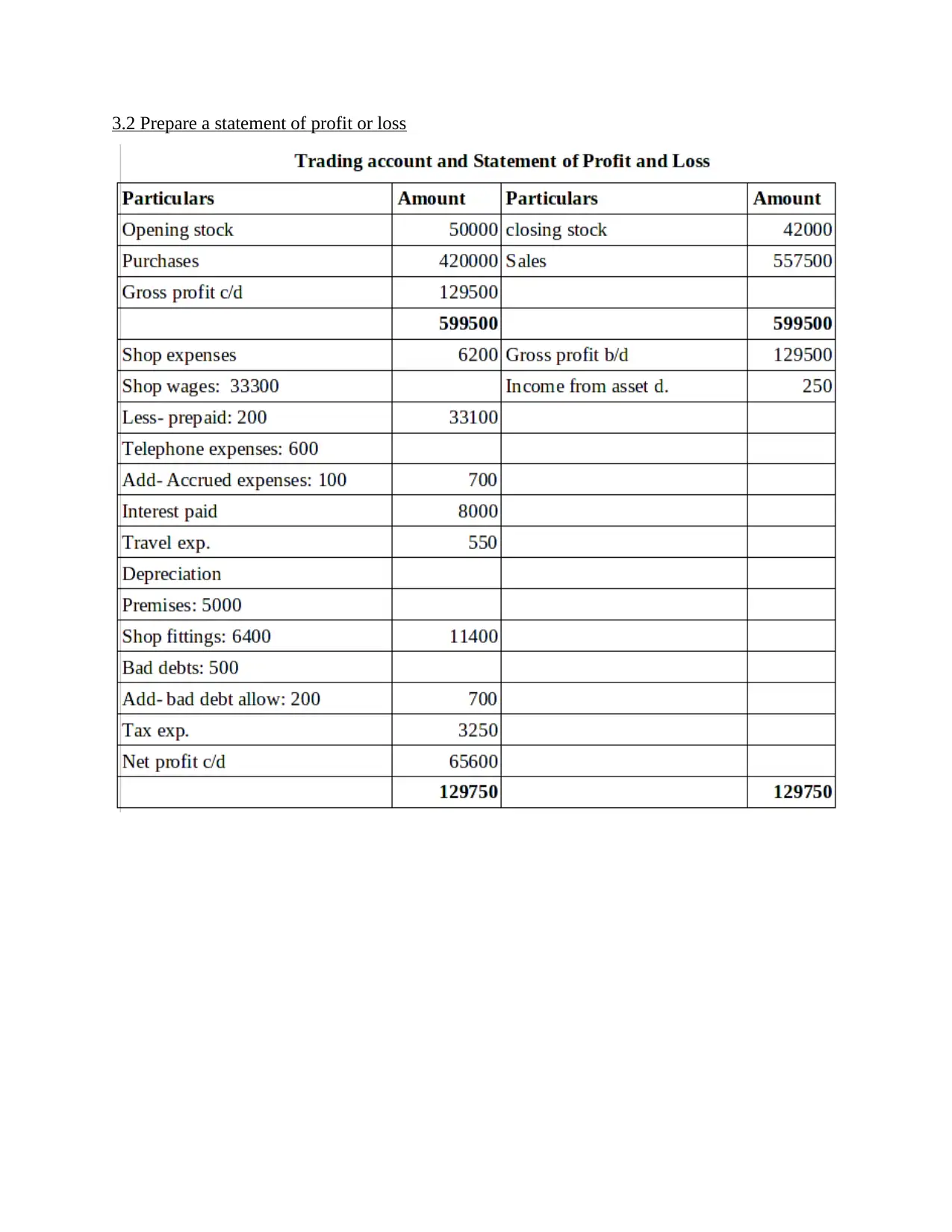
3.2 Prepare a statement of profit or loss
⊘ This is a preview!⊘
Do you want full access?
Subscribe today to unlock all pages.
Trusted by 1+ million students worldwide

1 out of 22


Related Documents


Your All-in-One AI-Powered Toolkit for Academic Success.
+13062052269
info@desklib.com
Available 24*7 on WhatsApp / Email
![[object Object]](/_next/static/media/star-bottom.7253800d.svg)
Unlock your academic potential
Copyright © 2020–2026 A2Z Services. All Rights Reserved. Developed and managed by ZUCOL.