University Accounting and Finance: ABC Costing Report and Analysis
VerifiedAdded on 2021/04/16
|9
|1591
|55
Report
AI Summary
This report provides a comprehensive overview of Activity-Based Costing (ABC) in accounting and finance. It begins by explaining the organizational context of costing and its importance in determining product or service costs. The report then details the five major steps involved in the ABC calculation process, including identifying major activities, allocating costs, identifying cost drivers, determining predetermined overhead rates, and calculating the cost of an individual product. It presents a step-by-step example using hypothetical figures to illustrate the calculation. The report also discusses the limitations of ABC, such as its costliness and time-consuming nature, the potential for misleading unitization of fixed costs, and its limited benefits for companies with little product variation. Finally, the report emphasizes the usefulness of ABC for managerial decision-making by providing relevant cost information, identifying cost drivers, and facilitating effective cost decisions. The report highlights how ABC supports a systematic approach to cost analysis, helping managers make informed decisions based on relevant, fixed, and variable costs.
Running head: ACCOUNTING AND FINANCE
Accounting and Finance
Name of the Student
Name of the University
Author’s Note
Accounting and Finance
Name of the Student
Name of the University
Author’s Note
Paraphrase This Document
Need a fresh take? Get an instant paraphrase of this document with our AI Paraphraser

1ACCOUNTING AND FINANCE
Table of Contents
Organizational Context....................................................................................................................2
Explanation of the Calculation........................................................................................................2
Discussion on Limitations...............................................................................................................6
Discussion on Usefulness for Decision-making..............................................................................6
References........................................................................................................................................8
Table of Contents
Organizational Context....................................................................................................................2
Explanation of the Calculation........................................................................................................2
Discussion on Limitations...............................................................................................................6
Discussion on Usefulness for Decision-making..............................................................................6
References........................................................................................................................................8

2ACCOUNTING AND FINANCE
Organizational Context
Costing is considered as an integral part of the accounting of the companies as it helps in
the determination of the cost of products or services so that desired profit can be obtained. There
are many costing methods available for the companies like Traditional Costing, Activity Based
Costing (ABC) and others. Among all these costing methods, the popularity of ABC can be seen
due to its simplicity in determining the cost of an individual product (Drury 2013).
Explanation of the Calculation
The following discussion shows the calculation of the cost of an individual product by
using ABC model.
Step 1
In the process of ABC, five major steps can be seen for the calculation of the calculation
of an individual product or service; and all these stages are interconnected among each other.
First step involves in the identification of the major activities having major impact on the
overhead costs of the product. In this particular case, the five major activities are Purchase of
Materials, Setting of Machines, Running Cost of Machines, Assembling Cost of Products and
Inspection Cost of Finishes Products (Fleischman and Parker 2017).
Step 2
In this particular step, the identified activities of first step are assigned to the activities.
The following table shows the amounts allocated against each activity. Thus, from this step, the
Organizational Context
Costing is considered as an integral part of the accounting of the companies as it helps in
the determination of the cost of products or services so that desired profit can be obtained. There
are many costing methods available for the companies like Traditional Costing, Activity Based
Costing (ABC) and others. Among all these costing methods, the popularity of ABC can be seen
due to its simplicity in determining the cost of an individual product (Drury 2013).
Explanation of the Calculation
The following discussion shows the calculation of the cost of an individual product by
using ABC model.
Step 1
In the process of ABC, five major steps can be seen for the calculation of the calculation
of an individual product or service; and all these stages are interconnected among each other.
First step involves in the identification of the major activities having major impact on the
overhead costs of the product. In this particular case, the five major activities are Purchase of
Materials, Setting of Machines, Running Cost of Machines, Assembling Cost of Products and
Inspection Cost of Finishes Products (Fleischman and Parker 2017).
Step 2
In this particular step, the identified activities of first step are assigned to the activities.
The following table shows the amounts allocated against each activity. Thus, from this step, the
⊘ This is a preview!⊘
Do you want full access?
Subscribe today to unlock all pages.

Trusted by 1+ million students worldwide

3ACCOUNTING AND FINANCE
organizations become able to identify the most important and costly activities required for the
production of the products (Rajabi and Dabiri 2012).
Activity Estimated Annual Overhead Costs ($)
Purchase of Materials
Setting of Machines
Running Cost of Machines
Assembling Cost of Products
Inspection Cost of Finishes Products
1,200,000
1,600,000
2,700,000
1,500,000
1,000,000
Total 8,000,000
Step 3
Cost Drivers refer to the actions causing the generation of costs for the activities.
Information is required to gather for the identification of cost drivers. In this case, the following
table shows the major cost drivers for the determination of the cost of product (Özkan and
Karaibrahimoğlu 2013).
Activity Cost Driver Estimated Annual Cost
Driver Activity
Purchase of Materials
Setting of Machines
Running Cost of Machines
Assembling Cost of Products
Inspection Cost of Finishes
Products
Purchase Requisition
Machine Setup
Machine Hours
Direct Labor Hours
Inspection Hours
10,000 requisitions
2,000 setups
90,000 hours
250,000 hours
20,000 hours
Step 4
organizations become able to identify the most important and costly activities required for the
production of the products (Rajabi and Dabiri 2012).
Activity Estimated Annual Overhead Costs ($)
Purchase of Materials
Setting of Machines
Running Cost of Machines
Assembling Cost of Products
Inspection Cost of Finishes Products
1,200,000
1,600,000
2,700,000
1,500,000
1,000,000
Total 8,000,000
Step 3
Cost Drivers refer to the actions causing the generation of costs for the activities.
Information is required to gather for the identification of cost drivers. In this case, the following
table shows the major cost drivers for the determination of the cost of product (Özkan and
Karaibrahimoğlu 2013).
Activity Cost Driver Estimated Annual Cost
Driver Activity
Purchase of Materials
Setting of Machines
Running Cost of Machines
Assembling Cost of Products
Inspection Cost of Finishes
Products
Purchase Requisition
Machine Setup
Machine Hours
Direct Labor Hours
Inspection Hours
10,000 requisitions
2,000 setups
90,000 hours
250,000 hours
20,000 hours
Step 4
Paraphrase This Document
Need a fresh take? Get an instant paraphrase of this document with our AI Paraphraser

4ACCOUNTING AND FINANCE
This step involves in the determination of predetermined overhead rate by dividing the
estimated cost of overhead by the estimated level of cost driver activity. As per the following
table, the product will be charged $120 cost for purchase requisition, $800 for machine setup,
$30 for each machine hour, $6 for each direct labor hour and $50 for each hour of inspection
(Monroy, Nasiri and Peláez 2014).
Activity Cost Driver Estimated
Overhead Costs
(A) ($)
Estimated Cost
Driver Activity
(B)
Predetermined
Overhead Rate
(A/B)
Purchase of
Materials
Setting of
Machines
Running Cost of
Machines
Assembling Cost
of Products
Inspection Cost
of Finishes
Products
Purchase
Requisition
Machine Setups
Machine Hours
Direct Labor
Hours
Inspection Hours
1,200,000
1,600,000
2,700,000
1,500,00
1,000,000
10,000
2,000
90,000
250,000
20,000
$120 per
requisition
800 per setup
30 per machine
hours
6 per direct labor
hours
50 per inspection
hours
Total 8,000,000
Step 5
This step involves in the determination of the cost of the individual product of the
company. In this step, it has been assumed that the total number of unit is 10,000. The following
table shows the allocation of total overheads with the use of cost driver activity and the
calculated rates of overhead. From this, it can be noticed that the total overhead cost is
This step involves in the determination of predetermined overhead rate by dividing the
estimated cost of overhead by the estimated level of cost driver activity. As per the following
table, the product will be charged $120 cost for purchase requisition, $800 for machine setup,
$30 for each machine hour, $6 for each direct labor hour and $50 for each hour of inspection
(Monroy, Nasiri and Peláez 2014).
Activity Cost Driver Estimated
Overhead Costs
(A) ($)
Estimated Cost
Driver Activity
(B)
Predetermined
Overhead Rate
(A/B)
Purchase of
Materials
Setting of
Machines
Running Cost of
Machines
Assembling Cost
of Products
Inspection Cost
of Finishes
Products
Purchase
Requisition
Machine Setups
Machine Hours
Direct Labor
Hours
Inspection Hours
1,200,000
1,600,000
2,700,000
1,500,00
1,000,000
10,000
2,000
90,000
250,000
20,000
$120 per
requisition
800 per setup
30 per machine
hours
6 per direct labor
hours
50 per inspection
hours
Total 8,000,000
Step 5
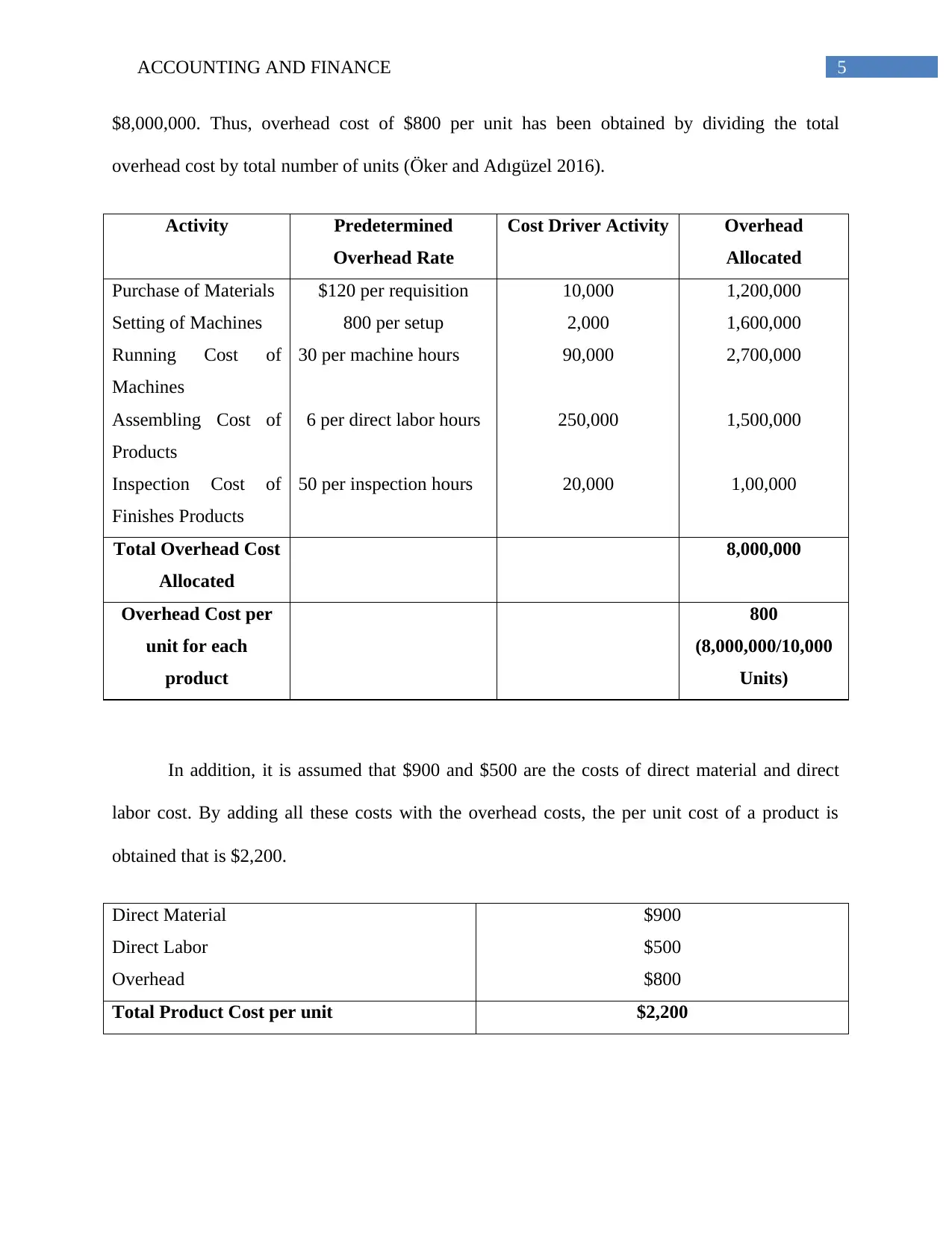
This step involves in the determination of the cost of the individual product of the
company. In this step, it has been assumed that the total number of unit is 10,000. The following
table shows the allocation of total overheads with the use of cost driver activity and the
calculated rates of overhead. From this, it can be noticed that the total overhead cost is

5ACCOUNTING AND FINANCE
$8,000,000. Thus, overhead cost of $800 per unit has been obtained by dividing the total
overhead cost by total number of units (Öker and Adıgüzel 2016).
Activity Predetermined
Overhead Rate
Cost Driver Activity Overhead
Allocated
Purchase of Materials
Setting of Machines
Running Cost of
Machines
Assembling Cost of
Products
Inspection Cost of
Finishes Products
$120 per requisition
800 per setup
30 per machine hours
6 per direct labor hours
50 per inspection hours
10,000
2,000
90,000
250,000
20,000
1,200,000
1,600,000
2,700,000
1,500,000
1,00,000
Total Overhead Cost
Allocated
8,000,000
Overhead Cost per
unit for each
product
800
(8,000,000/10,000
Units)
In addition, it is assumed that $900 and $500 are the costs of direct material and direct
labor cost. By adding all these costs with the overhead costs, the per unit cost of a product is
obtained that is $2,200.
Direct Material
Direct Labor
Overhead
$900
$500
$800
Total Product Cost per unit $2,200
$8,000,000. Thus, overhead cost of $800 per unit has been obtained by dividing the total
overhead cost by total number of units (Öker and Adıgüzel 2016).
Activity Predetermined
Overhead Rate
Cost Driver Activity Overhead
Allocated
Purchase of Materials
Setting of Machines
Running Cost of
Machines
Assembling Cost of
Products
Inspection Cost of
Finishes Products
$120 per requisition
800 per setup
30 per machine hours
6 per direct labor hours
50 per inspection hours
10,000
2,000
90,000
250,000
20,000
1,200,000
1,600,000
2,700,000
1,500,000
1,00,000
Total Overhead Cost
Allocated
8,000,000
Overhead Cost per
unit for each
product
800
(8,000,000/10,000
Units)
In addition, it is assumed that $900 and $500 are the costs of direct material and direct
labor cost. By adding all these costs with the overhead costs, the per unit cost of a product is
obtained that is $2,200.
Direct Material
Direct Labor
Overhead
$900
$500
$800
Total Product Cost per unit $2,200
⊘ This is a preview!⊘
Do you want full access?
Subscribe today to unlock all pages.

Trusted by 1+ million students worldwide

6ACCOUNTING AND FINANCE
Discussion on Limitations
In this context, it needs to be mentioned about certain limitation of ABC. Determination
of the cost of products is costly as well as time-consuming process. For this reason, there is a
high need for teamwork across the organization. After that, under ABC, the unitization process
of fixed costs can be misleading (Popesko 2013). The main reason is that no change can be seen
in the fixed costs with the change in the cost activities. There are certain situations where the
companies do not get many benefits in costs under the process of ABC. Companies not having
much variation in products may not be largely beneficial from the implementation of ABC. In
case there is one single type of product, all the overhead costs will be assigned to that one
product (Popesko 2013). Thus, it can be observed that there are some major limitations of the
calculation of product cost in ABC and the accountants are required to make effective judgment
about these limitations.
Discussion on Usefulness for Decision-making
ABC costing plays an important part in the managerial decision-making process by
providing important cost information. The above discussion shows that the determination of the
cost of individual product is done in five steps and each step is connected with others (Kaličanin
and Knežević 2013). Thus, all these steps provide information about relevant cost, fixed cost and
variable cost. Apart from this, with the implementation of ABC, the organizational managers can
identify the most important cost drivers having impact in the costing of the companies. In the
presence of all these information, it becomes easier for the managers to make effective cost-
decisions. In case of the calculation, it can be observed that the calculation is done in five stages
that has provided. The first table includes the allocation of total cost among the major cost
activities (Kaličanin and Knežević 2013). After that, the next step involves in the determination
Discussion on Limitations
In this context, it needs to be mentioned about certain limitation of ABC. Determination
of the cost of products is costly as well as time-consuming process. For this reason, there is a
high need for teamwork across the organization. After that, under ABC, the unitization process
of fixed costs can be misleading (Popesko 2013). The main reason is that no change can be seen
in the fixed costs with the change in the cost activities. There are certain situations where the
companies do not get many benefits in costs under the process of ABC. Companies not having
much variation in products may not be largely beneficial from the implementation of ABC. In
case there is one single type of product, all the overhead costs will be assigned to that one
product (Popesko 2013). Thus, it can be observed that there are some major limitations of the
calculation of product cost in ABC and the accountants are required to make effective judgment
about these limitations.
Discussion on Usefulness for Decision-making
ABC costing plays an important part in the managerial decision-making process by
providing important cost information. The above discussion shows that the determination of the
cost of individual product is done in five steps and each step is connected with others (Kaličanin
and Knežević 2013). Thus, all these steps provide information about relevant cost, fixed cost and
variable cost. Apart from this, with the implementation of ABC, the organizational managers can
identify the most important cost drivers having impact in the costing of the companies. In the
presence of all these information, it becomes easier for the managers to make effective cost-
decisions. In case of the calculation, it can be observed that the calculation is done in five stages
that has provided. The first table includes the allocation of total cost among the major cost
activities (Kaličanin and Knežević 2013). After that, the next step involves in the determination
Paraphrase This Document
Need a fresh take? Get an instant paraphrase of this document with our AI Paraphraser

7ACCOUNTING AND FINANCE
of the major cost drivers of the company so that the overhead cost can be allocated among the
cost drivers. From this, it can be seen that there is a systematic flow in the calculation of the
product cost. For the calculation, certain necessary assumptions are made. Hence, it can be
observed that this calculation plays an integral part in the determination of the cost of an
individual product (Popesko 2013).
of the major cost drivers of the company so that the overhead cost can be allocated among the
cost drivers. From this, it can be seen that there is a systematic flow in the calculation of the
product cost. For the calculation, certain necessary assumptions are made. Hence, it can be
observed that this calculation plays an integral part in the determination of the cost of an
individual product (Popesko 2013).

8ACCOUNTING AND FINANCE
References
DRURY, C.M., 2013. Management and cost accounting. Springer.
Fleischman, R.K. and Parker, L.D., 2017. What is Past is Prologue: Cost Accounting in the
British Industrial Revolution, 1760-1850 (Vol. 6). Routledge.
Kaličanin, Đ. and Knežević, V., 2013. Activity-based costing as an information basis for an
efficient strategic management process. Economic Annals, 58(197), pp.95-119.
Monroy, C.R., Nasiri, A. and Peláez, M.Á., 2014. Activity Based Costing, Time-Driven Activity
Based Costing and Lean Accounting: Differences among three accounting systems’ approach to
manufacturing. In Annals of Industrial Engineering 2012 (pp. 11-17). Springer, London.
Öker, F. and Adıgüzel, H., 2016. Time‐driven activity‐based costing: An implementation in a
manufacturing company. Journal of Corporate Accounting & Finance, 27(3), pp.39-56.
Özkan, S. and Karaibrahimoğlu, Y.Z., 2013. Activity-based costing approach in the
measurement of cost of quality in SMEs: a case study. Total Quality Management & Business
Excellence, 24(3-4), pp.420-431.
Popesko, B., 2013. Specifics of the activity-based costing applications in hospital
management. International Journal of Collaborative Research on Internal Medicine & Public
Health, 5(3).
Rajabi, A. and Dabiri, A., 2012. Applying activity based costing (ABC) method to calculate cost
price in hospital and remedy services. Iranian journal of public health, 41(4), p.100.
References
DRURY, C.M., 2013. Management and cost accounting. Springer.
Fleischman, R.K. and Parker, L.D., 2017. What is Past is Prologue: Cost Accounting in the
British Industrial Revolution, 1760-1850 (Vol. 6). Routledge.
Kaličanin, Đ. and Knežević, V., 2013. Activity-based costing as an information basis for an
efficient strategic management process. Economic Annals, 58(197), pp.95-119.
Monroy, C.R., Nasiri, A. and Peláez, M.Á., 2014. Activity Based Costing, Time-Driven Activity
Based Costing and Lean Accounting: Differences among three accounting systems’ approach to
manufacturing. In Annals of Industrial Engineering 2012 (pp. 11-17). Springer, London.
Öker, F. and Adıgüzel, H., 2016. Time‐driven activity‐based costing: An implementation in a
manufacturing company. Journal of Corporate Accounting & Finance, 27(3), pp.39-56.
Özkan, S. and Karaibrahimoğlu, Y.Z., 2013. Activity-based costing approach in the
measurement of cost of quality in SMEs: a case study. Total Quality Management & Business
Excellence, 24(3-4), pp.420-431.
Popesko, B., 2013. Specifics of the activity-based costing applications in hospital
management. International Journal of Collaborative Research on Internal Medicine & Public
Health, 5(3).
Rajabi, A. and Dabiri, A., 2012. Applying activity based costing (ABC) method to calculate cost
price in hospital and remedy services. Iranian journal of public health, 41(4), p.100.
⊘ This is a preview!⊘
Do you want full access?
Subscribe today to unlock all pages.

Trusted by 1+ million students worldwide
1 out of 9
Related Documents
Your All-in-One AI-Powered Toolkit for Academic Success.
+13062052269
info@desklib.com
Available 24*7 on WhatsApp / Email
Unlock your academic potential
Copyright © 2020–2026 A2Z Services. All Rights Reserved. Developed and managed by ZUCOL.