FINANCE 149 Assignment: Comprehensive Finance Solutions and Analysis
VerifiedAdded on 2019/09/22
|8
|1828
|364
Homework Assignment
AI Summary
This document provides detailed solutions to a finance assignment, likely for a course like FINANCE 149. The solutions cover a range of financial concepts and calculations, including simple and compound interest, present and future value, and discount rates. The assignment addresses specific problems involving profit margins, credit periods, interest rates on notes, T-bill yields, and debt valuation. Each question is thoroughly solved with clear explanations and calculations, demonstrating a strong understanding of financial principles. The document also includes references to relevant financial resources. The solutions are presented in a clear and organized manner, making it a valuable resource for students studying finance. It is an excellent example of how to approach and solve complex financial problems.
1
FINANCE 149 – FIRST ASSIGNMENT
Paraphrase This Document
Need a fresh take? Get an instant paraphrase of this document with our AI Paraphraser

2
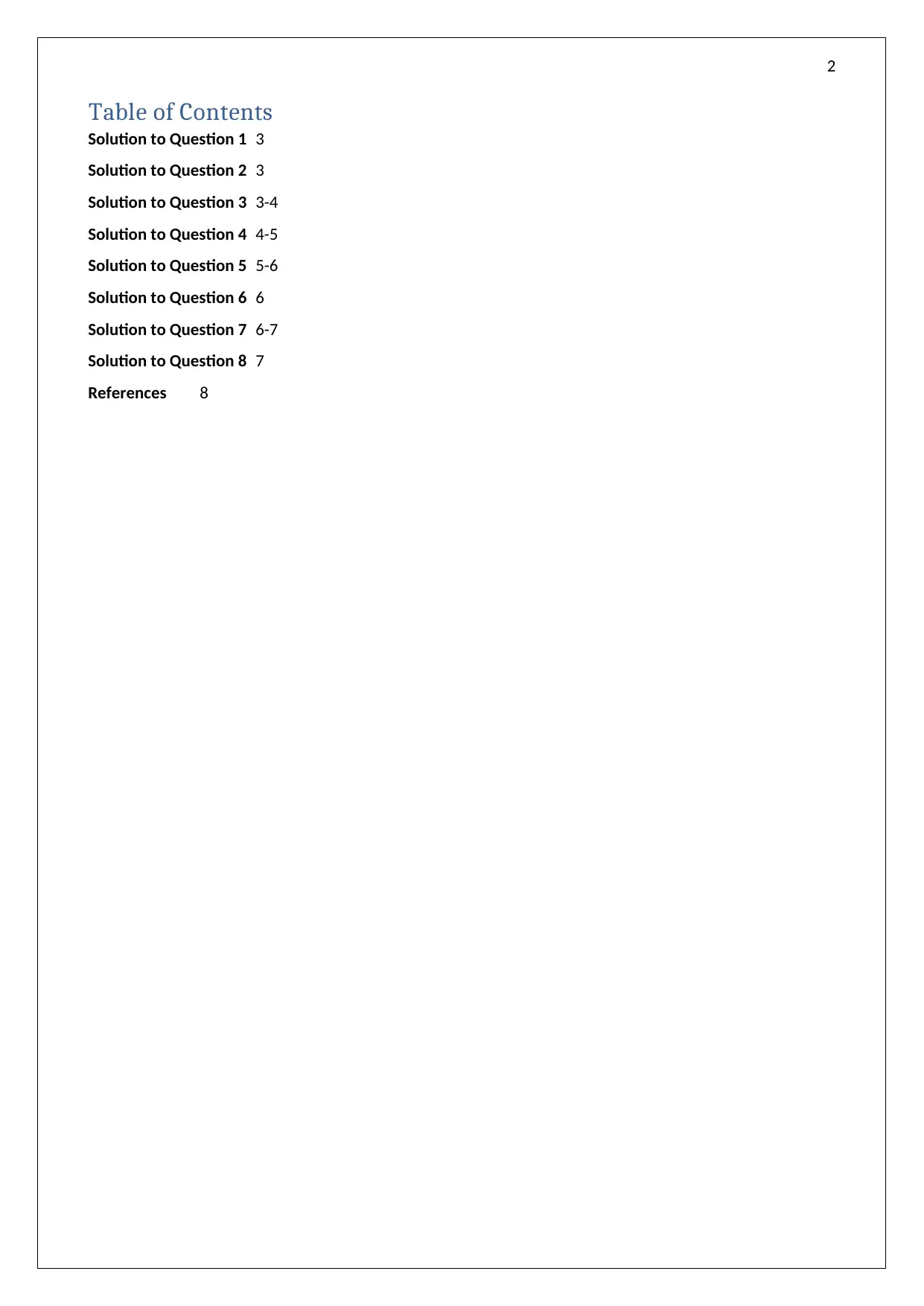
Table of Contents
Solution to Question 1 3
Solution to Question 2 3
Solution to Question 3 3-4
Solution to Question 4 4-5
Solution to Question 5 5-6
Solution to Question 6 6
Solution to Question 7 6-7
Solution to Question 8 7
References 8
Table of Contents
Solution to Question 1 3
Solution to Question 2 3
Solution to Question 3 3-4
Solution to Question 4 4-5
Solution to Question 5 5-6
Solution to Question 6 6
Solution to Question 7 6-7
Solution to Question 8 7
References 8

3
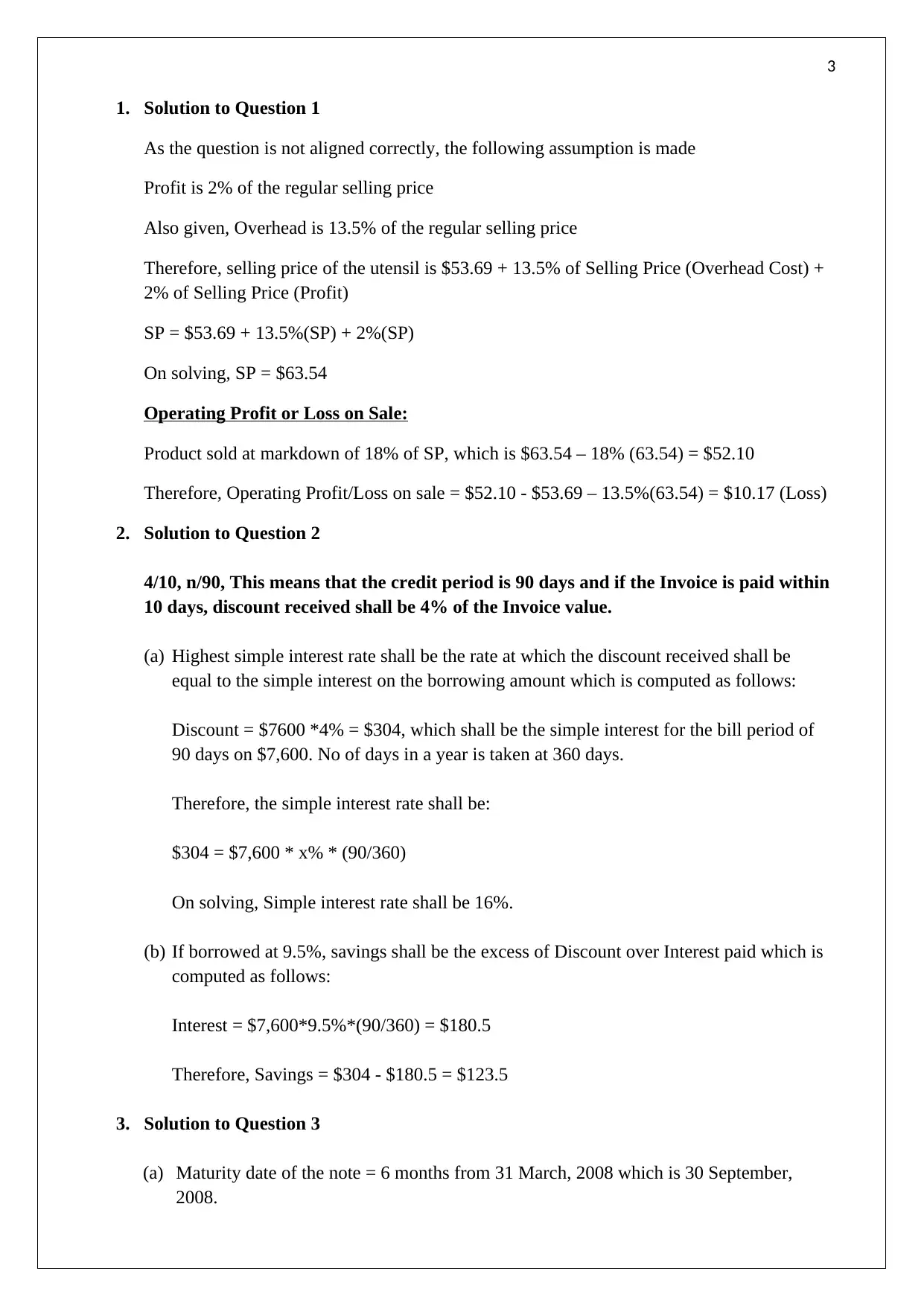
1. Solution to Question 1
As the question is not aligned correctly, the following assumption is made
Profit is 2% of the regular selling price
Also given, Overhead is 13.5% of the regular selling price
Therefore, selling price of the utensil is $53.69 + 13.5% of Selling Price (Overhead Cost) +
2% of Selling Price (Profit)
SP = $53.69 + 13.5%(SP) + 2%(SP)
On solving, SP = $63.54
Operating Profit or Loss on Sale:
Product sold at markdown of 18% of SP, which is $63.54 – 18% (63.54) = $52.10
Therefore, Operating Profit/Loss on sale = $52.10 - $53.69 – 13.5%(63.54) = $10.17 (Loss)
2. Solution to Question 2
4/10, n/90, This means that the credit period is 90 days and if the Invoice is paid within
10 days, discount received shall be 4% of the Invoice value.
(a) Highest simple interest rate shall be the rate at which the discount received shall be
equal to the simple interest on the borrowing amount which is computed as follows:
Discount = $7600 *4% = $304, which shall be the simple interest for the bill period of
90 days on $7,600. No of days in a year is taken at 360 days.
Therefore, the simple interest rate shall be:
$304 = $7,600 * x% * (90/360)
On solving, Simple interest rate shall be 16%.
(b) If borrowed at 9.5%, savings shall be the excess of Discount over Interest paid which is
computed as follows:
Interest = $7,600*9.5%*(90/360) = $180.5
Therefore, Savings = $304 - $180.5 = $123.5
3. Solution to Question 3
(a) Maturity date of the note = 6 months from 31 March, 2008 which is 30 September,
2008.
1. Solution to Question 1
As the question is not aligned correctly, the following assumption is made
Profit is 2% of the regular selling price
Also given, Overhead is 13.5% of the regular selling price
Therefore, selling price of the utensil is $53.69 + 13.5% of Selling Price (Overhead Cost) +
2% of Selling Price (Profit)
SP = $53.69 + 13.5%(SP) + 2%(SP)
On solving, SP = $63.54
Operating Profit or Loss on Sale:
Product sold at markdown of 18% of SP, which is $63.54 – 18% (63.54) = $52.10
Therefore, Operating Profit/Loss on sale = $52.10 - $53.69 – 13.5%(63.54) = $10.17 (Loss)
2. Solution to Question 2
4/10, n/90, This means that the credit period is 90 days and if the Invoice is paid within
10 days, discount received shall be 4% of the Invoice value.
(a) Highest simple interest rate shall be the rate at which the discount received shall be
equal to the simple interest on the borrowing amount which is computed as follows:
Discount = $7600 *4% = $304, which shall be the simple interest for the bill period of
90 days on $7,600. No of days in a year is taken at 360 days.
Therefore, the simple interest rate shall be:
$304 = $7,600 * x% * (90/360)
On solving, Simple interest rate shall be 16%.
(b) If borrowed at 9.5%, savings shall be the excess of Discount over Interest paid which is
computed as follows:
Interest = $7,600*9.5%*(90/360) = $180.5
Therefore, Savings = $304 - $180.5 = $123.5
3. Solution to Question 3
(a) Maturity date of the note = 6 months from 31 March, 2008 which is 30 September,
2008.
⊘ This is a preview!⊘
Do you want full access?
Subscribe today to unlock all pages.

Trusted by 1+ million students worldwide

4
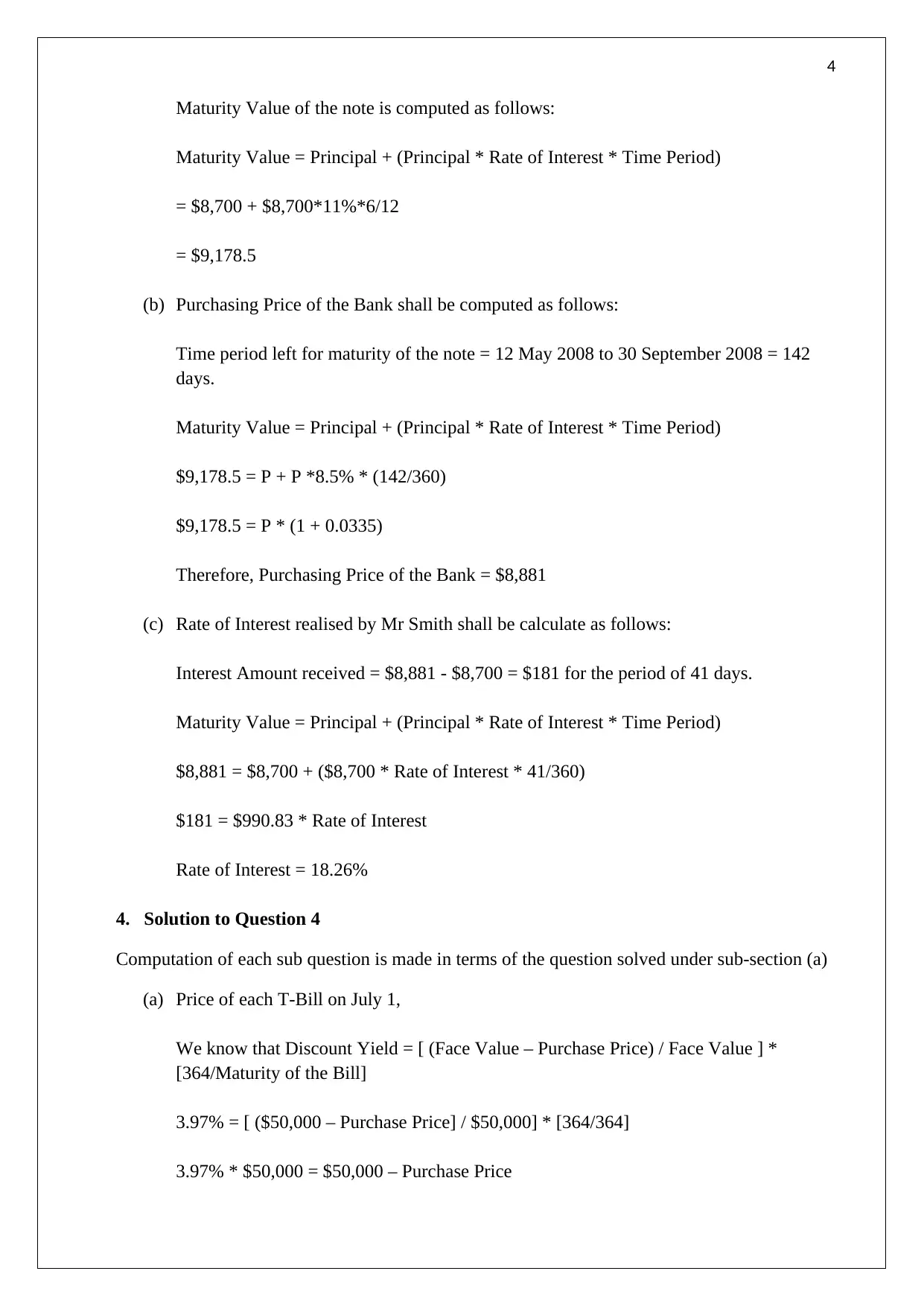
Maturity Value of the note is computed as follows:
Maturity Value = Principal + (Principal * Rate of Interest * Time Period)
= $8,700 + $8,700*11%*6/12
= $9,178.5
(b) Purchasing Price of the Bank shall be computed as follows:
Time period left for maturity of the note = 12 May 2008 to 30 September 2008 = 142
days.
Maturity Value = Principal + (Principal * Rate of Interest * Time Period)
$9,178.5 = P + P *8.5% * (142/360)
$9,178.5 = P * (1 + 0.0335)
Therefore, Purchasing Price of the Bank = $8,881
(c) Rate of Interest realised by Mr Smith shall be calculate as follows:
Interest Amount received = $8,881 - $8,700 = $181 for the period of 41 days.
Maturity Value = Principal + (Principal * Rate of Interest * Time Period)
$8,881 = $8,700 + ($8,700 * Rate of Interest * 41/360)
$181 = $990.83 * Rate of Interest
Rate of Interest = 18.26%
4. Solution to Question 4
Computation of each sub question is made in terms of the question solved under sub-section (a)
(a) Price of each T-Bill on July 1,
We know that Discount Yield = [ (Face Value – Purchase Price) / Face Value ] *
[364/Maturity of the Bill]
3.97% = [ ($50,000 – Purchase Price] / $50,000] * [364/364]
3.97% * $50,000 = $50,000 – Purchase Price
Maturity Value of the note is computed as follows:
Maturity Value = Principal + (Principal * Rate of Interest * Time Period)
= $8,700 + $8,700*11%*6/12
= $9,178.5
(b) Purchasing Price of the Bank shall be computed as follows:
Time period left for maturity of the note = 12 May 2008 to 30 September 2008 = 142
days.
Maturity Value = Principal + (Principal * Rate of Interest * Time Period)
$9,178.5 = P + P *8.5% * (142/360)
$9,178.5 = P * (1 + 0.0335)
Therefore, Purchasing Price of the Bank = $8,881
(c) Rate of Interest realised by Mr Smith shall be calculate as follows:
Interest Amount received = $8,881 - $8,700 = $181 for the period of 41 days.
Maturity Value = Principal + (Principal * Rate of Interest * Time Period)
$8,881 = $8,700 + ($8,700 * Rate of Interest * 41/360)
$181 = $990.83 * Rate of Interest
Rate of Interest = 18.26%
4. Solution to Question 4
Computation of each sub question is made in terms of the question solved under sub-section (a)
(a) Price of each T-Bill on July 1,
We know that Discount Yield = [ (Face Value – Purchase Price) / Face Value ] *
[364/Maturity of the Bill]
3.97% = [ ($50,000 – Purchase Price] / $50,000] * [364/364]
3.97% * $50,000 = $50,000 – Purchase Price
Paraphrase This Document
Need a fresh take? Get an instant paraphrase of this document with our AI Paraphraser

5
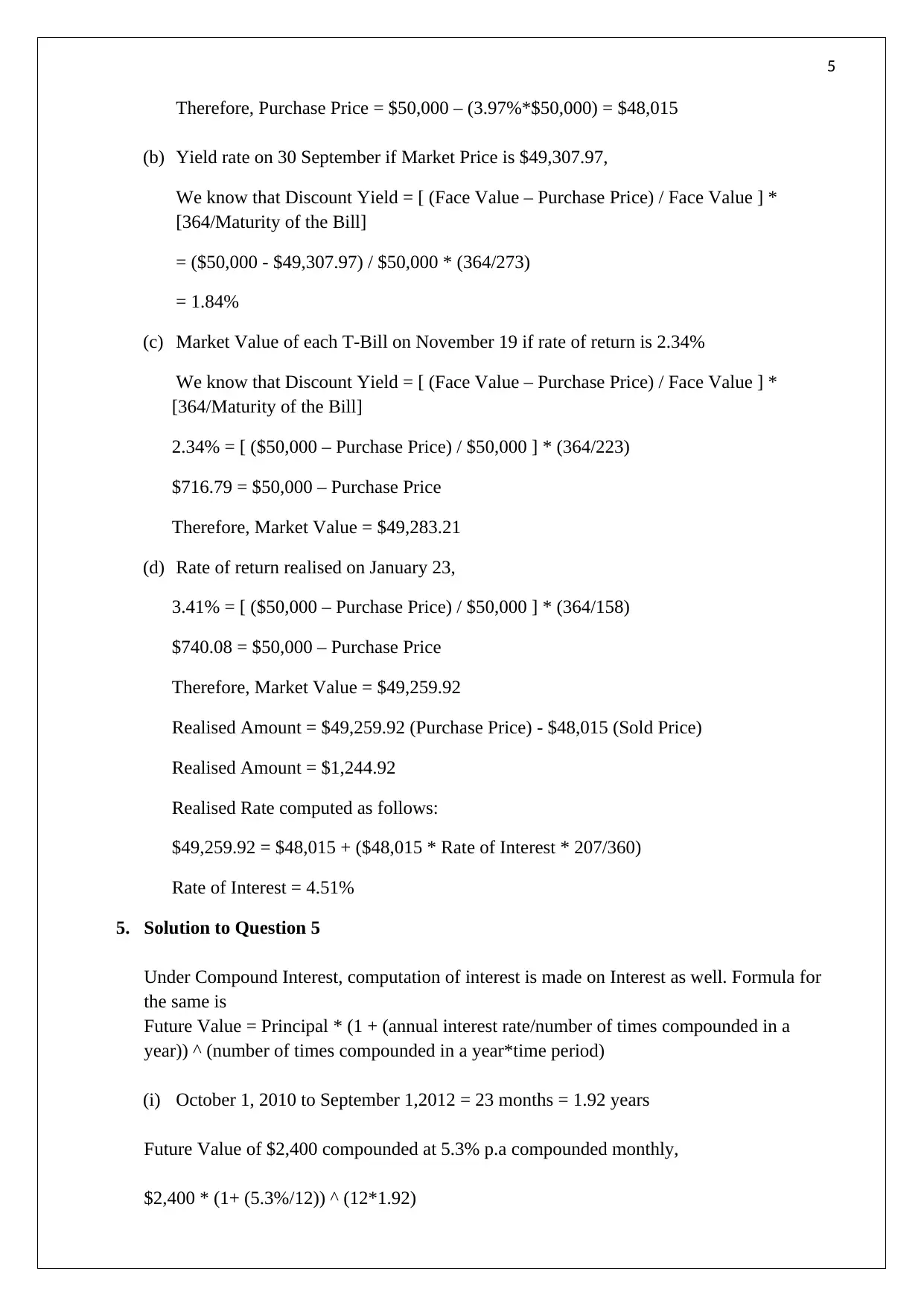
Therefore, Purchase Price = $50,000 – (3.97%*$50,000) = $48,015
(b) Yield rate on 30 September if Market Price is $49,307.97,
We know that Discount Yield = [ (Face Value – Purchase Price) / Face Value ] *
[364/Maturity of the Bill]
= ($50,000 - $49,307.97) / $50,000 * (364/273)
= 1.84%
(c) Market Value of each T-Bill on November 19 if rate of return is 2.34%
We know that Discount Yield = [ (Face Value – Purchase Price) / Face Value ] *
[364/Maturity of the Bill]
2.34% = [ ($50,000 – Purchase Price) / $50,000 ] * (364/223)
$716.79 = $50,000 – Purchase Price
Therefore, Market Value = $49,283.21
(d) Rate of return realised on January 23,
3.41% = [ ($50,000 – Purchase Price) / $50,000 ] * (364/158)
$740.08 = $50,000 – Purchase Price
Therefore, Market Value = $49,259.92
Realised Amount = $49,259.92 (Purchase Price) - $48,015 (Sold Price)
Realised Amount = $1,244.92
Realised Rate computed as follows:
$49,259.92 = $48,015 + ($48,015 * Rate of Interest * 207/360)
Rate of Interest = 4.51%
5. Solution to Question 5
Under Compound Interest, computation of interest is made on Interest as well. Formula for
the same is
Future Value = Principal * (1 + (annual interest rate/number of times compounded in a
year)) ^ (number of times compounded in a year*time period)
(i) October 1, 2010 to September 1,2012 = 23 months = 1.92 years
Future Value of $2,400 compounded at 5.3% p.a compounded monthly,
$2,400 * (1+ (5.3%/12)) ^ (12*1.92)
Therefore, Purchase Price = $50,000 – (3.97%*$50,000) = $48,015
(b) Yield rate on 30 September if Market Price is $49,307.97,
We know that Discount Yield = [ (Face Value – Purchase Price) / Face Value ] *
[364/Maturity of the Bill]
= ($50,000 - $49,307.97) / $50,000 * (364/273)
= 1.84%
(c) Market Value of each T-Bill on November 19 if rate of return is 2.34%
We know that Discount Yield = [ (Face Value – Purchase Price) / Face Value ] *
[364/Maturity of the Bill]
2.34% = [ ($50,000 – Purchase Price) / $50,000 ] * (364/223)
$716.79 = $50,000 – Purchase Price
Therefore, Market Value = $49,283.21
(d) Rate of return realised on January 23,
3.41% = [ ($50,000 – Purchase Price) / $50,000 ] * (364/158)
$740.08 = $50,000 – Purchase Price
Therefore, Market Value = $49,259.92
Realised Amount = $49,259.92 (Purchase Price) - $48,015 (Sold Price)
Realised Amount = $1,244.92
Realised Rate computed as follows:
$49,259.92 = $48,015 + ($48,015 * Rate of Interest * 207/360)
Rate of Interest = 4.51%
5. Solution to Question 5
Under Compound Interest, computation of interest is made on Interest as well. Formula for
the same is
Future Value = Principal * (1 + (annual interest rate/number of times compounded in a
year)) ^ (number of times compounded in a year*time period)
(i) October 1, 2010 to September 1,2012 = 23 months = 1.92 years
Future Value of $2,400 compounded at 5.3% p.a compounded monthly,
$2,400 * (1+ (5.3%/12)) ^ (12*1.92)

6
Value of $2,400 on October 1, 2010 including interest component compounded = $2,656.50
(ii) September 1,2012 to July, 1 2014 = 22 months = 1.83 years
Future Value of $2,656.5 + $3,100 = $5,756.5 compounded at 5.3% p.a compounded
monthly,
$5,756.5 * (1+ (5.3%/12)) ^ (12*1.83)
Value of $5,756.5 on July 1,2014 including interest component compounded = $6,341.44
(iii) July 1,2014 to December, 1 2018 = 53 months = 4.42 years
Future Value of $6,341.44 + $4,000 = $10,341.44 compounded at 5.3% p.a compounded
monthly,
$10,341.44 * (1+ (5.3%/12)) ^ (12*4.42)
Value of $10,341.44 on December 1, 2018 including interest component compounded =
$13,064.60
6. Solution to Question 6
Under Compound Interest, computation of interest is made on Interest as well. Formula for
the same is
Future Value = Principal * (1 + (annual interest rate/number of times compounded in a
year)) ^ (number of times compounded in a year*time period)
Value of Investment at the end of 2nd year =
$14,000 * (1+(8%/12))^(12*2) = $16,420.4
Value of Investment at the end of 3rd year =
$14,000 * (1+(8%/12))^(12*3) = $17,783.3
Therefore Interest earned in the third year = $17,783.3 - $16,420.4 = $1,362.9
7. Solution to Question 7
Under Compound Interest, computation of interest is made on Interest as well. Formula for
the same is
Computation of Value of Note as on 1 May, 2010:
Future Value = Principal * (1 + (annual interest rate/number of times compounded in a
year)) ^ (number of times compounded in a year*time period)
From August 1,2004 to May 1, 2010 , no of quarters = 69 months / 4 = 17.25 quarters
Value of Seven year note as at May 1,2010 =
Value of $2,400 on October 1, 2010 including interest component compounded = $2,656.50
(ii) September 1,2012 to July, 1 2014 = 22 months = 1.83 years
Future Value of $2,656.5 + $3,100 = $5,756.5 compounded at 5.3% p.a compounded
monthly,
$5,756.5 * (1+ (5.3%/12)) ^ (12*1.83)
Value of $5,756.5 on July 1,2014 including interest component compounded = $6,341.44
(iii) July 1,2014 to December, 1 2018 = 53 months = 4.42 years
Future Value of $6,341.44 + $4,000 = $10,341.44 compounded at 5.3% p.a compounded
monthly,
$10,341.44 * (1+ (5.3%/12)) ^ (12*4.42)
Value of $10,341.44 on December 1, 2018 including interest component compounded =
$13,064.60
6. Solution to Question 6
Under Compound Interest, computation of interest is made on Interest as well. Formula for
the same is
Future Value = Principal * (1 + (annual interest rate/number of times compounded in a
year)) ^ (number of times compounded in a year*time period)
Value of Investment at the end of 2nd year =
$14,000 * (1+(8%/12))^(12*2) = $16,420.4
Value of Investment at the end of 3rd year =
$14,000 * (1+(8%/12))^(12*3) = $17,783.3
Therefore Interest earned in the third year = $17,783.3 - $16,420.4 = $1,362.9
7. Solution to Question 7
Under Compound Interest, computation of interest is made on Interest as well. Formula for
the same is
Computation of Value of Note as on 1 May, 2010:
Future Value = Principal * (1 + (annual interest rate/number of times compounded in a
year)) ^ (number of times compounded in a year*time period)
From August 1,2004 to May 1, 2010 , no of quarters = 69 months / 4 = 17.25 quarters
Value of Seven year note as at May 1,2010 =
⊘ This is a preview!⊘
Do you want full access?
Subscribe today to unlock all pages.

Trusted by 1+ million students worldwide

7
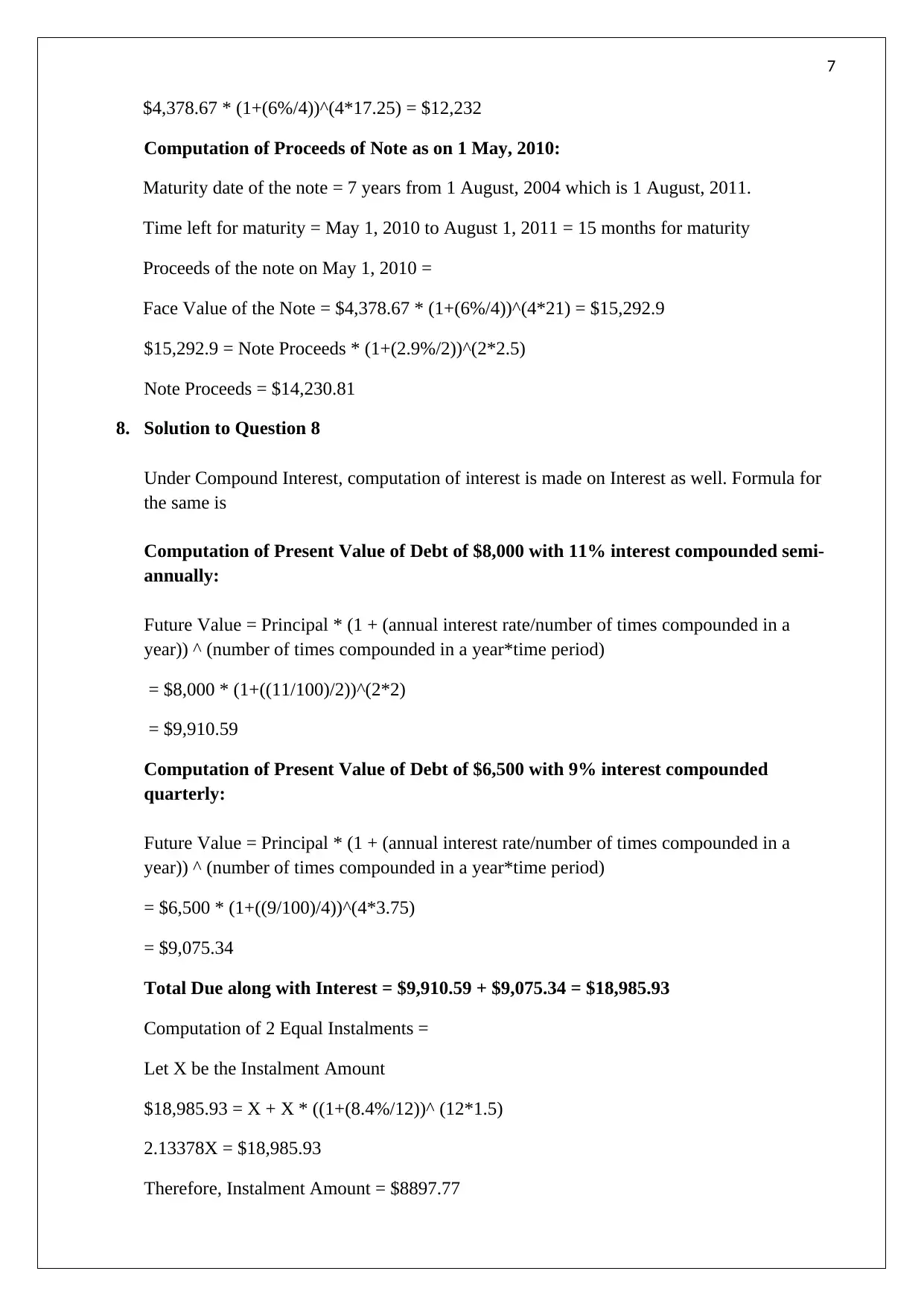
$4,378.67 * (1+(6%/4))^(4*17.25) = $12,232
Computation of Proceeds of Note as on 1 May, 2010:
Maturity date of the note = 7 years from 1 August, 2004 which is 1 August, 2011.
Time left for maturity = May 1, 2010 to August 1, 2011 = 15 months for maturity
Proceeds of the note on May 1, 2010 =
Face Value of the Note = $4,378.67 * (1+(6%/4))^(4*21) = $15,292.9
$15,292.9 = Note Proceeds * (1+(2.9%/2))^(2*2.5)
Note Proceeds = $14,230.81
8. Solution to Question 8
Under Compound Interest, computation of interest is made on Interest as well. Formula for
the same is
Computation of Present Value of Debt of $8,000 with 11% interest compounded semi-
annually:
Future Value = Principal * (1 + (annual interest rate/number of times compounded in a
year)) ^ (number of times compounded in a year*time period)
= $8,000 * (1+((11/100)/2))^(2*2)
= $9,910.59
Computation of Present Value of Debt of $6,500 with 9% interest compounded
quarterly:
Future Value = Principal * (1 + (annual interest rate/number of times compounded in a
year)) ^ (number of times compounded in a year*time period)
= $6,500 * (1+((9/100)/4))^(4*3.75)
= $9,075.34
Total Due along with Interest = $9,910.59 + $9,075.34 = $18,985.93
Computation of 2 Equal Instalments =
Let X be the Instalment Amount
$18,985.93 = X + X * ((1+(8.4%/12))^ (12*1.5)
2.13378X = $18,985.93
Therefore, Instalment Amount = $8897.77
$4,378.67 * (1+(6%/4))^(4*17.25) = $12,232
Computation of Proceeds of Note as on 1 May, 2010:
Maturity date of the note = 7 years from 1 August, 2004 which is 1 August, 2011.
Time left for maturity = May 1, 2010 to August 1, 2011 = 15 months for maturity
Proceeds of the note on May 1, 2010 =
Face Value of the Note = $4,378.67 * (1+(6%/4))^(4*21) = $15,292.9
$15,292.9 = Note Proceeds * (1+(2.9%/2))^(2*2.5)
Note Proceeds = $14,230.81
8. Solution to Question 8
Under Compound Interest, computation of interest is made on Interest as well. Formula for
the same is
Computation of Present Value of Debt of $8,000 with 11% interest compounded semi-
annually:
Future Value = Principal * (1 + (annual interest rate/number of times compounded in a
year)) ^ (number of times compounded in a year*time period)
= $8,000 * (1+((11/100)/2))^(2*2)
= $9,910.59
Computation of Present Value of Debt of $6,500 with 9% interest compounded
quarterly:
Future Value = Principal * (1 + (annual interest rate/number of times compounded in a
year)) ^ (number of times compounded in a year*time period)
= $6,500 * (1+((9/100)/4))^(4*3.75)
= $9,075.34
Total Due along with Interest = $9,910.59 + $9,075.34 = $18,985.93
Computation of 2 Equal Instalments =
Let X be the Instalment Amount
$18,985.93 = X + X * ((1+(8.4%/12))^ (12*1.5)
2.13378X = $18,985.93
Therefore, Instalment Amount = $8897.77
Paraphrase This Document
Need a fresh take? Get an instant paraphrase of this document with our AI Paraphraser

8
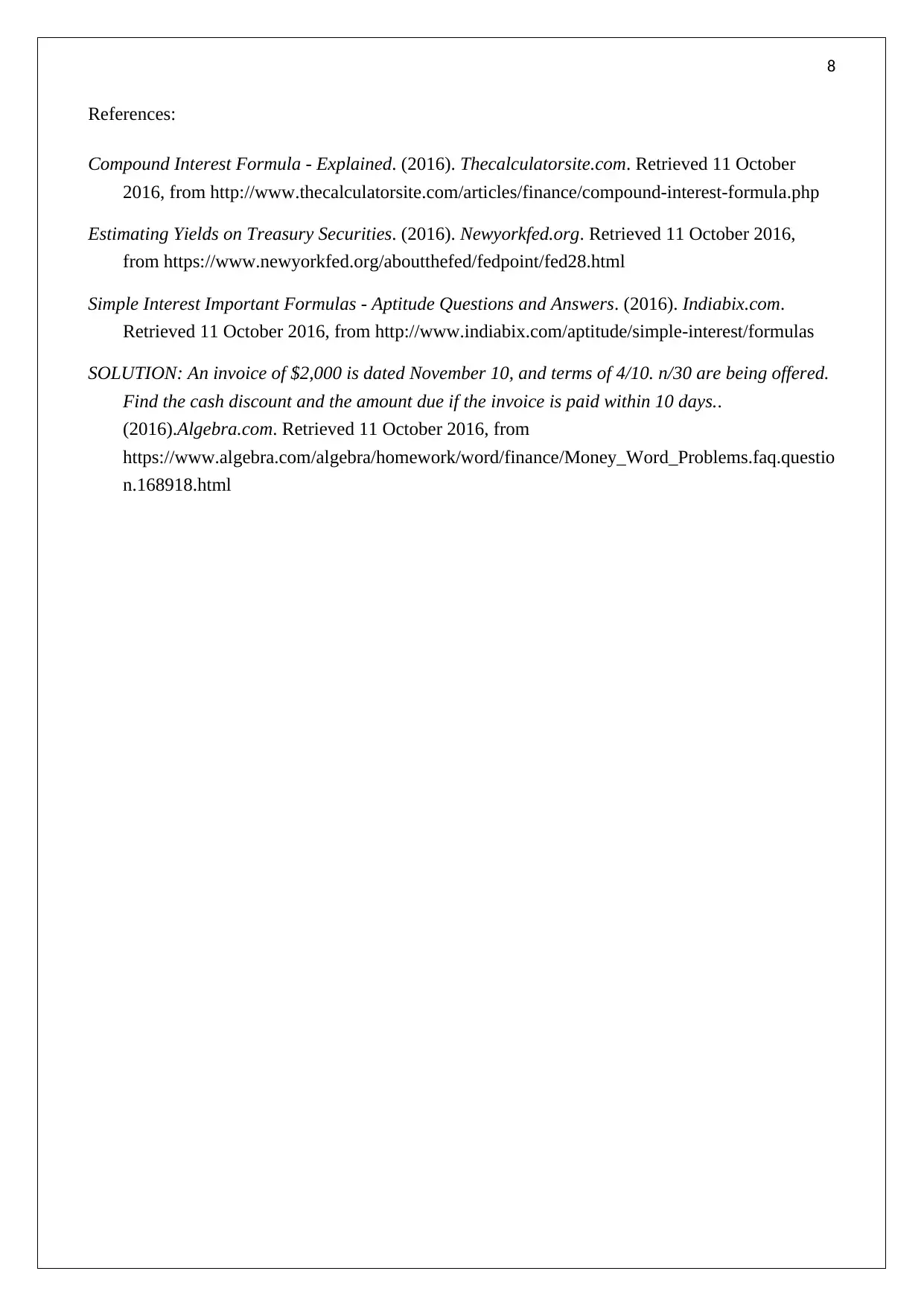
References:
Compound Interest Formula - Explained. (2016). Thecalculatorsite.com. Retrieved 11 October
2016, from http://www.thecalculatorsite.com/articles/finance/compound-interest-formula.php
Estimating Yields on Treasury Securities. (2016). Newyorkfed.org. Retrieved 11 October 2016,
from https://www.newyorkfed.org/aboutthefed/fedpoint/fed28.html
Simple Interest Important Formulas - Aptitude Questions and Answers. (2016). Indiabix.com.
Retrieved 11 October 2016, from http://www.indiabix.com/aptitude/simple-interest/formulas
SOLUTION: An invoice of $2,000 is dated November 10, and terms of 4/10. n/30 are being offered.
Find the cash discount and the amount due if the invoice is paid within 10 days..
(2016).Algebra.com. Retrieved 11 October 2016, from
https://www.algebra.com/algebra/homework/word/finance/Money_Word_Problems.faq.questio
n.168918.html
References:
Compound Interest Formula - Explained. (2016). Thecalculatorsite.com. Retrieved 11 October
2016, from http://www.thecalculatorsite.com/articles/finance/compound-interest-formula.php
Estimating Yields on Treasury Securities. (2016). Newyorkfed.org. Retrieved 11 October 2016,
from https://www.newyorkfed.org/aboutthefed/fedpoint/fed28.html
Simple Interest Important Formulas - Aptitude Questions and Answers. (2016). Indiabix.com.
Retrieved 11 October 2016, from http://www.indiabix.com/aptitude/simple-interest/formulas
SOLUTION: An invoice of $2,000 is dated November 10, and terms of 4/10. n/30 are being offered.
Find the cash discount and the amount due if the invoice is paid within 10 days..
(2016).Algebra.com. Retrieved 11 October 2016, from
https://www.algebra.com/algebra/homework/word/finance/Money_Word_Problems.faq.questio
n.168918.html
1 out of 8
Related Documents
Your All-in-One AI-Powered Toolkit for Academic Success.
+13062052269
info@desklib.com
Available 24*7 on WhatsApp / Email
Unlock your academic potential
Copyright © 2020–2026 A2Z Services. All Rights Reserved. Developed and managed by ZUCOL.