B10484 Cookery: Managing Finance Within a Budget Case Study Report
VerifiedAdded on 2023/01/12
|13
|3886
|25
Case Study
AI Summary
This document presents a comprehensive case study analysis of Cookery's financial performance, focusing on budget management, cost control, and variance analysis. It examines the variance between budgeted and actual sales, cost of sales, and gross profit, highlighting the impact on the company's financial health. The analysis includes an examination of payroll documentation requirements, legal compliance, and recommendations for staffing levels. The document also explores various options for controlling costs, such as inventory management, supplier selection, and food preparation techniques. Furthermore, it delves into the sources of supply for food products, factors influencing prices, and legal considerations related to price fixing and predatory pricing. Finally, the case study includes a management report analyzing financial statements, identifying trends, and discussing the impact of acquisitions on financial performance. Overall, this case study provides valuable insights into financial management within the food industry, offering practical solutions and strategies for improving profitability.
B10484
Manage finance within a
budget
Manage finance within a
budget

Paraphrase This Document
Need a fresh take? Get an instant paraphrase of this document with our AI Paraphraser
Case study B
Appendix 3
Task 1
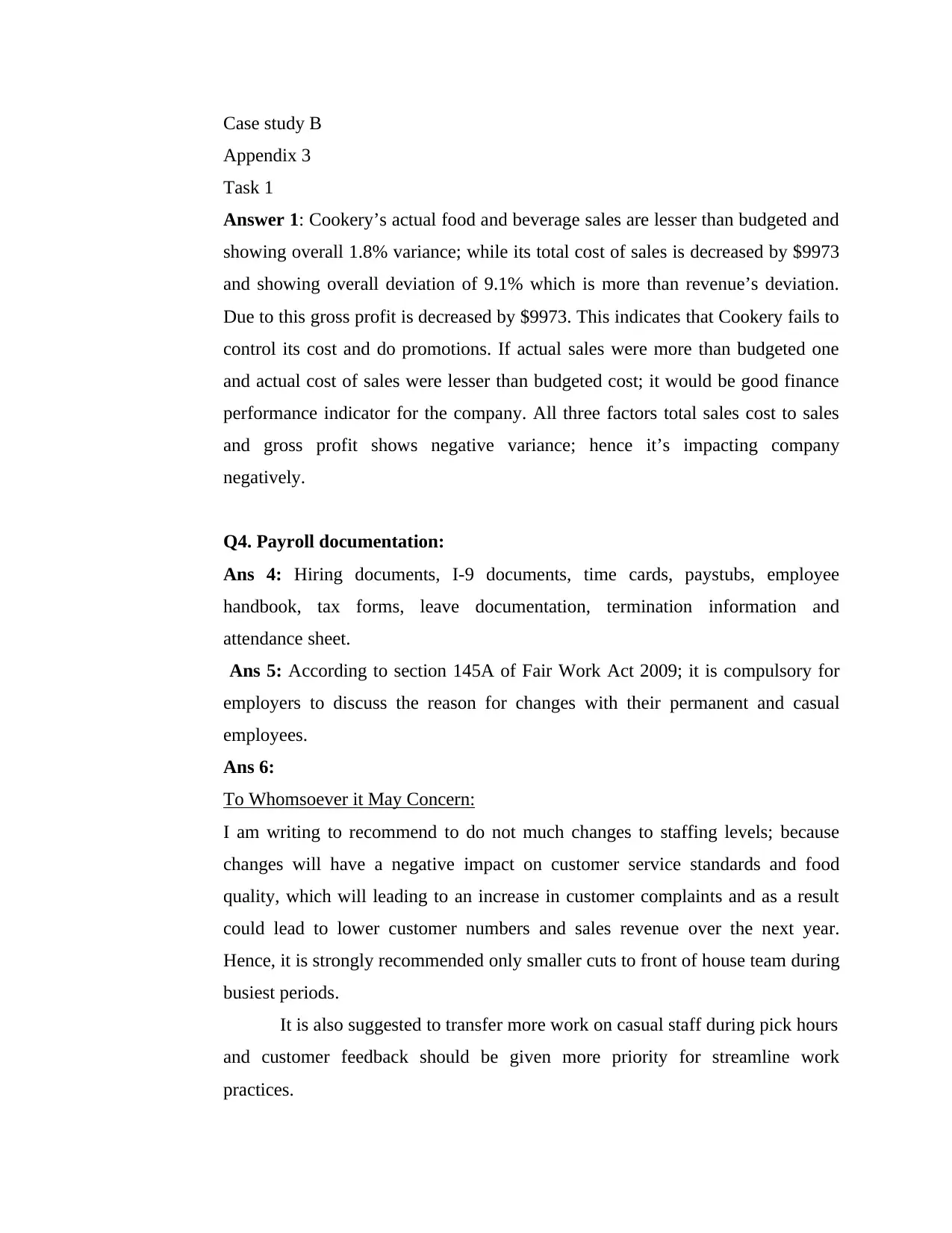
Answer 1: Cookery’s actual food and beverage sales are lesser than budgeted and
showing overall 1.8% variance; while its total cost of sales is decreased by $9973
and showing overall deviation of 9.1% which is more than revenue’s deviation.
Due to this gross profit is decreased by $9973. This indicates that Cookery fails to
control its cost and do promotions. If actual sales were more than budgeted one
and actual cost of sales were lesser than budgeted cost; it would be good finance
performance indicator for the company. All three factors total sales cost to sales
and gross profit shows negative variance; hence it’s impacting company
negatively.
Q4. Payroll documentation:
Ans 4: Hiring documents, I-9 documents, time cards, paystubs, employee
handbook, tax forms, leave documentation, termination information and
attendance sheet.
Ans 5: According to section 145A of Fair Work Act 2009; it is compulsory for
employers to discuss the reason for changes with their permanent and casual
employees.
Ans 6:
To Whomsoever it May Concern:
I am writing to recommend to do not much changes to staffing levels; because
changes will have a negative impact on customer service standards and food
quality, which will leading to an increase in customer complaints and as a result
could lead to lower customer numbers and sales revenue over the next year.
Hence, it is strongly recommended only smaller cuts to front of house team during
busiest periods.
It is also suggested to transfer more work on casual staff during pick hours
and customer feedback should be given more priority for streamline work
practices.
Appendix 3
Task 1
Answer 1: Cookery’s actual food and beverage sales are lesser than budgeted and
showing overall 1.8% variance; while its total cost of sales is decreased by $9973
and showing overall deviation of 9.1% which is more than revenue’s deviation.
Due to this gross profit is decreased by $9973. This indicates that Cookery fails to
control its cost and do promotions. If actual sales were more than budgeted one
and actual cost of sales were lesser than budgeted cost; it would be good finance
performance indicator for the company. All three factors total sales cost to sales
and gross profit shows negative variance; hence it’s impacting company
negatively.
Q4. Payroll documentation:
Ans 4: Hiring documents, I-9 documents, time cards, paystubs, employee
handbook, tax forms, leave documentation, termination information and
attendance sheet.
Ans 5: According to section 145A of Fair Work Act 2009; it is compulsory for
employers to discuss the reason for changes with their permanent and casual
employees.
Ans 6:
To Whomsoever it May Concern:
I am writing to recommend to do not much changes to staffing levels; because
changes will have a negative impact on customer service standards and food
quality, which will leading to an increase in customer complaints and as a result
could lead to lower customer numbers and sales revenue over the next year.
Hence, it is strongly recommended only smaller cuts to front of house team during
busiest periods.
It is also suggested to transfer more work on casual staff during pick hours
and customer feedback should be given more priority for streamline work
practices.
With regards
Budget Manager
Case study - A
Ans 1: List of options:
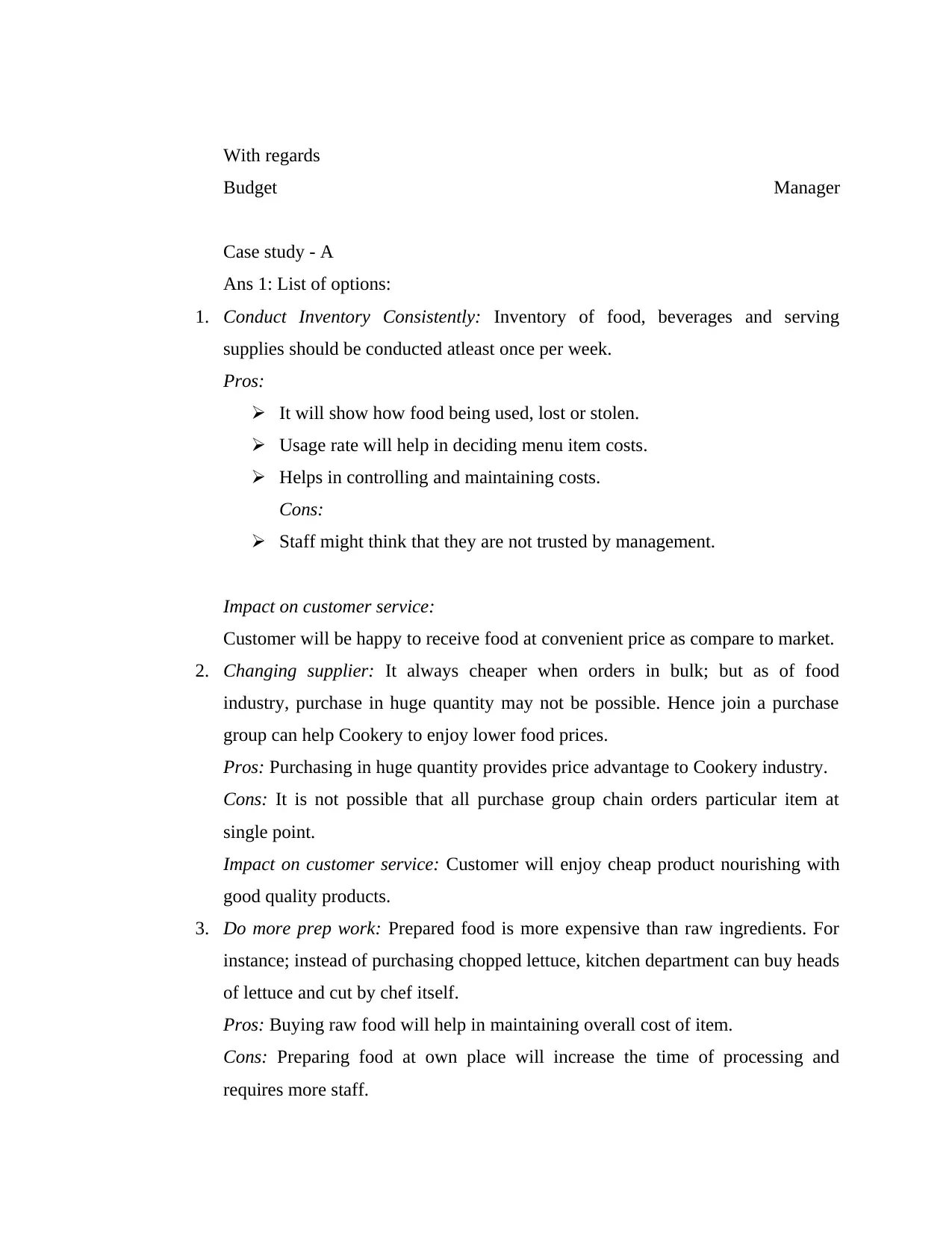
1. Conduct Inventory Consistently: Inventory of food, beverages and serving
supplies should be conducted atleast once per week.
Pros:
It will show how food being used, lost or stolen.
Usage rate will help in deciding menu item costs.
Helps in controlling and maintaining costs.
Cons:
Staff might think that they are not trusted by management.
Impact on customer service:
Customer will be happy to receive food at convenient price as compare to market.
2. Changing supplier: It always cheaper when orders in bulk; but as of food
industry, purchase in huge quantity may not be possible. Hence join a purchase
group can help Cookery to enjoy lower food prices.
Pros: Purchasing in huge quantity provides price advantage to Cookery industry.
Cons: It is not possible that all purchase group chain orders particular item at
single point.
Impact on customer service: Customer will enjoy cheap product nourishing with
good quality products.
3. Do more prep work: Prepared food is more expensive than raw ingredients. For
instance; instead of purchasing chopped lettuce, kitchen department can buy heads
of lettuce and cut by chef itself.
Pros: Buying raw food will help in maintaining overall cost of item.
Cons: Preparing food at own place will increase the time of processing and
requires more staff.
Budget Manager
Case study - A
Ans 1: List of options:
1. Conduct Inventory Consistently: Inventory of food, beverages and serving
supplies should be conducted atleast once per week.
Pros:
It will show how food being used, lost or stolen.
Usage rate will help in deciding menu item costs.
Helps in controlling and maintaining costs.
Cons:
Staff might think that they are not trusted by management.
Impact on customer service:
Customer will be happy to receive food at convenient price as compare to market.
2. Changing supplier: It always cheaper when orders in bulk; but as of food
industry, purchase in huge quantity may not be possible. Hence join a purchase
group can help Cookery to enjoy lower food prices.
Pros: Purchasing in huge quantity provides price advantage to Cookery industry.
Cons: It is not possible that all purchase group chain orders particular item at
single point.
Impact on customer service: Customer will enjoy cheap product nourishing with
good quality products.
3. Do more prep work: Prepared food is more expensive than raw ingredients. For
instance; instead of purchasing chopped lettuce, kitchen department can buy heads
of lettuce and cut by chef itself.
Pros: Buying raw food will help in maintaining overall cost of item.
Cons: Preparing food at own place will increase the time of processing and
requires more staff.
⊘ This is a preview!⊘
Do you want full access?
Subscribe today to unlock all pages.

Trusted by 1+ million students worldwide
Impact on customer service: It will have both negative as well as positive impact
on customer service. For instance; if Cookery assist with extra staff for processing
semi finished product than it will give reach taste to customer and thus having
positive impact.
4. Review produce specifications: Cookery must know what it want to serve to its
customers and what quality it requires; sometimes providing high quality
ingredients and lesser quality product creates less difference in taste but affect
cost by much impact.
Pros: It will help in reducing cost and maintenance of food price.
Cons: Less quality ingredients can be tracked from regular customers using
particular dish for long time and it might be possible that he no longer use this
service.
Impact on customer service: It can impact negatively to company’s image if
difference is much in taste of food.
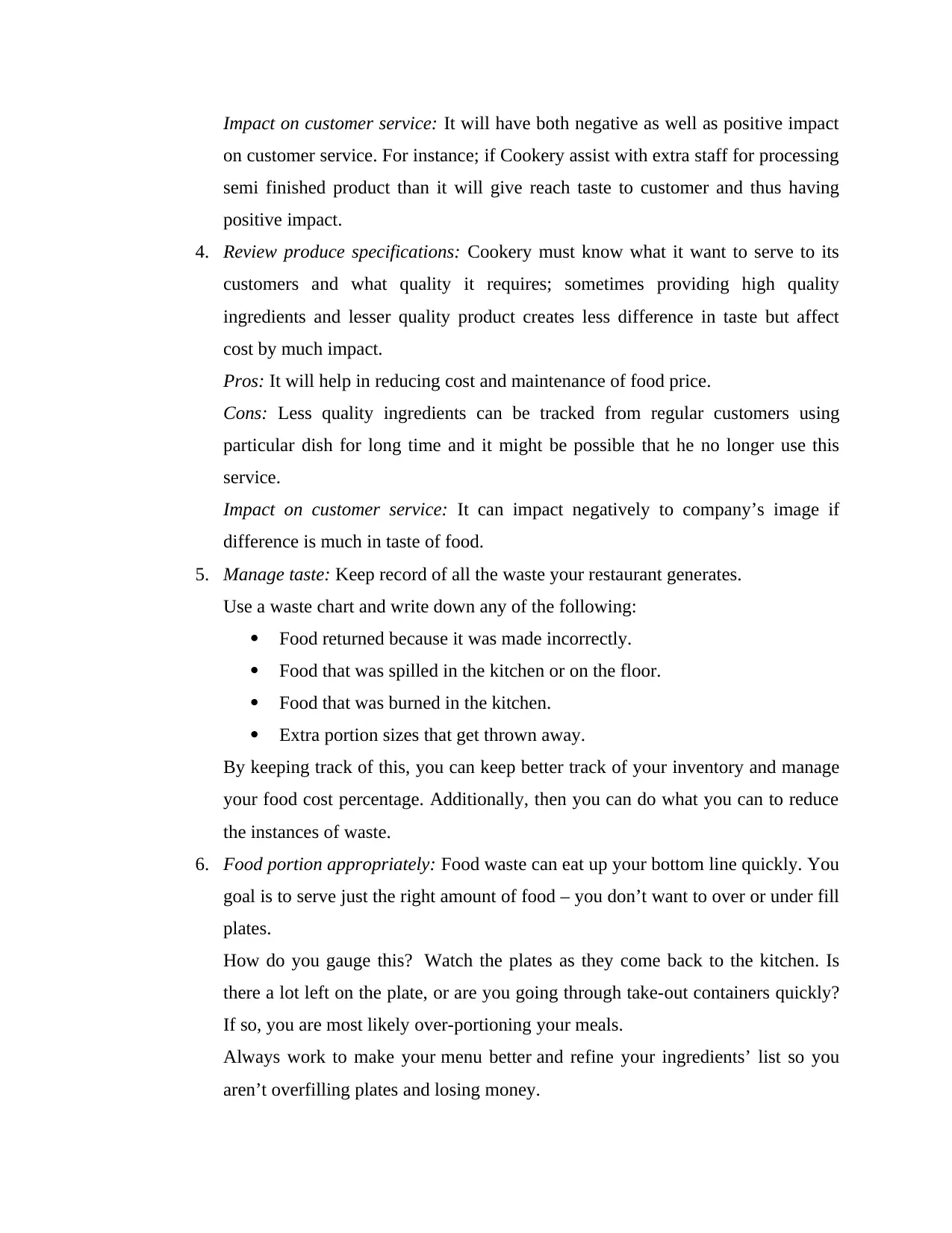
5. Manage taste: Keep record of all the waste your restaurant generates.
Use a waste chart and write down any of the following:
Food returned because it was made incorrectly.
Food that was spilled in the kitchen or on the floor.
Food that was burned in the kitchen.
Extra portion sizes that get thrown away.
By keeping track of this, you can keep better track of your inventory and manage
your food cost percentage. Additionally, then you can do what you can to reduce
the instances of waste.
6. Food portion appropriately: Food waste can eat up your bottom line quickly. You
goal is to serve just the right amount of food – you don’t want to over or under fill
plates.
How do you gauge this? Watch the plates as they come back to the kitchen. Is
there a lot left on the plate, or are you going through take-out containers quickly?
If so, you are most likely over-portioning your meals.
Always work to make your menu better and refine your ingredients’ list so you
aren’t overfilling plates and losing money.
on customer service. For instance; if Cookery assist with extra staff for processing
semi finished product than it will give reach taste to customer and thus having
positive impact.
4. Review produce specifications: Cookery must know what it want to serve to its
customers and what quality it requires; sometimes providing high quality
ingredients and lesser quality product creates less difference in taste but affect
cost by much impact.
Pros: It will help in reducing cost and maintenance of food price.
Cons: Less quality ingredients can be tracked from regular customers using
particular dish for long time and it might be possible that he no longer use this
service.
Impact on customer service: It can impact negatively to company’s image if
difference is much in taste of food.
5. Manage taste: Keep record of all the waste your restaurant generates.
Use a waste chart and write down any of the following:
Food returned because it was made incorrectly.
Food that was spilled in the kitchen or on the floor.
Food that was burned in the kitchen.
Extra portion sizes that get thrown away.
By keeping track of this, you can keep better track of your inventory and manage
your food cost percentage. Additionally, then you can do what you can to reduce
the instances of waste.
6. Food portion appropriately: Food waste can eat up your bottom line quickly. You
goal is to serve just the right amount of food – you don’t want to over or under fill
plates.
How do you gauge this? Watch the plates as they come back to the kitchen. Is
there a lot left on the plate, or are you going through take-out containers quickly?
If so, you are most likely over-portioning your meals.
Always work to make your menu better and refine your ingredients’ list so you
aren’t overfilling plates and losing money.
Paraphrase This Document
Need a fresh take? Get an instant paraphrase of this document with our AI Paraphraser
Ans 2:
Sources of supply vary considerably from location to location. Large cities have a
greater number and variety of suppliers than do small towns and isolated
communities. Purchasers should establish contact with available suppliers such as
wholesalers, local producers and packers, retailers, cooperative associations, and
food importers. In most instances, the person in charge of buying will contact
several suppliers to obtain the necessary foods. Some wholesalers diversify their
product lines in order to meet all food-related kitchen needs.
Food products are obtained from various sources of supply. For example, a
packing house supplies meat and meat products, while a food wholesaler supplies
dry goods. Once business is established with a supplier, all transactions should be
well documented and kept readily available on file.
There are two major food categories: perishables and non-perishables.
Perishables
Perishable items include fruits, vegetables, fresh fish and shellfish, fresh meats,
poultry, and dairy products. As a rule, perishables are bought frequently to ensure
freshness. Frozen foods, such as vegetables, fish and meat products, have a longer
lifespan and can be ordered less frequently and stored in a freezer.
Non-perishables
Non-perishable items include dry goods, flour, cereals, and miscellaneous items
such as olives, pickles, and other condiments. These can be ordered on a weekly
or monthly basis.
Keep in mind that just because something does not go bad isn’t a reason to buy it
in quantities larger than you need. Every item in your inventory is equal to a
dollar amount that you could be saving or spending on something else. Consider
that a case of 1000 sheets of parchment paper may cost $250. If you have a case
and a half sitting in your inventory, but only use a few sheets a day that is a lot of
money sitting in your storeroom.
Factors That Impact Prices
Food products in particular fluctuate in price over the year, due to many factors:
Sources of supply vary considerably from location to location. Large cities have a
greater number and variety of suppliers than do small towns and isolated
communities. Purchasers should establish contact with available suppliers such as
wholesalers, local producers and packers, retailers, cooperative associations, and
food importers. In most instances, the person in charge of buying will contact
several suppliers to obtain the necessary foods. Some wholesalers diversify their
product lines in order to meet all food-related kitchen needs.
Food products are obtained from various sources of supply. For example, a
packing house supplies meat and meat products, while a food wholesaler supplies
dry goods. Once business is established with a supplier, all transactions should be
well documented and kept readily available on file.
There are two major food categories: perishables and non-perishables.
Perishables
Perishable items include fruits, vegetables, fresh fish and shellfish, fresh meats,
poultry, and dairy products. As a rule, perishables are bought frequently to ensure
freshness. Frozen foods, such as vegetables, fish and meat products, have a longer
lifespan and can be ordered less frequently and stored in a freezer.
Non-perishables
Non-perishable items include dry goods, flour, cereals, and miscellaneous items
such as olives, pickles, and other condiments. These can be ordered on a weekly
or monthly basis.
Keep in mind that just because something does not go bad isn’t a reason to buy it
in quantities larger than you need. Every item in your inventory is equal to a
dollar amount that you could be saving or spending on something else. Consider
that a case of 1000 sheets of parchment paper may cost $250. If you have a case
and a half sitting in your inventory, but only use a few sheets a day that is a lot of
money sitting in your storeroom.
Factors That Impact Prices
Food products in particular fluctuate in price over the year, due to many factors:
Seasonality: When food is in season, there is more of it available in the
local food supply, bringing prices down. Additionally, foods in season are
usually of higher quality and have longer shelf life than those that are out
of season and need to be transported long distances to market.
Weather: Severe weather can have a huge impact on the cost of food.
Drought, flooding, and unseasonable frost have all affected major
produce-supplying areas of the world in recent years, causing a rise in
prices for many items.
Costs of transportation: If the cost of fuel or transportation rises, so does
the cost of food that needs to travel to market.
Commodity prices: A number of foods are traded on the commodity
market, such as meats and grains. These prices fluctuate as buyers who
trade in these products in large volumes buy and sell, much like the stock
market.
Ans 3:
Price fixing
It is illegal for competing businesses to get together and agree to fix their prices
(or to agree to charge certain fees). Price fixing agreements don’t need to be in
writing – a verbal agreement or an informal understanding is sufficient.
Businesses can apply to the ACCC for authorization to engage in this conduct if
they consider it provides a public benefit.
Imposing minimum prices on retailers
It is illegal for suppliers to attempt to set a minimum price for their products or
services that retailers can’t sell below (this is known as ‘resale price
maintenance’). However, a supplier may withhold the supply of goods when a
retailer has sold the goods at a price below cost for the purpose of attracting
customers (‘loss-leader selling’).
Selling goods below cost
While selling goods at a below-cost price is usually okay, it may be illegal if it is
done for the purpose of eliminating or substantially damaging a competitor. This
local food supply, bringing prices down. Additionally, foods in season are
usually of higher quality and have longer shelf life than those that are out
of season and need to be transported long distances to market.
Weather: Severe weather can have a huge impact on the cost of food.
Drought, flooding, and unseasonable frost have all affected major
produce-supplying areas of the world in recent years, causing a rise in
prices for many items.
Costs of transportation: If the cost of fuel or transportation rises, so does
the cost of food that needs to travel to market.
Commodity prices: A number of foods are traded on the commodity
market, such as meats and grains. These prices fluctuate as buyers who
trade in these products in large volumes buy and sell, much like the stock
market.
Ans 3:
Price fixing
It is illegal for competing businesses to get together and agree to fix their prices
(or to agree to charge certain fees). Price fixing agreements don’t need to be in
writing – a verbal agreement or an informal understanding is sufficient.
Businesses can apply to the ACCC for authorization to engage in this conduct if
they consider it provides a public benefit.
Imposing minimum prices on retailers
It is illegal for suppliers to attempt to set a minimum price for their products or
services that retailers can’t sell below (this is known as ‘resale price
maintenance’). However, a supplier may withhold the supply of goods when a
retailer has sold the goods at a price below cost for the purpose of attracting
customers (‘loss-leader selling’).
Selling goods below cost
While selling goods at a below-cost price is usually okay, it may be illegal if it is
done for the purpose of eliminating or substantially damaging a competitor. This
⊘ This is a preview!⊘
Do you want full access?
Subscribe today to unlock all pages.
Trusted by 1+ million students worldwide
is known as predatory pricing. Whether the law has been broken will depend on a
number of factors, such as how long the goods were sold below cost and how
much market powers the seller has.
Task 3 Preparation of management report:
Net sales increased by $4,129,000,000, or 13.3 percent. Cost of goods sold had a
corresponding increase of $1,605,000,000, or 14.5 percent. The increase in net
sales and related increase in cost of goods sold resulted in an increase in gross
margin of $2,524,000,000, or 12.7 percent. The increase in selling and
administrative expenses of $1,800,000,000, or 15.8 percent, outpaced the increase
in net sales, resulting in a relatively small increase in operating income of
$218,000,000, or 2.6 percent. The significant increase in other income (expenses),
net of 555.6 percent relates to a one-time gain of $4,978,000,000 resulting
from acquisition in June (this information comes from the notes to the financial
statements). This one-time gain caused an unusually large increase in net income
for 2010. This is important as we continue our analysis of Company throughout
the chapter. Net income will appear to have an unusually large increase as we
cover various measures of performance, but keep in mind that the one-time gain in
2010 of $4,978,000,000 caused most of the increase from May to June.
Overall, total assets increased by $24,250,000,000, or 49.8 percent. Of
course, total liabilities and shareholders’ equity also increased by the same
amount. The increases identified in almost every asset, liability, and shareholders’
equity line item are significant. From reading the notes to the financial statements,
the authors were able to identify the main source of these increases. In
2010, acquired the remaining 67 percent of Enterprises, North America business
that Cookery did not already own. This resulted in significant increases in
noncurrent assets and noncurrent liabilities, which were acquired as part of this
transaction. It also resulted in the reporting of a one-time gain on the income
statement of $4,978,000,000, which came from re measuring its equity interest to
fair value upon close of the transaction in 2010.
number of factors, such as how long the goods were sold below cost and how
much market powers the seller has.
Task 3 Preparation of management report:
Net sales increased by $4,129,000,000, or 13.3 percent. Cost of goods sold had a
corresponding increase of $1,605,000,000, or 14.5 percent. The increase in net
sales and related increase in cost of goods sold resulted in an increase in gross
margin of $2,524,000,000, or 12.7 percent. The increase in selling and
administrative expenses of $1,800,000,000, or 15.8 percent, outpaced the increase
in net sales, resulting in a relatively small increase in operating income of
$218,000,000, or 2.6 percent. The significant increase in other income (expenses),
net of 555.6 percent relates to a one-time gain of $4,978,000,000 resulting
from acquisition in June (this information comes from the notes to the financial
statements). This one-time gain caused an unusually large increase in net income
for 2010. This is important as we continue our analysis of Company throughout
the chapter. Net income will appear to have an unusually large increase as we
cover various measures of performance, but keep in mind that the one-time gain in
2010 of $4,978,000,000 caused most of the increase from May to June.
Overall, total assets increased by $24,250,000,000, or 49.8 percent. Of
course, total liabilities and shareholders’ equity also increased by the same
amount. The increases identified in almost every asset, liability, and shareholders’
equity line item are significant. From reading the notes to the financial statements,
the authors were able to identify the main source of these increases. In
2010, acquired the remaining 67 percent of Enterprises, North America business
that Cookery did not already own. This resulted in significant increases in
noncurrent assets and noncurrent liabilities, which were acquired as part of this
transaction. It also resulted in the reporting of a one-time gain on the income
statement of $4,978,000,000, which came from re measuring its equity interest to
fair value upon close of the transaction in 2010.
Paraphrase This Document
Need a fresh take? Get an instant paraphrase of this document with our AI Paraphraser
This analysis points to the reason we perform trend analysis—to identify the
increases and decreases in dollar amounts from one year to the next and to take a
close look at unusual trends.
Case Study C
Ans 2: Any business trying to sell a product is likely going to incur costs in order
to get that product sold. In the case of restaurants and other food operations, these
costs come mainly in the form of food, beverages, and labor. Cookery operators
purchase food and beverages, usually in the form of raw ingredients, and then
must pay for the labor of chefs and cooks who can transform those ingredients
into salable finished products. In order for a restaurant to be profitable, it must sell
these finished products at a higher price than it takes to prepare them. Careful and
methodical control of costs helps a restaurant operator set accurate menu prices
and is crucial for operational success and profitability.
Variance in cost of sales: Food and beverage costs show the value of food and
beverage products that were purchased and consumed in an operation over a set
period of time, such as weekly, monthly, or annually. Consumption is based
primarily on all of the raw ingredients used to produce menu items, but it is also
based on usage or waste for other reasons, such as free employee meals, food
spoilage, or theft. The beginning inventory is the value of the inventory at the
beginning of a tracking period (for example, March 1st - March 31st). Anything
purchased during the month is recorded in purchases and added to the value of the
beginning inventory. At the end of the month, the value of the inventory is
calculated again, and the difference is the Cost of Goods Sold.
The Cost of Goods Sold figure can then be used to calculate food and
beverage costs as a percentage of sales. The results provide figures that can be
used as a benchmark to analyze and compare the performance of the operation
using both historical data and industry standards. These numbers can also help
determine budgets for future months, and allow management to make better
decisions for greater business profitability.
Ans 3:
increases and decreases in dollar amounts from one year to the next and to take a
close look at unusual trends.
Case Study C
Ans 2: Any business trying to sell a product is likely going to incur costs in order
to get that product sold. In the case of restaurants and other food operations, these
costs come mainly in the form of food, beverages, and labor. Cookery operators
purchase food and beverages, usually in the form of raw ingredients, and then
must pay for the labor of chefs and cooks who can transform those ingredients
into salable finished products. In order for a restaurant to be profitable, it must sell
these finished products at a higher price than it takes to prepare them. Careful and
methodical control of costs helps a restaurant operator set accurate menu prices
and is crucial for operational success and profitability.
Variance in cost of sales: Food and beverage costs show the value of food and
beverage products that were purchased and consumed in an operation over a set
period of time, such as weekly, monthly, or annually. Consumption is based
primarily on all of the raw ingredients used to produce menu items, but it is also
based on usage or waste for other reasons, such as free employee meals, food
spoilage, or theft. The beginning inventory is the value of the inventory at the
beginning of a tracking period (for example, March 1st - March 31st). Anything
purchased during the month is recorded in purchases and added to the value of the
beginning inventory. At the end of the month, the value of the inventory is
calculated again, and the difference is the Cost of Goods Sold.
The Cost of Goods Sold figure can then be used to calculate food and
beverage costs as a percentage of sales. The results provide figures that can be
used as a benchmark to analyze and compare the performance of the operation
using both historical data and industry standards. These numbers can also help
determine budgets for future months, and allow management to make better
decisions for greater business profitability.
Ans 3:
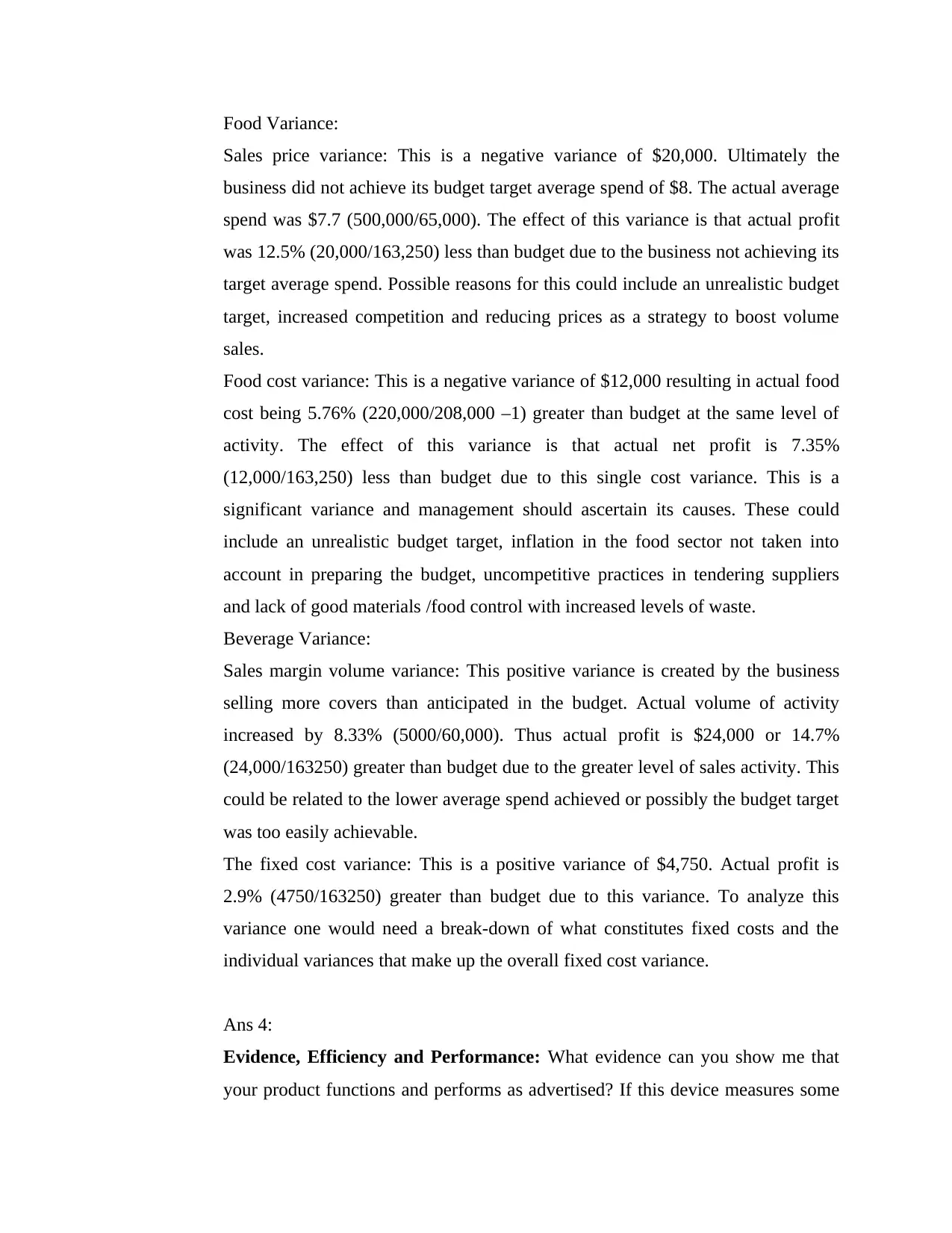
Food Variance:
Sales price variance: This is a negative variance of $20,000. Ultimately the
business did not achieve its budget target average spend of $8. The actual average
spend was $7.7 (500,000/65,000). The effect of this variance is that actual profit
was 12.5% (20,000/163,250) less than budget due to the business not achieving its
target average spend. Possible reasons for this could include an unrealistic budget
target, increased competition and reducing prices as a strategy to boost volume
sales.
Food cost variance: This is a negative variance of $12,000 resulting in actual food
cost being 5.76% (220,000/208,000 –1) greater than budget at the same level of
activity. The effect of this variance is that actual net profit is 7.35%
(12,000/163,250) less than budget due to this single cost variance. This is a
significant variance and management should ascertain its causes. These could
include an unrealistic budget target, inflation in the food sector not taken into
account in preparing the budget, uncompetitive practices in tendering suppliers
and lack of good materials /food control with increased levels of waste.
Beverage Variance:
Sales margin volume variance: This positive variance is created by the business
selling more covers than anticipated in the budget. Actual volume of activity
increased by 8.33% (5000/60,000). Thus actual profit is $24,000 or 14.7%
(24,000/163250) greater than budget due to the greater level of sales activity. This
could be related to the lower average spend achieved or possibly the budget target
was too easily achievable.
The fixed cost variance: This is a positive variance of $4,750. Actual profit is
2.9% (4750/163250) greater than budget due to this variance. To analyze this
variance one would need a break-down of what constitutes fixed costs and the
individual variances that make up the overall fixed cost variance.
Ans 4:
Evidence, Efficiency and Performance: What evidence can you show me that
your product functions and performs as advertised? If this device measures some
Sales price variance: This is a negative variance of $20,000. Ultimately the
business did not achieve its budget target average spend of $8. The actual average
spend was $7.7 (500,000/65,000). The effect of this variance is that actual profit
was 12.5% (20,000/163,250) less than budget due to the business not achieving its
target average spend. Possible reasons for this could include an unrealistic budget
target, increased competition and reducing prices as a strategy to boost volume
sales.
Food cost variance: This is a negative variance of $12,000 resulting in actual food
cost being 5.76% (220,000/208,000 –1) greater than budget at the same level of
activity. The effect of this variance is that actual net profit is 7.35%
(12,000/163,250) less than budget due to this single cost variance. This is a
significant variance and management should ascertain its causes. These could
include an unrealistic budget target, inflation in the food sector not taken into
account in preparing the budget, uncompetitive practices in tendering suppliers
and lack of good materials /food control with increased levels of waste.
Beverage Variance:
Sales margin volume variance: This positive variance is created by the business
selling more covers than anticipated in the budget. Actual volume of activity
increased by 8.33% (5000/60,000). Thus actual profit is $24,000 or 14.7%
(24,000/163250) greater than budget due to the greater level of sales activity. This
could be related to the lower average spend achieved or possibly the budget target
was too easily achievable.
The fixed cost variance: This is a positive variance of $4,750. Actual profit is
2.9% (4750/163250) greater than budget due to this variance. To analyze this
variance one would need a break-down of what constitutes fixed costs and the
individual variances that make up the overall fixed cost variance.
Ans 4:
Evidence, Efficiency and Performance: What evidence can you show me that
your product functions and performs as advertised? If this device measures some
⊘ This is a preview!⊘
Do you want full access?
Subscribe today to unlock all pages.
Trusted by 1+ million students worldwide
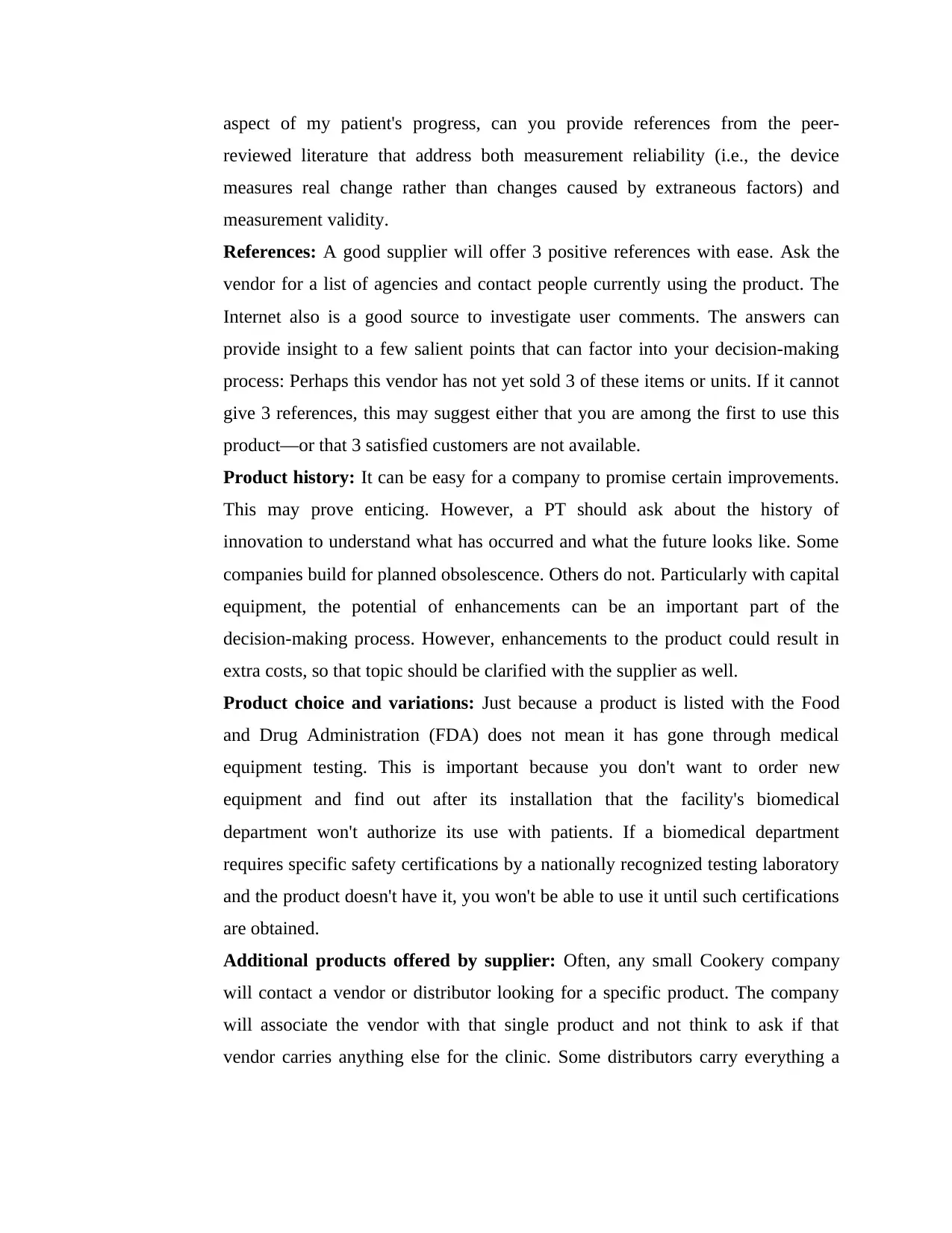
aspect of my patient's progress, can you provide references from the peer-
reviewed literature that address both measurement reliability (i.e., the device
measures real change rather than changes caused by extraneous factors) and
measurement validity.
References: A good supplier will offer 3 positive references with ease. Ask the
vendor for a list of agencies and contact people currently using the product. The
Internet also is a good source to investigate user comments. The answers can
provide insight to a few salient points that can factor into your decision-making
process: Perhaps this vendor has not yet sold 3 of these items or units. If it cannot
give 3 references, this may suggest either that you are among the first to use this
product—or that 3 satisfied customers are not available.
Product history: It can be easy for a company to promise certain improvements.
This may prove enticing. However, a PT should ask about the history of
innovation to understand what has occurred and what the future looks like. Some
companies build for planned obsolescence. Others do not. Particularly with capital
equipment, the potential of enhancements can be an important part of the
decision-making process. However, enhancements to the product could result in
extra costs, so that topic should be clarified with the supplier as well.
Product choice and variations: Just because a product is listed with the Food
and Drug Administration (FDA) does not mean it has gone through medical
equipment testing. This is important because you don't want to order new
equipment and find out after its installation that the facility's biomedical
department won't authorize its use with patients. If a biomedical department
requires specific safety certifications by a nationally recognized testing laboratory
and the product doesn't have it, you won't be able to use it until such certifications
are obtained.
Additional products offered by supplier: Often, any small Cookery company
will contact a vendor or distributor looking for a specific product. The company
will associate the vendor with that single product and not think to ask if that
vendor carries anything else for the clinic. Some distributors carry everything a
reviewed literature that address both measurement reliability (i.e., the device
measures real change rather than changes caused by extraneous factors) and
measurement validity.
References: A good supplier will offer 3 positive references with ease. Ask the
vendor for a list of agencies and contact people currently using the product. The
Internet also is a good source to investigate user comments. The answers can
provide insight to a few salient points that can factor into your decision-making
process: Perhaps this vendor has not yet sold 3 of these items or units. If it cannot
give 3 references, this may suggest either that you are among the first to use this
product—or that 3 satisfied customers are not available.
Product history: It can be easy for a company to promise certain improvements.
This may prove enticing. However, a PT should ask about the history of
innovation to understand what has occurred and what the future looks like. Some
companies build for planned obsolescence. Others do not. Particularly with capital
equipment, the potential of enhancements can be an important part of the
decision-making process. However, enhancements to the product could result in
extra costs, so that topic should be clarified with the supplier as well.
Product choice and variations: Just because a product is listed with the Food
and Drug Administration (FDA) does not mean it has gone through medical
equipment testing. This is important because you don't want to order new
equipment and find out after its installation that the facility's biomedical
department won't authorize its use with patients. If a biomedical department
requires specific safety certifications by a nationally recognized testing laboratory
and the product doesn't have it, you won't be able to use it until such certifications
are obtained.
Additional products offered by supplier: Often, any small Cookery company
will contact a vendor or distributor looking for a specific product. The company
will associate the vendor with that single product and not think to ask if that
vendor carries anything else for the clinic. Some distributors carry everything a
Paraphrase This Document
Need a fresh take? Get an instant paraphrase of this document with our AI Paraphraser
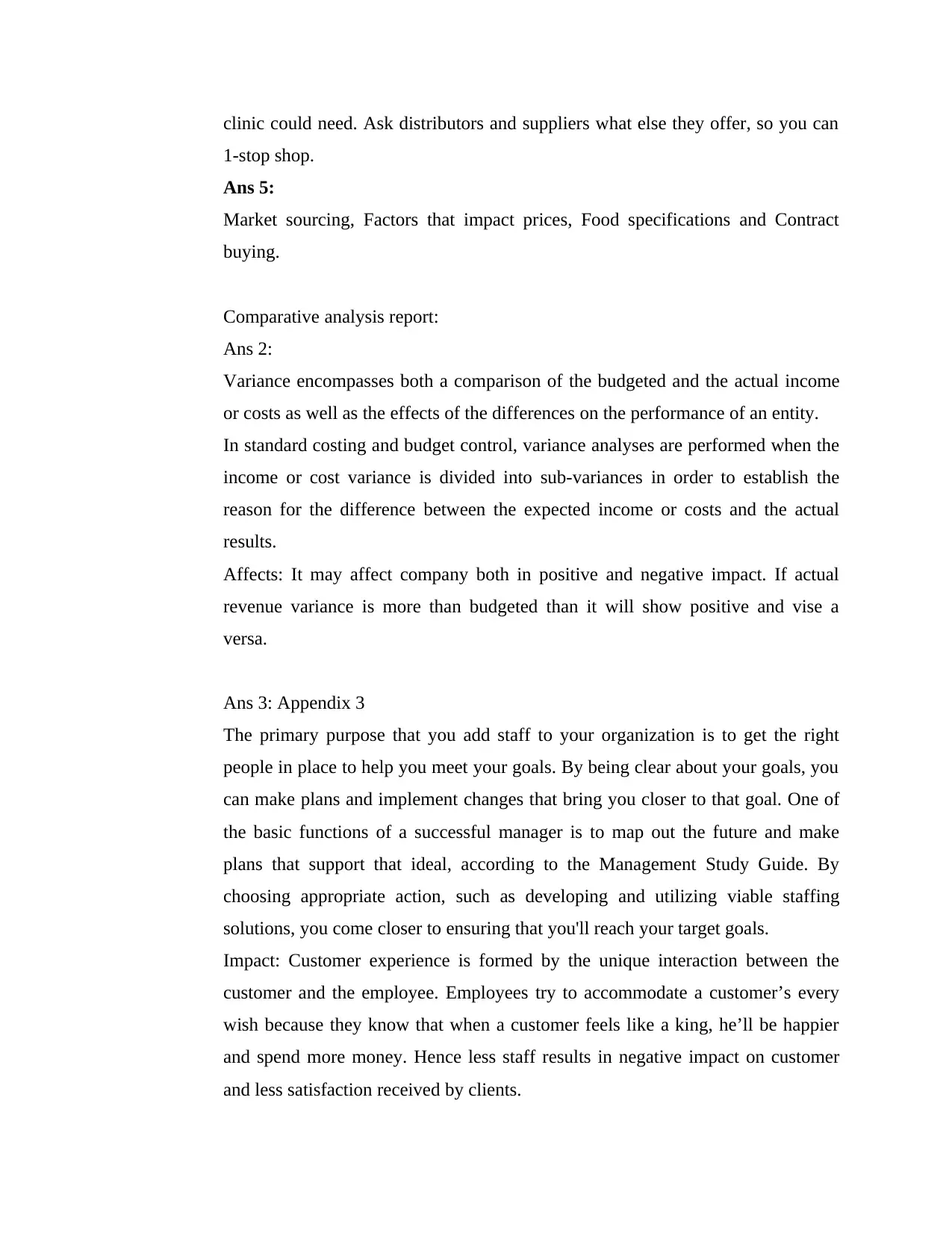
clinic could need. Ask distributors and suppliers what else they offer, so you can
1-stop shop.
Ans 5:
Market sourcing, Factors that impact prices, Food specifications and Contract
buying.
Comparative analysis report:
Ans 2:
Variance encompasses both a comparison of the budgeted and the actual income
or costs as well as the effects of the differences on the performance of an entity.
In standard costing and budget control, variance analyses are performed when the
income or cost variance is divided into sub-variances in order to establish the
reason for the difference between the expected income or costs and the actual
results.
Affects: It may affect company both in positive and negative impact. If actual
revenue variance is more than budgeted than it will show positive and vise a
versa.
Ans 3: Appendix 3
The primary purpose that you add staff to your organization is to get the right
people in place to help you meet your goals. By being clear about your goals, you
can make plans and implement changes that bring you closer to that goal. One of
the basic functions of a successful manager is to map out the future and make
plans that support that ideal, according to the Management Study Guide. By
choosing appropriate action, such as developing and utilizing viable staffing
solutions, you come closer to ensuring that you'll reach your target goals.
Impact: Customer experience is formed by the unique interaction between the
customer and the employee. Employees try to accommodate a customer’s every
wish because they know that when a customer feels like a king, he’ll be happier
and spend more money. Hence less staff results in negative impact on customer
and less satisfaction received by clients.
1-stop shop.
Ans 5:
Market sourcing, Factors that impact prices, Food specifications and Contract
buying.
Comparative analysis report:
Ans 2:
Variance encompasses both a comparison of the budgeted and the actual income
or costs as well as the effects of the differences on the performance of an entity.
In standard costing and budget control, variance analyses are performed when the
income or cost variance is divided into sub-variances in order to establish the
reason for the difference between the expected income or costs and the actual
results.
Affects: It may affect company both in positive and negative impact. If actual
revenue variance is more than budgeted than it will show positive and vise a
versa.
Ans 3: Appendix 3
The primary purpose that you add staff to your organization is to get the right
people in place to help you meet your goals. By being clear about your goals, you
can make plans and implement changes that bring you closer to that goal. One of
the basic functions of a successful manager is to map out the future and make
plans that support that ideal, according to the Management Study Guide. By
choosing appropriate action, such as developing and utilizing viable staffing
solutions, you come closer to ensuring that you'll reach your target goals.
Impact: Customer experience is formed by the unique interaction between the
customer and the employee. Employees try to accommodate a customer’s every
wish because they know that when a customer feels like a king, he’ll be happier
and spend more money. Hence less staff results in negative impact on customer
and less satisfaction received by clients.
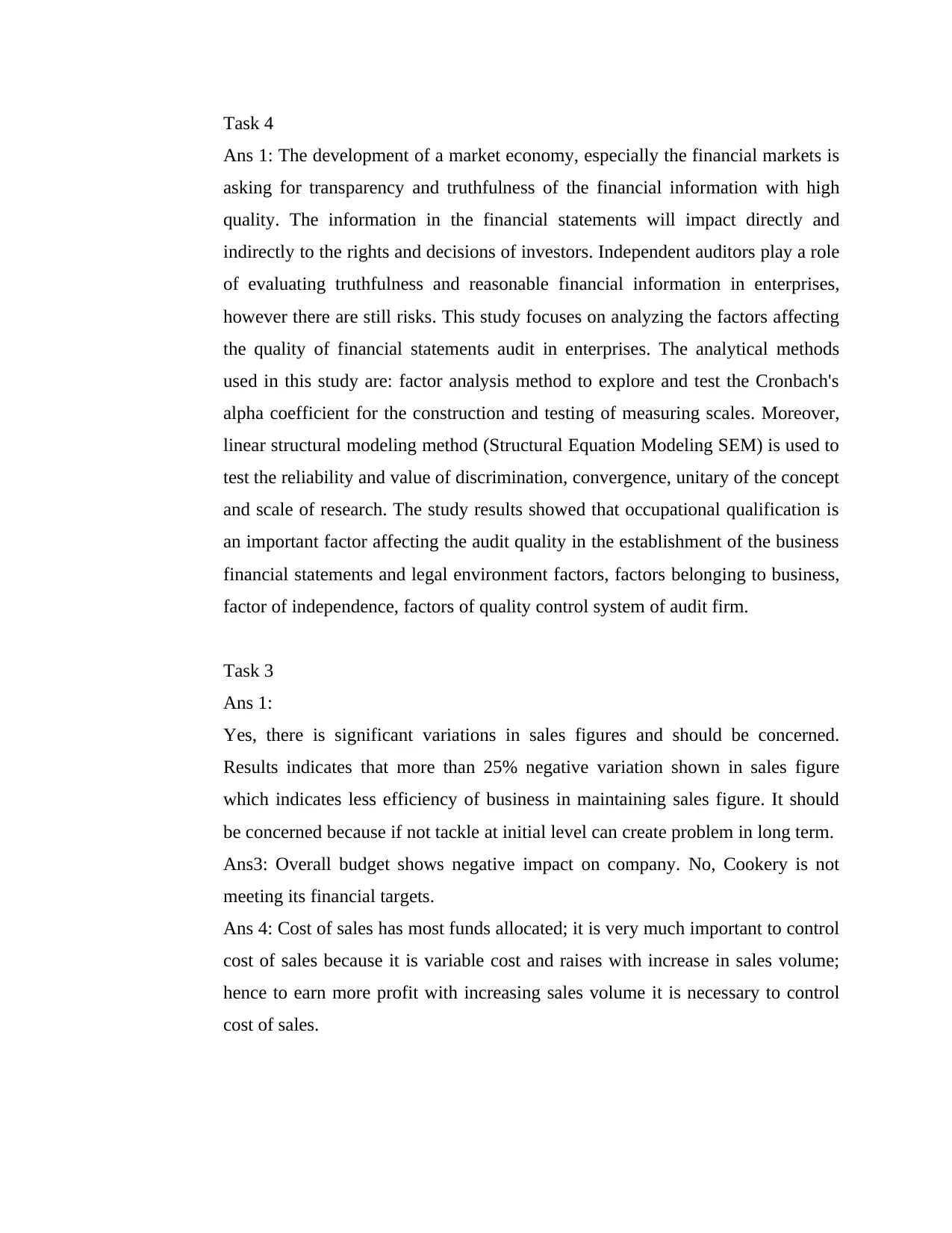
Task 4
Ans 1: The development of a market economy, especially the financial markets is
asking for transparency and truthfulness of the financial information with high
quality. The information in the financial statements will impact directly and
indirectly to the rights and decisions of investors. Independent auditors play a role
of evaluating truthfulness and reasonable financial information in enterprises,
however there are still risks. This study focuses on analyzing the factors affecting
the quality of financial statements audit in enterprises. The analytical methods
used in this study are: factor analysis method to explore and test the Cronbach's
alpha coefficient for the construction and testing of measuring scales. Moreover,
linear structural modeling method (Structural Equation Modeling SEM) is used to
test the reliability and value of discrimination, convergence, unitary of the concept
and scale of research. The study results showed that occupational qualification is
an important factor affecting the audit quality in the establishment of the business
financial statements and legal environment factors, factors belonging to business,
factor of independence, factors of quality control system of audit firm.
Task 3
Ans 1:
Yes, there is significant variations in sales figures and should be concerned.
Results indicates that more than 25% negative variation shown in sales figure
which indicates less efficiency of business in maintaining sales figure. It should
be concerned because if not tackle at initial level can create problem in long term.
Ans3: Overall budget shows negative impact on company. No, Cookery is not
meeting its financial targets.
Ans 4: Cost of sales has most funds allocated; it is very much important to control
cost of sales because it is variable cost and raises with increase in sales volume;
hence to earn more profit with increasing sales volume it is necessary to control
cost of sales.
Ans 1: The development of a market economy, especially the financial markets is
asking for transparency and truthfulness of the financial information with high
quality. The information in the financial statements will impact directly and
indirectly to the rights and decisions of investors. Independent auditors play a role
of evaluating truthfulness and reasonable financial information in enterprises,
however there are still risks. This study focuses on analyzing the factors affecting
the quality of financial statements audit in enterprises. The analytical methods
used in this study are: factor analysis method to explore and test the Cronbach's
alpha coefficient for the construction and testing of measuring scales. Moreover,
linear structural modeling method (Structural Equation Modeling SEM) is used to
test the reliability and value of discrimination, convergence, unitary of the concept
and scale of research. The study results showed that occupational qualification is
an important factor affecting the audit quality in the establishment of the business
financial statements and legal environment factors, factors belonging to business,
factor of independence, factors of quality control system of audit firm.
Task 3
Ans 1:
Yes, there is significant variations in sales figures and should be concerned.
Results indicates that more than 25% negative variation shown in sales figure
which indicates less efficiency of business in maintaining sales figure. It should
be concerned because if not tackle at initial level can create problem in long term.
Ans3: Overall budget shows negative impact on company. No, Cookery is not
meeting its financial targets.
Ans 4: Cost of sales has most funds allocated; it is very much important to control
cost of sales because it is variable cost and raises with increase in sales volume;
hence to earn more profit with increasing sales volume it is necessary to control
cost of sales.
⊘ This is a preview!⊘
Do you want full access?
Subscribe today to unlock all pages.
Trusted by 1+ million students worldwide

1 out of 13


Related Documents


Your All-in-One AI-Powered Toolkit for Academic Success.
+13062052269
info@desklib.com
Available 24*7 on WhatsApp / Email
![[object Object]](/_next/static/media/star-bottom.7253800d.svg)
Unlock your academic potential
Copyright © 2020–2026 A2Z Services. All Rights Reserved. Developed and managed by ZUCOL.