Finance for Managers: Financial Statement Analysis and Budgeting
VerifiedAdded on 2024/05/16
|24
|3142
|92
Report
AI Summary
This report provides a comprehensive analysis of key financial concepts relevant to business managers. It covers financial statements, including income statements, balance sheets, and cash flow statements, detailing their role in financial management. The report also explores break-even point analysis, flexible budgeting, and variance analysis, offering insights into cost control and performance evaluation. Furthermore, it examines investment appraisal techniques such as accounting rate of return, payback period, and net present value, providing a comparative analysis of different investment projects. The analysis includes calculations, advantages, and disadvantages of each method, aiding in informed financial decision-making. Desklib offers a wealth of similar resources for students seeking academic support.
Finance for managers
Paraphrase This Document
Need a fresh take? Get an instant paraphrase of this document with our AI Paraphraser

Contents
Introduction:....................................................................................................................................3
Task 1...........................................................................................................................................4
Task 2:.......................................................................................................................................12
Task 3.........................................................................................................................................16
Conclusion:....................................................................................................................................24
References:....................................................................................................................................25
Introduction:....................................................................................................................................3
Task 1...........................................................................................................................................4
Task 2:.......................................................................................................................................12
Task 3.........................................................................................................................................16
Conclusion:....................................................................................................................................24
References:....................................................................................................................................25

Introduction:
The following report has been prepared in order to understand the various concepts of finances
related with the business managers of the company and dealing with the matters of financing
while working in the company. The report will contain different cases and complex problems
associated with various calculations to be performed in order to assist in efficient financial work
in the company. The report will include investment appraisal techniques to be applied and
budgeting reports to be prepared in order to compare and draw the conclusions for the actual
results and deficiencies associated with that performance.
The following report has been prepared in order to understand the various concepts of finances
related with the business managers of the company and dealing with the matters of financing
while working in the company. The report will contain different cases and complex problems
associated with various calculations to be performed in order to assist in efficient financial work
in the company. The report will include investment appraisal techniques to be applied and
budgeting reports to be prepared in order to compare and draw the conclusions for the actual
results and deficiencies associated with that performance.
⊘ This is a preview!⊘
Do you want full access?
Subscribe today to unlock all pages.

Trusted by 1+ million students worldwide

Task 1
Financial statements are report of the financial position of a business. It includes the information
about expenses, incomes, assets, liabilities and other financial factors of entity. Financial
statements are classified as:
1. Income statement: The statement shows profit for the year called income statement. Income
statement includes trading and profit and loss account of company. It contains information about
the sales, closing stock, direct expenses and indirect expenses. Key points of income statement:
It is prepared at the end of the year.
It is categorized as second level in formulation of final accounts.
Includes all direct and indirect incomes and expenses which are related with current year.
All items of incomes and expenses which are related with current year are considered in
formulation of income statement. It is no matter that they are received or not (Hartley, 2014).
Financial statements are report of the financial position of a business. It includes the information
about expenses, incomes, assets, liabilities and other financial factors of entity. Financial
statements are classified as:
1. Income statement: The statement shows profit for the year called income statement. Income
statement includes trading and profit and loss account of company. It contains information about
the sales, closing stock, direct expenses and indirect expenses. Key points of income statement:
It is prepared at the end of the year.
It is categorized as second level in formulation of final accounts.
Includes all direct and indirect incomes and expenses which are related with current year.
All items of incomes and expenses which are related with current year are considered in
formulation of income statement. It is no matter that they are received or not (Hartley, 2014).
Paraphrase This Document
Need a fresh take? Get an instant paraphrase of this document with our AI Paraphraser

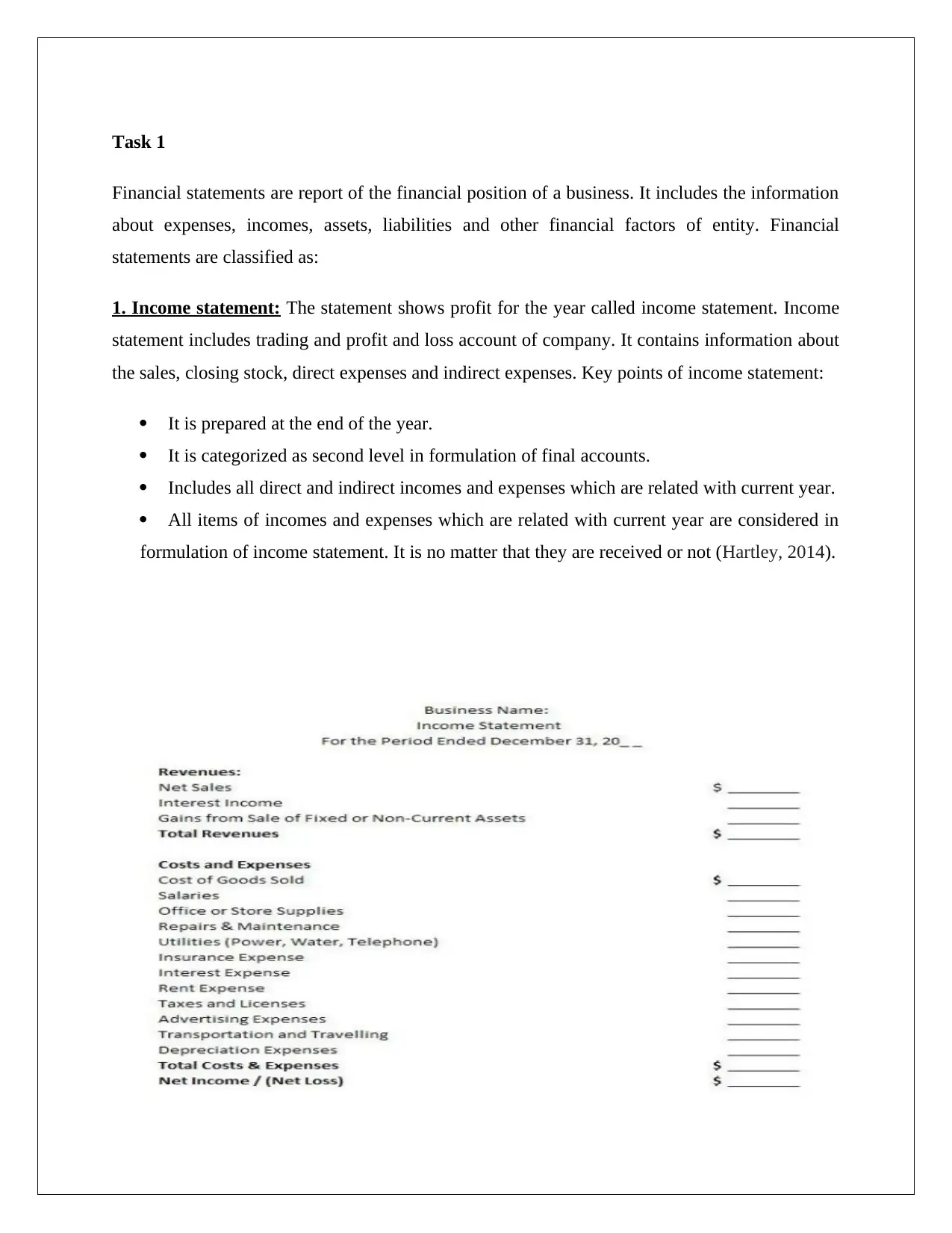
(Figure: Format of income statement)
Role in the process of financial management:
Main object of financial management is adequate and efficient management of funds.
Income statement is helpful to achieve this object. Income statement shows result of various
activities of business. Management can use this information for inter period comparison to
find out the loose points of process and employees and take corrective decision. Thus it helps
to increase efficiency (Pavlova, 2017).
Cost control and future planning: Income statement includes information about many
types of expenses which may use for comparing and controlling the cost which is essential
part of funds also Management can use this information as a base for future forecasting and
budgeting.
2. Balance sheet: balance sheet shows the position of assets, liabilities and owner’s capital at the
end of the year. It is image of financial position of company at particular point of time. The three
major elements of balance sheet is
Assets: items which business owns called assets. Assets are mainly classified as current
asses and non-current assets. Assets which are converted in cash with in the year called
current assets and assets which are hold by business for many years called non-current year.
Liabilities: liability is obligation or duty for business. It is also classified as current and
non-current liability (Hartley, 2014).
Owner’ capital: net of assets and liabilities is capital which indicates the owner’s or
shareholders fund.
Role in the process of financial management:
Main object of financial management is adequate and efficient management of funds.
Income statement is helpful to achieve this object. Income statement shows result of various
activities of business. Management can use this information for inter period comparison to
find out the loose points of process and employees and take corrective decision. Thus it helps
to increase efficiency (Pavlova, 2017).
Cost control and future planning: Income statement includes information about many
types of expenses which may use for comparing and controlling the cost which is essential
part of funds also Management can use this information as a base for future forecasting and
budgeting.
2. Balance sheet: balance sheet shows the position of assets, liabilities and owner’s capital at the
end of the year. It is image of financial position of company at particular point of time. The three
major elements of balance sheet is
Assets: items which business owns called assets. Assets are mainly classified as current
asses and non-current assets. Assets which are converted in cash with in the year called
current assets and assets which are hold by business for many years called non-current year.
Liabilities: liability is obligation or duty for business. It is also classified as current and
non-current liability (Hartley, 2014).
Owner’ capital: net of assets and liabilities is capital which indicates the owner’s or
shareholders fund.

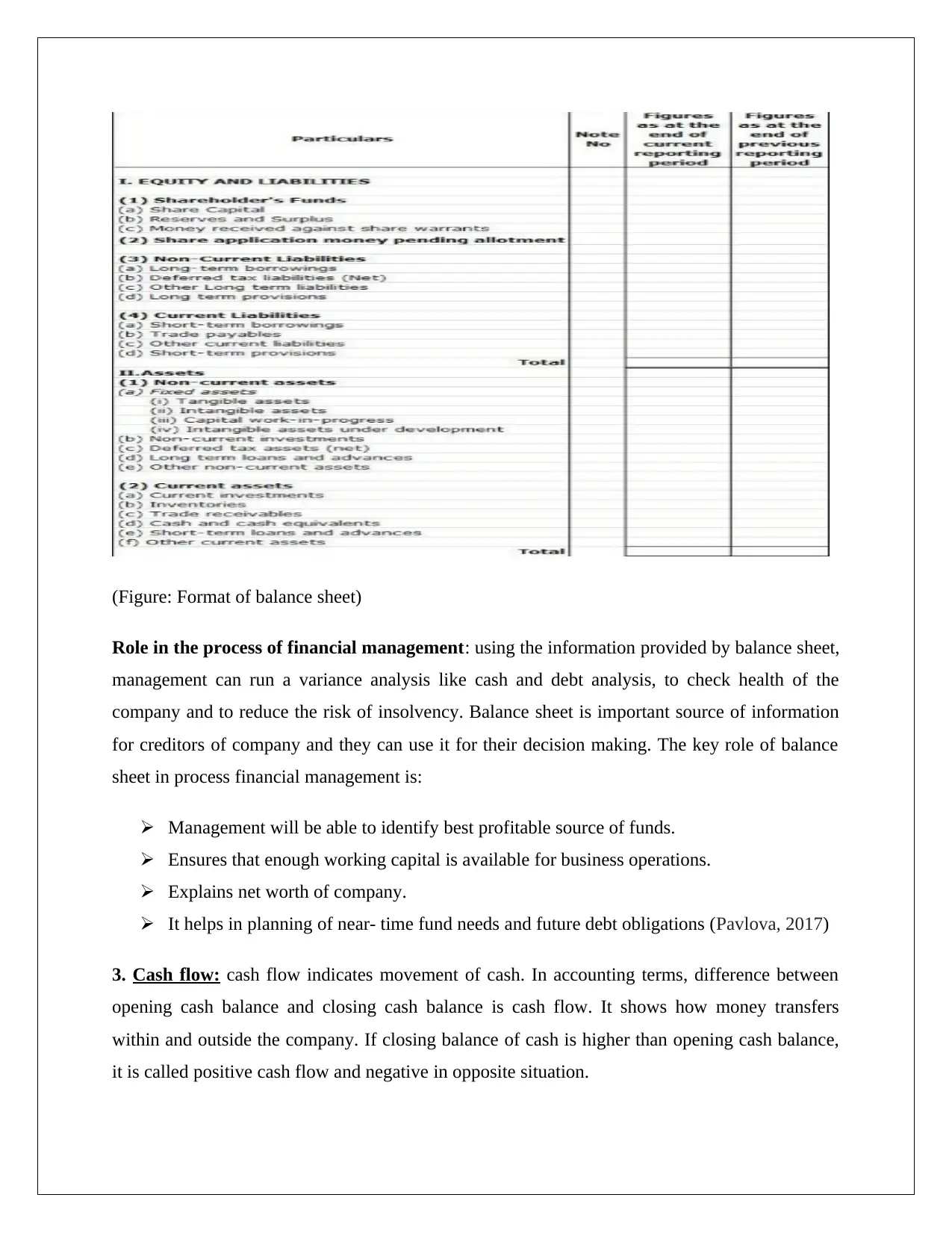
(Figure: Format of balance sheet)
Role in the process of financial management: using the information provided by balance sheet,
management can run a variance analysis like cash and debt analysis, to check health of the
company and to reduce the risk of insolvency. Balance sheet is important source of information
for creditors of company and they can use it for their decision making. The key role of balance
sheet in process financial management is:
Management will be able to identify best profitable source of funds.
Ensures that enough working capital is available for business operations.
Explains net worth of company.
It helps in planning of near- time fund needs and future debt obligations (Pavlova, 2017)
3. Cash flow: cash flow indicates movement of cash. In accounting terms, difference between
opening cash balance and closing cash balance is cash flow. It shows how money transfers
within and outside the company. If closing balance of cash is higher than opening cash balance,
it is called positive cash flow and negative in opposite situation.
Role in the process of financial management: using the information provided by balance sheet,
management can run a variance analysis like cash and debt analysis, to check health of the
company and to reduce the risk of insolvency. Balance sheet is important source of information
for creditors of company and they can use it for their decision making. The key role of balance
sheet in process financial management is:
Management will be able to identify best profitable source of funds.
Ensures that enough working capital is available for business operations.
Explains net worth of company.
It helps in planning of near- time fund needs and future debt obligations (Pavlova, 2017)
3. Cash flow: cash flow indicates movement of cash. In accounting terms, difference between
opening cash balance and closing cash balance is cash flow. It shows how money transfers
within and outside the company. If closing balance of cash is higher than opening cash balance,
it is called positive cash flow and negative in opposite situation.
⊘ This is a preview!⊘
Do you want full access?
Subscribe today to unlock all pages.

Trusted by 1+ million students worldwide

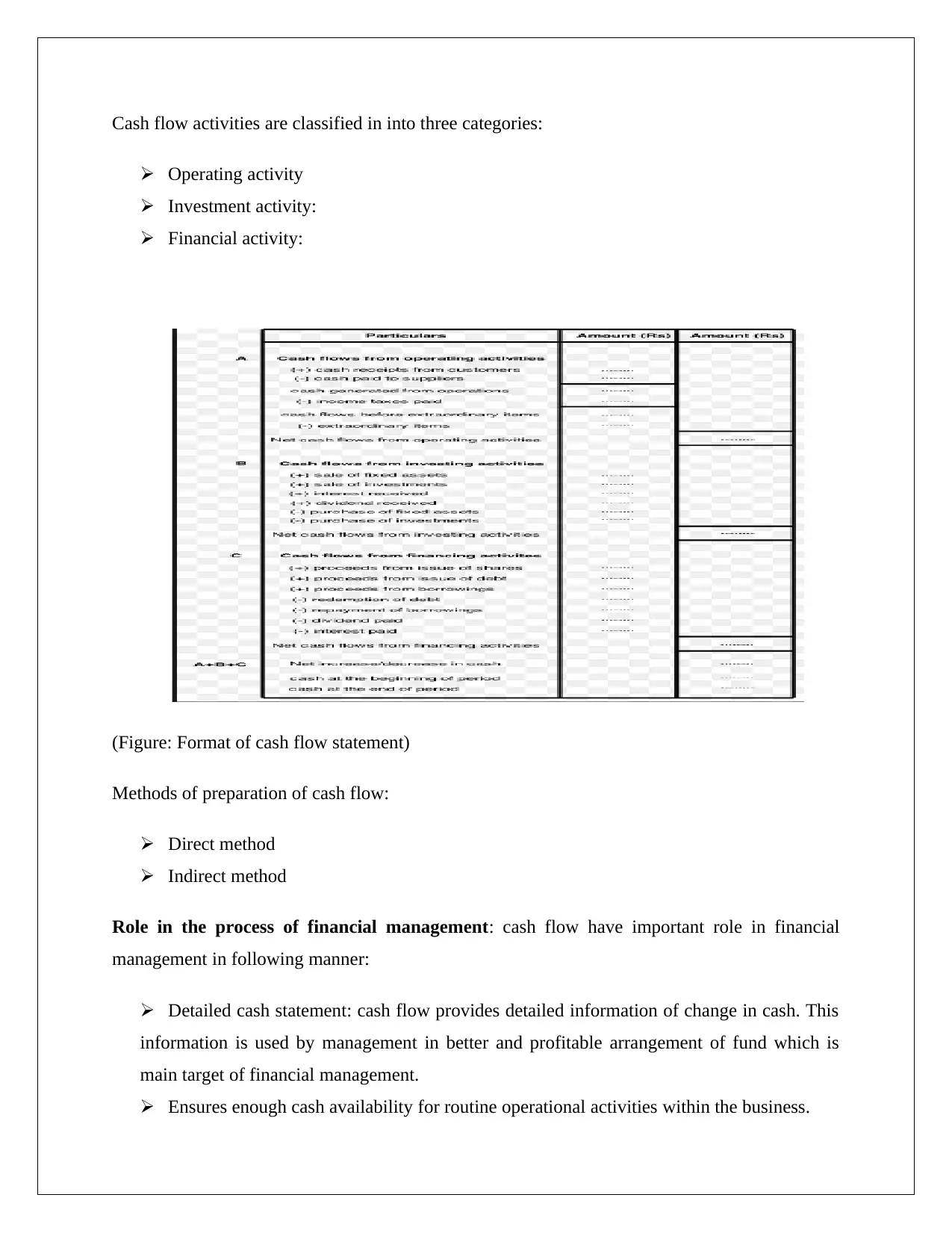
Cash flow activities are classified in into three categories:
Operating activity
Investment activity:
Financial activity:
(Figure: Format of cash flow statement)
Methods of preparation of cash flow:
Direct method
Indirect method
Role in the process of financial management: cash flow have important role in financial
management in following manner:
Detailed cash statement: cash flow provides detailed information of change in cash. This
information is used by management in better and profitable arrangement of fund which is
main target of financial management.
Ensures enough cash availability for routine operational activities within the business.
Operating activity
Investment activity:
Financial activity:
(Figure: Format of cash flow statement)
Methods of preparation of cash flow:
Direct method
Indirect method
Role in the process of financial management: cash flow have important role in financial
management in following manner:
Detailed cash statement: cash flow provides detailed information of change in cash. This
information is used by management in better and profitable arrangement of fund which is
main target of financial management.
Ensures enough cash availability for routine operational activities within the business.
Paraphrase This Document
Need a fresh take? Get an instant paraphrase of this document with our AI Paraphraser

Money is the premise of every monetary task. Consequently, a predictable income
statement will empower the management to plan and control the budgetary activities
accurately.
Income analysis together with the proportion examination helps measure the profitability
and monetary position of business (Pavlova, 2017).
It is helpful in creation of future financial plans for effective financial management.
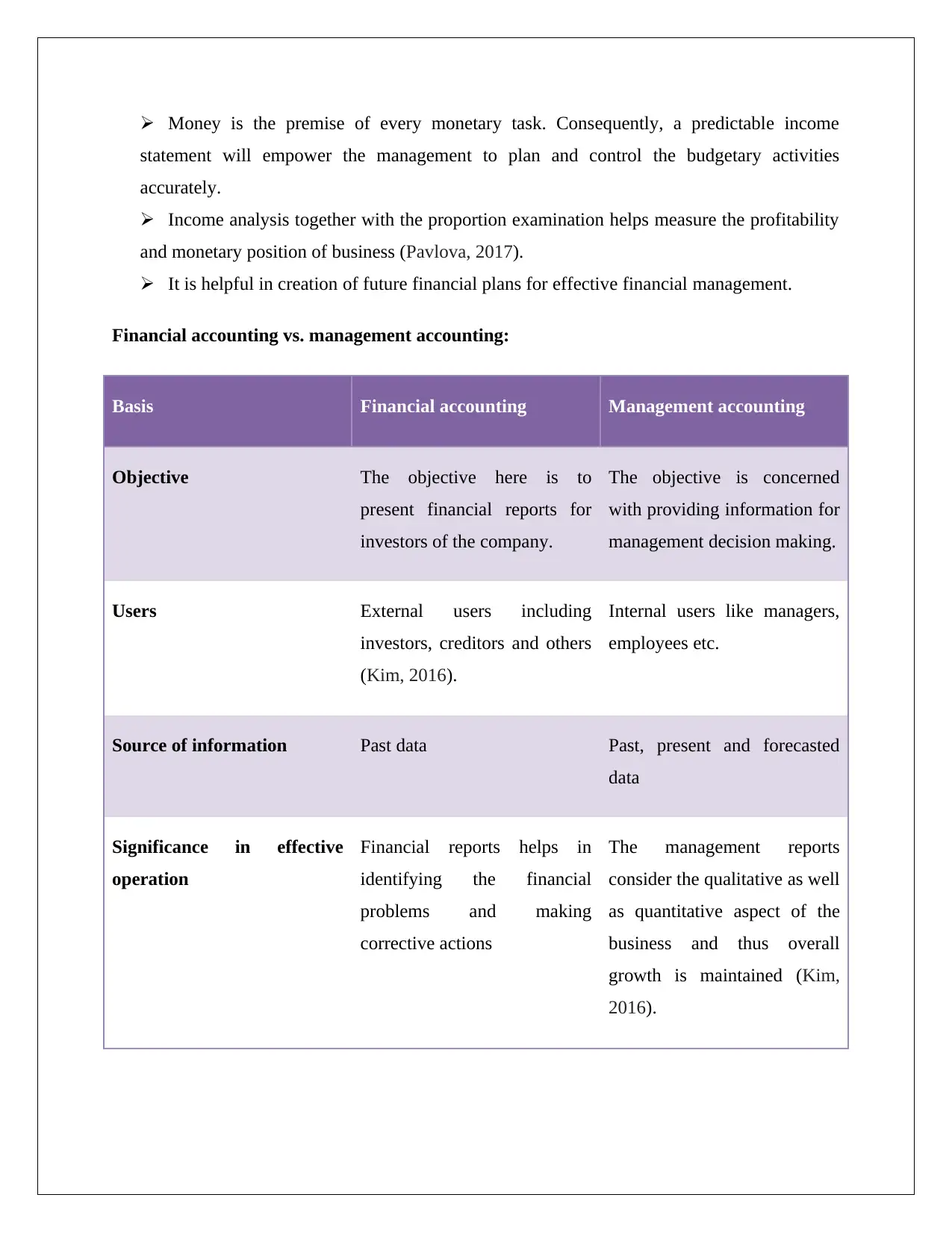
Financial accounting vs. management accounting:
Basis Financial accounting Management accounting
Objective The objective here is to
present financial reports for
investors of the company.
The objective is concerned
with providing information for
management decision making.
Users External users including
investors, creditors and others
(Kim, 2016).
Internal users like managers,
employees etc.
Source of information Past data Past, present and forecasted
data
Significance in effective
operation
Financial reports helps in
identifying the financial
problems and making
corrective actions
The management reports
consider the qualitative as well
as quantitative aspect of the
business and thus overall
growth is maintained (Kim,
2016).
statement will empower the management to plan and control the budgetary activities
accurately.
Income analysis together with the proportion examination helps measure the profitability
and monetary position of business (Pavlova, 2017).
It is helpful in creation of future financial plans for effective financial management.
Financial accounting vs. management accounting:
Basis Financial accounting Management accounting
Objective The objective here is to
present financial reports for
investors of the company.
The objective is concerned
with providing information for
management decision making.
Users External users including
investors, creditors and others
(Kim, 2016).
Internal users like managers,
employees etc.
Source of information Past data Past, present and forecasted
data
Significance in effective
operation
Financial reports helps in
identifying the financial
problems and making
corrective actions
The management reports
consider the qualitative as well
as quantitative aspect of the
business and thus overall
growth is maintained (Kim,
2016).

Break-even point: Point of sales where total cost of product is equal to total sales. In this
situation no profit or loss arises for company. The various types of costs are explained below:
Direct cost – Te cost which is directly associated with the production activity of the
product. Ex – Direct material consumed.
Indirect cost – The cost which is not associated directly in the production activity of the
product. Ex – Rent paid for premises (Plank, 2018).
Variable cost – The cost which directly vary with the level of production. Ex – Direct
labour.
Fixed cost – The cost which does not vary and remain fixed over the period. Ex – Rent
paid.
Calculation of breakeven point for ice cream product:
Selling price per unit = £15/unit
Variable cost per unit = £10/unit
Fixed cost per month = £6000
Break-even sales (units) = fixed cost/ (selling price –variable cost per unit)
= 6000/ (15-10)
=1200 units
Calculation of break even selling price:
In case of 2000 units:
Fixed cost = £6000
Total Variable cost = £20000
Selling price for BEP: [(Total variable cost + Total fixed cost) / No. of units produced]
= (20000+6000) / 2000
situation no profit or loss arises for company. The various types of costs are explained below:
Direct cost – Te cost which is directly associated with the production activity of the
product. Ex – Direct material consumed.
Indirect cost – The cost which is not associated directly in the production activity of the
product. Ex – Rent paid for premises (Plank, 2018).
Variable cost – The cost which directly vary with the level of production. Ex – Direct
labour.
Fixed cost – The cost which does not vary and remain fixed over the period. Ex – Rent
paid.
Calculation of breakeven point for ice cream product:
Selling price per unit = £15/unit
Variable cost per unit = £10/unit
Fixed cost per month = £6000
Break-even sales (units) = fixed cost/ (selling price –variable cost per unit)
= 6000/ (15-10)
=1200 units
Calculation of break even selling price:
In case of 2000 units:
Fixed cost = £6000
Total Variable cost = £20000
Selling price for BEP: [(Total variable cost + Total fixed cost) / No. of units produced]
= (20000+6000) / 2000
⊘ This is a preview!⊘
Do you want full access?
Subscribe today to unlock all pages.

Trusted by 1+ million students worldwide

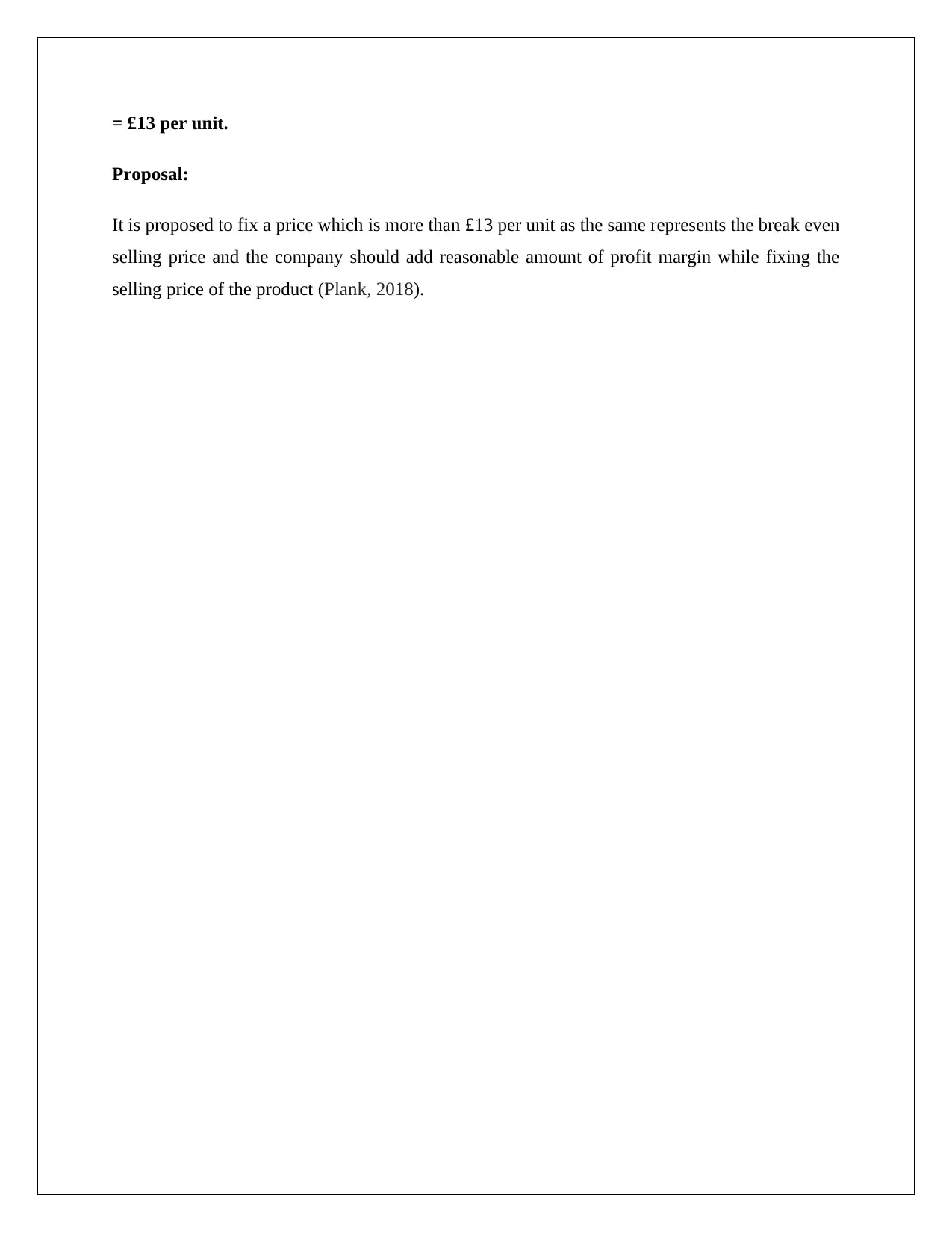
= £13 per unit.
Proposal:
It is proposed to fix a price which is more than £13 per unit as the same represents the break even
selling price and the company should add reasonable amount of profit margin while fixing the
selling price of the product (Plank, 2018).
Proposal:
It is proposed to fix a price which is more than £13 per unit as the same represents the break even
selling price and the company should add reasonable amount of profit margin while fixing the
selling price of the product (Plank, 2018).
Paraphrase This Document
Need a fresh take? Get an instant paraphrase of this document with our AI Paraphraser

Task 2:
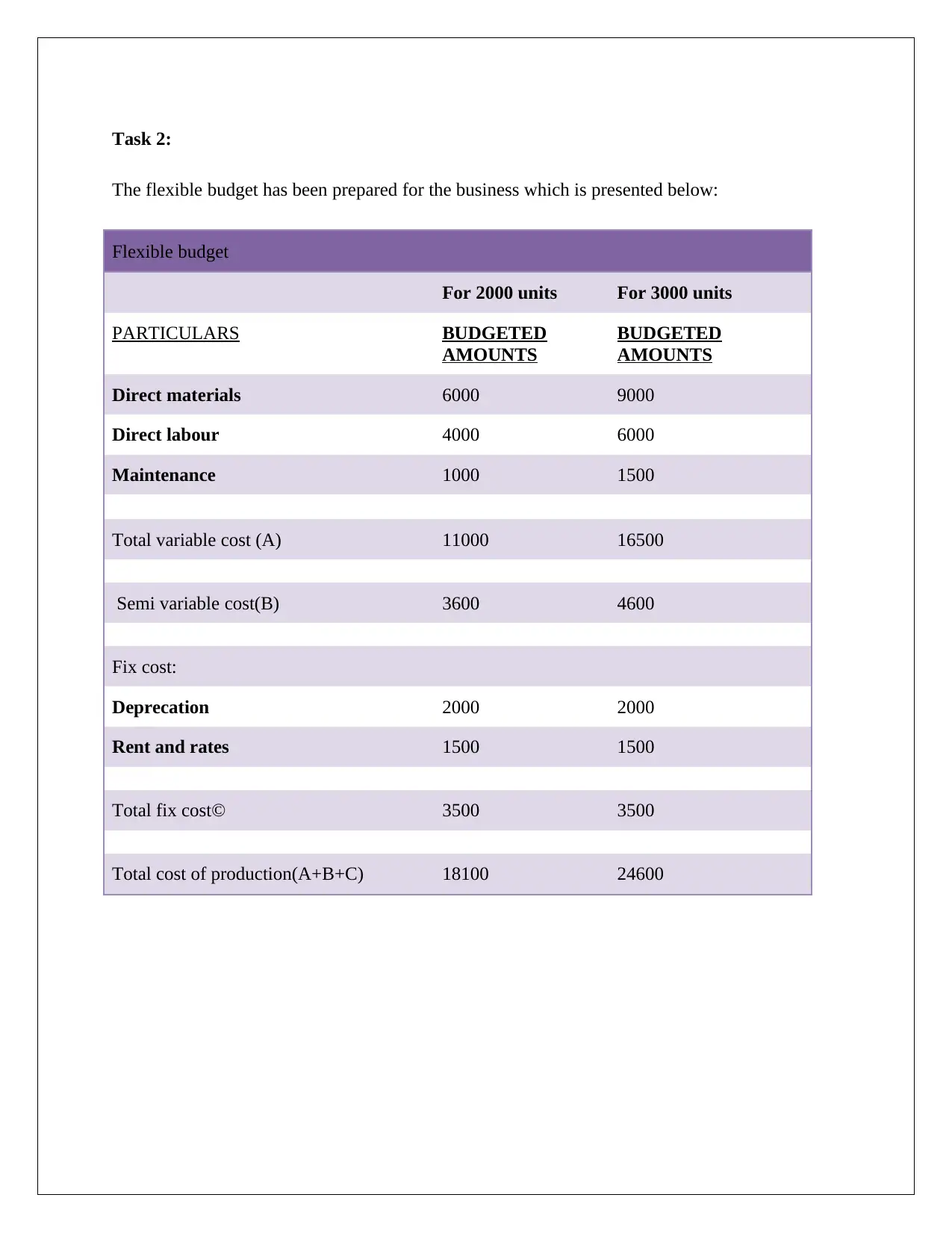
The flexible budget has been prepared for the business which is presented below:
Flexible budget
For 2000 units For 3000 units
PARTICULARS BUDGETED
AMOUNTS
BUDGETED
AMOUNTS
Direct materials 6000 9000
Direct labour 4000 6000
Maintenance 1000 1500
Total variable cost (A) 11000 16500
Semi variable cost(B) 3600 4600
Fix cost:
Deprecation 2000 2000
Rent and rates 1500 1500
Total fix cost© 3500 3500
Total cost of production(A+B+C) 18100 24600
The flexible budget has been prepared for the business which is presented below:
Flexible budget
For 2000 units For 3000 units
PARTICULARS BUDGETED
AMOUNTS
BUDGETED
AMOUNTS
Direct materials 6000 9000
Direct labour 4000 6000
Maintenance 1000 1500
Total variable cost (A) 11000 16500
Semi variable cost(B) 3600 4600
Fix cost:
Deprecation 2000 2000
Rent and rates 1500 1500
Total fix cost© 3500 3500
Total cost of production(A+B+C) 18100 24600

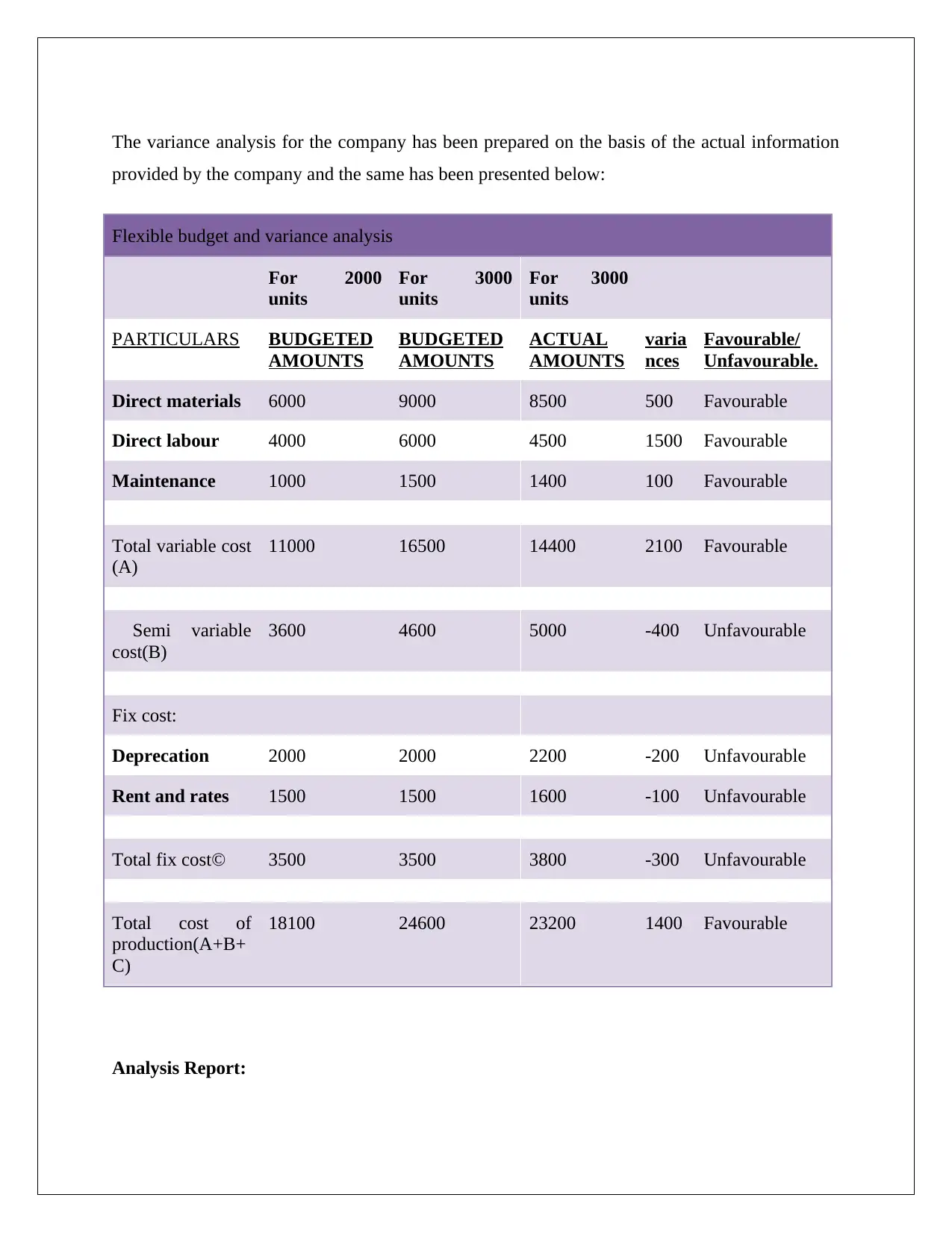
The variance analysis for the company has been prepared on the basis of the actual information
provided by the company and the same has been presented below:
Flexible budget and variance analysis
For 2000
units
For 3000
units
For 3000
units
PARTICULARS BUDGETED
AMOUNTS
BUDGETED
AMOUNTS
ACTUAL
AMOUNTS
varia
nces
Favourable/
Unfavourable.
Direct materials 6000 9000 8500 500 Favourable
Direct labour 4000 6000 4500 1500 Favourable
Maintenance 1000 1500 1400 100 Favourable
Total variable cost
(A)
11000 16500 14400 2100 Favourable
Semi variable
cost(B)
3600 4600 5000 -400 Unfavourable
Fix cost:
Deprecation 2000 2000 2200 -200 Unfavourable
Rent and rates 1500 1500 1600 -100 Unfavourable
Total fix cost© 3500 3500 3800 -300 Unfavourable
Total cost of
production(A+B+
C)
18100 24600 23200 1400 Favourable
Analysis Report:
provided by the company and the same has been presented below:
Flexible budget and variance analysis
For 2000
units
For 3000
units
For 3000
units
PARTICULARS BUDGETED
AMOUNTS
BUDGETED
AMOUNTS
ACTUAL
AMOUNTS
varia
nces
Favourable/
Unfavourable.
Direct materials 6000 9000 8500 500 Favourable
Direct labour 4000 6000 4500 1500 Favourable
Maintenance 1000 1500 1400 100 Favourable
Total variable cost
(A)
11000 16500 14400 2100 Favourable
Semi variable
cost(B)
3600 4600 5000 -400 Unfavourable
Fix cost:
Deprecation 2000 2000 2200 -200 Unfavourable
Rent and rates 1500 1500 1600 -100 Unfavourable
Total fix cost© 3500 3500 3800 -300 Unfavourable
Total cost of
production(A+B+
C)
18100 24600 23200 1400 Favourable
Analysis Report:
⊘ This is a preview!⊘
Do you want full access?
Subscribe today to unlock all pages.

Trusted by 1+ million students worldwide
1 out of 24
Related Documents
Your All-in-One AI-Powered Toolkit for Academic Success.
+13062052269
info@desklib.com
Available 24*7 on WhatsApp / Email
Unlock your academic potential
Copyright © 2020–2025 A2Z Services. All Rights Reserved. Developed and managed by ZUCOL.