Report on Cost Accounting, Variance Analysis, and Budgeting Practices
VerifiedAdded on 2021/06/16
|5
|1179
|29
Report
AI Summary
This report delves into the application of modern cost management accounting, particularly in the context of recreating the Roman Coliseum. It emphasizes the importance of accurate cost allocation, variance analysis, and budgeting. The report explores how modern cost accounting can provide accurate pricing for events, build a positive image, and facilitate cost-benefit analysis. It also examines variance analysis as a critical tool for identifying deviations between budgeted and actual costs across various departments, including material, labor, and overhead variances. Additionally, the report highlights the significance of budgeting in cost management, resource allocation, and tracking expenses, supported by a relevant image illustrating the importance of budget preparation and its role in monitoring spending. The report concludes by referencing key sources that support these concepts.
Solution-1
Part-B
Roman Coliseum is an oval amphitheater situated in the center of the city of Rome, Italy. It was built in
AD 80. However, due to subsequent fires and other damages, the structure needs a recreation. The
modern cost management accounting is far advanced than the traditional costing system. For recreation
of Roman Coliseum, the modern cost management accounting can be applied, to estimate the cost to be
used for recreation and application of those costs to the Coliseum. The management cost accounting
helps in correct allocation of costs to the products and hence, the correct cost of the structure can be
computed. With the help of correct cost, the subsequent prices for events going to be happened in the
recreated Roman Coliseum can be set. The correct pricing helps in building the good image of coliseum
amongst the romans and other people. Thus it will help in providing best services to the visitors in
controlled costs. Further, it will also help the people managing the coliseum in making various cost
benefit analysis, and various aspects related to cost and price. It will give the clear picture of revenues
earned and cost incurred for the Roman Coliseum.
Part-B
Roman Coliseum is an oval amphitheater situated in the center of the city of Rome, Italy. It was built in
AD 80. However, due to subsequent fires and other damages, the structure needs a recreation. The
modern cost management accounting is far advanced than the traditional costing system. For recreation
of Roman Coliseum, the modern cost management accounting can be applied, to estimate the cost to be
used for recreation and application of those costs to the Coliseum. The management cost accounting
helps in correct allocation of costs to the products and hence, the correct cost of the structure can be
computed. With the help of correct cost, the subsequent prices for events going to be happened in the
recreated Roman Coliseum can be set. The correct pricing helps in building the good image of coliseum
amongst the romans and other people. Thus it will help in providing best services to the visitors in
controlled costs. Further, it will also help the people managing the coliseum in making various cost
benefit analysis, and various aspects related to cost and price. It will give the clear picture of revenues
earned and cost incurred for the Roman Coliseum.
Paraphrase This Document
Need a fresh take? Get an instant paraphrase of this document with our AI Paraphraser

Solution-4
Part-B
Report
To Senior Management,
Regarding - Evaluating the Variances Analysis
Variance analysis is the quantitative investigation of the differences between the actual overheads
incurred and budgeted overheads. It is the most popular and important tool of management accounting,
to control and manage the budgeted and costs of the business. It helps in identifying the major
deviations between budgets and actuals and the reason for such deviations. It also establishes the
responsibility of the departments managing the costs. Such as for material variance, the buying
department is responsible and so on. The variance analysis is computed overhead wise, for example,
material overhead variance, labor overhead variance, manufacturing overhead variance and so on. The
variance analysis is the comparison of budget versus actual. For example, let’s say the budgeted sales
was 1000 units at $5 per unit, but in actual the company sold 800 units at $4. This represents a variance
of $1800 unfavorable i.e. (1000*5-800*4) and the reasons for such unfavorable variance is fall in
quantity sold and fall in selling price per unit. So, the variance analysis gives a bird’s eye view of the
costs and the difference between budgeted and actual costs with their potential reasons ("The Role of
Variance Analysis in Businesses", 2018).
The variance analysis is useful in almost every area of an organization, be it buying, or selling. Because
every department has its cost which needs to be compared with actuals. These comparisons are
prepared for the management so that the management can easily evaluate the differences arising
between the budgets they approved and actuals that they have incurred. So, this is the most important
management tool for analyzing the costs and is useful for almost every department of the organization.
The common cost derived by variances are (Bragg, 2018):
(a) Purchase price variance – Variance for the actual price paid for procuring the materials and the
budgeted price.
(b) Purchase quantity variance – variance for the actual quantity used and budgeted quantity.
(c) Labor rate variance – For the amount paid to labors as compared with the budgets.
(d) Variable overhead spending variance – actual variable overhead cost incurred as compared to
the budgeted overhead cost
(e) Selling price variance – the actual price for goods sold as compared to budgeted selling price per
unit
(f) Labor efficiency variance – the actual hours taken by labor to manufacture the products as
compared to the budgeted hours.
(g) Variable overhead efficiency variance – the actual units or hours consumed for manufacturing as
compared to the budgeted units or hours.
Thus, from the above variances we can see that the variance calculation is involved in almost every step
and department of the organizations and in practical as well it is the most important tool as without the
variance analysis, the management would not be able to understand the difference in cost and
Part-B
Report
To Senior Management,
Regarding - Evaluating the Variances Analysis
Variance analysis is the quantitative investigation of the differences between the actual overheads
incurred and budgeted overheads. It is the most popular and important tool of management accounting,
to control and manage the budgeted and costs of the business. It helps in identifying the major
deviations between budgets and actuals and the reason for such deviations. It also establishes the
responsibility of the departments managing the costs. Such as for material variance, the buying
department is responsible and so on. The variance analysis is computed overhead wise, for example,
material overhead variance, labor overhead variance, manufacturing overhead variance and so on. The
variance analysis is the comparison of budget versus actual. For example, let’s say the budgeted sales
was 1000 units at $5 per unit, but in actual the company sold 800 units at $4. This represents a variance
of $1800 unfavorable i.e. (1000*5-800*4) and the reasons for such unfavorable variance is fall in
quantity sold and fall in selling price per unit. So, the variance analysis gives a bird’s eye view of the
costs and the difference between budgeted and actual costs with their potential reasons ("The Role of
Variance Analysis in Businesses", 2018).
The variance analysis is useful in almost every area of an organization, be it buying, or selling. Because
every department has its cost which needs to be compared with actuals. These comparisons are
prepared for the management so that the management can easily evaluate the differences arising
between the budgets they approved and actuals that they have incurred. So, this is the most important
management tool for analyzing the costs and is useful for almost every department of the organization.
The common cost derived by variances are (Bragg, 2018):
(a) Purchase price variance – Variance for the actual price paid for procuring the materials and the
budgeted price.
(b) Purchase quantity variance – variance for the actual quantity used and budgeted quantity.
(c) Labor rate variance – For the amount paid to labors as compared with the budgets.
(d) Variable overhead spending variance – actual variable overhead cost incurred as compared to
the budgeted overhead cost
(e) Selling price variance – the actual price for goods sold as compared to budgeted selling price per
unit
(f) Labor efficiency variance – the actual hours taken by labor to manufacture the products as
compared to the budgeted hours.
(g) Variable overhead efficiency variance – the actual units or hours consumed for manufacturing as
compared to the budgeted units or hours.
Thus, from the above variances we can see that the variance calculation is involved in almost every step
and department of the organizations and in practical as well it is the most important tool as without the
variance analysis, the management would not be able to understand the difference in cost and

profitability of the actual overheads and the budgeted overheads. Further, to find out such differences
the management has to try various alternatives which might be not that much reliable and accurate as
the variance analysis is. Hence, we can say that it is the most useful and reliable tool for calculation of
variances between actuals and budgets.
the management has to try various alternatives which might be not that much reliable and accurate as
the variance analysis is. Hence, we can say that it is the most useful and reliable tool for calculation of
variances between actuals and budgets.
⊘ This is a preview!⊘
Do you want full access?
Subscribe today to unlock all pages.

Trusted by 1+ million students worldwide

Solution-5
Part-B
The budgeting is a vast and important concept of cost accounting. It involves making plans of upcoming
expenses and overheads. Thus, it helps in managing the costs by making forecast or budget for it. Then
these forecasts are compared with actuals to find out the differences and there reasons. The technical
expertise and experience is required for budgeting process as it involves preparations of complex budget
documentation as well as their analysis. It includes concentrating as to why a particular resource is
allocated and how much should be the allocation. As resources are limited and require the meaningful
use of them ("Budget Choice: Planning Versus Control", 2018).
However, some of the academic writers explore the allocation of resources and review the budget
process as a choice process, to find out its alternatives. In this process, they try to find out the
alternatives available for resource allocation and their treatment so that an alternative to this process
can be determined.
In the above comic picture, the discussion as regard to budget is portrayed. This image is very relevant
to our discussion, as it talks about the importance of budget. In this picture, the lady is asking as to why
to prepare the budget and the other person working on computer replies that budget is required so that
we can track the money spend before its actual spending and after it has spent. So, this picture
illustrates the importance of budget, as the budget is the important document which provides the
details of amount to be spent and the actual amount spent. It compares the budgeted expenses with
the actual expenses and provides the variance analysis. So, it keeps the track of expenses and provides
the reason of over spending and under spending of money.
Part-B
The budgeting is a vast and important concept of cost accounting. It involves making plans of upcoming
expenses and overheads. Thus, it helps in managing the costs by making forecast or budget for it. Then
these forecasts are compared with actuals to find out the differences and there reasons. The technical
expertise and experience is required for budgeting process as it involves preparations of complex budget
documentation as well as their analysis. It includes concentrating as to why a particular resource is
allocated and how much should be the allocation. As resources are limited and require the meaningful
use of them ("Budget Choice: Planning Versus Control", 2018).
However, some of the academic writers explore the allocation of resources and review the budget
process as a choice process, to find out its alternatives. In this process, they try to find out the
alternatives available for resource allocation and their treatment so that an alternative to this process
can be determined.
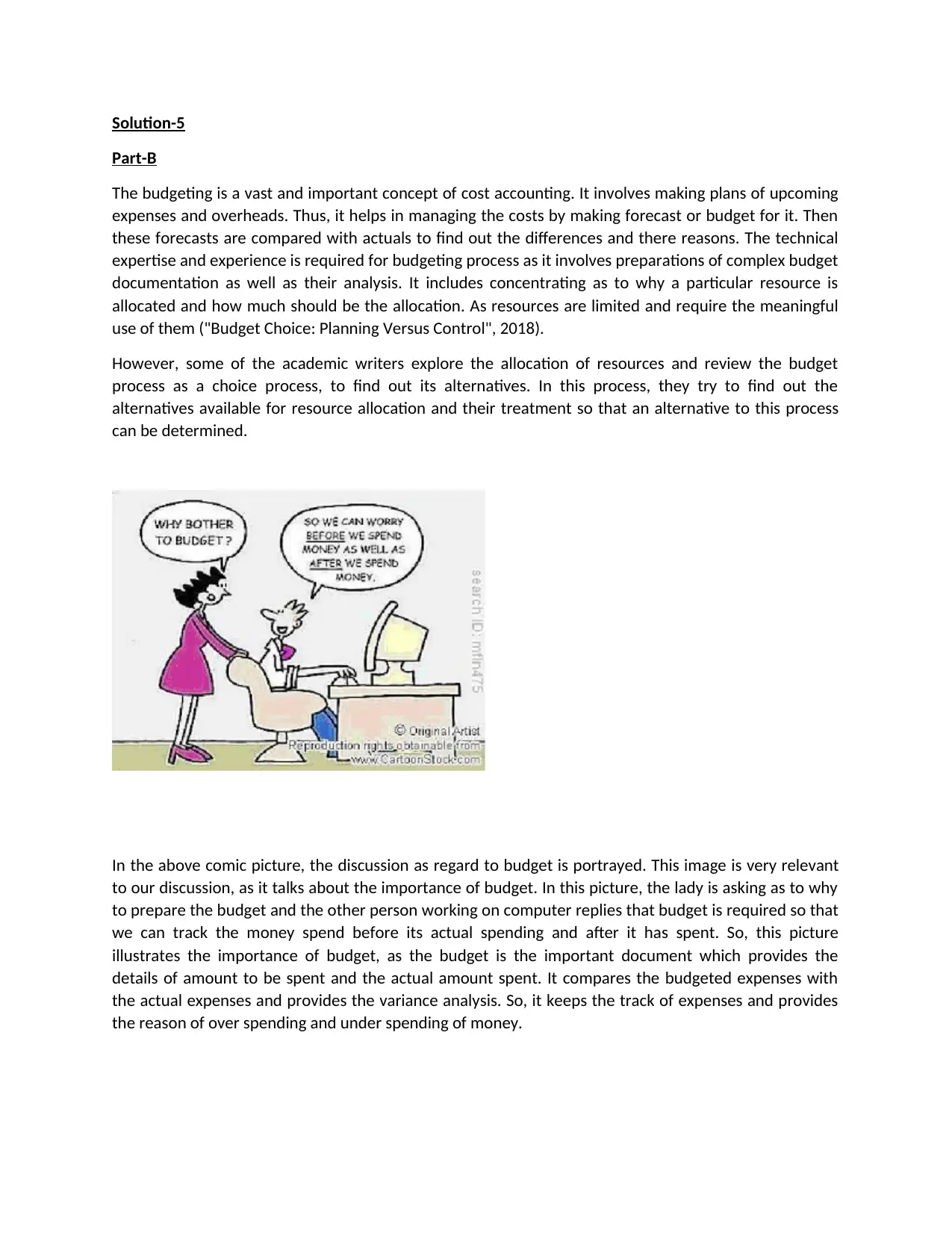
In the above comic picture, the discussion as regard to budget is portrayed. This image is very relevant
to our discussion, as it talks about the importance of budget. In this picture, the lady is asking as to why
to prepare the budget and the other person working on computer replies that budget is required so that
we can track the money spend before its actual spending and after it has spent. So, this picture
illustrates the importance of budget, as the budget is the important document which provides the
details of amount to be spent and the actual amount spent. It compares the budgeted expenses with
the actual expenses and provides the variance analysis. So, it keeps the track of expenses and provides
the reason of over spending and under spending of money.
Paraphrase This Document
Need a fresh take? Get an instant paraphrase of this document with our AI Paraphraser

References:
Budget Choice: Planning Versus Control. (2018). Retrieved from https://hbr.org/1984/07/budget-choice-
planning-versus-control
Bragg, S. (2018). Variance analysis. Retrieved from https://www.accountingtools.com/articles/what-is-
variance-analysis.html
The Role of Variance Analysis in Businesses. (2018). Retrieved from
http://smallbusiness.chron.com/role-variance-analysis-businesses-22641.html
Budget Choice: Planning Versus Control. (2018). Retrieved from https://hbr.org/1984/07/budget-choice-
planning-versus-control
Bragg, S. (2018). Variance analysis. Retrieved from https://www.accountingtools.com/articles/what-is-
variance-analysis.html
The Role of Variance Analysis in Businesses. (2018). Retrieved from
http://smallbusiness.chron.com/role-variance-analysis-businesses-22641.html
1 out of 5
Related Documents
Your All-in-One AI-Powered Toolkit for Academic Success.
+13062052269
info@desklib.com
Available 24*7 on WhatsApp / Email
Unlock your academic potential
Copyright © 2020–2025 A2Z Services. All Rights Reserved. Developed and managed by ZUCOL.