International Finance: Exchange Rates, Arbitrage and Effective Rates

Verified

Added on  2019/09/21

|3
|835
|123
Homework Assignment
AI Summary
This finance assignment provides solutions to problems related to foreign exchange, arbitrage, and effective exchange rates. The assignment covers topics such as calculating the amount of USD needed to purchase Mexican pesos based on the bid rate, comparing the benefits of different currency exchange methods like selling multiple times or using credit cards, computing bid-ask spreads and identifying arbitrage opportunities. It also includes the computation of effective exchange rates for the U.S. dollar against its trading partners, analyzing how an overall appreciation can occur despite depreciations against specific partners. Furthermore, the assignment delves into implied cross rates, arbitrage transactions involving multiple currencies, and the impact of transaction costs on the profitability of arbitrage strategies. Detailed calculations and explanations are provided for each problem, offering a comprehensive understanding of the concepts.
Document Page
Answer 1: It is to be noted that Bid rate will be consider as relevant while purchasing a foreign
currency. So for buying 5000 Mixican pesos ,following amount of Dollar need to be spend
= 5000 Mexican pepos/ 12.9 (Bid Rate per USD )
= 5000/12.9
= 387.60 USD
Answer 2
A) Why was Mr. Stein better off exchanging $200 than $50?
Answer 1 : It is to be noted that selling multiple times the same currency will take more
transaction cost and hence it is viable to sell of 200USA
B) Why do you think the credit card exchange rate was better than any rate he got while
in France?
Answer 2: It is to be noted that credit card helps to pay off only those amount which require
as expense It does not result in transaction cost for selling and purchasing the
currency under which expenditure need to be done
Answer 3
A) Compute S(US$/ask C$) and S(US$/bid C$).
S(US$/ask C$) = 1/1.235 = 0.8097
$(US/Bid C $) =1/1.2400 = 0.8064
A) Compute the percentage bid-ask spread for S(US$/C$).
Bid Ask Spread =( .8097-0.8064)/.8097
= .41%
Answer 4
Ans. Yes there exists an arbitrage opportunity. It can be done in following steps:
1) Sell 121.25 yen to Bank A and buy 1 USD
2) Sell this dollar for 121.30 yen at Bank B
The arbitrage takes place when the ask price of one bank is lower than bid price of another.
tabler-icon-diamond-filled.svg

Paraphrase This Document

Need a fresh take? Get an instant paraphrase of this document with our AI Paraphraser
Document Page
Answer 5:
Effective exchange rate is the exchange rate of the domestic currency vis-à-vis other
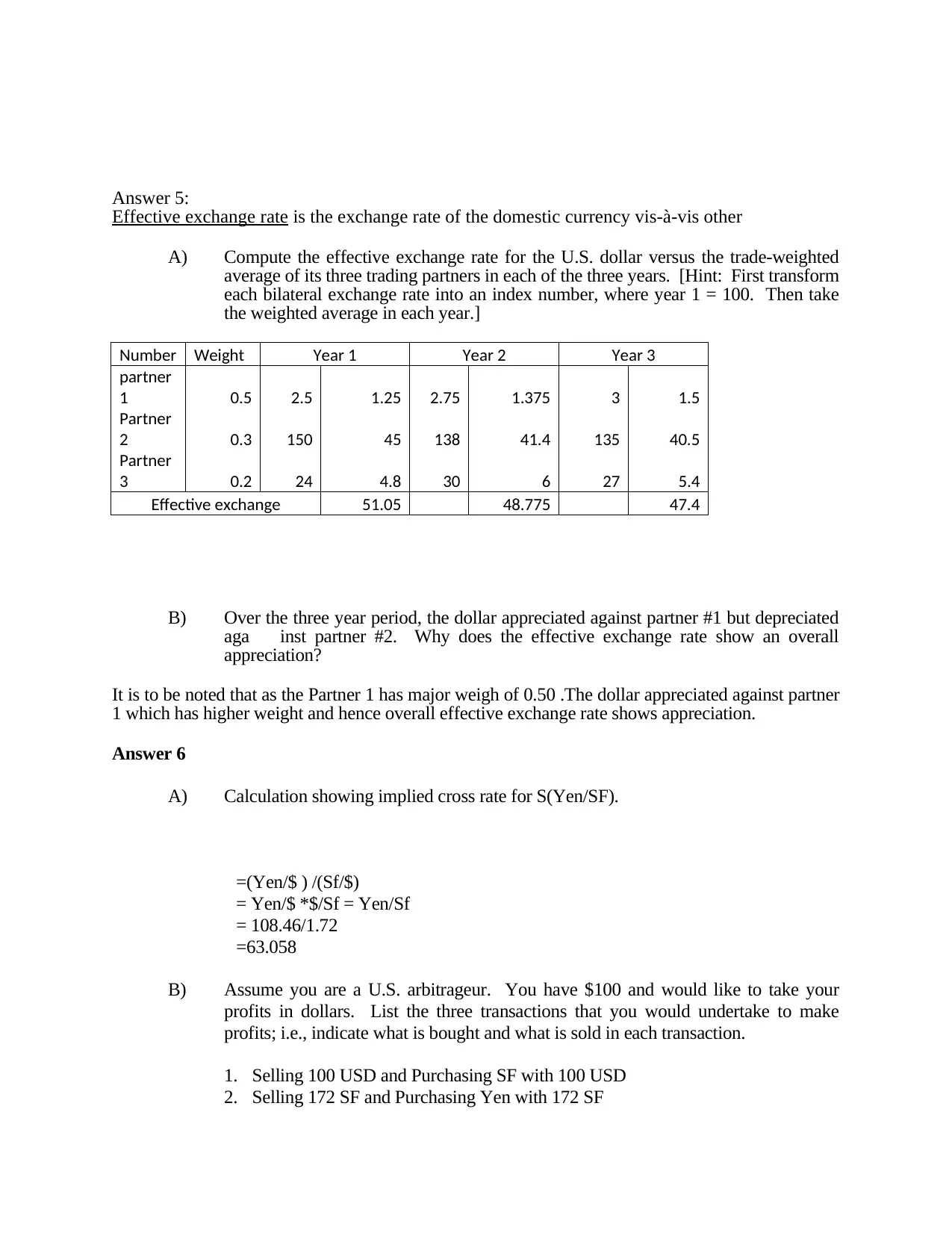
A) Compute the effective exchange rate for the U.S. dollar versus the trade-weighted
average of its three trading partners in each of the three years. [Hint: First transform
each bilateral exchange rate into an index number, where year 1 = 100. Then take
the weighted average in each year.]
Number Weight Year 1 Year 2 Year 3
partner
1 0.5 2.5 1.25 2.75 1.375 3 1.5
Partner
2 0.3 150 45 138 41.4 135 40.5
Partner
3 0.2 24 4.8 30 6 27 5.4
Effective exchange 51.05 48.775 47.4
B) Over the three year period, the dollar appreciated against partner #1 but depreciated
aga inst partner #2. Why does the effective exchange rate show an overall
appreciation?
It is to be noted that as the Partner 1 has major weigh of 0.50 .The dollar appreciated against partner
1 which has higher weight and hence overall effective exchange rate shows appreciation.
Answer 6
A) Calculation showing implied cross rate for S(Yen/SF).
=(Yen/$ ) /(Sf/$)
= Yen/$ *$/Sf = Yen/Sf
= 108.46/1.72
=63.058
B) Assume you are a U.S. arbitrageur. You have $100 and would like to take your
profits in dollars. List the three transactions that you would undertake to make
profits; i.e., indicate what is bought and what is sold in each transaction.
1. Selling 100 USD and Purchasing SF with 100 USD
2. Selling 172 SF and Purchasing Yen with 172 SF
Document Page
3. Selling 11180 Yen in US
C) Calculate how many dollars you have at the end of the three transactions described
in (B).
1. Selling 100 USD and Purchasing SF with 100 USD = 100*1.72 =172 SF
2. Selling 172 SF and Purchasing Yen with 172 SF = 172 *65 =11180 Yen
3. Selling 11180 Yen in US = 11180/108.46 = 103.0795
At the end f three transactions I will have 103.0795 USD
D) What is the effect of the transactions in part (B) on the three direct exchange rates?
Indicate whether each of the following rises, falls or stays the same:
S(SF/$) = Stays
S(Yen/$) = Stays
S(Yen/SF) = Rises
E) Suppose there are transactions costs and that the direct bid and ask prices are given
by:
S(SF/$ bid) = 1.71 S(SF/$ ask) = 1.73
S(Yen/$ bid) = 108.40 S(Yen/$ ask) = 108.52
S(Yen/SF bid) = 64.50 S(Yen/SF ask) = 65.50
If you start with $100 and do the transactions you described in (B), how many
dollars will you have in the end?
1.Selling 100 USD and purchasing SF = 100*1.71 = 171 SF
2. Selling 171 SF for purchasing Yen = 171SF *64.5 = 11029.5
3. Selling 11029.5 Yen in US = 11029.5/108.4 = 101.74
At the end of transaction I will have 101.74 USD
chevron_up_icon
1 out of 3
circle_padding
hide_on_mobile
zoom_out_icon
[object Object]