Financial Analysis and Funding Strategies for Merlin Entertainment PLC
VerifiedAdded on 2020/01/07
|12
|3582
|311
Report
AI Summary
This report provides a comprehensive analysis of finance and funding strategies within the context of Merlin Entertainment PLC, a prominent player in the travel and tourism industry. It begins by exploring the importance of finance and funding for business operations, emphasizing cost management and its impact on sales. The report delves into various cost, volume, and profit (CVP) analysis techniques, highlighting their significance in decision-making, including pricing strategies, break-even analysis, and investment decisions. Different pricing methods such as value-added, discounted, cost-plus, market-led, and marginal cost pricing are discussed, along with the factors influencing profit, including economic, political, and seasonal variations, and market trends. Furthermore, the report includes an analysis of financial ratios of The Restaurant Group PLC, providing interpretations of liquidity, profitability, and gearing ratios, and assessing their implications for the company's financial health. The report aims to provide readers with a thorough understanding of financial management in the travel and tourism sector.
Finance and
Funding
Funding

Paraphrase This Document
Need a fresh take? Get an instant paraphrase of this document with our AI Paraphraser
TABLE OF CONTENTS
INTRODUCTION...........................................................................................................................1
TASK 1............................................................................................................................................1
1.1................................................................................................................................................1
1.2................................................................................................................................................2
1.3................................................................................................................................................3
TASK 2............................................................................................................................................4
2.1................................................................................................................................................4
2.2................................................................................................................................................5
TASK 3............................................................................................................................................6
3.1................................................................................................................................................6
TASK 4............................................................................................................................................7
4.1................................................................................................................................................7
CONCLUSION................................................................................................................................8
REFERENCES..............................................................................................................................10
INTRODUCTION...........................................................................................................................1
TASK 1............................................................................................................................................1
1.1................................................................................................................................................1
1.2................................................................................................................................................2
1.3................................................................................................................................................3
TASK 2............................................................................................................................................4
2.1................................................................................................................................................4
2.2................................................................................................................................................5
TASK 3............................................................................................................................................6
3.1................................................................................................................................................6
TASK 4............................................................................................................................................7
4.1................................................................................................................................................7
CONCLUSION................................................................................................................................8
REFERENCES..............................................................................................................................10
INTRODUCTION
Finance and funding is one of the most imperative feature of any prosperous business
entity that aids in managing the cost of the concern. Without a financier an organization cannot
function efficiently. The following study is conducted in the similar context of the Merlin
Entertainment limited which carries out travel and tourism operations. These company's provide
a wide variety of services to its customers which require huge amount of investment in form of
funds. Main objective of the current study is to provide readers with an in-depth understanding of
varied skills, techniques, knowledge that is essential to undertake management decision-making
in travel and tourism industry (Abbasi, 2014). Furthermore, in the present research various
pricing methods such as market-led, discounted, cost-plus and value added methods have been
addressed that are used by several businesses entities. Apart from it, importance of management
accounting information and their use as decision making tool for the firm have also been
described.
TASK 1
1.1
Every business entity incurs several expenses in the form of purchasing raw materials,
equipment, salaries and many more. These costs are essential to be maintained as they have a
direct and consequent impact on the sales of company. Likewise, Merlin Entertainment PLC also
spends a huge amount in the form of arranging fun and leisure activities for its tourists, booking
tickets, accommodating rooms, etc. It is imperative to revise and analyse these costs periodically
as it aids in reviewing the financial position of firm thereby, increasing the overall revenue of
organisation (Ahrendsen and Katchova, 2012). These expenditures are either fixed, variable,
semi-variable, indirect or direct cost of business. CVP analysis is a technique used by the
concerned organization in order to ascertain relationship between cost and sales of the firm.
Some of the importance of cost and volume for the travel and tourism firms have been discussed
hereunder:
Many of he organization uses this method to identify the difference between the
operation and producing cost and aids in identifying the level profit that is likely to be
ascertained from its concerned activities.
This method is also important in measuring and identifying the financial position of the
firm. The Cost volume and profit of the companies are ascertained and used to make
1
Finance and funding is one of the most imperative feature of any prosperous business
entity that aids in managing the cost of the concern. Without a financier an organization cannot
function efficiently. The following study is conducted in the similar context of the Merlin
Entertainment limited which carries out travel and tourism operations. These company's provide
a wide variety of services to its customers which require huge amount of investment in form of
funds. Main objective of the current study is to provide readers with an in-depth understanding of
varied skills, techniques, knowledge that is essential to undertake management decision-making
in travel and tourism industry (Abbasi, 2014). Furthermore, in the present research various
pricing methods such as market-led, discounted, cost-plus and value added methods have been
addressed that are used by several businesses entities. Apart from it, importance of management
accounting information and their use as decision making tool for the firm have also been
described.
TASK 1
1.1
Every business entity incurs several expenses in the form of purchasing raw materials,
equipment, salaries and many more. These costs are essential to be maintained as they have a
direct and consequent impact on the sales of company. Likewise, Merlin Entertainment PLC also
spends a huge amount in the form of arranging fun and leisure activities for its tourists, booking
tickets, accommodating rooms, etc. It is imperative to revise and analyse these costs periodically
as it aids in reviewing the financial position of firm thereby, increasing the overall revenue of
organisation (Ahrendsen and Katchova, 2012). These expenditures are either fixed, variable,
semi-variable, indirect or direct cost of business. CVP analysis is a technique used by the
concerned organization in order to ascertain relationship between cost and sales of the firm.
Some of the importance of cost and volume for the travel and tourism firms have been discussed
hereunder:
Many of he organization uses this method to identify the difference between the
operation and producing cost and aids in identifying the level profit that is likely to be
ascertained from its concerned activities.
This method is also important in measuring and identifying the financial position of the
firm. The Cost volume and profit of the companies are ascertained and used to make
1
⊘ This is a preview!⊘
Do you want full access?
Subscribe today to unlock all pages.

Trusted by 1+ million students worldwide
varied financial decision. For instance, the revenue generated for the period can be used
to cover the variable expenses of fixed assets and then considered is at profit.
These decisions can be in terms of investment, dividend and finance. The cost volume
and profit of the firm can be used in various purposes. If there is sufficient revenue than it
can be invested in some beneficial activities. The residual amount can be used to increase
or decrease the dividends of the shareholders
These industries spend a huge amount of money on the fixed cost of company. These
costs remain constant for a longer duration and changes according to the increase in level of
production. This means that hotel industry carries a high amount of risk as decrease in the sales
can lead consequent losses for Merlin entertainment PLC (Bhowmik and Saha, 2013). Therefore,
CVP analysis is used to analyse the cost and sales of firm and decisions based on this are taken
to keep the cost stable. These enterprises provide its customers with a wide variety of products
and services which determine a constant sales mix. Therefore, CVP is used to ascertain break
even analysis for the firm which demonstrates a clear understanding where company's overall
revenue meets its total cost. Likewise, there are several other expenditure incurred in form of
variable cost (Brigham and Ehrhardt, 2013). The Merlin entertainment carries out several
activities such as recruiting new staff, buying or leasing new vessels as well as maintenance and
fuel cost for these vessels. All are categorized under the head variable cost. In certain
circumstances, the enterprise is able to gain economies of scale thereby reducing the input price
per unit. It also increases due to rise in the demand of tourism services.
Expenditure in form of paying electricity and telecommunication bills are the semi
variable costs that are incurred by such organisations. These amount are fixed as well as variable
in nature as such payments are made every month which comprises of fixed amount of
expenditure. Therefore, it can be said that all these costs and volume are important for the said
enterprise in arriving to several conclusions and making decisions based on it. (Dollery, Kortt
and Grant, 2013).
1.2
Pricing is a crucial element of every business concern that aids in determining the initial
cost, actual investment and the overall revenue of firm. There are several strategies available
with the Merlin entertainment PLC that can be used in order to gain competitive advantage.
Some of the strategies have been highlighted as below:
2
to cover the variable expenses of fixed assets and then considered is at profit.
These decisions can be in terms of investment, dividend and finance. The cost volume
and profit of the firm can be used in various purposes. If there is sufficient revenue than it
can be invested in some beneficial activities. The residual amount can be used to increase
or decrease the dividends of the shareholders
These industries spend a huge amount of money on the fixed cost of company. These
costs remain constant for a longer duration and changes according to the increase in level of
production. This means that hotel industry carries a high amount of risk as decrease in the sales
can lead consequent losses for Merlin entertainment PLC (Bhowmik and Saha, 2013). Therefore,
CVP analysis is used to analyse the cost and sales of firm and decisions based on this are taken
to keep the cost stable. These enterprises provide its customers with a wide variety of products
and services which determine a constant sales mix. Therefore, CVP is used to ascertain break
even analysis for the firm which demonstrates a clear understanding where company's overall
revenue meets its total cost. Likewise, there are several other expenditure incurred in form of
variable cost (Brigham and Ehrhardt, 2013). The Merlin entertainment carries out several
activities such as recruiting new staff, buying or leasing new vessels as well as maintenance and
fuel cost for these vessels. All are categorized under the head variable cost. In certain
circumstances, the enterprise is able to gain economies of scale thereby reducing the input price
per unit. It also increases due to rise in the demand of tourism services.
Expenditure in form of paying electricity and telecommunication bills are the semi
variable costs that are incurred by such organisations. These amount are fixed as well as variable
in nature as such payments are made every month which comprises of fixed amount of
expenditure. Therefore, it can be said that all these costs and volume are important for the said
enterprise in arriving to several conclusions and making decisions based on it. (Dollery, Kortt
and Grant, 2013).
1.2
Pricing is a crucial element of every business concern that aids in determining the initial
cost, actual investment and the overall revenue of firm. There are several strategies available
with the Merlin entertainment PLC that can be used in order to gain competitive advantage.
Some of the strategies have been highlighted as below:
2
Paraphrase This Document
Need a fresh take? Get an instant paraphrase of this document with our AI Paraphraser
Value Added pricing: This is a method used by the travel and tourism industry to gain
customer attraction. Herein, the firm provides people with various other services and
leisure activities in similar price. This is a trending method whereby the preference of
consumers have being given with more importance. The Merlin Entertainment provides
several value added services to its customers such as midway attractions, LEGO-LAND
and Resort theme parks (DRURY, 2013). Moreover, various adventurous activities have
also been organized by the concerned firm to provide tourists with fun and everlasting
experience. Discounted pricing: This is a simple strategy used by travel and tourism sector in the off
season to gain immediate response from customers. In the present era, people are
becoming money-minded and they want to save every single penny for the future. They
prefer discounted products and services. This method is adopted by TUI travel PLC
business entity to gain immediate response from consumers in terms of revenue and sales. Cost plus pricing: This is the basic and underlying technique used by most of the
enterprises where company charges total amount of fixed and variable cost along with the
cost margin. It aids in achieving business goals and objectives by maximizing the profits
of firm (Figge and Hahn, 2013). Market-led pricing: According to this strategy, almost all business concerns under travel
and tourism keep the prices of their services same. For instance, in case of summer
vacations of wedding seasons, prices of honeymoon packages are kept relatively high so
as to gain maximum advantage. Holiday Genie is the firm of UK that uses market led
pricing strategy to cater newly married couples in the peak seasons. This enables firm to
overlap the off season cost.
Marginal cost pricing: A method wherein the price is set equal to the cost of the
producing an extra unit of the output. Herein, the organisation charges only the marginal
amount of money including the total and direct cost of producing. In regards to the given
company, the firm will use marginal pricing at the times when demand for its services has
waned. This is so because earning a marginal amount is better than no sale.
There are several other pricing strategies such as cost led, marginal costing, absorption, top
down and return on investment. These are applied according to the needs and demands of varied
business entities in order to gain economies of scale (Galliers and Leidner, 2014).
3
customer attraction. Herein, the firm provides people with various other services and
leisure activities in similar price. This is a trending method whereby the preference of
consumers have being given with more importance. The Merlin Entertainment provides
several value added services to its customers such as midway attractions, LEGO-LAND
and Resort theme parks (DRURY, 2013). Moreover, various adventurous activities have
also been organized by the concerned firm to provide tourists with fun and everlasting
experience. Discounted pricing: This is a simple strategy used by travel and tourism sector in the off
season to gain immediate response from customers. In the present era, people are
becoming money-minded and they want to save every single penny for the future. They
prefer discounted products and services. This method is adopted by TUI travel PLC
business entity to gain immediate response from consumers in terms of revenue and sales. Cost plus pricing: This is the basic and underlying technique used by most of the
enterprises where company charges total amount of fixed and variable cost along with the
cost margin. It aids in achieving business goals and objectives by maximizing the profits
of firm (Figge and Hahn, 2013). Market-led pricing: According to this strategy, almost all business concerns under travel
and tourism keep the prices of their services same. For instance, in case of summer
vacations of wedding seasons, prices of honeymoon packages are kept relatively high so
as to gain maximum advantage. Holiday Genie is the firm of UK that uses market led
pricing strategy to cater newly married couples in the peak seasons. This enables firm to
overlap the off season cost.
Marginal cost pricing: A method wherein the price is set equal to the cost of the
producing an extra unit of the output. Herein, the organisation charges only the marginal
amount of money including the total and direct cost of producing. In regards to the given
company, the firm will use marginal pricing at the times when demand for its services has
waned. This is so because earning a marginal amount is better than no sale.
There are several other pricing strategies such as cost led, marginal costing, absorption, top
down and return on investment. These are applied according to the needs and demands of varied
business entities in order to gain economies of scale (Galliers and Leidner, 2014).
3
1.3
Profit can be deemed as the amount of revenue generated by business enterprise through
providing quality services or products to its customers. In travel and tourism industry, income,
cost and volume plays a crucial role in determining the selling price of goods and services. Some
of the factors that influence the profit of Merlin Entertainment have been enclosed beneath: Economic factors: Recession and inflation are the main components that govern the price
and profit of every business entity. At the time of depression in country, people tried to
spend less in various activities such as travel and tourism, luxurious products, etc. These
factors are likely to influence the operations and profits of concerned organization.
Tourism sector tries to lower down the price by providing discounts on services and
manages income for the period. Reduction of price and services also leads increase in the
cost of the same (Hanna, 2014). Political factors: The legal and regulatory bodies of UK modify and alter the tax rates of
country. These are likely to affect the profitability of firm. Certain modifications in the
government policies and rules of other countries cause severe impacts on travel and
tourism industry as it affects the cost of services of firm. At times of high taxes and
interest rates, the company will decrease its investment and its overall sales volume will
also get reduced. Seasonal variations: At the time of off seasons, company is not able to make nominal
amount of profit even after providing its customers with various discounts and other
offers. This in turn hampers the productivity and operations of firm that leads to high
amount of losses due to increase in operating cost of enterprise. Moreover, the cost of the
services are likely to increase and the volume of its sales will decrease.
Current and future market trends: The service industry is expanding day-by-day and it
has become a challenge for Merlin PLC to cope up with other industries (Inderst, 2013).
Moreover, it can also be ascertained that new ventures are trying to enter in the industry
by providing similar services at better prices for the customers. Therefore, in such state of
affairs, it becomes difficult for existing businesses to maintain the initial profit. They
have to ensure quality services to customers thereby, maintaining the reputation of firm.
Apart from that, changes in the standard of quality services of industry also hampers the
4
Profit can be deemed as the amount of revenue generated by business enterprise through
providing quality services or products to its customers. In travel and tourism industry, income,
cost and volume plays a crucial role in determining the selling price of goods and services. Some
of the factors that influence the profit of Merlin Entertainment have been enclosed beneath: Economic factors: Recession and inflation are the main components that govern the price
and profit of every business entity. At the time of depression in country, people tried to
spend less in various activities such as travel and tourism, luxurious products, etc. These
factors are likely to influence the operations and profits of concerned organization.
Tourism sector tries to lower down the price by providing discounts on services and
manages income for the period. Reduction of price and services also leads increase in the
cost of the same (Hanna, 2014). Political factors: The legal and regulatory bodies of UK modify and alter the tax rates of
country. These are likely to affect the profitability of firm. Certain modifications in the
government policies and rules of other countries cause severe impacts on travel and
tourism industry as it affects the cost of services of firm. At times of high taxes and
interest rates, the company will decrease its investment and its overall sales volume will
also get reduced. Seasonal variations: At the time of off seasons, company is not able to make nominal
amount of profit even after providing its customers with various discounts and other
offers. This in turn hampers the productivity and operations of firm that leads to high
amount of losses due to increase in operating cost of enterprise. Moreover, the cost of the
services are likely to increase and the volume of its sales will decrease.
Current and future market trends: The service industry is expanding day-by-day and it
has become a challenge for Merlin PLC to cope up with other industries (Inderst, 2013).
Moreover, it can also be ascertained that new ventures are trying to enter in the industry
by providing similar services at better prices for the customers. Therefore, in such state of
affairs, it becomes difficult for existing businesses to maintain the initial profit. They
have to ensure quality services to customers thereby, maintaining the reputation of firm.
Apart from that, changes in the standard of quality services of industry also hampers the
4
⊘ This is a preview!⊘
Do you want full access?
Subscribe today to unlock all pages.
Trusted by 1+ million students worldwide
profitability of Merlin Entertainment. Last but not the least, the company's overall cost
and volume will be affected.
TASK 2
Covered in PPT
TASK 3
3.1
Financial information of the company is essential in order to ascertain several ratios of he
firm that aids in deriving at various conclusions of the firm. The financial position of the
Restaurant group PLC can be ascertained from the following illustrated formulas and based on it
further interpretation has also being made.
Table 1: Financial Ratios For The Restaurant PLC
Financial Ratios Formulas 2015 2014
Liquidity Ratios
Current Ratio Current Asset / Current Liabilities 0.28 0.24
Quick Ratio (Current asset – closing
inventory)/Current Liabilities
0.12 0.08
Profitability Ratios
Gross Profit Ratio (Gross Profit/ Net Sales)*100 18.51 17.93
Net Profit Ratio (Net Profit/ Net sales)*100 10.05 10.55
Operating Profit Ratio (Operating profit/ Net sales)*100 12.97 13.75
Gearing Ratios
Debt Equity Ratios Debt/ Equity 0.12 0.17
Total asset Turnover ratio Net sales/ total assets 1.54 1.54
Inventory turnover ratio COGS/ inventory 93.71 98.22
Interpretation: From the above analysis of the given ratio, it can be concluded that The
Restaurant Group PLC liquidity ratio is quite low as the company is unable to maintain its
current assets. Moreover, the cash of the firm is not stable and it is unable to meet the
5
and volume will be affected.
TASK 2
Covered in PPT
TASK 3
3.1
Financial information of the company is essential in order to ascertain several ratios of he
firm that aids in deriving at various conclusions of the firm. The financial position of the
Restaurant group PLC can be ascertained from the following illustrated formulas and based on it
further interpretation has also being made.
Table 1: Financial Ratios For The Restaurant PLC
Financial Ratios Formulas 2015 2014
Liquidity Ratios
Current Ratio Current Asset / Current Liabilities 0.28 0.24
Quick Ratio (Current asset – closing
inventory)/Current Liabilities
0.12 0.08
Profitability Ratios
Gross Profit Ratio (Gross Profit/ Net Sales)*100 18.51 17.93
Net Profit Ratio (Net Profit/ Net sales)*100 10.05 10.55
Operating Profit Ratio (Operating profit/ Net sales)*100 12.97 13.75
Gearing Ratios
Debt Equity Ratios Debt/ Equity 0.12 0.17
Total asset Turnover ratio Net sales/ total assets 1.54 1.54
Inventory turnover ratio COGS/ inventory 93.71 98.22
Interpretation: From the above analysis of the given ratio, it can be concluded that The
Restaurant Group PLC liquidity ratio is quite low as the company is unable to maintain its
current assets. Moreover, the cash of the firm is not stable and it is unable to meet the
5
Paraphrase This Document
Need a fresh take? Get an instant paraphrase of this document with our AI Paraphraser
requirements of day-to-day expenses. Therefore, the firm needs to reduce the amount of trade
debtors in order to gain an ideal liquidity ratio (Freedman, 2016). Apart from it, the firms
profitability ratio depicts that firms overall net profit is decreasing due to the increase in the
amount of tax rates. Likewise, the indirect expenses of a firm have a consequent impact on the
operating income. Therefore, the firm must reduce its overall expenditures in order to gain
higher profitability. In addition to this the gearing ratios of the firm depicts about the level of
relationship between the debt and equity of the firm. In the year 2014 the equity was more
whereas in the next year it dropped down by 0.05 %. This shows that the firm is moving towards
debt year by year. Therefore, it can be said that the enterprise does not have a stable financial
accounts and it needs to work on maintaining its expenditure and revenue (Markgraf, 2016).
TASK 4
4.1
A company requires funds to carry out different operations of the concern. Apart from it,
finance is required by organization in order to invest in new businesses. The tourism sector is
expanding gradually in various areas by up-taking several capital investment projects such as
tourism information point, heritage sites, cross railway projects, integrated bridal ways
development, provision of secure cycle storage, theme parks, etc. In order to carry out any of
such activities the Merlin Entertainment requires huge amount of funds in capital investment
projects. This can be successfully availed by creating a prospect for the equity financier or
debenture holders. They are the main investors of any business entity in order to carry out large
projects. The same has been highlighted below:
Source of funds and their requirement for the development of Travel and Tourism Industry
Types of funds:
Equity Capital
Debenture Capital
Government Grants
6
debtors in order to gain an ideal liquidity ratio (Freedman, 2016). Apart from it, the firms
profitability ratio depicts that firms overall net profit is decreasing due to the increase in the
amount of tax rates. Likewise, the indirect expenses of a firm have a consequent impact on the
operating income. Therefore, the firm must reduce its overall expenditures in order to gain
higher profitability. In addition to this the gearing ratios of the firm depicts about the level of
relationship between the debt and equity of the firm. In the year 2014 the equity was more
whereas in the next year it dropped down by 0.05 %. This shows that the firm is moving towards
debt year by year. Therefore, it can be said that the enterprise does not have a stable financial
accounts and it needs to work on maintaining its expenditure and revenue (Markgraf, 2016).
TASK 4
4.1
A company requires funds to carry out different operations of the concern. Apart from it,
finance is required by organization in order to invest in new businesses. The tourism sector is
expanding gradually in various areas by up-taking several capital investment projects such as
tourism information point, heritage sites, cross railway projects, integrated bridal ways
development, provision of secure cycle storage, theme parks, etc. In order to carry out any of
such activities the Merlin Entertainment requires huge amount of funds in capital investment
projects. This can be successfully availed by creating a prospect for the equity financier or
debenture holders. They are the main investors of any business entity in order to carry out large
projects. The same has been highlighted below:
Source of funds and their requirement for the development of Travel and Tourism Industry
Types of funds:
Equity Capital
Debenture Capital
Government Grants
6
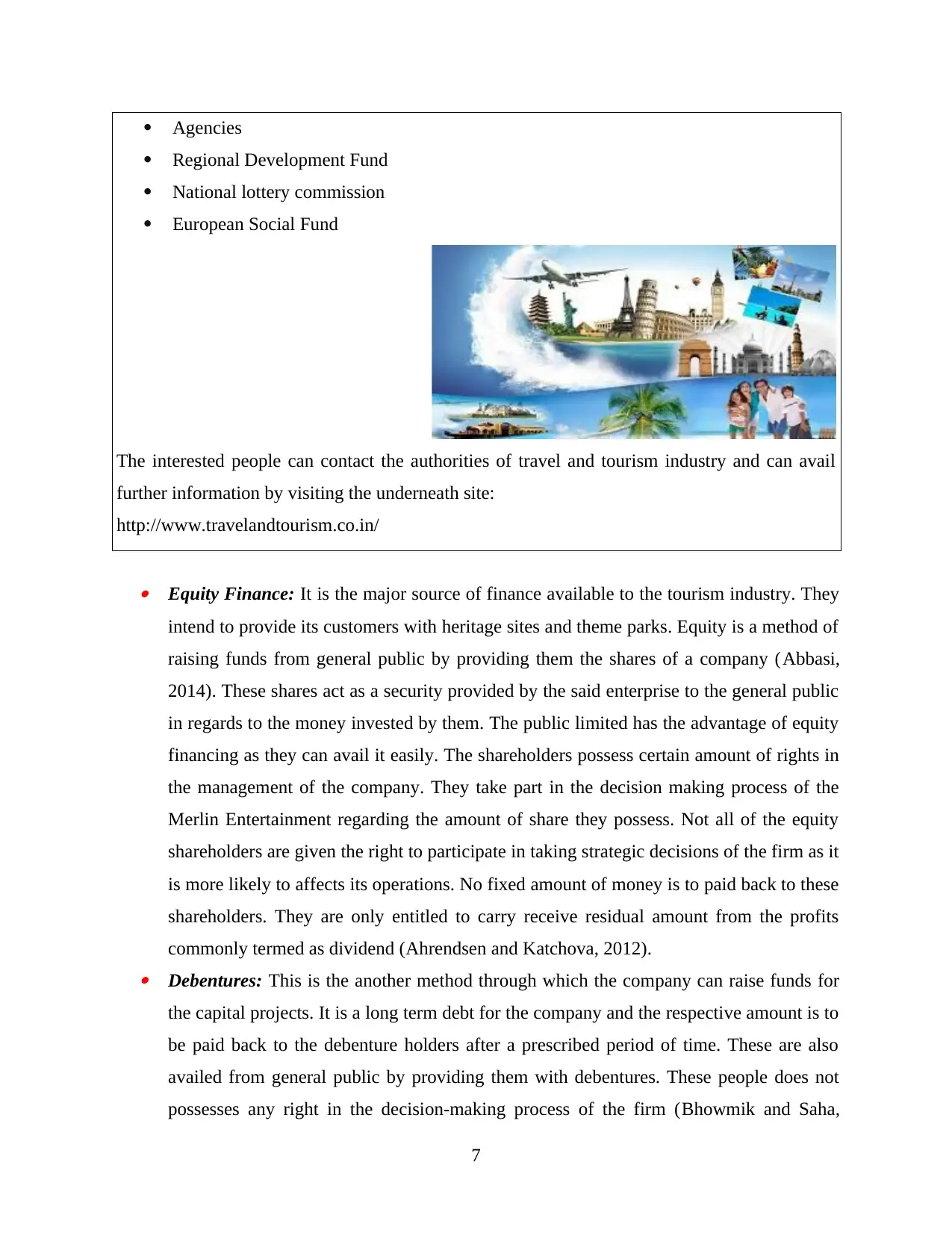
Agencies
Regional Development Fund
National lottery commission
European Social Fund
The interested people can contact the authorities of travel and tourism industry and can avail
further information by visiting the underneath site:
http://www.travelandtourism.co.in/
Equity Finance: It is the major source of finance available to the tourism industry. They
intend to provide its customers with heritage sites and theme parks. Equity is a method of
raising funds from general public by providing them the shares of a company (Abbasi,
2014). These shares act as a security provided by the said enterprise to the general public
in regards to the money invested by them. The public limited has the advantage of equity
financing as they can avail it easily. The shareholders possess certain amount of rights in
the management of the company. They take part in the decision making process of the
Merlin Entertainment regarding the amount of share they possess. Not all of the equity
shareholders are given the right to participate in taking strategic decisions of the firm as it
is more likely to affects its operations. No fixed amount of money is to paid back to these
shareholders. They are only entitled to carry receive residual amount from the profits
commonly termed as dividend (Ahrendsen and Katchova, 2012). Debentures: This is the another method through which the company can raise funds for
the capital projects. It is a long term debt for the company and the respective amount is to
be paid back to the debenture holders after a prescribed period of time. These are also
availed from general public by providing them with debentures. These people does not
possesses any right in the decision-making process of the firm (Bhowmik and Saha,
7
Regional Development Fund
National lottery commission
European Social Fund
The interested people can contact the authorities of travel and tourism industry and can avail
further information by visiting the underneath site:
http://www.travelandtourism.co.in/
Equity Finance: It is the major source of finance available to the tourism industry. They
intend to provide its customers with heritage sites and theme parks. Equity is a method of
raising funds from general public by providing them the shares of a company (Abbasi,
2014). These shares act as a security provided by the said enterprise to the general public
in regards to the money invested by them. The public limited has the advantage of equity
financing as they can avail it easily. The shareholders possess certain amount of rights in
the management of the company. They take part in the decision making process of the
Merlin Entertainment regarding the amount of share they possess. Not all of the equity
shareholders are given the right to participate in taking strategic decisions of the firm as it
is more likely to affects its operations. No fixed amount of money is to paid back to these
shareholders. They are only entitled to carry receive residual amount from the profits
commonly termed as dividend (Ahrendsen and Katchova, 2012). Debentures: This is the another method through which the company can raise funds for
the capital projects. It is a long term debt for the company and the respective amount is to
be paid back to the debenture holders after a prescribed period of time. These are also
availed from general public by providing them with debentures. These people does not
possesses any right in the decision-making process of the firm (Bhowmik and Saha,
7
⊘ This is a preview!⊘
Do you want full access?
Subscribe today to unlock all pages.
Trusted by 1+ million students worldwide
2013). Therefore, the company can work without any intervention of its debenture
holders. Although, this source of finance is likely to place the firm in a debt position and
it takes years to overcome from such source. If the interest rate is low and the repayment
period is less then it can opt for the particular source of finance. Government Grants: These are amount provided by the authorities of United Kingdom to
invest in public projects. National Lottery commission: These unions provide funds, knowledge and relevant
advising policies to uplift the new projects.
Regional Development Fund: The local authorities of united kingdom provide funds to
those industries who wants to uplift new projects and invest in public property for the
development of the country.
CONCLUSION
The above report depicts about the imperativeness of the management accounting
information in making various decisions for the firm. The relationship between cost, volume and
price of the firm have been briefly explained in the present study. Apart from it, various pricing
strategies have been suggested to the Merlin entertainment PLC in order to gain competitive
advantage in the travel and tourism industry (Brigham and Ehrhardt, 2013). Likewise, the report
also presents an overview of various financial ratios of The Restaurant Group PLC and the
source of funds that the Merlin Entertainment PLC can use to invest in the new project.
8
holders. Although, this source of finance is likely to place the firm in a debt position and
it takes years to overcome from such source. If the interest rate is low and the repayment
period is less then it can opt for the particular source of finance. Government Grants: These are amount provided by the authorities of United Kingdom to
invest in public projects. National Lottery commission: These unions provide funds, knowledge and relevant
advising policies to uplift the new projects.
Regional Development Fund: The local authorities of united kingdom provide funds to
those industries who wants to uplift new projects and invest in public property for the
development of the country.
CONCLUSION
The above report depicts about the imperativeness of the management accounting
information in making various decisions for the firm. The relationship between cost, volume and
price of the firm have been briefly explained in the present study. Apart from it, various pricing
strategies have been suggested to the Merlin entertainment PLC in order to gain competitive
advantage in the travel and tourism industry (Brigham and Ehrhardt, 2013). Likewise, the report
also presents an overview of various financial ratios of The Restaurant Group PLC and the
source of funds that the Merlin Entertainment PLC can use to invest in the new project.
8
Paraphrase This Document
Need a fresh take? Get an instant paraphrase of this document with our AI Paraphraser
REFERENCES
Books and journals
Abbasi, H., 2014. Role of Management Accounting Information System in Organizations.
Journal of Business and Technovation. 2(1). pp.96-102.
Ahrendsen, B. L. and Katchova, A. L., 2012. Financial ratio analysis using ARMS data.
Agricultural Finance Review. 72(2). pp.262-272.
Bhowmik, S. K. and Saha, D., 2013. Sources of Finance. In Financial Inclusion of the
Marginalised (pp. 61-71). Springer India.
Brigham, E. F. and Ehrhardt, M. C., 2013. Financial management: Theory & practice. Cengage
Learning.
Dollery, B. E., Kortt, M. A. and Grant, B. J., 2013. Funding the Future: Financial sustainability
and infrastructure finance in Australian Local Government.
DRURY, C. M., 2013. Management and cost accounting. Springer.
Figge, F. and Hahn, T., 2013. Value drivers of corporate eco-efficiency: Management accounting
information for the efficient use of environmental resources. Management Accounting
Research. 24(4). pp.387-400.
Galliers, R. D. and Leidner, D. E., 2014. Strategic information management: challenges and
strategies in managing information systems. Routledge.
Hanna, R. W., 2014. The adoption of performance funding in higher education: A combination
of public policy, finance and politics.
Inderst, G., 2013. Private infrastructure finance and investment in Europe.
Ismail, N. A. and King, M., 2014. Factors influencing the alignment of accounting information
systems in small and medium sized Malaysian manufacturing firms. Journal of
Information Systems and Small Business. 1(1-2). pp.1-20.
Kaplan, R. S. and Atkinson, A. A., 2015. Advanced management accounting. PHI Learning.
Kroenke, D. M. and Boyle, R. J., 2015. Using Mis. Prentice Hall Press.
Mulley, C. and Walters, J., 2014. Workshop 7 Report: Innovative finance for innovative public
transport. Research in Transportation Economics. 48. pp.389-392.
Norris, P. and van Es, A. A., 2016. The Lessons for Political Finance Reform.Checkbook
Elections?: Political Finance in Comparative Perspective. pp.257.
Stewart, B., 2014. Sport funding and finance. Routledge.
Ward, J. and Peppard, J., 2016. The Strategic Management of Information Systems: Building a
Digital Strategy. John Wiley & Sons.
WisCombe, C. and et.al., 2016. Finance and funding in the travel sector. Operations
Management in the Travel Industry. pp.154.
Online
9
Books and journals
Abbasi, H., 2014. Role of Management Accounting Information System in Organizations.
Journal of Business and Technovation. 2(1). pp.96-102.
Ahrendsen, B. L. and Katchova, A. L., 2012. Financial ratio analysis using ARMS data.
Agricultural Finance Review. 72(2). pp.262-272.
Bhowmik, S. K. and Saha, D., 2013. Sources of Finance. In Financial Inclusion of the
Marginalised (pp. 61-71). Springer India.
Brigham, E. F. and Ehrhardt, M. C., 2013. Financial management: Theory & practice. Cengage
Learning.
Dollery, B. E., Kortt, M. A. and Grant, B. J., 2013. Funding the Future: Financial sustainability
and infrastructure finance in Australian Local Government.
DRURY, C. M., 2013. Management and cost accounting. Springer.
Figge, F. and Hahn, T., 2013. Value drivers of corporate eco-efficiency: Management accounting
information for the efficient use of environmental resources. Management Accounting
Research. 24(4). pp.387-400.
Galliers, R. D. and Leidner, D. E., 2014. Strategic information management: challenges and
strategies in managing information systems. Routledge.
Hanna, R. W., 2014. The adoption of performance funding in higher education: A combination
of public policy, finance and politics.
Inderst, G., 2013. Private infrastructure finance and investment in Europe.
Ismail, N. A. and King, M., 2014. Factors influencing the alignment of accounting information
systems in small and medium sized Malaysian manufacturing firms. Journal of
Information Systems and Small Business. 1(1-2). pp.1-20.
Kaplan, R. S. and Atkinson, A. A., 2015. Advanced management accounting. PHI Learning.
Kroenke, D. M. and Boyle, R. J., 2015. Using Mis. Prentice Hall Press.
Mulley, C. and Walters, J., 2014. Workshop 7 Report: Innovative finance for innovative public
transport. Research in Transportation Economics. 48. pp.389-392.
Norris, P. and van Es, A. A., 2016. The Lessons for Political Finance Reform.Checkbook
Elections?: Political Finance in Comparative Perspective. pp.257.
Stewart, B., 2014. Sport funding and finance. Routledge.
Ward, J. and Peppard, J., 2016. The Strategic Management of Information Systems: Building a
Digital Strategy. John Wiley & Sons.
WisCombe, C. and et.al., 2016. Finance and funding in the travel sector. Operations
Management in the Travel Industry. pp.154.
Online
9
Freedman, J., 2016. Why Management Accounting Is Important in Decision-Making. [Online].
Available through: <http://smallbusiness.chron.com/management-accounting-important-
decisionmaking-53947.html>. [Accessed on 15 October 2016].
Markgraf, B., 2016. The Role of Management Information Systems in Decision-Making.
[Online]. Available through: <http://smallbusiness.chron.com/role-management-
information-systems-decisionmaking-63454.html>. [Accessed on 15 October 2016].
10
Available through: <http://smallbusiness.chron.com/management-accounting-important-
decisionmaking-53947.html>. [Accessed on 15 October 2016].
Markgraf, B., 2016. The Role of Management Information Systems in Decision-Making.
[Online]. Available through: <http://smallbusiness.chron.com/role-management-
information-systems-decisionmaking-63454.html>. [Accessed on 15 October 2016].
10
⊘ This is a preview!⊘
Do you want full access?
Subscribe today to unlock all pages.
Trusted by 1+ million students worldwide

1 out of 12


Related Documents


Your All-in-One AI-Powered Toolkit for Academic Success.
+13062052269
info@desklib.com
Available 24*7 on WhatsApp / Email
![[object Object]](/_next/static/media/star-bottom.7253800d.svg)
Unlock your academic potential
Copyright © 2020–2026 A2Z Services. All Rights Reserved. Developed and managed by ZUCOL.