Finance and Funding in Travel and Tourism Sector - Eurocarib Tours
VerifiedAdded on 2021/02/18
|16
|4721
|13
Report
AI Summary
This report provides a comprehensive overview of finance and funding within the travel and tourism sector, using Eurocarib Tours as a case study. It explores the importance of cost and volume in financial management, examining cost reduction strategies, decision-making processes, and the application of break-even analysis, economies of scale, and CVP analysis. The report then delves into various pricing techniques employed in the sector, including cost-based, demand-based, and competition-oriented pricing, along with seasonal pricing strategies. Furthermore, it analyzes factors that influence profits in the context of a Caribbean holiday trip, such as airplane charges, accommodation costs, and the number of tourists. Finally, it discusses different types of management accounting information, including budget reports, financial statements, and variance analysis, and the use of investment appraisal techniques as decision-making tools. The report also includes an interpretation of financial statements of a tour and tourism company and an analysis of the source and distribution of funds for the development of capital projects associated with tourism.
Finance and Funding in
Travel and Tourism Sector
Travel and Tourism Sector

Paraphrase This Document
Need a fresh take? Get an instant paraphrase of this document with our AI Paraphraser
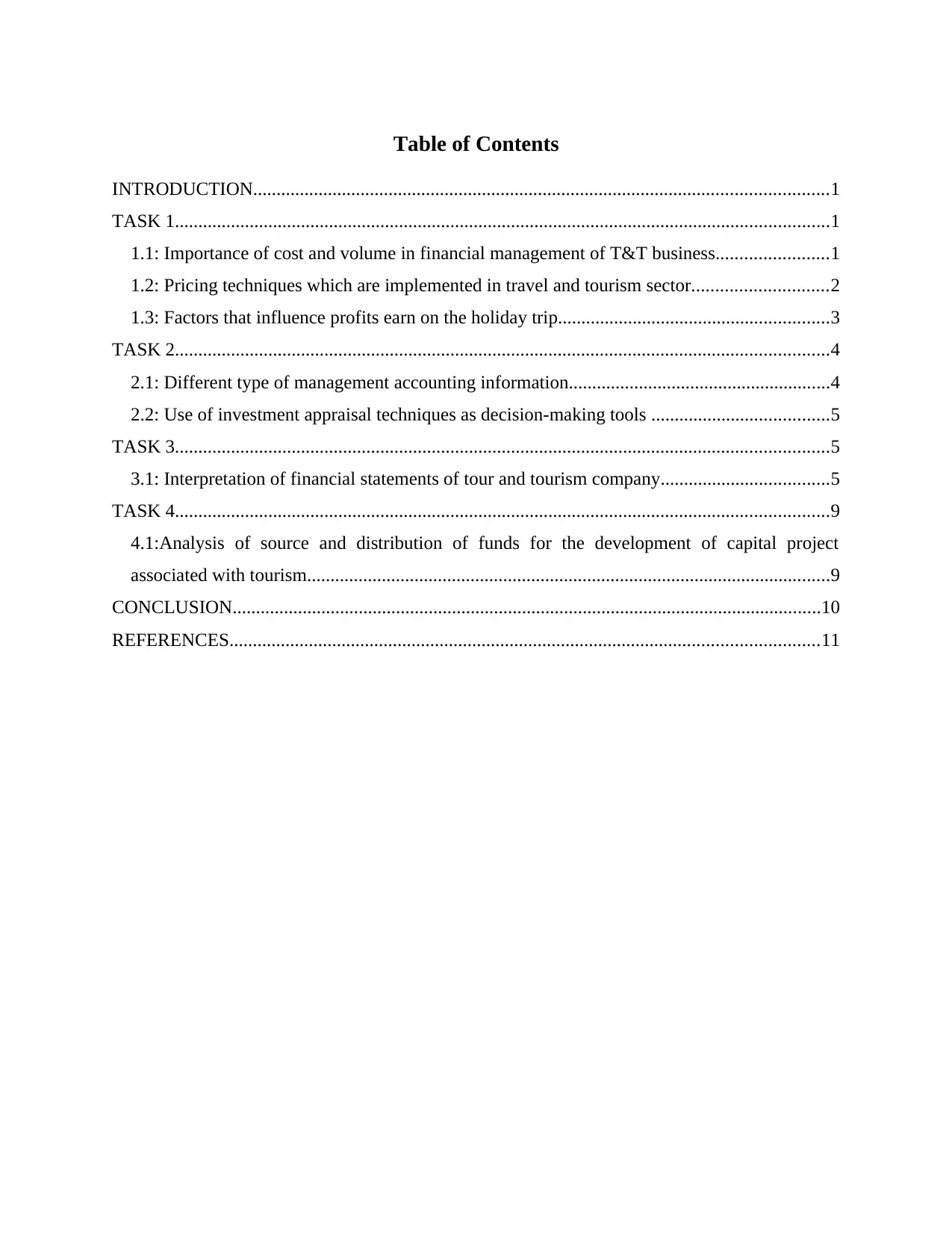
Table of Contents
INTRODUCTION...........................................................................................................................1
TASK 1............................................................................................................................................1
1.1: Importance of cost and volume in financial management of T&T business........................1
1.2: Pricing techniques which are implemented in travel and tourism sector.............................2
1.3: Factors that influence profits earn on the holiday trip..........................................................3
TASK 2............................................................................................................................................4
2.1: Different type of management accounting information........................................................4
2.2: Use of investment appraisal techniques as decision-making tools ......................................5
TASK 3............................................................................................................................................5
3.1: Interpretation of financial statements of tour and tourism company....................................5
TASK 4............................................................................................................................................9
4.1:Analysis of source and distribution of funds for the development of capital project
associated with tourism................................................................................................................9
CONCLUSION..............................................................................................................................10
REFERENCES..............................................................................................................................11
INTRODUCTION...........................................................................................................................1
TASK 1............................................................................................................................................1
1.1: Importance of cost and volume in financial management of T&T business........................1
1.2: Pricing techniques which are implemented in travel and tourism sector.............................2
1.3: Factors that influence profits earn on the holiday trip..........................................................3
TASK 2............................................................................................................................................4
2.1: Different type of management accounting information........................................................4
2.2: Use of investment appraisal techniques as decision-making tools ......................................5
TASK 3............................................................................................................................................5
3.1: Interpretation of financial statements of tour and tourism company....................................5
TASK 4............................................................................................................................................9
4.1:Analysis of source and distribution of funds for the development of capital project
associated with tourism................................................................................................................9
CONCLUSION..............................................................................................................................10
REFERENCES..............................................................................................................................11

⊘ This is a preview!⊘
Do you want full access?
Subscribe today to unlock all pages.

Trusted by 1+ million students worldwide
INTRODUCTION
Finance is defined as the systematic administration of fund and money and includes
activities like investing, borrowing, lending, budgeting, saving, and forecasting . Funding is an
activity which includes providing financial funds, usually in monetary term, or other amount
such as time or effort, to finance a demand, arrangements, and activity, by an enterprise.
Financing and funding are used in business to allocate its monetary or non monetary resources in
required areas and better utilisation of these available resources. This report describes finance
and funding activities in the context of travel and tourism sector company EUROCARIB
TOURS. Relevant approaches in relation to financing and funding are discussed and issues are
addressed in this context (Evans, Stonehouse and Campbell, 2012). This reports exhibits
importance of costs and volume in financial management of travel and tourism businesses, and a
systematic analysis of pricing methods and factors that will influence profits of an enterprise.
TASK 1
1.1: Importance of cost and volume in financial management of T&T business
Eurocarib tours : Eurocarib tours is a major London-based European tour operator
focusing on Caribbean holidays. Eurocarib tours is planning a summer holiday trip to a
Caribbean Holiday Resort lasting one month. The company will charter an air plane that carries
only its tourists. The company will also book a floor of a hotel at the resort to accommodate its
tourists. The travel and tourism industry provides an attractive profitability conditions in
business in present scenario. In this industry a major growth can be seen in weekends and
holidays. While working in this industry a business organisation go through various aspects
related with finance such as :
Cost: Cost is a major part of financing and funding, in travelling and tourism industry
cost is the amount occur in in financing of tour packages for customers. Estimation of cost helps
in achieving targeted profits, in tourism and travel business predetermination of cost helps to
organise a trip and for providing packages to customers (Kimbu and Ngoasong, 2013).
Volume: Volume refers to quantity of products and services. Cost and budget are
allocated to volume of product or service. Volume denotes the level of production in quantity
terms. In the context of tour and travel business it can be seen as number of tickets people are
purchasing from company.
1
Finance is defined as the systematic administration of fund and money and includes
activities like investing, borrowing, lending, budgeting, saving, and forecasting . Funding is an
activity which includes providing financial funds, usually in monetary term, or other amount
such as time or effort, to finance a demand, arrangements, and activity, by an enterprise.
Financing and funding are used in business to allocate its monetary or non monetary resources in
required areas and better utilisation of these available resources. This report describes finance
and funding activities in the context of travel and tourism sector company EUROCARIB
TOURS. Relevant approaches in relation to financing and funding are discussed and issues are
addressed in this context (Evans, Stonehouse and Campbell, 2012). This reports exhibits
importance of costs and volume in financial management of travel and tourism businesses, and a
systematic analysis of pricing methods and factors that will influence profits of an enterprise.
TASK 1
1.1: Importance of cost and volume in financial management of T&T business
Eurocarib tours : Eurocarib tours is a major London-based European tour operator
focusing on Caribbean holidays. Eurocarib tours is planning a summer holiday trip to a
Caribbean Holiday Resort lasting one month. The company will charter an air plane that carries
only its tourists. The company will also book a floor of a hotel at the resort to accommodate its
tourists. The travel and tourism industry provides an attractive profitability conditions in
business in present scenario. In this industry a major growth can be seen in weekends and
holidays. While working in this industry a business organisation go through various aspects
related with finance such as :
Cost: Cost is a major part of financing and funding, in travelling and tourism industry
cost is the amount occur in in financing of tour packages for customers. Estimation of cost helps
in achieving targeted profits, in tourism and travel business predetermination of cost helps to
organise a trip and for providing packages to customers (Kimbu and Ngoasong, 2013).
Volume: Volume refers to quantity of products and services. Cost and budget are
allocated to volume of product or service. Volume denotes the level of production in quantity
terms. In the context of tour and travel business it can be seen as number of tickets people are
purchasing from company.
1
Paraphrase This Document
Need a fresh take? Get an instant paraphrase of this document with our AI Paraphraser
Importance of costs:
Cost in a business organisation helps its owner in making decisions that enhances the
scope of sustainable growth and profitability. To determine cost a systematic process is adopted
by a business organisation whether in formal manner or not. (Heung, Kucukusta and Song,
2011). An organisation always focuses towards optimisation of cost while maintaining quality of
service and product .
Cost reduction: It is most considerable area for a business organisation. In tour and travel
business company always tries to provide attractive and better services to customer while
maintaining cost that helps organisation to achieve goals and to increase profitability.
Decision-making: Cost analysis helps finance department in making important decisions
regrading performance of company as compare to their competitors. To achieve
sustainable growth and performance evaluation of cost is important for a business
organisation.
Increasing performance of managers: Using data provided in cost system by analysing
various facts assists managerial personnel to increase their performance.
Importance of volume:
Trading volume, is the number of shares or contracts that points shows the overall
activity of a security or market for a given period. Trading amount/quantity is an important
technical indicator for a person or business who gives money to help start a business uses to
confirm a scenario or trend reversal. Volume gives investor an idea of the price action of a
security and whether they should buy or sell the security, following are the major aspects of
volume:
BEP Analysis: This is tool used by an organisation to determine the level company or
product or service will be most profitable (Chio, 2014.). Break-even analysis assists in evaluating
the relation between the variable cost, fixed cost and revenue. In practical term a company with
low fixed costs will have a low break-even sale such as a company with no fixed cost will
automatically have broken even upon the first sale of its product.
Economical of scale: It is a level in cost analysis that shows a increase in results related
with product and service. It assist the company to optimise variable cost per units due to
operational efficiency and sustainable growth(Thakran and Verma, 2013).
2
Cost in a business organisation helps its owner in making decisions that enhances the
scope of sustainable growth and profitability. To determine cost a systematic process is adopted
by a business organisation whether in formal manner or not. (Heung, Kucukusta and Song,
2011). An organisation always focuses towards optimisation of cost while maintaining quality of
service and product .
Cost reduction: It is most considerable area for a business organisation. In tour and travel
business company always tries to provide attractive and better services to customer while
maintaining cost that helps organisation to achieve goals and to increase profitability.
Decision-making: Cost analysis helps finance department in making important decisions
regrading performance of company as compare to their competitors. To achieve
sustainable growth and performance evaluation of cost is important for a business
organisation.
Increasing performance of managers: Using data provided in cost system by analysing
various facts assists managerial personnel to increase their performance.
Importance of volume:
Trading volume, is the number of shares or contracts that points shows the overall
activity of a security or market for a given period. Trading amount/quantity is an important
technical indicator for a person or business who gives money to help start a business uses to
confirm a scenario or trend reversal. Volume gives investor an idea of the price action of a
security and whether they should buy or sell the security, following are the major aspects of
volume:
BEP Analysis: This is tool used by an organisation to determine the level company or
product or service will be most profitable (Chio, 2014.). Break-even analysis assists in evaluating
the relation between the variable cost, fixed cost and revenue. In practical term a company with
low fixed costs will have a low break-even sale such as a company with no fixed cost will
automatically have broken even upon the first sale of its product.
Economical of scale: It is a level in cost analysis that shows a increase in results related
with product and service. It assist the company to optimise variable cost per units due to
operational efficiency and sustainable growth(Thakran and Verma, 2013).
2
Diseconomies of scale: It is level just opposite to the economical scale in which an
organisation faces adverse condition in relation to the performance and capabilities to generate
profits. These conditions arises due to high competition, low performance, compromise with
quality of services etc.
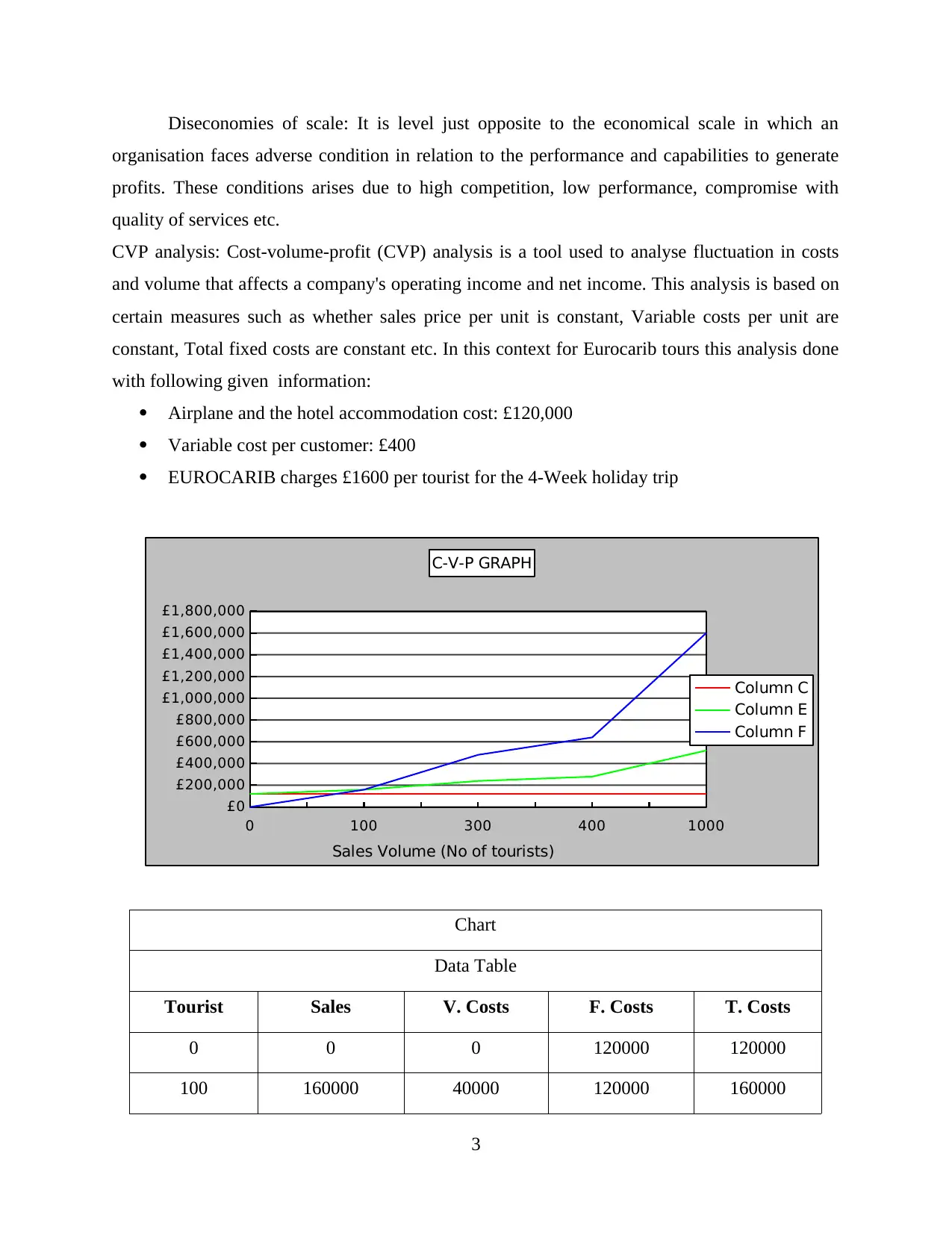
CVP analysis: Cost-volume-profit (CVP) analysis is a tool used to analyse fluctuation in costs
and volume that affects a company's operating income and net income. This analysis is based on
certain measures such as whether sales price per unit is constant, Variable costs per unit are
constant, Total fixed costs are constant etc. In this context for Eurocarib tours this analysis done
with following given information:
Airplane and the hotel accommodation cost: £120,000
Variable cost per customer: £400
EUROCARIB charges £1600 per tourist for the 4-Week holiday trip
Chart
Data Table
Tourist Sales V. Costs F. Costs T. Costs
0 0 0 120000 120000
100 160000 40000 120000 160000
3
0 100 300 400 1000
£0
£200,000
£400,000
£600,000
£800,000
£1,000,000
£1,200,000
£1,400,000
£1,600,000
£1,800,000
C-V-P GRAPH
Column C
Column E
Column F
Sales Volume (No of tourists)
organisation faces adverse condition in relation to the performance and capabilities to generate
profits. These conditions arises due to high competition, low performance, compromise with
quality of services etc.
CVP analysis: Cost-volume-profit (CVP) analysis is a tool used to analyse fluctuation in costs
and volume that affects a company's operating income and net income. This analysis is based on
certain measures such as whether sales price per unit is constant, Variable costs per unit are
constant, Total fixed costs are constant etc. In this context for Eurocarib tours this analysis done
with following given information:
Airplane and the hotel accommodation cost: £120,000
Variable cost per customer: £400
EUROCARIB charges £1600 per tourist for the 4-Week holiday trip
Chart
Data Table
Tourist Sales V. Costs F. Costs T. Costs
0 0 0 120000 120000
100 160000 40000 120000 160000
3
0 100 300 400 1000
£0
£200,000
£400,000
£600,000
£800,000
£1,000,000
£1,200,000
£1,400,000
£1,600,000
£1,800,000
C-V-P GRAPH
Column C
Column E
Column F
Sales Volume (No of tourists)
⊘ This is a preview!⊘
Do you want full access?
Subscribe today to unlock all pages.
Trusted by 1+ million students worldwide
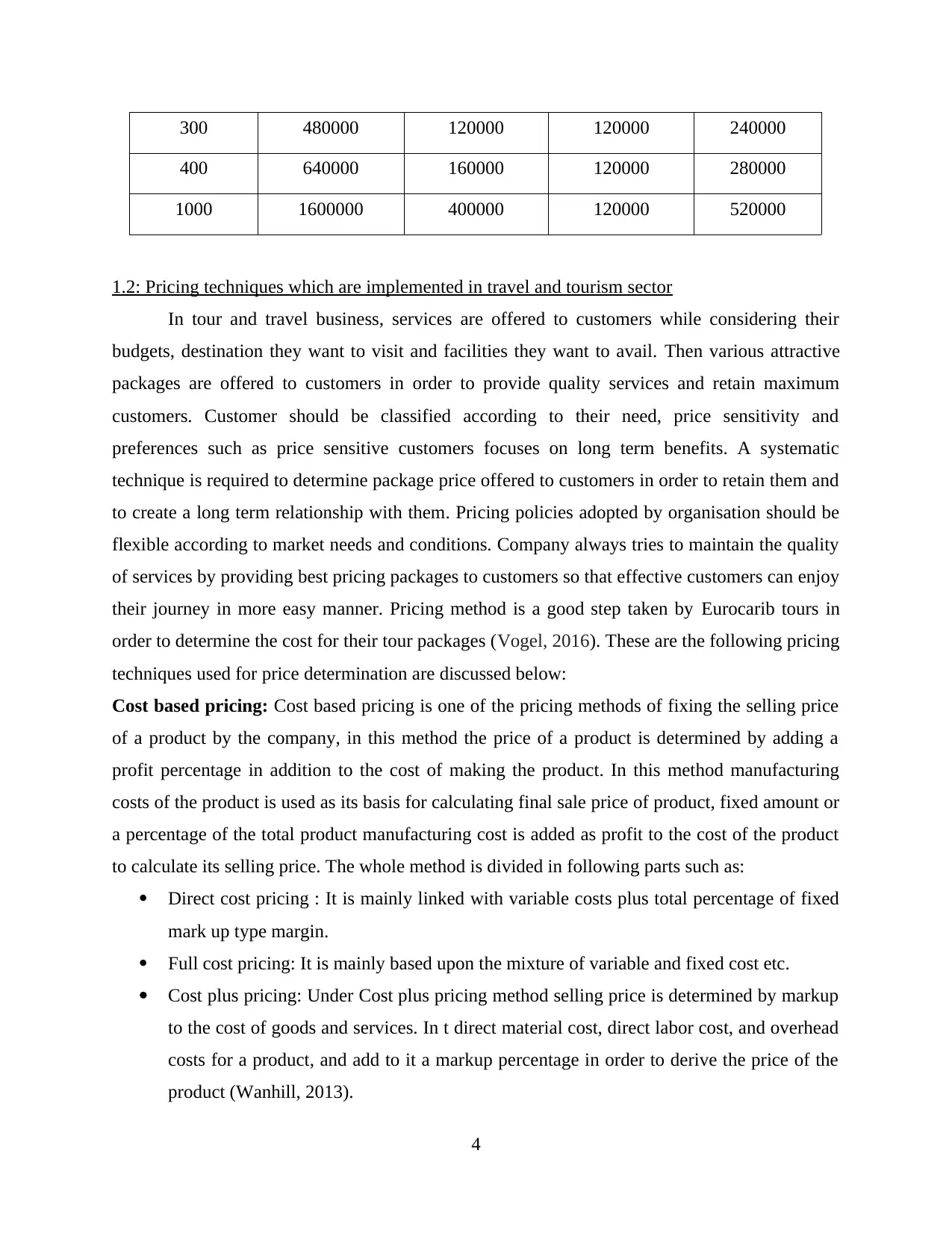
300 480000 120000 120000 240000
400 640000 160000 120000 280000
1000 1600000 400000 120000 520000
1.2: Pricing techniques which are implemented in travel and tourism sector
In tour and travel business, services are offered to customers while considering their
budgets, destination they want to visit and facilities they want to avail. Then various attractive
packages are offered to customers in order to provide quality services and retain maximum
customers. Customer should be classified according to their need, price sensitivity and
preferences such as price sensitive customers focuses on long term benefits. A systematic
technique is required to determine package price offered to customers in order to retain them and
to create a long term relationship with them. Pricing policies adopted by organisation should be
flexible according to market needs and conditions. Company always tries to maintain the quality
of services by providing best pricing packages to customers so that effective customers can enjoy
their journey in more easy manner. Pricing method is a good step taken by Eurocarib tours in
order to determine the cost for their tour packages (Vogel, 2016). These are the following pricing
techniques used for price determination are discussed below:
Cost based pricing: Cost based pricing is one of the pricing methods of fixing the selling price
of a product by the company, in this method the price of a product is determined by adding a
profit percentage in addition to the cost of making the product. In this method manufacturing
costs of the product is used as its basis for calculating final sale price of product, fixed amount or
a percentage of the total product manufacturing cost is added as profit to the cost of the product
to calculate its selling price. The whole method is divided in following parts such as:
Direct cost pricing : It is mainly linked with variable costs plus total percentage of fixed
mark up type margin.
Full cost pricing: It is mainly based upon the mixture of variable and fixed cost etc.
Cost plus pricing: Under Cost plus pricing method selling price is determined by markup
to the cost of goods and services. In t direct material cost, direct labor cost, and overhead
costs for a product, and add to it a markup percentage in order to derive the price of the
product (Wanhill, 2013).
4
400 640000 160000 120000 280000
1000 1600000 400000 120000 520000
1.2: Pricing techniques which are implemented in travel and tourism sector
In tour and travel business, services are offered to customers while considering their
budgets, destination they want to visit and facilities they want to avail. Then various attractive
packages are offered to customers in order to provide quality services and retain maximum
customers. Customer should be classified according to their need, price sensitivity and
preferences such as price sensitive customers focuses on long term benefits. A systematic
technique is required to determine package price offered to customers in order to retain them and
to create a long term relationship with them. Pricing policies adopted by organisation should be
flexible according to market needs and conditions. Company always tries to maintain the quality
of services by providing best pricing packages to customers so that effective customers can enjoy
their journey in more easy manner. Pricing method is a good step taken by Eurocarib tours in
order to determine the cost for their tour packages (Vogel, 2016). These are the following pricing
techniques used for price determination are discussed below:
Cost based pricing: Cost based pricing is one of the pricing methods of fixing the selling price
of a product by the company, in this method the price of a product is determined by adding a
profit percentage in addition to the cost of making the product. In this method manufacturing
costs of the product is used as its basis for calculating final sale price of product, fixed amount or
a percentage of the total product manufacturing cost is added as profit to the cost of the product
to calculate its selling price. The whole method is divided in following parts such as:
Direct cost pricing : It is mainly linked with variable costs plus total percentage of fixed
mark up type margin.
Full cost pricing: It is mainly based upon the mixture of variable and fixed cost etc.
Cost plus pricing: Under Cost plus pricing method selling price is determined by markup
to the cost of goods and services. In t direct material cost, direct labor cost, and overhead
costs for a product, and add to it a markup percentage in order to derive the price of the
product (Wanhill, 2013).
4
Paraphrase This Document
Need a fresh take? Get an instant paraphrase of this document with our AI Paraphraser
Demand based pricing: This pricing method is mostly based on the demand of customer as well
as supply of the tour plan. It is said to be more practical in nature.
Competition oriented pricing: This method of pricing is market oriented pricing which
includes prices that a competitors charges without considering client demand and with their own
costs such as premium pricing, discounted pricing and parity pricing.
Product line pricing: This method is related with fixed packages that are interrelated. The
predetermined cost of these tours is also will not be same. It is mostly indented to get higher
profit from the set line. Such as :
Destination Cost (In pound)
Domestic region 110
National 220
International 520
Seasonal pricing: this pricing method is used by Eurocarib tours according to the season like :
Summer pricing: in summer huge number of customers travel to different destinations
due to this company changes high price (Benson and Henderson, 2011). They increase
the cost of trip with providing necessary discount as well.
Winter pricing: In winter people prefers to travel to those country where temperature is
little at higher side (Tarlow, 2014). Charges in winter are differ according to their
selected destination.
1.3: Factors that influence profits earn on the holiday trip
In Eurocarib tours a trip to a Caribbean Holiday Resort for one month is planned and this
trip consist fixed and variable cost. Variable cost per consumer is £400 and total cost of the trip
is £1,20,000. Amount charged for the trip is £1600. Factors that will influence profits earned by
Eurocarib tours from this trip are-
Airplane charges- Tourists will taken by air-plan to place of vacation and charges of one
ticket taken for one person will effect profit earned by Eurocarib tours. As these charges
will become part of variable cost and influence profitability of company (Lunt, Mannion
and Exworthy, 2013).
5
as supply of the tour plan. It is said to be more practical in nature.
Competition oriented pricing: This method of pricing is market oriented pricing which
includes prices that a competitors charges without considering client demand and with their own
costs such as premium pricing, discounted pricing and parity pricing.
Product line pricing: This method is related with fixed packages that are interrelated. The
predetermined cost of these tours is also will not be same. It is mostly indented to get higher
profit from the set line. Such as :
Destination Cost (In pound)
Domestic region 110
National 220
International 520
Seasonal pricing: this pricing method is used by Eurocarib tours according to the season like :
Summer pricing: in summer huge number of customers travel to different destinations
due to this company changes high price (Benson and Henderson, 2011). They increase
the cost of trip with providing necessary discount as well.
Winter pricing: In winter people prefers to travel to those country where temperature is
little at higher side (Tarlow, 2014). Charges in winter are differ according to their
selected destination.
1.3: Factors that influence profits earn on the holiday trip
In Eurocarib tours a trip to a Caribbean Holiday Resort for one month is planned and this
trip consist fixed and variable cost. Variable cost per consumer is £400 and total cost of the trip
is £1,20,000. Amount charged for the trip is £1600. Factors that will influence profits earned by
Eurocarib tours from this trip are-
Airplane charges- Tourists will taken by air-plan to place of vacation and charges of one
ticket taken for one person will effect profit earned by Eurocarib tours. As these charges
will become part of variable cost and influence profitability of company (Lunt, Mannion
and Exworthy, 2013).
5
Accommodation- Tourists of Eurocarib tours during their trip will stay in resort for which
a floor is booked and this will influence profits of the company. As when more
consumers will involve in the trip then this cost will be divided in all otherwise cost will
be born by company itself.
Number of tourists- When number of tourist is as per plan then cost of the trip will be
divided among all tourist and profits will be more.
When 90 tourist make bookings for trip then revenue generated from them is £144000
and cost incurred for this revenue is £120000. Profits generated from booking of 90 tourist is
£24000. Eurocarib tours wants to earn profits of at least £30000 which will not be achieved by
getting bookings of only 90 tourist. This target will be achieved when bookings are made by at
least 94 tourists. This is calculated as 94*1600= £150400 this will be reduced by total cost of
£120000 the profits will be £30400.
TASK 2
2.1: Different type of management accounting information
Accounting information in order to better inform themselves before deciding matters
within the organisation and also aids management and performance of control functions. This is
considered as a tool for decision making that makes comparison with trend and also helps in
making forecasting. Travel and tourism sector is the fastest growing industry in service sector
throughout the world. Types of management accounting information are Budget report, financial
statement, variance analyse and job cost report (Page, Song and Wu, 2012V).
Budget report- Budget is a roadmap and set of activities that is required to attain
Eurocarib tours goals. Managers can use it as a tool to compare activity with the budget to study
variance.
Financial statements- The managers of Eurocarib tours can use financial statements for
the purpose of making decision for the company on the basis of accounting information.
Managers of Eurocarib tours can make decision on the area where future investment can be made
on the basis of analysing financial information.
Variance analysis- Eurocarib tours can use variance analysis to compute the variation
of actual outcome from the targeted. Reason of variance should be examined and appropriate
6
a floor is booked and this will influence profits of the company. As when more
consumers will involve in the trip then this cost will be divided in all otherwise cost will
be born by company itself.
Number of tourists- When number of tourist is as per plan then cost of the trip will be
divided among all tourist and profits will be more.
When 90 tourist make bookings for trip then revenue generated from them is £144000
and cost incurred for this revenue is £120000. Profits generated from booking of 90 tourist is
£24000. Eurocarib tours wants to earn profits of at least £30000 which will not be achieved by
getting bookings of only 90 tourist. This target will be achieved when bookings are made by at
least 94 tourists. This is calculated as 94*1600= £150400 this will be reduced by total cost of
£120000 the profits will be £30400.
TASK 2
2.1: Different type of management accounting information
Accounting information in order to better inform themselves before deciding matters
within the organisation and also aids management and performance of control functions. This is
considered as a tool for decision making that makes comparison with trend and also helps in
making forecasting. Travel and tourism sector is the fastest growing industry in service sector
throughout the world. Types of management accounting information are Budget report, financial
statement, variance analyse and job cost report (Page, Song and Wu, 2012V).
Budget report- Budget is a roadmap and set of activities that is required to attain
Eurocarib tours goals. Managers can use it as a tool to compare activity with the budget to study
variance.
Financial statements- The managers of Eurocarib tours can use financial statements for
the purpose of making decision for the company on the basis of accounting information.
Managers of Eurocarib tours can make decision on the area where future investment can be made
on the basis of analysing financial information.
Variance analysis- Eurocarib tours can use variance analysis to compute the variation
of actual outcome from the targeted. Reason of variance should be examined and appropriate
6
⊘ This is a preview!⊘
Do you want full access?
Subscribe today to unlock all pages.
Trusted by 1+ million students worldwide
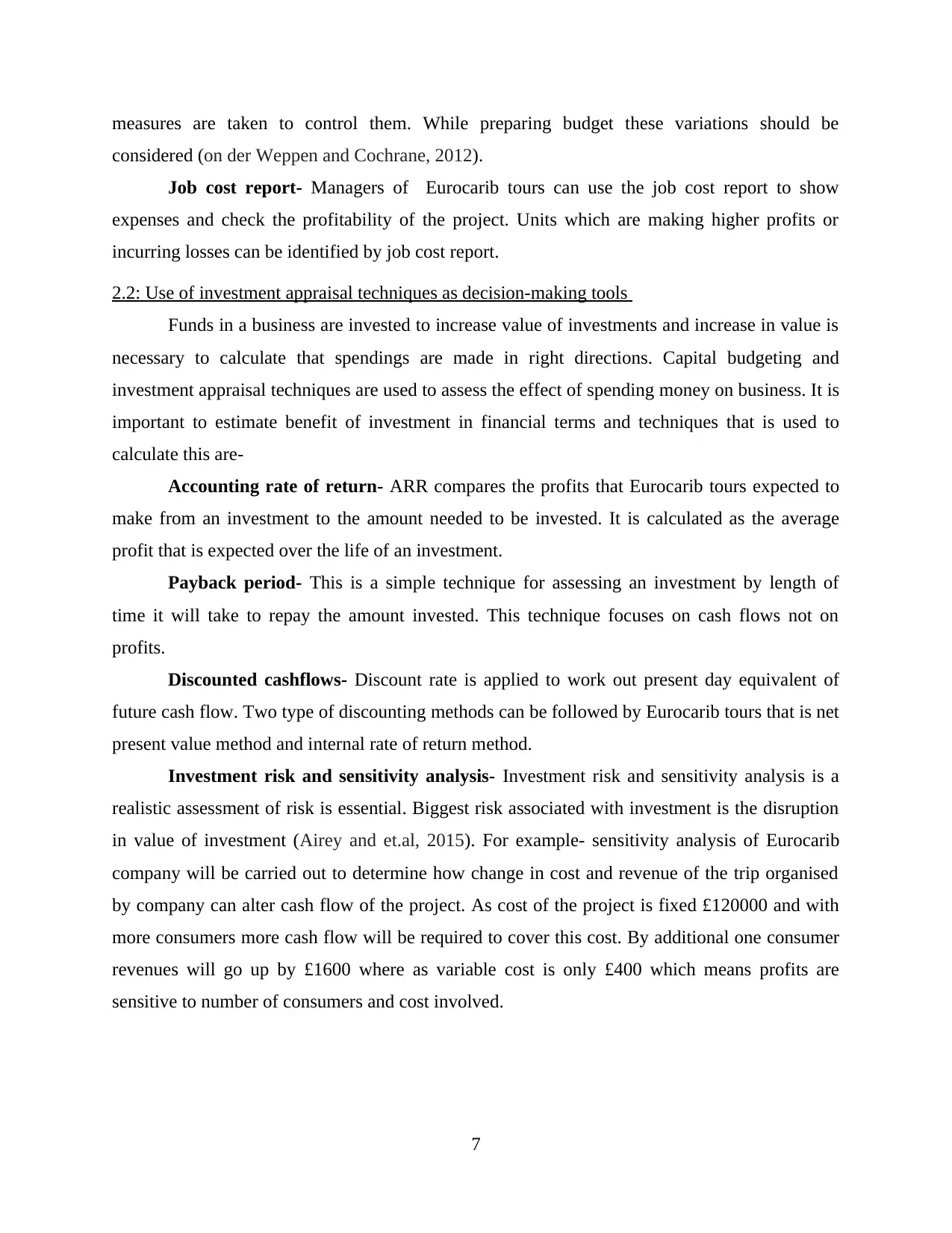
measures are taken to control them. While preparing budget these variations should be
considered (on der Weppen and Cochrane, 2012).
Job cost report- Managers of Eurocarib tours can use the job cost report to show
expenses and check the profitability of the project. Units which are making higher profits or
incurring losses can be identified by job cost report.
2.2: Use of investment appraisal techniques as decision-making tools
Funds in a business are invested to increase value of investments and increase in value is
necessary to calculate that spendings are made in right directions. Capital budgeting and
investment appraisal techniques are used to assess the effect of spending money on business. It is
important to estimate benefit of investment in financial terms and techniques that is used to
calculate this are-
Accounting rate of return- ARR compares the profits that Eurocarib tours expected to
make from an investment to the amount needed to be invested. It is calculated as the average
profit that is expected over the life of an investment.
Payback period- This is a simple technique for assessing an investment by length of
time it will take to repay the amount invested. This technique focuses on cash flows not on
profits.
Discounted cashflows- Discount rate is applied to work out present day equivalent of
future cash flow. Two type of discounting methods can be followed by Eurocarib tours that is net
present value method and internal rate of return method.
Investment risk and sensitivity analysis- Investment risk and sensitivity analysis is a
realistic assessment of risk is essential. Biggest risk associated with investment is the disruption
in value of investment (Airey and et.al, 2015). For example- sensitivity analysis of Eurocarib
company will be carried out to determine how change in cost and revenue of the trip organised
by company can alter cash flow of the project. As cost of the project is fixed £120000 and with
more consumers more cash flow will be required to cover this cost. By additional one consumer
revenues will go up by £1600 where as variable cost is only £400 which means profits are
sensitive to number of consumers and cost involved.
7
considered (on der Weppen and Cochrane, 2012).
Job cost report- Managers of Eurocarib tours can use the job cost report to show
expenses and check the profitability of the project. Units which are making higher profits or
incurring losses can be identified by job cost report.
2.2: Use of investment appraisal techniques as decision-making tools
Funds in a business are invested to increase value of investments and increase in value is
necessary to calculate that spendings are made in right directions. Capital budgeting and
investment appraisal techniques are used to assess the effect of spending money on business. It is
important to estimate benefit of investment in financial terms and techniques that is used to
calculate this are-
Accounting rate of return- ARR compares the profits that Eurocarib tours expected to
make from an investment to the amount needed to be invested. It is calculated as the average
profit that is expected over the life of an investment.
Payback period- This is a simple technique for assessing an investment by length of
time it will take to repay the amount invested. This technique focuses on cash flows not on
profits.
Discounted cashflows- Discount rate is applied to work out present day equivalent of
future cash flow. Two type of discounting methods can be followed by Eurocarib tours that is net
present value method and internal rate of return method.
Investment risk and sensitivity analysis- Investment risk and sensitivity analysis is a
realistic assessment of risk is essential. Biggest risk associated with investment is the disruption
in value of investment (Airey and et.al, 2015). For example- sensitivity analysis of Eurocarib
company will be carried out to determine how change in cost and revenue of the trip organised
by company can alter cash flow of the project. As cost of the project is fixed £120000 and with
more consumers more cash flow will be required to cover this cost. By additional one consumer
revenues will go up by £1600 where as variable cost is only £400 which means profits are
sensitive to number of consumers and cost involved.
7
Paraphrase This Document
Need a fresh take? Get an instant paraphrase of this document with our AI Paraphraser
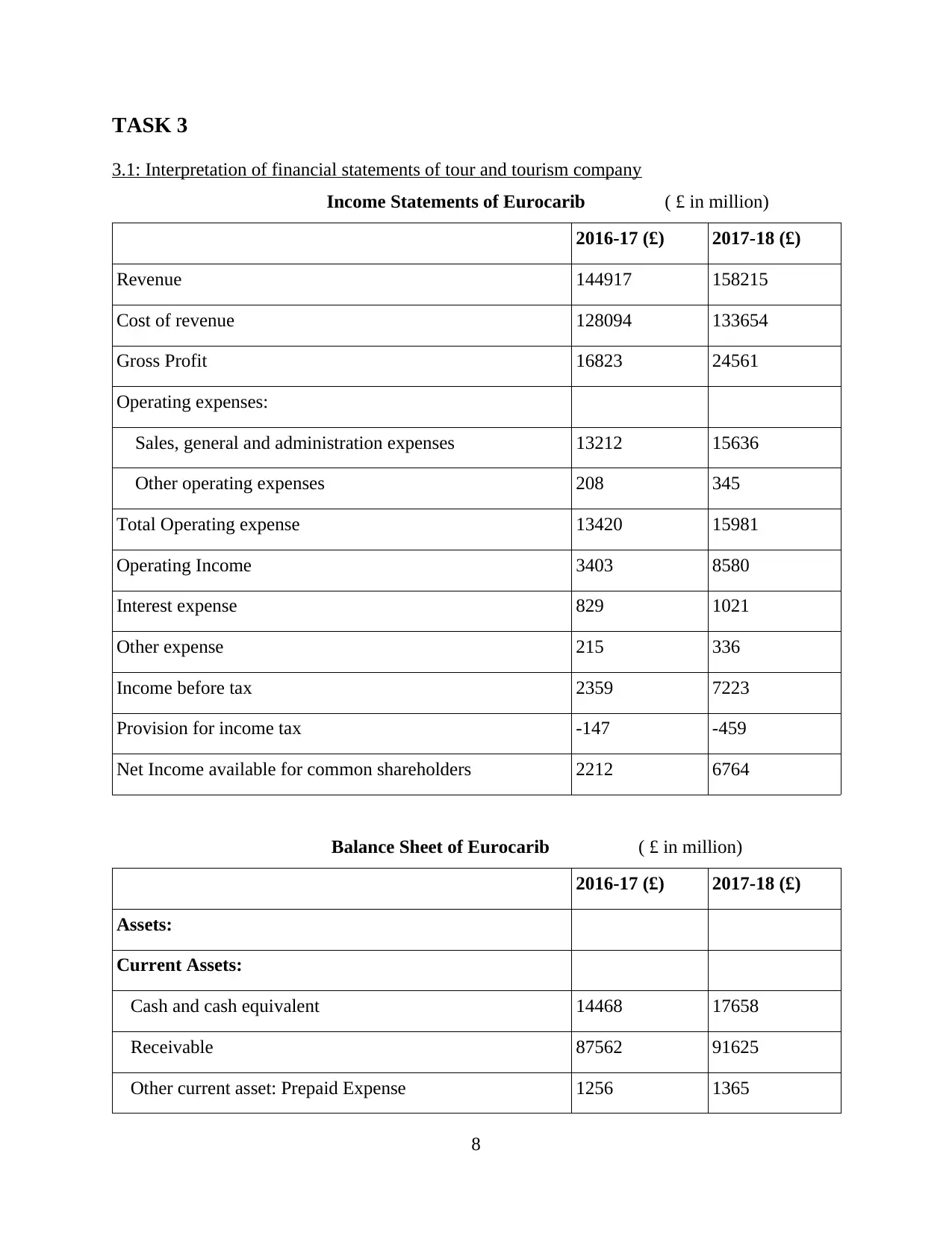
TASK 3
3.1: Interpretation of financial statements of tour and tourism company
Income Statements of Eurocarib ( £ in million)
2016-17 (£) 2017-18 (£)
Revenue 144917 158215
Cost of revenue 128094 133654
Gross Profit 16823 24561
Operating expenses:
Sales, general and administration expenses 13212 15636
Other operating expenses 208 345
Total Operating expense 13420 15981
Operating Income 3403 8580
Interest expense 829 1021
Other expense 215 336
Income before tax 2359 7223
Provision for income tax -147 -459
Net Income available for common shareholders 2212 6764
Balance Sheet of Eurocarib ( £ in million)
2016-17 (£) 2017-18 (£)
Assets:
Current Assets:
Cash and cash equivalent 14468 17658
Receivable 87562 91625
Other current asset: Prepaid Expense 1256 1365
8
3.1: Interpretation of financial statements of tour and tourism company
Income Statements of Eurocarib ( £ in million)
2016-17 (£) 2017-18 (£)
Revenue 144917 158215
Cost of revenue 128094 133654
Gross Profit 16823 24561
Operating expenses:
Sales, general and administration expenses 13212 15636
Other operating expenses 208 345
Total Operating expense 13420 15981
Operating Income 3403 8580
Interest expense 829 1021
Other expense 215 336
Income before tax 2359 7223
Provision for income tax -147 -459
Net Income available for common shareholders 2212 6764
Balance Sheet of Eurocarib ( £ in million)
2016-17 (£) 2017-18 (£)
Assets:
Current Assets:
Cash and cash equivalent 14468 17658
Receivable 87562 91625
Other current asset: Prepaid Expense 1256 1365
8
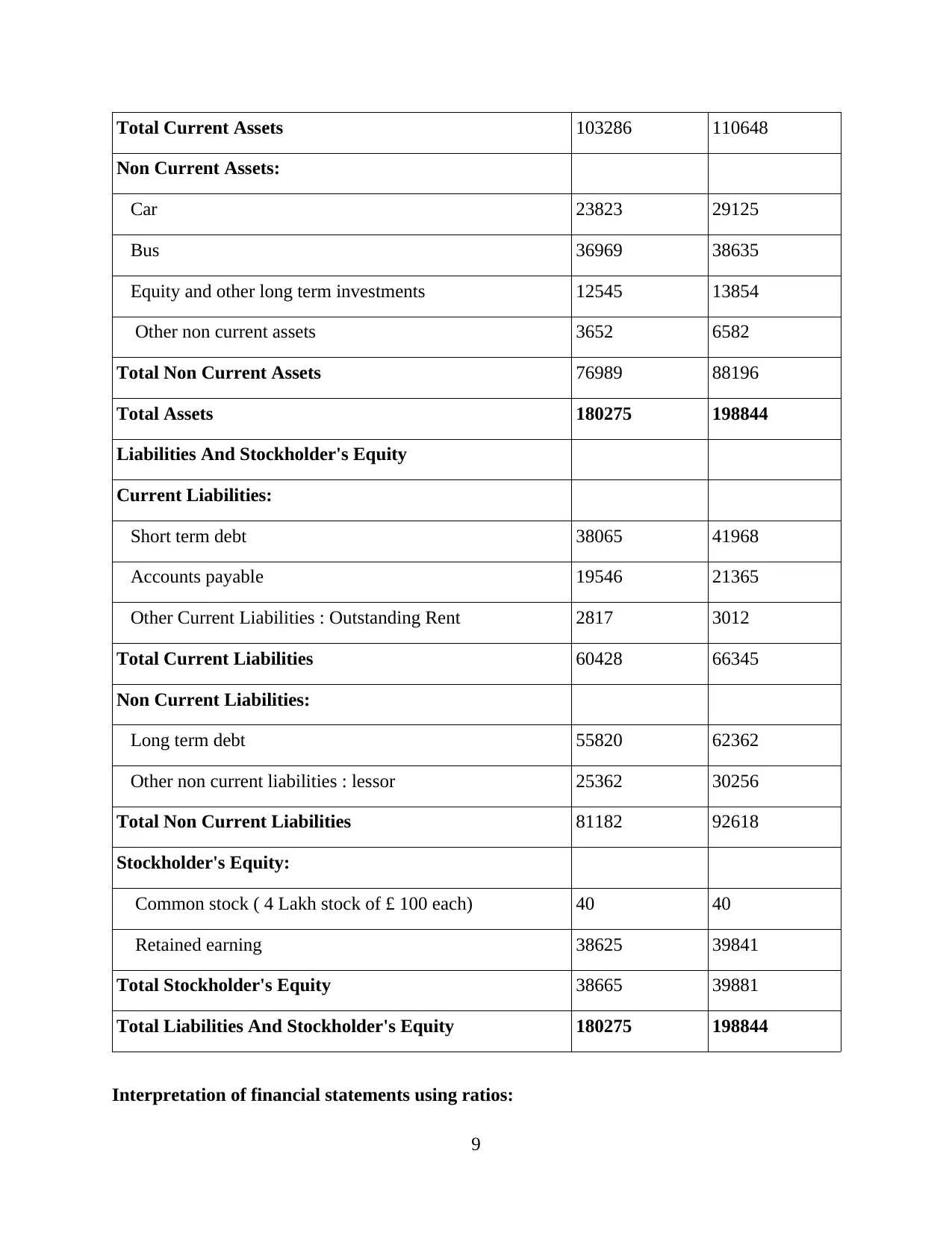
Total Current Assets 103286 110648
Non Current Assets:
Car 23823 29125
Bus 36969 38635
Equity and other long term investments 12545 13854
Other non current assets 3652 6582
Total Non Current Assets 76989 88196
Total Assets 180275 198844
Liabilities And Stockholder's Equity
Current Liabilities:
Short term debt 38065 41968
Accounts payable 19546 21365
Other Current Liabilities : Outstanding Rent 2817 3012
Total Current Liabilities 60428 66345
Non Current Liabilities:
Long term debt 55820 62362
Other non current liabilities : lessor 25362 30256
Total Non Current Liabilities 81182 92618
Stockholder's Equity:
Common stock ( 4 Lakh stock of £ 100 each) 40 40
Retained earning 38625 39841
Total Stockholder's Equity 38665 39881
Total Liabilities And Stockholder's Equity 180275 198844
Interpretation of financial statements using ratios:
9
Non Current Assets:
Car 23823 29125
Bus 36969 38635
Equity and other long term investments 12545 13854
Other non current assets 3652 6582
Total Non Current Assets 76989 88196
Total Assets 180275 198844
Liabilities And Stockholder's Equity
Current Liabilities:
Short term debt 38065 41968
Accounts payable 19546 21365
Other Current Liabilities : Outstanding Rent 2817 3012
Total Current Liabilities 60428 66345
Non Current Liabilities:
Long term debt 55820 62362
Other non current liabilities : lessor 25362 30256
Total Non Current Liabilities 81182 92618
Stockholder's Equity:
Common stock ( 4 Lakh stock of £ 100 each) 40 40
Retained earning 38625 39841
Total Stockholder's Equity 38665 39881
Total Liabilities And Stockholder's Equity 180275 198844
Interpretation of financial statements using ratios:
9
⊘ This is a preview!⊘
Do you want full access?
Subscribe today to unlock all pages.
Trusted by 1+ million students worldwide

1 out of 16


Related Documents


Your All-in-One AI-Powered Toolkit for Academic Success.
+13062052269
info@desklib.com
Available 24*7 on WhatsApp / Email
![[object Object]](/_next/static/media/star-bottom.7253800d.svg)
Unlock your academic potential
Copyright © 2020–2026 A2Z Services. All Rights Reserved. Developed and managed by ZUCOL.