University Finance Assignment: Inflation Impact and Market Indices

Verified

Added on  2021/10/03

|4
|780
|79
Homework Assignment
AI Summary
This finance assignment solution analyzes the impact of inflation rate changes on different investment classes, specifically fixed interest securities and stocks. It explains how rising inflation affects the returns and prices of these investments, considering factors like market interest rates and investor behavior. The assignment also compares the S&P/ASX 200 index and the Dow Jones Index, highlighting their key differences in terms of the number of stocks, selection criteria, weighting methods, and market capitalization. Furthermore, it discusses which index is more useful for assessing the general performance of a country's sharemarket, emphasizing the broader representation of sectors in the S&P/ASX 200 index. The solution references several finance textbooks to support the analysis.

Document Page
FINANCE
STUDENT ID:
[Pick the date]
tabler-icon-diamond-filled.svg

Paraphrase This Document

Need a fresh take? Get an instant paraphrase of this document with our AI Paraphraser
Document Page
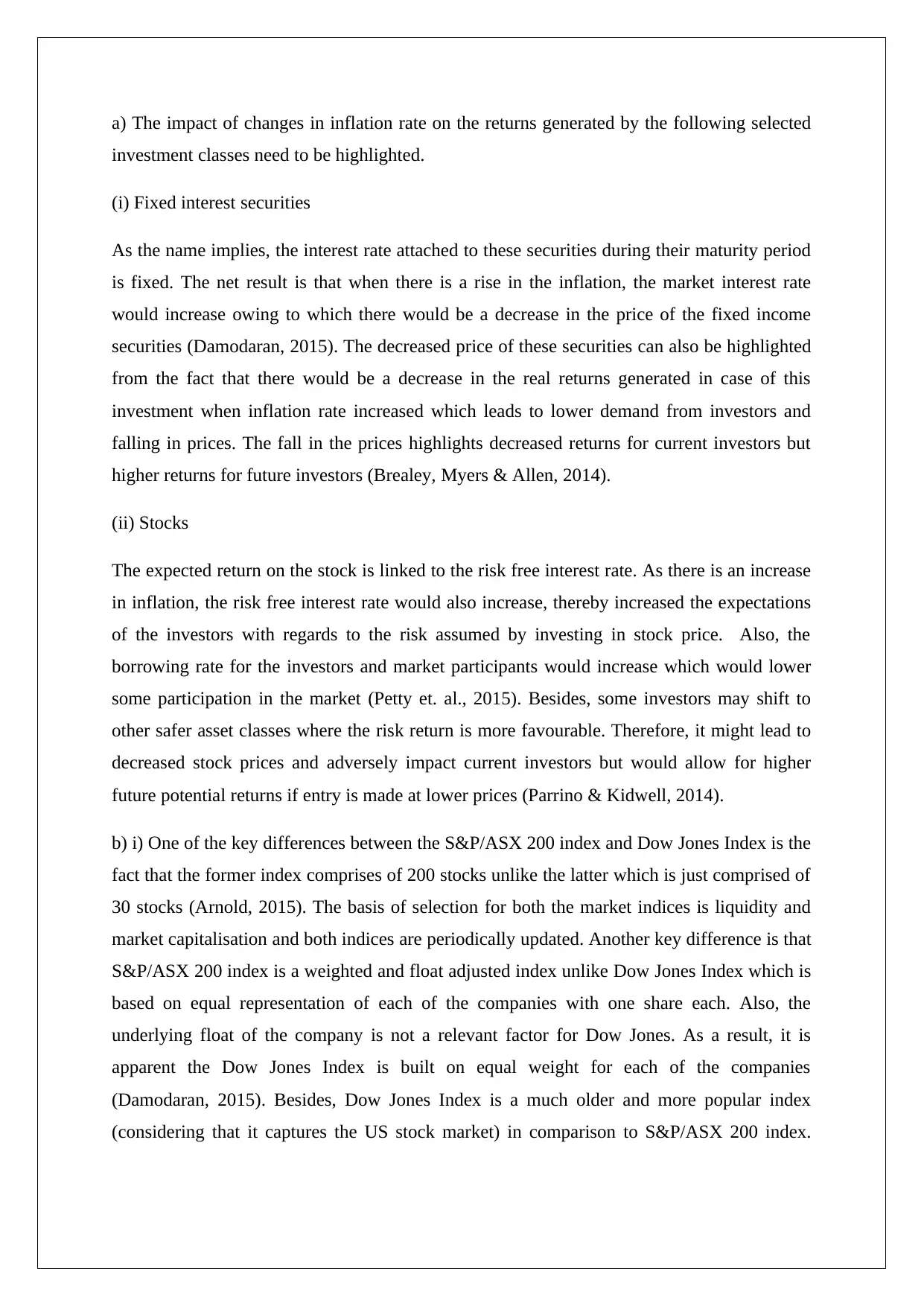
a) The impact of changes in inflation rate on the returns generated by the following selected
investment classes need to be highlighted.
(i) Fixed interest securities
As the name implies, the interest rate attached to these securities during their maturity period
is fixed. The net result is that when there is a rise in the inflation, the market interest rate
would increase owing to which there would be a decrease in the price of the fixed income
securities (Damodaran, 2015). The decreased price of these securities can also be highlighted
from the fact that there would be a decrease in the real returns generated in case of this
investment when inflation rate increased which leads to lower demand from investors and
falling in prices. The fall in the prices highlights decreased returns for current investors but
higher returns for future investors (Brealey, Myers & Allen, 2014).
(ii) Stocks
The expected return on the stock is linked to the risk free interest rate. As there is an increase
in inflation, the risk free interest rate would also increase, thereby increased the expectations
of the investors with regards to the risk assumed by investing in stock price. Also, the
borrowing rate for the investors and market participants would increase which would lower
some participation in the market (Petty et. al., 2015). Besides, some investors may shift to
other safer asset classes where the risk return is more favourable. Therefore, it might lead to
decreased stock prices and adversely impact current investors but would allow for higher
future potential returns if entry is made at lower prices (Parrino & Kidwell, 2014).
b) i) One of the key differences between the S&P/ASX 200 index and Dow Jones Index is the
fact that the former index comprises of 200 stocks unlike the latter which is just comprised of
30 stocks (Arnold, 2015). The basis of selection for both the market indices is liquidity and
market capitalisation and both indices are periodically updated. Another key difference is that
S&P/ASX 200 index is a weighted and float adjusted index unlike Dow Jones Index which is
based on equal representation of each of the companies with one share each. Also, the
underlying float of the company is not a relevant factor for Dow Jones. As a result, it is
apparent the Dow Jones Index is built on equal weight for each of the companies
(Damodaran, 2015). Besides, Dow Jones Index is a much older and more popular index
(considering that it captures the US stock market) in comparison to S&P/ASX 200 index.
Document Page
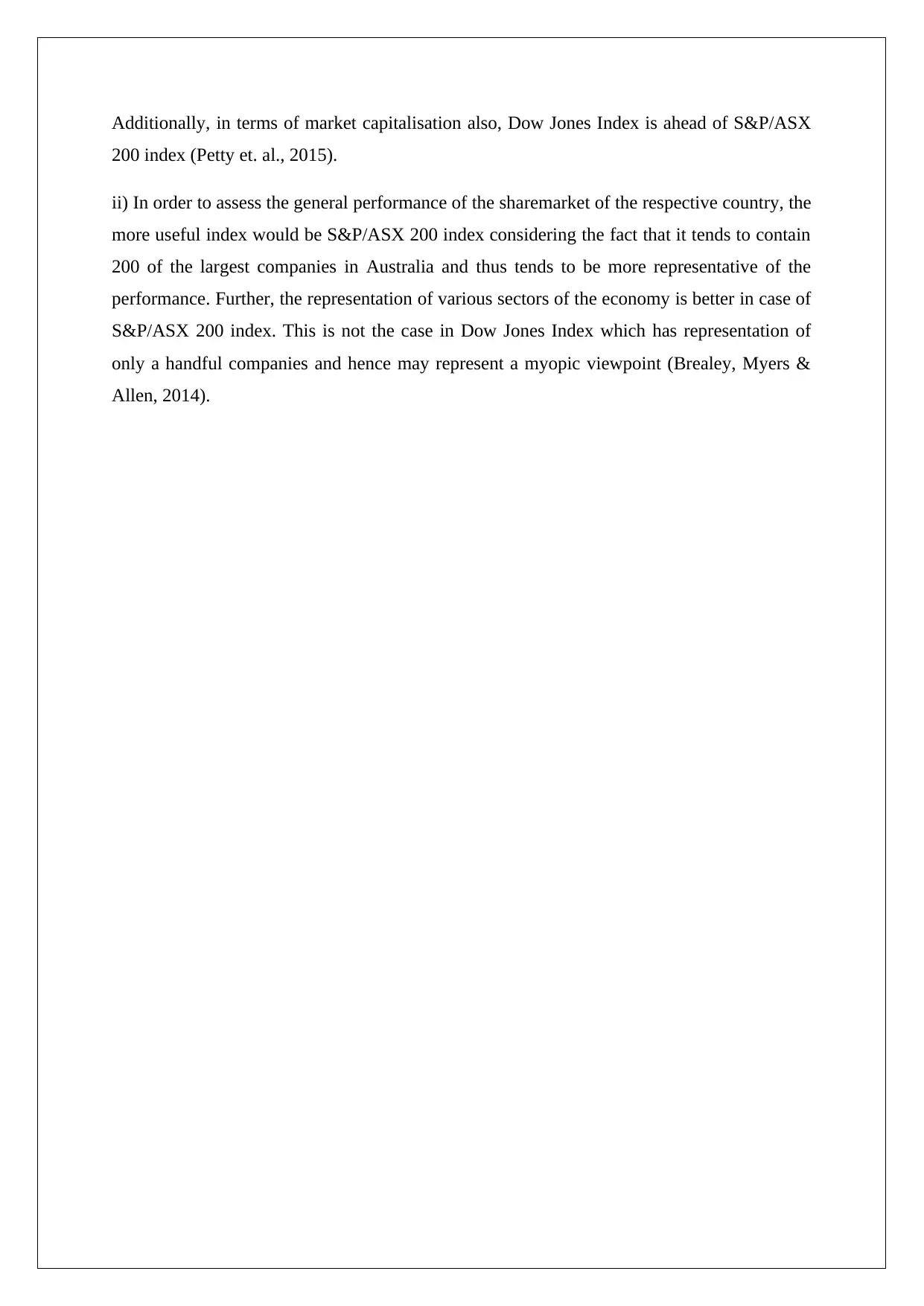
Additionally, in terms of market capitalisation also, Dow Jones Index is ahead of S&P/ASX
200 index (Petty et. al., 2015).
ii) In order to assess the general performance of the sharemarket of the respective country, the
more useful index would be S&P/ASX 200 index considering the fact that it tends to contain
200 of the largest companies in Australia and thus tends to be more representative of the
performance. Further, the representation of various sectors of the economy is better in case of
S&P/ASX 200 index. This is not the case in Dow Jones Index which has representation of
only a handful companies and hence may represent a myopic viewpoint (Brealey, Myers &
Allen, 2014).
Document Page
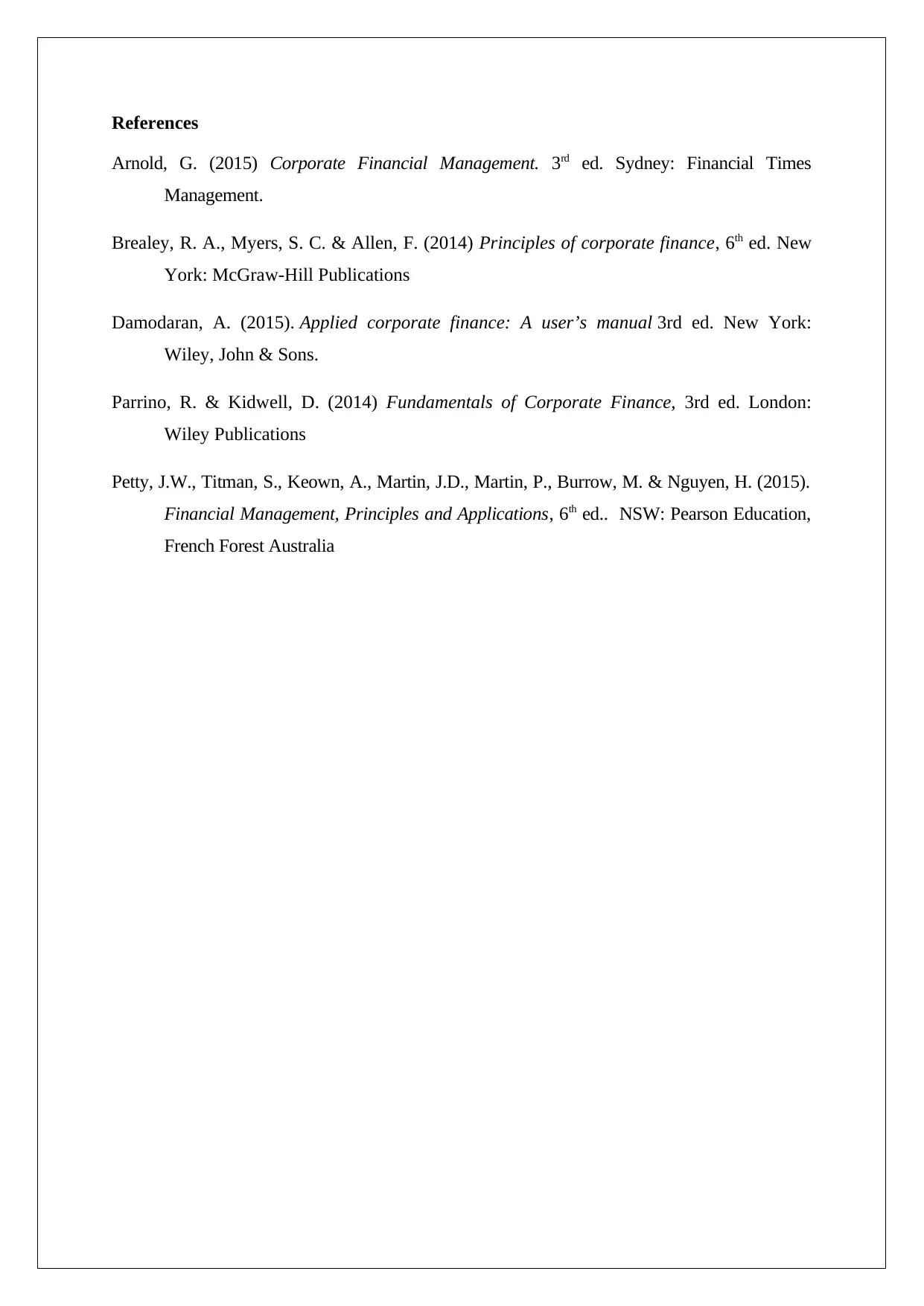
References
Arnold, G. (2015) Corporate Financial Management. 3rd ed. Sydney: Financial Times
Management.
Brealey, R. A., Myers, S. C. & Allen, F. (2014) Principles of corporate finance, 6th ed. New
York: McGraw-Hill Publications
Damodaran, A. (2015). Applied corporate finance: A user’s manual 3rd ed. New York:
Wiley, John & Sons.
Parrino, R. & Kidwell, D. (2014) Fundamentals of Corporate Finance, 3rd ed. London:
Wiley Publications
Petty, J.W., Titman, S., Keown, A., Martin, J.D., Martin, P., Burrow, M. & Nguyen, H. (2015).
Financial Management, Principles and Applications, 6th ed.. NSW: Pearson Education,
French Forest Australia
chevron_up_icon
1 out of 4
circle_padding
hide_on_mobile
zoom_out_icon
[object Object]