Principles of Finance Homework: Cash Flows, Ratios, and Valuation
VerifiedAdded on 2022/12/15
|19
|3559
|200
Homework Assignment
AI Summary
This finance homework assignment provides detailed solutions to various problems covering key finance principles. Activity 1 focuses on cash flow analysis, calculating accounting profit and financial cash flow for a rug importer, and assessing the company's financial success. Activity 2 delves into capital gains, taxable income calculations, and the application of corporate tax rates. Activity 3 presents an income statement analysis, ratio calculations (liquidity, activity, debt, and profitability), and balance sheet preparation. Activity 4 explores depreciation and cash flow calculations, determining operating cash flows and discussing their significance. Activity 5 addresses future value calculations related to inflation and car prices. Finally, a lottery claim present value calculation is included, assessing the minimum selling price based on different rates of return.
Principles of finance

Paraphrase This Document
Need a fresh take? Get an instant paraphrase of this document with our AI Paraphraser

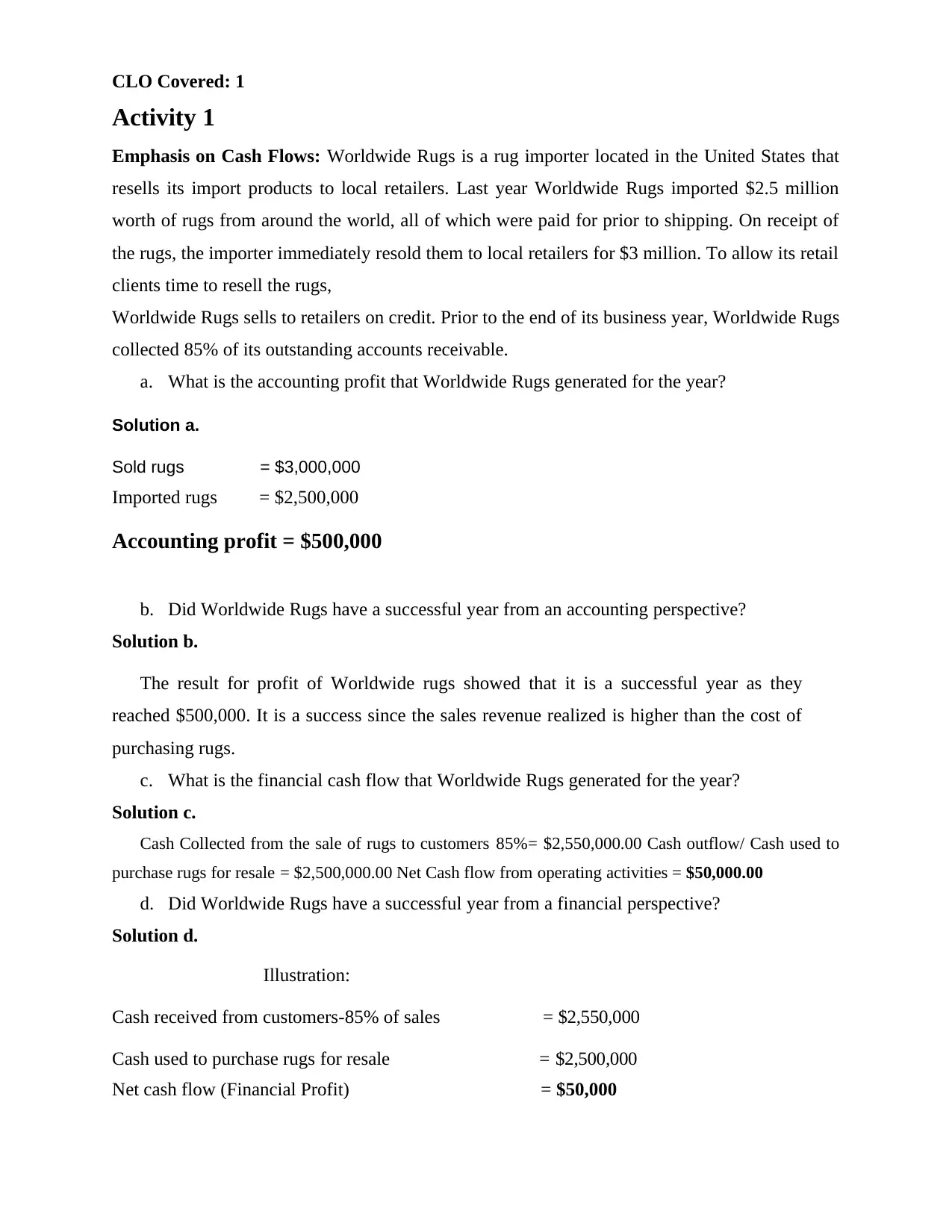
CLO Covered: 1
Activity 1
Emphasis on Cash Flows: Worldwide Rugs is a rug importer located in the United States that
resells its import products to local retailers. Last year Worldwide Rugs imported $2.5 million
worth of rugs from around the world, all of which were paid for prior to shipping. On receipt of
the rugs, the importer immediately resold them to local retailers for $3 million. To allow its retail
clients time to resell the rugs,
Worldwide Rugs sells to retailers on credit. Prior to the end of its business year, Worldwide Rugs
collected 85% of its outstanding accounts receivable.
a. What is the accounting profit that Worldwide Rugs generated for the year?
Solution a.
Sold rugs = $3,000,000
Imported rugs = $2,500,000
Accounting profit = $500,000
b. Did Worldwide Rugs have a successful year from an accounting perspective?
Solution b.
The result for profit of Worldwide rugs showed that it is a successful year as they
reached $500,000. It is a success since the sales revenue realized is higher than the cost of
purchasing rugs.
c. What is the financial cash flow that Worldwide Rugs generated for the year?
Solution c.
Cash Collected from the sale of rugs to customers 85%= $2,550,000.00 Cash outflow/ Cash used to
purchase rugs for resale = $2,500,000.00 Net Cash flow from operating activities = $50,000.00
d. Did Worldwide Rugs have a successful year from a financial perspective?
Solution d.
Illustration:
Cash received from customers-85% of sales = $2,550,000
Cash used to purchase rugs for resale = $2,500,000
Net cash flow (Financial Profit) = $50,000
Activity 1
Emphasis on Cash Flows: Worldwide Rugs is a rug importer located in the United States that
resells its import products to local retailers. Last year Worldwide Rugs imported $2.5 million
worth of rugs from around the world, all of which were paid for prior to shipping. On receipt of
the rugs, the importer immediately resold them to local retailers for $3 million. To allow its retail
clients time to resell the rugs,
Worldwide Rugs sells to retailers on credit. Prior to the end of its business year, Worldwide Rugs
collected 85% of its outstanding accounts receivable.
a. What is the accounting profit that Worldwide Rugs generated for the year?
Solution a.
Sold rugs = $3,000,000
Imported rugs = $2,500,000
Accounting profit = $500,000
b. Did Worldwide Rugs have a successful year from an accounting perspective?
Solution b.
The result for profit of Worldwide rugs showed that it is a successful year as they
reached $500,000. It is a success since the sales revenue realized is higher than the cost of
purchasing rugs.
c. What is the financial cash flow that Worldwide Rugs generated for the year?
Solution c.
Cash Collected from the sale of rugs to customers 85%= $2,550,000.00 Cash outflow/ Cash used to
purchase rugs for resale = $2,500,000.00 Net Cash flow from operating activities = $50,000.00
d. Did Worldwide Rugs have a successful year from a financial perspective?
Solution d.
Illustration:
Cash received from customers-85% of sales = $2,550,000
Cash used to purchase rugs for resale = $2,500,000
Net cash flow (Financial Profit) = $50,000
⊘ This is a preview!⊘
Do you want full access?
Subscribe today to unlock all pages.

Trusted by 1+ million students worldwide
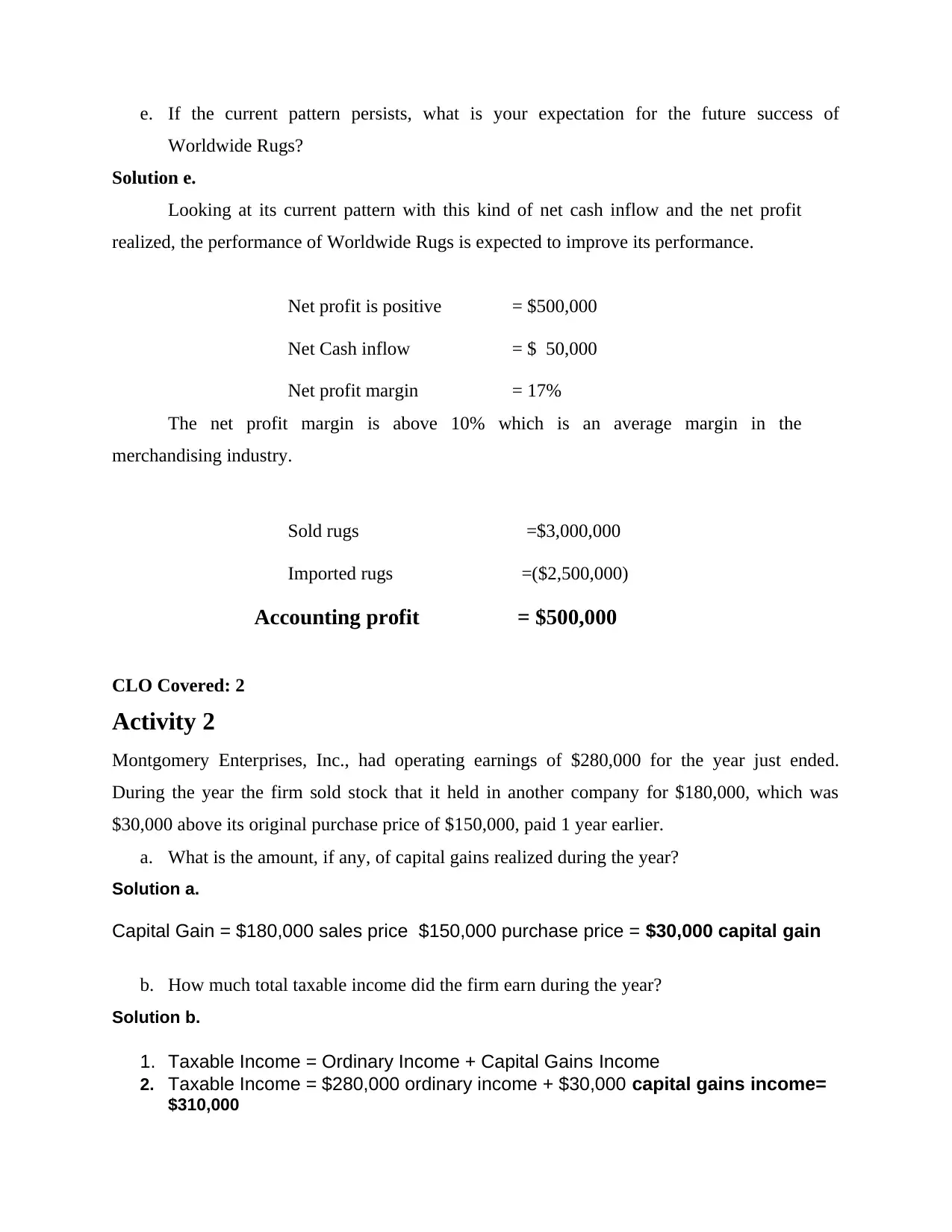
e. If the current pattern persists, what is your expectation for the future success of
Worldwide Rugs?
Solution e.
Looking at its current pattern with this kind of net cash inflow and the net profit
realized, the performance of Worldwide Rugs is expected to improve its performance.
Net profit is positive = $500,000
Net Cash inflow = $ 50,000
Net profit margin = 17%
The net profit margin is above 10% which is an average margin in the
merchandising industry.
Sold rugs =$3,000,000
Imported rugs =($2,500,000)
Accounting profit = $500,000
CLO Covered: 2
Activity 2
Montgomery Enterprises, Inc., had operating earnings of $280,000 for the year just ended.
During the year the firm sold stock that it held in another company for $180,000, which was
$30,000 above its original purchase price of $150,000, paid 1 year earlier.
a. What is the amount, if any, of capital gains realized during the year?
Solution a.
Capital Gain = $180,000 sales price $150,000 purchase price = $30,000 capital gain
b. How much total taxable income did the firm earn during the year?
Solution b.
1. Taxable Income = Ordinary Income + Capital Gains Income
2. Taxable Income = $280,000 ordinary income + $30,000 capital gains income=
$310,000
Worldwide Rugs?
Solution e.
Looking at its current pattern with this kind of net cash inflow and the net profit
realized, the performance of Worldwide Rugs is expected to improve its performance.
Net profit is positive = $500,000
Net Cash inflow = $ 50,000
Net profit margin = 17%
The net profit margin is above 10% which is an average margin in the
merchandising industry.
Sold rugs =$3,000,000
Imported rugs =($2,500,000)
Accounting profit = $500,000
CLO Covered: 2
Activity 2
Montgomery Enterprises, Inc., had operating earnings of $280,000 for the year just ended.
During the year the firm sold stock that it held in another company for $180,000, which was
$30,000 above its original purchase price of $150,000, paid 1 year earlier.
a. What is the amount, if any, of capital gains realized during the year?
Solution a.
Capital Gain = $180,000 sales price $150,000 purchase price = $30,000 capital gain
b. How much total taxable income did the firm earn during the year?
Solution b.
1. Taxable Income = Ordinary Income + Capital Gains Income
2. Taxable Income = $280,000 ordinary income + $30,000 capital gains income=
$310,000
Paraphrase This Document
Need a fresh take? Get an instant paraphrase of this document with our AI Paraphraser
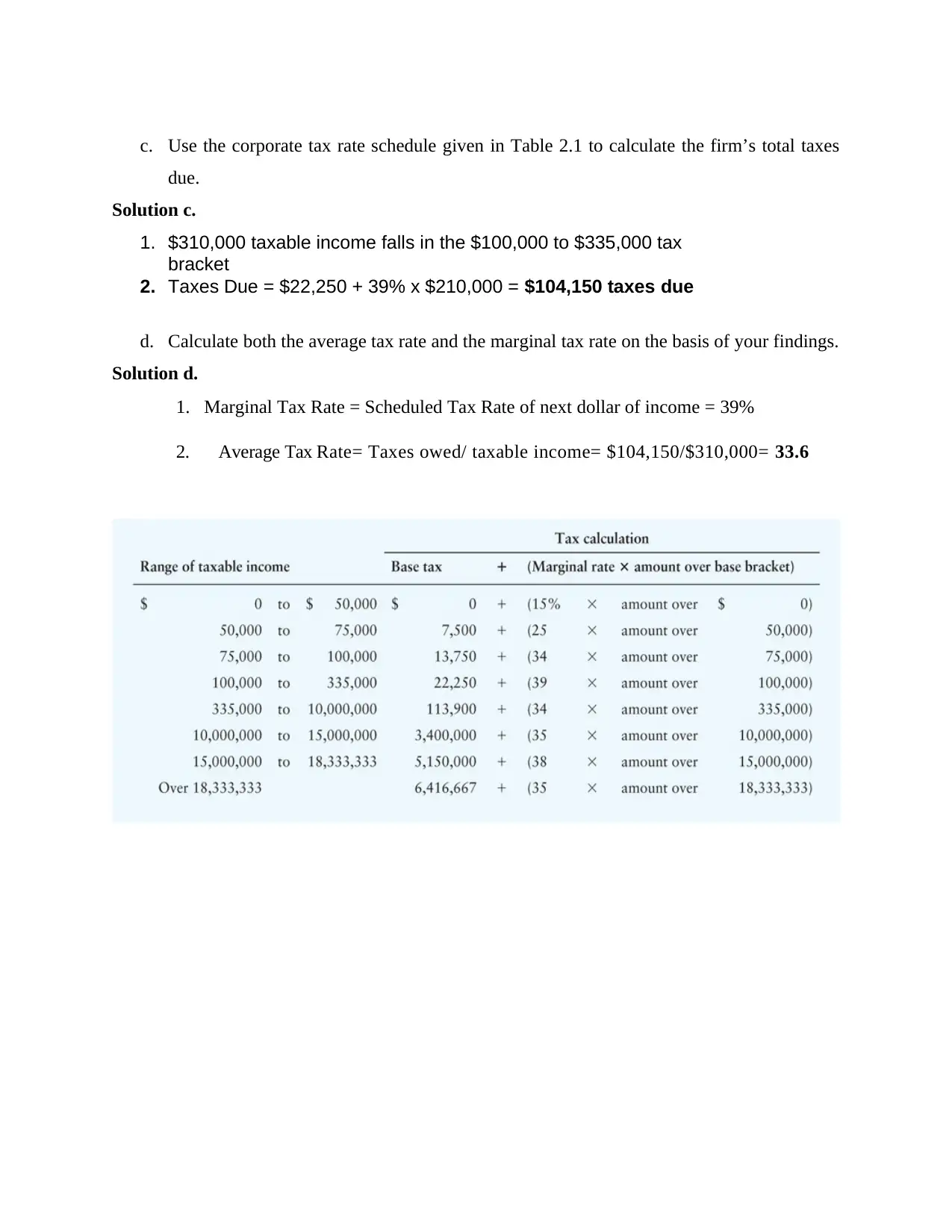
c. Use the corporate tax rate schedule given in Table 2.1 to calculate the firm’s total taxes
due.
Solution c.
1. $310,000 taxable income falls in the $100,000 to $335,000 tax
bracket
2. Taxes Due = $22,250 + 39% x $210,000 = $104,150 taxes due
d. Calculate both the average tax rate and the marginal tax rate on the basis of your findings.
Solution d.
1. Marginal Tax Rate = Scheduled Tax Rate of next dollar of income = 39%
2. Average Tax Rate= Taxes owed/ taxable income= $104,150/$310,000= 33.6
due.
Solution c.
1. $310,000 taxable income falls in the $100,000 to $335,000 tax
bracket
2. Taxes Due = $22,250 + 39% x $210,000 = $104,150 taxes due
d. Calculate both the average tax rate and the marginal tax rate on the basis of your findings.
Solution d.
1. Marginal Tax Rate = Scheduled Tax Rate of next dollar of income = 39%
2. Average Tax Rate= Taxes owed/ taxable income= $104,150/$310,000= 33.6
CLO Covered: 3
Activity 3 (a.)
All values ($000):
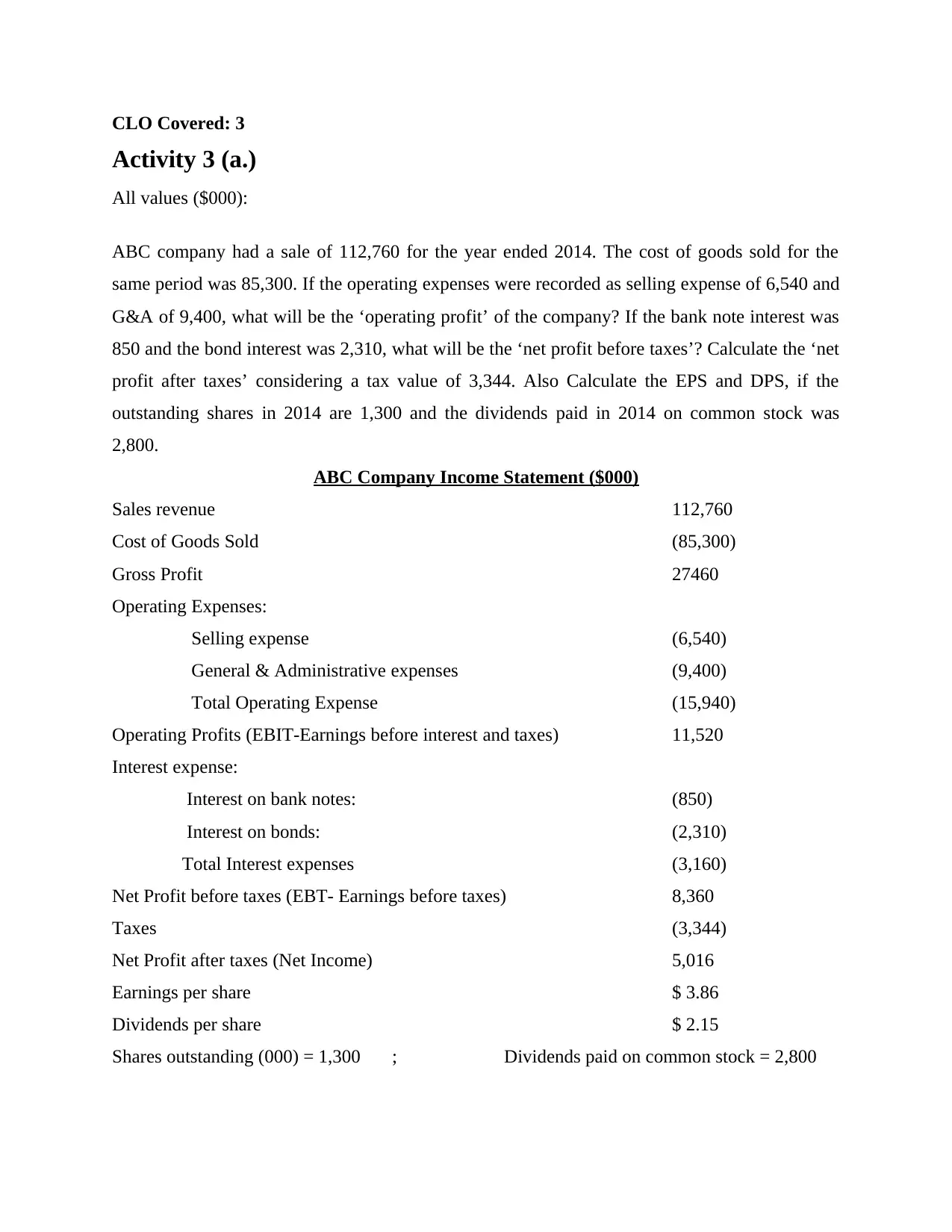
ABC company had a sale of 112,760 for the year ended 2014. The cost of goods sold for the
same period was 85,300. If the operating expenses were recorded as selling expense of 6,540 and
G&A of 9,400, what will be the ‘operating profit’ of the company? If the bank note interest was
850 and the bond interest was 2,310, what will be the ‘net profit before taxes’? Calculate the ‘net
profit after taxes’ considering a tax value of 3,344. Also Calculate the EPS and DPS, if the
outstanding shares in 2014 are 1,300 and the dividends paid in 2014 on common stock was
2,800.
ABC Company Income Statement ($000)
Sales revenue 112,760
Cost of Goods Sold (85,300)
Gross Profit 27460
Operating Expenses:
Selling expense (6,540)
General & Administrative expenses (9,400)
Total Operating Expense (15,940)
Operating Profits (EBIT-Earnings before interest and taxes) 11,520
Interest expense:
Interest on bank notes: (850)
Interest on bonds: (2,310)
Total Interest expenses (3,160)
Net Profit before taxes (EBT- Earnings before taxes) 8,360
Taxes (3,344)
Net Profit after taxes (Net Income) 5,016
Earnings per share $ 3.86
Dividends per share $ 2.15
Shares outstanding (000) = 1,300 ; Dividends paid on common stock = 2,800
Activity 3 (a.)
All values ($000):
ABC company had a sale of 112,760 for the year ended 2014. The cost of goods sold for the
same period was 85,300. If the operating expenses were recorded as selling expense of 6,540 and
G&A of 9,400, what will be the ‘operating profit’ of the company? If the bank note interest was
850 and the bond interest was 2,310, what will be the ‘net profit before taxes’? Calculate the ‘net
profit after taxes’ considering a tax value of 3,344. Also Calculate the EPS and DPS, if the
outstanding shares in 2014 are 1,300 and the dividends paid in 2014 on common stock was
2,800.
ABC Company Income Statement ($000)
Sales revenue 112,760
Cost of Goods Sold (85,300)
Gross Profit 27460
Operating Expenses:
Selling expense (6,540)
General & Administrative expenses (9,400)
Total Operating Expense (15,940)
Operating Profits (EBIT-Earnings before interest and taxes) 11,520
Interest expense:
Interest on bank notes: (850)
Interest on bonds: (2,310)
Total Interest expenses (3,160)
Net Profit before taxes (EBT- Earnings before taxes) 8,360
Taxes (3,344)
Net Profit after taxes (Net Income) 5,016
Earnings per share $ 3.86
Dividends per share $ 2.15
Shares outstanding (000) = 1,300 ; Dividends paid on common stock = 2,800
⊘ This is a preview!⊘
Do you want full access?
Subscribe today to unlock all pages.
Trusted by 1+ million students worldwide
CLO Covered: 3
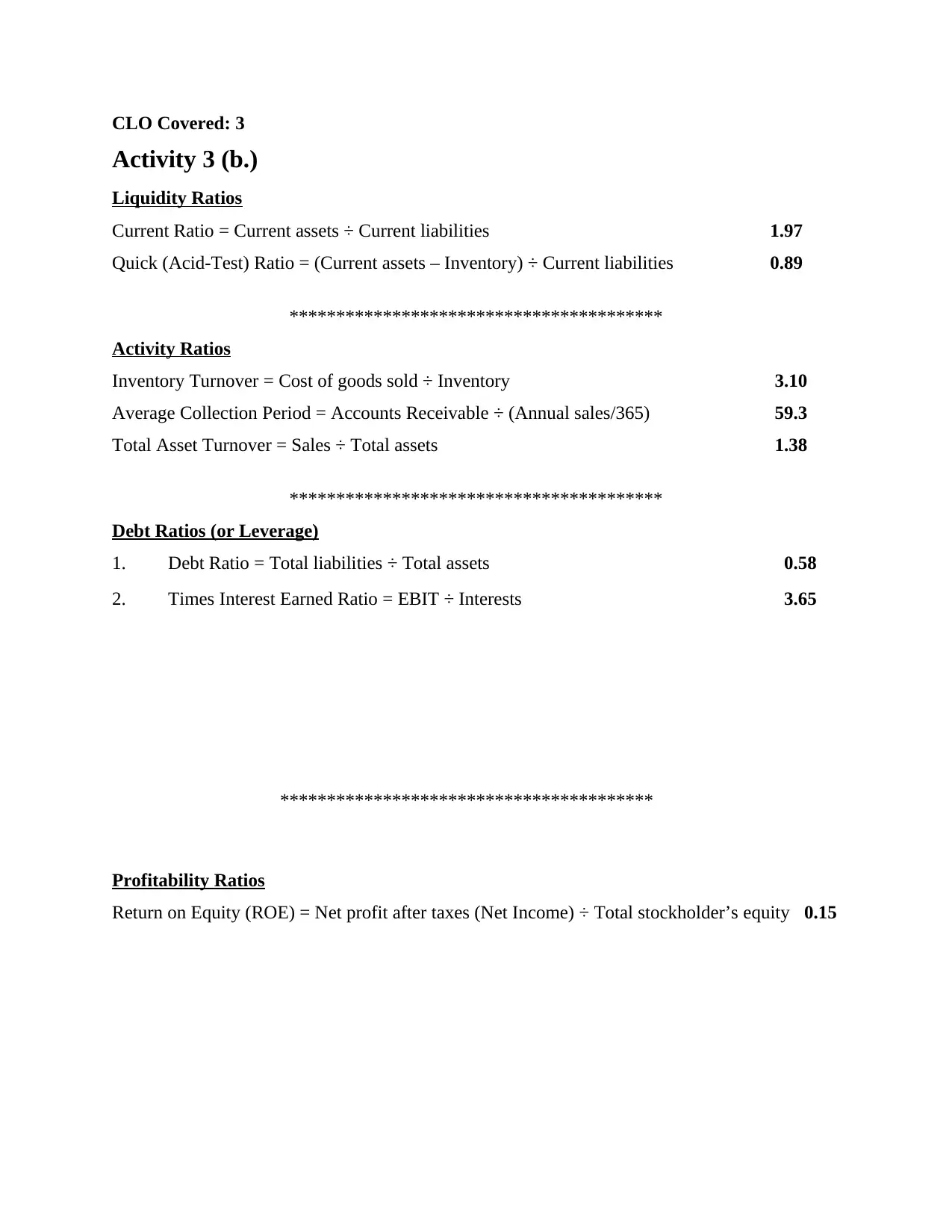
Activity 3 (b.)
Liquidity Ratios
Current Ratio = Current assets ÷ Current liabilities 1.97
Quick (Acid-Test) Ratio = (Current assets – Inventory) ÷ Current liabilities 0.89
****************************************
Activity Ratios
Inventory Turnover = Cost of goods sold ÷ Inventory 3.10
Average Collection Period = Accounts Receivable ÷ (Annual sales/365) 59.3
Total Asset Turnover = Sales ÷ Total assets 1.38
****************************************
Debt Ratios (or Leverage)
1. Debt Ratio = Total liabilities ÷ Total assets 0.58
2. Times Interest Earned Ratio = EBIT ÷ Interests 3.65
****************************************
Profitability Ratios
Return on Equity (ROE) = Net profit after taxes (Net Income) ÷ Total stockholder’s equity 0.15
Activity 3 (b.)
Liquidity Ratios
Current Ratio = Current assets ÷ Current liabilities 1.97
Quick (Acid-Test) Ratio = (Current assets – Inventory) ÷ Current liabilities 0.89
****************************************
Activity Ratios
Inventory Turnover = Cost of goods sold ÷ Inventory 3.10
Average Collection Period = Accounts Receivable ÷ (Annual sales/365) 59.3
Total Asset Turnover = Sales ÷ Total assets 1.38
****************************************
Debt Ratios (or Leverage)
1. Debt Ratio = Total liabilities ÷ Total assets 0.58
2. Times Interest Earned Ratio = EBIT ÷ Interests 3.65
****************************************
Profitability Ratios
Return on Equity (ROE) = Net profit after taxes (Net Income) ÷ Total stockholder’s equity 0.15
Paraphrase This Document
Need a fresh take? Get an instant paraphrase of this document with our AI Paraphraser
****************************************
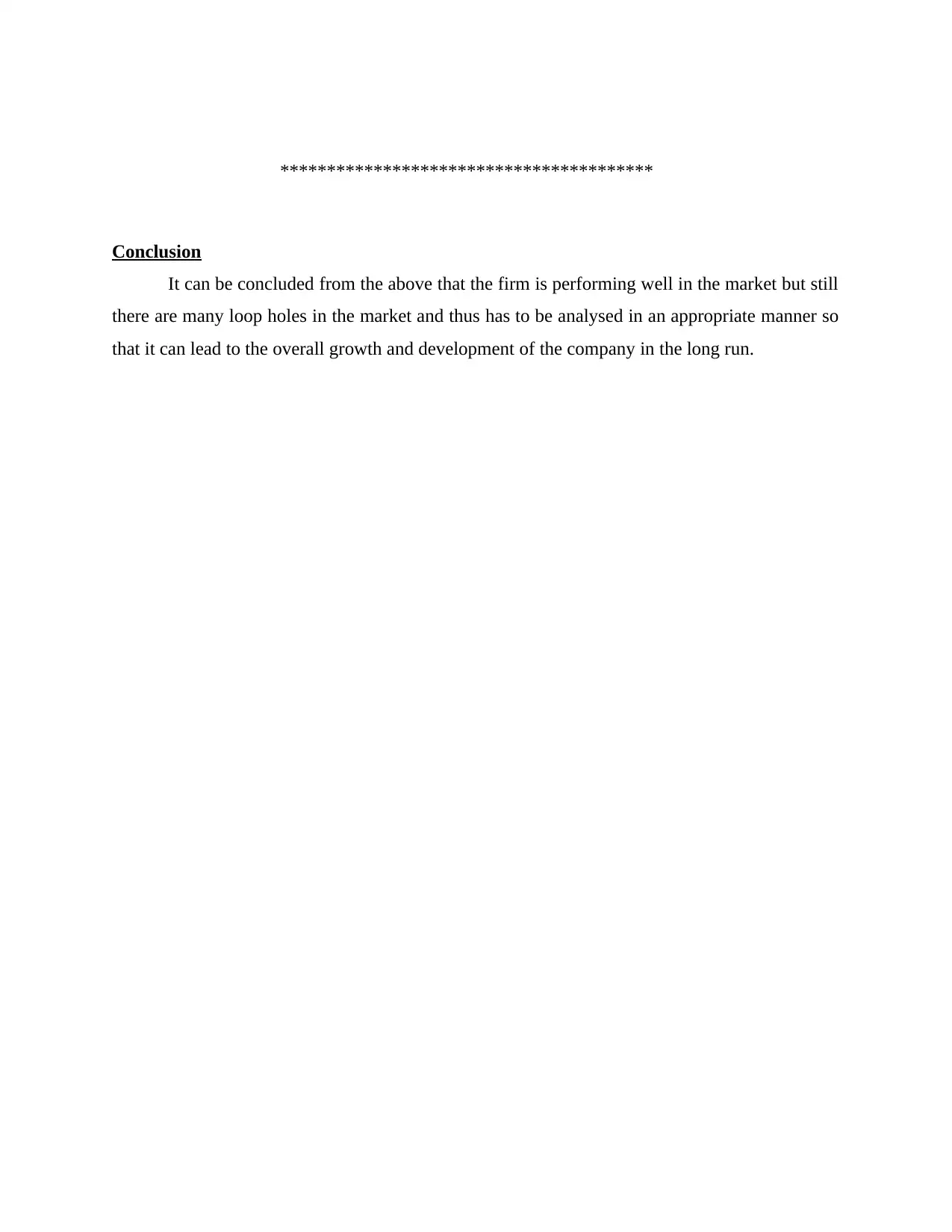
Conclusion
It can be concluded from the above that the firm is performing well in the market but still
there are many loop holes in the market and thus has to be analysed in an appropriate manner so
that it can lead to the overall growth and development of the company in the long run.
Conclusion
It can be concluded from the above that the firm is performing well in the market but still
there are many loop holes in the market and thus has to be analysed in an appropriate manner so
that it can lead to the overall growth and development of the company in the long run.
CLO Covered: 3
Activity 3 (c.)
All values ($000):
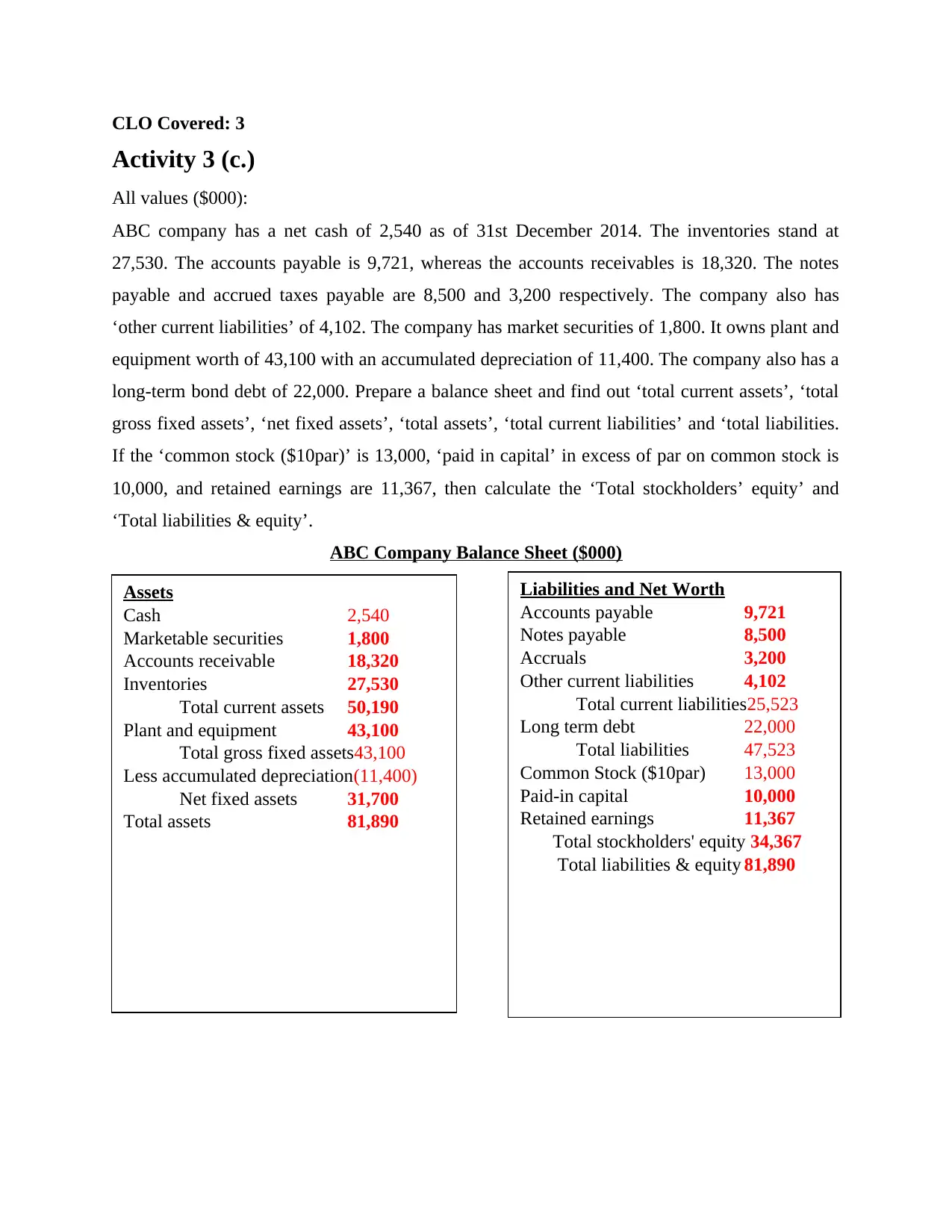
ABC company has a net cash of 2,540 as of 31st December 2014. The inventories stand at
27,530. The accounts payable is 9,721, whereas the accounts receivables is 18,320. The notes
payable and accrued taxes payable are 8,500 and 3,200 respectively. The company also has
‘other current liabilities’ of 4,102. The company has market securities of 1,800. It owns plant and
equipment worth of 43,100 with an accumulated depreciation of 11,400. The company also has a
long-term bond debt of 22,000. Prepare a balance sheet and find out ‘total current assets’, ‘total
gross fixed assets’, ‘net fixed assets’, ‘total assets’, ‘total current liabilities’ and ‘total liabilities.
If the ‘common stock ($10par)’ is 13,000, ‘paid in capital’ in excess of par on common stock is
10,000, and retained earnings are 11,367, then calculate the ‘Total stockholders’ equity’ and
‘Total liabilities & equity’.
ABC Company Balance Sheet ($000)
Assets
Cash 2,540
Marketable securities 1,800
Accounts receivable 18,320
Inventories 27,530
Total current assets 50,190
Plant and equipment 43,100
Total gross fixed assets43,100
Less accumulated depreciation(11,400)
Net fixed assets 31,700
Total assets 81,890
Liabilities and Net Worth
Accounts payable 9,721
Notes payable 8,500
Accruals 3,200
Other current liabilities 4,102
Total current liabilities25,523
Long term debt 22,000
Total liabilities 47,523
Common Stock ($10par) 13,000
Paid-in capital 10,000
Retained earnings 11,367
Total stockholders' equity 34,367
Total liabilities & equity 81,890
Activity 3 (c.)
All values ($000):
ABC company has a net cash of 2,540 as of 31st December 2014. The inventories stand at
27,530. The accounts payable is 9,721, whereas the accounts receivables is 18,320. The notes
payable and accrued taxes payable are 8,500 and 3,200 respectively. The company also has
‘other current liabilities’ of 4,102. The company has market securities of 1,800. It owns plant and
equipment worth of 43,100 with an accumulated depreciation of 11,400. The company also has a
long-term bond debt of 22,000. Prepare a balance sheet and find out ‘total current assets’, ‘total
gross fixed assets’, ‘net fixed assets’, ‘total assets’, ‘total current liabilities’ and ‘total liabilities.
If the ‘common stock ($10par)’ is 13,000, ‘paid in capital’ in excess of par on common stock is
10,000, and retained earnings are 11,367, then calculate the ‘Total stockholders’ equity’ and
‘Total liabilities & equity’.
ABC Company Balance Sheet ($000)
Assets
Cash 2,540
Marketable securities 1,800
Accounts receivable 18,320
Inventories 27,530
Total current assets 50,190
Plant and equipment 43,100
Total gross fixed assets43,100
Less accumulated depreciation(11,400)
Net fixed assets 31,700
Total assets 81,890
Liabilities and Net Worth
Accounts payable 9,721
Notes payable 8,500
Accruals 3,200
Other current liabilities 4,102
Total current liabilities25,523
Long term debt 22,000
Total liabilities 47,523
Common Stock ($10par) 13,000
Paid-in capital 10,000
Retained earnings 11,367
Total stockholders' equity 34,367
Total liabilities & equity 81,890
⊘ This is a preview!⊘
Do you want full access?
Subscribe today to unlock all pages.
Trusted by 1+ million students worldwide
CLO Covered: 4
Activity 4
Depreciation and Cash Flow Question
A firm expects to have earnings before interest and taxes (EBIT) of $160,000 in each of the next
6 years. It pays annual interest of $15,000. The firm is considering the purchase of an asset that
costs $140,000, requires $10,000 in installation cost, and has a recovery period of 5 years. It will
be the firm’s only asset, and the asset’s depreciation is already reflected in its EBIT estimates.
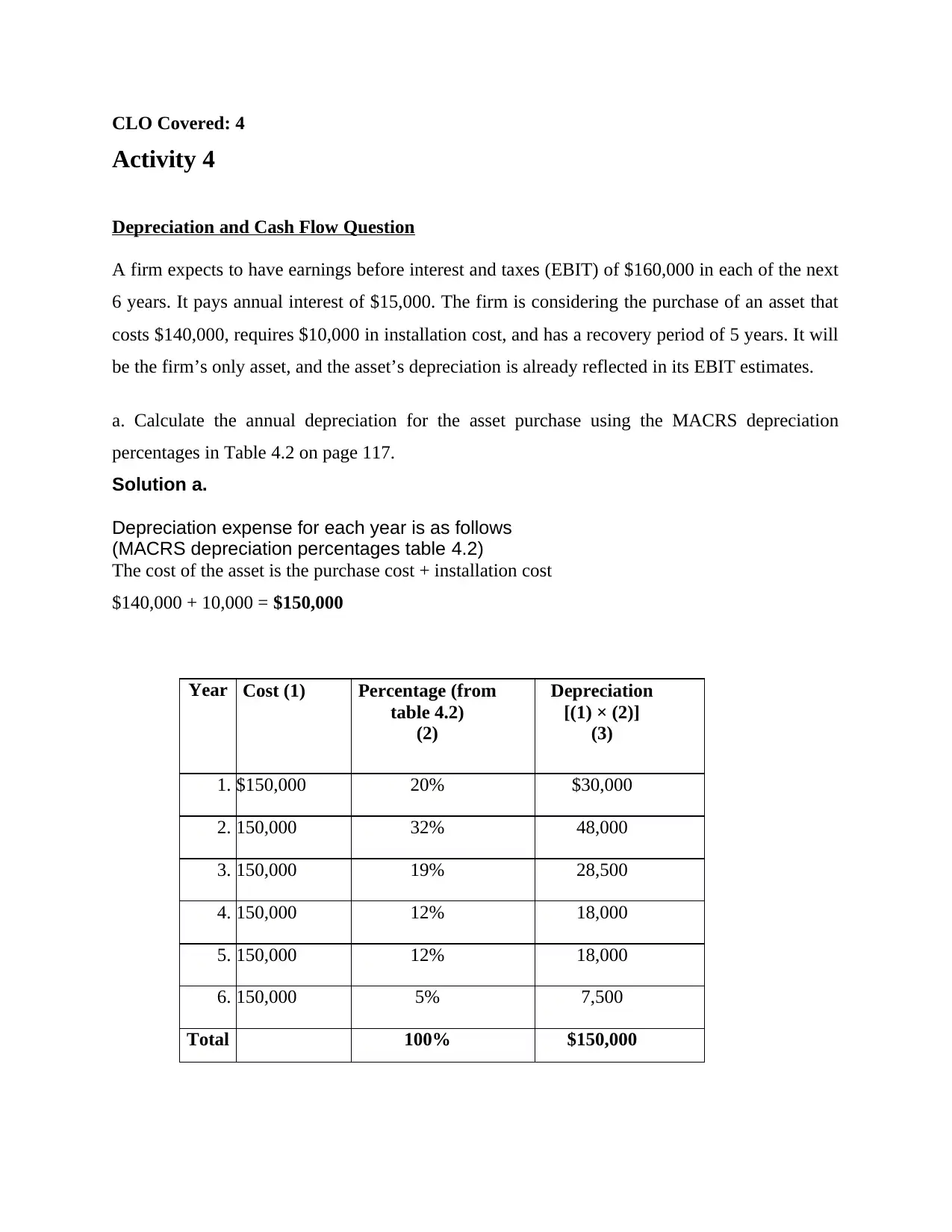
a. Calculate the annual depreciation for the asset purchase using the MACRS depreciation
percentages in Table 4.2 on page 117.
Solution a.
Depreciation expense for each year is as follows
(MACRS depreciation percentages table 4.2)
The cost of the asset is the purchase cost + installation cost
$140,000 + 10,000 = $150,000
Year Cost (1) Percentage (from
table 4.2)
(2)
Depreciation
[(1) × (2)]
(3)
1. $150,000 20% $30,000
2. 150,000 32% 48,000
3. 150,000 19% 28,500
4. 150,000 12% 18,000
5. 150,000 12% 18,000
6. 150,000 5% 7,500
Total 100% $150,000
Activity 4
Depreciation and Cash Flow Question
A firm expects to have earnings before interest and taxes (EBIT) of $160,000 in each of the next
6 years. It pays annual interest of $15,000. The firm is considering the purchase of an asset that
costs $140,000, requires $10,000 in installation cost, and has a recovery period of 5 years. It will
be the firm’s only asset, and the asset’s depreciation is already reflected in its EBIT estimates.
a. Calculate the annual depreciation for the asset purchase using the MACRS depreciation
percentages in Table 4.2 on page 117.
Solution a.
Depreciation expense for each year is as follows
(MACRS depreciation percentages table 4.2)
The cost of the asset is the purchase cost + installation cost
$140,000 + 10,000 = $150,000
Year Cost (1) Percentage (from
table 4.2)
(2)
Depreciation
[(1) × (2)]
(3)
1. $150,000 20% $30,000
2. 150,000 32% 48,000
3. 150,000 19% 28,500
4. 150,000 12% 18,000
5. 150,000 12% 18,000
6. 150,000 5% 7,500
Total 100% $150,000
Paraphrase This Document
Need a fresh take? Get an instant paraphrase of this document with our AI Paraphraser
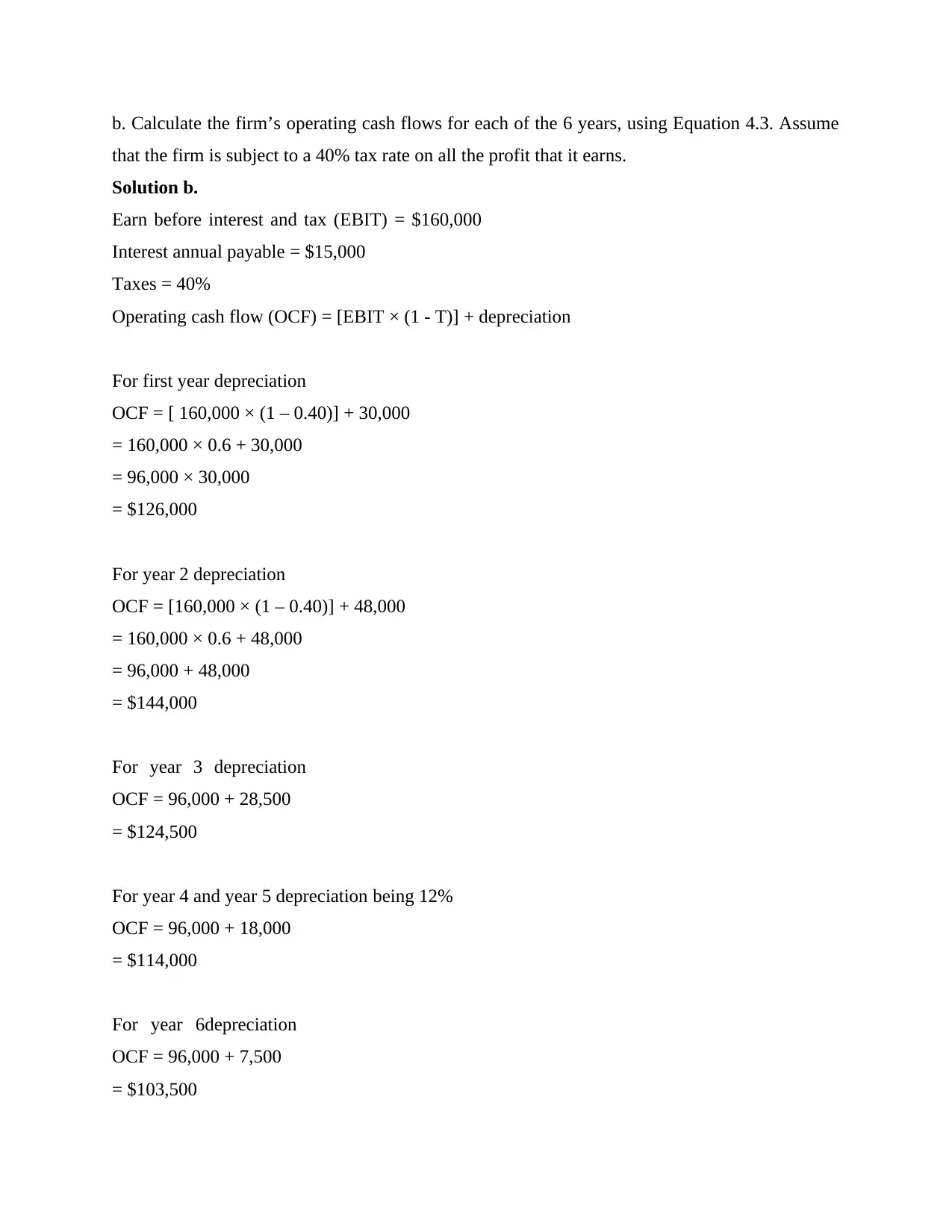
b. Calculate the firm’s operating cash flows for each of the 6 years, using Equation 4.3. Assume
that the firm is subject to a 40% tax rate on all the profit that it earns.
Solution b.
Earn before interest and tax (EBIT) = $160,000
Interest annual payable = $15,000
Taxes = 40%
Operating cash flow (OCF) = [EBIT × (1 - T)] + depreciation
For first year depreciation
OCF = [ 160,000 × (1 – 0.40)] + 30,000
= 160,000 × 0.6 + 30,000
= 96,000 × 30,000
= $126,000
For year 2 depreciation
OCF = [160,000 × (1 – 0.40)] + 48,000
= 160,000 × 0.6 + 48,000
= 96,000 + 48,000
= $144,000
For year 3 depreciation
OCF = 96,000 + 28,500
= $124,500
For year 4 and year 5 depreciation being 12%
OCF = 96,000 + 18,000
= $114,000
For year 6depreciation
OCF = 96,000 + 7,500
= $103,500
that the firm is subject to a 40% tax rate on all the profit that it earns.
Solution b.
Earn before interest and tax (EBIT) = $160,000
Interest annual payable = $15,000
Taxes = 40%
Operating cash flow (OCF) = [EBIT × (1 - T)] + depreciation
For first year depreciation
OCF = [ 160,000 × (1 – 0.40)] + 30,000
= 160,000 × 0.6 + 30,000
= 96,000 × 30,000
= $126,000
For year 2 depreciation
OCF = [160,000 × (1 – 0.40)] + 48,000
= 160,000 × 0.6 + 48,000
= 96,000 + 48,000
= $144,000
For year 3 depreciation
OCF = 96,000 + 28,500
= $124,500
For year 4 and year 5 depreciation being 12%
OCF = 96,000 + 18,000
= $114,000
For year 6depreciation
OCF = 96,000 + 7,500
= $103,500
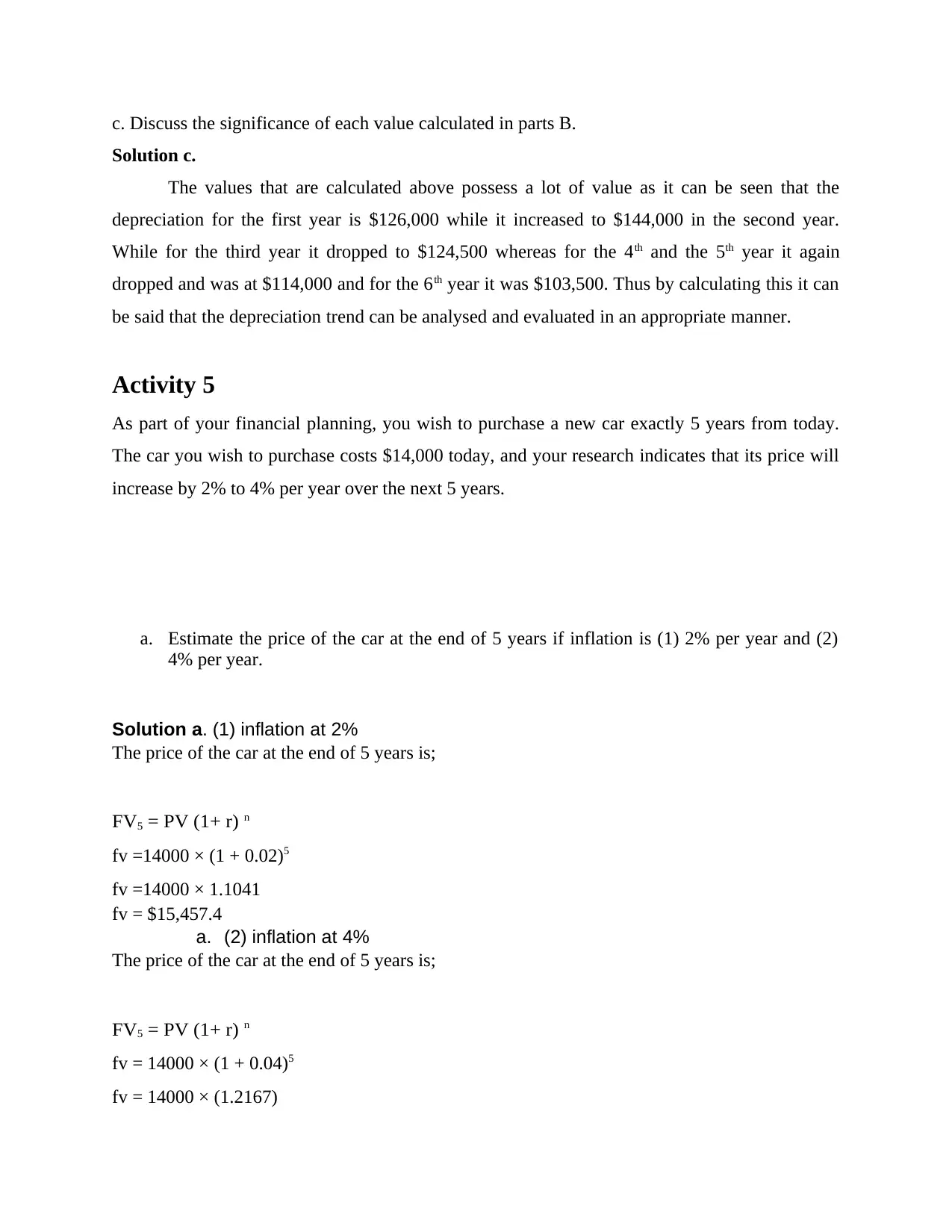
c. Discuss the significance of each value calculated in parts B.
Solution c.
The values that are calculated above possess a lot of value as it can be seen that the
depreciation for the first year is $126,000 while it increased to $144,000 in the second year.
While for the third year it dropped to $124,500 whereas for the 4th and the 5th year it again
dropped and was at $114,000 and for the 6th year it was $103,500. Thus by calculating this it can
be said that the depreciation trend can be analysed and evaluated in an appropriate manner.
Activity 5
As part of your financial planning, you wish to purchase a new car exactly 5 years from today.
The car you wish to purchase costs $14,000 today, and your research indicates that its price will
increase by 2% to 4% per year over the next 5 years.
a. Estimate the price of the car at the end of 5 years if inflation is (1) 2% per year and (2)
4% per year.
Solution a. (1) inflation at 2%
The price of the car at the end of 5 years is;
FV5 = PV (1+ r) n
fv =14000 × (1 + 0.02)5
fv =14000 × 1.1041
fv = $15,457.4
a. (2) inflation at 4%
The price of the car at the end of 5 years is;
FV5 = PV (1+ r) n
fv = 14000 × (1 + 0.04)5
fv = 14000 × (1.2167)
Solution c.
The values that are calculated above possess a lot of value as it can be seen that the
depreciation for the first year is $126,000 while it increased to $144,000 in the second year.
While for the third year it dropped to $124,500 whereas for the 4th and the 5th year it again
dropped and was at $114,000 and for the 6th year it was $103,500. Thus by calculating this it can
be said that the depreciation trend can be analysed and evaluated in an appropriate manner.
Activity 5
As part of your financial planning, you wish to purchase a new car exactly 5 years from today.
The car you wish to purchase costs $14,000 today, and your research indicates that its price will
increase by 2% to 4% per year over the next 5 years.
a. Estimate the price of the car at the end of 5 years if inflation is (1) 2% per year and (2)
4% per year.
Solution a. (1) inflation at 2%
The price of the car at the end of 5 years is;
FV5 = PV (1+ r) n
fv =14000 × (1 + 0.02)5
fv =14000 × 1.1041
fv = $15,457.4
a. (2) inflation at 4%
The price of the car at the end of 5 years is;
FV5 = PV (1+ r) n
fv = 14000 × (1 + 0.04)5
fv = 14000 × (1.2167)
⊘ This is a preview!⊘
Do you want full access?
Subscribe today to unlock all pages.
Trusted by 1+ million students worldwide

1 out of 19


Your All-in-One AI-Powered Toolkit for Academic Success.
+13062052269
info@desklib.com
Available 24*7 on WhatsApp / Email
![[object Object]](/_next/static/media/star-bottom.7253800d.svg)
Unlock your academic potential
Copyright © 2020–2026 A2Z Services. All Rights Reserved. Developed and managed by ZUCOL.