Accounting Concepts Report - University Finance Analysis
VerifiedAdded on 2022/08/25
|12
|3399
|18
Report
AI Summary
This report provides an analysis of several key accounting concepts. It begins by defining and explaining residual income, emphasizing its role in creating investor satisfaction and encouraging further investment. The report then explores Economic Value Added (EVA), detailing its significance as a measure of a company's operational strength, its role in profitability, and its use in evaluating projects and mediating conflicts. Next, the report discusses Return on Assets (ROA), highlighting its importance in management accounting for calculating Weighted Average Cost of Capital (WACC) and measuring the efficiency of asset utilization. The report also addresses the underinvestment problem, explaining how high levels of debt can lead to insufficient returns for investors. Finally, the report examines how companies create value for customers through products aligned with their preferences, and for suppliers through timely payments and collaborative innovation.
Running head: ACCOUNTING
Accounting Concepts
Name of the student
Name of the university
Author Note:
Accounting Concepts
Name of the student
Name of the university
Author Note:

Paraphrase This Document
Need a fresh take? Get an instant paraphrase of this document with our AI Paraphraser
1ACCOUNTING
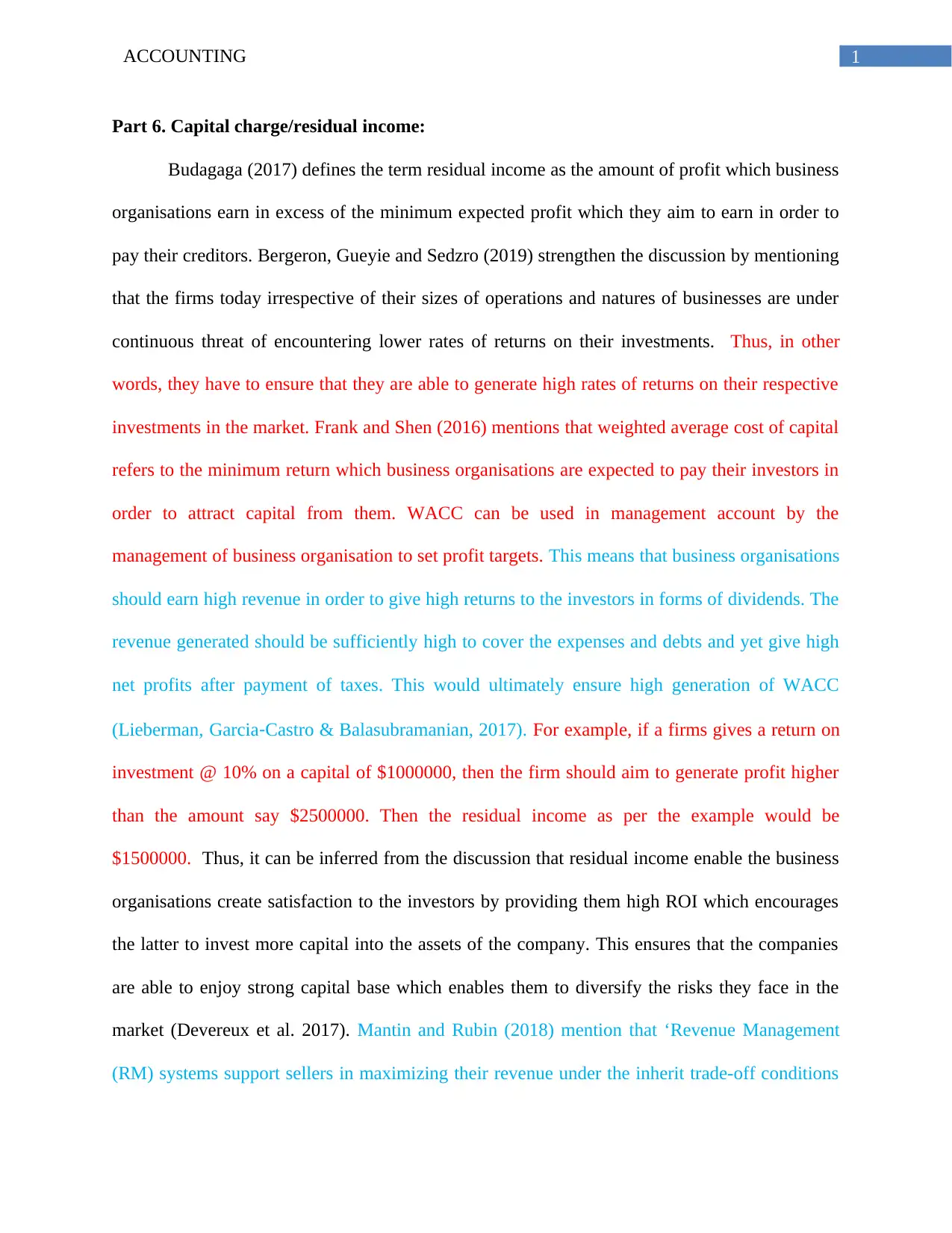
Part 6. Capital charge/residual income:
Budagaga (2017) defines the term residual income as the amount of profit which business
organisations earn in excess of the minimum expected profit which they aim to earn in order to
pay their creditors. Bergeron, Gueyie and Sedzro (2019) strengthen the discussion by mentioning
that the firms today irrespective of their sizes of operations and natures of businesses are under
continuous threat of encountering lower rates of returns on their investments. Thus, in other
words, they have to ensure that they are able to generate high rates of returns on their respective
investments in the market. Frank and Shen (2016) mentions that weighted average cost of capital
refers to the minimum return which business organisations are expected to pay their investors in
order to attract capital from them. WACC can be used in management account by the
management of business organisation to set profit targets. This means that business organisations
should earn high revenue in order to give high returns to the investors in forms of dividends. The
revenue generated should be sufficiently high to cover the expenses and debts and yet give high
net profits after payment of taxes. This would ultimately ensure high generation of WACC
(Lieberman, Garcia‐Castro & Balasubramanian, 2017). For example, if a firms gives a return on
investment @ 10% on a capital of $1000000, then the firm should aim to generate profit higher
than the amount say $2500000. Then the residual income as per the example would be
$1500000. Thus, it can be inferred from the discussion that residual income enable the business
organisations create satisfaction to the investors by providing them high ROI which encourages
the latter to invest more capital into the assets of the company. This ensures that the companies
are able to enjoy strong capital base which enables them to diversify the risks they face in the
market (Devereux et al. 2017). Mantin and Rubin (2018) mention that ‘Revenue Management
(RM) systems support sellers in maximizing their revenue under the inherit trade-off conditions
Part 6. Capital charge/residual income:
Budagaga (2017) defines the term residual income as the amount of profit which business
organisations earn in excess of the minimum expected profit which they aim to earn in order to
pay their creditors. Bergeron, Gueyie and Sedzro (2019) strengthen the discussion by mentioning
that the firms today irrespective of their sizes of operations and natures of businesses are under
continuous threat of encountering lower rates of returns on their investments. Thus, in other
words, they have to ensure that they are able to generate high rates of returns on their respective
investments in the market. Frank and Shen (2016) mentions that weighted average cost of capital
refers to the minimum return which business organisations are expected to pay their investors in
order to attract capital from them. WACC can be used in management account by the
management of business organisation to set profit targets. This means that business organisations
should earn high revenue in order to give high returns to the investors in forms of dividends. The
revenue generated should be sufficiently high to cover the expenses and debts and yet give high
net profits after payment of taxes. This would ultimately ensure high generation of WACC
(Lieberman, Garcia‐Castro & Balasubramanian, 2017). For example, if a firms gives a return on
investment @ 10% on a capital of $1000000, then the firm should aim to generate profit higher
than the amount say $2500000. Then the residual income as per the example would be
$1500000. Thus, it can be inferred from the discussion that residual income enable the business
organisations create satisfaction to the investors by providing them high ROI which encourages
the latter to invest more capital into the assets of the company. This ensures that the companies
are able to enjoy strong capital base which enables them to diversify the risks they face in the
market (Devereux et al. 2017). Mantin and Rubin (2018) mention that ‘Revenue Management
(RM) systems support sellers in maximizing their revenue under the inherit trade-off conditions
2ACCOUNTING
they face.’ This means that companies should integrate their marketing strategies with their
WCC strategies. This would form strategies aligned to their business targets and generate higher
WCC. For example, if the firms target to give a WCC @10%, they should form strategies to
generate revenue margin at least 110%. This would enable them to cover all their expenses and
generate high net profit. The firms while conducting their respective management accounting
forecasts, should take into account market occurances like increase in taxes and legal risks which
would impact their revenue generation as well as net profit generation, thus resulting in
generation of high capital charge. Thus, it can be established once again that capital charge can
be used to give high WCC to investors.
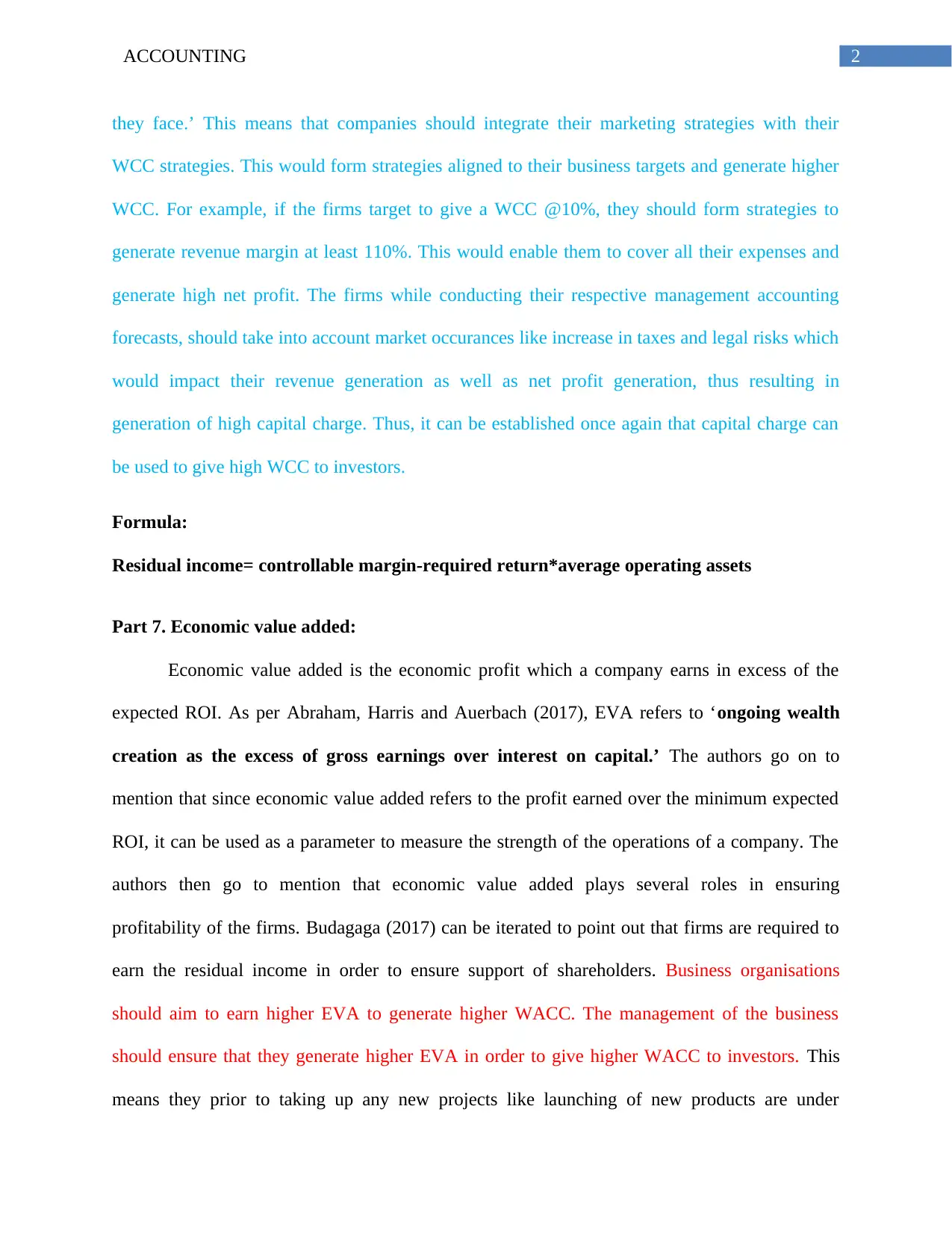
Formula:
Residual income= controllable margin-required return*average operating assets
Part 7. Economic value added:
Economic value added is the economic profit which a company earns in excess of the
expected ROI. As per Abraham, Harris and Auerbach (2017), EVA refers to ‘ongoing wealth
creation as the excess of gross earnings over interest on capital.’ The authors go on to
mention that since economic value added refers to the profit earned over the minimum expected
ROI, it can be used as a parameter to measure the strength of the operations of a company. The
authors then go to mention that economic value added plays several roles in ensuring
profitability of the firms. Budagaga (2017) can be iterated to point out that firms are required to
earn the residual income in order to ensure support of shareholders. Business organisations
should aim to earn higher EVA to generate higher WACC. The management of the business
should ensure that they generate higher EVA in order to give higher WACC to investors. This
means they prior to taking up any new projects like launching of new products are under
they face.’ This means that companies should integrate their marketing strategies with their
WCC strategies. This would form strategies aligned to their business targets and generate higher
WCC. For example, if the firms target to give a WCC @10%, they should form strategies to
generate revenue margin at least 110%. This would enable them to cover all their expenses and
generate high net profit. The firms while conducting their respective management accounting
forecasts, should take into account market occurances like increase in taxes and legal risks which
would impact their revenue generation as well as net profit generation, thus resulting in
generation of high capital charge. Thus, it can be established once again that capital charge can
be used to give high WCC to investors.
Formula:
Residual income= controllable margin-required return*average operating assets
Part 7. Economic value added:
Economic value added is the economic profit which a company earns in excess of the
expected ROI. As per Abraham, Harris and Auerbach (2017), EVA refers to ‘ongoing wealth
creation as the excess of gross earnings over interest on capital.’ The authors go on to
mention that since economic value added refers to the profit earned over the minimum expected
ROI, it can be used as a parameter to measure the strength of the operations of a company. The
authors then go to mention that economic value added plays several roles in ensuring
profitability of the firms. Budagaga (2017) can be iterated to point out that firms are required to
earn the residual income in order to ensure support of shareholders. Business organisations
should aim to earn higher EVA to generate higher WACC. The management of the business
should ensure that they generate higher EVA in order to give higher WACC to investors. This
means they prior to taking up any new projects like launching of new products are under
⊘ This is a preview!⊘
Do you want full access?
Subscribe today to unlock all pages.

Trusted by 1+ million students worldwide
3ACCOUNTING
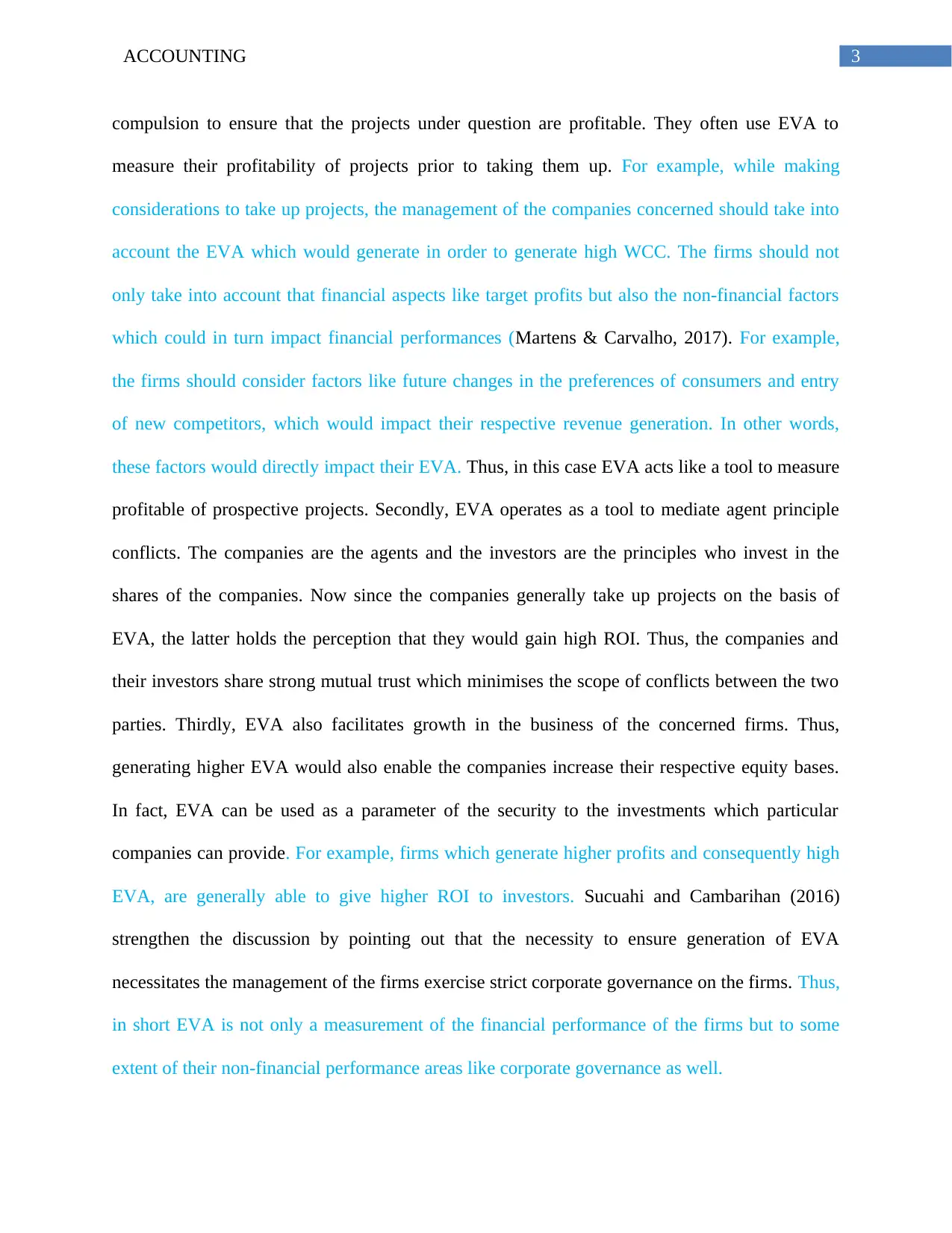
compulsion to ensure that the projects under question are profitable. They often use EVA to
measure their profitability of projects prior to taking them up. For example, while making
considerations to take up projects, the management of the companies concerned should take into
account the EVA which would generate in order to generate high WCC. The firms should not
only take into account that financial aspects like target profits but also the non-financial factors
which could in turn impact financial performances (Martens & Carvalho, 2017). For example,
the firms should consider factors like future changes in the preferences of consumers and entry
of new competitors, which would impact their respective revenue generation. In other words,
these factors would directly impact their EVA. Thus, in this case EVA acts like a tool to measure
profitable of prospective projects. Secondly, EVA operates as a tool to mediate agent principle
conflicts. The companies are the agents and the investors are the principles who invest in the
shares of the companies. Now since the companies generally take up projects on the basis of
EVA, the latter holds the perception that they would gain high ROI. Thus, the companies and
their investors share strong mutual trust which minimises the scope of conflicts between the two
parties. Thirdly, EVA also facilitates growth in the business of the concerned firms. Thus,
generating higher EVA would also enable the companies increase their respective equity bases.
In fact, EVA can be used as a parameter of the security to the investments which particular
companies can provide. For example, firms which generate higher profits and consequently high
EVA, are generally able to give higher ROI to investors. Sucuahi and Cambarihan (2016)
strengthen the discussion by pointing out that the necessity to ensure generation of EVA
necessitates the management of the firms exercise strict corporate governance on the firms. Thus,
in short EVA is not only a measurement of the financial performance of the firms but to some
extent of their non-financial performance areas like corporate governance as well.
compulsion to ensure that the projects under question are profitable. They often use EVA to
measure their profitability of projects prior to taking them up. For example, while making
considerations to take up projects, the management of the companies concerned should take into
account the EVA which would generate in order to generate high WCC. The firms should not
only take into account that financial aspects like target profits but also the non-financial factors
which could in turn impact financial performances (Martens & Carvalho, 2017). For example,
the firms should consider factors like future changes in the preferences of consumers and entry
of new competitors, which would impact their respective revenue generation. In other words,
these factors would directly impact their EVA. Thus, in this case EVA acts like a tool to measure
profitable of prospective projects. Secondly, EVA operates as a tool to mediate agent principle
conflicts. The companies are the agents and the investors are the principles who invest in the
shares of the companies. Now since the companies generally take up projects on the basis of
EVA, the latter holds the perception that they would gain high ROI. Thus, the companies and
their investors share strong mutual trust which minimises the scope of conflicts between the two
parties. Thirdly, EVA also facilitates growth in the business of the concerned firms. Thus,
generating higher EVA would also enable the companies increase their respective equity bases.
In fact, EVA can be used as a parameter of the security to the investments which particular
companies can provide. For example, firms which generate higher profits and consequently high
EVA, are generally able to give higher ROI to investors. Sucuahi and Cambarihan (2016)
strengthen the discussion by pointing out that the necessity to ensure generation of EVA
necessitates the management of the firms exercise strict corporate governance on the firms. Thus,
in short EVA is not only a measurement of the financial performance of the firms but to some
extent of their non-financial performance areas like corporate governance as well.
Paraphrase This Document
Need a fresh take? Get an instant paraphrase of this document with our AI Paraphraser
4ACCOUNTING
Formula:
EVA=NOPAT-(WACC*capital invested)
Part 8. Return on assets:
Return on assets or ROA is the ratio between the net profit after tax and the total assets.
Chew (2019) defines the term return on assets as ‘the number of profits earned relative to the
level of investment in total assets.’ He further goes to mention that higher the ratio of return on
assets, higher is the efficiency levels achieved by particular firms to utilise their assets. He
related the term to economic value added. ROA is a very important management accounting
criterion which business organisations should consider while calculating WACC. They should
ensure that they earn higher net profits per assets in order to be able to meet all their liabilities
and give higher ROI to investors. Zainuddin et al. (2017) point out that the prices of assets which
business organisations hold fluctuate owing to the changing market conditions. This means that
when the market conditions are favourable, the value of the assets increase and vice versa.
Favourable market conditions like increase in demand for products enable the firms to convert
assets into profit at a faster pace (Abraham, Harris & Auerbach, 2017). For example, when there
is an increase in demand for finished goods and the factors of production (manpower, raw
materials, financial capital, land and machine) are readily available, firms can mobilise raw
materials inventory (current assets) to manufacture finished goods. These finished goods can be
marketed in the market to generate profits. Thus, in short firms concerned enjoy higher levels of
liquidity. These two concepts can be synthesised to point out that ROA shows the liquidity rates
which firms enjoy in the market. Thus, ROA enables the management of the firms measure the
efficiency levels in the operations of the firms. For example, if the total operating income a firm
generates is $ 10000000 and its total assets amount to $100000, the ROA is 100:1. This means
Formula:
EVA=NOPAT-(WACC*capital invested)
Part 8. Return on assets:
Return on assets or ROA is the ratio between the net profit after tax and the total assets.
Chew (2019) defines the term return on assets as ‘the number of profits earned relative to the
level of investment in total assets.’ He further goes to mention that higher the ratio of return on
assets, higher is the efficiency levels achieved by particular firms to utilise their assets. He
related the term to economic value added. ROA is a very important management accounting
criterion which business organisations should consider while calculating WACC. They should
ensure that they earn higher net profits per assets in order to be able to meet all their liabilities
and give higher ROI to investors. Zainuddin et al. (2017) point out that the prices of assets which
business organisations hold fluctuate owing to the changing market conditions. This means that
when the market conditions are favourable, the value of the assets increase and vice versa.
Favourable market conditions like increase in demand for products enable the firms to convert
assets into profit at a faster pace (Abraham, Harris & Auerbach, 2017). For example, when there
is an increase in demand for finished goods and the factors of production (manpower, raw
materials, financial capital, land and machine) are readily available, firms can mobilise raw
materials inventory (current assets) to manufacture finished goods. These finished goods can be
marketed in the market to generate profits. Thus, in short firms concerned enjoy higher levels of
liquidity. These two concepts can be synthesised to point out that ROA shows the liquidity rates
which firms enjoy in the market. Thus, ROA enables the management of the firms measure the
efficiency levels in the operations of the firms. For example, if the total operating income a firm
generates is $ 10000000 and its total assets amount to $100000, the ROA is 100:1. This means
5ACCOUNTING
that firm is able to pay its liabilities and debts. It is still able to generate WACC to give high
returns to its investors.
Formula:
ROA=Operating income/total assets
Part 9. Under investment problem:
Under investment problem or debt overhang problem refers to the situation when
business organisations have so much debt that the major portions of the profits earned by the
concerned companies go towards repayment of the debts leaving insufficient ROI for the
investors (Murphy, 2018). For example, a firm generates a gross profit of $ 1000000 and has
debts amounting to $ 500000. This means that as high as 50% of the gross goes into payment of
the debts. Considering the fact, that the firm would also meet its expenditures including taxes,
one can point out that it would have insufficient profits to give high returns to its investors. In
other words, it would be incapable of protecting the interests of the investors. Khaw and Lee
(2016) while explaining this situation mention that, firms using debt and equities to finance their
operations have to consider the tenure for which they borrow debts. The debts which are
borrowed for long terms usually tend to occupy substantial portions of the revenue generated by
the firms. This means that the firms have to cede more returns to debtors compared to the
shareholders, who are the owners. Thus, the shareholders do not approve new investments since
their interests are not protected. This situation is an agency problem which is the outcome of
conflict of interests of the shareholders and the debtors. The can lose future projects owing to
this issue since the shareholders do not approve them. Thus, owing to losing of profitable
projects and market investment options, companies often suffer losses (Ren, 2016). Thus, it
transpires from the discussion that under investment is a situation when major portions of the
that firm is able to pay its liabilities and debts. It is still able to generate WACC to give high
returns to its investors.
Formula:
ROA=Operating income/total assets
Part 9. Under investment problem:
Under investment problem or debt overhang problem refers to the situation when
business organisations have so much debt that the major portions of the profits earned by the
concerned companies go towards repayment of the debts leaving insufficient ROI for the
investors (Murphy, 2018). For example, a firm generates a gross profit of $ 1000000 and has
debts amounting to $ 500000. This means that as high as 50% of the gross goes into payment of
the debts. Considering the fact, that the firm would also meet its expenditures including taxes,
one can point out that it would have insufficient profits to give high returns to its investors. In
other words, it would be incapable of protecting the interests of the investors. Khaw and Lee
(2016) while explaining this situation mention that, firms using debt and equities to finance their
operations have to consider the tenure for which they borrow debts. The debts which are
borrowed for long terms usually tend to occupy substantial portions of the revenue generated by
the firms. This means that the firms have to cede more returns to debtors compared to the
shareholders, who are the owners. Thus, the shareholders do not approve new investments since
their interests are not protected. This situation is an agency problem which is the outcome of
conflict of interests of the shareholders and the debtors. The can lose future projects owing to
this issue since the shareholders do not approve them. Thus, owing to losing of profitable
projects and market investment options, companies often suffer losses (Ren, 2016). Thus, it
transpires from the discussion that under investment is a situation when major portions of the
⊘ This is a preview!⊘
Do you want full access?
Subscribe today to unlock all pages.
Trusted by 1+ million students worldwide
6ACCOUNTING
profit of the firms go to the debtors at the expense of the investors. The investors do not approve
fresh financing options in the companies concerned due to the fear of losing on ROI. This
concept of underinvestment is a very crucial concept of management accounting. The investors
do not invest capital into the firms suffering from debt overhang since they may receive
insufficient dividend. This creates lack of capital which ultimately impacts the operations of the
firms concerned. Thus, management accounting operations of the firms should ensure that the
target profits should be such that they are able to cover both debts and WACC. For example, if
the expected debt is $100000 and WACC is $ 200000, the gross profits which the firms should
aim to generate should be at least $ 500000 (considering $100000 would go into expenses).
Part 10. When do company create value?
Sheth (2019) explores the concept of value creation from two perspectives. The first
perspective is that business organisations create value for customers by creating products which
are aligned with the preferences of the latter. He mentions that when companies produce goods
and services which are aligned with the preferences of customers, the goods and services cause
utility to the customers. This creation of utility causes customer satisfaction among the
customers, thus creating a perception of value creation among the customers. The second
perspective of value creation is when the companies create value for their suppliers. The
companies maintain suppliers who either provide them with the raw materials and WIPs which
are channelized into manufacturing processes. The retail firms procure finished goods from their
suppliers. The companies make timely payment of the credits to the suppliers which create value
for the latter. Chesbrough, Lettl and Ritter (2018) strengthen the discussion by pointing out that
business can value for customers by carrying out innovation. They go on to mention that
business organisations conduct open innovation which enables sharing of knowledge with both
profit of the firms go to the debtors at the expense of the investors. The investors do not approve
fresh financing options in the companies concerned due to the fear of losing on ROI. This
concept of underinvestment is a very crucial concept of management accounting. The investors
do not invest capital into the firms suffering from debt overhang since they may receive
insufficient dividend. This creates lack of capital which ultimately impacts the operations of the
firms concerned. Thus, management accounting operations of the firms should ensure that the
target profits should be such that they are able to cover both debts and WACC. For example, if
the expected debt is $100000 and WACC is $ 200000, the gross profits which the firms should
aim to generate should be at least $ 500000 (considering $100000 would go into expenses).
Part 10. When do company create value?
Sheth (2019) explores the concept of value creation from two perspectives. The first
perspective is that business organisations create value for customers by creating products which
are aligned with the preferences of the latter. He mentions that when companies produce goods
and services which are aligned with the preferences of customers, the goods and services cause
utility to the customers. This creation of utility causes customer satisfaction among the
customers, thus creating a perception of value creation among the customers. The second
perspective of value creation is when the companies create value for their suppliers. The
companies maintain suppliers who either provide them with the raw materials and WIPs which
are channelized into manufacturing processes. The retail firms procure finished goods from their
suppliers. The companies make timely payment of the credits to the suppliers which create value
for the latter. Chesbrough, Lettl and Ritter (2018) strengthen the discussion by pointing out that
business can value for customers by carrying out innovation. They go on to mention that
business organisations conduct open innovation which enables sharing of knowledge with both
Paraphrase This Document
Need a fresh take? Get an instant paraphrase of this document with our AI Paraphraser
7ACCOUNTING
customers and business partners. This sharing of knowledge results in creation of value for the
parties involved. These open innovations enable firms to market more suited to the customer
preferences and create customer satisfaction. This perception of high level of satisfaction creates
value among the customers. Gokten and Gokten (2017) point out that second form of value
creation which business organisations result in through their activities namely, value creation
for investors. In other words, the concept of value creation finds use in management accounting
as well. The firms should generate more amount of profits higher than their WACC to ensure
that they create value to them. The business organisations owing to the first type of value
creation discussed namely, value creation for customers, are able to generate high revenue. Thus,
they are able to generate higher profits compared to the cost of capital. They as a result are able
to provide higher rates of returns to the shareholders, thereby creating capital maximisation in
their investment portfolios. This shareholders perceive this capital maximisation as value
creation to them. Thus, it can be construed from the discussion that shareholders create value to
shareholders by giving higher ROIs and dividends. The next form of value creation which
business organisations cause is value creation for the employees. Aguenza and Som (2018)
mention that business organisations in order to retain employees have to create value to the latter
by providing legitimate compensations, both in financial terms and non-financial terms. The
authors mention that employees regard remuneration, bonuses and incentives as important
parameters to continue working with the companies. They further go on to mention that non-
financial factors like strong organisational culture, strong working relationships with co-
employees and security of jobs as important aspects of value creation to employees. Thus, it
transpires that companies create values to employees by offering these financial as well as non-
customers and business partners. This sharing of knowledge results in creation of value for the
parties involved. These open innovations enable firms to market more suited to the customer
preferences and create customer satisfaction. This perception of high level of satisfaction creates
value among the customers. Gokten and Gokten (2017) point out that second form of value
creation which business organisations result in through their activities namely, value creation
for investors. In other words, the concept of value creation finds use in management accounting
as well. The firms should generate more amount of profits higher than their WACC to ensure
that they create value to them. The business organisations owing to the first type of value
creation discussed namely, value creation for customers, are able to generate high revenue. Thus,
they are able to generate higher profits compared to the cost of capital. They as a result are able
to provide higher rates of returns to the shareholders, thereby creating capital maximisation in
their investment portfolios. This shareholders perceive this capital maximisation as value
creation to them. Thus, it can be construed from the discussion that shareholders create value to
shareholders by giving higher ROIs and dividends. The next form of value creation which
business organisations cause is value creation for the employees. Aguenza and Som (2018)
mention that business organisations in order to retain employees have to create value to the latter
by providing legitimate compensations, both in financial terms and non-financial terms. The
authors mention that employees regard remuneration, bonuses and incentives as important
parameters to continue working with the companies. They further go on to mention that non-
financial factors like strong organisational culture, strong working relationships with co-
employees and security of jobs as important aspects of value creation to employees. Thus, it
transpires that companies create values to employees by offering these financial as well as non-
8ACCOUNTING
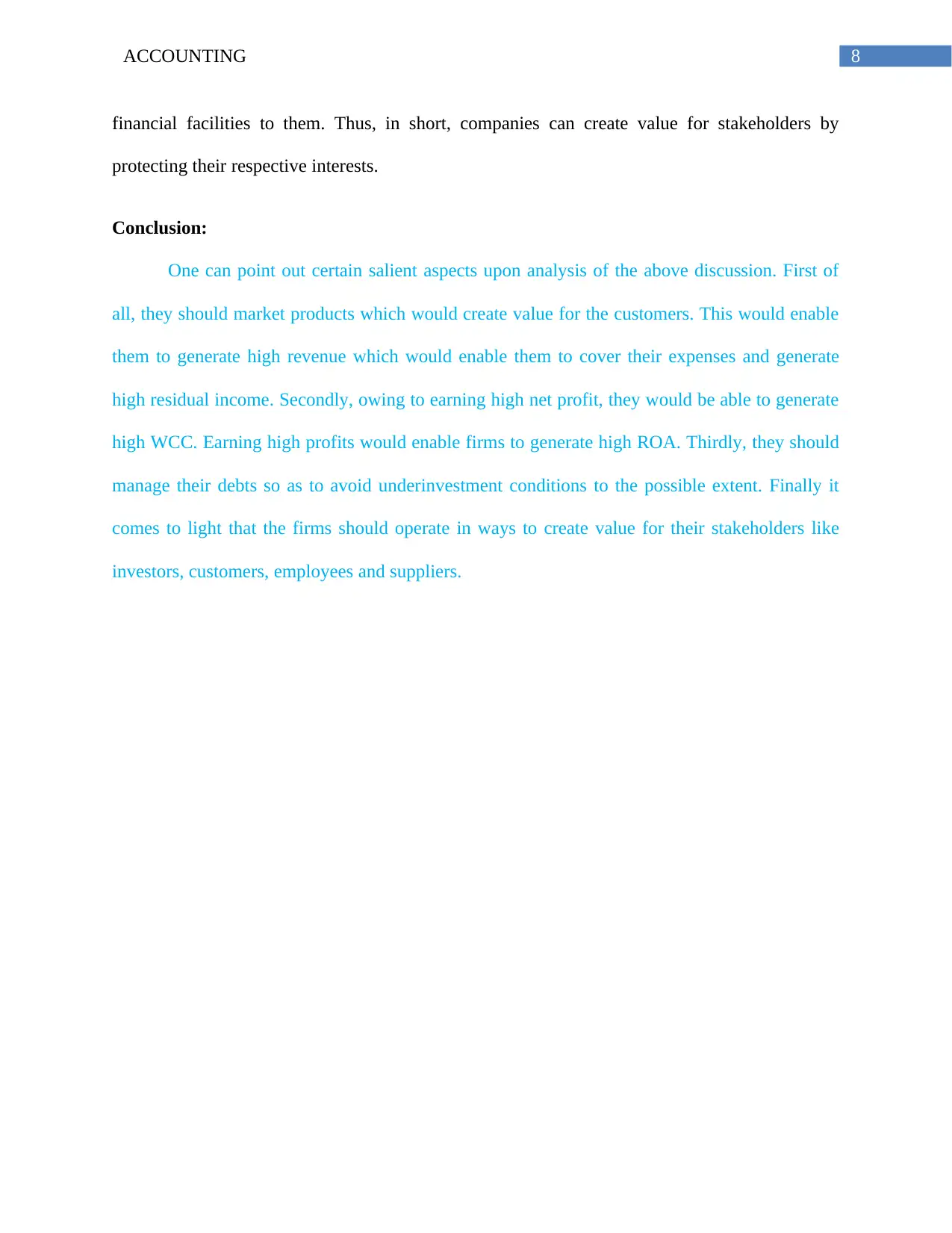
financial facilities to them. Thus, in short, companies can create value for stakeholders by
protecting their respective interests.
Conclusion:
One can point out certain salient aspects upon analysis of the above discussion. First of
all, they should market products which would create value for the customers. This would enable
them to generate high revenue which would enable them to cover their expenses and generate
high residual income. Secondly, owing to earning high net profit, they would be able to generate
high WCC. Earning high profits would enable firms to generate high ROA. Thirdly, they should
manage their debts so as to avoid underinvestment conditions to the possible extent. Finally it
comes to light that the firms should operate in ways to create value for their stakeholders like
investors, customers, employees and suppliers.
financial facilities to them. Thus, in short, companies can create value for stakeholders by
protecting their respective interests.
Conclusion:
One can point out certain salient aspects upon analysis of the above discussion. First of
all, they should market products which would create value for the customers. This would enable
them to generate high revenue which would enable them to cover their expenses and generate
high residual income. Secondly, owing to earning high net profit, they would be able to generate
high WCC. Earning high profits would enable firms to generate high ROA. Thirdly, they should
manage their debts so as to avoid underinvestment conditions to the possible extent. Finally it
comes to light that the firms should operate in ways to create value for their stakeholders like
investors, customers, employees and suppliers.
⊘ This is a preview!⊘
Do you want full access?
Subscribe today to unlock all pages.
Trusted by 1+ million students worldwide
9ACCOUNTING
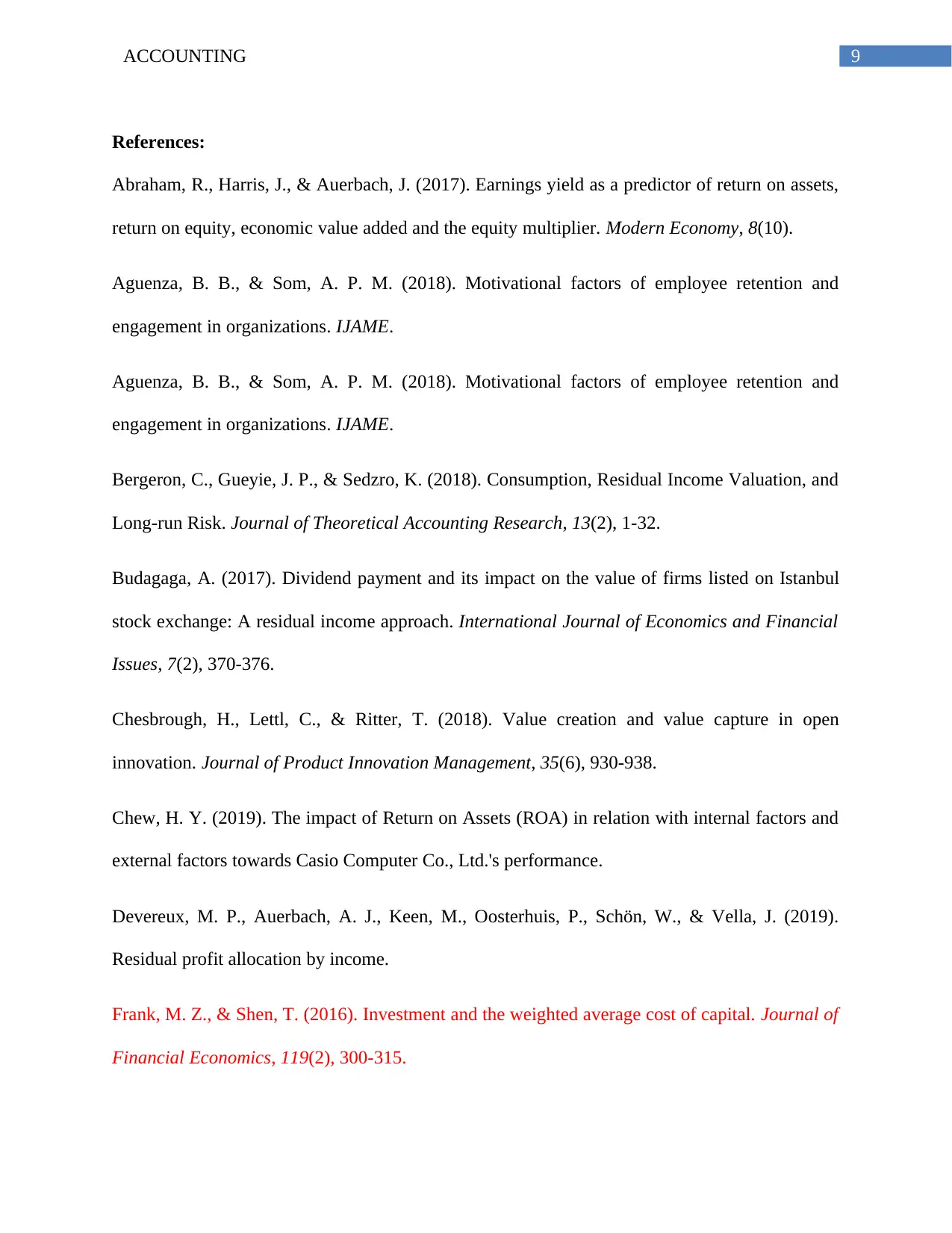
References:
Abraham, R., Harris, J., & Auerbach, J. (2017). Earnings yield as a predictor of return on assets,
return on equity, economic value added and the equity multiplier. Modern Economy, 8(10).
Aguenza, B. B., & Som, A. P. M. (2018). Motivational factors of employee retention and
engagement in organizations. IJAME.
Aguenza, B. B., & Som, A. P. M. (2018). Motivational factors of employee retention and
engagement in organizations. IJAME.
Bergeron, C., Gueyie, J. P., & Sedzro, K. (2018). Consumption, Residual Income Valuation, and
Long-run Risk. Journal of Theoretical Accounting Research, 13(2), 1-32.
Budagaga, A. (2017). Dividend payment and its impact on the value of firms listed on Istanbul
stock exchange: A residual income approach. International Journal of Economics and Financial
Issues, 7(2), 370-376.
Chesbrough, H., Lettl, C., & Ritter, T. (2018). Value creation and value capture in open
innovation. Journal of Product Innovation Management, 35(6), 930-938.
Chew, H. Y. (2019). The impact of Return on Assets (ROA) in relation with internal factors and
external factors towards Casio Computer Co., Ltd.'s performance.
Devereux, M. P., Auerbach, A. J., Keen, M., Oosterhuis, P., Schön, W., & Vella, J. (2019).
Residual profit allocation by income.
Frank, M. Z., & Shen, T. (2016). Investment and the weighted average cost of capital. Journal of
Financial Economics, 119(2), 300-315.
References:
Abraham, R., Harris, J., & Auerbach, J. (2017). Earnings yield as a predictor of return on assets,
return on equity, economic value added and the equity multiplier. Modern Economy, 8(10).
Aguenza, B. B., & Som, A. P. M. (2018). Motivational factors of employee retention and
engagement in organizations. IJAME.
Aguenza, B. B., & Som, A. P. M. (2018). Motivational factors of employee retention and
engagement in organizations. IJAME.
Bergeron, C., Gueyie, J. P., & Sedzro, K. (2018). Consumption, Residual Income Valuation, and
Long-run Risk. Journal of Theoretical Accounting Research, 13(2), 1-32.
Budagaga, A. (2017). Dividend payment and its impact on the value of firms listed on Istanbul
stock exchange: A residual income approach. International Journal of Economics and Financial
Issues, 7(2), 370-376.
Chesbrough, H., Lettl, C., & Ritter, T. (2018). Value creation and value capture in open
innovation. Journal of Product Innovation Management, 35(6), 930-938.
Chew, H. Y. (2019). The impact of Return on Assets (ROA) in relation with internal factors and
external factors towards Casio Computer Co., Ltd.'s performance.
Devereux, M. P., Auerbach, A. J., Keen, M., Oosterhuis, P., Schön, W., & Vella, J. (2019).
Residual profit allocation by income.
Frank, M. Z., & Shen, T. (2016). Investment and the weighted average cost of capital. Journal of
Financial Economics, 119(2), 300-315.
Paraphrase This Document
Need a fresh take? Get an instant paraphrase of this document with our AI Paraphraser
10ACCOUNTING
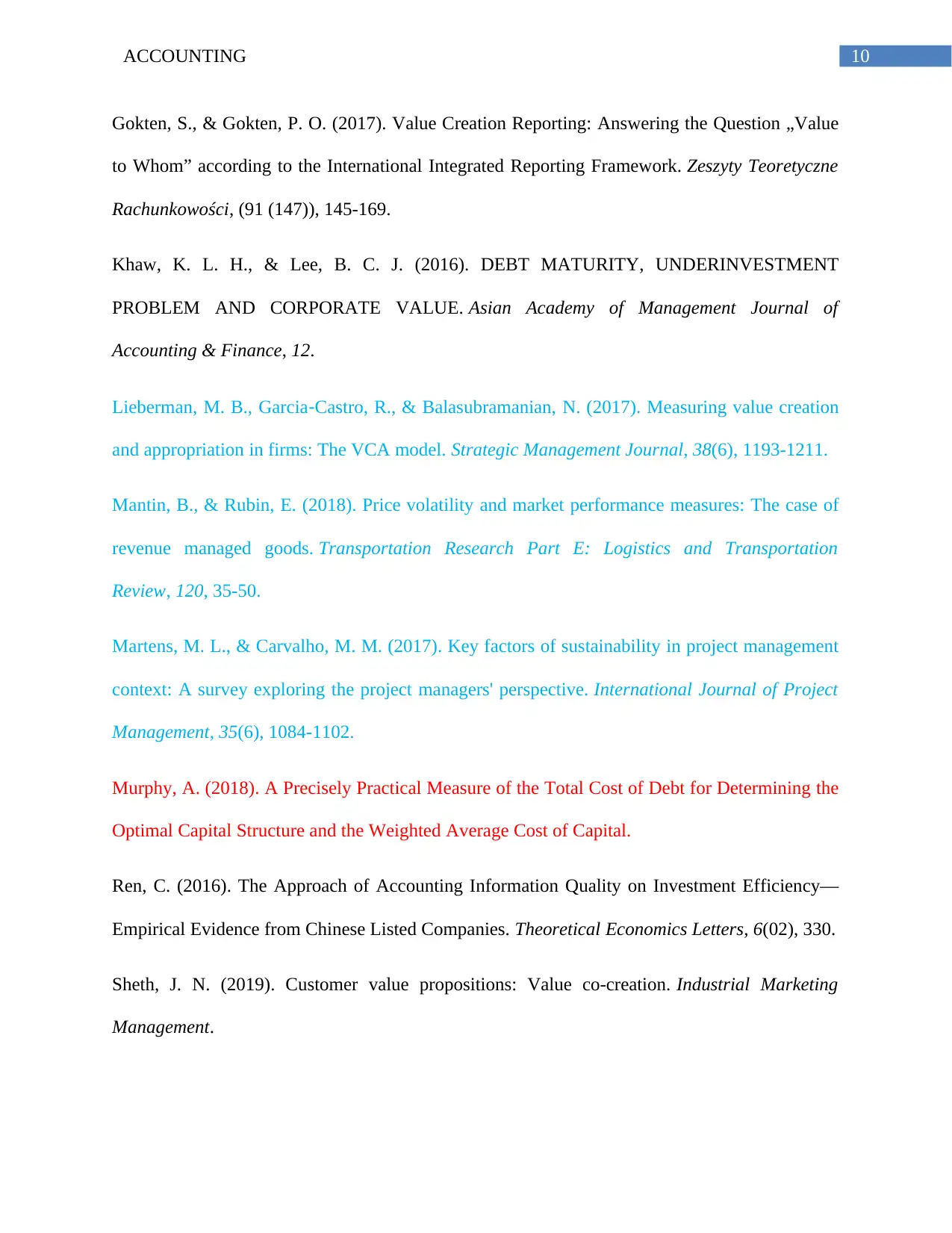
Gokten, S., & Gokten, P. O. (2017). Value Creation Reporting: Answering the Question „Value
to Whom” according to the International Integrated Reporting Framework. Zeszyty Teoretyczne
Rachunkowości, (91 (147)), 145-169.
Khaw, K. L. H., & Lee, B. C. J. (2016). DEBT MATURITY, UNDERINVESTMENT
PROBLEM AND CORPORATE VALUE. Asian Academy of Management Journal of
Accounting & Finance, 12.
Lieberman, M. B., Garcia‐Castro, R., & Balasubramanian, N. (2017). Measuring value creation
and appropriation in firms: The VCA model. Strategic Management Journal, 38(6), 1193-1211.
Mantin, B., & Rubin, E. (2018). Price volatility and market performance measures: The case of
revenue managed goods. Transportation Research Part E: Logistics and Transportation
Review, 120, 35-50.
Martens, M. L., & Carvalho, M. M. (2017). Key factors of sustainability in project management
context: A survey exploring the project managers' perspective. International Journal of Project
Management, 35(6), 1084-1102.
Murphy, A. (2018). A Precisely Practical Measure of the Total Cost of Debt for Determining the
Optimal Capital Structure and the Weighted Average Cost of Capital.
Ren, C. (2016). The Approach of Accounting Information Quality on Investment Efficiency—
Empirical Evidence from Chinese Listed Companies. Theoretical Economics Letters, 6(02), 330.
Sheth, J. N. (2019). Customer value propositions: Value co-creation. Industrial Marketing
Management.
Gokten, S., & Gokten, P. O. (2017). Value Creation Reporting: Answering the Question „Value
to Whom” according to the International Integrated Reporting Framework. Zeszyty Teoretyczne
Rachunkowości, (91 (147)), 145-169.
Khaw, K. L. H., & Lee, B. C. J. (2016). DEBT MATURITY, UNDERINVESTMENT
PROBLEM AND CORPORATE VALUE. Asian Academy of Management Journal of
Accounting & Finance, 12.
Lieberman, M. B., Garcia‐Castro, R., & Balasubramanian, N. (2017). Measuring value creation
and appropriation in firms: The VCA model. Strategic Management Journal, 38(6), 1193-1211.
Mantin, B., & Rubin, E. (2018). Price volatility and market performance measures: The case of
revenue managed goods. Transportation Research Part E: Logistics and Transportation
Review, 120, 35-50.
Martens, M. L., & Carvalho, M. M. (2017). Key factors of sustainability in project management
context: A survey exploring the project managers' perspective. International Journal of Project
Management, 35(6), 1084-1102.
Murphy, A. (2018). A Precisely Practical Measure of the Total Cost of Debt for Determining the
Optimal Capital Structure and the Weighted Average Cost of Capital.
Ren, C. (2016). The Approach of Accounting Information Quality on Investment Efficiency—
Empirical Evidence from Chinese Listed Companies. Theoretical Economics Letters, 6(02), 330.
Sheth, J. N. (2019). Customer value propositions: Value co-creation. Industrial Marketing
Management.
11ACCOUNTING
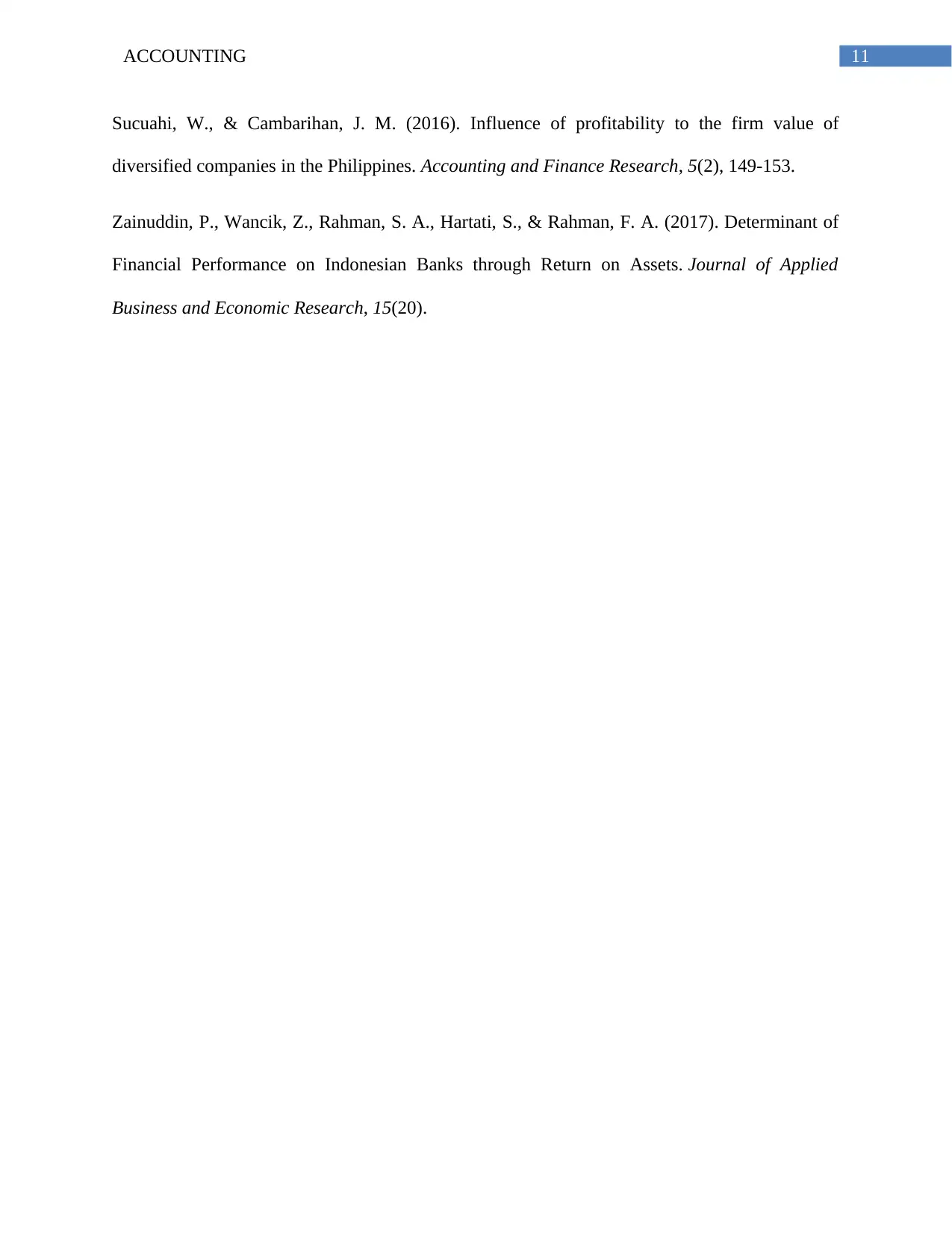
Sucuahi, W., & Cambarihan, J. M. (2016). Influence of profitability to the firm value of
diversified companies in the Philippines. Accounting and Finance Research, 5(2), 149-153.
Zainuddin, P., Wancik, Z., Rahman, S. A., Hartati, S., & Rahman, F. A. (2017). Determinant of
Financial Performance on Indonesian Banks through Return on Assets. Journal of Applied
Business and Economic Research, 15(20).
Sucuahi, W., & Cambarihan, J. M. (2016). Influence of profitability to the firm value of
diversified companies in the Philippines. Accounting and Finance Research, 5(2), 149-153.
Zainuddin, P., Wancik, Z., Rahman, S. A., Hartati, S., & Rahman, F. A. (2017). Determinant of
Financial Performance on Indonesian Banks through Return on Assets. Journal of Applied
Business and Economic Research, 15(20).
⊘ This is a preview!⊘
Do you want full access?
Subscribe today to unlock all pages.
Trusted by 1+ million students worldwide

1 out of 12


Related Documents


Your All-in-One AI-Powered Toolkit for Academic Success.
+13062052269
info@desklib.com
Available 24*7 on WhatsApp / Email
![[object Object]](/_next/static/media/star-bottom.7253800d.svg)
Unlock your academic potential
Copyright © 2020–2026 A2Z Services. All Rights Reserved. Developed and managed by ZUCOL.