Managing Operations and Finance: A Comprehensive Report
VerifiedAdded on 2023/01/19
|15
|3561
|76
Report
AI Summary
This report delves into the critical aspects of managing operations and finance, starting with an introduction to management accounting and its role in business decision-making, contrasting it with financial accounting. It explores investment appraisal techniques, including Net Present Value (NPV), Payback Period, and Internal Rate of Return (IRR), to evaluate project viability, using Cucumber Limited as a case study. The report then emphasizes the significance of business plans and budgeting in guiding operations and controlling costs. Furthermore, it discusses the balanced scorecard method for performance evaluation. The report provides insights into strategic decision-making, cost control, and financial planning, offering a comprehensive overview of key concepts in operations and finance management.

Managing Operations and Finance
1
1

Paraphrase This Document
Need a fresh take? Get an instant paraphrase of this document with our AI Paraphraser

Contents
Introduction...........................................................................................................................................3
Role of Management Accounting and difference with financial accounting..........................................4
Investment appraisal..............................................................................................................................7
Importance of business plan and budgeting.........................................................................................10
Balanced scorecard method.................................................................................................................12
Conclusion...........................................................................................................................................14
References...........................................................................................................................................15
2
Introduction...........................................................................................................................................3
Role of Management Accounting and difference with financial accounting..........................................4
Investment appraisal..............................................................................................................................7
Importance of business plan and budgeting.........................................................................................10
Balanced scorecard method.................................................................................................................12
Conclusion...........................................................................................................................................14
References...........................................................................................................................................15
2
Introduction
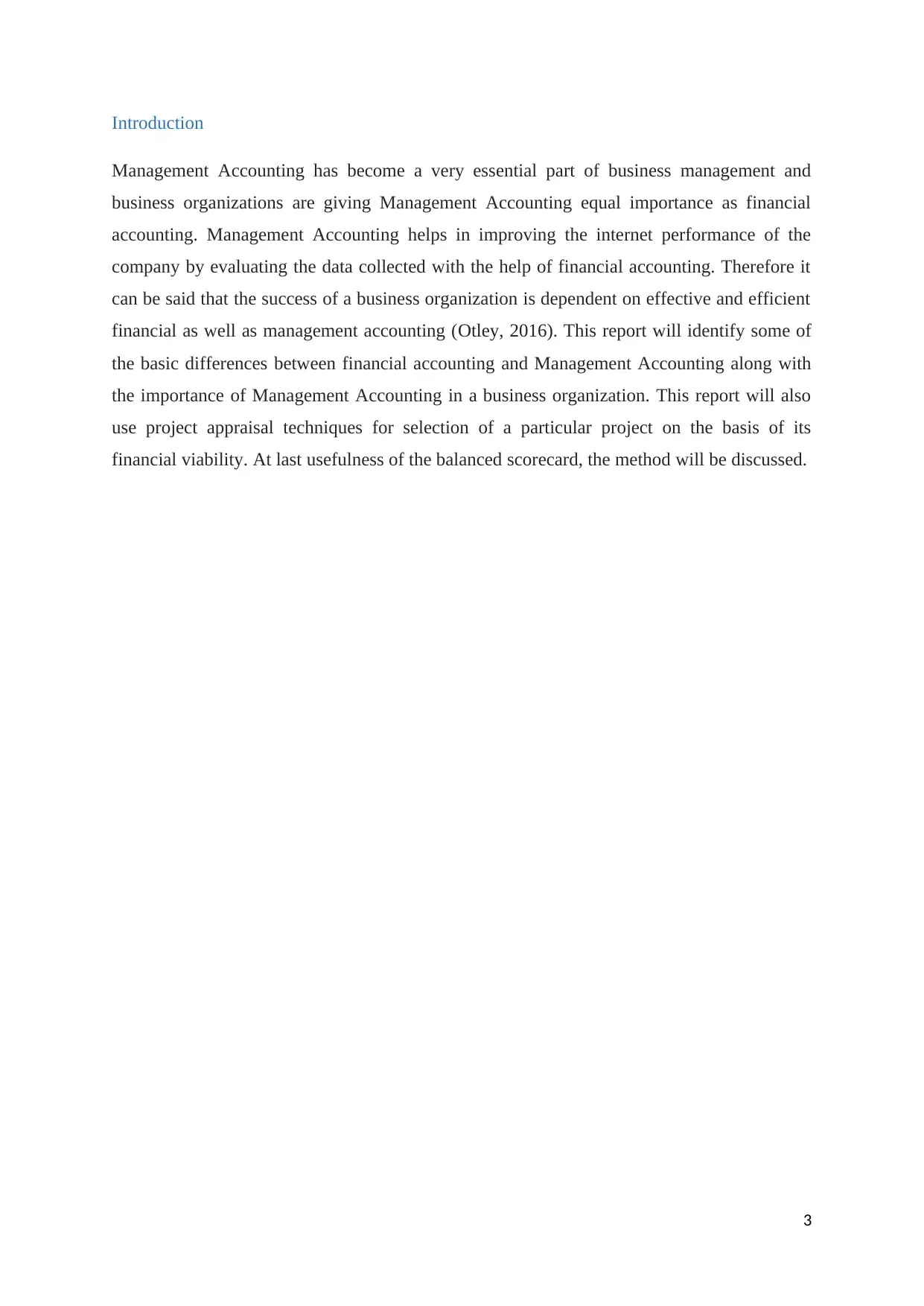
Management Accounting has become a very essential part of business management and
business organizations are giving Management Accounting equal importance as financial
accounting. Management Accounting helps in improving the internet performance of the
company by evaluating the data collected with the help of financial accounting. Therefore it
can be said that the success of a business organization is dependent on effective and efficient
financial as well as management accounting (Otley, 2016). This report will identify some of
the basic differences between financial accounting and Management Accounting along with
the importance of Management Accounting in a business organization. This report will also
use project appraisal techniques for selection of a particular project on the basis of its
financial viability. At last usefulness of the balanced scorecard, the method will be discussed.
3
Management Accounting has become a very essential part of business management and
business organizations are giving Management Accounting equal importance as financial
accounting. Management Accounting helps in improving the internet performance of the
company by evaluating the data collected with the help of financial accounting. Therefore it
can be said that the success of a business organization is dependent on effective and efficient
financial as well as management accounting (Otley, 2016). This report will identify some of
the basic differences between financial accounting and Management Accounting along with
the importance of Management Accounting in a business organization. This report will also
use project appraisal techniques for selection of a particular project on the basis of its
financial viability. At last usefulness of the balanced scorecard, the method will be discussed.
3
⊘ This is a preview!⊘
Do you want full access?
Subscribe today to unlock all pages.

Trusted by 1+ million students worldwide
Role of Management Accounting and difference with financial accounting
Management Accounting has become a very essential part of business management as it
helps business managers to take important business decisions. Data collected by business
managers through financial accounting is taken as primary data in Management Accounting.
Information provided by managerial Accountants helps in the development of long term as
well as short term business strategies (Weygandt, Kimmel and Kieso, 2015). Importance of
Managerial Accounting in business can be explained with the help of the following factors-
Productivity and profitability of a product- management of the company can easily
identify the profitability and productivity of a product with the help of financial statement
analysis which is a part of managerial accounting. Management uses trend analysis of
historical data for evaluating whether a particular product is profitable or not. Decisions in
relation to expansion or shutdown can be taken with the help of managerial accounting.
Purchase for manufacturing decision- Decisions in relation to production or purchase of
raw material is also important to maintain effective balance in the cost structure (Appelbaum
et.al, 2017). With the help of managerial accounting, the various factors can be considered by
business managers before taking such decisions in the interest of the company.
Managerial decision making- Managerial accounting please very important role in the
decision-making process of managers. Different Tools and techniques of managerial
accounting such as budgeting, cost analysis, break-even analysis, etc. are used by managers
or before evaluating any business decision.
On the basis of these factors, it can be said that the importance of managerial accounting is
equal to financial accounting if not more.
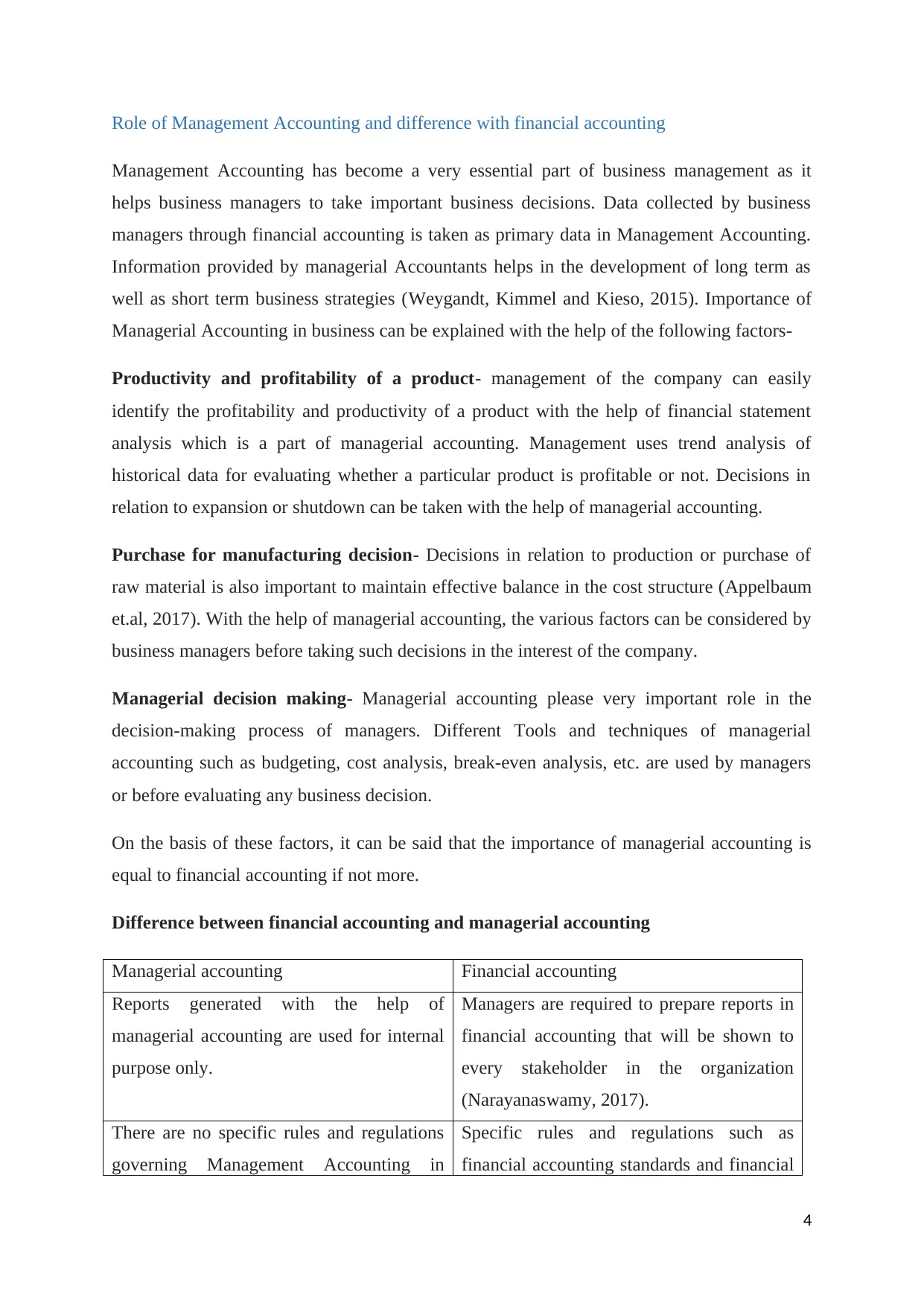
Difference between financial accounting and managerial accounting
Managerial accounting Financial accounting
Reports generated with the help of
managerial accounting are used for internal
purpose only.
Managers are required to prepare reports in
financial accounting that will be shown to
every stakeholder in the organization
(Narayanaswamy, 2017).
There are no specific rules and regulations
governing Management Accounting in
Specific rules and regulations such as
financial accounting standards and financial
4
Management Accounting has become a very essential part of business management as it
helps business managers to take important business decisions. Data collected by business
managers through financial accounting is taken as primary data in Management Accounting.
Information provided by managerial Accountants helps in the development of long term as
well as short term business strategies (Weygandt, Kimmel and Kieso, 2015). Importance of
Managerial Accounting in business can be explained with the help of the following factors-
Productivity and profitability of a product- management of the company can easily
identify the profitability and productivity of a product with the help of financial statement
analysis which is a part of managerial accounting. Management uses trend analysis of
historical data for evaluating whether a particular product is profitable or not. Decisions in
relation to expansion or shutdown can be taken with the help of managerial accounting.
Purchase for manufacturing decision- Decisions in relation to production or purchase of
raw material is also important to maintain effective balance in the cost structure (Appelbaum
et.al, 2017). With the help of managerial accounting, the various factors can be considered by
business managers before taking such decisions in the interest of the company.
Managerial decision making- Managerial accounting please very important role in the
decision-making process of managers. Different Tools and techniques of managerial
accounting such as budgeting, cost analysis, break-even analysis, etc. are used by managers
or before evaluating any business decision.
On the basis of these factors, it can be said that the importance of managerial accounting is
equal to financial accounting if not more.
Difference between financial accounting and managerial accounting
Managerial accounting Financial accounting
Reports generated with the help of
managerial accounting are used for internal
purpose only.
Managers are required to prepare reports in
financial accounting that will be shown to
every stakeholder in the organization
(Narayanaswamy, 2017).
There are no specific rules and regulations
governing Management Accounting in
Specific rules and regulations such as
financial accounting standards and financial
4
Paraphrase This Document
Need a fresh take? Get an instant paraphrase of this document with our AI Paraphraser
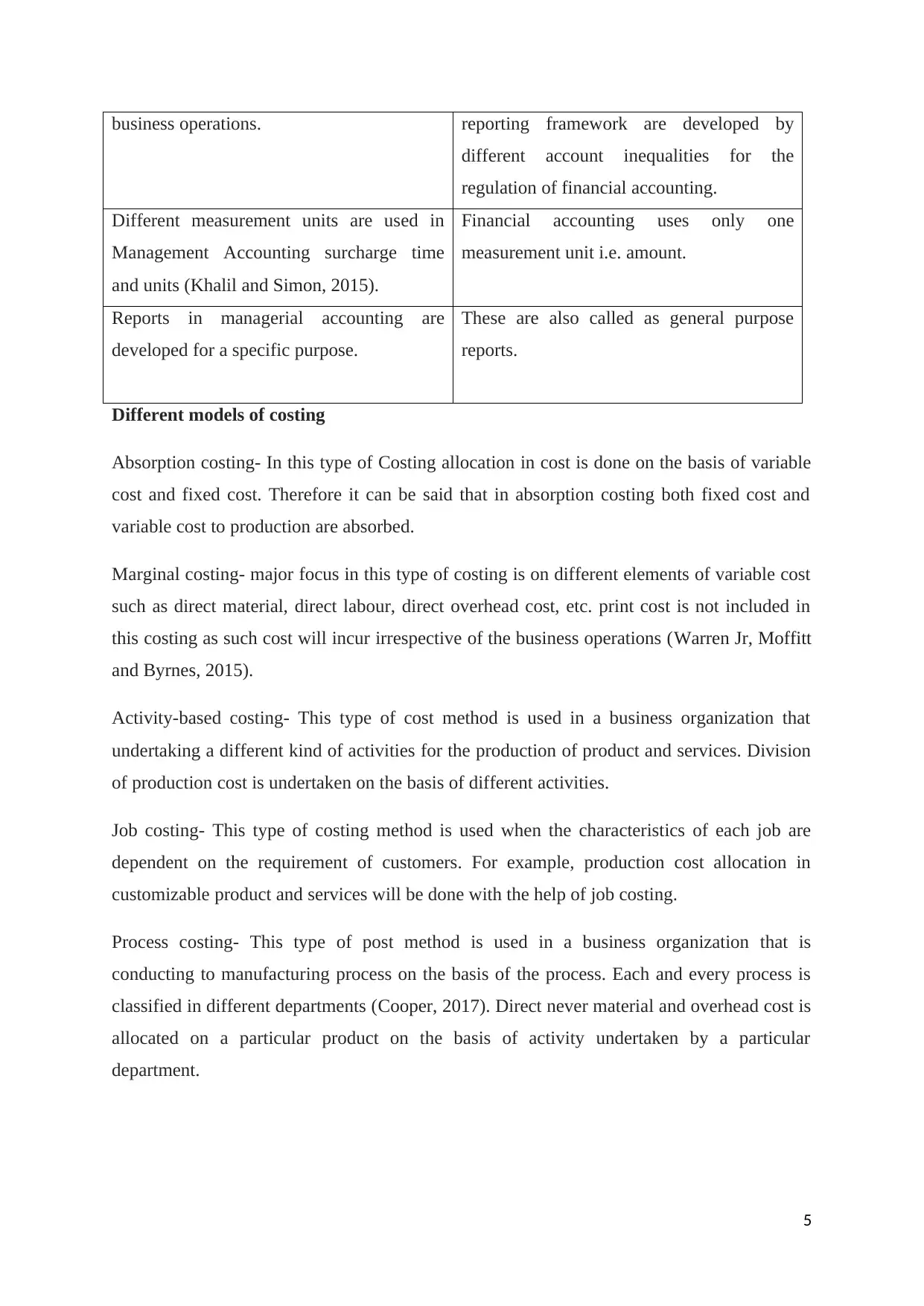
business operations. reporting framework are developed by
different account inequalities for the
regulation of financial accounting.
Different measurement units are used in
Management Accounting surcharge time
and units (Khalil and Simon, 2015).
Financial accounting uses only one
measurement unit i.e. amount.
Reports in managerial accounting are
developed for a specific purpose.
These are also called as general purpose
reports.
Different models of costing
Absorption costing- In this type of Costing allocation in cost is done on the basis of variable
cost and fixed cost. Therefore it can be said that in absorption costing both fixed cost and
variable cost to production are absorbed.
Marginal costing- major focus in this type of costing is on different elements of variable cost
such as direct material, direct labour, direct overhead cost, etc. print cost is not included in
this costing as such cost will incur irrespective of the business operations (Warren Jr, Moffitt
and Byrnes, 2015).
Activity-based costing- This type of cost method is used in a business organization that
undertaking a different kind of activities for the production of product and services. Division
of production cost is undertaken on the basis of different activities.
Job costing- This type of costing method is used when the characteristics of each job are
dependent on the requirement of customers. For example, production cost allocation in
customizable product and services will be done with the help of job costing.
Process costing- This type of post method is used in a business organization that is
conducting to manufacturing process on the basis of the process. Each and every process is
classified in different departments (Cooper, 2017). Direct never material and overhead cost is
allocated on a particular product on the basis of activity undertaken by a particular
department.
5
different account inequalities for the
regulation of financial accounting.
Different measurement units are used in
Management Accounting surcharge time
and units (Khalil and Simon, 2015).
Financial accounting uses only one
measurement unit i.e. amount.
Reports in managerial accounting are
developed for a specific purpose.
These are also called as general purpose
reports.
Different models of costing
Absorption costing- In this type of Costing allocation in cost is done on the basis of variable
cost and fixed cost. Therefore it can be said that in absorption costing both fixed cost and
variable cost to production are absorbed.
Marginal costing- major focus in this type of costing is on different elements of variable cost
such as direct material, direct labour, direct overhead cost, etc. print cost is not included in
this costing as such cost will incur irrespective of the business operations (Warren Jr, Moffitt
and Byrnes, 2015).
Activity-based costing- This type of cost method is used in a business organization that
undertaking a different kind of activities for the production of product and services. Division
of production cost is undertaken on the basis of different activities.
Job costing- This type of costing method is used when the characteristics of each job are
dependent on the requirement of customers. For example, production cost allocation in
customizable product and services will be done with the help of job costing.
Process costing- This type of post method is used in a business organization that is
conducting to manufacturing process on the basis of the process. Each and every process is
classified in different departments (Cooper, 2017). Direct never material and overhead cost is
allocated on a particular product on the basis of activity undertaken by a particular
department.
5
Investment appraisal
It is very important to evaluate the financial viability of a project before executing such a
project as a part of normal business operations. Execution of a particular project requires the
utilization of different resources in the organization that could have been used for continuing
and expanding current business operations, this is the reason that project appraisal techniques
are used to for evaluating financial viability. Different methods of a project appraisal can be
used for conducting financial viability search is not a present value method, payback period
method and internal rate of return method.
Cucumber Limited as a proposed to expand is business operations for increasing overall
productivity and revenue of the company (Baum and Crosby, 2014). Managers in the
organization as a proposed four different proposal for this expansion strategy and one
proposal are required to be accepted. All of the above-mentioned methods will be undertaken
for evaluating the financial viability of the project proposed by the management of Cucumber
Limited.
Net present value method
This is a project appraisal method that helps in evaluating the present value of future cash
inflows expected from a particular project. This present value is compared with a current
outflow of money in the form of capital investment in a particular project (Gaspars-Wieloch,
2017). A project is accepted by managers if the net present value of a particular project is
higher than zero i.e. if net inflow in a project is higher than net outflow.
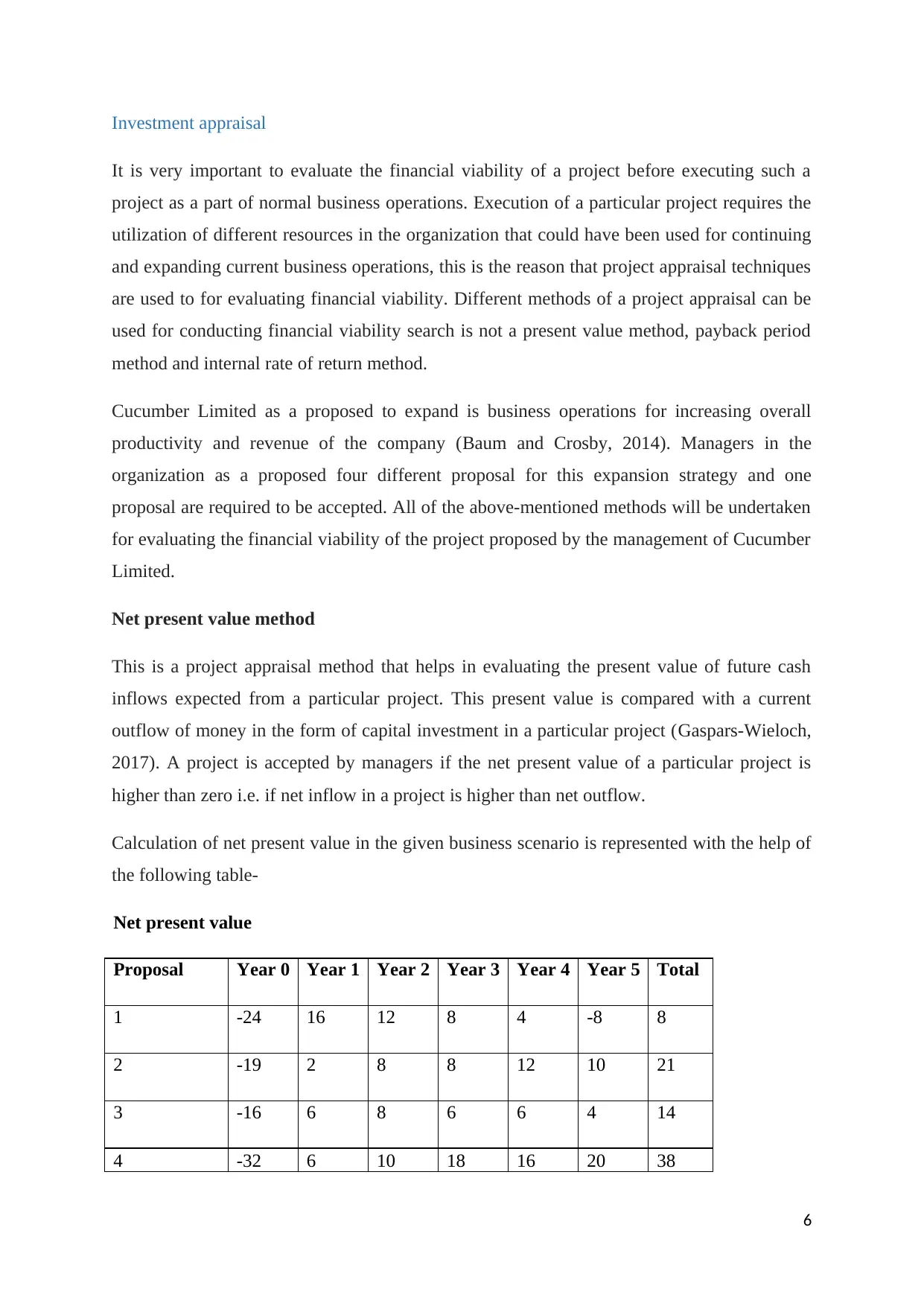
Calculation of net present value in the given business scenario is represented with the help of
the following table-
Net present value
Proposal Year 0 Year 1 Year 2 Year 3 Year 4 Year 5 Total
1 -24 16 12 8 4 -8 8
2 -19 2 8 8 12 10 21
3 -16 6 8 6 6 4 14
4 -32 6 10 18 16 20 38
6
It is very important to evaluate the financial viability of a project before executing such a
project as a part of normal business operations. Execution of a particular project requires the
utilization of different resources in the organization that could have been used for continuing
and expanding current business operations, this is the reason that project appraisal techniques
are used to for evaluating financial viability. Different methods of a project appraisal can be
used for conducting financial viability search is not a present value method, payback period
method and internal rate of return method.
Cucumber Limited as a proposed to expand is business operations for increasing overall
productivity and revenue of the company (Baum and Crosby, 2014). Managers in the
organization as a proposed four different proposal for this expansion strategy and one
proposal are required to be accepted. All of the above-mentioned methods will be undertaken
for evaluating the financial viability of the project proposed by the management of Cucumber
Limited.
Net present value method
This is a project appraisal method that helps in evaluating the present value of future cash
inflows expected from a particular project. This present value is compared with a current
outflow of money in the form of capital investment in a particular project (Gaspars-Wieloch,
2017). A project is accepted by managers if the net present value of a particular project is
higher than zero i.e. if net inflow in a project is higher than net outflow.
Calculation of net present value in the given business scenario is represented with the help of
the following table-
Net present value
Proposal Year 0 Year 1 Year 2 Year 3 Year 4 Year 5 Total
1 -24 16 12 8 4 -8 8
2 -19 2 8 8 12 10 21
3 -16 6 8 6 6 4 14
4 -32 6 10 18 16 20 38
6
⊘ This is a preview!⊘
Do you want full access?
Subscribe today to unlock all pages.
Trusted by 1+ million students worldwide
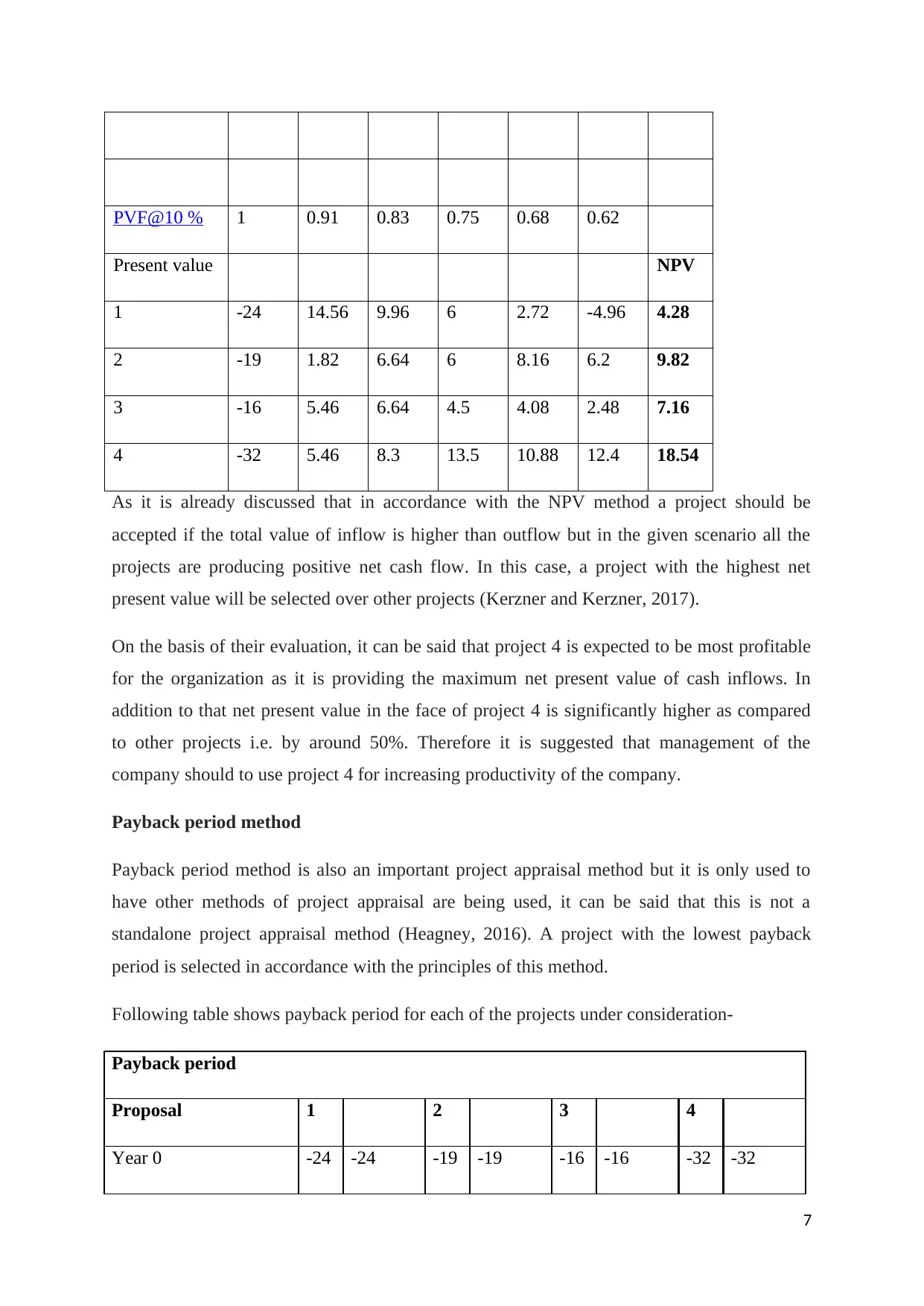
PVF@10 % 1 0.91 0.83 0.75 0.68 0.62
Present value NPV
1 -24 14.56 9.96 6 2.72 -4.96 4.28
2 -19 1.82 6.64 6 8.16 6.2 9.82
3 -16 5.46 6.64 4.5 4.08 2.48 7.16
4 -32 5.46 8.3 13.5 10.88 12.4 18.54
As it is already discussed that in accordance with the NPV method a project should be
accepted if the total value of inflow is higher than outflow but in the given scenario all the
projects are producing positive net cash flow. In this case, a project with the highest net
present value will be selected over other projects (Kerzner and Kerzner, 2017).
On the basis of their evaluation, it can be said that project 4 is expected to be most profitable
for the organization as it is providing the maximum net present value of cash inflows. In
addition to that net present value in the face of project 4 is significantly higher as compared
to other projects i.e. by around 50%. Therefore it is suggested that management of the
company should to use project 4 for increasing productivity of the company.
Payback period method
Payback period method is also an important project appraisal method but it is only used to
have other methods of project appraisal are being used, it can be said that this is not a
standalone project appraisal method (Heagney, 2016). A project with the lowest payback
period is selected in accordance with the principles of this method.
Following table shows payback period for each of the projects under consideration-
Payback period
Proposal 1 2 3 4
Year 0 -24 -24 -19 -19 -16 -16 -32 -32
7
Present value NPV
1 -24 14.56 9.96 6 2.72 -4.96 4.28
2 -19 1.82 6.64 6 8.16 6.2 9.82
3 -16 5.46 6.64 4.5 4.08 2.48 7.16
4 -32 5.46 8.3 13.5 10.88 12.4 18.54
As it is already discussed that in accordance with the NPV method a project should be
accepted if the total value of inflow is higher than outflow but in the given scenario all the
projects are producing positive net cash flow. In this case, a project with the highest net
present value will be selected over other projects (Kerzner and Kerzner, 2017).
On the basis of their evaluation, it can be said that project 4 is expected to be most profitable
for the organization as it is providing the maximum net present value of cash inflows. In
addition to that net present value in the face of project 4 is significantly higher as compared
to other projects i.e. by around 50%. Therefore it is suggested that management of the
company should to use project 4 for increasing productivity of the company.
Payback period method
Payback period method is also an important project appraisal method but it is only used to
have other methods of project appraisal are being used, it can be said that this is not a
standalone project appraisal method (Heagney, 2016). A project with the lowest payback
period is selected in accordance with the principles of this method.
Following table shows payback period for each of the projects under consideration-
Payback period
Proposal 1 2 3 4
Year 0 -24 -24 -19 -19 -16 -16 -32 -32
7
Paraphrase This Document
Need a fresh take? Get an instant paraphrase of this document with our AI Paraphraser
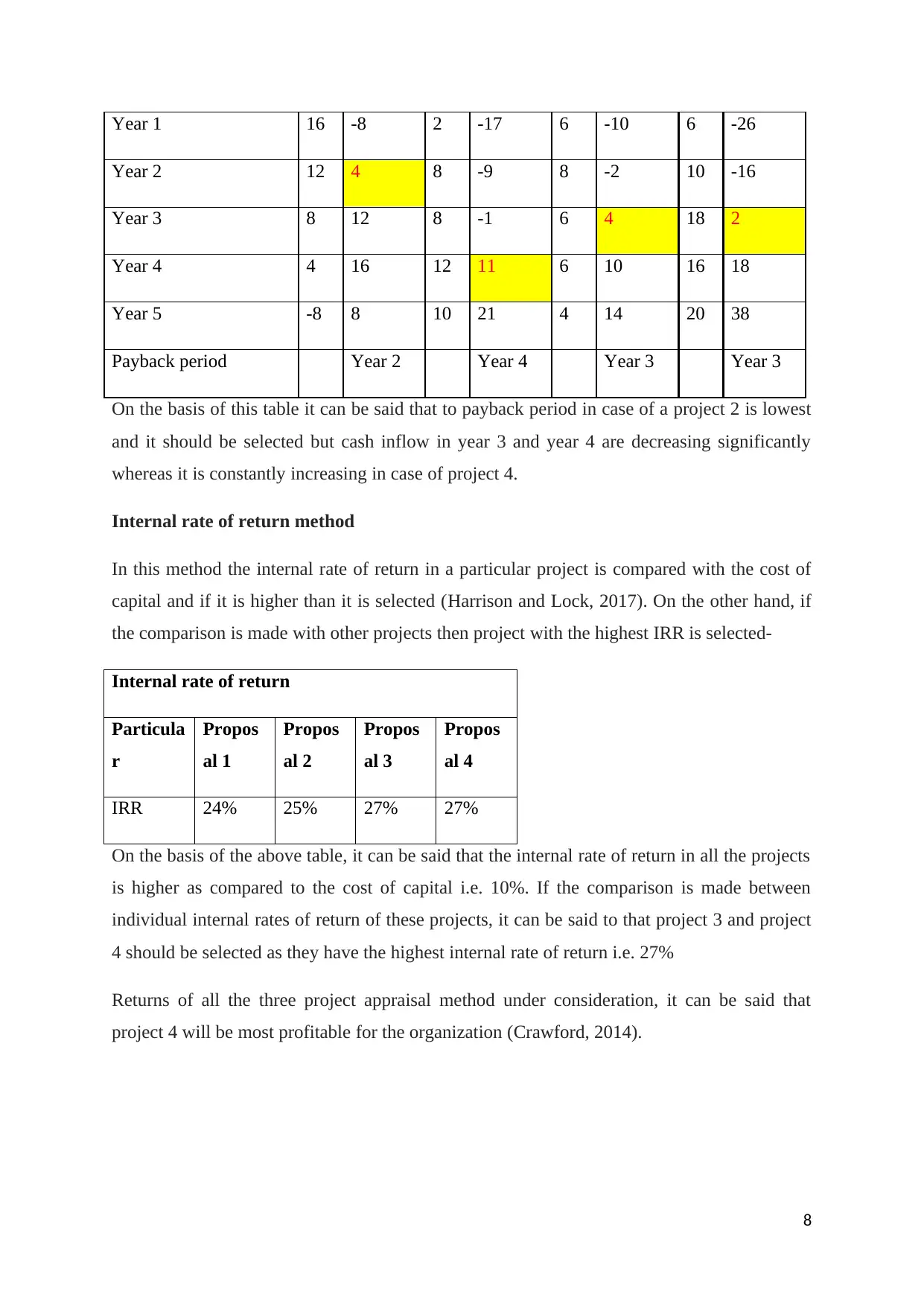
Year 1 16 -8 2 -17 6 -10 6 -26
Year 2 12 4 8 -9 8 -2 10 -16
Year 3 8 12 8 -1 6 4 18 2
Year 4 4 16 12 11 6 10 16 18
Year 5 -8 8 10 21 4 14 20 38
Payback period Year 2 Year 4 Year 3 Year 3
On the basis of this table it can be said that to payback period in case of a project 2 is lowest
and it should be selected but cash inflow in year 3 and year 4 are decreasing significantly
whereas it is constantly increasing in case of project 4.
Internal rate of return method
In this method the internal rate of return in a particular project is compared with the cost of
capital and if it is higher than it is selected (Harrison and Lock, 2017). On the other hand, if
the comparison is made with other projects then project with the highest IRR is selected-
Internal rate of return
Particula
r
Propos
al 1
Propos
al 2
Propos
al 3
Propos
al 4
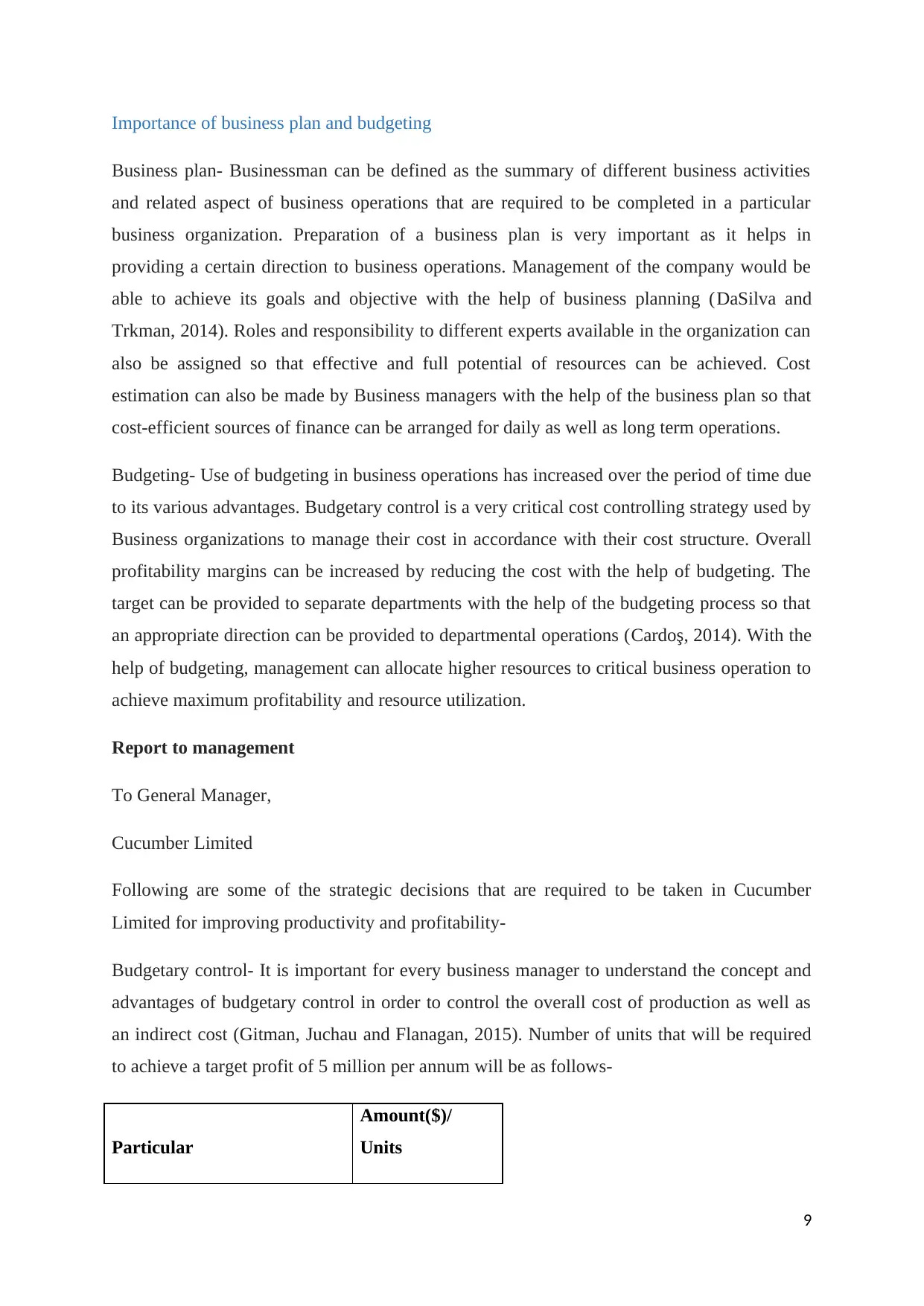
IRR 24% 25% 27% 27%
On the basis of the above table, it can be said that the internal rate of return in all the projects
is higher as compared to the cost of capital i.e. 10%. If the comparison is made between
individual internal rates of return of these projects, it can be said to that project 3 and project
4 should be selected as they have the highest internal rate of return i.e. 27%
Returns of all the three project appraisal method under consideration, it can be said that
project 4 will be most profitable for the organization (Crawford, 2014).
8
Year 2 12 4 8 -9 8 -2 10 -16
Year 3 8 12 8 -1 6 4 18 2
Year 4 4 16 12 11 6 10 16 18
Year 5 -8 8 10 21 4 14 20 38
Payback period Year 2 Year 4 Year 3 Year 3
On the basis of this table it can be said that to payback period in case of a project 2 is lowest
and it should be selected but cash inflow in year 3 and year 4 are decreasing significantly
whereas it is constantly increasing in case of project 4.
Internal rate of return method
In this method the internal rate of return in a particular project is compared with the cost of
capital and if it is higher than it is selected (Harrison and Lock, 2017). On the other hand, if
the comparison is made with other projects then project with the highest IRR is selected-
Internal rate of return
Particula
r
Propos
al 1
Propos
al 2
Propos
al 3
Propos
al 4
IRR 24% 25% 27% 27%
On the basis of the above table, it can be said that the internal rate of return in all the projects
is higher as compared to the cost of capital i.e. 10%. If the comparison is made between
individual internal rates of return of these projects, it can be said to that project 3 and project
4 should be selected as they have the highest internal rate of return i.e. 27%
Returns of all the three project appraisal method under consideration, it can be said that
project 4 will be most profitable for the organization (Crawford, 2014).
8
Importance of business plan and budgeting
Business plan- Businessman can be defined as the summary of different business activities
and related aspect of business operations that are required to be completed in a particular
business organization. Preparation of a business plan is very important as it helps in
providing a certain direction to business operations. Management of the company would be
able to achieve its goals and objective with the help of business planning (DaSilva and
Trkman, 2014). Roles and responsibility to different experts available in the organization can
also be assigned so that effective and full potential of resources can be achieved. Cost
estimation can also be made by Business managers with the help of the business plan so that
cost-efficient sources of finance can be arranged for daily as well as long term operations.
Budgeting- Use of budgeting in business operations has increased over the period of time due
to its various advantages. Budgetary control is a very critical cost controlling strategy used by
Business organizations to manage their cost in accordance with their cost structure. Overall
profitability margins can be increased by reducing the cost with the help of budgeting. The
target can be provided to separate departments with the help of the budgeting process so that
an appropriate direction can be provided to departmental operations (Cardoş, 2014). With the
help of budgeting, management can allocate higher resources to critical business operation to
achieve maximum profitability and resource utilization.
Report to management
To General Manager,
Cucumber Limited
Following are some of the strategic decisions that are required to be taken in Cucumber
Limited for improving productivity and profitability-
Budgetary control- It is important for every business manager to understand the concept and
advantages of budgetary control in order to control the overall cost of production as well as
an indirect cost (Gitman, Juchau and Flanagan, 2015). Number of units that will be required
to achieve a target profit of 5 million per annum will be as follows-
Particular
Amount($)/
Units
9
Business plan- Businessman can be defined as the summary of different business activities
and related aspect of business operations that are required to be completed in a particular
business organization. Preparation of a business plan is very important as it helps in
providing a certain direction to business operations. Management of the company would be
able to achieve its goals and objective with the help of business planning (DaSilva and
Trkman, 2014). Roles and responsibility to different experts available in the organization can
also be assigned so that effective and full potential of resources can be achieved. Cost
estimation can also be made by Business managers with the help of the business plan so that
cost-efficient sources of finance can be arranged for daily as well as long term operations.
Budgeting- Use of budgeting in business operations has increased over the period of time due
to its various advantages. Budgetary control is a very critical cost controlling strategy used by
Business organizations to manage their cost in accordance with their cost structure. Overall
profitability margins can be increased by reducing the cost with the help of budgeting. The
target can be provided to separate departments with the help of the budgeting process so that
an appropriate direction can be provided to departmental operations (Cardoş, 2014). With the
help of budgeting, management can allocate higher resources to critical business operation to
achieve maximum profitability and resource utilization.
Report to management
To General Manager,
Cucumber Limited
Following are some of the strategic decisions that are required to be taken in Cucumber
Limited for improving productivity and profitability-
Budgetary control- It is important for every business manager to understand the concept and
advantages of budgetary control in order to control the overall cost of production as well as
an indirect cost (Gitman, Juchau and Flanagan, 2015). Number of units that will be required
to achieve a target profit of 5 million per annum will be as follows-
Particular
Amount($)/
Units
9
⊘ This is a preview!⊘
Do you want full access?
Subscribe today to unlock all pages.
Trusted by 1+ million students worldwide
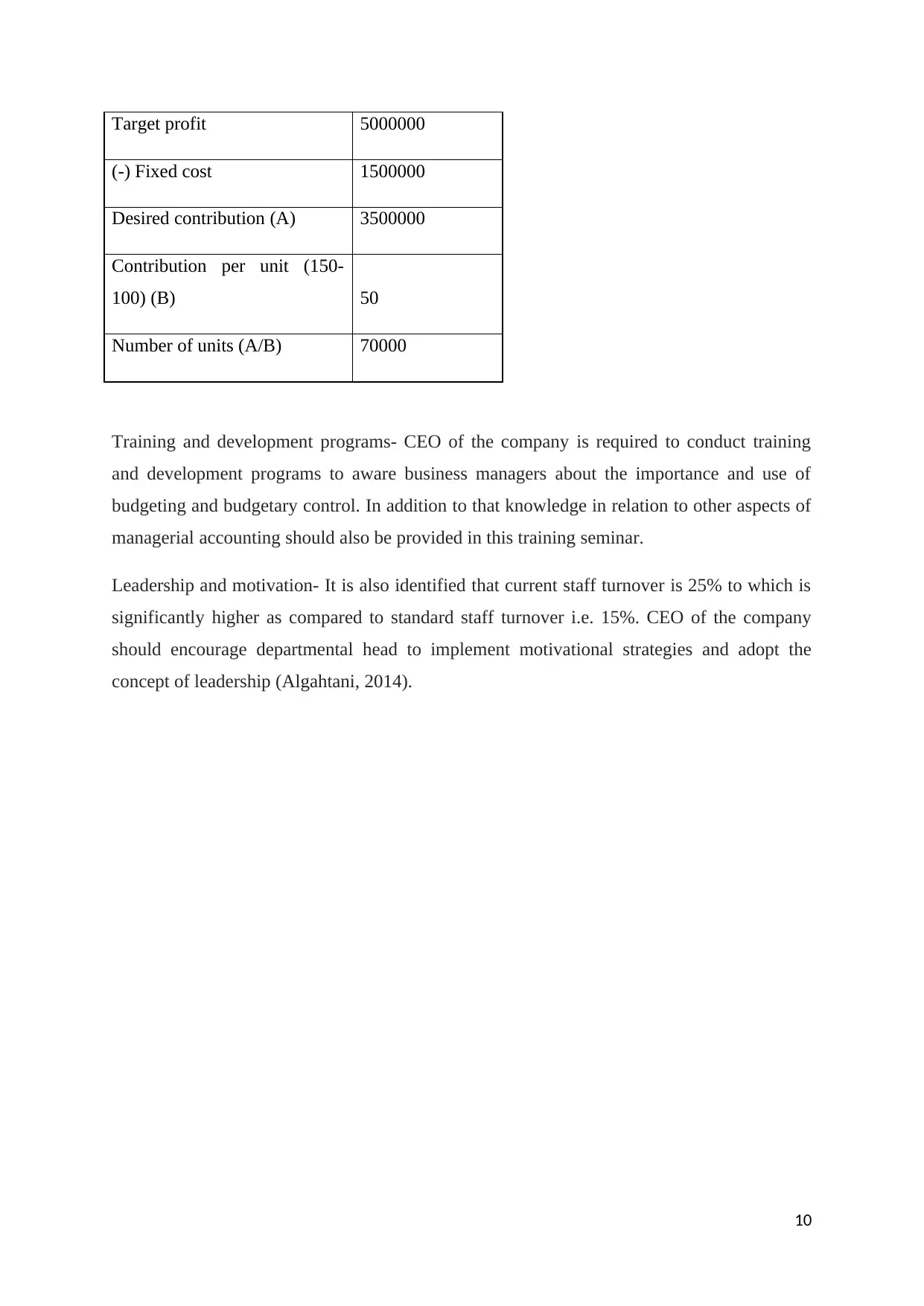
Target profit 5000000
(-) Fixed cost 1500000
Desired contribution (A) 3500000
Contribution per unit (150-
100) (B) 50
Number of units (A/B) 70000
Training and development programs- CEO of the company is required to conduct training
and development programs to aware business managers about the importance and use of
budgeting and budgetary control. In addition to that knowledge in relation to other aspects of
managerial accounting should also be provided in this training seminar.
Leadership and motivation- It is also identified that current staff turnover is 25% to which is
significantly higher as compared to standard staff turnover i.e. 15%. CEO of the company
should encourage departmental head to implement motivational strategies and adopt the
concept of leadership (Algahtani, 2014).
10
(-) Fixed cost 1500000
Desired contribution (A) 3500000
Contribution per unit (150-
100) (B) 50
Number of units (A/B) 70000
Training and development programs- CEO of the company is required to conduct training
and development programs to aware business managers about the importance and use of
budgeting and budgetary control. In addition to that knowledge in relation to other aspects of
managerial accounting should also be provided in this training seminar.
Leadership and motivation- It is also identified that current staff turnover is 25% to which is
significantly higher as compared to standard staff turnover i.e. 15%. CEO of the company
should encourage departmental head to implement motivational strategies and adopt the
concept of leadership (Algahtani, 2014).
10
Paraphrase This Document
Need a fresh take? Get an instant paraphrase of this document with our AI Paraphraser
Balanced scorecard method
Balanced scorecard methodology can be described as a performance metric that is used for
evaluating different aspects of the business. Various internal functioning in a business
organization can be improved with the help of the balanced scorecard method. Primary
advantages of using balanced scorecard method as follows-
Balanced scorecard method helps in the overall analysis of the internal performance of
the company which is very essential for making strategic decisions and improving the
current situation of the company. Currently, there are various internal issues in the
management of Cucumber Limited, balanced scorecard method can be very useful in this
scenario (Niven, 2014).
Balanced scorecard method is primarily useful in strategic management of the company
and one of the primary issues identified in case of cucumber Limited is strategic
management as business managers do not have sufficient knowledge about budgetary
control and other managerial accounting tools and techniques.
Balanced scorecard method helps in integration of long term goals and objectives into
daily operations of the company.
This methodology helps in providing a performance evaluation Framework who business
operations that can be helpful in aligning business operations in accordance with vision
and mission.
The financial health of an organization can be identified with the help of key performance
indicators provided in the balanced scorecard methodology framework (Mehralian et.al,
2017). Performance evaluation of different resources can be conducted with the help of a
balanced scorecard method which will be helpful in the identification of operational and
management issues.
Balanced scorecard for Cucumber Limited
Following are the factors that should be considered for performance evaluation in accordance
with balance for card developed for cucumber Limited. These factors can also be considered
as key performance indicators-
Financial
11
Balanced scorecard methodology can be described as a performance metric that is used for
evaluating different aspects of the business. Various internal functioning in a business
organization can be improved with the help of the balanced scorecard method. Primary
advantages of using balanced scorecard method as follows-
Balanced scorecard method helps in the overall analysis of the internal performance of
the company which is very essential for making strategic decisions and improving the
current situation of the company. Currently, there are various internal issues in the
management of Cucumber Limited, balanced scorecard method can be very useful in this
scenario (Niven, 2014).
Balanced scorecard method is primarily useful in strategic management of the company
and one of the primary issues identified in case of cucumber Limited is strategic
management as business managers do not have sufficient knowledge about budgetary
control and other managerial accounting tools and techniques.
Balanced scorecard method helps in integration of long term goals and objectives into
daily operations of the company.
This methodology helps in providing a performance evaluation Framework who business
operations that can be helpful in aligning business operations in accordance with vision
and mission.
The financial health of an organization can be identified with the help of key performance
indicators provided in the balanced scorecard methodology framework (Mehralian et.al,
2017). Performance evaluation of different resources can be conducted with the help of a
balanced scorecard method which will be helpful in the identification of operational and
management issues.
Balanced scorecard for Cucumber Limited
Following are the factors that should be considered for performance evaluation in accordance
with balance for card developed for cucumber Limited. These factors can also be considered
as key performance indicators-
Financial
11
Increased revenue - overall revenue of the company should be analysed over the period of
time in order to identify whether resources employed by the organization are adding value to
the company or not.
Increased profitability and decreased operating cost- This performance indicator will help in
evaluating the efficiency of Management to control cost with the help of effective budgeting
and budgetary control (Valmohammadi and Ahmadi, 2015). Overall profitability margin such
as gross profit and net profit should be analysed over the period of time.
Customer
Key performance indicator in relation to Customer Management has already prepared by the
organization i.e. "Excellent" customer rating should be at least 80%.
Internal processes
Current management of the company has been identified as a different kind of internal
problems. First key performance indicator should be variance identified in variance analysis
after comparing actual results with budgeted results (Mehralian et.al, 2017). Staff turnover
ratio should be another key performance indicator and it should be reduced from 25 % to
15%.
Organizational capacity
Increase of productivity- Management has proposed to implement a new project for
increasing capacity of the organization. The comparison should be made with actually
increased productivity with target productivity projected by the management.
12
time in order to identify whether resources employed by the organization are adding value to
the company or not.
Increased profitability and decreased operating cost- This performance indicator will help in
evaluating the efficiency of Management to control cost with the help of effective budgeting
and budgetary control (Valmohammadi and Ahmadi, 2015). Overall profitability margin such
as gross profit and net profit should be analysed over the period of time.
Customer
Key performance indicator in relation to Customer Management has already prepared by the
organization i.e. "Excellent" customer rating should be at least 80%.
Internal processes
Current management of the company has been identified as a different kind of internal
problems. First key performance indicator should be variance identified in variance analysis
after comparing actual results with budgeted results (Mehralian et.al, 2017). Staff turnover
ratio should be another key performance indicator and it should be reduced from 25 % to
15%.
Organizational capacity
Increase of productivity- Management has proposed to implement a new project for
increasing capacity of the organization. The comparison should be made with actually
increased productivity with target productivity projected by the management.
12
⊘ This is a preview!⊘
Do you want full access?
Subscribe today to unlock all pages.
Trusted by 1+ million students worldwide

1 out of 15


Related Documents


Your All-in-One AI-Powered Toolkit for Academic Success.
+13062052269
info@desklib.com
Available 24*7 on WhatsApp / Email
![[object Object]](/_next/static/media/star-bottom.7253800d.svg)
Unlock your academic potential
Copyright © 2020–2026 A2Z Services. All Rights Reserved. Developed and managed by ZUCOL.