Finance Report: Interest Rates, Inflation Analysis & Forecasting
VerifiedAdded on 2023/06/03
|7
|1424
|212
Report
AI Summary
This finance report analyzes interest rates and inflation in Germany and Japan, utilizing the liquidity and expectations hypotheses to forecast future trends. It incorporates real-world market data and various forecasting models, including regression analysis, to estimate future values. The report examines discount rates, bond valuations, and the relationship between coupon rates and yields, highlighting how investors' liquidity preferences influence interest rate demands. The analysis includes detailed tables presenting discount rates for German and Japanese government bonds across different maturities, along with expected inflation rates and real interest rates. The report provides a comprehensive overview of the factors influencing interest rate and inflation dynamics, offering insights into market conditions and future financial outlooks. Desklib provides this document and other study resources for students.

Running head: FINANCE
Finance
Name of the Student
Name of the University
Author Note
Finance
Name of the Student
Name of the University
Author Note
Paraphrase This Document
Need a fresh take? Get an instant paraphrase of this document with our AI Paraphraser

1FINANCE
Liquidity ad expectations hypothesis helps to predict short-term interest rate in future
depending on the present long-term interest rates. This theory suggests investors that they can
earn the same amount of interest rate through investing in bond for one year and for the next year
bond after maturing the first on (Guidolin & Thornton, 2018). This is same compare to the
purchasing of two-year bond from the present year. Hence, through this theory, investors forecast
future interest rates and take proper decisions (Bao, Hommes & Makarewicz, 2017). This theory
can be described with the help of expectations theory and liquidity preference theory.
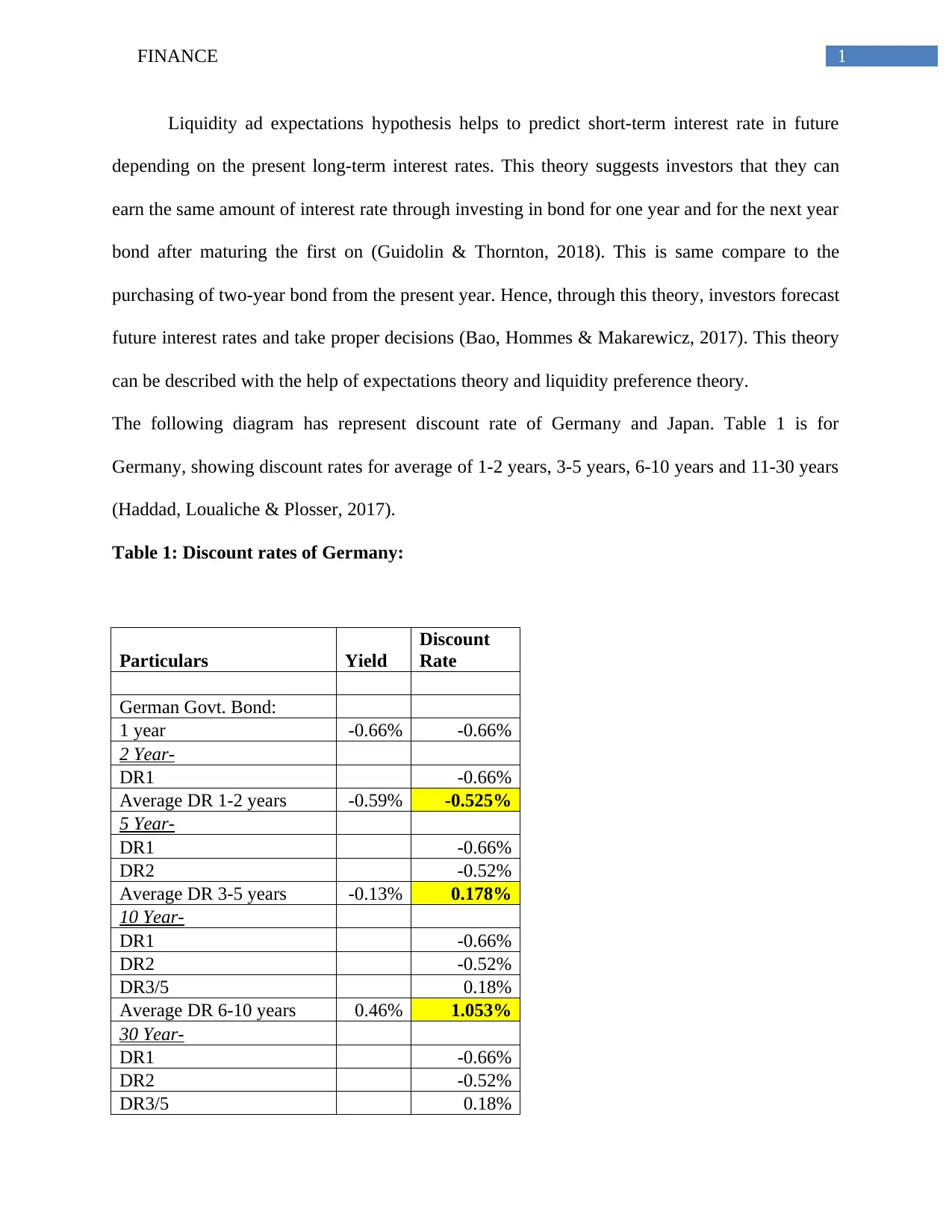
The following diagram has represent discount rate of Germany and Japan. Table 1 is for
Germany, showing discount rates for average of 1-2 years, 3-5 years, 6-10 years and 11-30 years
(Haddad, Loualiche & Plosser, 2017).
Table 1: Discount rates of Germany:
Particulars Yield
Discount
Rate
German Govt. Bond:
1 year -0.66% -0.66%
2 Year-
DR1 -0.66%
Average DR 1-2 years -0.59% -0.525%
5 Year-
DR1 -0.66%
DR2 -0.52%
Average DR 3-5 years -0.13% 0.178%
10 Year-
DR1 -0.66%
DR2 -0.52%
DR3/5 0.18%
Average DR 6-10 years 0.46% 1.053%
30 Year-
DR1 -0.66%
DR2 -0.52%
DR3/5 0.18%
Liquidity ad expectations hypothesis helps to predict short-term interest rate in future
depending on the present long-term interest rates. This theory suggests investors that they can
earn the same amount of interest rate through investing in bond for one year and for the next year
bond after maturing the first on (Guidolin & Thornton, 2018). This is same compare to the
purchasing of two-year bond from the present year. Hence, through this theory, investors forecast
future interest rates and take proper decisions (Bao, Hommes & Makarewicz, 2017). This theory
can be described with the help of expectations theory and liquidity preference theory.
The following diagram has represent discount rate of Germany and Japan. Table 1 is for
Germany, showing discount rates for average of 1-2 years, 3-5 years, 6-10 years and 11-30 years
(Haddad, Loualiche & Plosser, 2017).
Table 1: Discount rates of Germany:
Particulars Yield
Discount
Rate
German Govt. Bond:
1 year -0.66% -0.66%
2 Year-
DR1 -0.66%
Average DR 1-2 years -0.59% -0.525%
5 Year-
DR1 -0.66%
DR2 -0.52%
Average DR 3-5 years -0.13% 0.178%
10 Year-
DR1 -0.66%
DR2 -0.52%
DR3/5 0.18%
Average DR 6-10 years 0.46% 1.053%
30 Year-
DR1 -0.66%
DR2 -0.52%
DR3/5 0.18%

2FINANCE
DR6/10 1.05%
Average DR 11-30 years 1.09% 1.406%
Source: (World Government Bonds, 2018)
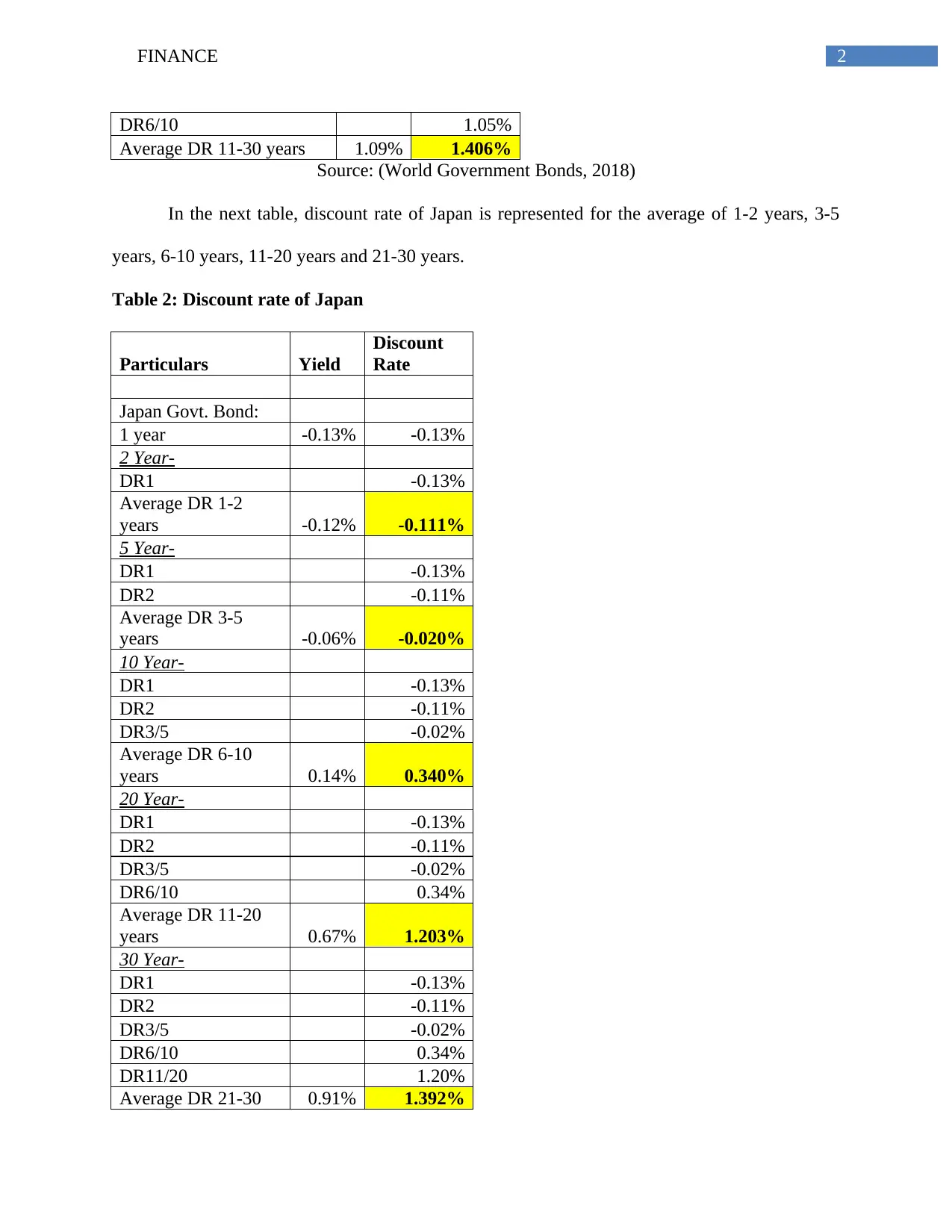
In the next table, discount rate of Japan is represented for the average of 1-2 years, 3-5
years, 6-10 years, 11-20 years and 21-30 years.
Table 2: Discount rate of Japan
Particulars Yield
Discount
Rate
Japan Govt. Bond:
1 year -0.13% -0.13%
2 Year-
DR1 -0.13%
Average DR 1-2
years -0.12% -0.111%
5 Year-
DR1 -0.13%
DR2 -0.11%
Average DR 3-5
years -0.06% -0.020%
10 Year-
DR1 -0.13%
DR2 -0.11%
DR3/5 -0.02%
Average DR 6-10
years 0.14% 0.340%
20 Year-
DR1 -0.13%
DR2 -0.11%
DR3/5 -0.02%
DR6/10 0.34%
Average DR 11-20
years 0.67% 1.203%
30 Year-
DR1 -0.13%
DR2 -0.11%
DR3/5 -0.02%
DR6/10 0.34%
DR11/20 1.20%
Average DR 21-30 0.91% 1.392%
DR6/10 1.05%
Average DR 11-30 years 1.09% 1.406%
Source: (World Government Bonds, 2018)
In the next table, discount rate of Japan is represented for the average of 1-2 years, 3-5
years, 6-10 years, 11-20 years and 21-30 years.
Table 2: Discount rate of Japan
Particulars Yield
Discount
Rate
Japan Govt. Bond:
1 year -0.13% -0.13%
2 Year-
DR1 -0.13%
Average DR 1-2
years -0.12% -0.111%
5 Year-
DR1 -0.13%
DR2 -0.11%
Average DR 3-5
years -0.06% -0.020%
10 Year-
DR1 -0.13%
DR2 -0.11%
DR3/5 -0.02%
Average DR 6-10
years 0.14% 0.340%
20 Year-
DR1 -0.13%
DR2 -0.11%
DR3/5 -0.02%
DR6/10 0.34%
Average DR 11-20
years 0.67% 1.203%
30 Year-
DR1 -0.13%
DR2 -0.11%
DR3/5 -0.02%
DR6/10 0.34%
DR11/20 1.20%
Average DR 21-30 0.91% 1.392%
⊘ This is a preview!⊘
Do you want full access?
Subscribe today to unlock all pages.

Trusted by 1+ million students worldwide

3FINANCE
years
Source: (World Government Bonds, 2018)
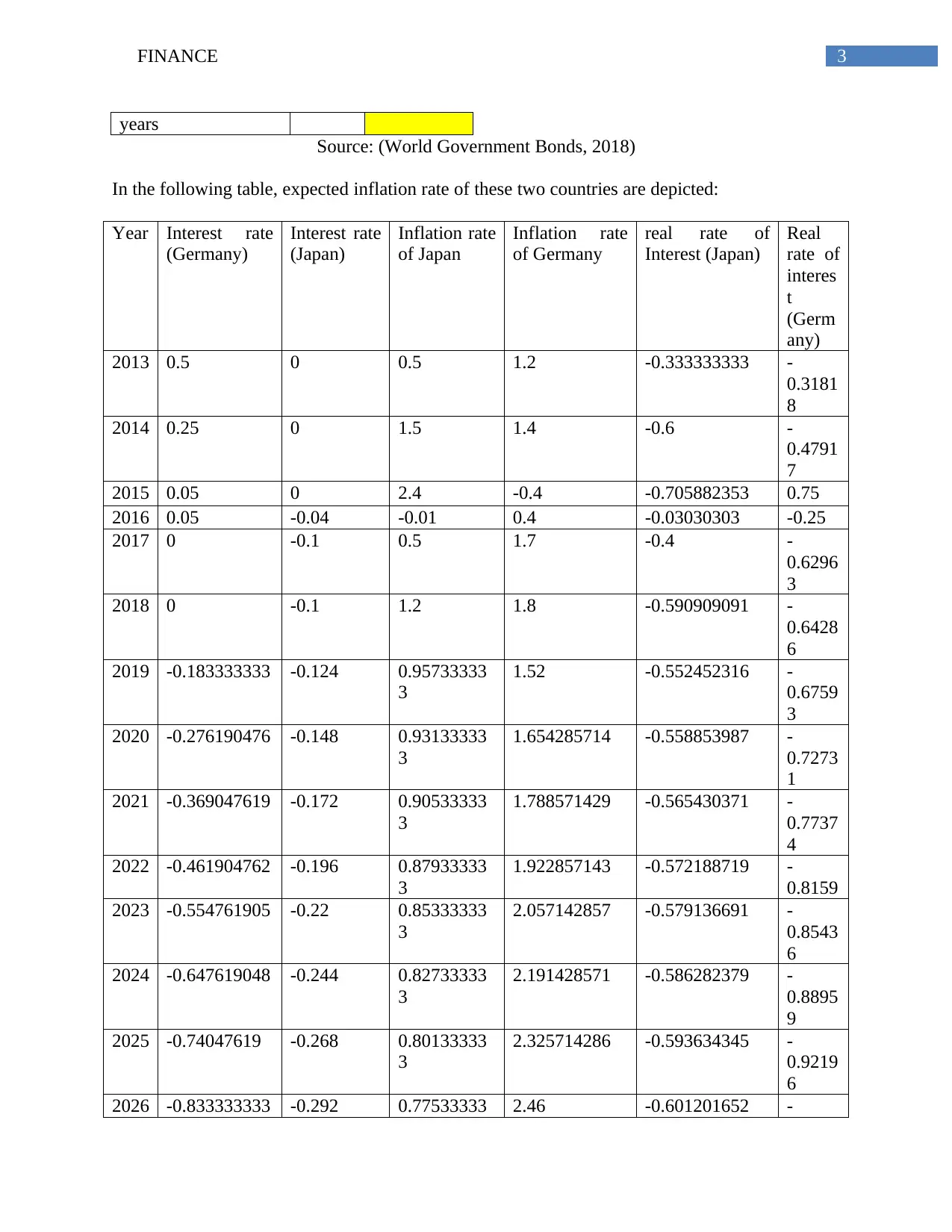
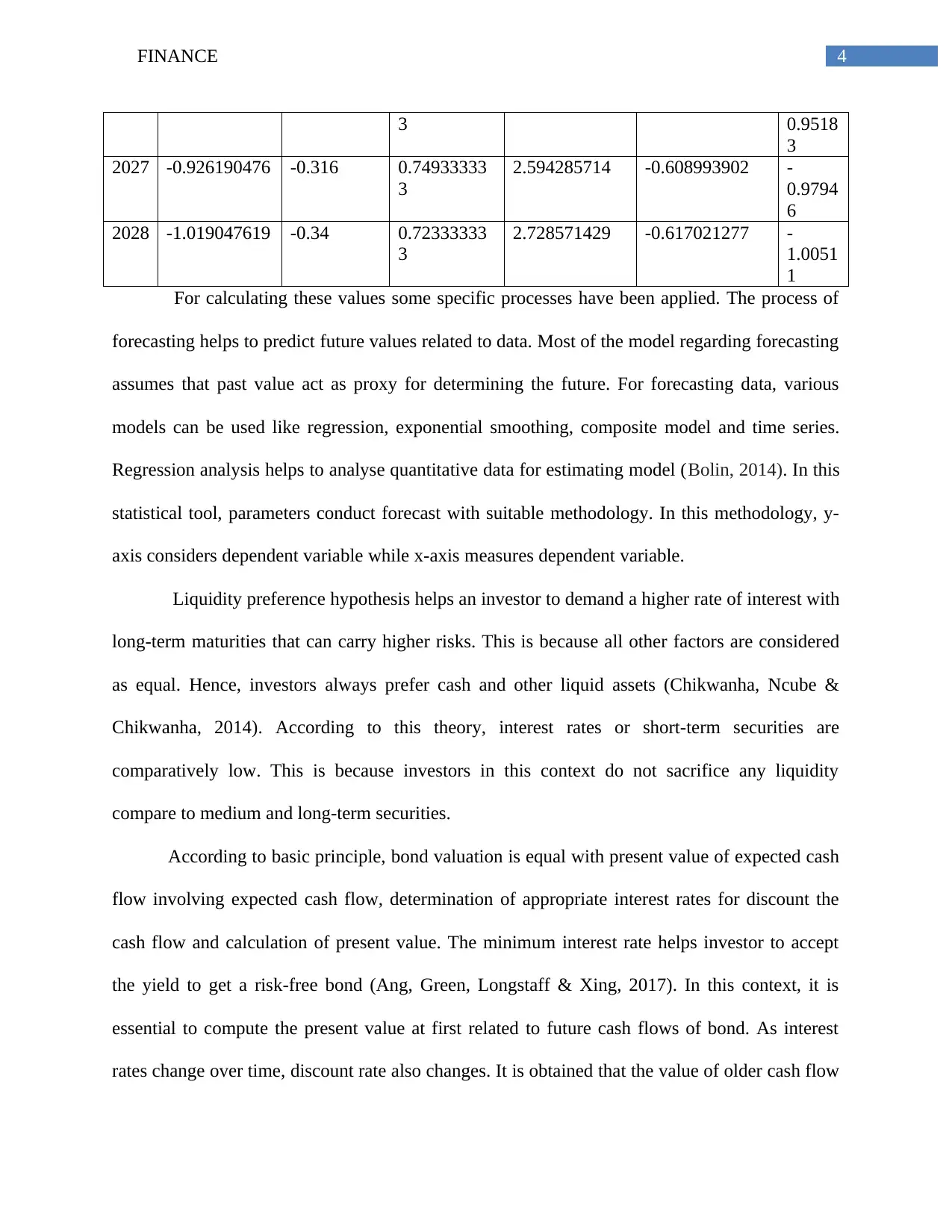
In the following table, expected inflation rate of these two countries are depicted:
Year Interest rate
(Germany)
Interest rate
(Japan)
Inflation rate
of Japan
Inflation rate
of Germany
real rate of
Interest (Japan)
Real
rate of
interes
t
(Germ
any)
2013 0.5 0 0.5 1.2 -0.333333333 -
0.3181
8
2014 0.25 0 1.5 1.4 -0.6 -
0.4791
7
2015 0.05 0 2.4 -0.4 -0.705882353 0.75
2016 0.05 -0.04 -0.01 0.4 -0.03030303 -0.25
2017 0 -0.1 0.5 1.7 -0.4 -
0.6296
3
2018 0 -0.1 1.2 1.8 -0.590909091 -
0.6428
6
2019 -0.183333333 -0.124 0.95733333
3
1.52 -0.552452316 -
0.6759
3
2020 -0.276190476 -0.148 0.93133333
3
1.654285714 -0.558853987 -
0.7273
1
2021 -0.369047619 -0.172 0.90533333
3
1.788571429 -0.565430371 -
0.7737
4
2022 -0.461904762 -0.196 0.87933333
3
1.922857143 -0.572188719 -
0.8159
2023 -0.554761905 -0.22 0.85333333
3
2.057142857 -0.579136691 -
0.8543
6
2024 -0.647619048 -0.244 0.82733333
3
2.191428571 -0.586282379 -
0.8895
9
2025 -0.74047619 -0.268 0.80133333
3
2.325714286 -0.593634345 -
0.9219
6
2026 -0.833333333 -0.292 0.77533333 2.46 -0.601201652 -
years
Source: (World Government Bonds, 2018)
In the following table, expected inflation rate of these two countries are depicted:
Year Interest rate
(Germany)
Interest rate
(Japan)
Inflation rate
of Japan
Inflation rate
of Germany
real rate of
Interest (Japan)
Real
rate of
interes
t
(Germ
any)
2013 0.5 0 0.5 1.2 -0.333333333 -
0.3181
8
2014 0.25 0 1.5 1.4 -0.6 -
0.4791
7
2015 0.05 0 2.4 -0.4 -0.705882353 0.75
2016 0.05 -0.04 -0.01 0.4 -0.03030303 -0.25
2017 0 -0.1 0.5 1.7 -0.4 -
0.6296
3
2018 0 -0.1 1.2 1.8 -0.590909091 -
0.6428
6
2019 -0.183333333 -0.124 0.95733333
3
1.52 -0.552452316 -
0.6759
3
2020 -0.276190476 -0.148 0.93133333
3
1.654285714 -0.558853987 -
0.7273
1
2021 -0.369047619 -0.172 0.90533333
3
1.788571429 -0.565430371 -
0.7737
4
2022 -0.461904762 -0.196 0.87933333
3
1.922857143 -0.572188719 -
0.8159
2023 -0.554761905 -0.22 0.85333333
3
2.057142857 -0.579136691 -
0.8543
6
2024 -0.647619048 -0.244 0.82733333
3
2.191428571 -0.586282379 -
0.8895
9
2025 -0.74047619 -0.268 0.80133333
3
2.325714286 -0.593634345 -
0.9219
6
2026 -0.833333333 -0.292 0.77533333 2.46 -0.601201652 -
Paraphrase This Document
Need a fresh take? Get an instant paraphrase of this document with our AI Paraphraser

4FINANCE
3 0.9518
3
2027 -0.926190476 -0.316 0.74933333
3
2.594285714 -0.608993902 -
0.9794
6
2028 -1.019047619 -0.34 0.72333333
3
2.728571429 -0.617021277 -
1.0051
1
For calculating these values some specific processes have been applied. The process of
forecasting helps to predict future values related to data. Most of the model regarding forecasting
assumes that past value act as proxy for determining the future. For forecasting data, various
models can be used like regression, exponential smoothing, composite model and time series.
Regression analysis helps to analyse quantitative data for estimating model (Bolin, 2014). In this
statistical tool, parameters conduct forecast with suitable methodology. In this methodology, y-
axis considers dependent variable while x-axis measures dependent variable.
Liquidity preference hypothesis helps an investor to demand a higher rate of interest with
long-term maturities that can carry higher risks. This is because all other factors are considered
as equal. Hence, investors always prefer cash and other liquid assets (Chikwanha, Ncube &
Chikwanha, 2014). According to this theory, interest rates or short-term securities are
comparatively low. This is because investors in this context do not sacrifice any liquidity
compare to medium and long-term securities.
According to basic principle, bond valuation is equal with present value of expected cash
flow involving expected cash flow, determination of appropriate interest rates for discount the
cash flow and calculation of present value. The minimum interest rate helps investor to accept
the yield to get a risk-free bond (Ang, Green, Longstaff & Xing, 2017). In this context, it is
essential to compute the present value at first related to future cash flows of bond. As interest
rates change over time, discount rate also changes. It is obtained that the value of older cash flow
3 0.9518
3
2027 -0.926190476 -0.316 0.74933333
3
2.594285714 -0.608993902 -
0.9794
6
2028 -1.019047619 -0.34 0.72333333
3
2.728571429 -0.617021277 -
1.0051
1
For calculating these values some specific processes have been applied. The process of
forecasting helps to predict future values related to data. Most of the model regarding forecasting
assumes that past value act as proxy for determining the future. For forecasting data, various
models can be used like regression, exponential smoothing, composite model and time series.
Regression analysis helps to analyse quantitative data for estimating model (Bolin, 2014). In this
statistical tool, parameters conduct forecast with suitable methodology. In this methodology, y-
axis considers dependent variable while x-axis measures dependent variable.
Liquidity preference hypothesis helps an investor to demand a higher rate of interest with
long-term maturities that can carry higher risks. This is because all other factors are considered
as equal. Hence, investors always prefer cash and other liquid assets (Chikwanha, Ncube &
Chikwanha, 2014). According to this theory, interest rates or short-term securities are
comparatively low. This is because investors in this context do not sacrifice any liquidity
compare to medium and long-term securities.
According to basic principle, bond valuation is equal with present value of expected cash
flow involving expected cash flow, determination of appropriate interest rates for discount the
cash flow and calculation of present value. The minimum interest rate helps investor to accept
the yield to get a risk-free bond (Ang, Green, Longstaff & Xing, 2017). In this context, it is
essential to compute the present value at first related to future cash flows of bond. As interest
rates change over time, discount rate also changes. It is obtained that the value of older cash flow

5FINANCE
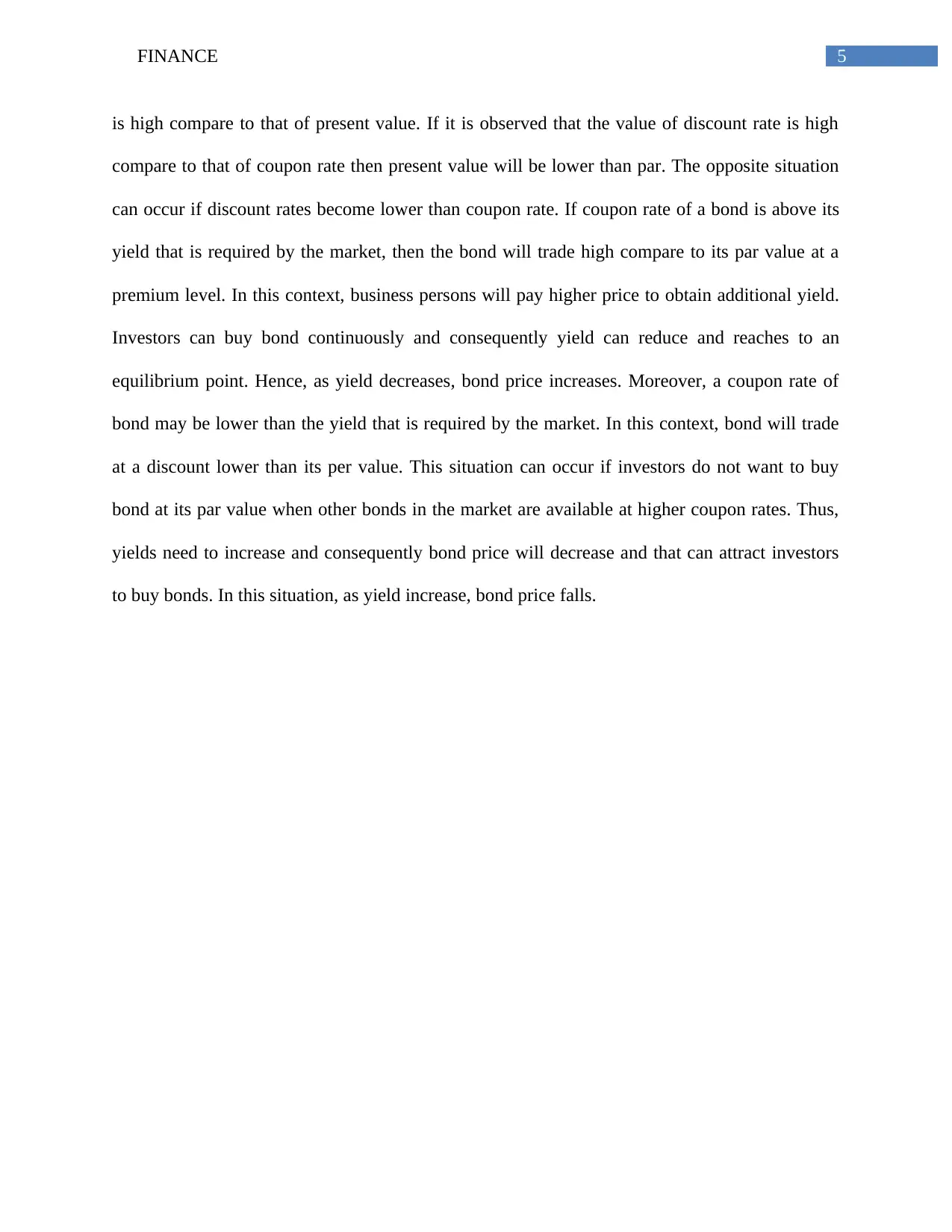
is high compare to that of present value. If it is observed that the value of discount rate is high
compare to that of coupon rate then present value will be lower than par. The opposite situation
can occur if discount rates become lower than coupon rate. If coupon rate of a bond is above its
yield that is required by the market, then the bond will trade high compare to its par value at a
premium level. In this context, business persons will pay higher price to obtain additional yield.
Investors can buy bond continuously and consequently yield can reduce and reaches to an
equilibrium point. Hence, as yield decreases, bond price increases. Moreover, a coupon rate of
bond may be lower than the yield that is required by the market. In this context, bond will trade
at a discount lower than its per value. This situation can occur if investors do not want to buy
bond at its par value when other bonds in the market are available at higher coupon rates. Thus,
yields need to increase and consequently bond price will decrease and that can attract investors
to buy bonds. In this situation, as yield increase, bond price falls.
is high compare to that of present value. If it is observed that the value of discount rate is high
compare to that of coupon rate then present value will be lower than par. The opposite situation
can occur if discount rates become lower than coupon rate. If coupon rate of a bond is above its
yield that is required by the market, then the bond will trade high compare to its par value at a
premium level. In this context, business persons will pay higher price to obtain additional yield.
Investors can buy bond continuously and consequently yield can reduce and reaches to an
equilibrium point. Hence, as yield decreases, bond price increases. Moreover, a coupon rate of
bond may be lower than the yield that is required by the market. In this context, bond will trade
at a discount lower than its per value. This situation can occur if investors do not want to buy
bond at its par value when other bonds in the market are available at higher coupon rates. Thus,
yields need to increase and consequently bond price will decrease and that can attract investors
to buy bonds. In this situation, as yield increase, bond price falls.
⊘ This is a preview!⊘
Do you want full access?
Subscribe today to unlock all pages.

Trusted by 1+ million students worldwide

6FINANCE
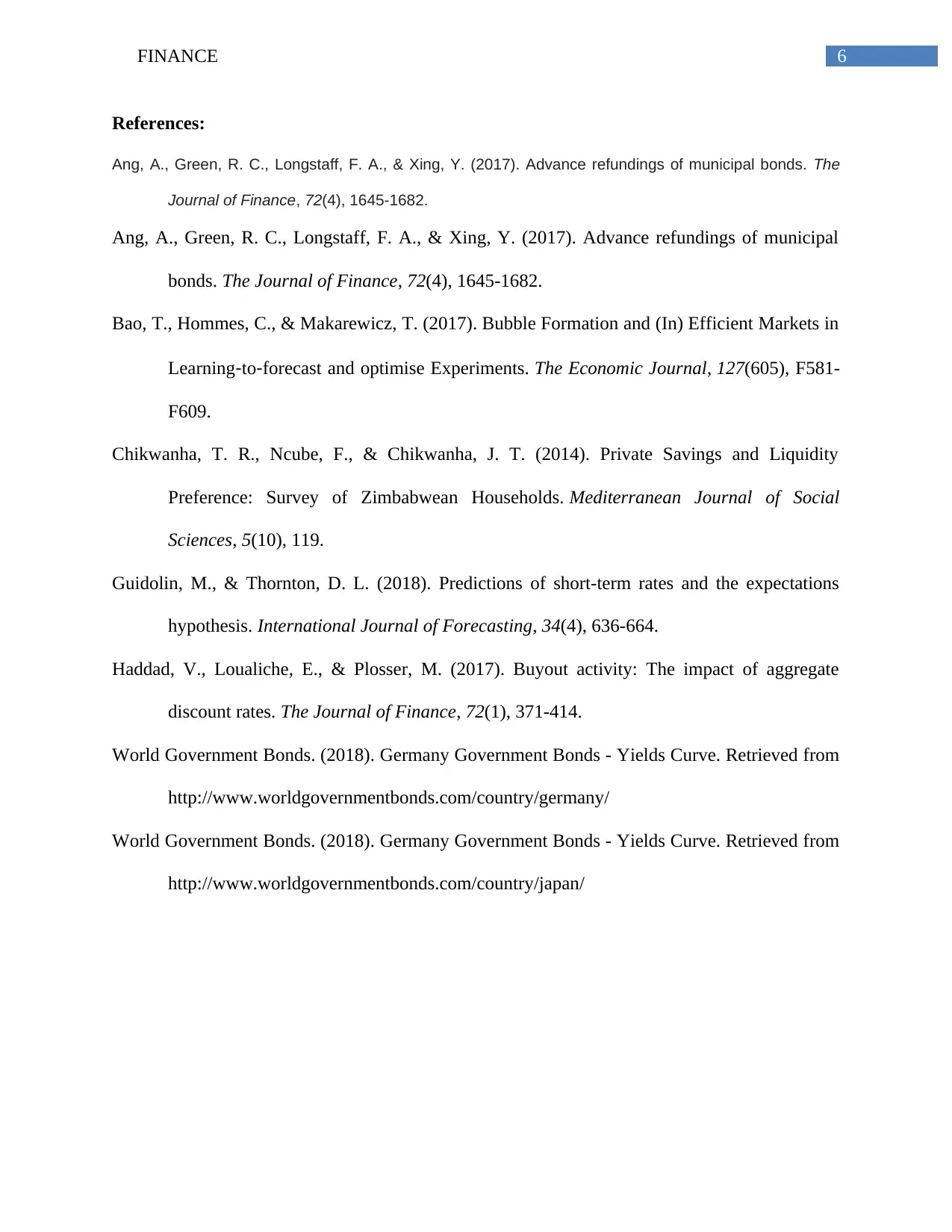
References:
Ang, A., Green, R. C., Longstaff, F. A., & Xing, Y. (2017). Advance refundings of municipal bonds. The
Journal of Finance, 72(4), 1645-1682.
Ang, A., Green, R. C., Longstaff, F. A., & Xing, Y. (2017). Advance refundings of municipal
bonds. The Journal of Finance, 72(4), 1645-1682.
Bao, T., Hommes, C., & Makarewicz, T. (2017). Bubble Formation and (In) Efficient Markets in
Learning‐to‐forecast and optimise Experiments. The Economic Journal, 127(605), F581-
F609.
Chikwanha, T. R., Ncube, F., & Chikwanha, J. T. (2014). Private Savings and Liquidity
Preference: Survey of Zimbabwean Households. Mediterranean Journal of Social
Sciences, 5(10), 119.
Guidolin, M., & Thornton, D. L. (2018). Predictions of short-term rates and the expectations
hypothesis. International Journal of Forecasting, 34(4), 636-664.
Haddad, V., Loualiche, E., & Plosser, M. (2017). Buyout activity: The impact of aggregate
discount rates. The Journal of Finance, 72(1), 371-414.
World Government Bonds. (2018). Germany Government Bonds - Yields Curve. Retrieved from
http://www.worldgovernmentbonds.com/country/germany/
World Government Bonds. (2018). Germany Government Bonds - Yields Curve. Retrieved from
http://www.worldgovernmentbonds.com/country/japan/
References:
Ang, A., Green, R. C., Longstaff, F. A., & Xing, Y. (2017). Advance refundings of municipal bonds. The
Journal of Finance, 72(4), 1645-1682.
Ang, A., Green, R. C., Longstaff, F. A., & Xing, Y. (2017). Advance refundings of municipal
bonds. The Journal of Finance, 72(4), 1645-1682.
Bao, T., Hommes, C., & Makarewicz, T. (2017). Bubble Formation and (In) Efficient Markets in
Learning‐to‐forecast and optimise Experiments. The Economic Journal, 127(605), F581-
F609.
Chikwanha, T. R., Ncube, F., & Chikwanha, J. T. (2014). Private Savings and Liquidity
Preference: Survey of Zimbabwean Households. Mediterranean Journal of Social
Sciences, 5(10), 119.
Guidolin, M., & Thornton, D. L. (2018). Predictions of short-term rates and the expectations
hypothesis. International Journal of Forecasting, 34(4), 636-664.
Haddad, V., Loualiche, E., & Plosser, M. (2017). Buyout activity: The impact of aggregate
discount rates. The Journal of Finance, 72(1), 371-414.
World Government Bonds. (2018). Germany Government Bonds - Yields Curve. Retrieved from
http://www.worldgovernmentbonds.com/country/germany/
World Government Bonds. (2018). Germany Government Bonds - Yields Curve. Retrieved from
http://www.worldgovernmentbonds.com/country/japan/
1 out of 7
Related Documents
Your All-in-One AI-Powered Toolkit for Academic Success.
+13062052269
info@desklib.com
Available 24*7 on WhatsApp / Email
Unlock your academic potential
Copyright © 2020–2025 A2Z Services. All Rights Reserved. Developed and managed by ZUCOL.