University Finance Report: Working Capital Management of XYZ Company

Verified

Added on  2022/11/28

|6
|1002
|156
Report
AI Summary
This report provides a comprehensive analysis of working capital management for XYZ Company, focusing on key financial aspects. The report begins by defining operating expenses and identifying relevant items from the income statement and balance sheet, explaining their significance in working capital management. It then calculates the net working capital for XYZ Company, providing an interpretation of the results and assessing the company's liquidity position. Furthermore, the report delves into the relationship between profitability, liquidity, and risk within the context of working capital management, using financial ratios to evaluate the company's performance and strategy. The analysis concludes with a summary of findings and suggestions for optimizing working capital components, based on the provided financial data and relevant financial principles. This report aims to demonstrate an understanding of financial principles and practices, applying various techniques to support financial decisions.
Document Page
Running head: WORKING CAPITAL MANAGEMENT
Working capital management
Name of the Student:
Name of the University:
Author’s Note:
Course ID:
tabler-icon-diamond-filled.svg

Paraphrase This Document

Need a fresh take? Get an instant paraphrase of this document with our AI Paraphraser
Document Page
1
WORKING CAPITAL MANAGEMENT
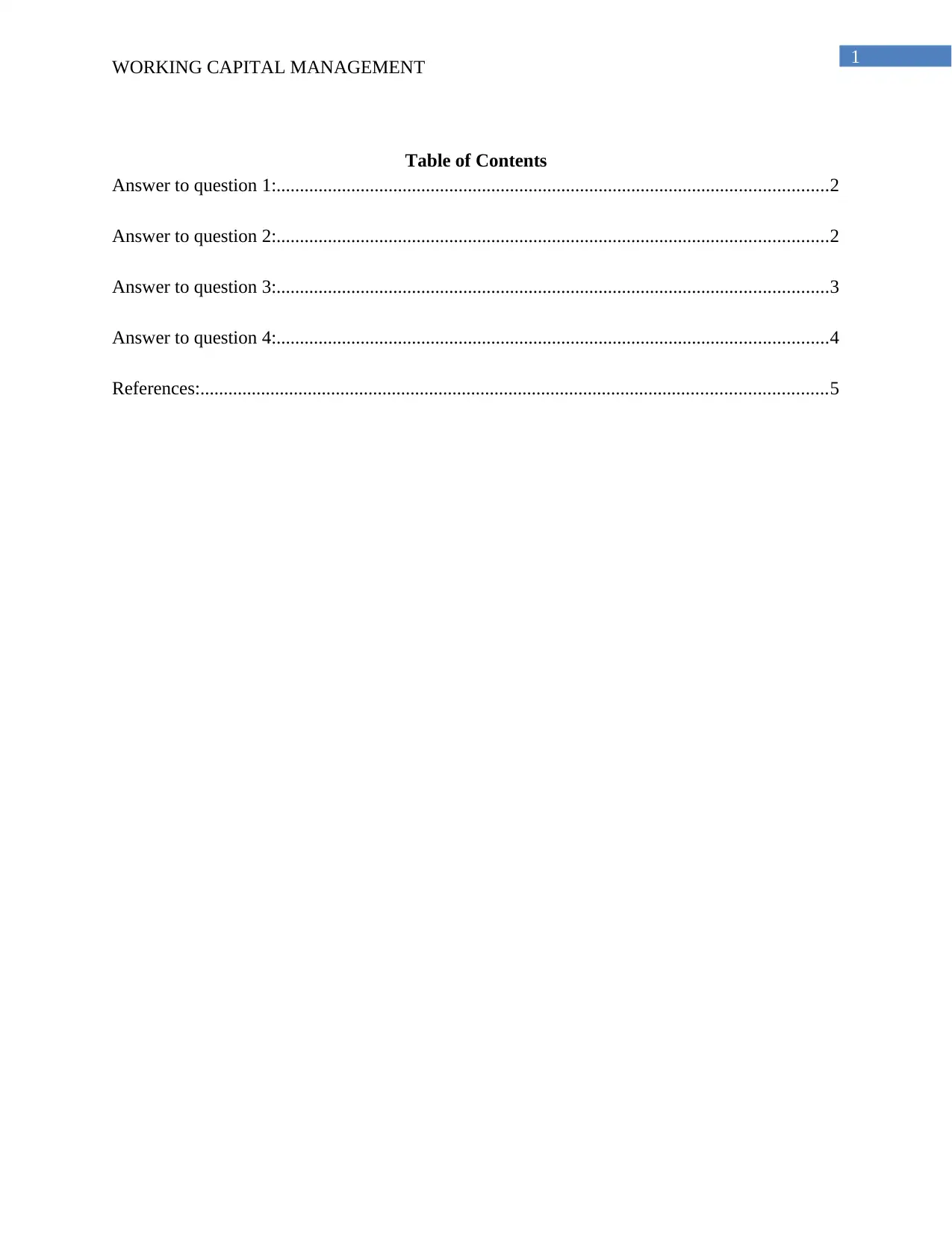
Table of Contents
Answer to question 1:......................................................................................................................2
Answer to question 2:......................................................................................................................2
Answer to question 3:......................................................................................................................3
Answer to question 4:......................................................................................................................4
References:......................................................................................................................................5
Document Page
2
WORKING CAPITAL MANAGEMENT
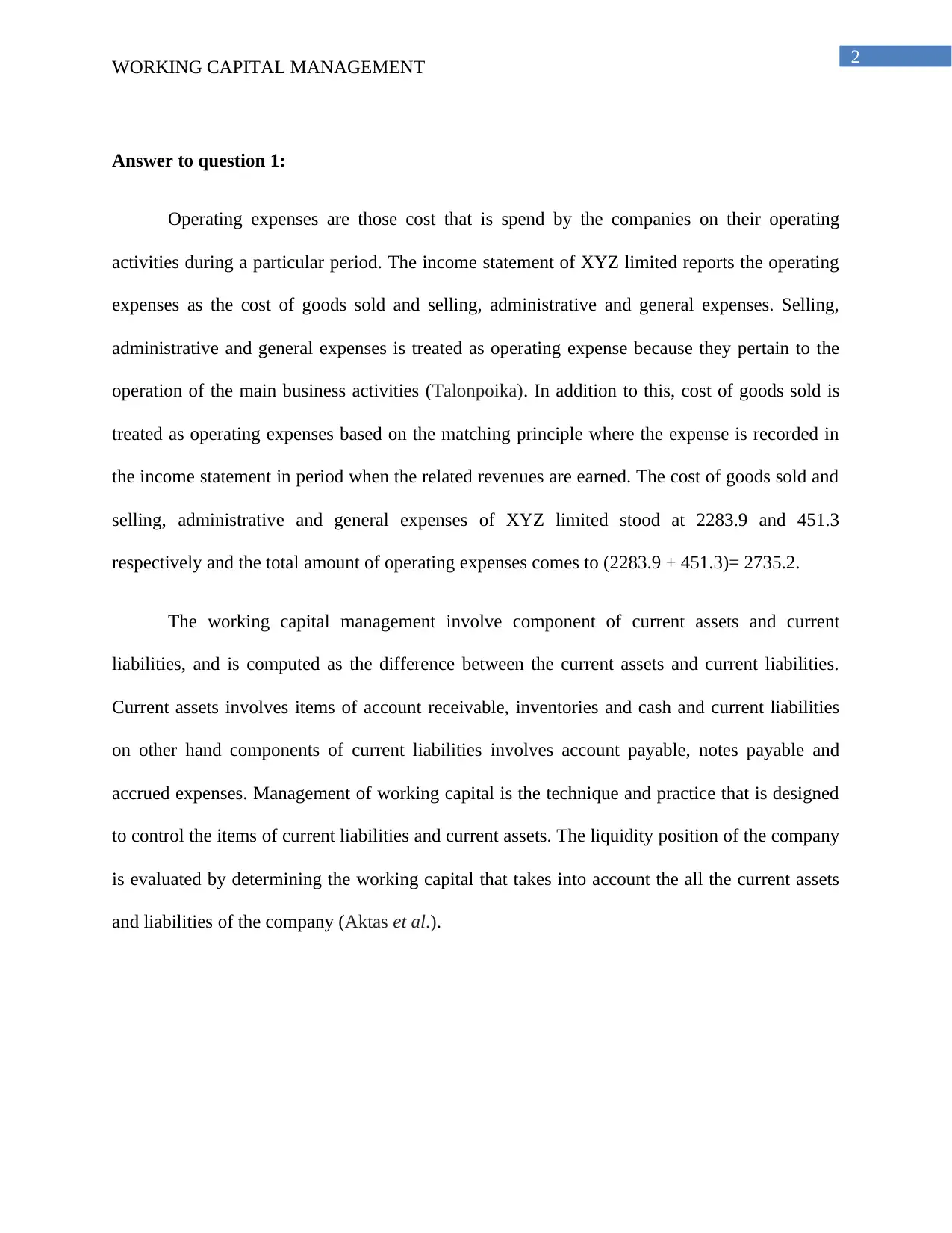
Answer to question 1:
Operating expenses are those cost that is spend by the companies on their operating
activities during a particular period. The income statement of XYZ limited reports the operating
expenses as the cost of goods sold and selling, administrative and general expenses. Selling,
administrative and general expenses is treated as operating expense because they pertain to the
operation of the main business activities (Talonpoika). In addition to this, cost of goods sold is
treated as operating expenses based on the matching principle where the expense is recorded in
the income statement in period when the related revenues are earned. The cost of goods sold and
selling, administrative and general expenses of XYZ limited stood at 2283.9 and 451.3
respectively and the total amount of operating expenses comes to (2283.9 + 451.3)= 2735.2.
The working capital management involve component of current assets and current
liabilities, and is computed as the difference between the current assets and current liabilities.
Current assets involves items of account receivable, inventories and cash and current liabilities
on other hand components of current liabilities involves account payable, notes payable and
accrued expenses. Management of working capital is the technique and practice that is designed
to control the items of current liabilities and current assets. The liquidity position of the company
is evaluated by determining the working capital that takes into account the all the current assets
and liabilities of the company (Aktas et al.).
Document Page
3
WORKING CAPITAL MANAGEMENT
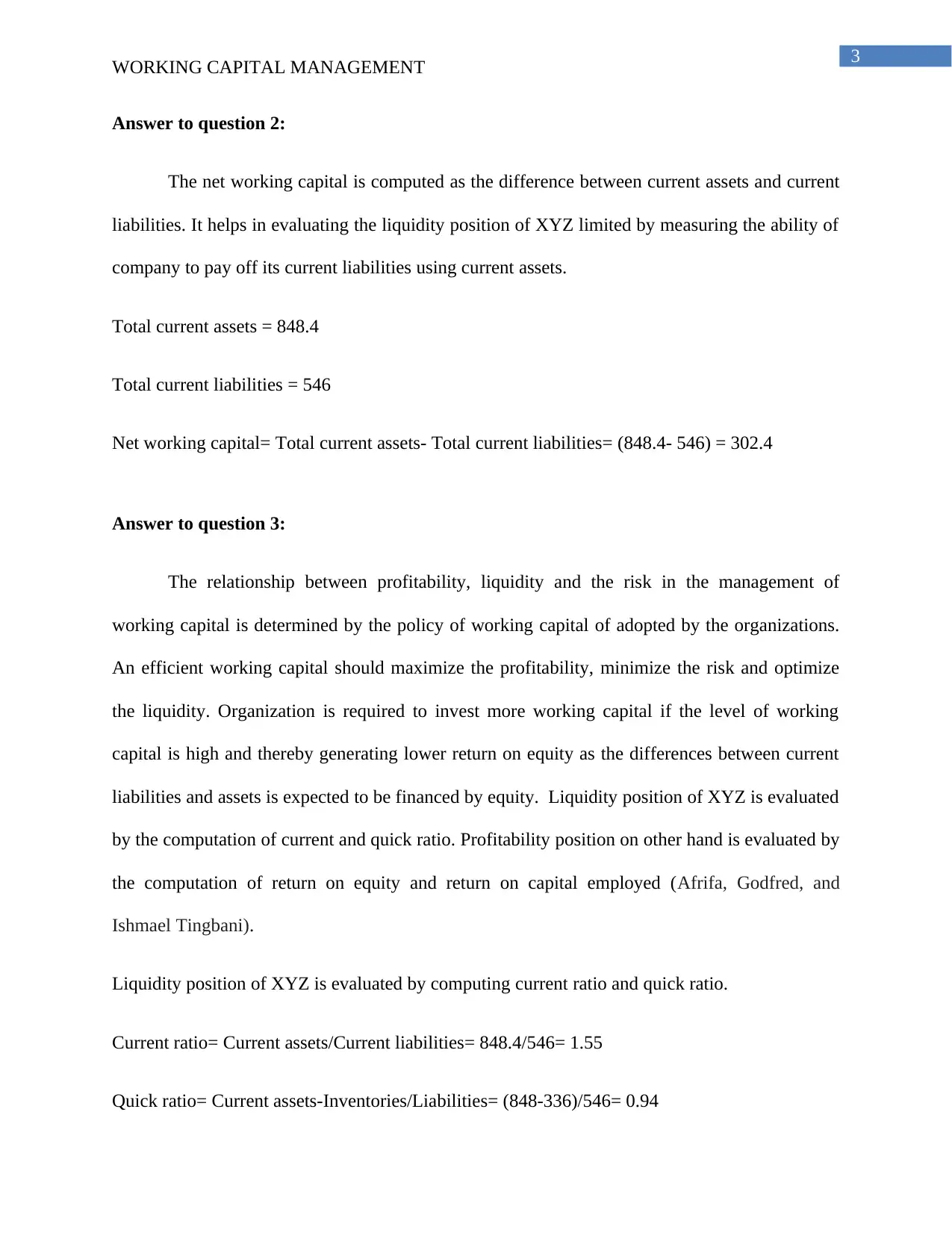
Answer to question 2:
The net working capital is computed as the difference between current assets and current
liabilities. It helps in evaluating the liquidity position of XYZ limited by measuring the ability of
company to pay off its current liabilities using current assets.
Total current assets = 848.4
Total current liabilities = 546
Net working capital= Total current assets- Total current liabilities= (848.4- 546) = 302.4
Answer to question 3:
The relationship between profitability, liquidity and the risk in the management of
working capital is determined by the policy of working capital of adopted by the organizations.
An efficient working capital should maximize the profitability, minimize the risk and optimize
the liquidity. Organization is required to invest more working capital if the level of working
capital is high and thereby generating lower return on equity as the differences between current
liabilities and assets is expected to be financed by equity. Liquidity position of XYZ is evaluated
by the computation of current and quick ratio. Profitability position on other hand is evaluated by
the computation of return on equity and return on capital employed (Afrifa, Godfred, and
Ishmael Tingbani).
Liquidity position of XYZ is evaluated by computing current ratio and quick ratio.
Current ratio= Current assets/Current liabilities= 848.4/546= 1.55
Quick ratio= Current assets-Inventories/Liabilities= (848-336)/546= 0.94
tabler-icon-diamond-filled.svg

Paraphrase This Document

Need a fresh take? Get an instant paraphrase of this document with our AI Paraphraser
Document Page
4
WORKING CAPITAL MANAGEMENT
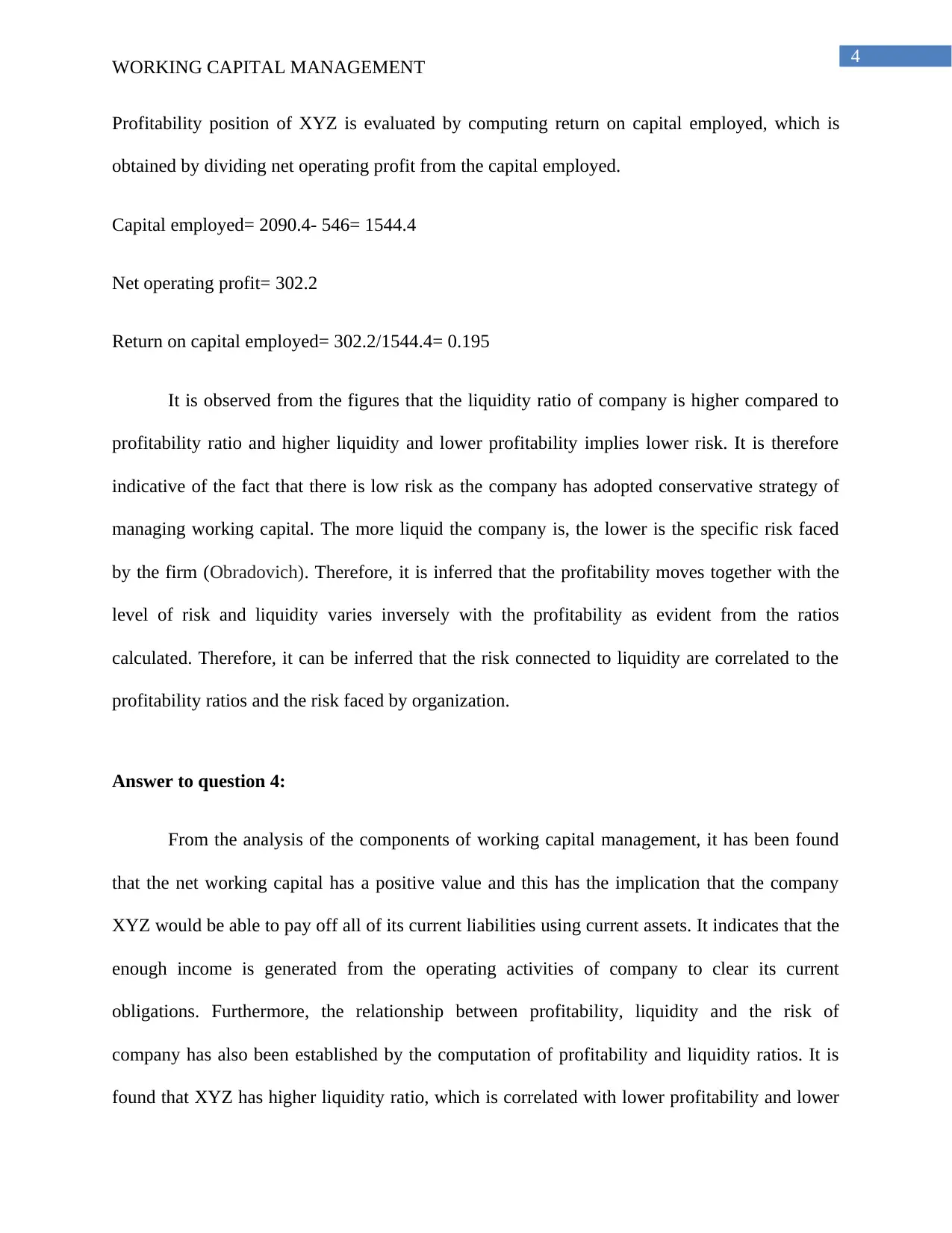
Profitability position of XYZ is evaluated by computing return on capital employed, which is
obtained by dividing net operating profit from the capital employed.
Capital employed= 2090.4- 546= 1544.4
Net operating profit= 302.2
Return on capital employed= 302.2/1544.4= 0.195
It is observed from the figures that the liquidity ratio of company is higher compared to
profitability ratio and higher liquidity and lower profitability implies lower risk. It is therefore
indicative of the fact that there is low risk as the company has adopted conservative strategy of
managing working capital. The more liquid the company is, the lower is the specific risk faced
by the firm (Obradovich). Therefore, it is inferred that the profitability moves together with the
level of risk and liquidity varies inversely with the profitability as evident from the ratios
calculated. Therefore, it can be inferred that the risk connected to liquidity are correlated to the
profitability ratios and the risk faced by organization.
Answer to question 4:
From the analysis of the components of working capital management, it has been found
that the net working capital has a positive value and this has the implication that the company
XYZ would be able to pay off all of its current liabilities using current assets. It indicates that the
enough income is generated from the operating activities of company to clear its current
obligations. Furthermore, the relationship between profitability, liquidity and the risk of
company has also been established by the computation of profitability and liquidity ratios. It is
found that XYZ has higher liquidity ratio, which is correlated with lower profitability and lower
Document Page
5
WORKING CAPITAL MANAGEMENT
risk, and this further implies that the company has implemented conservative working capital
policy.
References:
Afrifa, Godfred, and Ishmael Tingbani. "Working capital management, cash flow and SMEs’
performance." Int. J. Banking, Accounting and Finance 9.1 (2018).
Aktas, Nihat, Ettore Croci, and Dimitris Petmezas. "Is working capital management value-
enhancing? Evidence from firm performance and investments." Journal of Corporate Finance30
(2015): 98-113.
Obradovich, John. "The impact of working capital management on the decision of production
firms about the amount of dividends. pdf." Int. J. Business and Globalisation22.3 (2019).
Talonpoika, Anna-Maria, et al. "Defined strategies for financial working capital
management." International Journal of Managerial Finance 12.3 (2016): 277-294.
chevron_up_icon
1 out of 6
circle_padding
hide_on_mobile
zoom_out_icon
[object Object]