Financial Reporting Online Exam Solution: Ratio Analysis & NPV
VerifiedAdded on 2023/06/15
|18
|3980
|406
Homework Assignment
AI Summary
This document presents a comprehensive solution to an online exam focused on finance and financial reporting. It begins by analyzing the impact of COVID-19 on accounting functions, highlighting challenges such as revenue decline and compensation issues. The solution then addresses budgeting, goodwill, and ratio analysis, providing detailed explanations and examples. Furthermore, it explores methods of raising finance, including IPOs and offers through sale. The document includes an income statement, calculation of tax liability, and a statement of financial position, followed by the calculation and commentary on financial ratios. Finally, it covers NPV and payback period calculations for investment appraisal, concluding with a recommendation based on the analysis. This resource offers a detailed overview of key financial concepts and their practical application.

ONLINE EXAM FINANCE
AND FINANCIAL
REPORTING
AND FINANCIAL
REPORTING

Paraphrase This Document
Need a fresh take? Get an instant paraphrase of this document with our AI Paraphraser
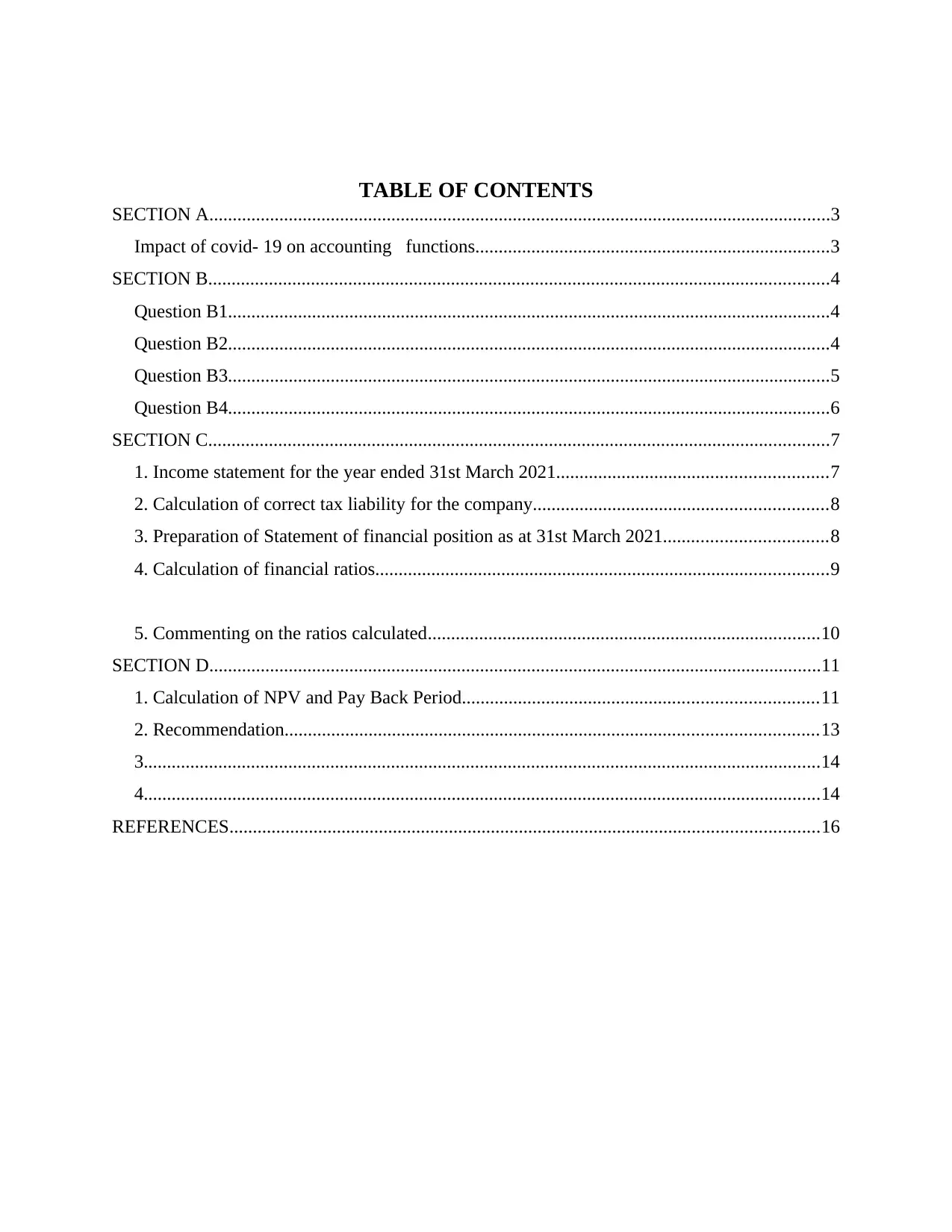
TABLE OF CONTENTS
SECTION A.....................................................................................................................................3
Impact of covid- 19 on accounting functions............................................................................3
SECTION B.....................................................................................................................................4
Question B1.................................................................................................................................4
Question B2.................................................................................................................................4
Question B3.................................................................................................................................5
Question B4.................................................................................................................................6
SECTION C.....................................................................................................................................7
1. Income statement for the year ended 31st March 2021..........................................................7
2. Calculation of correct tax liability for the company...............................................................8
3. Preparation of Statement of financial position as at 31st March 2021...................................8
4. Calculation of financial ratios.................................................................................................9
5. Commenting on the ratios calculated....................................................................................10
SECTION D...................................................................................................................................11
1. Calculation of NPV and Pay Back Period............................................................................11
2. Recommendation..................................................................................................................13
3.................................................................................................................................................14
4.................................................................................................................................................14
REFERENCES..............................................................................................................................16
SECTION A.....................................................................................................................................3
Impact of covid- 19 on accounting functions............................................................................3
SECTION B.....................................................................................................................................4
Question B1.................................................................................................................................4
Question B2.................................................................................................................................4
Question B3.................................................................................................................................5
Question B4.................................................................................................................................6
SECTION C.....................................................................................................................................7
1. Income statement for the year ended 31st March 2021..........................................................7
2. Calculation of correct tax liability for the company...............................................................8
3. Preparation of Statement of financial position as at 31st March 2021...................................8
4. Calculation of financial ratios.................................................................................................9
5. Commenting on the ratios calculated....................................................................................10
SECTION D...................................................................................................................................11
1. Calculation of NPV and Pay Back Period............................................................................11
2. Recommendation..................................................................................................................13
3.................................................................................................................................................14
4.................................................................................................................................................14
REFERENCES..............................................................................................................................16
SECTION A
Impact of covid- 19 on accounting functions
Coronavirus has negatively affect the revenue of every organization and
most of the small companies were shut down and closed. On the other hand
accounting function include systematic tracking, storing, recording, analyzing and
summarizing and reporting of company financial transaction. All this functions is
necessary to be maintain properly in order to manage the accounts of
organization. Along with this, corona virus has impacted negatively on the finance
function as most of the organization has faced loss and the large companies
has reported considerable decline. In addition, to this, it has impacted on the
compensation in finance. Due to pandemic there was reduction in the
compensation such as in salary and bonus. Because of coronavirus there were
reduction in the fixed cost as organization has to pay the standard salary and
compensation to their employees (Roozen, Steens and Spoor, 2019). This has lead in the
loss to the company along with this there were deal in sending the income to
the subordinates because business was not able to generate revenue properly.
Along with this, there was negative impact on the account payable. It means the
amount that are due to the vendor or suppliers that has not been paid. The
organization was not able to pay the amount to their creditors as due to
pandemic there was not generation of profit and the company has to pay the
delayed expense to their employees. Along with this, due to lockdown in
many countries there was no export and import and because of that organization
has to face huge loss.
For example, in order to reduce the negative impact of Covid-19 over the individuals
and businesses, the Bank of England has reduced the interest rate up to 0.1% which has put
major impact over the function of accounting and finance. The finance team of the company are
responsible for selecting the best sources out of many from where they can acquire funds from
the market. The main goal of finance team is such that they have to select the sources whose cost
of acquisition must be low (Baum, Crosby and Devaney, 2021). So, as the interest rates are
decreases, the finance team can recommend the company to acquire the funds from the banks.
Impact of covid- 19 on accounting functions
Coronavirus has negatively affect the revenue of every organization and
most of the small companies were shut down and closed. On the other hand
accounting function include systematic tracking, storing, recording, analyzing and
summarizing and reporting of company financial transaction. All this functions is
necessary to be maintain properly in order to manage the accounts of
organization. Along with this, corona virus has impacted negatively on the finance
function as most of the organization has faced loss and the large companies
has reported considerable decline. In addition, to this, it has impacted on the
compensation in finance. Due to pandemic there was reduction in the
compensation such as in salary and bonus. Because of coronavirus there were
reduction in the fixed cost as organization has to pay the standard salary and
compensation to their employees (Roozen, Steens and Spoor, 2019). This has lead in the
loss to the company along with this there were deal in sending the income to
the subordinates because business was not able to generate revenue properly.
Along with this, there was negative impact on the account payable. It means the
amount that are due to the vendor or suppliers that has not been paid. The
organization was not able to pay the amount to their creditors as due to
pandemic there was not generation of profit and the company has to pay the
delayed expense to their employees. Along with this, due to lockdown in
many countries there was no export and import and because of that organization
has to face huge loss.
For example, in order to reduce the negative impact of Covid-19 over the individuals
and businesses, the Bank of England has reduced the interest rate up to 0.1% which has put
major impact over the function of accounting and finance. The finance team of the company are
responsible for selecting the best sources out of many from where they can acquire funds from
the market. The main goal of finance team is such that they have to select the sources whose cost
of acquisition must be low (Baum, Crosby and Devaney, 2021). So, as the interest rates are
decreases, the finance team can recommend the company to acquire the funds from the banks.
⊘ This is a preview!⊘
Do you want full access?
Subscribe today to unlock all pages.

Trusted by 1+ million students worldwide
But on the same side, as the interest rate decreases, the company unable to get higher returns
from the investment they invest in the banks and financial institutions of UK. Thus, in such way
the change of Covid-19 has affect the business in both positive and negative way.
SECTION B
Question B1
Budgeting in business involves preparation of financial plan on the basis current revenues and
expenses to forecast future events associated with such budgeted costs and revenues. With the
help of budgets, business can estimate its spending in advance, identify their resources and
allocate it efficiently along with facilitating prediction for future revenues (Flower and Ebbers,
2018). Thus, company performance can be determined and comparison can be done between the
budgeted and actual performance, so that deviations can be found out at the earliest and
subsequent corrective decisions can be make for correcting deviations. Accordingly, business's
strengths and weaknesses can be highlighted through budgeting. Concentration on cash flows,
cost reduction, profit improvements and increasing returns on investment could be possible
through budgeting.
Also, budgeting helps in demonstrating business priorities to all associated with the
business and thus organization's vision can be shared with both internal and external parties of
the organization (Iriyadi, Maulana and Nurjanah, 2018). Further, budgeting is helpful in meeting
business objectives by making financial decisions confidently.
Budgets are generally meant for those internal to the organisation, however in certain
case where external parties like auditors may demand for business budgets to ensure the business
objectives and goals are in alignment of the shareholder's goals and expectations. Managers uses
budgets for making arrangement for required financial resources on time and allocating it in
efficient and effective manner.
Question B2
The nature of goodwill is such where it is considered as an intangible fixed asset having no
physical existence and which cannot be seen or touched. The goodwill can be described and
identified in two ways that is, purchased and non – purchased goodwill (Barth, 2018). The
former arises when the consideration paid for business during acquisition and merger is higher
than the fair value of identifiable assets (Net). Alternatively, the valuation of non – purchased
from the investment they invest in the banks and financial institutions of UK. Thus, in such way
the change of Covid-19 has affect the business in both positive and negative way.
SECTION B
Question B1
Budgeting in business involves preparation of financial plan on the basis current revenues and
expenses to forecast future events associated with such budgeted costs and revenues. With the
help of budgets, business can estimate its spending in advance, identify their resources and
allocate it efficiently along with facilitating prediction for future revenues (Flower and Ebbers,
2018). Thus, company performance can be determined and comparison can be done between the
budgeted and actual performance, so that deviations can be found out at the earliest and
subsequent corrective decisions can be make for correcting deviations. Accordingly, business's
strengths and weaknesses can be highlighted through budgeting. Concentration on cash flows,
cost reduction, profit improvements and increasing returns on investment could be possible
through budgeting.
Also, budgeting helps in demonstrating business priorities to all associated with the
business and thus organization's vision can be shared with both internal and external parties of
the organization (Iriyadi, Maulana and Nurjanah, 2018). Further, budgeting is helpful in meeting
business objectives by making financial decisions confidently.
Budgets are generally meant for those internal to the organisation, however in certain
case where external parties like auditors may demand for business budgets to ensure the business
objectives and goals are in alignment of the shareholder's goals and expectations. Managers uses
budgets for making arrangement for required financial resources on time and allocating it in
efficient and effective manner.
Question B2
The nature of goodwill is such where it is considered as an intangible fixed asset having no
physical existence and which cannot be seen or touched. The goodwill can be described and
identified in two ways that is, purchased and non – purchased goodwill (Barth, 2018). The
former arises when the consideration paid for business during acquisition and merger is higher
than the fair value of identifiable assets (Net). Alternatively, the valuation of non – purchased
Paraphrase This Document
Need a fresh take? Get an instant paraphrase of this document with our AI Paraphraser
goodwill is done on the basis of customers of the trade where calculation is done as number of
year's purchase of super or average profits.
When a merger or acquisition took place in business, there is an amount shown in the balance
sheet of the company which indicates that the purchase consideration exceeds the net identifiable
fair value of the assets of the business (Breuer, 2021). It is shown under intangible assets section
of the balance sheet. When a company has large amount of goodwill in its balance sheet, it
results in attracting higher purchase prices.
For instance, company A acquires company B for $5 million. Assets are equal to $1.5 million
and liabilities are equal to $500000 million which results in fair value of the net identifiable
assets equivalent to $1million.
Goodwill = Purchase consideration – fair value of net identifiable assets = $5 million - $1million
= $4million.
This $4 million is the premium paid by company A which is over and above the company's net
identifiable assets and this amount will be shown in the balance sheet of the group as goodwill
under the intangible assets section.
Question B3
Basis of ratio analysis
Ratio analysis is a quantitative method to analyse the liquidity, efficiency and
performance of the company. The base of ratio analysis is as follows:
Income statement: This is a statement which covers the list of income and expenses
which is earned and incur by business. This income and expenses must be related to the
ongoing operation of business. The income statement is prepared by the company on the
basis of accrual concept and provides profit and loss.
Balance Sheet: The balance sheet of the business states the list of liabilities and assets
which must be balanced at the end date. This includes current and non-current assets,
liabilities, equities which is further used to analyse the liquidity and efficiency
performance of business (Harris, Hoang and Ngan, 2017).
Rationale of Ratio analysis
The importance and rationale of ratio analysis is as follows which provides various
benefits to the company:
year's purchase of super or average profits.
When a merger or acquisition took place in business, there is an amount shown in the balance
sheet of the company which indicates that the purchase consideration exceeds the net identifiable
fair value of the assets of the business (Breuer, 2021). It is shown under intangible assets section
of the balance sheet. When a company has large amount of goodwill in its balance sheet, it
results in attracting higher purchase prices.
For instance, company A acquires company B for $5 million. Assets are equal to $1.5 million
and liabilities are equal to $500000 million which results in fair value of the net identifiable
assets equivalent to $1million.
Goodwill = Purchase consideration – fair value of net identifiable assets = $5 million - $1million
= $4million.
This $4 million is the premium paid by company A which is over and above the company's net
identifiable assets and this amount will be shown in the balance sheet of the group as goodwill
under the intangible assets section.
Question B3
Basis of ratio analysis
Ratio analysis is a quantitative method to analyse the liquidity, efficiency and
performance of the company. The base of ratio analysis is as follows:
Income statement: This is a statement which covers the list of income and expenses
which is earned and incur by business. This income and expenses must be related to the
ongoing operation of business. The income statement is prepared by the company on the
basis of accrual concept and provides profit and loss.
Balance Sheet: The balance sheet of the business states the list of liabilities and assets
which must be balanced at the end date. This includes current and non-current assets,
liabilities, equities which is further used to analyse the liquidity and efficiency
performance of business (Harris, Hoang and Ngan, 2017).
Rationale of Ratio analysis
The importance and rationale of ratio analysis is as follows which provides various
benefits to the company:
It is important to analyse the financial statement of the company such as income
statement and balance sheet.
It is also important to analyse the operational efficiency of the firm using average
collection period and average payment period.
This is also helpful for identifying the profitability of company along with the business
risk to firms.
It also helps in determining the financial risk of firms including planning and forecasting
of futures.
Further, it is also helpful for the business to compare its performance with its own past
performance along with that of others competitors (Agbloyor and et.al., 2021).
For example, Gross profit margin of A company is 25% in the year 2020 while the gross
profit margin of B company is 20% in the same year. It means that company A is more profitable
than B and is earning high profit percentage than its competitors. This provides an opportunity to
company A that they can gain competitive advantage if they improve its profitability more. This
indicates that ratio analysis is most important part of every business (Lindvall and Larsson,
2017).
Question B4
There are many popular and potential methods of raising finance in the business which include
initial public offering or IPO and offer through sale (Choudhary, Merkley and Schipper, 2021).
Business must choose those method for raising finance which helps in making arrangement for
finance for the business operations. Floatation involves selling and issuing shares to the public
which facilitates raising finance from external sources. The two methods of floating to the stock
market are as follows:
Initial public offering (IPO): Here the shares or ownership stake of the private company are
issued to the public for the first time in the stock market. Often, investment bank gets involved in
the process and undertake the process of underwriting where they determined the share price,
develop prospectus, number of shares to be issued and promote the share issue among the
potential investors.
statement and balance sheet.
It is also important to analyse the operational efficiency of the firm using average
collection period and average payment period.
This is also helpful for identifying the profitability of company along with the business
risk to firms.
It also helps in determining the financial risk of firms including planning and forecasting
of futures.
Further, it is also helpful for the business to compare its performance with its own past
performance along with that of others competitors (Agbloyor and et.al., 2021).
For example, Gross profit margin of A company is 25% in the year 2020 while the gross
profit margin of B company is 20% in the same year. It means that company A is more profitable
than B and is earning high profit percentage than its competitors. This provides an opportunity to
company A that they can gain competitive advantage if they improve its profitability more. This
indicates that ratio analysis is most important part of every business (Lindvall and Larsson,
2017).
Question B4
There are many popular and potential methods of raising finance in the business which include
initial public offering or IPO and offer through sale (Choudhary, Merkley and Schipper, 2021).
Business must choose those method for raising finance which helps in making arrangement for
finance for the business operations. Floatation involves selling and issuing shares to the public
which facilitates raising finance from external sources. The two methods of floating to the stock
market are as follows:
Initial public offering (IPO): Here the shares or ownership stake of the private company are
issued to the public for the first time in the stock market. Often, investment bank gets involved in
the process and undertake the process of underwriting where they determined the share price,
develop prospectus, number of shares to be issued and promote the share issue among the
potential investors.
⊘ This is a preview!⊘
Do you want full access?
Subscribe today to unlock all pages.
Trusted by 1+ million students worldwide
Offer through sale: Here floatation took place where shares are first offered to an intermediary
also known as stockbroker where the shares are not available to public directly (Amiram and
et.al., 2018). Such floatation methods are useful for companies during their initial years of
operations or also due to the high floatation costs involved in reaching to public investors.
SECTION C
1. Income statement for the year ended 31st March 2021
Particulars Amount in £ Amount in £
Sales 2400
Less:
Opening inventories 320
Inventory purchases 720
Less: Closing inventories -280 -760
Gross profit 1640
Add: other income
Investment income 85
Total income 1725
Less:
Administrative expenses + outstanding amount 500 + 17 = 517
Advertising 430
Auditor's fees 90
Debenture interest paid 25
Director's remuneration 150
Depreciation on furniture and fittings (WN 1) 80
Wages and salaries (WN 2) 238
Total expenses -1530
also known as stockbroker where the shares are not available to public directly (Amiram and
et.al., 2018). Such floatation methods are useful for companies during their initial years of
operations or also due to the high floatation costs involved in reaching to public investors.
SECTION C
1. Income statement for the year ended 31st March 2021
Particulars Amount in £ Amount in £
Sales 2400
Less:
Opening inventories 320
Inventory purchases 720
Less: Closing inventories -280 -760
Gross profit 1640
Add: other income
Investment income 85
Total income 1725
Less:
Administrative expenses + outstanding amount 500 + 17 = 517
Advertising 430
Auditor's fees 90
Debenture interest paid 25
Director's remuneration 150
Depreciation on furniture and fittings (WN 1) 80
Wages and salaries (WN 2) 238
Total expenses -1530
Paraphrase This Document
Need a fresh take? Get an instant paraphrase of this document with our AI Paraphraser
Profit before tax 195
Less: Tax liability -39
Profit after tax 156
Less: dividends
Preference dividend 10
Ordinary dividend 130 -140
Retained earnings for the year 16
Working notes:
1. Depreciation on furniture and fittings = 400 * 20% = 80
2. Wages and salaries amount to be shown in income statement = 260 – paid in advance
= 260 – 22 = 238.
2. Calculation of correct tax liability for the company
Tax liability estimated on years profit = 39000
Correct corporation tax liabilities = Profit before tax + unallowable deductions (depreciation)
= 195 + 80 = 275
corporation tax liability = 275 * 19% = 52.25
There is a difference in the amount of tax liability estimated and the tax liability occurred
due to the difference in the amount of profit earned before and after allowing for depreciation as
deduction. The correct corporation tax liability has been calculated through considering profit
without allowing for depreciation and applying the flat tax rate applicable on corporate profit @
19% (Flower and Ebbers, 2018). However, the liability differs from the estimated tax liability
because the latter may be based on the profit mention in income statement or also may be
estimated by deducting depreciation amount from the taxable income. In this way, due to all
these reasons there is a difference in the actual corporation tax liability and estimated tax
liability.
3. Preparation of Statement of financial position as at 31st March 2021
Particulars Amount in £
Less: Tax liability -39
Profit after tax 156
Less: dividends
Preference dividend 10
Ordinary dividend 130 -140
Retained earnings for the year 16
Working notes:
1. Depreciation on furniture and fittings = 400 * 20% = 80
2. Wages and salaries amount to be shown in income statement = 260 – paid in advance
= 260 – 22 = 238.
2. Calculation of correct tax liability for the company
Tax liability estimated on years profit = 39000
Correct corporation tax liabilities = Profit before tax + unallowable deductions (depreciation)
= 195 + 80 = 275
corporation tax liability = 275 * 19% = 52.25
There is a difference in the amount of tax liability estimated and the tax liability occurred
due to the difference in the amount of profit earned before and after allowing for depreciation as
deduction. The correct corporation tax liability has been calculated through considering profit
without allowing for depreciation and applying the flat tax rate applicable on corporate profit @
19% (Flower and Ebbers, 2018). However, the liability differs from the estimated tax liability
because the latter may be based on the profit mention in income statement or also may be
estimated by deducting depreciation amount from the taxable income. In this way, due to all
these reasons there is a difference in the actual corporation tax liability and estimated tax
liability.
3. Preparation of Statement of financial position as at 31st March 2021
Particulars Amount in £
Assets
Non – current assets
Investments 520
Furniture and fittings at cost 400
Current assets
Cash at bank 410
Trade receivables 450
Inventories 280
Prepaid salaries 22
TOTAL ASSETS 2082
Equity and liabilities
Non – current liabilities
Debentures (10%) 250
Current liabilities
Trade payables 220
Tax liability 39
Accumulated depreciation 170
Outstanding administrative expenses 17
Equity
Ordinary share capital 420
Non – current assets
Investments 520
Furniture and fittings at cost 400
Current assets
Cash at bank 410
Trade receivables 450
Inventories 280
Prepaid salaries 22
TOTAL ASSETS 2082
Equity and liabilities
Non – current liabilities
Debentures (10%) 250
Current liabilities
Trade payables 220
Tax liability 39
Accumulated depreciation 170
Outstanding administrative expenses 17
Equity
Ordinary share capital 420
⊘ This is a preview!⊘
Do you want full access?
Subscribe today to unlock all pages.
Trusted by 1+ million students worldwide
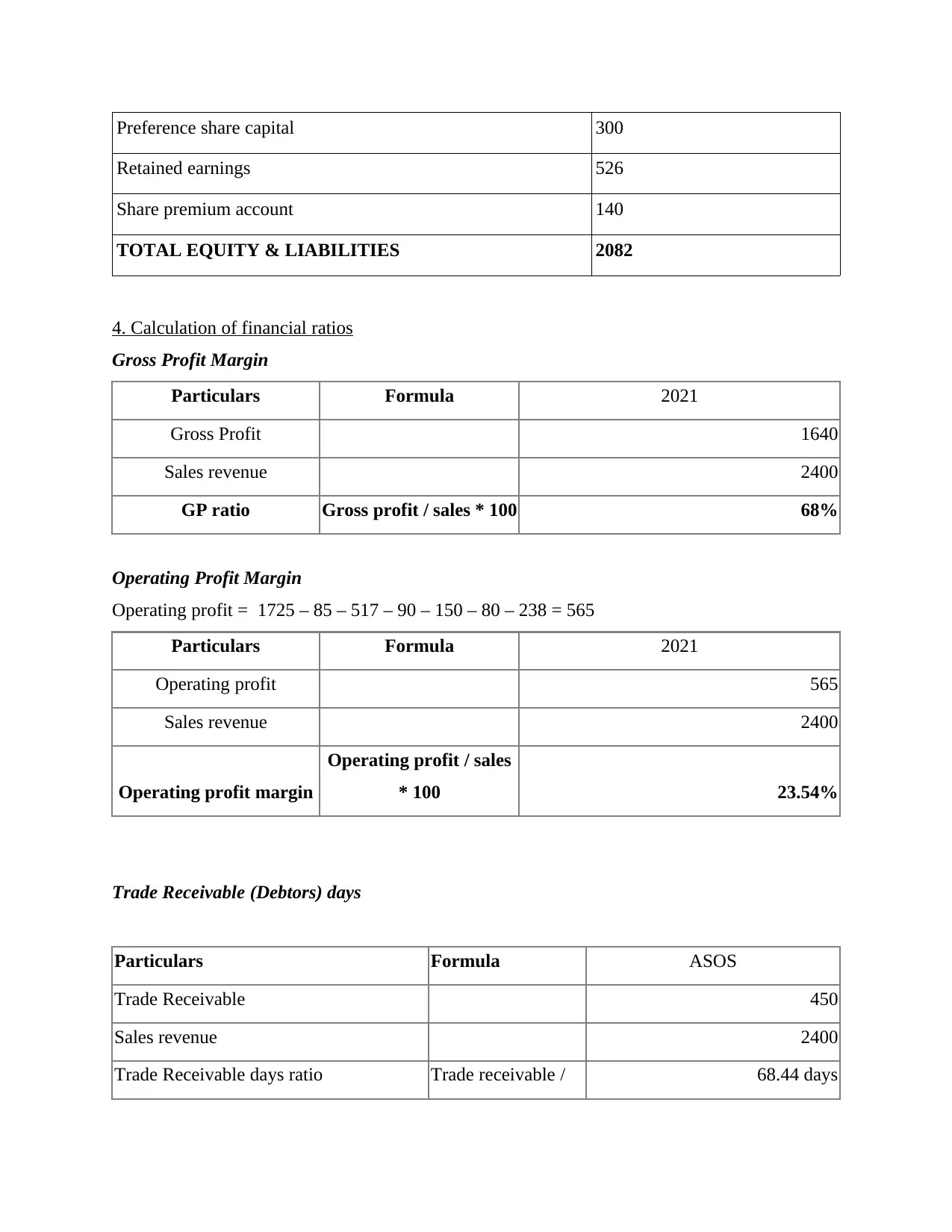
Preference share capital 300
Retained earnings 526
Share premium account 140
TOTAL EQUITY & LIABILITIES 2082
4. Calculation of financial ratios
Gross Profit Margin
Particulars Formula 2021
Gross Profit 1640
Sales revenue 2400
GP ratio Gross profit / sales * 100 68%
Operating Profit Margin
Operating profit = 1725 – 85 – 517 – 90 – 150 – 80 – 238 = 565
Particulars Formula 2021
Operating profit 565
Sales revenue 2400
Operating profit margin
Operating profit / sales
* 100 23.54%
Trade Receivable (Debtors) days
Particulars Formula ASOS
Trade Receivable 450
Sales revenue 2400
Trade Receivable days ratio Trade receivable / 68.44 days
Retained earnings 526
Share premium account 140
TOTAL EQUITY & LIABILITIES 2082
4. Calculation of financial ratios
Gross Profit Margin
Particulars Formula 2021
Gross Profit 1640
Sales revenue 2400
GP ratio Gross profit / sales * 100 68%
Operating Profit Margin
Operating profit = 1725 – 85 – 517 – 90 – 150 – 80 – 238 = 565
Particulars Formula 2021
Operating profit 565
Sales revenue 2400
Operating profit margin
Operating profit / sales
* 100 23.54%
Trade Receivable (Debtors) days
Particulars Formula ASOS
Trade Receivable 450
Sales revenue 2400
Trade Receivable days ratio Trade receivable / 68.44 days
Paraphrase This Document
Need a fresh take? Get an instant paraphrase of this document with our AI Paraphraser
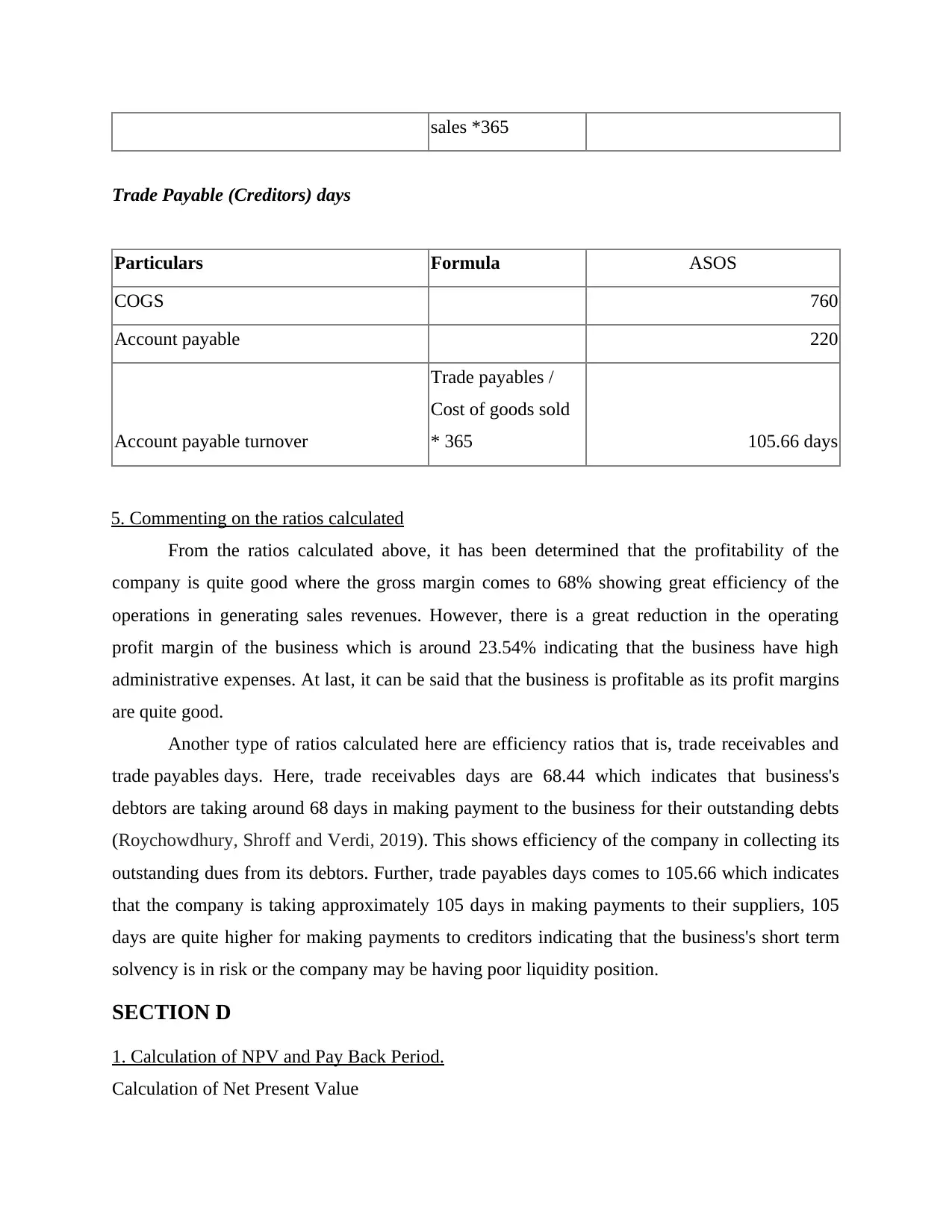
sales *365
Trade Payable (Creditors) days
Particulars Formula ASOS
COGS 760
Account payable 220
Account payable turnover
Trade payables /
Cost of goods sold
* 365 105.66 days
5. Commenting on the ratios calculated
From the ratios calculated above, it has been determined that the profitability of the
company is quite good where the gross margin comes to 68% showing great efficiency of the
operations in generating sales revenues. However, there is a great reduction in the operating
profit margin of the business which is around 23.54% indicating that the business have high
administrative expenses. At last, it can be said that the business is profitable as its profit margins
are quite good.
Another type of ratios calculated here are efficiency ratios that is, trade receivables and
trade payables days. Here, trade receivables days are 68.44 which indicates that business's
debtors are taking around 68 days in making payment to the business for their outstanding debts
(Roychowdhury, Shroff and Verdi, 2019). This shows efficiency of the company in collecting its
outstanding dues from its debtors. Further, trade payables days comes to 105.66 which indicates
that the company is taking approximately 105 days in making payments to their suppliers, 105
days are quite higher for making payments to creditors indicating that the business's short term
solvency is in risk or the company may be having poor liquidity position.
SECTION D
1. Calculation of NPV and Pay Back Period.
Calculation of Net Present Value
Trade Payable (Creditors) days
Particulars Formula ASOS
COGS 760
Account payable 220
Account payable turnover
Trade payables /
Cost of goods sold
* 365 105.66 days
5. Commenting on the ratios calculated
From the ratios calculated above, it has been determined that the profitability of the
company is quite good where the gross margin comes to 68% showing great efficiency of the
operations in generating sales revenues. However, there is a great reduction in the operating
profit margin of the business which is around 23.54% indicating that the business have high
administrative expenses. At last, it can be said that the business is profitable as its profit margins
are quite good.
Another type of ratios calculated here are efficiency ratios that is, trade receivables and
trade payables days. Here, trade receivables days are 68.44 which indicates that business's
debtors are taking around 68 days in making payment to the business for their outstanding debts
(Roychowdhury, Shroff and Verdi, 2019). This shows efficiency of the company in collecting its
outstanding dues from its debtors. Further, trade payables days comes to 105.66 which indicates
that the company is taking approximately 105 days in making payments to their suppliers, 105
days are quite higher for making payments to creditors indicating that the business's short term
solvency is in risk or the company may be having poor liquidity position.
SECTION D
1. Calculation of NPV and Pay Back Period.
Calculation of Net Present Value
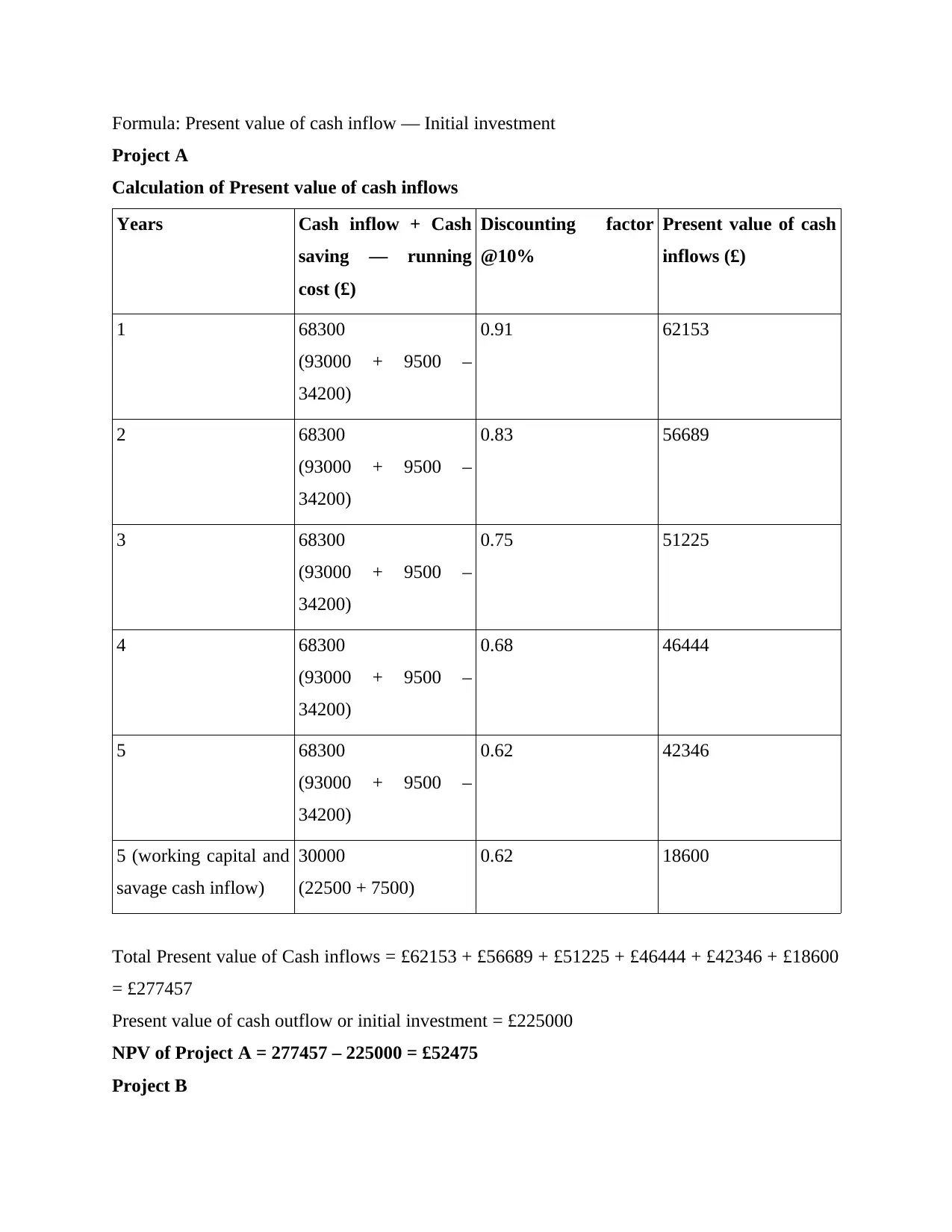
Formula: Present value of cash inflow — Initial investment
Project A
Calculation of Present value of cash inflows
Years Cash inflow + Cash
saving — running
cost (£)
Discounting factor
@10%
Present value of cash
inflows (£)
1 68300
(93000 + 9500 –
34200)
0.91 62153
2 68300
(93000 + 9500 –
34200)
0.83 56689
3 68300
(93000 + 9500 –
34200)
0.75 51225
4 68300
(93000 + 9500 –
34200)
0.68 46444
5 68300
(93000 + 9500 –
34200)
0.62 42346
5 (working capital and
savage cash inflow)
30000
(22500 + 7500)
0.62 18600
Total Present value of Cash inflows = £62153 + £56689 + £51225 + £46444 + £42346 + £18600
= £277457
Present value of cash outflow or initial investment = £225000
NPV of Project A = 277457 – 225000 = £52475
Project B
Project A
Calculation of Present value of cash inflows
Years Cash inflow + Cash
saving — running
cost (£)
Discounting factor
@10%
Present value of cash
inflows (£)
1 68300
(93000 + 9500 –
34200)
0.91 62153
2 68300
(93000 + 9500 –
34200)
0.83 56689
3 68300
(93000 + 9500 –
34200)
0.75 51225
4 68300
(93000 + 9500 –
34200)
0.68 46444
5 68300
(93000 + 9500 –
34200)
0.62 42346
5 (working capital and
savage cash inflow)
30000
(22500 + 7500)
0.62 18600
Total Present value of Cash inflows = £62153 + £56689 + £51225 + £46444 + £42346 + £18600
= £277457
Present value of cash outflow or initial investment = £225000
NPV of Project A = 277457 – 225000 = £52475
Project B
⊘ This is a preview!⊘
Do you want full access?
Subscribe today to unlock all pages.
Trusted by 1+ million students worldwide

1 out of 18


Related Documents


Your All-in-One AI-Powered Toolkit for Academic Success.
+13062052269
info@desklib.com
Available 24*7 on WhatsApp / Email
![[object Object]](/_next/static/media/star-bottom.7253800d.svg)
Unlock your academic potential
Copyright © 2020–2026 A2Z Services. All Rights Reserved. Developed and managed by ZUCOL.