Report on Managing Financial Resources in Business Finance
VerifiedAdded on 2023/06/10
|15
|3205
|182
Report
AI Summary
This report provides a detailed analysis of financial resource management in a business context, covering three scenarios. The first scenario outlines the process of capital project approval, emphasizing the importance of requirement specifications, aggregation of requirements, feasibility reports, funding sources, sourcing, and negotiation. The second scenario discusses capital project evaluation methods, including Net Present Value (NPV), Internal Rate of Return (IRR), and payback period, justifying the use of cost of capital as a discount rate and providing advantages and disadvantages of each method, ultimately recommending NPV. The third scenario involves computation of return on equity and the required rate of return using provided formulas and trial-and-error methods, demonstrating practical financial calculations. This document is available on Desklib, a platform offering a range of study tools and solved assignments for students.

Running head: MANAGING FINANCIAL RESOURCES
Managing financial resources
Name of the student
Name of the university
Student ID
Author note
Managing financial resources
Name of the student
Name of the university
Student ID
Author note

Paraphrase This Document
Need a fresh take? Get an instant paraphrase of this document with our AI Paraphraser
1MANAGING FINANCIAL RESOURCES
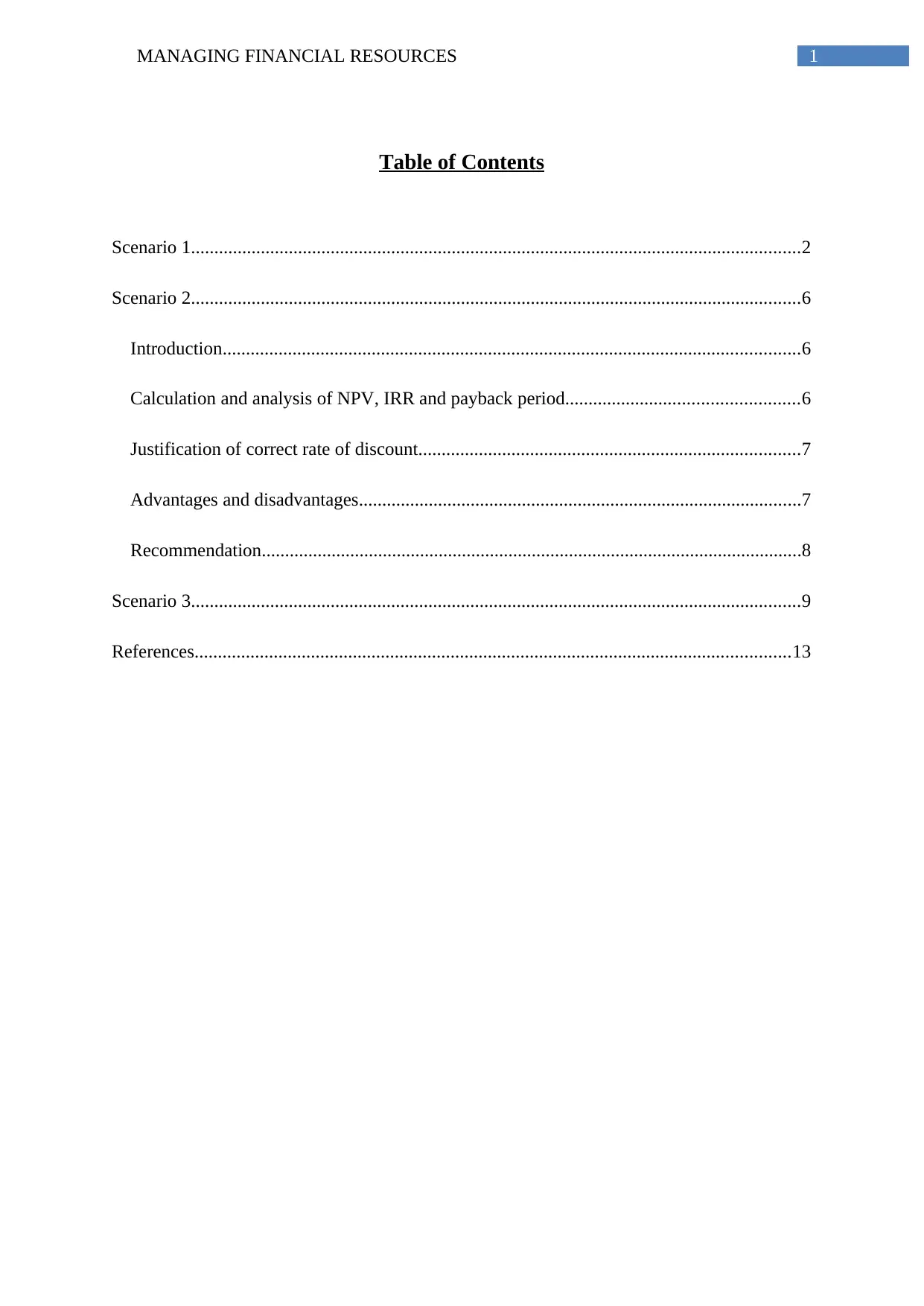
Table of Contents
Scenario 1...................................................................................................................................2
Scenario 2...................................................................................................................................6
Introduction............................................................................................................................6
Calculation and analysis of NPV, IRR and payback period..................................................6
Justification of correct rate of discount..................................................................................7
Advantages and disadvantages...............................................................................................7
Recommendation....................................................................................................................8
Scenario 3...................................................................................................................................9
References................................................................................................................................13
Table of Contents
Scenario 1...................................................................................................................................2
Scenario 2...................................................................................................................................6
Introduction............................................................................................................................6
Calculation and analysis of NPV, IRR and payback period..................................................6
Justification of correct rate of discount..................................................................................7
Advantages and disadvantages...............................................................................................7
Recommendation....................................................................................................................8
Scenario 3...................................................................................................................................9
References................................................................................................................................13
2MANAGING FINANCIAL RESOURCES
Assessment task 3: Business Finance
Scenario 1
Process of capital project approval is determined by various factors like size of the
project, type of the project and source of fund for the project. It is the board’s policy to
prepare budget for replacing of the existing worn out piece of the equipment through capital
improvement program and annual operating budget. However, while preparing the budget for
replacing the equipment other capital as well as not capital asset those are required to be
replaced shall be considered in the operating budget. However as per the given scenario, in
past the requests for approving the replacements of equipments have been approved without
any information (Barth Konchitchki and Landsman 2013).
Information required for replacing the equipment is as follows –
1. Requirement specification
Requirement of replacing the equipment shall be identified and the requirement
specification statement shall be prepared accordingly. Even if the requirement is
urgent and the company is required to accumulate the fund on urgent basis the
requirement statement is the best way to approve the fund. Requirement specification
statement shall include the benefits that can be expected from new equipment, how
acquisition of new equipment will promote the company’s long-term objectives and
ownership cost over the entire useful life of the equipment that will include the
purchase cost, operating cost and disposal cost. The specification requirement
statement will also include the details of new equipment like basic functions of the
machine, whether the functions are necessary or performed in any other way, whether
the performance can be merged or wastes can be reduced and the environmental
impact of the equipment (Hann, Ogneva and Ozbas 2013).
Assessment task 3: Business Finance
Scenario 1
Process of capital project approval is determined by various factors like size of the
project, type of the project and source of fund for the project. It is the board’s policy to
prepare budget for replacing of the existing worn out piece of the equipment through capital
improvement program and annual operating budget. However, while preparing the budget for
replacing the equipment other capital as well as not capital asset those are required to be
replaced shall be considered in the operating budget. However as per the given scenario, in
past the requests for approving the replacements of equipments have been approved without
any information (Barth Konchitchki and Landsman 2013).
Information required for replacing the equipment is as follows –
1. Requirement specification
Requirement of replacing the equipment shall be identified and the requirement
specification statement shall be prepared accordingly. Even if the requirement is
urgent and the company is required to accumulate the fund on urgent basis the
requirement statement is the best way to approve the fund. Requirement specification
statement shall include the benefits that can be expected from new equipment, how
acquisition of new equipment will promote the company’s long-term objectives and
ownership cost over the entire useful life of the equipment that will include the
purchase cost, operating cost and disposal cost. The specification requirement
statement will also include the details of new equipment like basic functions of the
machine, whether the functions are necessary or performed in any other way, whether
the performance can be merged or wastes can be reduced and the environmental
impact of the equipment (Hann, Ogneva and Ozbas 2013).
⊘ This is a preview!⊘
Do you want full access?
Subscribe today to unlock all pages.

Trusted by 1+ million students worldwide
3MANAGING FINANCIAL RESOURCES
Responsible manager from each department shall provide details regarding the assets
that will require replacement in the same year and arrangement of fund for the same.
Finance manager shall compile the replacement schedule for both capital as well as
not capital asset. He shall further assist the project manager to formulate the
recommendation regarding finding for the replacement of equipment.
2. Aggregation of the requirements –
Aggregating of similar requirements will reduce the purchase price significantly and
will also reduce the maintenance cost, ordering cost, delivery cost and process of payment.
Purchase shall be made from the designated suppliers if they provide the equipment at
favourable terms and competitive price (Li 2015). It will include life time cost of the project
like –
Fixed or index linked cost
Pre-negotiation trials and on-site tests
Installations, commissioning and delivery
Maintenance costs
Availability and costs of spare parts
Training for operating and maintaining the equipment
3. Feasibility report –
Project budget that will include all the relevant cost associated with the project. These
costs shall be projected with sufficient detail for enabling the signing of project
agreement.
Developing detailed and realistic schedules for major fund requirement within which
the company has to manage the cash flow (Ortiz-Molina and Phillips 2014)
Recognizing most appropriate way of procuring the fund along with the costs and
associated risks.
Responsible manager from each department shall provide details regarding the assets
that will require replacement in the same year and arrangement of fund for the same.
Finance manager shall compile the replacement schedule for both capital as well as
not capital asset. He shall further assist the project manager to formulate the
recommendation regarding finding for the replacement of equipment.
2. Aggregation of the requirements –
Aggregating of similar requirements will reduce the purchase price significantly and
will also reduce the maintenance cost, ordering cost, delivery cost and process of payment.
Purchase shall be made from the designated suppliers if they provide the equipment at
favourable terms and competitive price (Li 2015). It will include life time cost of the project
like –
Fixed or index linked cost
Pre-negotiation trials and on-site tests
Installations, commissioning and delivery
Maintenance costs
Availability and costs of spare parts
Training for operating and maintaining the equipment
3. Feasibility report –
Project budget that will include all the relevant cost associated with the project. These
costs shall be projected with sufficient detail for enabling the signing of project
agreement.
Developing detailed and realistic schedules for major fund requirement within which
the company has to manage the cash flow (Ortiz-Molina and Phillips 2014)
Recognizing most appropriate way of procuring the fund along with the costs and
associated risks.
Paraphrase This Document
Need a fresh take? Get an instant paraphrase of this document with our AI Paraphraser
4MANAGING FINANCIAL RESOURCES
Evaluating and recommending required expertise and personnel for project
management for successfully delivering of the project within the budget and scope.
4. Funding –
Projections of purchase cost will be required while seeking funds for the new
equipment. If possible, provision shall be made to adjust the final amount downwards
or upwards, for covering cost of most advantageous economic offer. Further funding
may also be required for covering charges like consumables, lease charges, upgrading
and overhauling charges. Costs associated with energy, staffing, waste disposal and
cost of disposing the equipment shall also be included (Cheynel 2013).
Generally researchers are in close relationship with leading suppliers, however, they
may require advice regarding obtaining of the initial quotations without any
commitment. The procurement officer may provide guidance regarding how to obtain
competitive bid including delivery element, servicing, consumables and trade – in for
old equipment, if any.
5. Sourcing –
Procurement of funds for capital asset ties up the money for long-term periods.
Longer the period, greater is the risk and uncertainty involved with the project. Information
regarding potential suppliers is easily available and can be selected from wide range of
suppliers, trade directors, peer contact and consultants. However, considering limited number
of suppliers will not lead to best value for money as new suppliers also may come up with
competitive price and better features (Jones and Tuzel 2013). Further, the reliability of the
supplier shall be evaluated through the following –
Additional costs that will be required in case of failure on suppliers part to meet the
obligation regarding quality, servicing, price and delivery.
Evaluating and recommending required expertise and personnel for project
management for successfully delivering of the project within the budget and scope.
4. Funding –
Projections of purchase cost will be required while seeking funds for the new
equipment. If possible, provision shall be made to adjust the final amount downwards
or upwards, for covering cost of most advantageous economic offer. Further funding
may also be required for covering charges like consumables, lease charges, upgrading
and overhauling charges. Costs associated with energy, staffing, waste disposal and
cost of disposing the equipment shall also be included (Cheynel 2013).
Generally researchers are in close relationship with leading suppliers, however, they
may require advice regarding obtaining of the initial quotations without any
commitment. The procurement officer may provide guidance regarding how to obtain
competitive bid including delivery element, servicing, consumables and trade – in for
old equipment, if any.
5. Sourcing –
Procurement of funds for capital asset ties up the money for long-term periods.
Longer the period, greater is the risk and uncertainty involved with the project. Information
regarding potential suppliers is easily available and can be selected from wide range of
suppliers, trade directors, peer contact and consultants. However, considering limited number
of suppliers will not lead to best value for money as new suppliers also may come up with
competitive price and better features (Jones and Tuzel 2013). Further, the reliability of the
supplier shall be evaluated through the following –
Additional costs that will be required in case of failure on suppliers part to meet the
obligation regarding quality, servicing, price and delivery.

5MANAGING FINANCIAL RESOURCES
Value of contract as compared to the supplier’s turnover as the business that depends
on 1 dominant customer will be regarded as risky.
Complexity of order and and likelihood of the issues that may arise during execution
of the contract.
6. Negotiation –
Before making final decision regarding the supplier the company shall negotiate with
all the suppliers having reasonable chance of winning the contract. Negotiation shall be
carried out with the decision makers or suppliers representative. Further, the minutes of the
meeting shall be distributed to all the persons associated with the contract (Jurek and Stafford
2015). Apart from discounts and contractual safeguards negotiations shall also include the
following –
Free training
Free spares
Free cover for maintenance
Improved specification
More favourable terms of payments
Refurbished equipment or ex-demonstrator.
Without the above mentioned information the approval may be given for such project
which is not financially viable or which may not be the best deal. If approval is given without
considering the feasibility or viability the management may end up with a project that will
erodes the company’s money and that may not fulfil the actual purpose of replacing the
equipment. Hence, before approving any such request the requirement specification,
feasibility report, availability of fund and sources of fund shall be considered.
Value of contract as compared to the supplier’s turnover as the business that depends
on 1 dominant customer will be regarded as risky.
Complexity of order and and likelihood of the issues that may arise during execution
of the contract.
6. Negotiation –
Before making final decision regarding the supplier the company shall negotiate with
all the suppliers having reasonable chance of winning the contract. Negotiation shall be
carried out with the decision makers or suppliers representative. Further, the minutes of the
meeting shall be distributed to all the persons associated with the contract (Jurek and Stafford
2015). Apart from discounts and contractual safeguards negotiations shall also include the
following –
Free training
Free spares
Free cover for maintenance
Improved specification
More favourable terms of payments
Refurbished equipment or ex-demonstrator.
Without the above mentioned information the approval may be given for such project
which is not financially viable or which may not be the best deal. If approval is given without
considering the feasibility or viability the management may end up with a project that will
erodes the company’s money and that may not fulfil the actual purpose of replacing the
equipment. Hence, before approving any such request the requirement specification,
feasibility report, availability of fund and sources of fund shall be considered.
⊘ This is a preview!⊘
Do you want full access?
Subscribe today to unlock all pages.
Trusted by 1+ million students worldwide
6MANAGING FINANCIAL RESOURCES
Scenario 2
Introduction
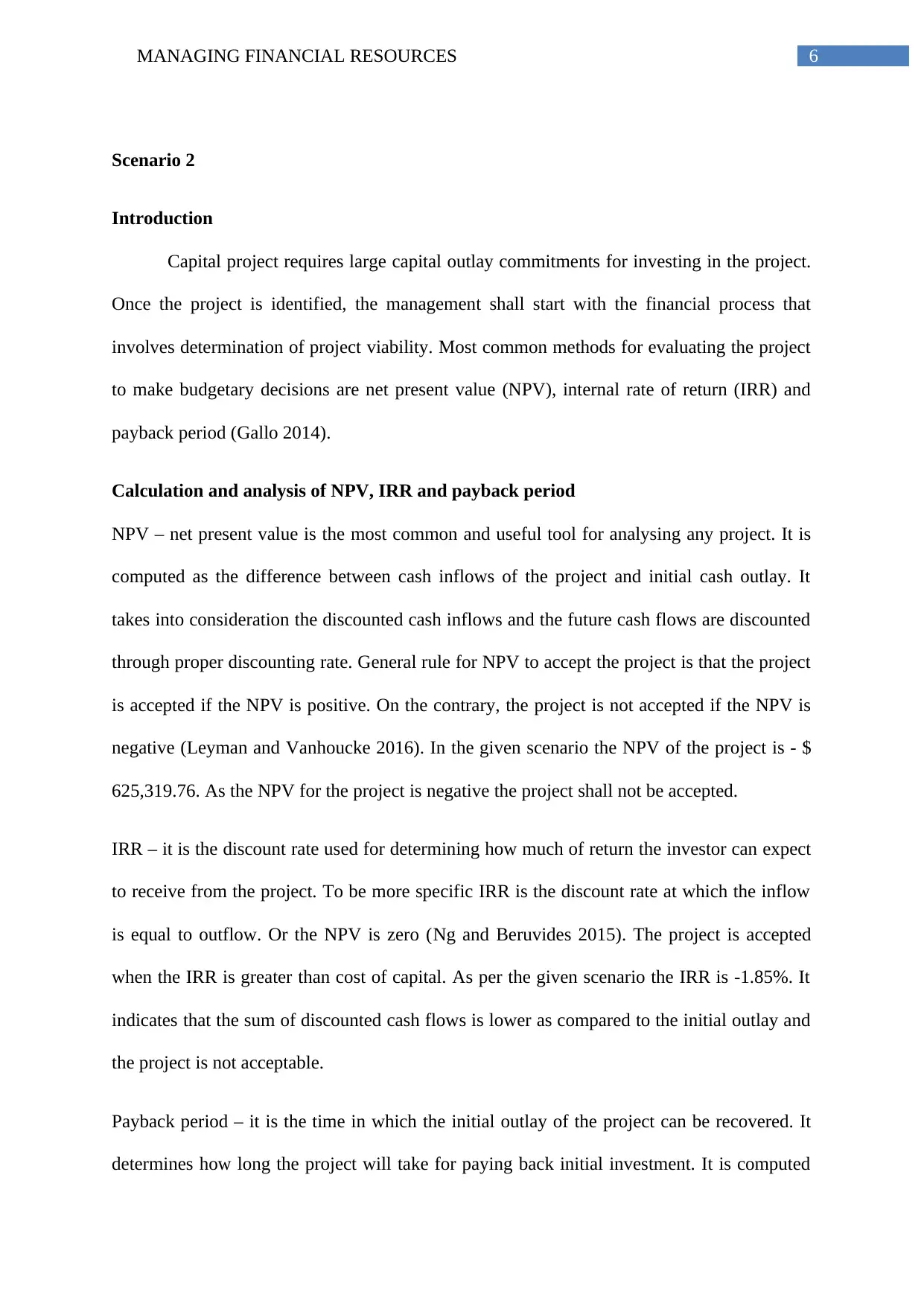
Capital project requires large capital outlay commitments for investing in the project.
Once the project is identified, the management shall start with the financial process that
involves determination of project viability. Most common methods for evaluating the project
to make budgetary decisions are net present value (NPV), internal rate of return (IRR) and
payback period (Gallo 2014).
Calculation and analysis of NPV, IRR and payback period
NPV – net present value is the most common and useful tool for analysing any project. It is
computed as the difference between cash inflows of the project and initial cash outlay. It
takes into consideration the discounted cash inflows and the future cash flows are discounted
through proper discounting rate. General rule for NPV to accept the project is that the project
is accepted if the NPV is positive. On the contrary, the project is not accepted if the NPV is
negative (Leyman and Vanhoucke 2016). In the given scenario the NPV of the project is - $
625,319.76. As the NPV for the project is negative the project shall not be accepted.
IRR – it is the discount rate used for determining how much of return the investor can expect
to receive from the project. To be more specific IRR is the discount rate at which the inflow
is equal to outflow. Or the NPV is zero (Ng and Beruvides 2015). The project is accepted
when the IRR is greater than cost of capital. As per the given scenario the IRR is -1.85%. It
indicates that the sum of discounted cash flows is lower as compared to the initial outlay and
the project is not acceptable.
Payback period – it is the time in which the initial outlay of the project can be recovered. It
determines how long the project will take for paying back initial investment. It is computed
Scenario 2
Introduction
Capital project requires large capital outlay commitments for investing in the project.
Once the project is identified, the management shall start with the financial process that
involves determination of project viability. Most common methods for evaluating the project
to make budgetary decisions are net present value (NPV), internal rate of return (IRR) and
payback period (Gallo 2014).
Calculation and analysis of NPV, IRR and payback period
NPV – net present value is the most common and useful tool for analysing any project. It is
computed as the difference between cash inflows of the project and initial cash outlay. It
takes into consideration the discounted cash inflows and the future cash flows are discounted
through proper discounting rate. General rule for NPV to accept the project is that the project
is accepted if the NPV is positive. On the contrary, the project is not accepted if the NPV is
negative (Leyman and Vanhoucke 2016). In the given scenario the NPV of the project is - $
625,319.76. As the NPV for the project is negative the project shall not be accepted.
IRR – it is the discount rate used for determining how much of return the investor can expect
to receive from the project. To be more specific IRR is the discount rate at which the inflow
is equal to outflow. Or the NPV is zero (Ng and Beruvides 2015). The project is accepted
when the IRR is greater than cost of capital. As per the given scenario the IRR is -1.85%. It
indicates that the sum of discounted cash flows is lower as compared to the initial outlay and
the project is not acceptable.
Payback period – it is the time in which the initial outlay of the project can be recovered. It
determines how long the project will take for paying back initial investment. It is computed
Paraphrase This Document
Need a fresh take? Get an instant paraphrase of this document with our AI Paraphraser
7MANAGING FINANCIAL RESOURCES
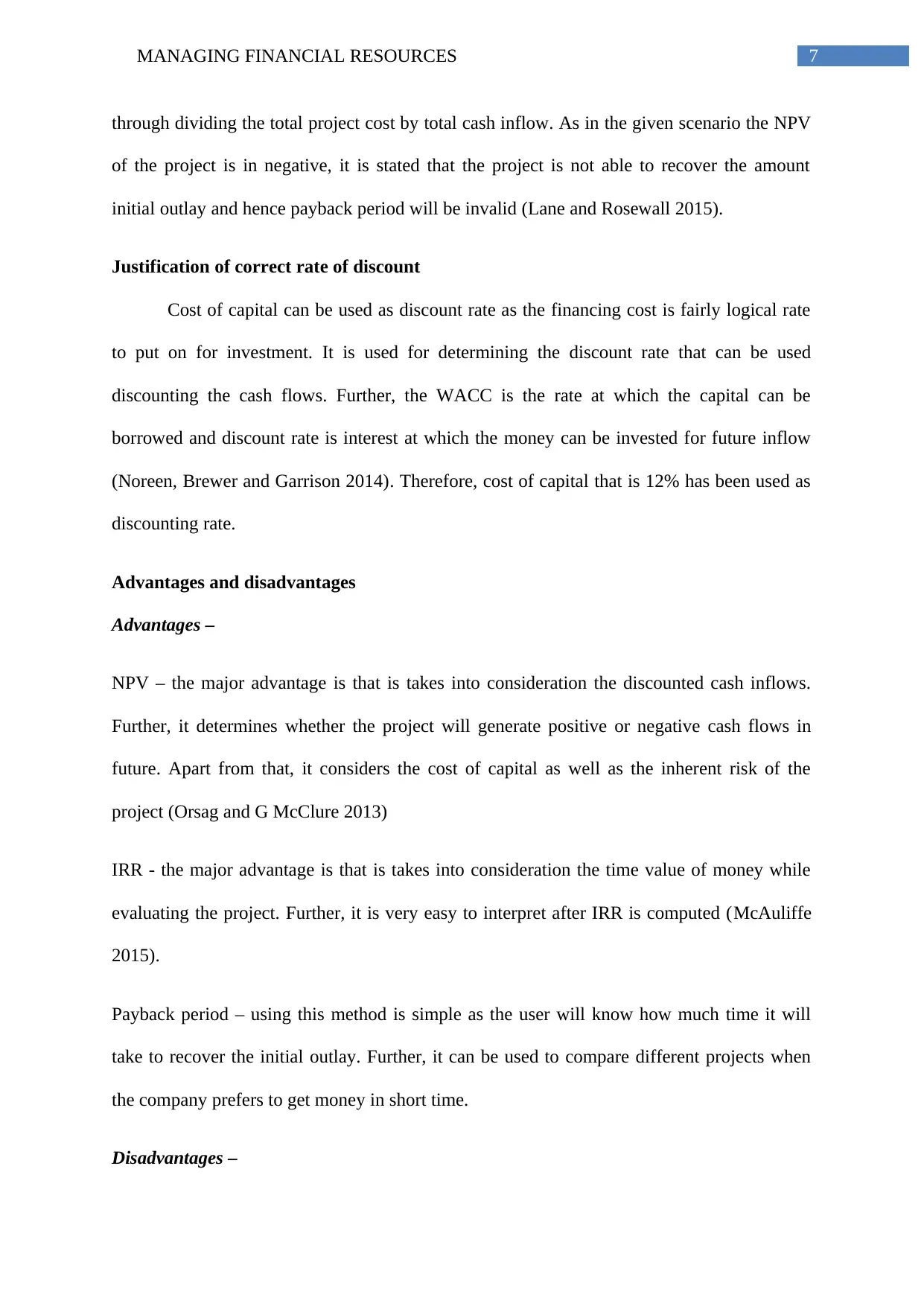
through dividing the total project cost by total cash inflow. As in the given scenario the NPV
of the project is in negative, it is stated that the project is not able to recover the amount
initial outlay and hence payback period will be invalid (Lane and Rosewall 2015).
Justification of correct rate of discount
Cost of capital can be used as discount rate as the financing cost is fairly logical rate
to put on for investment. It is used for determining the discount rate that can be used
discounting the cash flows. Further, the WACC is the rate at which the capital can be
borrowed and discount rate is interest at which the money can be invested for future inflow
(Noreen, Brewer and Garrison 2014). Therefore, cost of capital that is 12% has been used as
discounting rate.
Advantages and disadvantages
Advantages –
NPV – the major advantage is that is takes into consideration the discounted cash inflows.
Further, it determines whether the project will generate positive or negative cash flows in
future. Apart from that, it considers the cost of capital as well as the inherent risk of the
project (Orsag and G McClure 2013)
IRR - the major advantage is that is takes into consideration the time value of money while
evaluating the project. Further, it is very easy to interpret after IRR is computed (McAuliffe
2015).
Payback period – using this method is simple as the user will know how much time it will
take to recover the initial outlay. Further, it can be used to compare different projects when
the company prefers to get money in short time.
Disadvantages –
through dividing the total project cost by total cash inflow. As in the given scenario the NPV
of the project is in negative, it is stated that the project is not able to recover the amount
initial outlay and hence payback period will be invalid (Lane and Rosewall 2015).
Justification of correct rate of discount
Cost of capital can be used as discount rate as the financing cost is fairly logical rate
to put on for investment. It is used for determining the discount rate that can be used
discounting the cash flows. Further, the WACC is the rate at which the capital can be
borrowed and discount rate is interest at which the money can be invested for future inflow
(Noreen, Brewer and Garrison 2014). Therefore, cost of capital that is 12% has been used as
discounting rate.
Advantages and disadvantages
Advantages –
NPV – the major advantage is that is takes into consideration the discounted cash inflows.
Further, it determines whether the project will generate positive or negative cash flows in
future. Apart from that, it considers the cost of capital as well as the inherent risk of the
project (Orsag and G McClure 2013)
IRR - the major advantage is that is takes into consideration the time value of money while
evaluating the project. Further, it is very easy to interpret after IRR is computed (McAuliffe
2015).
Payback period – using this method is simple as the user will know how much time it will
take to recover the initial outlay. Further, it can be used to compare different projects when
the company prefers to get money in short time.
Disadvantages –
8MANAGING FINANCIAL RESOURCES
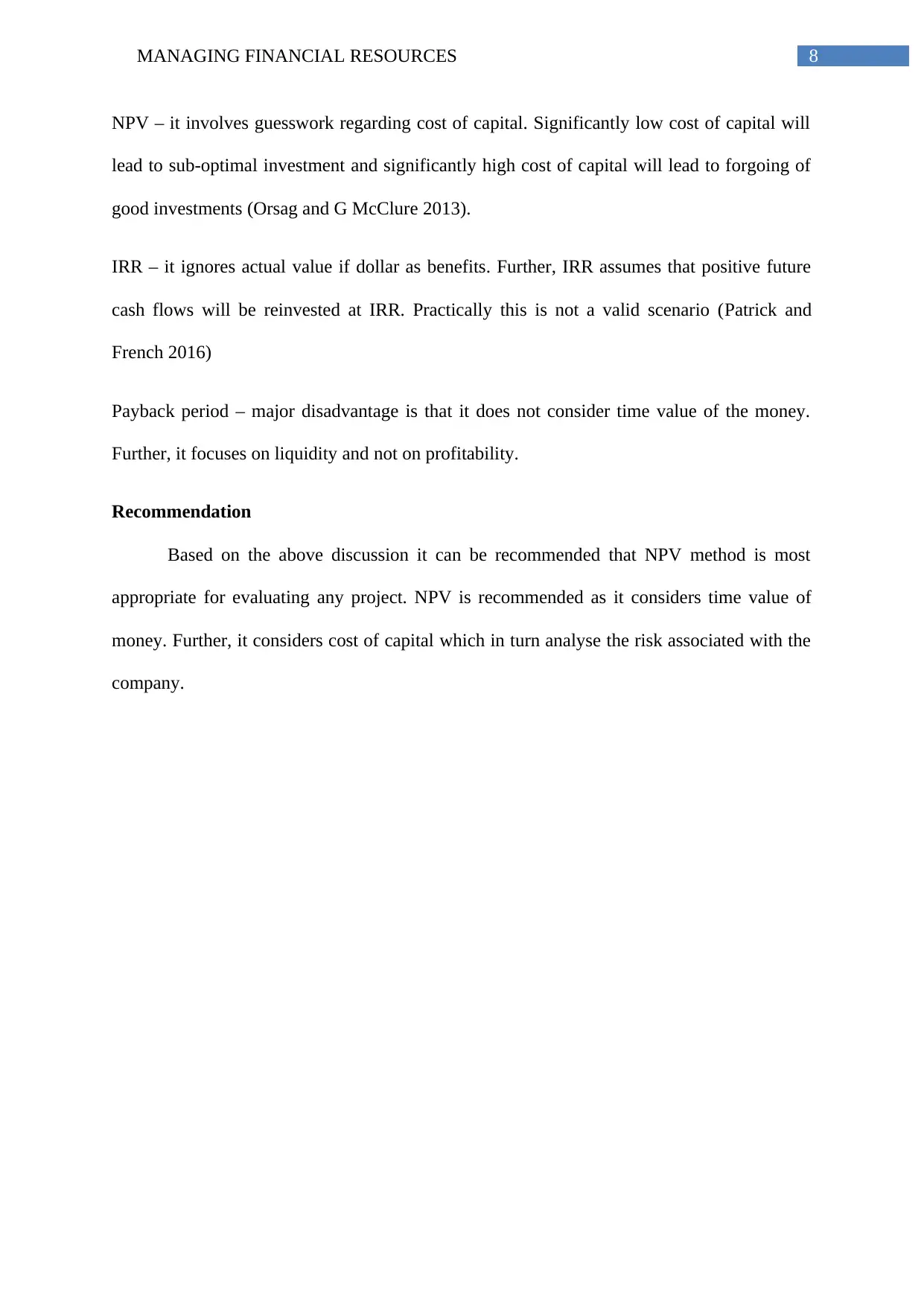
NPV – it involves guesswork regarding cost of capital. Significantly low cost of capital will
lead to sub-optimal investment and significantly high cost of capital will lead to forgoing of
good investments (Orsag and G McClure 2013).
IRR – it ignores actual value if dollar as benefits. Further, IRR assumes that positive future
cash flows will be reinvested at IRR. Practically this is not a valid scenario (Patrick and
French 2016)
Payback period – major disadvantage is that it does not consider time value of the money.
Further, it focuses on liquidity and not on profitability.
Recommendation
Based on the above discussion it can be recommended that NPV method is most
appropriate for evaluating any project. NPV is recommended as it considers time value of
money. Further, it considers cost of capital which in turn analyse the risk associated with the
company.
NPV – it involves guesswork regarding cost of capital. Significantly low cost of capital will
lead to sub-optimal investment and significantly high cost of capital will lead to forgoing of
good investments (Orsag and G McClure 2013).
IRR – it ignores actual value if dollar as benefits. Further, IRR assumes that positive future
cash flows will be reinvested at IRR. Practically this is not a valid scenario (Patrick and
French 2016)
Payback period – major disadvantage is that it does not consider time value of the money.
Further, it focuses on liquidity and not on profitability.
Recommendation
Based on the above discussion it can be recommended that NPV method is most
appropriate for evaluating any project. NPV is recommended as it considers time value of
money. Further, it considers cost of capital which in turn analyse the risk associated with the
company.
⊘ This is a preview!⊘
Do you want full access?
Subscribe today to unlock all pages.
Trusted by 1+ million students worldwide
9MANAGING FINANCIAL RESOURCES
Scenario 3
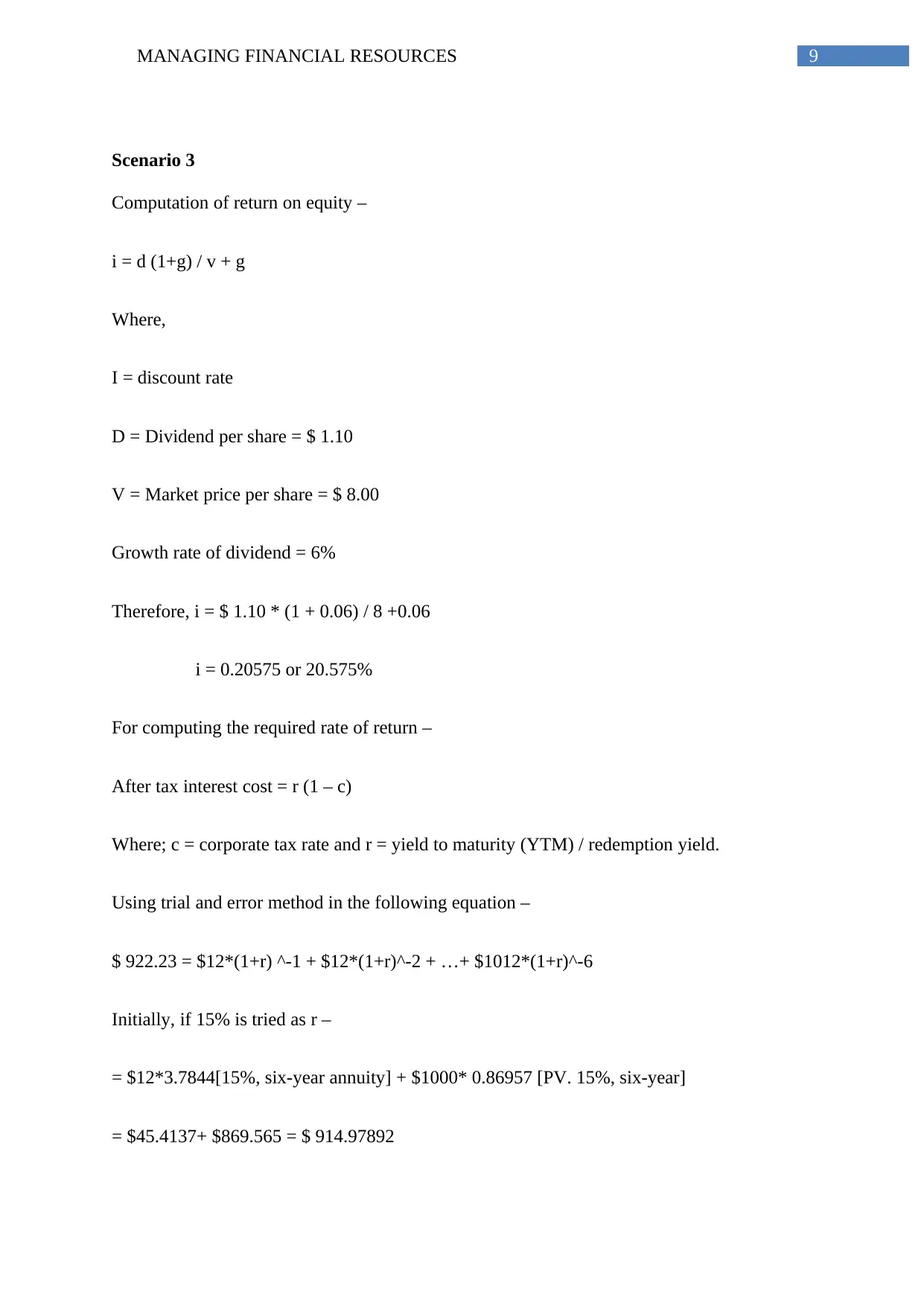
Computation of return on equity –
i = d (1+g) / v + g
Where,
I = discount rate
D = Dividend per share = $ 1.10
V = Market price per share = $ 8.00
Growth rate of dividend = 6%
Therefore, i = $ 1.10 * (1 + 0.06) / 8 +0.06
i = 0.20575 or 20.575%
For computing the required rate of return –
After tax interest cost = r (1 – c)
Where; c = corporate tax rate and r = yield to maturity (YTM) / redemption yield.
Using trial and error method in the following equation –
$ 922.23 = $12*(1+r) ^-1 + $12*(1+r)^-2 + …+ $1012*(1+r)^-6
Initially, if 15% is tried as r –
= $12*3.7844[15%, six-year annuity] + $1000* 0.86957 [PV. 15%, six-year]
= $45.4137+ $869.565 = $ 914.97892
Scenario 3
Computation of return on equity –
i = d (1+g) / v + g
Where,
I = discount rate
D = Dividend per share = $ 1.10
V = Market price per share = $ 8.00
Growth rate of dividend = 6%
Therefore, i = $ 1.10 * (1 + 0.06) / 8 +0.06
i = 0.20575 or 20.575%
For computing the required rate of return –
After tax interest cost = r (1 – c)
Where; c = corporate tax rate and r = yield to maturity (YTM) / redemption yield.
Using trial and error method in the following equation –
$ 922.23 = $12*(1+r) ^-1 + $12*(1+r)^-2 + …+ $1012*(1+r)^-6
Initially, if 15% is tried as r –
= $12*3.7844[15%, six-year annuity] + $1000* 0.86957 [PV. 15%, six-year]
= $45.4137+ $869.565 = $ 914.97892
Paraphrase This Document
Need a fresh take? Get an instant paraphrase of this document with our AI Paraphraser
10MANAGING FINANCIAL RESOURCES
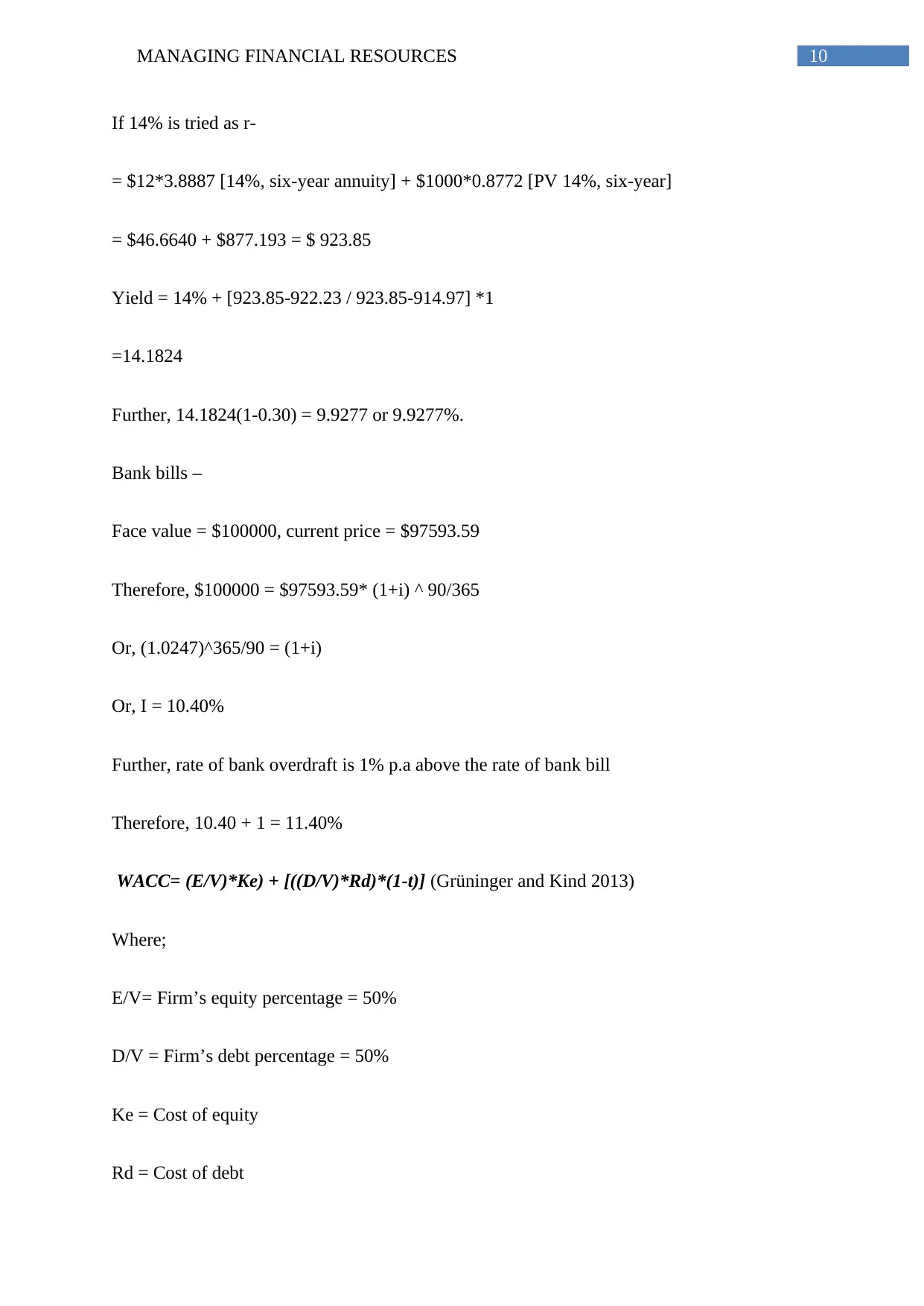
If 14% is tried as r-
= $12*3.8887 [14%, six-year annuity] + $1000*0.8772 [PV 14%, six-year]
= $46.6640 + $877.193 = $ 923.85
Yield = 14% + [923.85-922.23 / 923.85-914.97] *1
=14.1824
Further, 14.1824(1-0.30) = 9.9277 or 9.9277%.
Bank bills –
Face value = $100000, current price = $97593.59
Therefore, $100000 = $97593.59* (1+i) ^ 90/365
Or, (1.0247)^365/90 = (1+i)
Or, I = 10.40%
Further, rate of bank overdraft is 1% p.a above the rate of bank bill
Therefore, 10.40 + 1 = 11.40%
WACC= (E/V)*Ke) + [((D/V)*Rd)*(1-t)] (Grüninger and Kind 2013)
Where;
E/V= Firm’s equity percentage = 50%
D/V = Firm’s debt percentage = 50%
Ke = Cost of equity
Rd = Cost of debt
If 14% is tried as r-
= $12*3.8887 [14%, six-year annuity] + $1000*0.8772 [PV 14%, six-year]
= $46.6640 + $877.193 = $ 923.85
Yield = 14% + [923.85-922.23 / 923.85-914.97] *1
=14.1824
Further, 14.1824(1-0.30) = 9.9277 or 9.9277%.
Bank bills –
Face value = $100000, current price = $97593.59
Therefore, $100000 = $97593.59* (1+i) ^ 90/365
Or, (1.0247)^365/90 = (1+i)
Or, I = 10.40%
Further, rate of bank overdraft is 1% p.a above the rate of bank bill
Therefore, 10.40 + 1 = 11.40%
WACC= (E/V)*Ke) + [((D/V)*Rd)*(1-t)] (Grüninger and Kind 2013)
Where;
E/V= Firm’s equity percentage = 50%
D/V = Firm’s debt percentage = 50%
Ke = Cost of equity
Rd = Cost of debt
11MANAGING FINANCIAL RESOURCES
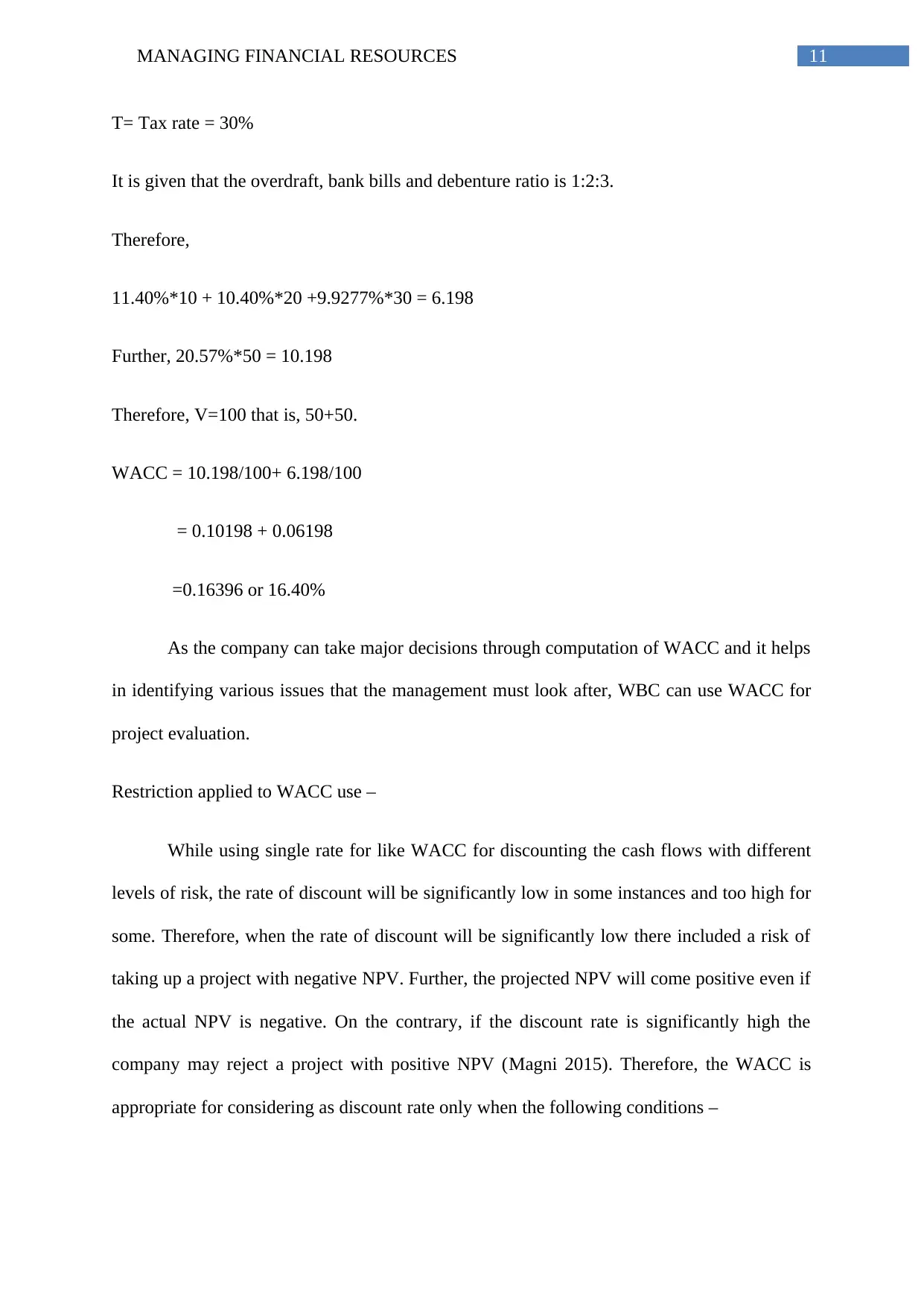
T= Tax rate = 30%
It is given that the overdraft, bank bills and debenture ratio is 1:2:3.
Therefore,
11.40%*10 + 10.40%*20 +9.9277%*30 = 6.198
Further, 20.57%*50 = 10.198
Therefore, V=100 that is, 50+50.
WACC = 10.198/100+ 6.198/100
= 0.10198 + 0.06198
=0.16396 or 16.40%
As the company can take major decisions through computation of WACC and it helps
in identifying various issues that the management must look after, WBC can use WACC for
project evaluation.
Restriction applied to WACC use –
While using single rate for like WACC for discounting the cash flows with different
levels of risk, the rate of discount will be significantly low in some instances and too high for
some. Therefore, when the rate of discount will be significantly low there included a risk of
taking up a project with negative NPV. Further, the projected NPV will come positive even if
the actual NPV is negative. On the contrary, if the discount rate is significantly high the
company may reject a project with positive NPV (Magni 2015). Therefore, the WACC is
appropriate for considering as discount rate only when the following conditions –
T= Tax rate = 30%
It is given that the overdraft, bank bills and debenture ratio is 1:2:3.
Therefore,
11.40%*10 + 10.40%*20 +9.9277%*30 = 6.198
Further, 20.57%*50 = 10.198
Therefore, V=100 that is, 50+50.
WACC = 10.198/100+ 6.198/100
= 0.10198 + 0.06198
=0.16396 or 16.40%
As the company can take major decisions through computation of WACC and it helps
in identifying various issues that the management must look after, WBC can use WACC for
project evaluation.
Restriction applied to WACC use –
While using single rate for like WACC for discounting the cash flows with different
levels of risk, the rate of discount will be significantly low in some instances and too high for
some. Therefore, when the rate of discount will be significantly low there included a risk of
taking up a project with negative NPV. Further, the projected NPV will come positive even if
the actual NPV is negative. On the contrary, if the discount rate is significantly high the
company may reject a project with positive NPV (Magni 2015). Therefore, the WACC is
appropriate for considering as discount rate only when the following conditions –
⊘ This is a preview!⊘
Do you want full access?
Subscribe today to unlock all pages.
Trusted by 1+ million students worldwide

1 out of 15


Related Documents


Your All-in-One AI-Powered Toolkit for Academic Success.
+13062052269
info@desklib.com
Available 24*7 on WhatsApp / Email
![[object Object]](/_next/static/media/star-bottom.7253800d.svg)
Unlock your academic potential
Copyright © 2020–2026 A2Z Services. All Rights Reserved. Developed and managed by ZUCOL.