Financial Strategies Report: Hospitality Business Management (BA)
VerifiedAdded on 2021/02/03
|10
|1930
|89
Report
AI Summary
This report evaluates financial strategies for a hospitality business, focusing on investment appraisal methods like payback period, net present value (NPV), and accounting rate of return (ARR). The analysis includes a detailed investment appraisal for purchasing a delivery van, considering cash flows and discount rates. The report also assesses different sources of finance, such as bank overdrafts and business angels, recommending the most suitable option for the business. The conclusion highlights the financial viability of the van purchase based on positive NPV and a reasonable payback period, suggesting business angels as the preferred funding source due to their provision of capital and expertise. The report is supported by relevant financial theories and academic references.
Financial Strategies
(Resit and First Attempt Report to replace Exam 1)
(BA) Hospitality Business Management
1
(Resit and First Attempt Report to replace Exam 1)
(BA) Hospitality Business Management
1

Paraphrase This Document
Need a fresh take? Get an instant paraphrase of this document with our AI Paraphraser
Table of Contents
Introduction 3
Investment Appraisal 3
Payback Period 4
Net present Value 5
Accounting Rate of return 6
Evaluation of sources of finance 7
Bank Overdraft 7
Business Angels 8
Conclusions 9
Recommendation 9
References 10
2
Introduction 3
Investment Appraisal 3
Payback Period 4
Net present Value 5
Accounting Rate of return 6
Evaluation of sources of finance 7
Bank Overdraft 7
Business Angels 8
Conclusions 9
Recommendation 9
References 10
2
Introduction
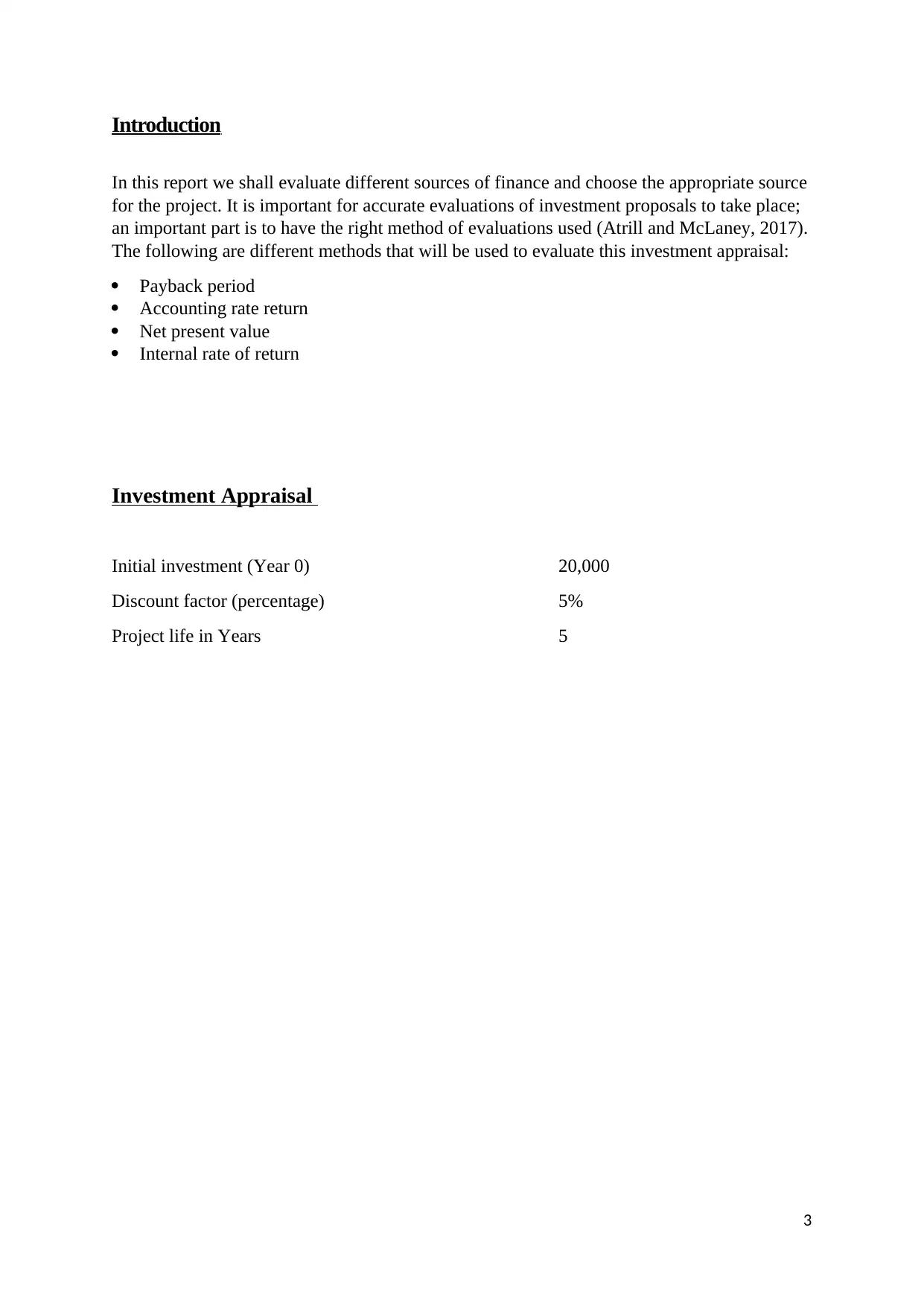
In this report we shall evaluate different sources of finance and choose the appropriate source
for the project. It is important for accurate evaluations of investment proposals to take place;
an important part is to have the right method of evaluations used (Atrill and McLaney, 2017).
The following are different methods that will be used to evaluate this investment appraisal:
Payback period
Accounting rate return
Net present value
Internal rate of return
Investment Appraisal
Initial investment (Year 0) 20,000
Discount factor (percentage) 5%
Project life in Years 5
3
In this report we shall evaluate different sources of finance and choose the appropriate source
for the project. It is important for accurate evaluations of investment proposals to take place;
an important part is to have the right method of evaluations used (Atrill and McLaney, 2017).
The following are different methods that will be used to evaluate this investment appraisal:
Payback period
Accounting rate return
Net present value
Internal rate of return
Investment Appraisal
Initial investment (Year 0) 20,000
Discount factor (percentage) 5%
Project life in Years 5
3
⊘ This is a preview!⊘
Do you want full access?
Subscribe today to unlock all pages.

Trusted by 1+ million students worldwide
Pay Back period
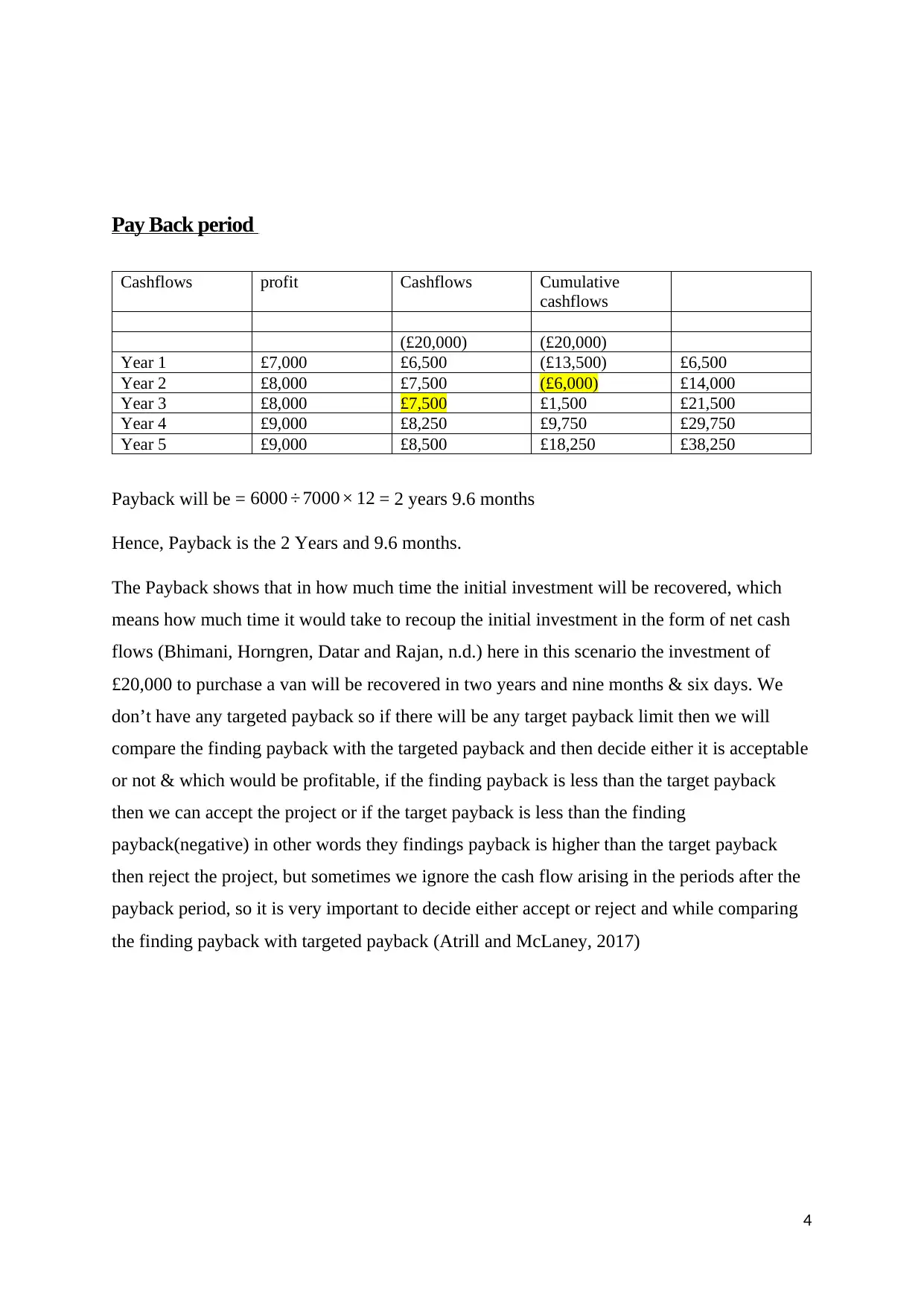
Cashflows profit Cashflows Cumulative
cashflows
(£20,000) (£20,000)
Year 1 £7,000 £6,500 (£13,500) £6,500
Year 2 £8,000 £7,500 (£6,000) £14,000
Year 3 £8,000 £7,500 £1,500 £21,500
Year 4 £9,000 £8,250 £9,750 £29,750
Year 5 £9,000 £8,500 £18,250 £38,250
Payback will be = 6000 ÷ 7000× 12 = 2 years 9.6 months
Hence, Payback is the 2 Years and 9.6 months.
The Payback shows that in how much time the initial investment will be recovered, which
means how much time it would take to recoup the initial investment in the form of net cash
flows (Bhimani, Horngren, Datar and Rajan, n.d.) here in this scenario the investment of
£20,000 to purchase a van will be recovered in two years and nine months & six days. We
don’t have any targeted payback so if there will be any target payback limit then we will
compare the finding payback with the targeted payback and then decide either it is acceptable
or not & which would be profitable, if the finding payback is less than the target payback
then we can accept the project or if the target payback is less than the finding
payback(negative) in other words they findings payback is higher than the target payback
then reject the project, but sometimes we ignore the cash flow arising in the periods after the
payback period, so it is very important to decide either accept or reject and while comparing
the finding payback with targeted payback (Atrill and McLaney, 2017)
4
Cashflows profit Cashflows Cumulative
cashflows
(£20,000) (£20,000)
Year 1 £7,000 £6,500 (£13,500) £6,500
Year 2 £8,000 £7,500 (£6,000) £14,000
Year 3 £8,000 £7,500 £1,500 £21,500
Year 4 £9,000 £8,250 £9,750 £29,750
Year 5 £9,000 £8,500 £18,250 £38,250
Payback will be = 6000 ÷ 7000× 12 = 2 years 9.6 months
Hence, Payback is the 2 Years and 9.6 months.
The Payback shows that in how much time the initial investment will be recovered, which
means how much time it would take to recoup the initial investment in the form of net cash
flows (Bhimani, Horngren, Datar and Rajan, n.d.) here in this scenario the investment of
£20,000 to purchase a van will be recovered in two years and nine months & six days. We
don’t have any targeted payback so if there will be any target payback limit then we will
compare the finding payback with the targeted payback and then decide either it is acceptable
or not & which would be profitable, if the finding payback is less than the target payback
then we can accept the project or if the target payback is less than the finding
payback(negative) in other words they findings payback is higher than the target payback
then reject the project, but sometimes we ignore the cash flow arising in the periods after the
payback period, so it is very important to decide either accept or reject and while comparing
the finding payback with targeted payback (Atrill and McLaney, 2017)
4
Paraphrase This Document
Need a fresh take? Get an instant paraphrase of this document with our AI Paraphraser
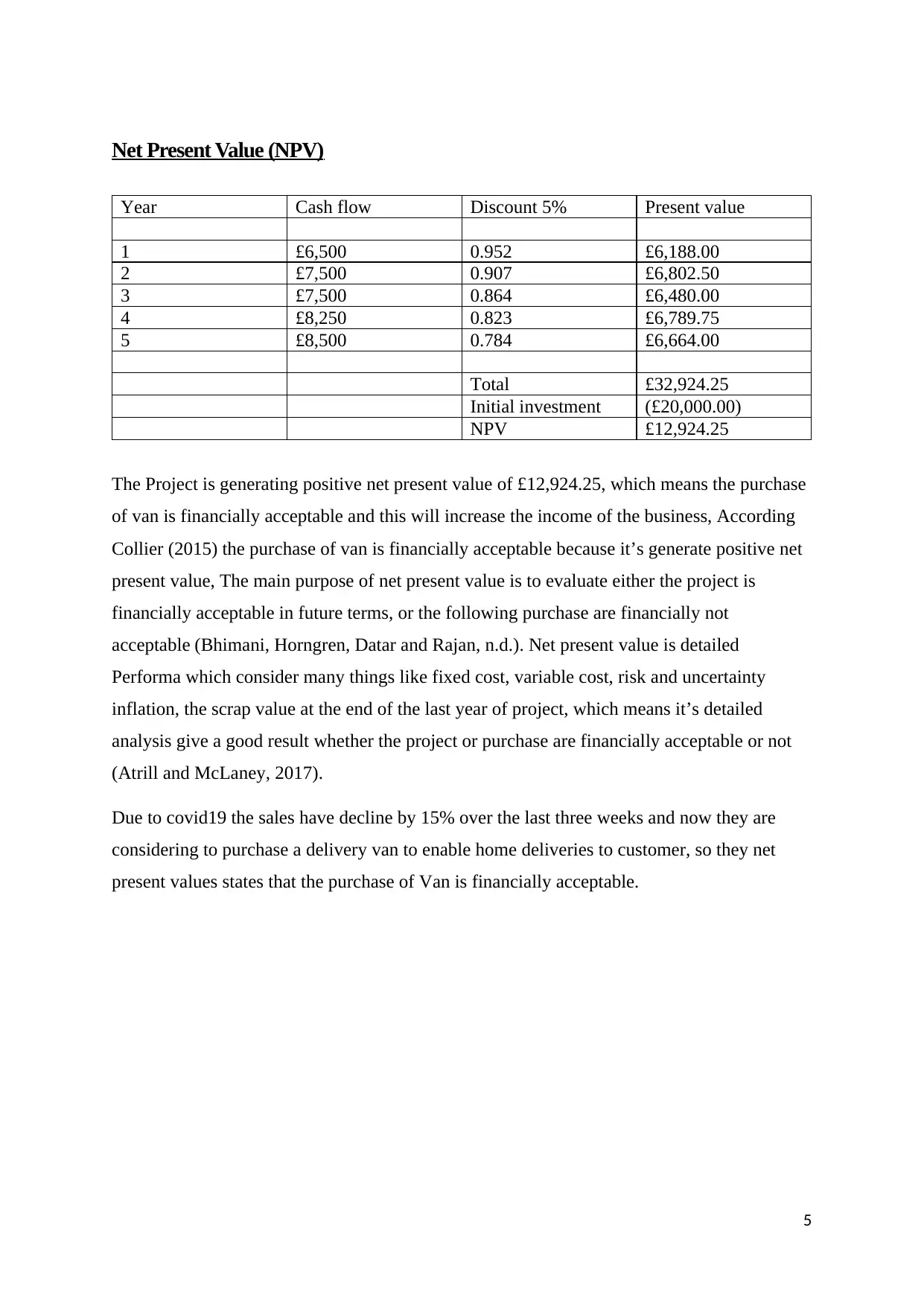
Net Present Value (NPV)
Year Cash flow Discount 5% Present value
1 £6,500 0.952 £6,188.00
2 £7,500 0.907 £6,802.50
3 £7,500 0.864 £6,480.00
4 £8,250 0.823 £6,789.75
5 £8,500 0.784 £6,664.00
Total £32,924.25
Initial investment (£20,000.00)
NPV £12,924.25
The Project is generating positive net present value of £12,924.25, which means the purchase
of van is financially acceptable and this will increase the income of the business, According
Collier (2015) the purchase of van is financially acceptable because it’s generate positive net
present value, The main purpose of net present value is to evaluate either the project is
financially acceptable in future terms, or the following purchase are financially not
acceptable (Bhimani, Horngren, Datar and Rajan, n.d.). Net present value is detailed
Performa which consider many things like fixed cost, variable cost, risk and uncertainty
inflation, the scrap value at the end of the last year of project, which means it’s detailed
analysis give a good result whether the project or purchase are financially acceptable or not
(Atrill and McLaney, 2017).
Due to covid19 the sales have decline by 15% over the last three weeks and now they are
considering to purchase a delivery van to enable home deliveries to customer, so they net
present values states that the purchase of Van is financially acceptable.
5
Year Cash flow Discount 5% Present value
1 £6,500 0.952 £6,188.00
2 £7,500 0.907 £6,802.50
3 £7,500 0.864 £6,480.00
4 £8,250 0.823 £6,789.75
5 £8,500 0.784 £6,664.00
Total £32,924.25
Initial investment (£20,000.00)
NPV £12,924.25
The Project is generating positive net present value of £12,924.25, which means the purchase
of van is financially acceptable and this will increase the income of the business, According
Collier (2015) the purchase of van is financially acceptable because it’s generate positive net
present value, The main purpose of net present value is to evaluate either the project is
financially acceptable in future terms, or the following purchase are financially not
acceptable (Bhimani, Horngren, Datar and Rajan, n.d.). Net present value is detailed
Performa which consider many things like fixed cost, variable cost, risk and uncertainty
inflation, the scrap value at the end of the last year of project, which means it’s detailed
analysis give a good result whether the project or purchase are financially acceptable or not
(Atrill and McLaney, 2017).
Due to covid19 the sales have decline by 15% over the last three weeks and now they are
considering to purchase a delivery van to enable home deliveries to customer, so they net
present values states that the purchase of Van is financially acceptable.
5
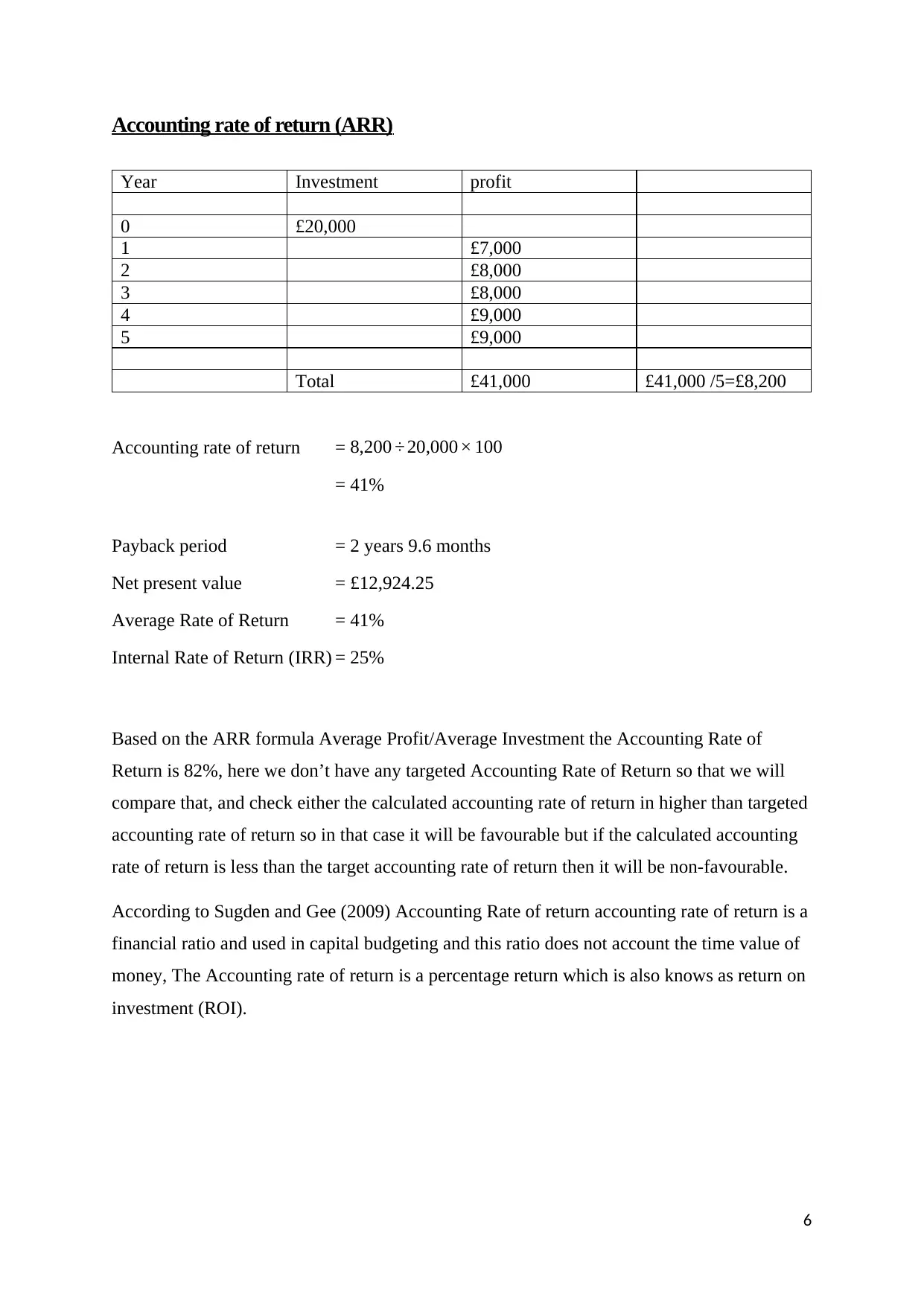
Accounting rate of return (ARR)
Year Investment profit
0 £20,000
1 £7,000
2 £8,000
3 £8,000
4 £9,000
5 £9,000
Total £41,000 £41,000 /5=£8,200
Accounting rate of return = 8,200 ÷ 20,000× 100
= 41%
Payback period = 2 years 9.6 months
Net present value = £12,924.25
Average Rate of Return = 41%
Internal Rate of Return (IRR) = 25%
Based on the ARR formula Average Profit/Average Investment the Accounting Rate of
Return is 82%, here we don’t have any targeted Accounting Rate of Return so that we will
compare that, and check either the calculated accounting rate of return in higher than targeted
accounting rate of return so in that case it will be favourable but if the calculated accounting
rate of return is less than the target accounting rate of return then it will be non-favourable.
According to Sugden and Gee (2009) Accounting Rate of return accounting rate of return is a
financial ratio and used in capital budgeting and this ratio does not account the time value of
money, The Accounting rate of return is a percentage return which is also knows as return on
investment (ROI).
6
Year Investment profit
0 £20,000
1 £7,000
2 £8,000
3 £8,000
4 £9,000
5 £9,000
Total £41,000 £41,000 /5=£8,200
Accounting rate of return = 8,200 ÷ 20,000× 100
= 41%
Payback period = 2 years 9.6 months
Net present value = £12,924.25
Average Rate of Return = 41%
Internal Rate of Return (IRR) = 25%
Based on the ARR formula Average Profit/Average Investment the Accounting Rate of
Return is 82%, here we don’t have any targeted Accounting Rate of Return so that we will
compare that, and check either the calculated accounting rate of return in higher than targeted
accounting rate of return so in that case it will be favourable but if the calculated accounting
rate of return is less than the target accounting rate of return then it will be non-favourable.
According to Sugden and Gee (2009) Accounting Rate of return accounting rate of return is a
financial ratio and used in capital budgeting and this ratio does not account the time value of
money, The Accounting rate of return is a percentage return which is also knows as return on
investment (ROI).
6
⊘ This is a preview!⊘
Do you want full access?
Subscribe today to unlock all pages.
Trusted by 1+ million students worldwide
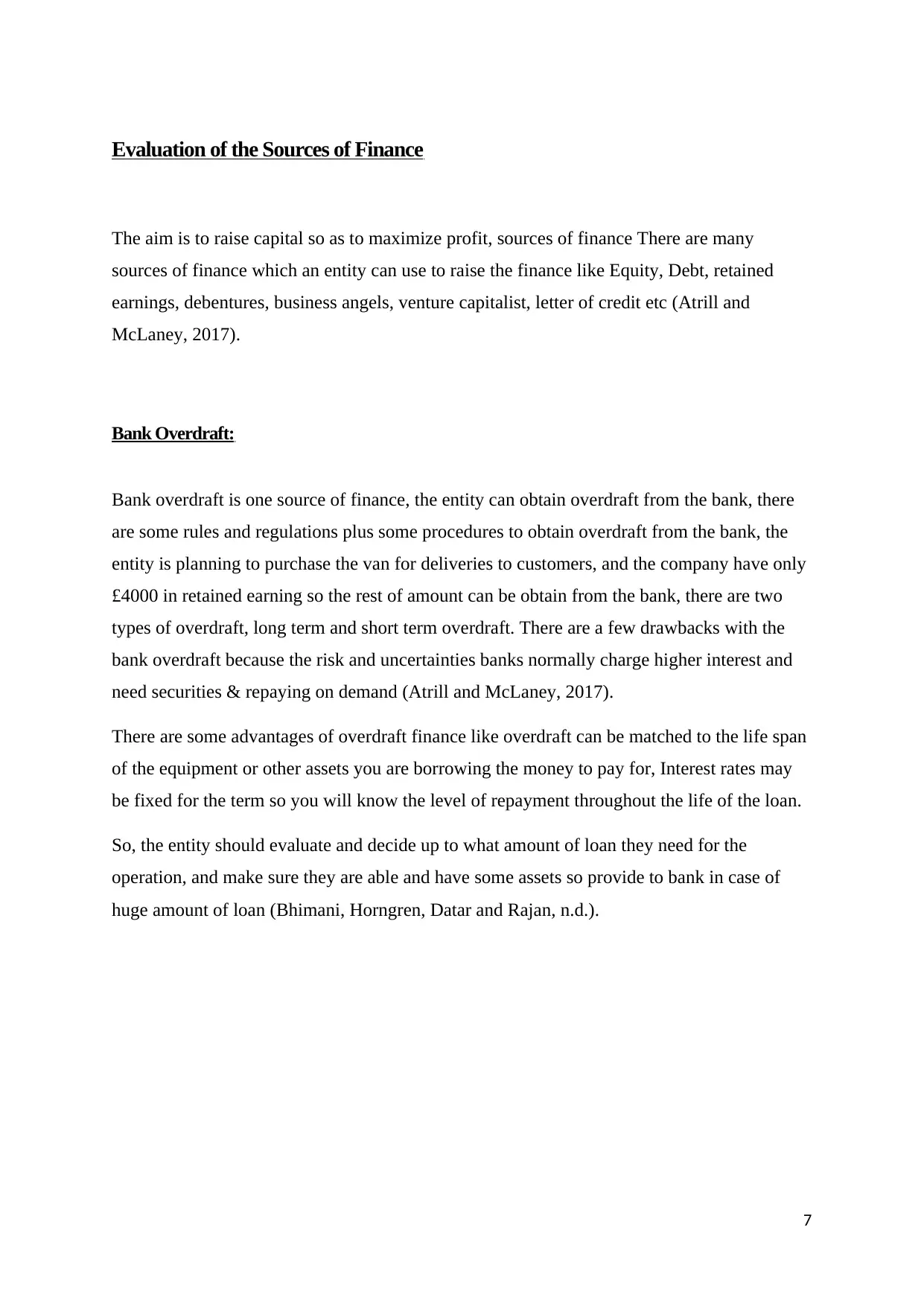
Evaluation of the Sources of Finance
The aim is to raise capital so as to maximize profit, sources of finance There are many
sources of finance which an entity can use to raise the finance like Equity, Debt, retained
earnings, debentures, business angels, venture capitalist, letter of credit etc (Atrill and
McLaney, 2017).
Bank Overdraft:
Bank overdraft is one source of finance, the entity can obtain overdraft from the bank, there
are some rules and regulations plus some procedures to obtain overdraft from the bank, the
entity is planning to purchase the van for deliveries to customers, and the company have only
£4000 in retained earning so the rest of amount can be obtain from the bank, there are two
types of overdraft, long term and short term overdraft. There are a few drawbacks with the
bank overdraft because the risk and uncertainties banks normally charge higher interest and
need securities & repaying on demand (Atrill and McLaney, 2017).
There are some advantages of overdraft finance like overdraft can be matched to the life span
of the equipment or other assets you are borrowing the money to pay for, Interest rates may
be fixed for the term so you will know the level of repayment throughout the life of the loan.
So, the entity should evaluate and decide up to what amount of loan they need for the
operation, and make sure they are able and have some assets so provide to bank in case of
huge amount of loan (Bhimani, Horngren, Datar and Rajan, n.d.).
7
The aim is to raise capital so as to maximize profit, sources of finance There are many
sources of finance which an entity can use to raise the finance like Equity, Debt, retained
earnings, debentures, business angels, venture capitalist, letter of credit etc (Atrill and
McLaney, 2017).
Bank Overdraft:
Bank overdraft is one source of finance, the entity can obtain overdraft from the bank, there
are some rules and regulations plus some procedures to obtain overdraft from the bank, the
entity is planning to purchase the van for deliveries to customers, and the company have only
£4000 in retained earning so the rest of amount can be obtain from the bank, there are two
types of overdraft, long term and short term overdraft. There are a few drawbacks with the
bank overdraft because the risk and uncertainties banks normally charge higher interest and
need securities & repaying on demand (Atrill and McLaney, 2017).
There are some advantages of overdraft finance like overdraft can be matched to the life span
of the equipment or other assets you are borrowing the money to pay for, Interest rates may
be fixed for the term so you will know the level of repayment throughout the life of the loan.
So, the entity should evaluate and decide up to what amount of loan they need for the
operation, and make sure they are able and have some assets so provide to bank in case of
huge amount of loan (Bhimani, Horngren, Datar and Rajan, n.d.).
7
Paraphrase This Document
Need a fresh take? Get an instant paraphrase of this document with our AI Paraphraser
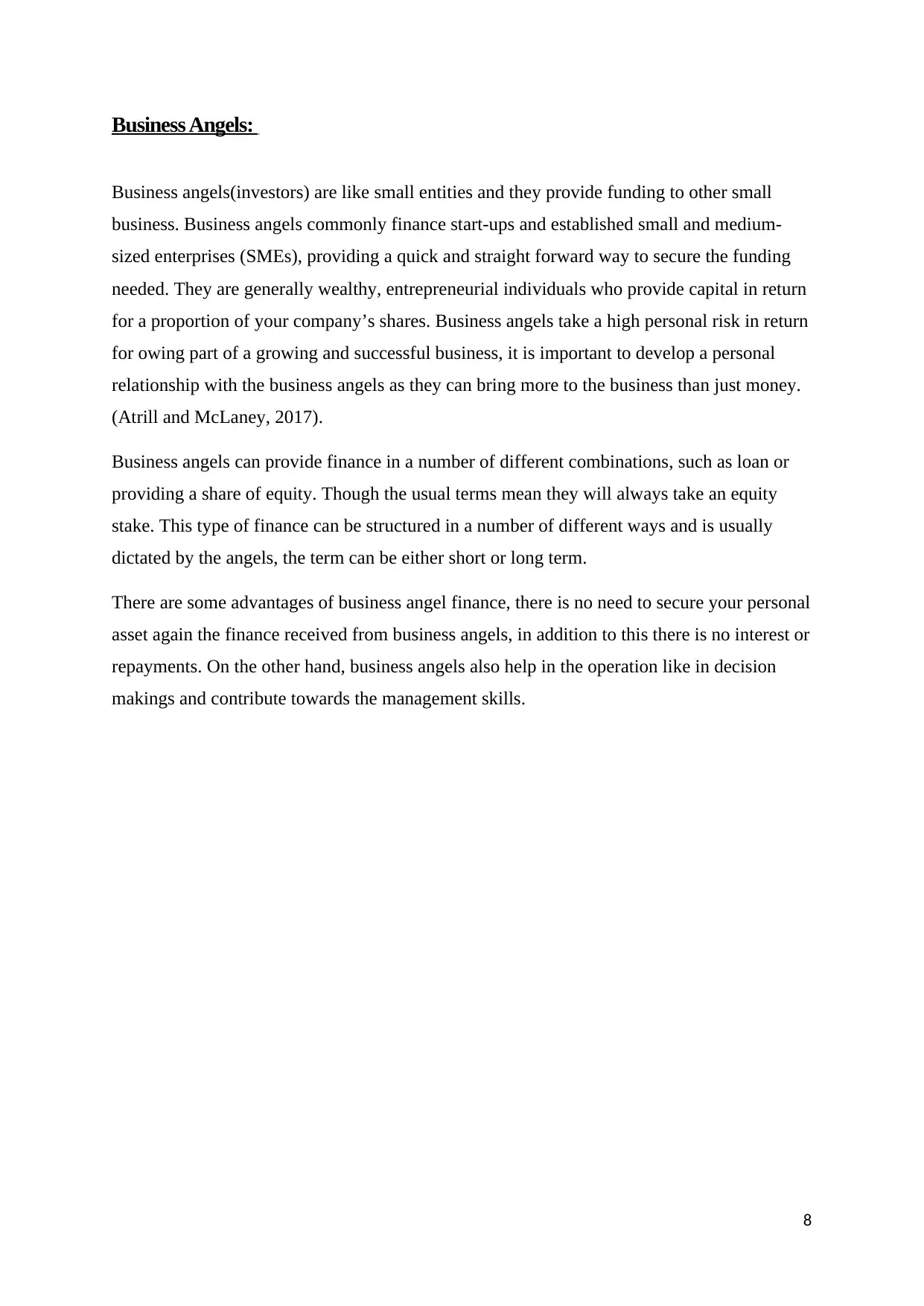
Business Angels:
Business angels(investors) are like small entities and they provide funding to other small
business. Business angels commonly finance start-ups and established small and medium-
sized enterprises (SMEs), providing a quick and straight forward way to secure the funding
needed. They are generally wealthy, entrepreneurial individuals who provide capital in return
for a proportion of your company’s shares. Business angels take a high personal risk in return
for owing part of a growing and successful business, it is important to develop a personal
relationship with the business angels as they can bring more to the business than just money.
(Atrill and McLaney, 2017).
Business angels can provide finance in a number of different combinations, such as loan or
providing a share of equity. Though the usual terms mean they will always take an equity
stake. This type of finance can be structured in a number of different ways and is usually
dictated by the angels, the term can be either short or long term.
There are some advantages of business angel finance, there is no need to secure your personal
asset again the finance received from business angels, in addition to this there is no interest or
repayments. On the other hand, business angels also help in the operation like in decision
makings and contribute towards the management skills.
8
Business angels(investors) are like small entities and they provide funding to other small
business. Business angels commonly finance start-ups and established small and medium-
sized enterprises (SMEs), providing a quick and straight forward way to secure the funding
needed. They are generally wealthy, entrepreneurial individuals who provide capital in return
for a proportion of your company’s shares. Business angels take a high personal risk in return
for owing part of a growing and successful business, it is important to develop a personal
relationship with the business angels as they can bring more to the business than just money.
(Atrill and McLaney, 2017).
Business angels can provide finance in a number of different combinations, such as loan or
providing a share of equity. Though the usual terms mean they will always take an equity
stake. This type of finance can be structured in a number of different ways and is usually
dictated by the angels, the term can be either short or long term.
There are some advantages of business angel finance, there is no need to secure your personal
asset again the finance received from business angels, in addition to this there is no interest or
repayments. On the other hand, business angels also help in the operation like in decision
makings and contribute towards the management skills.
8
Conclusion
There is a decline of 15% in sales from the last three weeks and the entity is considering to
purchase of van to make deliveries, There is only £4000 available in retained earnings
towards the capital cost of the project, so the entity is considering to purchase the van for
deliveries to customer, so for this purpose the calculated net present value is £32,924.25
which shows purchase of van is financially acceptable, In addition to this the payback period
is two years and nice point six months which means the purchase of van amounting £20000
will be recover in two years and nine point six months. There are sources of finance available
for the so they can raise finance like by obtain loan from the bank or they can also obtain
finance and expertise from the business angels. Sources of finance which will be used as a
capital of the project will be Business angel. There are some advantages of business angel
finance, there is no need to secure your personal asset again the finance received from
business angels, in addition to this there is no interest or repayments. On the other hand,
business angels also help in the operation like in decision makings and contribute towards the
management skills (Atrill and McLaney, 2017).
Recommendation
On the basis of Net present value which are £32,924.25, accounting rate of return which is
82% and payback period which are two years and nine point six months and the sources of
finance option availability the recommendation is to purchase the van, this will increases the
wealth of entity and in addition to this the customer satisfaction will increases if the
deliveries will be made to them properly. The customer will be happy to know about they
support from entity, they will be happy and will realised that in this hard times they are
delivering which will make them feel valued, this could lead to increase in customer goodwill
and for the sources of finance they should check either if the bank loan will be obtained
easily with comparatively less interest charges or either get help from business angels, so
they should obtain loan from the good option which is less costly for the business. In short
the entity should purchase the Van because the purchase of van is financially acceptable &
choose business angels as it is the most appropriate source, giving out a small share of the
company for capital & business expertise (Atrill and McLaney, 2017).
9
There is a decline of 15% in sales from the last three weeks and the entity is considering to
purchase of van to make deliveries, There is only £4000 available in retained earnings
towards the capital cost of the project, so the entity is considering to purchase the van for
deliveries to customer, so for this purpose the calculated net present value is £32,924.25
which shows purchase of van is financially acceptable, In addition to this the payback period
is two years and nice point six months which means the purchase of van amounting £20000
will be recover in two years and nine point six months. There are sources of finance available
for the so they can raise finance like by obtain loan from the bank or they can also obtain
finance and expertise from the business angels. Sources of finance which will be used as a
capital of the project will be Business angel. There are some advantages of business angel
finance, there is no need to secure your personal asset again the finance received from
business angels, in addition to this there is no interest or repayments. On the other hand,
business angels also help in the operation like in decision makings and contribute towards the
management skills (Atrill and McLaney, 2017).
Recommendation
On the basis of Net present value which are £32,924.25, accounting rate of return which is
82% and payback period which are two years and nine point six months and the sources of
finance option availability the recommendation is to purchase the van, this will increases the
wealth of entity and in addition to this the customer satisfaction will increases if the
deliveries will be made to them properly. The customer will be happy to know about they
support from entity, they will be happy and will realised that in this hard times they are
delivering which will make them feel valued, this could lead to increase in customer goodwill
and for the sources of finance they should check either if the bank loan will be obtained
easily with comparatively less interest charges or either get help from business angels, so
they should obtain loan from the good option which is less costly for the business. In short
the entity should purchase the Van because the purchase of van is financially acceptable &
choose business angels as it is the most appropriate source, giving out a small share of the
company for capital & business expertise (Atrill and McLaney, 2017).
9
⊘ This is a preview!⊘
Do you want full access?
Subscribe today to unlock all pages.
Trusted by 1+ million students worldwide
References
Accounting for managers: Interpreting accounting information for decision making
Atrill, P. and McLaney, E., 2017. Accounting and Finance for Non-Specialists.
Bhimani, A., Horngren, C., Datar, S. and Rajan, M., n.d. Management and Cost Accounting.
Book by Paul M. Collier 2015.
Sugden, M. and Gee, P., 2009. Interpreting Company Reports and Accounts. Financial
Times/ Prentice Hall.3
10
Accounting for managers: Interpreting accounting information for decision making
Atrill, P. and McLaney, E., 2017. Accounting and Finance for Non-Specialists.
Bhimani, A., Horngren, C., Datar, S. and Rajan, M., n.d. Management and Cost Accounting.
Book by Paul M. Collier 2015.
Sugden, M. and Gee, P., 2009. Interpreting Company Reports and Accounts. Financial
Times/ Prentice Hall.3
10

1 out of 10


Your All-in-One AI-Powered Toolkit for Academic Success.
+13062052269
info@desklib.com
Available 24*7 on WhatsApp / Email
![[object Object]](/_next/static/media/star-bottom.7253800d.svg)
Unlock your academic potential
Copyright © 2020–2026 A2Z Services. All Rights Reserved. Developed and managed by ZUCOL.