Financial Accounting Assignment 1: Revenue Recognition and Taxation
VerifiedAdded on 2023/06/08
|15
|3401
|173
Homework Assignment
AI Summary
This financial accounting assignment explores the impact of the new revenue recognition standard (AASB 15) replacing the old standards (AASB 8 and AASB 11) and its implications for financial reporting. It analyzes the shortcomings of the old standard and how the new standard addresses them, along with a five-step procedure for revenue recognition. The assignment includes case studies of two Australian companies, Telstra Limited and Wesfarmers Limited, examining how their accounting practices would be affected by the new standard. The solution further addresses the treatment of current and deferred taxation, with journal entries for provision for annual leave and accounts receivable. The assignment provides a detailed analysis of financial accounting principles and their practical applications.

FINANCIAL
ACCOUNTING
ASSIGNMENT
ACCOUNTING
ASSIGNMENT

Paraphrase This Document
Need a fresh take? Get an instant paraphrase of this document with our AI Paraphraser

1
By student name
Professor
University
Date: 25 April 2018.
1 | P a g e
By student name
Professor
University
Date: 25 April 2018.
1 | P a g e
2
Executive Summary
A report has been prepared to discuss on the effect of the replacement of old revenue recognition
standard with the new revenue recognition standard. The new standard AASB 15 replaces the old
ones being AASB 8 and AASB 11 (that on the construction contract). The report highlights the
major shortcomings of the old standard, which is being replaced, by the new standard and two
listed Australian companies, which would be affected due to these changes. The changes in
reporting and accounting has also been captured in the report. The second question given in the
assignment has been solved to show the treatment of the current as well as deferred taxation.
Finally, requisite journal entry has been passed and discussion on accounting treatment of
provision for annual leave and accounts receivable has been made.
2 | P a g e
Executive Summary
A report has been prepared to discuss on the effect of the replacement of old revenue recognition
standard with the new revenue recognition standard. The new standard AASB 15 replaces the old
ones being AASB 8 and AASB 11 (that on the construction contract). The report highlights the
major shortcomings of the old standard, which is being replaced, by the new standard and two
listed Australian companies, which would be affected due to these changes. The changes in
reporting and accounting has also been captured in the report. The second question given in the
assignment has been solved to show the treatment of the current as well as deferred taxation.
Finally, requisite journal entry has been passed and discussion on accounting treatment of
provision for annual leave and accounts receivable has been made.
2 | P a g e
⊘ This is a preview!⊘
Do you want full access?
Subscribe today to unlock all pages.

Trusted by 1+ million students worldwide

3
Contents
Question 1 (a)..............................................................................................................................................4
Question 1 (b)..............................................................................................................................................6
Question 2 (a)..............................................................................................................................................9
Question 2 (b)............................................................................................................................................11
Question 2 (c)............................................................................................................................................12
Question 2 (d)............................................................................................................................................12
References.................................................................................................................................................13
3 | P a g e
Contents
Question 1 (a)..............................................................................................................................................4
Question 1 (b)..............................................................................................................................................6
Question 2 (a)..............................................................................................................................................9
Question 2 (b)............................................................................................................................................11
Question 2 (c)............................................................................................................................................12
Question 2 (d)............................................................................................................................................12
References.................................................................................................................................................13
3 | P a g e
Paraphrase This Document
Need a fresh take? Get an instant paraphrase of this document with our AI Paraphraser
4
Question 1 (a)
When the new revenue recognition standard is being implemented, the same be complex as well
as challenging to reciprocate in the existing affairs of the business. It can drastically change the
way in which the financial reporting is being done. This new standard would be effective from 1st
January 2018 for the profit making entities and from 01st January 2019 for the non-profit
organizations (Belton, 2017). The new standard is very integrated as well as very comprehensive
and sets up a five-step procedure in order to recognise revenue in the books of accounts. There
steps have been described below in brief:
1. Identification of the contract from the customer, which can be in written form, oral, or
verbal or even implied. All the terms and conditions would be clearly stated in the
contract.
2. The second step in the process is the identification of the performance to be done in
respect of the contract. The same can be in the form of the delivery of goods or the
provision of services or both of these. These may again be divided into a number of sub
parts or different components of goods delivery or services levels within a given period.
3. The 3rd step in the process is the determination of the transaction prices. For this, several
aspects are taken into consideration like the discount, refund, bonus, concession, etc.
Once the entire final contract price has been determined, it also needs to be seen that
what will be the scenario in case of escalation in prices (Alexander, 2016).
4. The fourth step in the process is the allocation of the transaction price to the different
components of the contract. This needs various estimates, assumptions and supporting in
terms of cost incurred on each component.
5. The fifth and the last step as per the new revenue standard is recognition of the revenue in
the books when the Performance is completed (Dichev, 2017).
Besides this, there are a number of shortcomings in the old standard, which the new standard
purports to resolve.
1. Uniformity and comparable status: Before the new standard, several guidance’s processes
and standards were being used for revenue recognition in different countries. This led
financial statements to be incomparable and thus missing one of the qualitative
4 | P a g e
Question 1 (a)
When the new revenue recognition standard is being implemented, the same be complex as well
as challenging to reciprocate in the existing affairs of the business. It can drastically change the
way in which the financial reporting is being done. This new standard would be effective from 1st
January 2018 for the profit making entities and from 01st January 2019 for the non-profit
organizations (Belton, 2017). The new standard is very integrated as well as very comprehensive
and sets up a five-step procedure in order to recognise revenue in the books of accounts. There
steps have been described below in brief:
1. Identification of the contract from the customer, which can be in written form, oral, or
verbal or even implied. All the terms and conditions would be clearly stated in the
contract.
2. The second step in the process is the identification of the performance to be done in
respect of the contract. The same can be in the form of the delivery of goods or the
provision of services or both of these. These may again be divided into a number of sub
parts or different components of goods delivery or services levels within a given period.
3. The 3rd step in the process is the determination of the transaction prices. For this, several
aspects are taken into consideration like the discount, refund, bonus, concession, etc.
Once the entire final contract price has been determined, it also needs to be seen that
what will be the scenario in case of escalation in prices (Alexander, 2016).
4. The fourth step in the process is the allocation of the transaction price to the different
components of the contract. This needs various estimates, assumptions and supporting in
terms of cost incurred on each component.
5. The fifth and the last step as per the new revenue standard is recognition of the revenue in
the books when the Performance is completed (Dichev, 2017).
Besides this, there are a number of shortcomings in the old standard, which the new standard
purports to resolve.
1. Uniformity and comparable status: Before the new standard, several guidance’s processes
and standards were being used for revenue recognition in different countries. This led
financial statements to be incomparable and thus missing one of the qualitative
4 | P a g e
5
characteristics of conceptual framework. However, AASB 15 proposes to remove all
these inconsistencies and giving flexibility in the hands of the auditors and accountants
while preparation and presentation of financial statements.
2. Disclosure requirements: The new revenue standard warrants for more detailed disclosure
in respect of revenue line item, which is shown just as a single line item in the profit and
loss account. This will help the user of the financial statement in understanding the
nature, extent and timing of the revenues recorded and if at all there is any uncertainty in
the collection of revenues. It will also help the user in understanding the estimates,
judgements of management and what are the terms of major contracts (Choy, 2018).
3. Focus shift from income statement to the balance sheet: The previous standard on
revenue used to focus only on the income statement aspect for recognizing revenue in
books, as if the same should have been realized, realizable as well as earned. The new
standard does away with this rule and focuses on whether the goods and services, which
were promised to the customer, have been delivered or rendered and whether the entity
expects to receive payment in respect of that. The new standard will require the
companies to move the asset out of the books and the pay off the liabilities in order to
recognize revenue.
In addition to the above-mentioned points, it can be said that the new standards are
fundamentally balanced and do away with the inherent deficiencies in the old standard. The old
standard measured the revenue at the fair value whereas the new standard recognizes the revenue
based on assets and liabilities approach. Even though the contractual; delivery of the goods has
happened or not, irrespective of the same, the revenue can be booked in the P&L under the new
standard if the net assets have increased. Few of the advantages with new standard are as
follows:
1. The old concept was based on the principle of prudence whereas the new concept is
based on neutrality concept and hence it will help the company to show the true and
fair view of the books of accounts (Das, 2017).
2. The new standard also does away with the concept of deferred revenue, which is
against the definition of liability.
5 | P a g e
characteristics of conceptual framework. However, AASB 15 proposes to remove all
these inconsistencies and giving flexibility in the hands of the auditors and accountants
while preparation and presentation of financial statements.
2. Disclosure requirements: The new revenue standard warrants for more detailed disclosure
in respect of revenue line item, which is shown just as a single line item in the profit and
loss account. This will help the user of the financial statement in understanding the
nature, extent and timing of the revenues recorded and if at all there is any uncertainty in
the collection of revenues. It will also help the user in understanding the estimates,
judgements of management and what are the terms of major contracts (Choy, 2018).
3. Focus shift from income statement to the balance sheet: The previous standard on
revenue used to focus only on the income statement aspect for recognizing revenue in
books, as if the same should have been realized, realizable as well as earned. The new
standard does away with this rule and focuses on whether the goods and services, which
were promised to the customer, have been delivered or rendered and whether the entity
expects to receive payment in respect of that. The new standard will require the
companies to move the asset out of the books and the pay off the liabilities in order to
recognize revenue.
In addition to the above-mentioned points, it can be said that the new standards are
fundamentally balanced and do away with the inherent deficiencies in the old standard. The old
standard measured the revenue at the fair value whereas the new standard recognizes the revenue
based on assets and liabilities approach. Even though the contractual; delivery of the goods has
happened or not, irrespective of the same, the revenue can be booked in the P&L under the new
standard if the net assets have increased. Few of the advantages with new standard are as
follows:
1. The old concept was based on the principle of prudence whereas the new concept is
based on neutrality concept and hence it will help the company to show the true and
fair view of the books of accounts (Das, 2017).
2. The new standard also does away with the concept of deferred revenue, which is
against the definition of liability.
5 | P a g e
⊘ This is a preview!⊘
Do you want full access?
Subscribe today to unlock all pages.
Trusted by 1+ million students worldwide
6
3. This development will also eliminate the different approaches being used by the
accountants in revenue accounting based on industry. This will ensure uniformity and
comparability of financials throughout the world (Trieu, 2017).
Thus, the new standard overcomes all the inefficiencies being posed by the old standard.
Question 1 (b)
For analysing the impact of new revenue accounting standard on the Australian companies, two
companies have been chosen, both listed on the Australian Stock Exchange. The companies are
namely Telstra Limited and Wesfarmers Limited. Telstra is the largest telecommunication
company in Australia serving millions of customers and engaged in construction, operation and
maintenance of the telecommunication networks including broadband services, mobile, internet,
voice media and several other services. Out of the many impacts due to the introduction of the
new revenue recognition standard, some of the major impacts are listed below:
1. The long term contracts which were usually bundled under the old standard can no more
be bundled and have to be separated between the hardware and services component
upfront while entering into the contract and the revenue on account of each component
would also be divided and fixed upfront so that there is no ambiguity later on (Saeidi,
2012).
2. In the earlier standard, discount was given to the customers in case of the bundled
contracts but now the same will be required to be allocated or apportioned in between the
services and goods going forward.
3. Earlier revenue standard allowed for deferred payment terms in the contract but as per the
new standard, the finance portion in the contract will be required to be separated using an
appropriate discounting factor and the basis of the calculation would need to be disclosed.
4. Furthermore, in case of telecommunication industry like Telstra, the treatment of few
types of costs like the activation costs, customer acquisition cost and the contract
fulfilment cost may change in greater proportion (Raiborn, et al., 2016).
5. At present, in the telecommunication industries, concept of residual method is being
followed but with the elimination of concept of “contingent revenue cap” under the new
6 | P a g e
3. This development will also eliminate the different approaches being used by the
accountants in revenue accounting based on industry. This will ensure uniformity and
comparability of financials throughout the world (Trieu, 2017).
Thus, the new standard overcomes all the inefficiencies being posed by the old standard.
Question 1 (b)
For analysing the impact of new revenue accounting standard on the Australian companies, two
companies have been chosen, both listed on the Australian Stock Exchange. The companies are
namely Telstra Limited and Wesfarmers Limited. Telstra is the largest telecommunication
company in Australia serving millions of customers and engaged in construction, operation and
maintenance of the telecommunication networks including broadband services, mobile, internet,
voice media and several other services. Out of the many impacts due to the introduction of the
new revenue recognition standard, some of the major impacts are listed below:
1. The long term contracts which were usually bundled under the old standard can no more
be bundled and have to be separated between the hardware and services component
upfront while entering into the contract and the revenue on account of each component
would also be divided and fixed upfront so that there is no ambiguity later on (Saeidi,
2012).
2. In the earlier standard, discount was given to the customers in case of the bundled
contracts but now the same will be required to be allocated or apportioned in between the
services and goods going forward.
3. Earlier revenue standard allowed for deferred payment terms in the contract but as per the
new standard, the finance portion in the contract will be required to be separated using an
appropriate discounting factor and the basis of the calculation would need to be disclosed.
4. Furthermore, in case of telecommunication industry like Telstra, the treatment of few
types of costs like the activation costs, customer acquisition cost and the contract
fulfilment cost may change in greater proportion (Raiborn, et al., 2016).
5. At present, in the telecommunication industries, concept of residual method is being
followed but with the elimination of concept of “contingent revenue cap” under the new
6 | P a g e
Paraphrase This Document
Need a fresh take? Get an instant paraphrase of this document with our AI Paraphraser
7
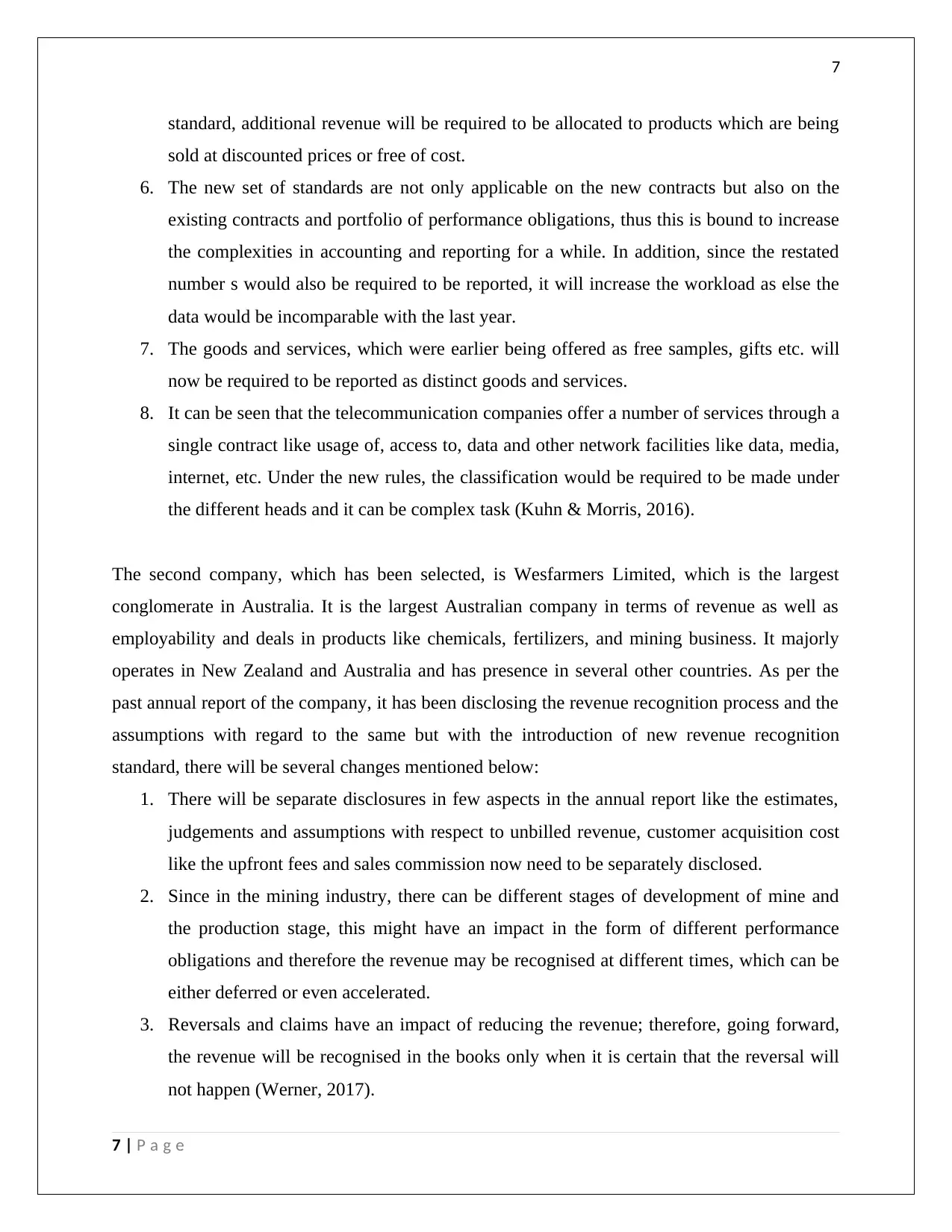
standard, additional revenue will be required to be allocated to products which are being
sold at discounted prices or free of cost.
6. The new set of standards are not only applicable on the new contracts but also on the
existing contracts and portfolio of performance obligations, thus this is bound to increase
the complexities in accounting and reporting for a while. In addition, since the restated
number s would also be required to be reported, it will increase the workload as else the
data would be incomparable with the last year.
7. The goods and services, which were earlier being offered as free samples, gifts etc. will
now be required to be reported as distinct goods and services.
8. It can be seen that the telecommunication companies offer a number of services through a
single contract like usage of, access to, data and other network facilities like data, media,
internet, etc. Under the new rules, the classification would be required to be made under
the different heads and it can be complex task (Kuhn & Morris, 2016).
The second company, which has been selected, is Wesfarmers Limited, which is the largest
conglomerate in Australia. It is the largest Australian company in terms of revenue as well as
employability and deals in products like chemicals, fertilizers, and mining business. It majorly
operates in New Zealand and Australia and has presence in several other countries. As per the
past annual report of the company, it has been disclosing the revenue recognition process and the
assumptions with regard to the same but with the introduction of new revenue recognition
standard, there will be several changes mentioned below:
1. There will be separate disclosures in few aspects in the annual report like the estimates,
judgements and assumptions with respect to unbilled revenue, customer acquisition cost
like the upfront fees and sales commission now need to be separately disclosed.
2. Since in the mining industry, there can be different stages of development of mine and
the production stage, this might have an impact in the form of different performance
obligations and therefore the revenue may be recognised at different times, which can be
either deferred or even accelerated.
3. Reversals and claims have an impact of reducing the revenue; therefore, going forward,
the revenue will be recognised in the books only when it is certain that the reversal will
not happen (Werner, 2017).
7 | P a g e
standard, additional revenue will be required to be allocated to products which are being
sold at discounted prices or free of cost.
6. The new set of standards are not only applicable on the new contracts but also on the
existing contracts and portfolio of performance obligations, thus this is bound to increase
the complexities in accounting and reporting for a while. In addition, since the restated
number s would also be required to be reported, it will increase the workload as else the
data would be incomparable with the last year.
7. The goods and services, which were earlier being offered as free samples, gifts etc. will
now be required to be reported as distinct goods and services.
8. It can be seen that the telecommunication companies offer a number of services through a
single contract like usage of, access to, data and other network facilities like data, media,
internet, etc. Under the new rules, the classification would be required to be made under
the different heads and it can be complex task (Kuhn & Morris, 2016).
The second company, which has been selected, is Wesfarmers Limited, which is the largest
conglomerate in Australia. It is the largest Australian company in terms of revenue as well as
employability and deals in products like chemicals, fertilizers, and mining business. It majorly
operates in New Zealand and Australia and has presence in several other countries. As per the
past annual report of the company, it has been disclosing the revenue recognition process and the
assumptions with regard to the same but with the introduction of new revenue recognition
standard, there will be several changes mentioned below:
1. There will be separate disclosures in few aspects in the annual report like the estimates,
judgements and assumptions with respect to unbilled revenue, customer acquisition cost
like the upfront fees and sales commission now need to be separately disclosed.
2. Since in the mining industry, there can be different stages of development of mine and
the production stage, this might have an impact in the form of different performance
obligations and therefore the revenue may be recognised at different times, which can be
either deferred or even accelerated.
3. Reversals and claims have an impact of reducing the revenue; therefore, going forward,
the revenue will be recognised in the books only when it is certain that the reversal will
not happen (Werner, 2017).
7 | P a g e
8
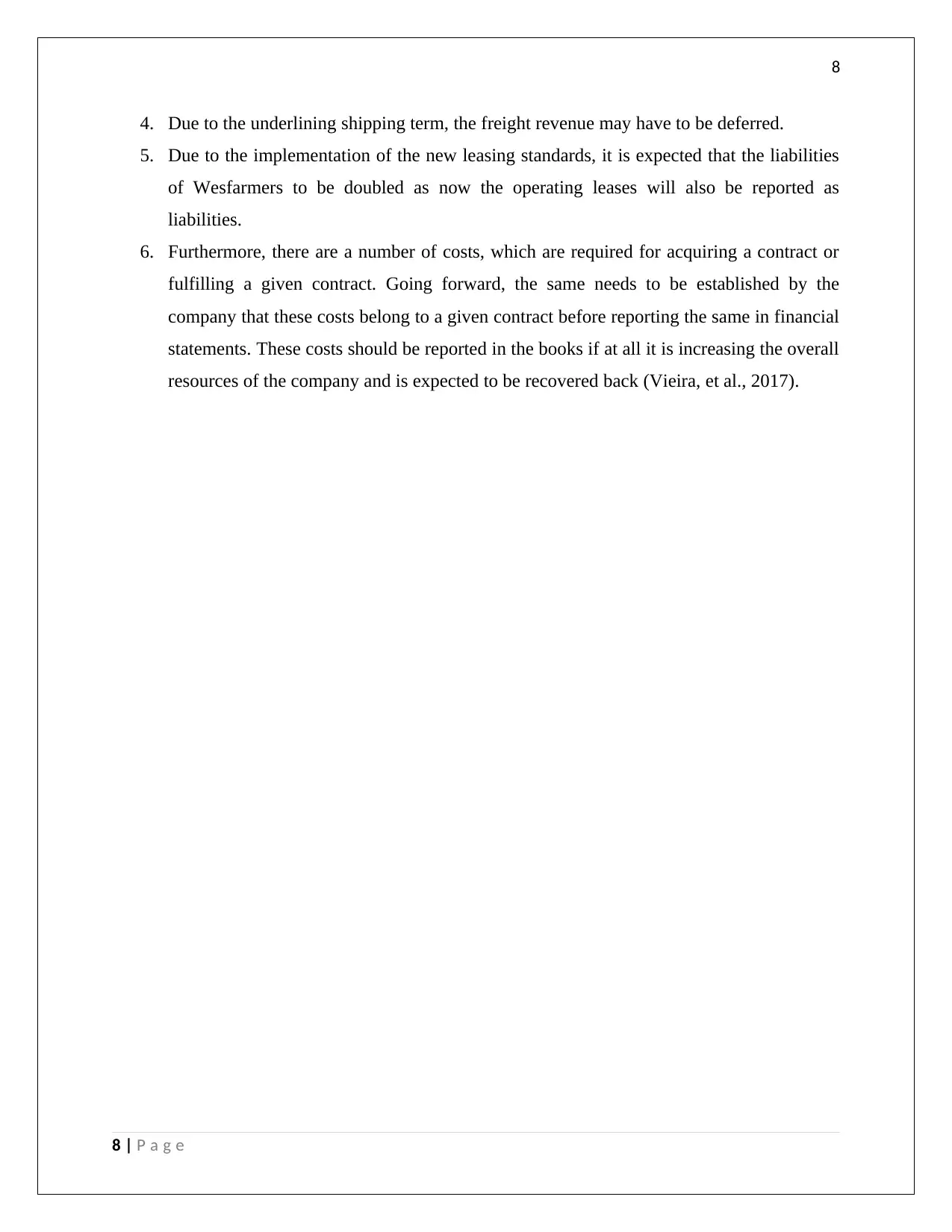
4. Due to the underlining shipping term, the freight revenue may have to be deferred.
5. Due to the implementation of the new leasing standards, it is expected that the liabilities
of Wesfarmers to be doubled as now the operating leases will also be reported as
liabilities.
6. Furthermore, there are a number of costs, which are required for acquiring a contract or
fulfilling a given contract. Going forward, the same needs to be established by the
company that these costs belong to a given contract before reporting the same in financial
statements. These costs should be reported in the books if at all it is increasing the overall
resources of the company and is expected to be recovered back (Vieira, et al., 2017).
8 | P a g e
4. Due to the underlining shipping term, the freight revenue may have to be deferred.
5. Due to the implementation of the new leasing standards, it is expected that the liabilities
of Wesfarmers to be doubled as now the operating leases will also be reported as
liabilities.
6. Furthermore, there are a number of costs, which are required for acquiring a contract or
fulfilling a given contract. Going forward, the same needs to be established by the
company that these costs belong to a given contract before reporting the same in financial
statements. These costs should be reported in the books if at all it is increasing the overall
resources of the company and is expected to be recovered back (Vieira, et al., 2017).
8 | P a g e
⊘ This is a preview!⊘
Do you want full access?
Subscribe today to unlock all pages.
Trusted by 1+ million students worldwide
9
Question 2 (a)
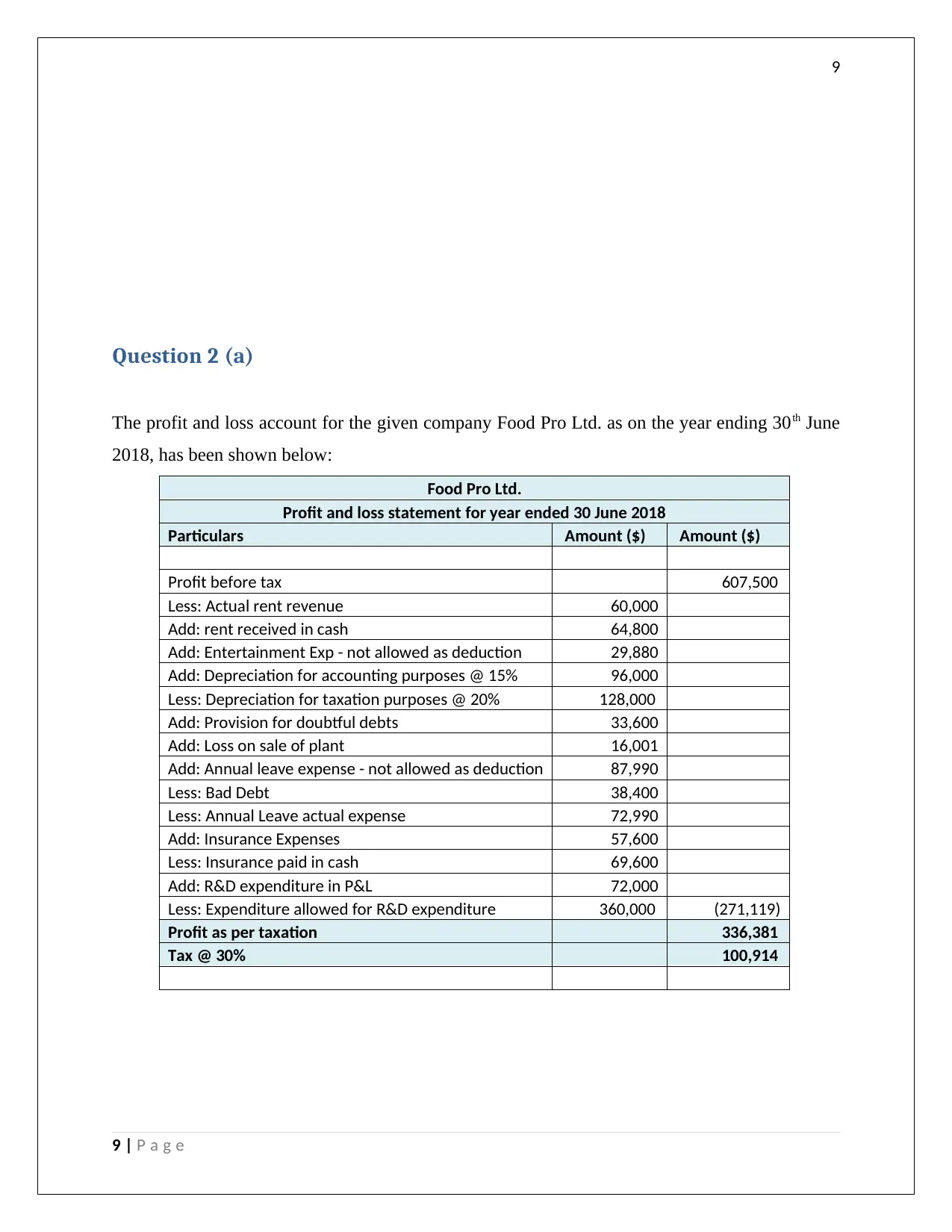
The profit and loss account for the given company Food Pro Ltd. as on the year ending 30th June
2018, has been shown below:
Food Pro Ltd.
Profit and loss statement for year ended 30 June 2018
Particulars Amount ($) Amount ($)
Profit before tax 607,500
Less: Actual rent revenue 60,000
Add: rent received in cash 64,800
Add: Entertainment Exp - not allowed as deduction 29,880
Add: Depreciation for accounting purposes @ 15% 96,000
Less: Depreciation for taxation purposes @ 20% 128,000
Add: Provision for doubtful debts 33,600
Add: Loss on sale of plant 16,001
Add: Annual leave expense - not allowed as deduction 87,990
Less: Bad Debt 38,400
Less: Annual Leave actual expense 72,990
Add: Insurance Expenses 57,600
Less: Insurance paid in cash 69,600
Add: R&D expenditure in P&L 72,000
Less: Expenditure allowed for R&D expenditure 360,000 (271,119)
Profit as per taxation 336,381
Tax @ 30% 100,914
9 | P a g e
Question 2 (a)
The profit and loss account for the given company Food Pro Ltd. as on the year ending 30th June
2018, has been shown below:
Food Pro Ltd.
Profit and loss statement for year ended 30 June 2018
Particulars Amount ($) Amount ($)
Profit before tax 607,500
Less: Actual rent revenue 60,000
Add: rent received in cash 64,800
Add: Entertainment Exp - not allowed as deduction 29,880
Add: Depreciation for accounting purposes @ 15% 96,000
Less: Depreciation for taxation purposes @ 20% 128,000
Add: Provision for doubtful debts 33,600
Add: Loss on sale of plant 16,001
Add: Annual leave expense - not allowed as deduction 87,990
Less: Bad Debt 38,400
Less: Annual Leave actual expense 72,990
Add: Insurance Expenses 57,600
Less: Insurance paid in cash 69,600
Add: R&D expenditure in P&L 72,000
Less: Expenditure allowed for R&D expenditure 360,000 (271,119)
Profit as per taxation 336,381
Tax @ 30% 100,914
9 | P a g e
Paraphrase This Document
Need a fresh take? Get an instant paraphrase of this document with our AI Paraphraser
10
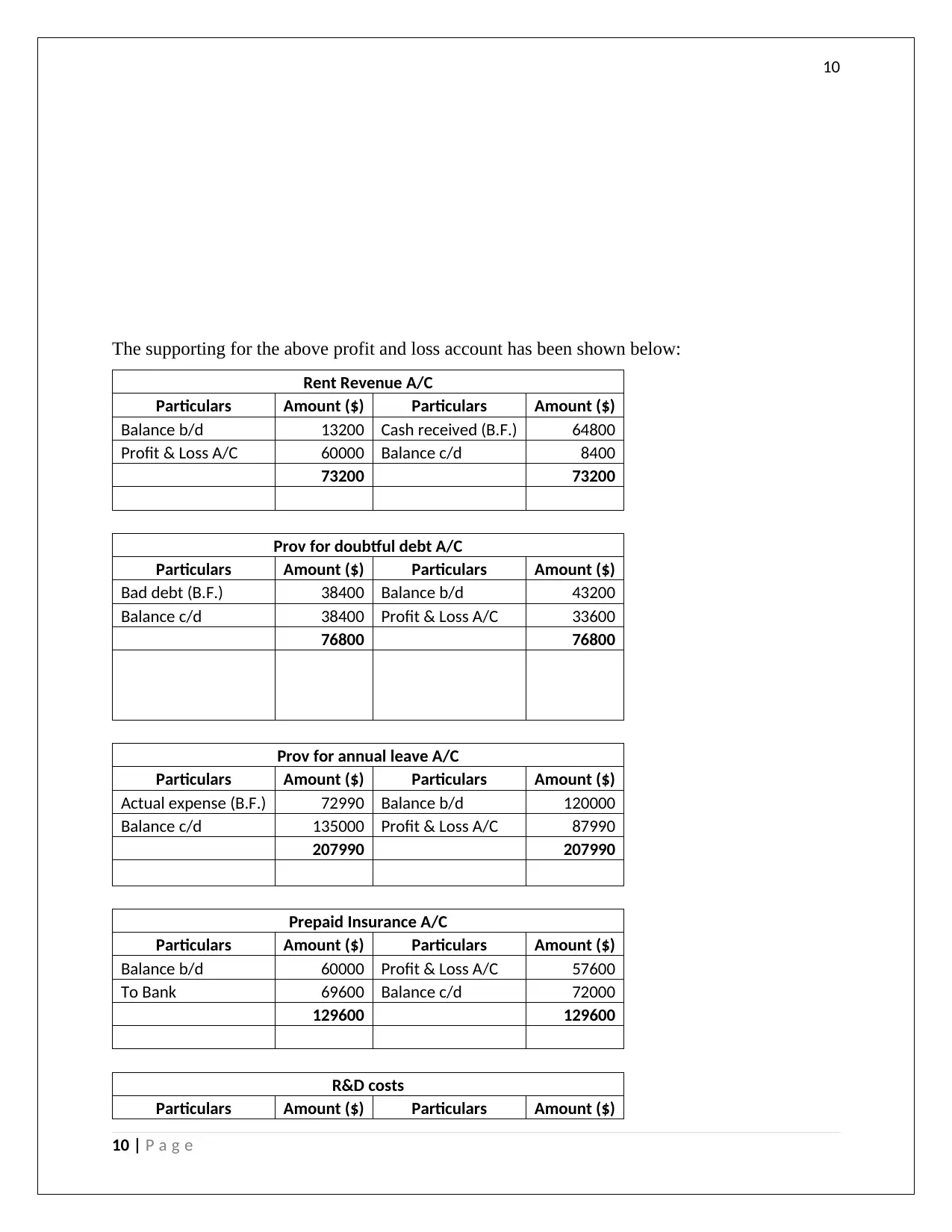
The supporting for the above profit and loss account has been shown below:
Rent Revenue A/C
Particulars Amount ($) Particulars Amount ($)
Balance b/d 13200 Cash received (B.F.) 64800
Profit & Loss A/C 60000 Balance c/d 8400
73200 73200
Prov for doubtful debt A/C
Particulars Amount ($) Particulars Amount ($)
Bad debt (B.F.) 38400 Balance b/d 43200
Balance c/d 38400 Profit & Loss A/C 33600
76800 76800
Prov for annual leave A/C
Particulars Amount ($) Particulars Amount ($)
Actual expense (B.F.) 72990 Balance b/d 120000
Balance c/d 135000 Profit & Loss A/C 87990
207990 207990
Prepaid Insurance A/C
Particulars Amount ($) Particulars Amount ($)
Balance b/d 60000 Profit & Loss A/C 57600
To Bank 69600 Balance c/d 72000
129600 129600
R&D costs
Particulars Amount ($) Particulars Amount ($)
10 | P a g e
The supporting for the above profit and loss account has been shown below:
Rent Revenue A/C
Particulars Amount ($) Particulars Amount ($)
Balance b/d 13200 Cash received (B.F.) 64800
Profit & Loss A/C 60000 Balance c/d 8400
73200 73200
Prov for doubtful debt A/C
Particulars Amount ($) Particulars Amount ($)
Bad debt (B.F.) 38400 Balance b/d 43200
Balance c/d 38400 Profit & Loss A/C 33600
76800 76800
Prov for annual leave A/C
Particulars Amount ($) Particulars Amount ($)
Actual expense (B.F.) 72990 Balance b/d 120000
Balance c/d 135000 Profit & Loss A/C 87990
207990 207990
Prepaid Insurance A/C
Particulars Amount ($) Particulars Amount ($)
Balance b/d 60000 Profit & Loss A/C 57600
To Bank 69600 Balance c/d 72000
129600 129600
R&D costs
Particulars Amount ($) Particulars Amount ($)
10 | P a g e
11
Balance b/d 60000 Profit & Loss A/C 57600
To Bank 285600 Balance c/d 288000
345600 345600
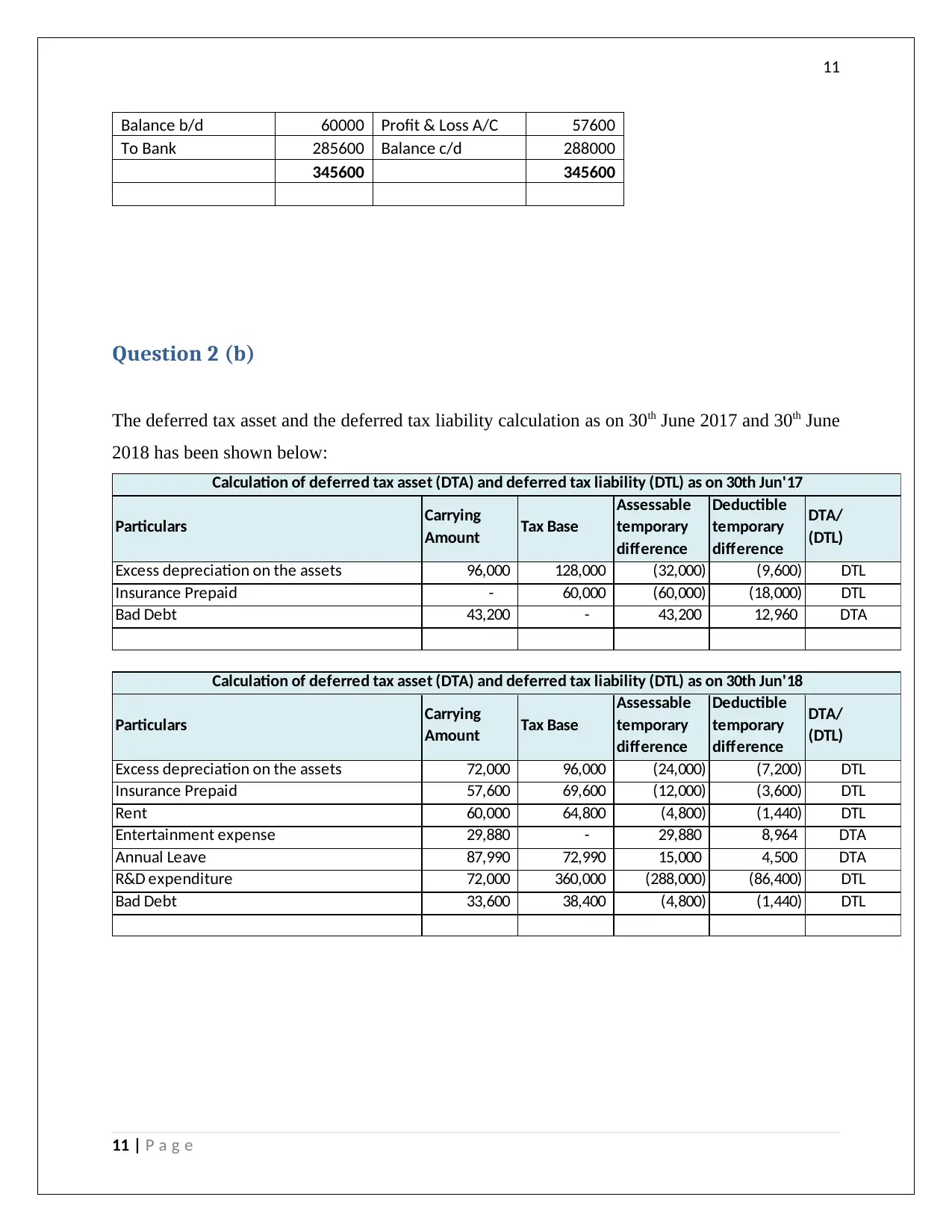
Question 2 (b)
The deferred tax asset and the deferred tax liability calculation as on 30th June 2017 and 30th June
2018 has been shown below:
Particulars Carrying
Amount Tax Base
Assessable
temporary
difference
Deductible
temporary
difference
DTA/
(DTL)
Excess depreciation on the assets 96,000 128,000 (32,000) (9,600) DTL
Insurance Prepaid - 60,000 (60,000) (18,000) DTL
Bad Debt 43,200 - 43,200 12,960 DTA
Particulars Carrying
Amount Tax Base
Assessable
temporary
difference
Deductible
temporary
difference
DTA/
(DTL)
Excess depreciation on the assets 72,000 96,000 (24,000) (7,200) DTL
Insurance Prepaid 57,600 69,600 (12,000) (3,600) DTL
Rent 60,000 64,800 (4,800) (1,440) DTL
Entertainment expense 29,880 - 29,880 8,964 DTA
Annual Leave 87,990 72,990 15,000 4,500 DTA
R&D expenditure 72,000 360,000 (288,000) (86,400) DTL
Bad Debt 33,600 38,400 (4,800) (1,440) DTL
Calculation of deferred tax asset (DTA) and deferred tax liability (DTL) as on 30th Jun'17
Calculation of deferred tax asset (DTA) and deferred tax liability (DTL) as on 30th Jun'18
11 | P a g e
Balance b/d 60000 Profit & Loss A/C 57600
To Bank 285600 Balance c/d 288000
345600 345600
Question 2 (b)
The deferred tax asset and the deferred tax liability calculation as on 30th June 2017 and 30th June
2018 has been shown below:
Particulars Carrying
Amount Tax Base
Assessable
temporary
difference
Deductible
temporary
difference
DTA/
(DTL)
Excess depreciation on the assets 96,000 128,000 (32,000) (9,600) DTL
Insurance Prepaid - 60,000 (60,000) (18,000) DTL
Bad Debt 43,200 - 43,200 12,960 DTA
Particulars Carrying
Amount Tax Base
Assessable
temporary
difference
Deductible
temporary
difference
DTA/
(DTL)
Excess depreciation on the assets 72,000 96,000 (24,000) (7,200) DTL
Insurance Prepaid 57,600 69,600 (12,000) (3,600) DTL
Rent 60,000 64,800 (4,800) (1,440) DTL
Entertainment expense 29,880 - 29,880 8,964 DTA
Annual Leave 87,990 72,990 15,000 4,500 DTA
R&D expenditure 72,000 360,000 (288,000) (86,400) DTL
Bad Debt 33,600 38,400 (4,800) (1,440) DTL
Calculation of deferred tax asset (DTA) and deferred tax liability (DTL) as on 30th Jun'17
Calculation of deferred tax asset (DTA) and deferred tax liability (DTL) as on 30th Jun'18
11 | P a g e
⊘ This is a preview!⊘
Do you want full access?
Subscribe today to unlock all pages.
Trusted by 1+ million students worldwide

1 out of 15


Related Documents


Your All-in-One AI-Powered Toolkit for Academic Success.
+13062052269
info@desklib.com
Available 24*7 on WhatsApp / Email
![[object Object]](/_next/static/media/star-bottom.7253800d.svg)
Unlock your academic potential
Copyright © 2020–2025 A2Z Services. All Rights Reserved. Developed and managed by ZUCOL.