Financial Accounting Report: Analysis of Australian Bankruptcies
VerifiedAdded on 2019/10/30
|10
|2945
|164
Report
AI Summary
This report provides a critical analysis of the role of rising liabilities in the liquidation of Australian companies. It examines several prominent bankruptcy cases, including ABC Learning, HIH Insurance, and One Tel, to identify the underlying causes beyond immediate financial stress. The analysis reveals that poor corporate governance, unethical management practices, and related party transactions significantly contributed to these failures. The report explores lapses in internal reporting, compromised auditor independence, and imprudent business policies, highlighting how these factors exacerbated financial liabilities. It emphasizes the importance of robust corporate governance and ethical conduct in preventing business failures. The report uses secondary data from journals and research papers to provide insights for academics, researchers, and practitioners, concluding that bankruptcy often stems from a combination of financial stress and deeper issues within corporate structures and management practices.
FINANCIAL ACCOUNTING

Paraphrase This Document
Need a fresh take? Get an instant paraphrase of this document with our AI Paraphraser
Financial accounting
Executive Summary
The given report aims to present a critical analysis on the role of rising liabilities in relation to
the increasing incidence of companies being liquidated. To address the given question in the
Australian context, some of the prominent Australian bankruptcy cases have been researched so
as to highlight the exact reason which contributed to the liquidation. The source of information
for this is secondary and exists in the form of journals, research papers in the public domain for
the use of academicians, researchers and practitioners. On the surface bankruptcy may seem the
result of the mounting liabilities but the reason behind these lay in the poor corporate governance
coupled with an unethical management which promoted wrong practices that eventually led to
the bankruptcy of the business. If it had not been for such practices and unethical management
aided by other stakeholders, then these businesses could potentially have been saved from
bankruptcy.
2
Executive Summary
The given report aims to present a critical analysis on the role of rising liabilities in relation to
the increasing incidence of companies being liquidated. To address the given question in the
Australian context, some of the prominent Australian bankruptcy cases have been researched so
as to highlight the exact reason which contributed to the liquidation. The source of information
for this is secondary and exists in the form of journals, research papers in the public domain for
the use of academicians, researchers and practitioners. On the surface bankruptcy may seem the
result of the mounting liabilities but the reason behind these lay in the poor corporate governance
coupled with an unethical management which promoted wrong practices that eventually led to
the bankruptcy of the business. If it had not been for such practices and unethical management
aided by other stakeholders, then these businesses could potentially have been saved from
bankruptcy.
2
Financial accounting
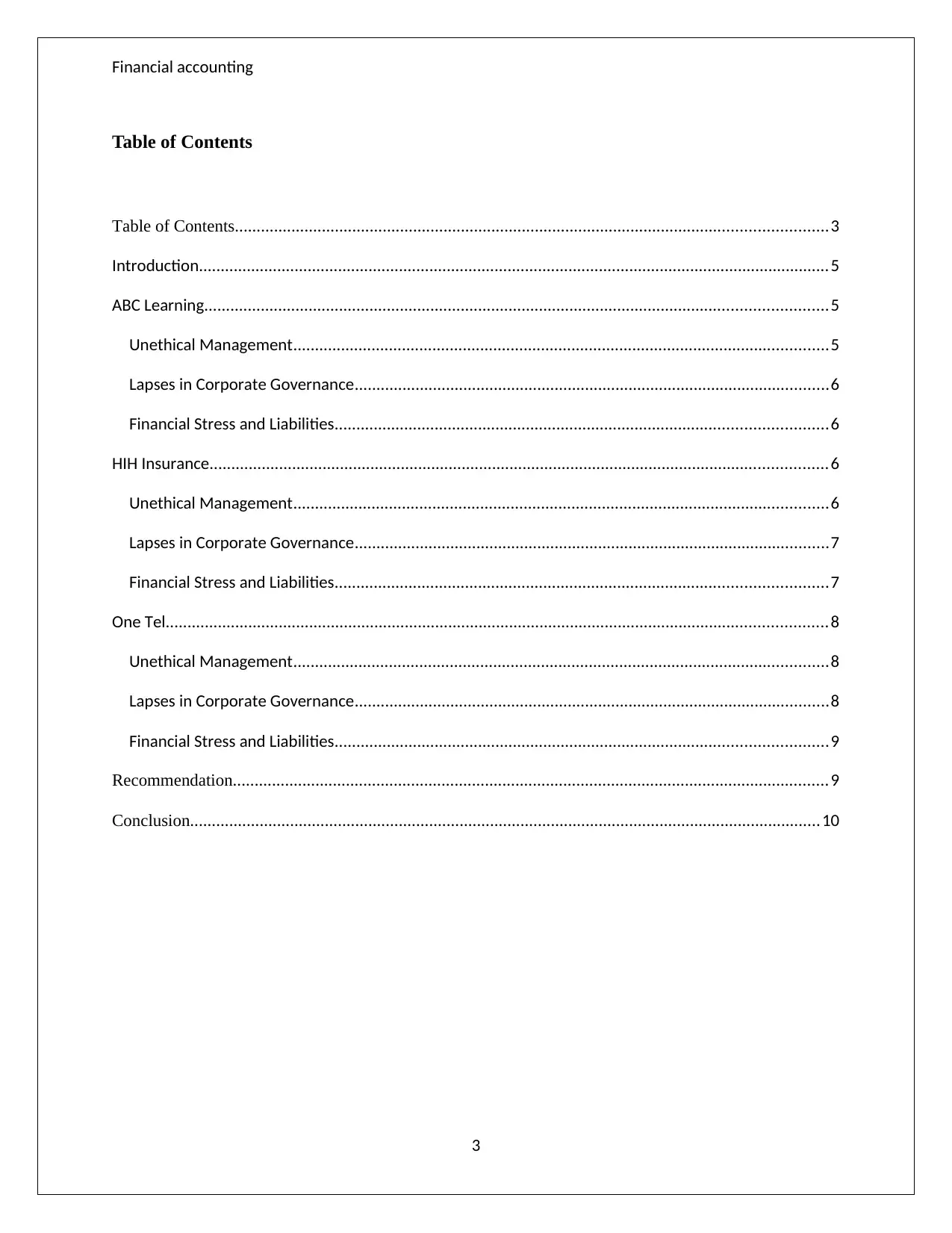
Table of Contents
Table of Contents........................................................................................................................................3
Introduction.................................................................................................................................................5
ABC Learning...............................................................................................................................................5
Unethical Management...........................................................................................................................5
Lapses in Corporate Governance.............................................................................................................6
Financial Stress and Liabilities.................................................................................................................6
HIH Insurance..............................................................................................................................................6
Unethical Management...........................................................................................................................6
Lapses in Corporate Governance.............................................................................................................7
Financial Stress and Liabilities.................................................................................................................7
One Tel........................................................................................................................................................8
Unethical Management...........................................................................................................................8
Lapses in Corporate Governance.............................................................................................................8
Financial Stress and Liabilities.................................................................................................................9
Recommendation.........................................................................................................................................9
Conclusion.................................................................................................................................................10
3
Table of Contents
Table of Contents........................................................................................................................................3
Introduction.................................................................................................................................................5
ABC Learning...............................................................................................................................................5
Unethical Management...........................................................................................................................5
Lapses in Corporate Governance.............................................................................................................6
Financial Stress and Liabilities.................................................................................................................6
HIH Insurance..............................................................................................................................................6
Unethical Management...........................................................................................................................6
Lapses in Corporate Governance.............................................................................................................7
Financial Stress and Liabilities.................................................................................................................7
One Tel........................................................................................................................................................8
Unethical Management...........................................................................................................................8
Lapses in Corporate Governance.............................................................................................................8
Financial Stress and Liabilities.................................................................................................................9
Recommendation.........................................................................................................................................9
Conclusion.................................................................................................................................................10
3
⊘ This is a preview!⊘
Do you want full access?
Subscribe today to unlock all pages.

Trusted by 1+ million students worldwide
Financial accounting
Introduction
Ever since the dawn of the 20th century, there has been a rise in the business liquidation which is
not limited to Australia but is essentially a worldwide trend. As a result, this topic has gained
immense attention in the recent times which poses question over the reason which is responsible
for the same. In line with the basic understanding of bankruptcy, the immediate reason is almost
always overwhelming liabilities which cannot be met with the existing asset on the balance sheet
of the company which essentially forces the business to file for bankruptcy leading to liquidation
of business. However, beneath the overwhelming liabilities lie the various causes which pose a
bigger threat and need to be guarded against. To aid in this process, real life cases involving the
bankruptcy in recent times have been discussed. These include One Tel, ABC Learning along
with HIH Insurance.
ABC Learning
Unethical Management
Even though the company had existence since 1988 but it came into limelight from 2001
onwards when in a matter of a few months, the geographical presence and the concentration of
centres grew. Further, a crucial aspect of this expansion strategy was acquisitions of various day
care canters. As the company expanded operations across geography, a major issue it faced was
in the form of falling quality. This was on account of the staff shortage which increased the
overall dissatisfaction of the customers with the services of the company centres. It would have
been expected that the company would have corrected these issues through increased staff so that
there is a positive feedback from customers (Arens et. al., 2013). However, the management was
more concerned with geographical expansion to cash in on the subsidy provided by the
government related to day care. Hence, the number of centres grew with little focus on the level
of quality of services being delivered and the financial viability of these centres. Besides, the
management resorted to misrepresentation in terms of corporate reporting and hence formed a
quid pro quo relationship with the auditors (Pitcher Partners). Also, there were significant related
party disclosures that were not captured in the financial statements (Kaplan, 2007). This led the
external users to be misguided and the stock soared nearly 10 times after it was listed in 2001.
4
Introduction
Ever since the dawn of the 20th century, there has been a rise in the business liquidation which is
not limited to Australia but is essentially a worldwide trend. As a result, this topic has gained
immense attention in the recent times which poses question over the reason which is responsible
for the same. In line with the basic understanding of bankruptcy, the immediate reason is almost
always overwhelming liabilities which cannot be met with the existing asset on the balance sheet
of the company which essentially forces the business to file for bankruptcy leading to liquidation
of business. However, beneath the overwhelming liabilities lie the various causes which pose a
bigger threat and need to be guarded against. To aid in this process, real life cases involving the
bankruptcy in recent times have been discussed. These include One Tel, ABC Learning along
with HIH Insurance.
ABC Learning
Unethical Management
Even though the company had existence since 1988 but it came into limelight from 2001
onwards when in a matter of a few months, the geographical presence and the concentration of
centres grew. Further, a crucial aspect of this expansion strategy was acquisitions of various day
care canters. As the company expanded operations across geography, a major issue it faced was
in the form of falling quality. This was on account of the staff shortage which increased the
overall dissatisfaction of the customers with the services of the company centres. It would have
been expected that the company would have corrected these issues through increased staff so that
there is a positive feedback from customers (Arens et. al., 2013). However, the management was
more concerned with geographical expansion to cash in on the subsidy provided by the
government related to day care. Hence, the number of centres grew with little focus on the level
of quality of services being delivered and the financial viability of these centres. Besides, the
management resorted to misrepresentation in terms of corporate reporting and hence formed a
quid pro quo relationship with the auditors (Pitcher Partners). Also, there were significant related
party disclosures that were not captured in the financial statements (Kaplan, 2007). This led the
external users to be misguided and the stock soared nearly 10 times after it was listed in 2001.
4
Paraphrase This Document
Need a fresh take? Get an instant paraphrase of this document with our AI Paraphraser
Financial accounting
Clearly this conduct was unethical on part of the management and amounts to violation of
fiduciary duties of agent (Gay and Simnett, 2012).
Lapses in Corporate Governance
There were severe lapses in corporate governance framework which enabled the management to
misrepresent the performance of the company and continue with their faulty practices. While
sound corporate governance measures are imperative in order to ensure that there are internal
reporting mechanisms which tend to complement the external auditor (Kaplan, 2011). In case of
ABC Learning, the internal mechanisms were compromised and also there were no attempts to
maintain the independence of the external auditor. The external auditor on their part never
questioned the explanation provided by the management in relation to the swelling intangibles
which formed about 70% of the total assets. Further, lucrative contracts were given to the
relatives of the top management which clearly amounts to nepotism and hints towards ineffective
internal control mechanisms (CPA, 2012).
Financial Stress and Liabilities
On the basis of the support from the revenues provided by the government and rising share price,
the company was able to assume huge loans from leading bank such as Commonwealth Bank of
Australia and in the year of their failure had about $ 1 billion outstanding debts. Further, about
70% of the assets of the company were in the form of intangible assets which were actually not
there. As much as 40% of the day care centres had been loss making from several years but the
management continued with these so that the share price can be jacked up which can be used for
raising incremental capital (Arens et. al., 2013). However, the financial stress and liabilities of
the company was exposed when in 2007-2008, the auditor was changed to E&Y and it disclosed
questionable practices and hinted that the loss for the year would be greater than the cumulative
profit minted by the company. This essentially led to insurmountable liability for the company as
there was massive write off of assets particularly intangibles (CPA, 2012).
HIH Insurance
Unethical Management
Even though the company came into existence in 1968, but the growth trajectory really started in
the last decade of the 20th century when the company aggressively went on an acquisition spree
5
Clearly this conduct was unethical on part of the management and amounts to violation of
fiduciary duties of agent (Gay and Simnett, 2012).
Lapses in Corporate Governance
There were severe lapses in corporate governance framework which enabled the management to
misrepresent the performance of the company and continue with their faulty practices. While
sound corporate governance measures are imperative in order to ensure that there are internal
reporting mechanisms which tend to complement the external auditor (Kaplan, 2011). In case of
ABC Learning, the internal mechanisms were compromised and also there were no attempts to
maintain the independence of the external auditor. The external auditor on their part never
questioned the explanation provided by the management in relation to the swelling intangibles
which formed about 70% of the total assets. Further, lucrative contracts were given to the
relatives of the top management which clearly amounts to nepotism and hints towards ineffective
internal control mechanisms (CPA, 2012).
Financial Stress and Liabilities
On the basis of the support from the revenues provided by the government and rising share price,
the company was able to assume huge loans from leading bank such as Commonwealth Bank of
Australia and in the year of their failure had about $ 1 billion outstanding debts. Further, about
70% of the assets of the company were in the form of intangible assets which were actually not
there. As much as 40% of the day care centres had been loss making from several years but the
management continued with these so that the share price can be jacked up which can be used for
raising incremental capital (Arens et. al., 2013). However, the financial stress and liabilities of
the company was exposed when in 2007-2008, the auditor was changed to E&Y and it disclosed
questionable practices and hinted that the loss for the year would be greater than the cumulative
profit minted by the company. This essentially led to insurmountable liability for the company as
there was massive write off of assets particularly intangibles (CPA, 2012).
HIH Insurance
Unethical Management
Even though the company came into existence in 1968, but the growth trajectory really started in
the last decade of the 20th century when the company aggressively went on an acquisition spree
5
Financial accounting
which led to growing number of subsidiaries as the company ventured into all different forms of
insurance coupled with larger geographical presence in a bid to expand business. Investigations
into the matter highlighted the reporting lapses coupled with a faulty business model which were
the main culprit. The nexus between the management and auditor made it worse and hence the
flawed practices kept on stretching to a point where bankruptcy became inevitable. Also, the
management was charged with stock market manipulation, dishonest conduct and dissemination
of false information (Mak, Deo & Cooper, 2005).
It is noteworthy that a high intrinsic risk is found in the insurance business and therefore while
attracting new customers, the premiums should be decided keeping in mind the underlying risk
However, HIH in a bid to attract more customers and increase the market share launched in USA
with premiums that were so low that there were increasing liabilities. Also, the management
decision to use the reinsurance model also compounded the problem coupled with acquisitions
that did not make much financial sense. Further, hefty premiums were paid which further
aggravated the financial position of the company and reflect at the poor conduct of the
management (Mirshekary, Yaftian & Cross, 2005).
Lapses in Corporate Governance
The above wrongdoings by the management of the company could be sustained only because of
the lack of sound corporate governance. One of the first ones relates to the compromised
independence of the external auditor (Arthur Anderson). There was a mutual understanding
between the management and the external auditor whereby the external auditor issued an
unqualified audit report and the management in turn gave lucrative business consulting contracts
to Arthur Anderson. As a business consultant also, Arthur Anderson never indicated the
additional risks associated with reinsurance model (Mak, Deo & Cooper, 2005). Besides, in
2000, the independence of the board was comprised when three ex-partners at Arthur Anderson
were appointed at the board of HIH Insurance. Also, the audit committee in place did not have a
single non-executive independent director thus ensuring that the internal reporting was
compromised (Mirshekary, Yaftian & Cross, 2005).
6
which led to growing number of subsidiaries as the company ventured into all different forms of
insurance coupled with larger geographical presence in a bid to expand business. Investigations
into the matter highlighted the reporting lapses coupled with a faulty business model which were
the main culprit. The nexus between the management and auditor made it worse and hence the
flawed practices kept on stretching to a point where bankruptcy became inevitable. Also, the
management was charged with stock market manipulation, dishonest conduct and dissemination
of false information (Mak, Deo & Cooper, 2005).
It is noteworthy that a high intrinsic risk is found in the insurance business and therefore while
attracting new customers, the premiums should be decided keeping in mind the underlying risk
However, HIH in a bid to attract more customers and increase the market share launched in USA
with premiums that were so low that there were increasing liabilities. Also, the management
decision to use the reinsurance model also compounded the problem coupled with acquisitions
that did not make much financial sense. Further, hefty premiums were paid which further
aggravated the financial position of the company and reflect at the poor conduct of the
management (Mirshekary, Yaftian & Cross, 2005).
Lapses in Corporate Governance
The above wrongdoings by the management of the company could be sustained only because of
the lack of sound corporate governance. One of the first ones relates to the compromised
independence of the external auditor (Arthur Anderson). There was a mutual understanding
between the management and the external auditor whereby the external auditor issued an
unqualified audit report and the management in turn gave lucrative business consulting contracts
to Arthur Anderson. As a business consultant also, Arthur Anderson never indicated the
additional risks associated with reinsurance model (Mak, Deo & Cooper, 2005). Besides, in
2000, the independence of the board was comprised when three ex-partners at Arthur Anderson
were appointed at the board of HIH Insurance. Also, the audit committee in place did not have a
single non-executive independent director thus ensuring that the internal reporting was
compromised (Mirshekary, Yaftian & Cross, 2005).
6
⊘ This is a preview!⊘
Do you want full access?
Subscribe today to unlock all pages.
Trusted by 1+ million students worldwide
Financial accounting
Financial Stress and Liabilities
Considering the nature of the insurance business, financial stress in the balance sheet is not
unexpected. However, even in the heydays, the company’s financial position was dubious since
despite have assets worth $ 8 billion, the net stood at $ 133 million and hence even minor
fluctuations could potentially be disastrous for the company. Then in 2001, the company posted a
loss of over $ 800 million for the six months ending on December 31, 2000. As a result, attempts
were made to save the company through receivership but in vain. Later the liquidated appointers
put the loss for the company at $ 5.3 billion. Thus, the company has since become a run-off
which is managing the claims arising from the insurance contracts and does not take any new
business (Mak, Deo & Cooper, 2005).
One Tel
Unethical Management
The core issue with the company which culminated in bankruptcy were essentially the imprudent
business policies. As a result, in a bid to register rapid growth, the company witnessed huge
losses which were concealed through incorrect reporting which eventually led to bankruptcy
when the losses become unsustainably huge (Monem, 2009). The top management had the sole
concentration towards increasing the subscriber base irrespective of the underlying financial cost
involved and thus they made sure that the losses incurred were not represented as part of the
financial reports so that the strategy could be continued (Gilbert, Joseph & Terry, 2005).
However, the actual financial results were never reported by the management. Also, the CEO
tweaked with the composition of the board and key internal committees so that two particular
non-executive directors with whom the CEO had close connections always were members which
amounts of dereliction of duty in light of the duties for directors bestowed by Corporations Act
2001 (Brown and Caylor, 2009).
Lapses in Corporate Governance
The critical issue in relation to One Tel which pushed the company towards liquidation was the
lapse in corporate reporting coupled with lack of sound corporate governance practices. The
information that was contained in the management reports was not verified by the executives and
as a result, there was deterioration of decision making both internally as well as externally. The
7
Financial Stress and Liabilities
Considering the nature of the insurance business, financial stress in the balance sheet is not
unexpected. However, even in the heydays, the company’s financial position was dubious since
despite have assets worth $ 8 billion, the net stood at $ 133 million and hence even minor
fluctuations could potentially be disastrous for the company. Then in 2001, the company posted a
loss of over $ 800 million for the six months ending on December 31, 2000. As a result, attempts
were made to save the company through receivership but in vain. Later the liquidated appointers
put the loss for the company at $ 5.3 billion. Thus, the company has since become a run-off
which is managing the claims arising from the insurance contracts and does not take any new
business (Mak, Deo & Cooper, 2005).
One Tel
Unethical Management
The core issue with the company which culminated in bankruptcy were essentially the imprudent
business policies. As a result, in a bid to register rapid growth, the company witnessed huge
losses which were concealed through incorrect reporting which eventually led to bankruptcy
when the losses become unsustainably huge (Monem, 2009). The top management had the sole
concentration towards increasing the subscriber base irrespective of the underlying financial cost
involved and thus they made sure that the losses incurred were not represented as part of the
financial reports so that the strategy could be continued (Gilbert, Joseph & Terry, 2005).
However, the actual financial results were never reported by the management. Also, the CEO
tweaked with the composition of the board and key internal committees so that two particular
non-executive directors with whom the CEO had close connections always were members which
amounts of dereliction of duty in light of the duties for directors bestowed by Corporations Act
2001 (Brown and Caylor, 2009).
Lapses in Corporate Governance
The critical issue in relation to One Tel which pushed the company towards liquidation was the
lapse in corporate reporting coupled with lack of sound corporate governance practices. The
information that was contained in the management reports was not verified by the executives and
as a result, there was deterioration of decision making both internally as well as externally. The
7
Paraphrase This Document
Need a fresh take? Get an instant paraphrase of this document with our AI Paraphraser
Financial accounting
internal control mechanisms with regards to audit were farce and hence there was fraudulent
reporting in the internal books which had presence of only limited entries (Bhagat and Bolton,
2008). Also, for representation of company’s performance, there was no consistency of
underlying financial policies and hence the results for two consecutive years were not
comparable. The accounting policy was used based on the underlying business environment so
that the performance could be moderated and the stock performance can be ensured. This
resulted in the financial performance of the company appearing very consistent giving the
impression of stability in business. In the whole financial misrepresentation, the independence of
the external auditor, the board and the key internal committees was compromised so that the
CEO can misrepresent the financial statements (Monem, 2009).
Financial Stress and Liabilities
The financial stress for the company is visible from the period 1998 to 2000 i.e. before the
liquidation period when the reported financial performance of the declined in stark contrast to the
telecommunication industry which had improved result during this period. However, from a
marginal profit in 1998, the company made a loss of around $ 291 million in 2000 which marked
the demise of the company. Further, in the same year, the company had to spend $ 523 million
for purchasing spectrum. Despite the losses, the CEO kept on deriving fat salary with bonus of
upto $ 10 million. There were last moment attempts to provide funding to the company but on
account of glaring errors in financial reporting, it could not go through and company became
bankrupt (Monem, 2009).
Recommendation
It is evident from the analysis carried out in relation to the recent bankruptcy that the failure of
business is more attributed to failure of corporate governance and reporting norms rather than the
huge outstanding liabilities. As a result, it is imperative that a more active role in the board
decisions need to be played by executive directors who in turn also constitute various committees
for internal control (Gay & Simnett, 2012). Further, a pivotal role in bringing any financial
misreporting or any faulty business practice that poses serious risk to light is played by the
external auditor who needs to be independent of the influence of the management. In the
aftermath of the above bankruptcies, various provisions have been introduced to ensure the same
8
internal control mechanisms with regards to audit were farce and hence there was fraudulent
reporting in the internal books which had presence of only limited entries (Bhagat and Bolton,
2008). Also, for representation of company’s performance, there was no consistency of
underlying financial policies and hence the results for two consecutive years were not
comparable. The accounting policy was used based on the underlying business environment so
that the performance could be moderated and the stock performance can be ensured. This
resulted in the financial performance of the company appearing very consistent giving the
impression of stability in business. In the whole financial misrepresentation, the independence of
the external auditor, the board and the key internal committees was compromised so that the
CEO can misrepresent the financial statements (Monem, 2009).
Financial Stress and Liabilities
The financial stress for the company is visible from the period 1998 to 2000 i.e. before the
liquidation period when the reported financial performance of the declined in stark contrast to the
telecommunication industry which had improved result during this period. However, from a
marginal profit in 1998, the company made a loss of around $ 291 million in 2000 which marked
the demise of the company. Further, in the same year, the company had to spend $ 523 million
for purchasing spectrum. Despite the losses, the CEO kept on deriving fat salary with bonus of
upto $ 10 million. There were last moment attempts to provide funding to the company but on
account of glaring errors in financial reporting, it could not go through and company became
bankrupt (Monem, 2009).
Recommendation
It is evident from the analysis carried out in relation to the recent bankruptcy that the failure of
business is more attributed to failure of corporate governance and reporting norms rather than the
huge outstanding liabilities. As a result, it is imperative that a more active role in the board
decisions need to be played by executive directors who in turn also constitute various committees
for internal control (Gay & Simnett, 2012). Further, a pivotal role in bringing any financial
misreporting or any faulty business practice that poses serious risk to light is played by the
external auditor who needs to be independent of the influence of the management. In the
aftermath of the above bankruptcies, various provisions have been introduced to ensure the same
8
Financial accounting
in the form of CLERP 9 and Ramsay report recommendations (Clout Chappelle & Gandhi,
2009). Further, the duty of the directors have been outlined in pivotal statute such as
Corporations Act 2001 and violation of the same can potentially attract both civil and criminal
liabilities. It is expected that steps such as these which ensure accountability and transparency
would go a long way in prevention of corporate frauds and related bankruptcies (Arens et. al.,
2013).
Conclusion
Based on the discussion carried out above, it is apparent that on the face of the bankruptcy, it is
liquidation that prima facie seems as the contributing factor. However, deeper introspection of
the circumstances and the contributory factors would indicate that the liabilities were essentially
the result of faulty corporate governance setup under the control of an unethical management
running in collusion with the auditor. Typically, the management are driven by short term
incentives and hence aim to achieve growth without considering sustainability and in the process
increase the liability to such an extent that the business revival becomes impossible. It is
essential that the corporate governance norms need to be improved coupled with auditor
independence and greater role for non-executive directors as these steps would ensure that the
wrongdoing by the management would come to light and rectifying measures could be taken on
time to prevent bankruptcy.
9
in the form of CLERP 9 and Ramsay report recommendations (Clout Chappelle & Gandhi,
2009). Further, the duty of the directors have been outlined in pivotal statute such as
Corporations Act 2001 and violation of the same can potentially attract both civil and criminal
liabilities. It is expected that steps such as these which ensure accountability and transparency
would go a long way in prevention of corporate frauds and related bankruptcies (Arens et. al.,
2013).
Conclusion
Based on the discussion carried out above, it is apparent that on the face of the bankruptcy, it is
liquidation that prima facie seems as the contributing factor. However, deeper introspection of
the circumstances and the contributory factors would indicate that the liabilities were essentially
the result of faulty corporate governance setup under the control of an unethical management
running in collusion with the auditor. Typically, the management are driven by short term
incentives and hence aim to achieve growth without considering sustainability and in the process
increase the liability to such an extent that the business revival becomes impossible. It is
essential that the corporate governance norms need to be improved coupled with auditor
independence and greater role for non-executive directors as these steps would ensure that the
wrongdoing by the management would come to light and rectifying measures could be taken on
time to prevent bankruptcy.
9
⊘ This is a preview!⊘
Do you want full access?
Subscribe today to unlock all pages.
Trusted by 1+ million students worldwide
Financial accounting
References
Arens, A., Best, P., Shailer, G. and Fiedler,I. (2013). Auditing, Assurance Services and Ethics in
Australia, 2nd eds., Sydney: Pearson Australia
Clout, V, Chappelle, E and Gandhi, N (2013), ‘The impact of auditor independence regulations
on established and emerging firms’, Accounting Research Journal Vol. 26, No. 2, pp. 88-108
Gay, G. and Simnett, R. (2012), Auditing and Assurance Services in Australia, 5th eds., Sydney:
McGraw-Hill Education
Bhagat, S. and Bolton, B. (2008), ‘Corporate Governance and Firm Performance’, Journal of
Corporate Finance, Vol.14, No.3, pp. 257-273.
Brown, L and Caylor, M. (2009), ‘Corporate Governance and Firm Operating Performance’,
Review of Quantitative Finance and Accounting, Vol. 32, No. 2, pp. 129-144.
CPA (2012). ABC learning collapse case study., CPA Website, [online ] Available at
https://www.cpaaustralia.com.au/professional-resources/education/abc-learning-collapse-case-
study [Accessed September 12, 2017]
Gilbert, W., Joseph J. and Terry J.E (2005), ‘The Use of Control Self-Assessment by
Independent Auditors’. The CPA Journal, Vol. 3, pp. 66-92
Kaplan, R.S. (2011). ‘Accounting scholarship that advances professional knowledge and
practice’. The Accounting Review, Vol. 86, No.2, pp. 367–383.
.Mirshekary, S., Yaftian, A. and Cross, D. (2005), ‘Australian Corporate Collapse: The Case of
HIH Insurance’, Journal of Financial Services Marketing, Vol. 9, No.3, pp. 249-58.
Mak, T., Deo, H. and Cooper, K. (2005), ‘Australia’s Major Corporate Collapse: Health
International Holdings (HIH) Insurance ‘May the Force Be with You’, Journal of American
Academy of Business, Vol. 6, No.2, pp. 104-112.
Monem, R. (2009), The Life and Death of OneTel, Griffith University, [online] Available at
http://www98.griffith.edu.au/dspace/bitstream/handle/10072/42673/74746_1.pdf [Accessed
September 12, 2017]
10
References
Arens, A., Best, P., Shailer, G. and Fiedler,I. (2013). Auditing, Assurance Services and Ethics in
Australia, 2nd eds., Sydney: Pearson Australia
Clout, V, Chappelle, E and Gandhi, N (2013), ‘The impact of auditor independence regulations
on established and emerging firms’, Accounting Research Journal Vol. 26, No. 2, pp. 88-108
Gay, G. and Simnett, R. (2012), Auditing and Assurance Services in Australia, 5th eds., Sydney:
McGraw-Hill Education
Bhagat, S. and Bolton, B. (2008), ‘Corporate Governance and Firm Performance’, Journal of
Corporate Finance, Vol.14, No.3, pp. 257-273.
Brown, L and Caylor, M. (2009), ‘Corporate Governance and Firm Operating Performance’,
Review of Quantitative Finance and Accounting, Vol. 32, No. 2, pp. 129-144.
CPA (2012). ABC learning collapse case study., CPA Website, [online ] Available at
https://www.cpaaustralia.com.au/professional-resources/education/abc-learning-collapse-case-
study [Accessed September 12, 2017]
Gilbert, W., Joseph J. and Terry J.E (2005), ‘The Use of Control Self-Assessment by
Independent Auditors’. The CPA Journal, Vol. 3, pp. 66-92
Kaplan, R.S. (2011). ‘Accounting scholarship that advances professional knowledge and
practice’. The Accounting Review, Vol. 86, No.2, pp. 367–383.
.Mirshekary, S., Yaftian, A. and Cross, D. (2005), ‘Australian Corporate Collapse: The Case of
HIH Insurance’, Journal of Financial Services Marketing, Vol. 9, No.3, pp. 249-58.
Mak, T., Deo, H. and Cooper, K. (2005), ‘Australia’s Major Corporate Collapse: Health
International Holdings (HIH) Insurance ‘May the Force Be with You’, Journal of American
Academy of Business, Vol. 6, No.2, pp. 104-112.
Monem, R. (2009), The Life and Death of OneTel, Griffith University, [online] Available at
http://www98.griffith.edu.au/dspace/bitstream/handle/10072/42673/74746_1.pdf [Accessed
September 12, 2017]
10

1 out of 10


Related Documents


Your All-in-One AI-Powered Toolkit for Academic Success.
+13062052269
info@desklib.com
Available 24*7 on WhatsApp / Email
![[object Object]](/_next/static/media/star-bottom.7253800d.svg)
Unlock your academic potential
Copyright © 2020–2026 A2Z Services. All Rights Reserved. Developed and managed by ZUCOL.